Witnessing the birth of a sibling
—Looking at drawings to understand the possible effects on children—
Cheryl OKUBO
*1, Chihoko SANKAI
*3Hatsumi YANAGISAWA
*2, Naomi KANO
*3Abstract
The present study attempts to reveal the effects on children of being with their mothers during the birth of a sibling. The literature shows overall positive effects for fathers attending birth, however very little research has been done about how children are affected by witnessing birth. With the growing trend for entire families to take part in the birth experience, the authors believe it necessary to assess possible impacts on children from such practice before arbitrarily encouraging families to include children in the labor and birth experience.
Because young children often express themselves more freely through imagery than through language, draw-ings were used to assess the effects that witnessing birth had on children. Drawdraw-ings were collected before, during, and after a sibling's birth from 24 children between the ages of two and twelve. The artwork was then examined from two different perspectives: an overview and a case study.
I An overall look at the artwork indicated no signs of trauma or shock. There seemed to be three patterns or tenden-cies for children as they drew in their sketchbooks during a two- month period; rendering drawings with more detail, about the same, or less organized. Half the children in this study drew pictures that became more detailed following the birth of their sibling. Eight others produced drawings with no significant changes. Drawings which tended to change towards regression-that is becoming more chaotic or less developed-after the birth were evident in four of the children.
II An in-depth look was given to the artwork of one boy who seemed to be negatively impacted by witnessing his mother's very difficult labor. In this case study, one can see how initial anxiety, surprise and fear gradually trans-form into his search for a new path, or way, to co-exist with the new baby in his home.
The results of this research show that family support seems to be a larger factor impacting siblings than actually witnessing birth itself. In addition, a tendency for very young children and boys in particular to be distressed by hearing and seeing their mother in pain was noted. In response to this, certain precautions are recommended in order to prepare children for the reality of childbirth and ensure a positive experience for everyone involved.
Keywords: art therapy, birth, drawings, sibling, witnessing
Original article
*1 Ibaraki Prefectural University, Research Fellow *2 Birth Aoba Maternity Home
*3 Ibaraki Prefectural University, Nursing Department
Received 16 June 2008; accept 21 November 2008
I. Introduction
1. Purpose
The positive effects on fathers who take part in the birth experience has spawned a trend for children to be included as well. While adults and older children can verbally express how the experience affects them,
younger children rarely have the words to do so. More-over, it is common for siblings to be born just 2 or 3 years apart, giving very young children the possibility of exposure to labor and birth. Therefore, before recom-mending this as common practice, we felt it necessary to take a look at how children respond to the birth experi-ence via their drawings, in order to discover what kinds
of emotional and psychological impact it had on them.
2. Methodology
Artwork has been used as a means of understand-ing children's inner worlds since the 1940s in the United States7). In various settings, artwork has been used as a diagnostic tool for insight into one's psychological condition. The art therapy aspect of this research proj-ect was intended not only to help understand possible effects on children of witnessing childbirth, but also to serve as a means of support and emotional release for the child going through such a major family event/tran-sition. Having paper and crayons available to children before, during, and after the birth of their siblings not only served the authors' purpose of understanding pos-sible psychological changes in the child, but also gave the children another way to express feelings related to the birth.
3. Objectives and Research Questions
The object of this study was to discover the follow-ing: What happens to children when they they witness the birth of a sibling? Are they shocked by this experi-ence? Are there any precautions that can be taken to increase the likelihood of a positive experience for such children?
II. Literature Review
There have been many studies concerned with how fathers respond to being present during the births of their children (Draper, 1997: Hathaway, 1980: Klaus & Ken-nel, 1982). Research shows overwhelmingly positive emotional experiences for fathers who assist their wives during labor and birth (Draper, 1997: Green, Coupland & Kitzinger, 1998: Hathaway & Jay, 1980: Reed, 2005)
Midwives and families have written about their experiences and give credible advice (Bartell, 1995: Is-sokson, 2001: Hoge, 2002). However, very few studies have been conducted concerning siblings who are part of the birthing process. Pioneers in this area are Hatha-way & Jay (1980), who promote the inclusion of family members in a birth as a way to welcome the new baby and ease the adjustment the whole family makes.
How-ever, Hathaway & Jay (1980) also notes that preschool children can be frightened by seeing their mothers in labor, so prior preparation is necessary to increase the chances of a positive experience. According to clini-cal psychologist Leonard (1979), many children who observe birth are too young to verbalize what they have seen. Hence the authors of this research emphasize the need for visual communication via art therapy. In her doctoral dissertation, Issokson (2001) interviewed 12 children ages 5-7 who witnessed the birth of at least one child, and received feedback from all that they had posi-tive experiences. This age group is old enough to explain their feelings verbally as well as visually. Along with many other health professionals, Bartell (1995) strongly recommends having a special caretaker for young chil-dren if they are to attend birth. More research needs to be done, particularly with toddlers and pre-school chil-dren. Such research will require non-verbal forms of assessment, given the limited vocabulary of children in that age group.
III. Methods and Procedures
1. Participants
Pregnant mothers planning to include their chil-dren during labor and/or birth were invited to join this research project. All mothers were patients at small ma-ternity clinics. One mother had a home birth, all the others had normal deliveries at clinics designed to feel like home. In total, seventeen mothers and 24 children volunteered to participate. The children's ages ranged from two to twelve, although there were no nine, ten, or eleven year olds in this study. Children had the option to quit the project at anytime.
2. Materials
Each child was given an identical B4 size white sketchbook and a new box of ten crayons. Mothers were given forms for taking notes on the child's behavior and comments about the artwork.
3. Procedures
Children were encouraged to draw freely from about one month before the birth, during the birth or
immediately after seeing the newborn baby, and up to about one month after the birth. Drawings were divided into three time zones: before, during, and after the birth. All drawings were looked at in order to recognize the particular styles and patterns of each individual, and to notice any unusual or 'out of character' patterns or re-gressions in the artwork which could be seen as a sign of stress or trauma for that child. Mothers took notes on the child's behavior and/or comments s/he made while the drawing was rendered, and were interviewed by the authors along with pre-school children. Older children were interviewed separately from their mothers, and were asked about their drawings as well as their experi-ence of witnessing birth.
1) Prior to Birth
When mothers came in for their 32nd week check up, they were briefed on the aims and structure of this research. Confidentiality was assured and consent forms were signed for the use of artwork. The children then met with the art therapist, who gave them the sketch-books and crayons, and encouraged them to draw freely. Explicit directions on how or what to draw (for example, to draw a baby or their feelings about becoming a big sister or brother) were not given. However, they were asked to use only that sketchbook and those crayons throughout the duration of this project (until one month after the birth of their sibling). It was the art therapist's purpose to explain the task and to build rapport so that the children could express their feelings easily, with as little inhibition as possible. Mothers were instructed to have these same materials available during labor so the child(ren) could draw during the birthing process.
2) During Labor and Birth
Whenever possible, children were brought to the birthing room (whether it was at home or in a maternity clinic) and given their sketchbooks and crayons while their mothers went into labor. They could draw freely whenever they liked, and were also asked to draw a pic-ture just after birth. Children who had planned to wit-ness the birth but were unable to, because of sleeping or school schedules, were asked to draw a picture soon after meeting the baby for the first time.
3) Post Birth
About one month after birth, children met with the art therapist again for the final interview. All previous drawings were viewed and children were asked about the birth experiences. They were asked to draw one last picture. After drawing, the child was encouraged to talk about the drawing, and tell how he/she felt about having a new baby. Then the therapist "borrowed" the child's entire sketchbook for documentation, assuring him or her that it would be safely returned to them in a few months.
* Permission to conduct this study was obtained from the Human Rights Review Committee for the Ibaraki Prefectural University.
IV. Results
As shown in table 1, a total of 14 boys and 10 girls expected to participate in the birth experience. Of these 24 children, 20 were actually in the birthing room dur-ing at least part of labor, and the remaindur-ing four were not able to attend because of school or sleep schedules. Of the 20 who attempted to attend birth, 12 were ac-tually present during the birth itself and eight chose to leave the room sometime during labor. More boys than girls chose to leave during labor, and two year olds were most likely to leave or be taken out of the room because of their distress.
Regardless of age, gender, or whether the child witnessed birth, half of the participants showed signs of progress or development in their artwork (Tables 2 and 3).
Eight children, four of whom witnessed the birth, showed no outward sign of change in their drawing pat-terns. Two- and three- year-olds accounted for five of these eight children (Table 3).
Table 4 shows the ages of children and which ones actually witnessed birth. Most of the children in this study were five and under, and while none of the 2 year olds witnessed birth, most of the other children did.
1. Positive Feedback
Table 1 Breakdown of each child's age, gender, witnessing status and artwork changes CHILD AGE SEX AT BIRTH ARTWORK
1 12 M present developed 2 8 M present no change 3 3 M present no change 4 7 F present no change 5 5 M left developed 6 2 M left regressed 7 7 F present no change 8 5 M left developed 9 5 M present developed 10 4 M present developed 11 2 M left developed 12 3 F present developed 13 6 F present developed 14 4 F present developed 15 2 F left developed 16 2 F left developed 17 3 M left regressed 18 5 F present no change
19 8 M not present no change
20 7 M left no change
21 5 M not present regressed
22 2 M not present no change
23 2.5 F not present developed
24 3 F present regressed
total Ave 14M 5 5 3 6 5 3
24 4.69 10F 7 3 1 6 3 1
Table 2 Change in artwork according witnessing birth, divided by gender (M=male F=female)
present left during not present developed 3M, 3F 3M, 2F 1F
no change 2M, 3F 1M 2M
regressed 1F 2M 1M
Table 3 Change in artwork according to age and gender
Gender / age 2 3 4 5 6 7 8 12 total
Developed Male 1 1 2 1 1 6 Female 2 1 1 2 6 No change Male 2 1 2 1 6 Female 2 2 Regressed Male 1 1 1 3 Female 1 1 Total 6 4 2 5 1 3 2 1 24
throughout labor and birth expressed joy, surprise, and relief upon seeing their newborn sibling. Their drawings show that attention was given to the physical details of birthing and breastfeeding. Many drawings also focus on the whole family being together (Fig. 1). Even if the father is often absent because of work, for example, he was included in the picture, shown driving a car to work (Fig. 2). Such inclusion was a sign that the family was a unit, even though not together all the time.
Even though midwives and mothers reported that some children felt afraid during labor, most children ex-pressed great emotion, excitement, and awe upon see-ing the baby emerge. Older girls in particular reported
feeling more respect for their mothers, after seeing them work so hard to give birth. Figure 3 shows an exhausted mother, with a blanket over her, suggesting an empty womb area, protected and covered. (Fig. 3) Notice the arms are outstretched, as if she gave her all, and the folds in the baby's blanket seem to suggest those arms wrapped around the baby protectively. Another seven year old girl said she looked forward to having her own baby someday, taking pride in being female.
The oldest boy in this study said the opposite; that he was reluctant to have a baby in the future because he realized for the first time how hard it was not only to give birth but also to care for the baby afterwards (Fig. 4). He said he was glad to be male. Although this boy openly complained that his baby brother cried a lot, he held him the whole time his mother had her checkup, as well as before and after his interview with the art thera-pist. It was obvious by his handling of his brother that
Table 4 Number of Children witnessing birth according to age age 2 3 4 5 6 7 8 12 Present during birth 0 3 2 2 1 2 1 1
left during birth 4 1 2 1
Not present at birth 2 1 1
total number 6 4 2 5 1 3 2 1
Fig. 1
Fig. 2
Fig. 3
he was very attached to him and proud to be able to care for him. This same boy also said that by seeing how his mother loved the new baby, he was made aware that she must have once shown him the same affection, which deepened the bond between them. This boy's young-er brothyoung-er, who slept through the birth, drew the new baby much differently (Fig. 5). Notice the awareness is very different, the face as opposed to the whole body, the eyes closed instead of looking at something, the hair less baby-like, and the strained emotion. The younger boy agreed that the baby cried a lot, and that he opted not to get so close. Perhaps if he had been included in the birth, he would feel differently—perhaps he was sad and angry, like the expression on the baby's face, to have missed the event. Obviously, the older and more verbal the child is, the more information we can glean about their experience of the birth and transition of the family.
2. Points of Concern
There was no indication of shock or trauma in any of the artwork from this study. There was nothing to suggest that children should not be included as part of the birth process. However, some children, aged two to three, did not seem able to comprehend the condi-tion of the mother during labor. Two of them became distressed and were taken back home by a relative, one refused to enter the room, and another left the room of his own accord. Fatigue, fear, or not being able to de-pend on their mother seemed to be a factor in their exits from the birthing room. More boys than girls expressed these emotions during labor and either chose to leave
or decided not to attend the labor at all. One boy, aged two, blatantly ignored his mother and refused to come near her during labor and after the birth. His artwork revealed more aggression in his scribbling: prior to birth the line pressure and use of space was lighter and smaller(Fig. 6A, 6B). Whether girls experienced less anxiety or whether they expressed it differently is not known. Moreover, in the case of five year old boys, mothers and midwives suggested that fear and helpless-ness may to be the main factors in not staying to withelpless-ness birth. In light of these findings, precautions for families with young children are suggested under 5.1 Conclu-sions.
1) Case Study
There was only one child in this study who seemed to be particularly disturbed by his mother's difficult la-bor. More in-depth attention was given to him and his artwork following birth. No lasting distress was antici-pated; within a month he was well on his way to ad-justing to the new baby in his home. A key factor in
Fig. 5 Fig. 6B
his progress was the loving support and understanding of his family and extended family. More details of this case are in section 4.3.5.
3. Clues in Artwork
Looking for clues in artwork includes noticing a wide variety of detail, such as the child's preferred color patterns, line quality, line pressure, the use of space, at-tention to detail, content, and comments made by the child during or after drawing. Each child draws in a unique manner, so it is important to see their style over a period of time, in order to determine what is "normal" or "unusual" for him or her. Any specific color or line quality does not have any real meaning, except to the individual. One cannot just look at drawings and de-rive "meanings" from them. For this research, several drawings created by the same child over a period of time were examined, and changes, if any, were noted. Such changes are explored in 4.3.1 through 4.3.4.
According to art educator, Viktor Lowenfeld, chil-dren naturally go through various stages in drawing, from scribbling to developing a 'schema' or pattern for well known objects, to drawing realistically. These stages were taken into consideration for this study in order to note regression in drawing as a possible indica-tion of shock, and development in drawing as a sign of growth or benefit as a result of witnessing birth.
Often a dramatic shift can be seen in artwork im-mediately after a traumatic or shocking experience. There were no dramatic shifts in the drawing style or content that would suggest shock or trauma in any of the drawings in this study, although some level of anxiety or distress appears to be present in the drawings of the boy whose case study will be discussed.
1) Development
Twelve children showed signs of progress or de-velopment in their series, from before to after the birth of their siblings. Such "development" was evident by the more realistic way the child drew family figures or the added color or detail in pictures after the birth. Of these 12 children, however, only half of them actu-ally witnessed birth, the others leaving during labor or not attending at all. In addition, age did not seem to
be a factor in whether or not the child's drawing ability progressed or developed. Slightly more girls tended to render drawings in more detail afterwards, but this dif-ference does not appear to be significant.
2) No Change
Eight children showed no signs of changes in their drawings, in other words, they kept similar color pat-terns and schematic styles. This was common among very young children in the scribbling stage, and for old-er girls in the schematic stage who had well-developed drawing skills and were very interested in their mothers giving birth and the new baby.
3) Regression
Four children showed signs of regression in their artwork, evident by less organization, fewer details, or by more aggressive line quality. Three of these children were boys, two of whom left during labor, and one of whom slept through it. The girl in this category was present for birth, and the regression in her artwork is quite obvious. (Fig. 7A,7B).
4) Realism and Detail
Many children who witnessed birth were able to draw figures more realistically after having seen the whole experience firsthand (Fig. 8). Yet more than half the children in this study who left the room during labor also showed clear progression in their artwork, albeit differently from those who stayed for birth. Children who witnessed birth often included physiological ele-ments in their drawings, such as the umbilical cord, pla-centa, and or breastfeeding (Fig. 9). The new baby was nearly always depicted being held by the mother. In ad-dition, these children often talked with excitement about the workings of the mother's and baby's bodies. This seems to reflect the child's sense of wonder and insight into the miracle of life. In contrast, children who missed the birth often depicted the baby as he or she was first viewed-wrapped in blankets or clothing. Sometimes the figure of the new baby was "floating" in the center of the page, or lying alone in a crib on the side of the page.
5) Case Study: S-Kun (Name altered for confiden-tiality)
S-kun is a five year-old first-born son who experi-enced fear during his mother's difficult labor. S-kun's mother was very nervous about giving birth for the sec-ond time, because she had had a very difficult labor with S-kun. A very intelligent and affectionate child, S-kun drew several pictures indicating a close identification with his mother prior to the birth of his brother (Fig. 10). A midwife reported that during the birth, he became very frightened by his mother's cries and ran from the room. Unfortunately, his father and grandmother had not yet arrived at the birthing clinic, so he waited alone in the hallway until they arrived, and the midwives checked on him from time to time. Although disturbed by the experience of his mother's labor at that time, S-kun was willing to return to the room later that day as well as other days, without hesitation or fear. This suggests that S-kun was not "traumatized" by the experience per se.
Based on the fact that his mother had asked him to stay by her side and help her during birth, midwives believe that S-kun felt shame over leaving his mother in time of need and perhaps blamed himself for losing "center stage" so to speak, running from the room while every-one stayed focused on his mother and the new baby. He had wanted to retain the spotlight as "a big brother" but in fact stood alone in the hallway for some time, unable to face his mother and what was happening. It is pos-sible that S-kun felt helpless in that situation: he could not comfort his mother nor be comforted by her during her painful labor. It wasn't until a relative arrived that he could rejoin her in the room.
Given the close identification with the mother in his artwork, the authors also feel his reaction during labor was literally that, a "re-action", or "doing again" what his mother was going through: worry, fear, pain, and a desire to run away from it. We can clearly see how the mother's attitude strongly affects the child, especially a
Fig. 7A
Fig. 7B
Fig. 8
child very close to her.
After a period of regression and withdrawing, which are typical ways for children to understand and adjust to a new baby, S-kun demonstrated his ability to find a new path, or a "new way of getting home", or be-ing at home with his newly- formed family. This case brings to light the surprise and possible distress that may come with witnessing a mother in difficult labor, and shows us how to better prepare children for their experi-ence.
Following are some of S-kun's drawings before the birth of his brother, just after the birth, and one month later. Suggestions for preparing a child for the birth of a sibling are given at the end.
S-kun's first drawing shows his identification with an anxious mother(Fig. 10). A smiling but worried-look-ing mom is floatworried-look-ing above the ground with another fig-ure, nearly identical but smaller, nearby. S-kun said that he was in the middle, and we can see this figure of him holding back and looking towards the figure he said was "mother". This "mirroring" indicates a closeness with his mother and her feelings of worry and dread about the upcoming birth. Both figures are pregnant, and S-kun's arms are colored in pink. Arms connote relation-ship with others, and the ability to hold, and because he rarely uses pink otherwise, perhaps S-kun was draw-ing attention to his need or capability for relationship. The flowers, well grounded, are labeled and "enclosed" with one or two lines. This categorization may show S-kun's knowledge of and security in nature and its beauty. These enclosures may also indicate "pregnancy" and "protection", as if the earth is pregnant. The sun was a
constant pattern in his drawings, and its face reflected various expressions throughout his series.
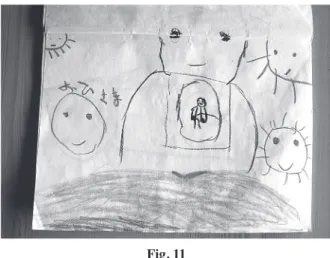
In the next drawing (Fig. 11) an enlarged mother figure, rising up from the earth, is surrounded by friend-ly-looking sons. A worried-looking sun is smaller and in the opposite corner now, suggesting his fears may be at bay for the moment. The mother is central and large, connected to earth, almost goddess-like. He, as sun (son) is also elevated to the heavens, surrounding her, shining on her, giving her warmth. The baby is in her heart area, enclosed and with an umbilical cord, imply-ing an attachment to mother, perhaps in a heartfelt way. Despite the god-like quality of sun and the great mother, only the ground is filled in-mother earth is a solid base of green growth. This connotes a sense of security in Mother Nature, and all powerful mother. The mother figure is "empty" or "transparent", something trans-par-ent (the earth) is his solid grounding.
Again S-kun draws a pregnant figure (Fig. 12) with-out color or legs/ grounding. The unborn baby has legs and attachment to the mother. This shows that he is highly aware of the physical aspects of pregnancy, considering his age and experience, yet he does not include hair or legs, suggesting a lack of grounding and perhaps immatu-rity. (Legs allow one to stand on one's own, hair is some-times absent or minimal in babies.)
In the next drawing (Fig. 13) S-kun draws his neighborhood. He surrounds his mother with a double layer of protective fencing, and fills her legs in solid or-ange. She is above a field, and candy is near the road to home. This suggests a protection of and separation from the pregnant mother. When she is protected, she stands
with solid feet on solid ground, and food is below her (nurturance is her base). His home is also cornered and 'fenced in' or protected by roads, with sweet things along the side. All this imagery suggests safety and security, sweetness and health, privacy and yet access to the out-side (roads). It is interesting to note that the marks for the green food are similar to the fence posts-and mirror each other: a mother growing (nurturing) a baby and the earth growing foods to nurture mother.
In the next drawing (Fig. 14) we see another trans-parent pregnant figure, this time with legs and some sort of grounding, a futon the color of earth. Inside are two babies, possibly suggesting his identification with his brother or the desire to return to the protective womb. Again, the red sun in the right hand corner appears, per-haps showing a "normal", or "stable" drawing pattern for him. When he is within the mother, with the new baby, there is more security and a soft, earthy grounding.
Just after meeting his brother for the first time, S-kun drew this picture (Fig. 15). He said the Christmas
tree was there because the baby is like a gift, like baby Jesus was a gift from God. The page is entirely cov-ered with color, except for the baby, which may indicate a sense of being filled up, or overwhelmed even, with emotion. Even the sun has been filled in with "ground" color, and wears a somewhat worried expression. The figure is still outlined, as before, except now there is hair. The hair has been rendered very softly, and looks exactly like his baby brother's hair, and it is the first time he has drawn hair on his figures, which is a sign of "pro-gression" or "development". Other physical features are schematic and not particular to his brother. This shows that he is looking carefully at this new brother, and drawing him carefully with as much detail or real-ism as he can.
The next drawing (Fig. 16) is a replica (altered for confidentiality purposes) of the drawing S-kun made in the presence of the art therapist, a few days after his brother's birth. He had been leaning on the art therapist while showing her his pictures and talking about them.
Fig. 12
Fig. 14 Fig. 15
When she asked him about the actual birth, he began, si-lently, to write names of family members in red. Because of his silence, the midwife nearby laughed while recant-ing the birth process: how his mother cried very loudly because of the pain, and how out of fear he ran from the room. Upon hearing this, S-kun seemed to remember the event, then looked down and avoided eye contact with anyone. He wrote his name very large in the center of the page before running loudly out of the room. He seemed to be saying, "I am still in the center!". His leav-ing the room again may have been to avoid memories of the event and the embarrassment of hearing the midwife laugh while telling the therapist what happened. Perhaps it was also a chance to receive the support he lacked during the actual labor. We assured him that everything was okay then, both his actions and the condition of his mother, but he remained silent.
S-kun refused to draw anything for many days after this episode. At home, his mother reported that he delib-erately tried not to please her, as he used to. Rather, he avoided her gaze and did not look at the baby. Although he found negative ways to get his mother's attention, such as wetting his pants or the bed, he slowly started to pay more attention to his brother. When he did fi-nally draw again, (Fig. 17) there was much agitation as suggested by the jagged line 'protecting' the flower, the floating figure, the sun's expression, and the different color of the air. It seems obvious that he was having, and quite normal for him to have, mixed emotions in association with the new baby, which seems to leave his protective cover a bit wavy or 'up and down'.
About one week after the birth, S-kun started to
show openness to others (Fig. 18). The flowers, once covered by outlines, are now open (out of the protec-tive cover, or womb) which may indicate S-kun's open-ness towards his brother. The figure is still floating and mostly transparent, and the light manner in which the hair was drawn clearly again shows a new way of draw-ing...a careful and soft touch for his brother.
The next drawing, made one month after his broth-er's birth, indicates S-kun's process of dealing with his new brother(Fig. 19). He started by drawing the famil-iar ground-although there was less of it this time than in many previous drawings, a sign that he may have felt less grounded than before, or that he had less of a base in mother/nature. After this he quickly drew a snake in the grass, a snake with an open mouth, saying "Aaah!". Thus he named it "Ah-chan", perhaps a representation of his new sibling with open, crying mouth, or perhaps an expression of his own fear or instinctive feelings. Archetypically, snakes are an ancient symbol of fertil-ity and instinct, and when they are surfacing from the
Fig. 16
Fig. 17
ground, they may also indicate unconscious material coming into consciousness. For S-kun, this snake is perhaps how he perceived his baby brother, as some-thing scary coming out of 'mother earth', a snake with an open mouth, an intimidating pose that could make anyone run away. But the wavy snake is also a way for S-kun to express his own "up and down" feelings of surprise or trepidation in relation to dealing with the emotions and challenges that surfaced during the time of the birth and subsequent life with a newborn baby.
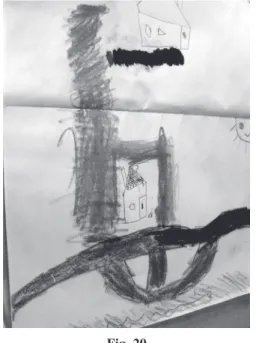
After the snake, S-kun said he wanted to draw roads: concrete, dirt/rock, and grassy roads. Starting with black and changing to brown, he explained that this road had shortcuts, and that they led to a friend's house (Fig. 20). The snake preceded the need for "a new kind of road", as he called it. In other words, with such a new and somewhat menacing base, he had to find a new way of moving in the world. The roads start out black, concrete, and gradually get softer-dirt and then grass-before leading him "to a friend's house" and then to his home via a tiny bit of dirt and then concrete again. These changes indicate a change from smooth, solid travel to bumpy or rocky travel, then onto a soft grassy natural pathway, and finally back to a smooth road for easy movement into his house. There is what he calls "a shortcut" which is really a "long cut", indicat-ing regression or a "circlindicat-ing backwards in his progres-sion forward". Indeed his behavior had been regressive (wetting pants) and sometimes inconsistent, but eventu-ally he made his way home, ending up with the same concrete roads on which he started out. So the rocky, bumpy, twisted roads in between were a "natural path"
for him. In other words, this adjustment to the startling birth of his brother (the snake emerging from a hole in mother earth) and to becoming a big brother was not an easy road for him to travel, but a necessary one that he managed to take even though he backtracked and tried to find shortcuts. On his own, instinctively, he came back to the smooth, solid, concrete roads and to a warm home. The 'friend's house' by the way, may be seen as his former way of living, his first house, a friendly place to which he wanted to return.
There are two chimneys in his house now, (Fig. 21) with bits of fire mixed with the smoke. This may be an indication of the two sons now in his home, and he may have a 'fiery' competition with his brother to contain the 'energy' (the heat, fuel, warmth) of the family. Note that the smoke from each chimney blows in opposite direc-tions; S-kun may originate from the same home, but go a very different way from his brother. This wavy smoke could also indicate two different directions or mixed feelings within himself.
This case study shows how the apparent distress of witnessing birth can be overcome within a matter of weeks, if given the proper care. S-kun was very expres-sive of his emotions, from his initial anxiety (as seen in the worried eyebrows) to his gradual opening up (flow-ers being out in the open) and independence. S-kun's artwork showed a distinct shift from being dependent upon his mother/mother earth to facing and naming a
Fig. 20 Fig. 19
scary snake, forging his own roads, going his own way, living with two sons in the home.
V. Discussion
Overall, children who witnessed birth expressed joy and pride in being a part of the experience. Chil-dren old enough to talk about the experience expressed positive interest in their new sibling and also accurate knowledge of birth and the caretaking of infants. This wisdom and attitude is a very positive result of being present during birth. While a few children were fright-ened during the final stages of labor, they were able to remove themselves from the disturbing situation, and there did not seem to be any lasting distress caused by witnessing labor. Even in the most upsetting case of S-kun, after just one month he had adjusted well, thanks to the love and support from his family. With adequate preparation, we find no reason to exclude children of any age or gender from the birthing process. The key is to make sure the entire family is ready. It is of utmost importance for adults to understand that birth can be a crisis for siblings, and when the family dynamics are clearly understood the appropriate care is more likely to be given to all children, and even parents.
The fact that half of the children in this study showed signs of progress or development in their art-work (Table 2) suggests that children will continue to grow and mature regularly after a sibling is born, wheth-er or not they are present during the sibling's birth.
Similarly, eight children, four of whom witnessed the sibling's birth, showed no outward sign of change
in their drawing patterns. This further supports that the actual witnessing had no developmental effects on the child per se. Two- and three- year-olds accounted for five of these eight children, so age rather than witness-ing may be more of a contributwitness-ing factor to development in artwork. (Table 3).
As regression in artwork can sometimes be a sign of trauma or shock, it was noted that four out of 24 chil-dren showed signs of regression in behavior and art-work, yet only one of them was present for the birth. All three boys whose artwork regressed were not pres-ent for labor or birth (Table 2). More information was gathered from the mother of the three-year old girl who witnessed birth and whose artwork showed regression. It was found that the paternal grandmother had become a primary caretaker for the girl, and that the mother and grandmother clashed on a number of important family issues. The authors surmise that the child carried the stress from the family relationships, and it showed up in her chaotic drawings of what the child called "bag-gage" or "purse"; a heavy but potentially valuable thing to carry. Therefore it cannot be said that witnessing birth itself causes shock or regression in children per se. Rather, it is likely that some children regress in artwork and/ or behavior as a natural response to a new sibling in the home.
It is interesting to note that some children who did not witness birth drew the baby wrapped in blankets or clothes, separate from other family members. Perhaps by missing the initial emergence into the family, they were sort of "blanketed out" of the process, separated from the innate wisdom of their mother's and sibling's physical body. Children who were part of the process, on the other hand, drew the mother and sibling with more detail. This realism indicates that those children learned about the physiology of the human body from witnessing birth.
In terms of gender, we found it interesting that a proportionately larger number of boys chose to leave the birthing room while the mother was in labor, as opposed to girls (Table 1). Girls also seemed to experience more pride in being female, and one said she looked forward to having a baby someday. Whether or not this difference was due to a lack of preparation, or simply the nature of
boys and girls is an issue to be researched further. Age seems to be a factor in relation to the vulner-ability of feeling frightened. It is important to note that most of the children who left the room during labor were the two- and three- year-olds, the youngest members in this survey (Table 4). This age group is more dependent on their mothers than older children and consequently may feel frightened by seeing her in pain. This may also be the first time they experience her inability to care for them fully. For these small children, much more thorough explaining and preparation needs to be given before labor and birth in order to ensure a positive ex-perience.
For five-year-olds, not having an active part in the process appeared to be a key factor in their leaving the room. The two who did not leave the room had an active role to play, whether it was simply drawing, reading, or caring for younger siblings or even the mother herself. When the child is able to "help" the mother in some way, he or she is better able to experience the event. It gives the child a comfortable place to be during the birthing process. When multiple siblings are present, they may get various duties, from cutting the umbilical cord to an-nouncing the gender of the baby to others. This makes for a positive memorable event, which bonds the family members together.
Older children in this study (ages eight and 12) said that after watching their mother, they had a better idea of how hard it is to give birth and care for a child. They were also observed doting on their baby siblings and tak-ing pride in their ability to hold or feed the baby. Again, giving older siblings a role to play during and after birth helps foster bonding and self-esteem. The 12 year old boy gave himself the job of drawing his brother's picture every year on his birthday, as a birthday present.
Many factors influence the change in relationships within a family when a baby is born. We could not de-termine, in this small study, whether emotions like jeal-ously, rivalry, or affection could be attributed solely on whether they witnessed birth or not. The authors feel it is very difficult to identify specific emotions by looking at artwork without thoroughly interviewing the subjects and their immediate families. More research is needed.
Likewise, it is difficult to assess the cause of
"re-gressive" or "developed" tendencies in drawings of chil-dren when a baby comes into their lives. We cannot say that it is due to the fact that they did or did not wit-ness the birth of their sibling. It could be the natural development of their drawing skills, or a reflection of the natural regression some kids go through when a new baby arrives. In addition, these changes in artwork are not necessarily "positive" or "negative", but rather an indication of the child's natural process of integrating the birth of a sibling.
Finding common patterns and putting them into these three categories may be a limiting factor in this small study. In future research, a large number of same-aged children who witness the birth process might be assessed in contrast to the same number and ages of children whose mothers give birth in a conventional hospital, without family members present. Such a study might be more revealing in its observations of how many children in each group "developed" or "regressed" after the birth of a sibling.
In addition, this study was conducted by an art therapist, who wished to give children a natural stress relief by being able to draw freely. The drawings could be compared before, during, and after the birth in an at-tempt to discover personal changes. In future studies, children in a control group might be given explicit di-rectives, such as "draw your family" before, during, and after birth, so that their artwork might be compared to an experimental group receiving the same directives.
As seen in the case study, even when a child is upset by seeing the mother in labor/birth, it can be overcome with the proper care. Having art materials available for siblings to use freely may be one of the best ways for them to express their emotions and release stress. Through drawing, S-kun was able to express what ap-peared to be anxiety, fear, threatening feelings and even confusion before forging out his own new path, or way, of being at home with a new baby.
VI. Conclusions
We acknowledge that the birth of a child is some-what a crisis for older siblings, whether or not they witness the actual birth. To help children adjust to this
substantial change in their family, we feel it is most im-portant to prepare children for the birth of their sibling, and to include them in the process if this is desired by the mother, the other family members and the children themselves. Some suggestions for preparing siblings for birth include talking about birth itself, reading books or watching videos together, and answering any questions the sibling may have. The child should not be forced to attend the birth, and at any time they should be given the means to leave the room if they so wish. The child should be of an age able to relate these needs, and a caregiver should be assigned specifically to taking care of him or her.
Giving the child a specific task to do, such as drawing the scene or their feelings, counting the toes of the new baby, cutting the umbilical cord, or simply announcing the name or gender of the baby to relatives is a good way to let him or her interact with other family members. During this time, it is natural for attention to go to the new baby, so giving the siblings a special role to play will help off-set this imbalance.
It is also essential to give children the opportunity to express themselves, either verbally or artistically, as a way to work through the complicated feelings that arise during the family's adjustment. There should be no judgment placed upon their expressions, behavior, and artwork, for whether it is developed or regressed, it is simply the necessary process for the child.
Acknowledgements
This research was conducted with the 2004 re-search grants of the Japan Academy of Midwifery. The authors wish to thank the children and mothers for their contributions.
References
Bartell, S. (1995). Should my child attend the birth of his/her sibling? http://www.havinganotherbaby.com/articles/ birth.html [2007-09-16]
Draper, J. (1997). Whose welfare in the labour room? A dis-cussion of the increasing trend of fathers' birth atten-dance Midwifery 13:132 138.
Green, J.M., Coupland,V.A. & Kitzinger, J.V. (1998). Great expectations: A prospective study of women's expec-tations and experiences of childbirth Second edition. Books for Midwives Press.
Hathaway, M. & Jay (1980). Children at Birth. AAHCC. Hoge, H. (2002). Women's stories of divorce at childbirth:
When the baby rocks the cradle binghamton, NY Haworth Clinical Practice Press.
Issokson, D (2001). A phenomenological study of children who witness the birth of a sibling. Dr. Issokson's Doc-toral Dissertation.
Junge, M.B. & Asawa, P.P. (1994). A history of art therapy in the United States American Art Therapy Assoc., Mundelein, Ill.
Klaus M.H. & Kennel J.H. (1982). Parent/ infant bonding. Mosby College; 2nd edition.
Lowenfeld, V. (1987). Creative and mental growth, 8th. ed. N.J.: Prentice Hall.
Leonard, CH. (1979). Preliminary observations on the be-havior of children present at the birth of a sibling. PE-DIATRICS Vol. 64 No. 6 December, pp. 949-951. Peterson, G.H. (1993). An easier childbirth 2nd Edition-A
mother's guide for birthing normally-Chapter 6 p. 93, 95 Shadow & Light Publications.
Reed, R.K. (2005). Birthing Fathers: The Transformation of Men in American Rites of Birth. Rutgers University Press.
Zorn C.B. (2000). Attending your grandchild's birth: A guide for grandparents. Authorhouse.