Mark A
LLON
Progress Report for Kuthodaw Pagoda Project
(Mandalay, Myanmar)
for Work Undertaken to September 2015
― Presented to Chuo Academic Research Institute of Rissho Kosei-Kai ―
for Work Undertaken to September 2015
― Presented to Chuo Academic Research Institute of Rissho Kosei-Kai ―
Mark A
LLONBrief summary of achievements:
Pagoda doors were secured and locks purchased and fitted.
An initial cleaning of stelae and site was undertaken in January-February 2015.
Dr Mark Allon, Dr Wendy Reade, and Grace Flitter worked in Mandalay 3-20 July initiating and overseeing the final cleaning of the stelae and site and photographing of the stelae.
Final cleaning has been completed for approximately half the stelae to date. Approximately half the stelae have been photographed to date.
Initial investigations into setting up the transcription project were undertaken. A preservative coating for the stelae was tested.
Securing and locking the pagoda doors
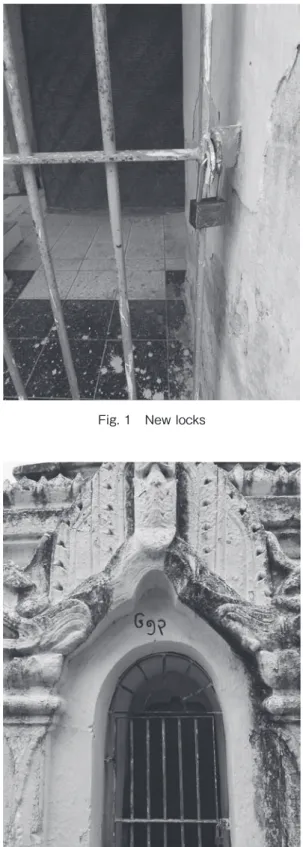
A major problem at the Kuthodaw Pagoda site was that many of the metal-grate doors to the pagodas that housed the stone inscriptions were damaged or unlocked, which allowed visitors to enter the pagodas. This resulted in graffiti being written on the stelae and internal pagoda walls, rubbish being deposited, and in some cases people to live in the pagodas. It was therefore imperative that pagodas be locked.
The Kuthodaw Pagoda Project purchased locks for the doors of the 729 pagodas and the Department of Archaeology repaired the doors and fitted the locks. All pagodas are now locked, with the exception of a select few near the entrance to the site left open to allow visitors to inspect the inscriptions. [Fig. 1]
Initial cleaning of stelae and site, January to February 2015
In January to February 2015 an initial cleaning of the stelae and site was undertaken by the Department of Archaeology. This included
Clearing away rubbish from inside the pagodas.
Cutting back some of the overhanging trees, removing plants growing on the pagodas, cleaning away some of the rubbish and weeds from the surrounding area.
Repainting pagoda numbers. [Fig. 2]
Removing most whitewash, graffiti, wasp nests, dirt, etc. from the stelae. Taking conservation quality photographs of the stelae post-cleaning.
Work undertaken in July 2015 during visit of Australian team members
Dr Mark Allon (project leader), Dr Wendy Reade (project conservator), and Grace Flitter (trainee conservator) worked at the Kuthodaw Pagoda 6-17 July (Allon 3-20 July).
Work at the Kuthodaw Pagoda was negotiated through the Director of the Department of Archaeology Mandalay, U Nyo Myint Tun, and the Assistant Director U Naing Win. Allon also spoke to the Director General of the Department of Archaeology in Naypyidaw, U Kyaw Oo Lwin, to update him on the project. The Director General expressed his appreciation of the value of our project and offered whatever assistance his Department could give.
The following were undertaken during this period:
Met with the newly elected Kuthodaw Pagoda Trustee committee members to discuss our work at the site and how they could assist. Their term is three years and they appear to be more energetic and organized than the previous committee. They expressed their interest in helping us in whatever way possible.
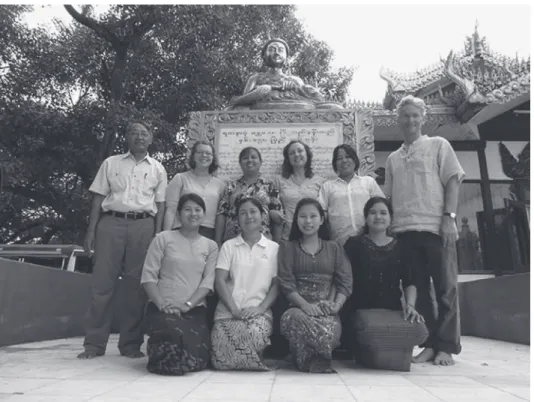
Set up the local Department of Archaeology team that would undertake the cleaning of the stelae and site. The team consisted of a project manager (U Wai Lwin, retired Department of Archaeology conservator and engineer), seven conservators/skilled workers, and two labourers. Not all conservators/skilled workers work at the same time. [Figs. 3 & 4]
Trained the Myanmar conservators and manager in the best methods for undertaking the final cleaning of the stelae.
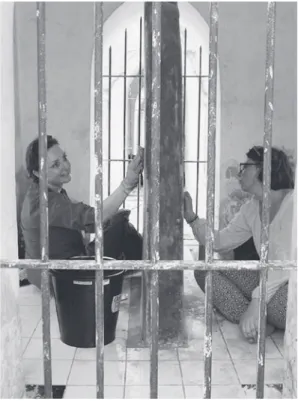
Began cleaning the stelae in preparation for photography. This included removing remaining remnants of whitewash, graffiti, paint, splashes of cement, etc. Over 100
had been completed by the time the Australian team left Mandalay. Approximately half have been completed to date. [Figs. 5, 6, 7]
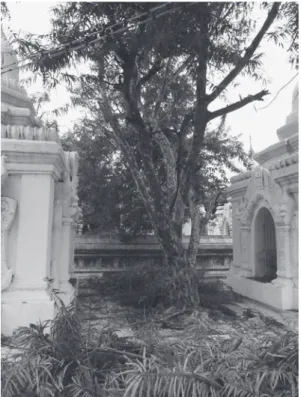
Initiated the cutting of the trees that still overhung the pagodas, removal of plants growing on pagodas, and the clearing away of rubble, rubbish, and weeds from around the site. [Figs. 8, 9, 10]
Produced guidelines for future work: (1) guidelines for the work the Department of Archaeology team would undertake when the Australian team members left; (2) guidelines for the future treatment of the site, including the whitewashing of the pagodas (that stelae should be covered if this is undertaken), re-inking of the inscriptions, etc.
Arranged for the photographers to start their work and assessed the quality of the resulting images. Approximately half the stelae have been photographed to date. The resulting images are of a very high quality. [Figs. 11 & 12]
Collected samples of the traditional preservative coating that had been applied to the stelae sometime in the past (no information is available of when this was done). This will be tested at the University of Sydney by Dr Elizabeth Carter, Facility Manager, Vibrational Spectroscopy Core Facility, with the aim of identifying the substance if possible.
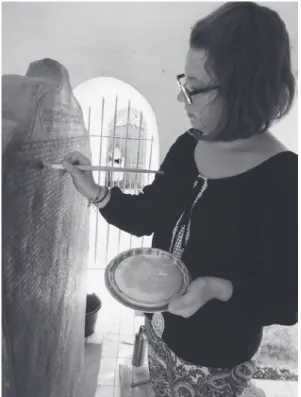
Tested the application of microcrystalline wax. The wax provides a coating that protects the stone and inscription and would replace or supplement the previous traditional coating. [Fig. 13]
Made initial steps in setting up the transcription project. Met with representatives from two organizations that may undertake the work. They are the Sitagu Sayadaw Academy in Sagaing and the State Pariyatti Sasana University in Mandalay.
Met with Dr Alexey Kirichenko (Institute of Asian and African Studies at Moscow State University), an expert in Burmese manuscripts and inscriptions, to discuss obtaining research materials.
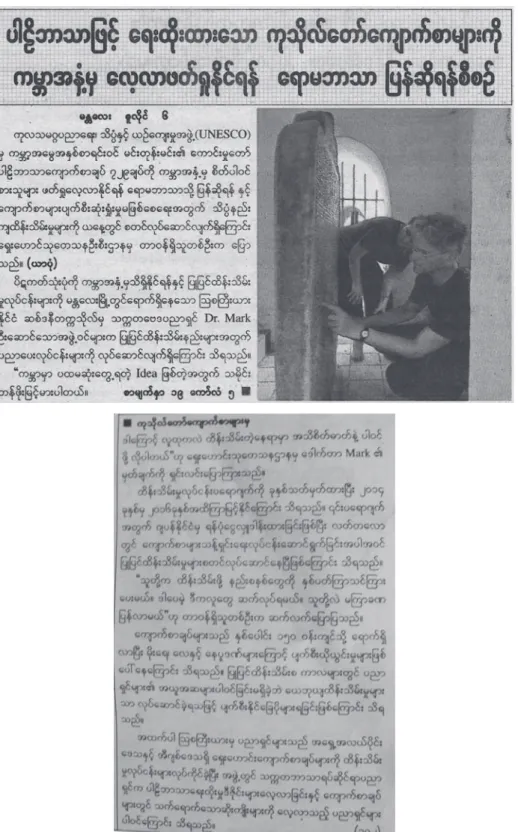
Collected data for the study of the donor inscriptions that appear on the pagodas and contain valuable historical information, such as the re-inking of the inscriptions, whitewashing of the pagodas, gifting of the metal umbrellas, and so on. [Fig. 14] Mark Allon and Wendy Reade were interviewed by reporters from the Yadanapon, a
local Burmese language newspaper. Articles on the Kuthodaw Pagoda Project appeared in two issues of the newspaper: Yadanapon, 7.7.15 (pp. 1 & 19) and 14.7.15 (p. 5). [Fig. 15]
and produced a short story on the Kuthodaw Pagoda Project which appeared on Myanmar TV on July 30.
Mark Allon and Wendy Reade presented their paper “The Conservation, Photographing, and Study of the Kuthodaw Pagoda Marble-stelae Recension of the Pali Buddhist Canon in Mandalay, Myanmar” at the Australia Myanmar Conference Myanmar and
the Sustainable Development Goals: “Informed by the Past, Looking to the Future”,
Yangon University, 10-13 July 2015.
Fig. 1 New locks
Fig. 3 Kuthodaw Pagoda Project team
Fig. 5 Conservators cleaning stela
Fig. 7 Allon and manager inspecting cleaned stela
Fig. 9 Plants to be removed from pagodas
Fig. 11 Photographers
Fig. 13 Testing preservative coating
Fig. 15 Articles on the Kuthodaw Pagoda Project appeared in two issues of the newspaper: Yadanapon, 7.7.15