naphthylbenzamides
著者
KUBO, Kanji; KUBO, Junko; KAMINAGA, Chifumi;
SAKURAI, Tadamitsu
引用
北海学園大学工学部研究報告(43): 39-47
Synthesis and Properties of N -Hydroxy-N -naphthylbenzamides
Kanji K
UBO*, Junko K
UBO**, Chifumi K
AMINAGA**and Tadamitsu S
AKURAI** AbstractN -Hydroxy-N -naphthylbenzamide derivatives (3, 5) were prepared from nitronaphthalenes by
reduction with raney Ni-hydrazine and benzoylation. Compounds (3, 5) were found to display unique absorption spectral changes in the presence of Cu2+and Fe3+and exhibited high Cu2+
se-lectivity. Compounds (3, 5) were effective for Cu2+transport through a liquid membrane.
1. Introduction
Hydroxamic acids, a group of weak organic acids, have wide applications as antifungal agent, food additives, inhibitors for copper corrosion in metallurgy and in nuclear fuel processing. The isolation of N -hydroxyoxamic acid from the reaction products of diethyloxalate and hydroxylamine attracted much attention to the chemistry of hydroxamic acids.1,2The complexation of hydroxamic acids with
metal ions constitutes the basis of many analytical determinations. A beautiful purple color of the Fe3+
and Cu2+ complexes enabled sensitive qualitative and quantitative determinations of carboxylic acids
and their derivatives. They form stable transition-metal complexes and are used as analytical re-agents.3-7 Considerable attention has been devoted to the effective separation and recovery of heavy
metal ions. In this respect, Bacon has reported transport of heavy metal ions such as Hg2+ and Pb2+
through a liquid membrane.8,9 Liquid membrane methods are useful for assessing the partitioning of
metal into and out of organic phases and are of considerable importance in medicine, water purifica-ton, and metallurgy. A liquid membrane, (which consists of an organic solvent placed at the bottom of a U-tube), has been widely used in order to study ion transport from one water compartment to the other, a process requiring, of course, passage through the chloroform barrier.10,11 We have also been
reported Hg2+transport with troponoid dithiocrown ethers through a liquid membrane.12-15A few
stud-ies regarding metal ion transport with hydroxamic acid derivatives5,6,16 such as N hydroxyN
-*北海学園大学工学部生命工学科
Department of Life Science and Technology, Faculty of Engineering, Hokkai−Gakuen University
**神奈川大学工学部応用化学科
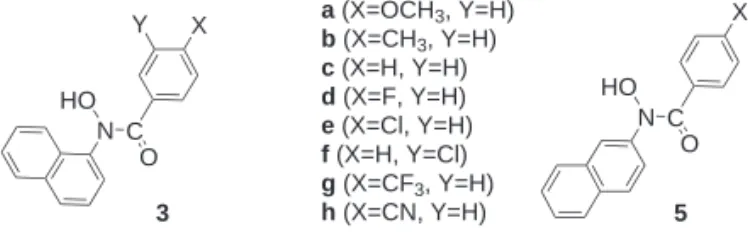
N HO C O N HO C O 3 a (X=OCH3, Y=H) b (X=CH3, Y=H) c (X=H, Y=H) d (X=F, Y=H) e (X=Cl, Y=H) f (X=H, Y=Cl) g (X=CF3, Y=H) h (X=CN, Y=H) 5 Y X X
Fig. 1. Chemical structures of 3 and 5.
phenylbenzamide ( BPA ) , N -hydroxy-N -phenylcinnamamide and N -hydroxy-N -naphthylbenzamide through liquid membranes have been reported. In this paper, we will report the synthesis and proper-ties of N -hydroxy-N -naphthylbenzamides that can use as an analytical reagent and transporting agent of Cu2+through a liquid membrane.
2. Experimental
Elemental analyses were performed by Perkin Elmer PE2400 series II CHNS/O analyzer. The melt-ing points were obtained with a Yanagimoto Micro Meltmelt-ing Point Apparatus and were uncorrected. The NMR spectra were measured on a JEOL JNM-500 Model spectrometer in CDCl3; the chemical
shifts are expressed by anδ unit using tetramethylsilane as an internal standard. The IR spectra were recorded on a Hitachi Model 270-30 infrared spectrometer with KBr disks for crystalline compounds. The UV spectra were measured using a Shimadzu Model UV-2200 spectrophotometer.
2.1. Synthesis of N -Hydroxy-N -naphthalenyl-benzamides
Nitronaphthalene (0.02 mol, 5.18 g) was dissolved in ethanol/1,2-dichloroethane (1 : 1 v/v, 50 cm3)
and was cooled to 0 ºC. Raney nickel (type W-4 ; 1.0 g) was added by stirring into the solution. Then, 80 % hydrazine hydrate solution (2.0 cm3, 0.064 mol) was added drop by drop, taking care to
maintain the reaction temperature below 10 ºC. The complete (or nearly complete) nitronaphthalene conversion was confirmed by TLC analysis on silica gel using benzene as an eluent. The catalyst was removed by filtration. The solvent was evaporated and the residue was recrystallized from benzene to yield N -naphthylhydroxylamines. The residue of the N -arylhydroxylamine (which was obtained by the evaporation of solvents in the above procedure) was dissolved in benzene (40 cm3) and was
washed with ice-cold water (20 cm3). This mixture was added with stirring into a previously cooled
solution (0 ºC) of 5% sodium hydrogencarbonate in water (60 cm3). The corresponding benzoyl
chlo-ride (0.03 mol) in benzene (30 cm3) was added drop by drop to the well-stirred mixture in about 0.5
h, taking care to maintain the temparature of the reaction below 5 ºC. The mixture was stirred for 2h at 0-5 ºC. The benzene layer was separated and the aqueous layer was extracted with benzene (30 cm3). The combined benzene extract was washed with water (40 cm3) and then with 10% sodium
hy-Kanji KUBO, Junko KUBO, Chifumi KAMINAGAand Tadamitsu SAKURAI 40
droxide solution (150 cm3). The aqueous alkaline solution was separated and acidified with a 10%
hy-drochloric acid solution when the N -Hydroxy-N -naphthylbenzamides were separated from the solu-tion. The obtained crystals were purified by column chromatography over silica gel (70-230 mesh, Merck) using hexane and benzene as the eluent. Recrystallization from ethyl acetate or ethanol gave analytically pure samples (3, 5) with the following physical properties. The physical properties of N -hydroxy-N -1-naphthylbenzamide (3c) and N --hydroxy-N -2-naphthylbenzamide (5c) have been re-ported in our previous paper.5
N -Hydroxy-4-methoxy-N -1-naphthalenylbenzamide (3a)17: Colorless crystals.1H NMR (CDCl 3) δ= 3.70 (3H, s), 6.62 (2H, dt, J=9.8, 2.5 Hz), 7.24 (1H, dd, J=7.3, 1.2 Hz), 7.33-7.36 (3H, m), 7.58 (1H, dd, J=8.2, 7.0 Hz), 7.64 (1H, dd, J=8.2, 7.0 Hz), 7.87 (1H, d, J=8.2 Hz), 8.22 (1H, d, J=8.5 Hz), and 9.32 (1H, brs).13C NMR (CDCl 3) δ=55.2, 113.4, 123.3, 123.5, 125.3, 127.0, 127.3, 127.8, 128.3, 130.2, 130.5, 134.5, 136.5, 161.8, 167.0. IR (KBr)ν 612, 666, 753, 774, 915, 975, 1029, 1110, 1155, 1176, 1257, 1305, 1404, 1461, 1509, 1575, 1629, 2896, 3052, 3480 cm-1. Found : C, 73.47 ; H, 5.28 ; N, 4.48%. Calcd for C18H15NO3: C, 73.71 ; H, 5.15 ; N, 4.78%.
N -Hydroxy-4-methyl-N -1-naphthalenylbenzamide (3b)17: Colorless crystals, mp 149-151ºC.1H NMR
(CDCl3)δ=2.22 (3H, s), 6.92 (2H, d, J=8.0 Hz), 7.24 (1H, d, J=7.3 Hz), 7.27 (2H, d, J=8.0 Hz), 7.33 (1H, dd, J=8.2, 7.3 Hz), 7.58 (1H, dd, J=8.2, 7.0 Hz), 7.65 (1H, dd, J=8.2, 7.0 Hz), 7.87 (1H, d, J= 8.2 Hz), 7.90 (1H, d, J=8.0 Hz), and 9.32 (1H, brs).13C NMR (CDCl 3)δ=21.4, 123.3, 125.3, 127.0, 127.4, 127.8, 128.3, 128.5, 128.8, 130.3, 134.5, 136.1, 141.7, 167.1. IR (KBr)ν 543, 609, 666, 738, 777, 807, 831, 912, 972, 1416, 1506, 1572, 1632, 2878, 3094, 3448 cm-1. Found : C, 77.97 ; H, 5.60 ; N, 4.81%. Calcd for C18H15NO2: C, 77.96 ; H, 5.45 ; N, 5.05%.
4-Fluoro-N -hydroxy-N -1-naphthalenylbenzamides (3d) : Colorless crystals, mp 134.0-135.5 ºC. 1H
NMR (CDCl3)δ=6.81 (2H, t, J=8.7 Hz), 7.24 (1H, d, J=7.4 Hz), 7.35 (1H, t, J=8.2 Hz), 7.39 (2H, t, J =8.7 Hz), 7.59 (1H, dd, J=8.2, 6.8 Hz), 7.65 (1H, dd, J=8.2, 6.8 Hz), 7.89 (1H, d, J=8.2 Hz), 7.91 (1 H, d, J=8.2 Hz), 8.19 (1H, d, J=8.2 Hz), and 9.26 (1H, bs).13C NMR (CDCl 3)δ=115.2, 115.4, 123.1, 125.3, 127.1, 127.5, 128.0, 128.5, 130.4, 130.6. 130.8, 130.9, 134.5, 163.2, 165.2. IR (KBr)ν 609, 771, 849, 915, 972, 1155, 1227, 1401, 1416, 1509, 1605, 1632, 2878, 3052, 3448 cm-1. Found : C, 72.97 ; H, 4.66 ; N, 4.91%. Calcd for C17H12NO2F : C, 72.59 ; H, 4.30 ; N, 4.98%.
4-Chloro-N -hydroxy-N -1-naphthalenylbenzamide (3e) : Colorless crystals, mp 142.5-144.5ºC (lit. 148 ºC)18,19.1H NMR (CDCl
3)δ=7.10 (2H, d, J=8.7 Hz), 7.23 (1H, d, J=7.0 Hz), 7.30 (2H, d, J=8.7 Hz),
41 Synthesis and Properties ofN -Hydroxy-N -naphthylbenzamides
7.34 (1H, dd, J=8.2, 7.0 Hz), 7.59 (1H, dd, J=8.2, 7.0 Hz), 7.65 (1H, dd, J=8.2, 7.0 Hz), 7.89 (1H, d, J=8.2 Hz), 7.91 (1H, d, J=8.2 Hz), 8.19 (1H, d, J=8.2 Hz), and 9.31 (1H, bs).13C NMR (CDCl
3)δ=
123.1, 125.3, 127.1, 127.5, 128.0, 128.4, 128.5, 129.8, 130.0, 130.4, 130.7, 134.5, 135.6, 137.4, 165.9. IR (KBr)ν 558, 663, 744, 774, 804, 840, 912, 972, 1017, 1092, 1416, 1491, 1569,1629, 2878, 3112, 3586 cm-1. Found : C, 68.86 ; H, 4.25 ; N, 4.84%. Calcd for C
17H12NO2Cl : C, 68.58 ; H,
4.06 ; N, 4.70%.
3-Chloro-N -hydroxy-N -1-naphthalenylbenzamide ( 3 f ) : Colorless crystals, mp 147.0-149.0 ºC. 1H
NMR (CDCl3)δ=6.98 (1H, dd, J=8.2, 7.5 Hz), 7.08 (1H, d, J=7.0 Hz), 7.23 (1H, d, J=8.2 Hz), 7.26 (1H, d, J=8.2 Hz), 7.35 (1H, dd, J=8.2, 7.5 Hz), 7.51 (1H, s), 7.59 (1H, dd, J=8.2, 7.0 Hz), 7.65 (1H, dd, J=8.2, 7.0 Hz), 7.89 (1H, d, J=8.2 Hz), 7.91 (1H, d, J=8.8 Hz), 8.18 (1H, d, J=8.8 Hz), and 9.45 (1H, bs).13C NMR (CDCl 3)δ=123.0, 125.2, 126.3, 127.0, 127.5, 128.0, 128.5, 128.7, 129.3, 130.0, 130.8, 131.2, 133.4, 134.3, 134.5, 135.3, 165.5. IR (KBr)ν 723, 777, 792, 810, 879, 927, 975, 1161, 1404, 1572, 1593, 1635, 2902, 3154, 3448 cm-1. Found : C, 68.71 ; H, 4.30 ; N, 4.75%. Calcd for C17H12NO2Cl : C, 68.58 ; H, 4.06 ; N, 4.70%.
N -hydroxy-N -1-naphthalenyl-4-trifluoromethylbenzamide (3g) : Colorless crystals, mp 159.0-160.0ºC. 1H NMR (CDCl 3)δ=7.24 (1H, d, J=7.0 Hz), 7.35 (1H, dd, J=8.2, 7.0 Hz), 7.39 (2H, d, J=8.2 Hz), 7.45 (2H, d, J=8.2 Hz), 7.60 (1H, dd, J=8.2, 7.0 Hz), 7.68 (1H, dd, J=8.2, 7.0 Hz), 7.90 (1H, d, J=8.5 Hz), 7.92 (1H, d, J=8.5 Hz), 8.20 (1H, d, J=8.2 Hz), and 9.27 (1H, bs).13C NMR (CDCl 3)δ=122.3, 122.9, 124.5, 125.1 (q, J=4Hz), 125.3, 127.2, 127.6, 128.1, 128.5, 128.8, 130.4, 130.9, 132.7 (q, J=33 Hz), 134.5, 135.1, 165.4. IR (KBr)ν 561, 693, 774, 804, 855, 876, 975, 1017, 1068, 1116, 1170, 1335, 1425, 1638, 2932, 3196, 3448 cm-1. Found : C, 65.58 ; H, 3.90 ; N, 4.09%. Calcd for C
18H12
NO2F3: C, 65.26 ; H, 3.65 ; N, 4.23%.
4-Cyano-N -hydroxy-N -naphthalen-1-yl-benzamide (3h) : Colorless crystals, mp 150.0-153.0 ºC. 1H
NMR (CDCl3)δ=7.23 (1H, d, J=7.3 Hz), 7.34 (1H, dd, J=8.2, 7.3 Hz), 7.41 (2H, d, J=8.2 Hz), 7.45 (2H, d, J=8.2 Hz), 7.61 (1H, dd, J=8.2, 7.3 Hz), 7.67 (1H, dd, J=8.2, 7.3 Hz), 7.90 (1H, d, J=8.2 Hz), 7.92 (1H, d, J=7.3 Hz), 8.17 (1H, d, J=8.2 Hz), and 9.28 (1H, bs).13C NMR (CDCl 3)δ=114.7, 117.7, 122.8, 125.2, 127.3, 127.6, 128.2, 128.6, 128.9, 130.3, 131.1, 131.9, 134.5, 134.8, 135.9, 164.8. IR (KBr)ν 750, 777, 807, 846, 912, 972, 1410, 1506, 1566, 1626, 2230, 2860, 3100, 3424 cm-1. Found : C, 75.20 ; H, 4.67 ; N, 9.70%. Calcd for C18H12N2O2: C, 74.99 ; H, 4.20 ; N, 9.72%.
Kanji KUBO, Junko KUBO, Chifumi KAMINAGAand Tadamitsu SAKURAI 42
N -Hydroxy-4-methoxy-N -2-naphthalenyl-benzamide (5a) : Colorless crystals, mp 148.0-149.0ºC. 1H NMR (CDCl3)δ=3.75 (3H, s) , 6.72 (2H, d, J=9.1 Hz) , 7.30 (1H, d, J=8.9 Hz) , 7.44 (2H, d, J=9.1 Hz) , 7.47-7.52 (2H, m), 7.72 (1H, d, J=2.4 Hz), 7.74 (1H, dd, J=6.8, 2.4 Hz), 7.77 (1H, d, J=8.9 Hz), 7.81 (1H, dd, J=6.8, 2.4 Hz), and 9.21 (1H, bs).13C NMR (CDCl 3)δ=55.3, 113.6, 123.8, 123.9, 124.6, 126.9, 127.7, 128.2, 129.1, 131.0, 132.4, 133.2, 137.3, 161.8, 165.2. IR (KBr) ν 594, 660, 741, 759, 810, 834, 1026, 1053, 1161, 1179, 1257, 1302, 1407, 1428, 1512, 1569, 1590, 2914, 3112 cm-1. Found : C, 73.89 ; H, 5.42 ; N, 4.71%. Calcd for C
18H15NO3: C, 73.71 ; H, 5.15 ; N, 4.78%.
2.2. Determination of Equilibrium Constant
An aqueous solution (3 cm3) containing metal salts ([CuCl
2] or [FeCl3] / mol dm-3=0–0.1) was
shaken with a chloroform solution (3 cm3) of 3 or 5 (5x10⁻⁵ mol dm-3) for 5 min. The chloroform
layer was measured spectrophotometrically (Cu2+: λ=330 nm, Fe3+: 430 nm) and the equilibrium
constants were estimated by using the Benesi-Hildebrand approximation equation.20
2.3. Transport of Cu2+
Transport experiments were performed using a liquid membrane system which consists of source phase (10 cm3, 5 x 10⁻³mol dm-33 or 5), and a receiving phase (10 cm3, 2.0 moldm-3HCl). A single
apparatus and a constant stirring at 25ºC were used.12,15As described,21 to measure Cu2+, 0.5 cm3 was
also taken from aq. I and aq. II and was diluted with water to 5 cm3. To the diluted solution (0.5 cm3)
aqueous citric acid solution (2.00 g, in 10 cm3) was added to acidify the solution, and then aqueous
EDTA solution (500 mg of EDTA hydrate in 10 cm3) was added. The mixture was adjusted to pH=
9.0 by adding NH3solution. After 20 min the mixture was transferred into a separate funnel and was
diluted with water to 50 cm3. A sodium diethyldithiocarbamate (DDTC) solution (1 x 10⁻²mol dm-3, 5
cm3) was added and was shaken with CHCl
3(10 cm3). The organic layer was dried onto a filter paper
and was measured spectrophotometrically (λ=440 nm).
3. Result and Discussition
N -Hydroxy-N -naphthylbenzamides (3, 5) were prepared from nitronaphthalenes in two steps, as
shown in Fig. 2.22 Reduction of 1 with raney-nickel and hydrazine furnished the hydroxylamines (2,
4), which were converted to the corresponding N -hydroxy-N -naphthylbenzamides by benzoylation. The structure and purity of 3 and 5 were ascertained by NMR spectroscopy and elemental analysis.
43 Synthesis and Properties ofN -Hydroxy-N -naphthylbenzamides
NO2 NHOH Raney Ni, NH2NH2 EtOH, CH2ClCH2Cl NHOH O Cl X Y NaHCO3 H2O-Benzene + 1 1 2 3 a (X=OCH3, Y=H) b (X=CH3, Y=H) c (X=H, Y=H) d (X=F, Y=H) e (X=Cl, Y=H) f (X=H, Y=Cl) g (X=CF3, Y=H) h (X=CN, Y=H) NO2 Raney Ni, NH 2NH2 EtOH, CH2ClCH2Cl 4 4 O Cl X NaHCO3 H2O-Benzene + 2 5 N HO C O N HO C O Y X X NHOH NHOH
Fig. 2. Synthesis of 3 and 5.
Extraction of various metal ions (1.0 x 10⁻²mol dm-3) into the chloroform solutions containing 3
and 5 (5.0 x 10⁻⁵ mol dm-3) was checked by UV spectroscopy ; lithium, sodium, potassium,
magne-sium, calcium, barium, cobalt, nickel, and zinc ions revealed no indication of UV spectral change, but Cu2+and Fe3+ showed a spectral change. In Fig. 3 are shown the absorption spectra of 3a and 5c
ob-tained in the presence of varying concentrations of Cu2+ or Fe3+. The complexation of 3 and 5 with
Cu2+and Fe3+ (Fig. 3) showed an enhancement of the absorption, while the Fe3+complex gave a new
band at 430 nm. The composition of the complexes was determined as 1 (metal) : 2 (ligand) for the Cu2+- N -hydroxy-N -naphthylbenzamides ( 3, 5 ) system and 1 : 3 for the Fe3+ N hydroxyN
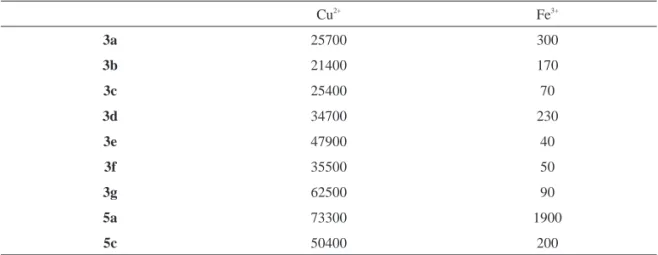
-naphthylbenzamides (3, 5) system by the molar ratio method. The extraction equilibrium constants were determined by the Benesi-Hildebrand method. The equilibrium constants of Cu2+ complex were
larger than those of Fe3+complex. The deeasing orders of equilibrium constants for Cu2+and Fe3+were
5a > 3g > 5c > 3e > 3f > 3d > 3a > 3c > 3b and 5a > 3a > 3d > 5c > 3b > 3g > 3c > 3f > 3e. Hy-droxylamines 3 and 5 captured Cu2+ ion under neutral conditions and liberated it upon acidification
with hydrochloric acid as detected by UV spectroscopy. This means that 3 and 5 can serve as a trans-porting agent of Cu2+through the liquid membrane.
Kanji KUBO, Junko KUBO, Chifumi KAMINAGAand Tadamitsu SAKURAI 44
Fig. 3. UV-vis spectral changes of (a) 3a with Cu2+, (b) 5c with Cu2+, (c) 3a with Fe3+, and (d) 5c with Fe3+in CHCl3. Cu2+ Fe3+ 3a 25700 300 3b 21400 170 3c 25400 70 3d 34700 230 3e 47900 40 3f 35500 50 3g 62500 90 5a 73300 1900 5c 50400 200
Table 1. Extraction equilibrium constants of Cu2+and Fe3+complexes of 3 and 5
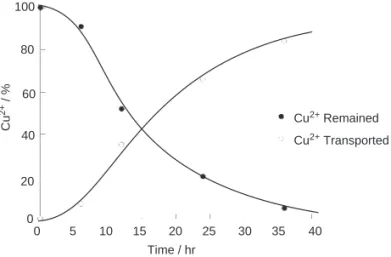
Transport experiments were performed using a liquid membrane system (see experimental section). The Cu2+concentrations in the aqueous compartments were monitored as a function of time by means
of the colorimetric method. The transport data are an average of at least three runs whose experimen-tal error is less than 5%. No movement of Cu2+through the chloroform was observed unless a carrier
was used. When an aqueous solution of CuCl2 in the source phase was brought into contact with a
chloroform solution of 3 or 5, stirring with a magnetic bar at 25ºC, the concentration of Cu2+ in the
45 Synthesis and Properties ofN -Hydroxy-N -naphthylbenzamides
0 5 10 15 20 25 30 35 40 0 20 40 60 80 100 Cu2+ Remained Cu2+ Transported Time / hr Cu 2+ / %
Fig. 4. Percent of Cu2+in the source phase (CuCl
2, 5 x 10⁻³mol dm-3, 10 cm3) and the receiving phase (2 mol
dm-3HCl, 10 cm3) as a function of time (hr) using the chloroform phase (10cm3) for carrier 3c (5 x 10⁻³mol
dm-3) (Reproduced from ref. 5.).
C N O Cu O O C N O Np Ar Ar Np C N Np O Ar HO Cu2+ Cu2+ H+ H+ Membrane Aq. I Aq. II 3-H+ or 5-H+
Fig. 5. Schematic presentation of the reactions taking place at the boundary of the source phase and the chlo-roform and at the boundary of the chlochlo-roform and the receiving phase (Modified from ref. 5.).
source phase decreased. Fig. 4 shows the result of transport experiment of Cu2+with 3c. Cu2+transport
with 3 and 5 was promoted by the counterflow of protons from the receiving to the source phase, al-though proton concentration was not quantitatively investigated. Fig. 5 shows that the reaction takes place at both interfaces.
In conclusion, hydroxamic acid derivatives with naphthyl substituents were found to display unique absorption spectral changes in the presence of Cu2+ and Fe3+ and are used as analytical reagents for
Cu2+. N -Hydroxy-N -naphthylbenzamides were effective for Cu2+transport through a liquid membrane
and indicate that slight structural changes affect the extraction and transport rate of Cu2+ to a great
ex-tent. This makes it possible to design an effective carrier for Cu2+separation.
Kanji KUBO, Junko KUBO, Chifumi KAMINAGAand Tadamitsu SAKURAI 46
4. References
1)L. Bauer and O. Exner : Angew. Chem. Int. Ed. Eng. 13, 376 (1974). 2)E. Lipczynska-Kochany : Chem. Rev., 91, 477 (1991).
3)S. Mizukami and K. Nagata : Coord. Chem. Rev., 3, 267 (1968). 4)T. J. King and P. G. Harrison : J. Chem. Soc. Chem. Comm., 1972, 815. 5)K. Kubo, J. Kubo, C. Kaminaga and T. Sakurai : Talanta, 45, 963 (1998). 6)N. Dallali, A. Darabi and Y. K. Argawal : Rev. Anal. Chem., 24, 263 (2005).
7)K. Kubo, T. Matumoto, K. Yuhi, J. Kubo and T. Sakurai : Acta Cryst., E63, o1942 (2007). 8)E. Bacon and M. Kirch : J. Membr.Sci., 24, 185 (1985).
9)E. Bacon and M. Kirch : J. Membr.Sci., 32, 159 (1985).
10)R. D. Noble and J. D. Way (Eds.), “Liquid Membaranes : Theory and Applications” ; American Chemical Soci-ety : Washington, D. C. (1987).
11)T. Araki and H. Tsukube (Eds.), “Liquid Membaranes : Chemical Applications”, CRC Press : Boca Raton, FL (1990).
12)A. Mori, K. Kubo and H. Takeshita : Bull. Chem. Soc. Jpn., 67, 1094 (1994). 13)A. Mori, K. Kubo and H. Takeshita : Coord. Chem. Rev., 148, 71 (1996). 14)K. Kubo, A. Mori, T. Nishimura and N. Kato : Heterocycles, 76, 209 (2008). 15)K. Kubo : Oleoscience, 9, 561 (2009).
16)L. K. Shpigun and E. N. Abanina : Zh. Anal. Khim., 39, 1829 (1984). 17)V. K. Gupta and S. G. Tandon : Anal. Chim. Acta, 66, 39 (1973). 18)V. K. Gupta : J. Chem. Eng. Data, 17, 248 (1972).
19)A. Mudaliar and Y. K. Agrawal : J. Chem. Eng. Data, 24, 246 (1979). 20)H. A. Benesi, and J. H. Hildebrand : J. Am. Chem. Soc., 71, 2703 (1949).
21)“Shin Jikken Kagaku Koza”, Vol. 9, Chem. Soc. Jpn., Maruzen, Tokyo, 1975, p. 382. 22)N. R. Ayyanger, K. C. Brahme, U. R. Kalkote and K. V. Srinivasan : Synthesis, 1984, 938.
47 Synthesis and Properties ofN -Hydroxy-N -naphthylbenzamides