INVITED PAPER
Special Section on Wideband SystemsOptical Wireless Communication: A Candidate 6G Technology?
Shintaro ARAI†a), Masayuki KINOSHITA††,Members,andTakaya YAMAZATO†††,Fellow
SUMMARY We discuss herein whether an optical wireless communi- cation (OWC) system can be a candidate for post 5G or 6G cellular commu- nication. Almost once per decade, cellular mobile communication is trans- formed by a significant evolution, with each generation developing a dis- tinctive concept or technology. Interestingly, similar trends have occurred in OWC systems based on visible light and light fidelity (Li-Fi). Unfortu- nately, OWC is currently relegated to a limited role in any 5G scenario, but the debate whether this is unavoidable has yet to be settled. Whether OWC is adopted post 5G or 6G is not the vital issue; rather, the aim should be that OWC coexists with 5G and 6G communication technologies. In working toward this goal, research and development in OWC will continue to extend its benefits and standardize its systems so that it can be widely deployed in the market. For example, given that a standard already exists for a visible- light beacon identifier and Li-Fi, a service using this standard should be developed to satisfy user demand. Toward this end, we propose herein a method for visible-light beacon identification that involves using a rolling shutter to receive visible-light communications with a smartphone camera.
In addition, we introduce a rotary LED transmitter for image-sensor com- munication.
key words: post 5G/6G, visible light communication, Li-Fi, IEC 62943 visible light beacon, rolling shutter, rotary LED transmitter
1. Introduction
2020 was supposed to be the year that fifth-generation (5G) cellular mobile communications made its grand debut. Un- fortunately, the coronavirus pandemic postponed this devel- opment. However, 5G communications remain the main technological focus for cellular mobile communications. In fact, research on wireless communication systems has al- ready shifted from 5G to post 5G and 6G technologies. In this paper, we address the question of whether optical wire- less communication (OWC)[1],[2] can be a candidate for post 5G or 6G technology, what form it should take, and what technical elements are required for such a scenario.
Almost once per decade, cellular mobile communica- tion is transformed by a significant evolution, with each generation developing a distinctive concept or technology.
For example, first-generation mobile communication intro- duced the cellular concept, and second generation technol- ogy transitioned from analog to digital, making the devices smaller and more affordable. Third-generation technology
Manuscript received August 17, 2020.
†The author is with the Okayama University of Science, Okayama-shi, 700-0005 Japan.
††The author is with the Chiba Institute of Technology, Narashino-shi, 275-0016 Japan.
†††The author is with the Nagoya University, Nagoya-shi, 464- 8601 Japan.
a) E-mail: [email protected]
DOI: 10.1587/transfun.2020WBI0001
used multiple access systems such as code division multi- ple access (CDMA), and included data in addition to voice.
The fourth generation adopted orthogonal frequency divi- sion multiplexing (OFDM) to allow high-speed data com- munication and multi-input multi-output (MIMO) to accel- erate user connectivity for smartphone applications. Finally, 5G technology is now expanding beyond ultrafast data com- munications to autonomous driving control and the Internet of Things (IoT).
In mobile wireless communication, OWC has already been used in 2G technology in the form of an infrared data module. With this technology, terminals that are mainly used for voice communication are also used for data com- munication via infrared communication systems. However, with the rise of Bluetooth and wireless LAN, the adoption of OWC has stalled.
In this paper, we discuss whether OWC can be a can- didate for post 5G or 6G communications. In particular, we look at the trends in cellular mobile radio communica- tions and OWC and discuss what form, if any, OWC sys- tems should take and what technical elements would be re- quired in such a case. As a candidate technology, we in- troduce visible-light communication (VLC) with a camera also known as image-sensor communication (ISC) [3]–[5]
or optical camera communication (OCC)[6]–[8]). We also introduce a rotary LED transmitter for ISC.
This paper consists of two parts: In the first part, we consider trends in cellular mobile radio communications and OWC and discuss the technical challenges to be resolved for OWC to be a candidate for post 5G or 6G technology. In the second part of the paper, we introduce the rolling-shutter method, which allows VLC using a smartphone camera and provides a visible light beacon (VLB) identification (ID) system. We also introduce a method that uses the smart- phone camera and produces an afterimage by rotating the transmitter, thereby creating an effect similar to the rolling- shutter method.
2. Reviewing Trends in Mobile Radio Communications and Optical Wireless Communication
2.1 Timeline
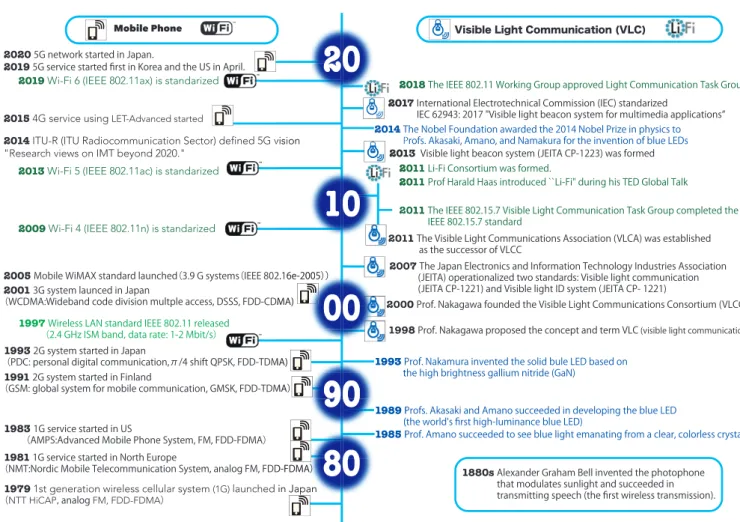
Figure 1 summarizes the trends in mobile radio communi- cations and OWC from 1980 to 2020. As seen from the figure, cellular radio communication technology has under- gone a generational change every decade since 1980, with Copyright c2021 The Institute of Electronics, Information and Communication Engineers
Fig. 1 Brief history of mobile phone systems, Wi-Fi, VLC, and Li-Fi. Cellular mobile radio and Wi- Fi, being mobile radio communication systems, are listed on the left side of the figure. On the right, we show the trends of VLC and light fidelity (Li-Fi)[9]–[11]as OWC systems. Note that we exclude IrDA[12]–[14], free-space optical (FSO) communication[15]–[18], etc. and focus only on VLC and Li-Fi. We also exclude Bluetooth from mobile radio communications.
VLC and Li-Fi concentrated after 2010.
We may also assume that, for VLC and Li-Fi, tech- nological generational transitions will also occur roughly every ten years. VLC was first proposed by Nakagawa at Keio University at the end of the 1990s when white-light LEDs or phasor-coated blue-light LEDs first came on the market[19]–[22], which was almost ten years after Akasaki and Amano invented blue-light LEDs in 1989[23].
Slightly over a decade later, in 2011, Haas at the Uni- versity of Edinburgh proposed Li-Fi, which is a high-speed wireless communication system based on optical radiation transmitted along a line of sight[11]. Finally, in 2018, the IEEE 802.11 study group was established to form the wire- less LAN standard.
Haruyama of Keio University then proposed the LED VLB as a standard for VLC. In 2007, the Japan Electronics and Information Technology Industries Association (JEITA) operationalized two standards: Visible light communication (JEITA CP-1221)[24]and Visible light ID system (JEITA CP-1222)[25]. Later, in 2013, the VLB system (JEITA CP- 1223)[26]was formed. Ten years after the first standard in
2007, the International Electrotechnical Commission (IEC) produced the standardized IEC 62943: 2017, entitled “Vis- ible light beacon system for multimedia applications”[27], and which we refer to herein asIEC62943 VLB.
Thus, based on the history of generational advances in OWC systems every ten years, we may expect break- throughs in OWC systems to mature around 2030, which is when 6G communications will appear.
2.2 Research Trends in Optical Wireless Communications We now discuss the research trends in OWC systems. Fig- ure 2 shows the yearly number of research papers related to infrared communication (Ir), VLC, ISC (or OCC), Li-Wi, FSO communication, and others. Furthermore, Table 1 sum- marizes the classification and characteristics of OWC tech- nologies.
As seen in Fig. 2, the number of research papers has increased since 2010. In particular, the VLC category grew remarkably and Li-Fi and ISC, which are derived from VLC, grew in tandem. Conversely, we count a constant and mod-
Table 1 Classification and characteristics of OWC technologies[28]–[32].
Ir VLC ISC Li-Fi FSO
Transmitter LED/LD LED/LD LED/Display LED/LD LD
Receiver PD PD/Camera Camera PD PD
Data rate kbps-Gbps Mbps-Gbps bps-Mbps kbps-Gbps Gbps
Range <10m <100m <200m <10m >1km
Implementation
complexity Moderate Moderate Low Moderate High
Application Optical USB,
PAN (Personal Area Network)
Navigation, PAN ID, Underwater
Navigation, PAN
ID, ITS Indoor internet access Backhaul, Space, Underwater
Standard
IrDA SIR (1994) IrDA MIR (1994) IrDA VFIR (1998) IrDA UFIR (2006) IrDA Giga-IR (2009)
JEITA CP-1221 (2007), JEITA CP-1222 (2007), JEITA CP-1223 (2013), IEC 62943:2017 (2017), IEEE 802.15.7 (2011), IEEE 802.15.7m (2018)
JEITA CP-1221 (2007), JEITA CP-1222 (2007), JEITA CP-1223 (2013), IEC 62943:2017 (2017), IEEE 802.15.7 (2011), IEEE 802.15.7m (2018)
Under discussion at IEEE 802.11 Light Communication Task Group
—
Fig. 2 The yearly number of published research papers by Nov. 17, 2020.
These data were obtained by searching for each keyword in the Web of Sci- ence database, following which the articles were classified based on titles and keywords. We treat OWC as a generic term; in other words, Ir, VLC, ISC, Li-Fi, and FSO are all methods of OWC, but papers are only classi- fied as belonging to the OWC category if the author specified “OWC” as a keyword or used it in the title.
erate number of FSO papers since 1990 with only a slight increase in number since 2010. FSO has been evaluated as a backhaul network technology and a certain level of demand for this type of technology is expected in the future. In the Ir category, although a certain number of publications appear every year, no growth trend is apparent. Ir uses near-infrared radiation and is a successful example of OWC. It was used in 2G devices and IrDA and set the standard[33]in 1993, when it was established. However, with the advent of smart- phones, Bluetooth and Wi-Fi have been adopted, with Ir be- coming less used. This explains why relatively few Ir papers have been published.
3. Can Optical Wireless Communication Systems be Candidates for Post 5G or 6G Technology?
3.1 5G Use Scenarios and Suitability of Optical Wireless Communication
The International Telecommunications Union Radiocom- munication Sector started research on 5G at the workshop
Fig. 3 Usage scenarios of 5G. Li-Fi and VLB adaptation in a limited scenario[34],[35].
entitled “Research views on IMT†Beyond 2020” at Work- ing Party 5D, held in May 2014. After a year and a half of work, they produced a draft vision recommendation [34], [35]. Because it took time to specify the frequency band for 3G and 4G technology and to examine how the sys- tem would work when using this frequency band, the draft also outlines the use of the 6–100 GHz frequency band and the system’s requirements. For example, with 3G, it took seven years to identify the spectrum and 15 years to deploy the system. For 4G, it took about nine years from the 2003 vision recommendation to final approval of the radio inter- face for 4G systems (IMT-Advanced).
The recommendation for the 5G vision presents three typical use scenarios (see Fig. 3). Assuming that post 5G and 6G technologies will follow the extension of 5G, we also inherit the use cases shown here for post 5G and 6G.
We now discuss the applicability of OWC to each of the following use scenarios.
(1) eMBB: Enhanced mobile broadband.
Enhanced mobile broadband is a people-centric scenario, where multimedia content can be accessed anytime, any-
†International Mobile Telecommunications.
where. Unfortunately, it is challenging to ensure ubiquity when using OWC.
For a human-centered scenario, access must be guar- anteed in all locations, including when moving. When the wavelength of the radiation is 1 mm or less, absorption by molecules in the air or at the surface of a material is likely.
When the surface of an object is not sufficiently flat (relative to optical flatness), irregular reflection occurs, and radiation is rapidly attenuated. Therefore, the signal becomes weak, and communication is not possible if the radiation source is not visible. Conversely, radio waves have longer wave- lengths than optical radiation and are easily transmitted be- yond the field of vision because they are reflected from ob- jects. It is also quite possible to envision, for example, the use of OWC in a limited indoor space; this is the scenario for which Li-Fi is considered.
Post 5G and 6G are expected to use higher-frequency bands than are currently in use. However, assuming the use of frequencies above 300 GHz, the wavelength would be 1 mm or less, making communications more susceptible to absorption in matter and air. Thus, the characteristics of the transmitting radiation would become closer to those of visible light. Because a sufficiently large frequency band is available for OWC, it may prove to be an excellent solution for implementing the ultrafast communications expected in post 5G and 6G. Therefore, one may consider that OWC is a viable candidate for post 5G and 6G.
(2) URLLC: Ultra-reliable, low-latency communication.
This scenario assumes wireless operation in the manufac- turing industry, telemedicine surgery, smart grids, vehicle automation, etc. and requires precision from the viewpoints of throughput, delay, and reliability. Adoption of OWC is unlikely in this scenario because of the difficulty in ensur- ing ubiquity as described in Sect. 3.1 (1). However, it may be adopted as an alternative measure in places where radio waves are not used, such as at medical sites.
(3) mMTC: Massive-machine-type communication.
OWC is expected to only find limited use in this scenario.
Since this scenario involves low-speed or immobile objects, line-of-sight communication is easily secured. In such an environment, OWC can play a significant role. In particular, VLC and Li-Fi use visible light as a transmission source so that communication paths can be visually determined, which would greatly facilitate designing the communication path. Conversely, the use of OWC would be limited because IoT devices installed outside the line of sight, for example, behind shelves, would be inaccessible.
3.2 Can Optical Wireless Communication be a Candidate for Post 5G or 6G?
As we have seen, the application of OWC in any of the 5G scenarios appears rather limited. However, users expect 5G and, later, post 5G and 6G, to provide flexibility over the network infrastructure for a variety of use cases. To accom-
modate this, 5G adopts a virtualization technology repre- sented by network slicing, which could allow OWC to play an active role, even in limited use scenarios.
Furthermore, given that optical radiation does not in- terfere with radio waves, OWC can further expand its field of activity. If OWC can satisfy user demand in a limited use scene, it may find its place in communications other than cellular mobile communications. Since OWC does not use radio waves and the communication band is license-free, we can use any technology that coexists with or complements radio waves. Thus, adoption of OWC need not to be re- stricted to only post 5G and 6G technologies.
Although optical radiation can coexist with radio waves, and different systems can easily coexist, standard- ization is required, as already exists for VLC. For example, a VLB ID system has already been standardized, and Li- Fi is also being considered for standardization as a wireless LAN. Wireless LAN uses its own path with mobile phones and provides an essential function for user terminals such as smartphones. In view of the above, OWC should aim to co- exist as a complementary technology in the post 5G or 6G world rather than aiming to be a standard technology.
In summary, the goal should not be that OWC be adopted for post 5G and 6G, but rather that it coexist with the other technologies. Research and development into OWC will continue to extend its benefits and to standard- ize it so that it can be widely deployed in the market. For example, standards such as VLB ID already exist, and the implementation of a service based on the standard to satisfy user demand would be a welcomed development.
4. Coexistence of Optical Wireless Communication with Cellular Mobile Communications
4.1 Visible-Light Identification, Visible-Beacons Sys- tems, and Li-Fi
How can OWC coexist with post 5G or 6G? One of the solu- tions is Li-Fi, which provides indoor high-speed internet ac- cess. Li-Fi can provide multiple access with seamless han- dover and offers mobility [36]and no interference from a different radio spectrum. Therefore, it is suitable for imple- menting femto- or attocells as parts of the post 5G or 6G network and is easy to integrate into existing networks[37].
Another solution is a VLB ID, which serves as the start- ing point of internet connections in post 5G and 6G. Al- though the ID itself has a low data rate, the desired informa- tion can be fetched from a server on the internet associated with the received ID. With the directivity of LEDs, a reli- able link can be established without interference from other sources simply by pointing the receiver to the target infor- mation source. Furthermore, OWC complements wireless communications, where radio waves are of limited use, such as underwater [38], in tunnels[39], in hospitals[40], etc.
For these reasons, VLB ID is a critical solution and would allow OWC to coexist with post 5G and 6G technologies.
Figure 4 illustrates services where OWC coexists with post
Fig. 4 Examples of services where optical wireless communication co- exists with post 5G and 6G technologies. Visible light beacon (VLB) ID serves as the starting point of internet connections.
5G and 6G technologies.
4.2 Standard for Visible-Light Identification and Beacon Systems
To determine whether OWC can coexist with post 5G and 6G technologies, we focus on a VLB system for multime- dia applications (i.e., IEC62943 VLB)[27]. In this system, a VLB sends a unique ID, and the receiver uses communi- cation technologies other than VLC and ISC to download data from a content server linked to the ID. Thus, VLB ID serves only as a trigger to start a service. This VLB system is a good example of OWC coexisting with cellular mobile communications.
The IEC62943 VLB is modulated at 9.6 kHz. To re- ceive beacons modulated at 9.6 kHz, the VLB system was originally designed to use a photo diode (PD) as a beacon receiver. However, very few applications exist that use PD- type receivers, and smartphones are not equipped with PDs, which would delay the spread of this technology.
To receive a beacon at this data rate with a smartphone image sensor would require a creative VLC transmitter and receiver. Toward this end, we introduce below in Sect. 4.3 the rolling-shutter ISC, which is actually used to receive vis- ible beacons. Additionally, we present in Sect. 4.4 a unique device called a “rotary LED transmitter” to increase ISC rate on the transmitter side.
4.3 Reception of Visible-Light Beacon Using Rolling Shutter
The rolling-shutter-type image sensor, which uses the smart- phone camera, creates a possible use of OWC in post 5G and 6G technologies. Cameras mounted on smartphones usually have framerates of 30–60 fps. Cameras operating at 30–
60 fps cannot receive signals from VLB IDs modulated at 9.6 kHz. However, by focusing on the line-scan mechanism of the rolling-shutter camera, Danakis et al. proposed re- ceiving high-speed modulated LED transmission signals by using a commercial off-the-shelf low-frame-rate smartphone camera[41]. This approach allows a VLB ID modulated at 9.6 kHz to be received by the image sensor, including the
Fig. 5 Operation process of rolling shutter based ISC. Pixels are read out sequentially line by line, and each line is exposed with a different timing Tls.
commercial off-the-shelf cameras in smartphones.
We now explain the basic principal of ISC based on the rolling-shutter method. In general, two types of cam- era imaging mechanisms are in use: one is called “rolling shutter” and the other is called “global shutter.” As illus- trated in Fig. 5, pixels are read out sequentially line by line in the rolling shutter method, whereas pixels are all read out simultaneously in the global shutter method. Although this sequential exposure mechanism distorts moving objects and degrades image quality, it offers substantial benefits for ISC in terms of data rate[42].
Specifically, as shown in Fig. 5, the transmission light source is modulated at the same rate as the line scan (1/Tl).
Next, upon receiving the image, each line is projected as a striped pattern in the row direction by modulating the light source [43]. Data can be obtained by demodulating each stripe of the received image obtained by the rolling-shutter camera[44]. For example, assume that the receiver can cap- ture images (columns×rows = 1920×1080) at a frame rate of 1/Tf =30 fps. At this time, the maximum sampling rate is 1/Tl=1/Tf ×rows=30×1080=32.4 kHz. In this way, the rolling-shutter method can receive signals modu- lated faster than the frame rate and can thus receive VLB IDs modulated at 9.6 kHz.
Panasonic started a service (with the commercial name
“LinkRay”) that uses this rolling-shutter method and that captures ID information simply by holding the smartphone over the light source that transmits the VLB ID[45]. With LinkRay, the VLB ID is repeatedly transmitted, and the ID can be acquired within approximately 0.3 s. In applications, LinkRay assumes that IDs are transmitted from lighting, signboards, and displays and provides public-transportation and facility information, shop-product information, and coupons.
4.4 Transmission of Visible-Light Beacon by Using Ro- tary LED Transmitter
One way to improve the data rate in ISC is to increase the number of LEDs on the transmitter and for each LED to independently transmit data; this method is called “paral-
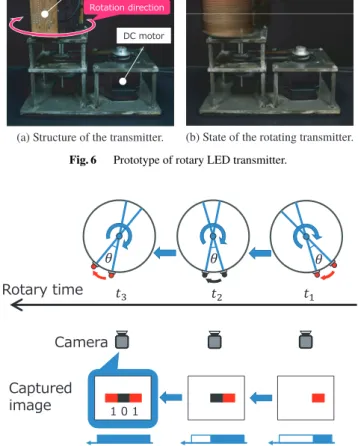
Fig. 6 Prototype of rotary LED transmitter.
Fig. 7 Improving the amount of the received data per image by rotation.
lel data transmission”[46]–[48]. Rather than increasing the number of LEDs, increase the number of LEDs in the image by intentionally moving the LEDs during data transmission, which creates an afterimage of the blinking LEDs. This is called a “rotary LED transmitter”[49],[50].
Figures 6(a) and 6(b) show a prototype of the rotary LED transmitter, which comprises a LED unit, a rotary en- coder, and a DC motor. Let us first explain the operation of the rotary LED transmitter. We first rotate the LED unit, which consists of nine LEDs arranged vertically. While ro- tating, the LEDs blink to communicate the data. Next, the image sensor detects the signal from the rotating-LED trans- mitter. Here, we assume that the exposure time of the sensor is significantly less than the period of rotation of the trans- mitter and greater than the blinking period of the LEDs. In this case, the image sensor can capture multiple LED blinks per image, as shown in Fig. 6(b). If the LED blinking de- pends on data modulated by on-offkeying, then the receiver can obtain the blink state of LEDs per degree of rotation from a single image as a data sequence.
Figure 7 shows the mechanism used to improve the data rate. When the LEDs are fixed as in a conventional
Fig. 8 Actual images captured from fixed and rotary LED transmitter.
VLC transmitter, the receiver captures a single LED blink state per image. Conversely, the multiple blink states can be captured in a single frame if we rotate the blinking LED in front of the camera, as shown in Fig. 7. The change in the blinking LED is stored as an afterimage in the captured frame. Thus, the amount of data received per image can be increased by rotating the blinking LED.
We implemented this transmitter and verified its oper- ation in a laboratory experiment. In this experiment, we set the rotation speed of the transmitter and the shutter speed of the image sensor to 300 rpm (rotations per minute) and 5 fps (frames per second), respectively. The nine-chip LEDs on the transmitter switched the blinking status per each de- gree of rotation. The transmitter and receiver were placed 1.0 m apart and arranged face-to-face with no interceding objects. The receiver captured the blinking of LEDs that were rotated by the transmitter and counted the number of captured LEDs per image.
Figures 8(a) and 8(b) show actual captured images of a nine-chip fixed LED and of the same nine-chip LED un- der rotation. When the nine-chip LEDs are rotated in front of the camera during the exposure, the camera captures the blinking LEDs after 180◦of rotation as afterimages in a sin- gle frame. Here, we assume that the demodulation range is limited to the±30◦ from the center of the captured image in Fig. 8(b). In this case, 540 blinking LEDs are captured (=9 LEDs×60◦;−30◦–+30◦). This result indicates that the image sensor can receive 540 bits of data per image in the case of on-off-keying.
An advantage of the rotary LED transmitter is that the increase in communication speed is independent of the image-capturing methods of the camera. Although the IEC62943 VLB is a technology standard based on a rolling- shutter-type camera, the rotary LED transmitter would sat- isfy the communication speed required by IEC62943 VLB even if using a global-shutter-type camera. If the beacon can be received regardless of the image-capturing methods of the camera, we could develop OWC technology suitable
for the post 5G and 6G IoT because any camera, such as in- vehicle cameras and security cameras, could be used as the beacon receiver.
5. Conclusion
This paper discusses whether OWC systems can be candi- dates for post 5G or 6G technology. Unfortunately, the po- tential use of OWC in any 5G scenario is limited, with few cases of its use. However, whether post 5G or 6G technol- ogy adopts OWC is not the crucial question; rather, the tech- nologies should be designed to coexist with each other. Re- search and development in OWC will continue to extend its benefits and standardize its systems so that it can be widely deployed in the market. For example, if a standard such as a VLB ID already exists, it would be preferable to develop a service that uses the standard to satisfy user demand. As one such candidate, we introduce the rolling-shutter method, which is a method to receive VLC via the smartphone cam- era and that can be used to implement a VLB ID system. The Panasonic LinkRay service has already started using such a system, and we can expect more from it. We also introduce a method that produces an afterimage in the smartphone cam- era by rotating the transmitter, which creates an effect simi- lar to that of the rolling-shutter method.
Acknowledgments
This work was supported in part by JSPS KAKENHI Grant Numbers JP17K18282, JP19K23520. The authors would like to thank Prof. Shinichiro Haruyama (Keio Univ.), Prof. Wataru Chujo (Meijo Univ.), Prof. Koji Kamakura (Chiba Inst. of Tech.), Prof. Toshiaki Fujii (Nagoya Univ.), Prof. Hiraku Okada (Nagoya Univ.), Prof. Tomohiro Yendo (Nagaoka Univ. of Tech.), and Dr. Yusuke Kozawa (Ibaraki Univ.) for useful discussions and suggestions.
References
[1] H. Elgala, R. Mesleh, and H. Haas, “Indoor optical wireless com- munication: Potential and state-of-the-art,” IEEE Commun. Mag., vol.49, no.9, pp.56–62, Sept. 2011.
[2] I. Takai, S. Ito, K. Yasutomi, K. Kagawa, M. Andoh, and S.
Kawahito, “LED and CMOS image sensor based optical wireless communication system for automotive applications,” IEEE Photon.
J., vol.5, no.5, Oct. 2013.
[3] T. Yamazato, I. Takai, H. Okada, T. Fujii, T. Yendo, S. Arai, M. An- doh, T. Harada, K. Yasutomi, K. Kagawa, and S. Kawahito, “Image- sensor-based visible light communication for automotive applica- tions,” IEEE Commun. Mag., vol.52, no.7, pp.88–97, July 2014.
[4] K. Kamakura, “Image sensors meet LEDs,” IEICE Trans. Commun., vol.E100-B, no.6, pp.917–925, June 2017.
[5] W. Huang and Z. Xu, “Characteristics and performance of image sensor communication,” IEEE Photon. J., vol.9, no.2, pp.1–19, April 2017.
[6] P. Luo, M. Zhang, Z. Ghassemlooy, H.L. Minh, H. Tsai, X. Tang, L.C. Png, and D. Han, “Experimental demonstration of RGB LED- based optical camera communications,” IEEE Photon. J., vol.7, no.5, pp.1–12, Oct. 2015.
[7] T. Nguyen, A. Islam, T. Hossan, and Y.M. Jang, “Current status and
performance analysis of optical camera communication technolo- gies for 5G networks,” IEEE Access, vol.5, pp.4574–4594, March 2017.
[8] J. Lain, Z. Yang, and T. Xu, “Experimental DCO-OFDM opti- cal camera communication systems with a commercial smartphone camera,” IEEE Photon. J., vol.11, no.6, pp.1–13, Dec. 2019.
[9] S. Dimitrov and H. Haas, Principles of LED Light Communications:
Towards Networked Li-Fi, Cambridge Univ. Press, March 2015.
[10] Y. Wang and H. Haas, “Dynamic load balancing with handover in hybrid Li-Fi and Wi-Fi networks,” J. Lightw. Technol., vol.33, no.22, pp.4671–4682, Nov. 2015.
[11] H. Haas, L. Yin, Y. Wang, and C. Chen, “What is LiFi?,” J. Lightw.
Technol., vol.34, no.6, pp.1533–1544, March 2016.
[12] S. Williams, “IrDA: Past, present and future,” IEEE Pers. Commun., vol.7, no.1, pp.11–19, Feb. 2000.
[13] W. Hirt, M. Hassner, and N. Heise, “IrDA-VFIr (16 Mb/s): Modu- lation code and system design,” IEEE Pers. Commun., vol.8, no.1, pp.58–71, Feb. 2001.
[14] V. Vitsas and A.C. Boucouvalas, “Optimization of IrDA IrLAP link access protocol,” IEEE Trans. Wireless Commun., vol.2, no.5, pp.926–938, Sept. 2003.
[15] V.W.S. Chan, “Free-space optical communications,” J. Lightw.
Technol., vol.24, no.12, pp.4750–4762, Dec. 2006.
[16] M.A. Khalighi and M. Uysal, “Survey on free space optical com- munication: A communication theory perspective,” IEEE Commun.
Surveys Tuts., vol.16, no.4, pp.2231–2258, June 2014.
[17] K. Mori, M. Terada, D. Yamaguchi, K. Nakamura, K. Kaneko, F. Teraoka, and S. Haruyama, “Fast handover mechanism for high data rate ground-to-train free-space optical communication transceiver for internet streaming applications,” IEICE Trans. Com- mun., vol.E99-B, no.5, pp.1206–1215, May 2016.
[18] R. Sun, H. Habuchi, and Y. Kozawa, “Free space optical turbo coded communication system with hybrid ppm-ook signaling,” IEICE Trans. Fundamentals, vol.E103-A, no.1, pp.287–294, Jan. 2020.
[19] M. Akanegawa, Y. Tanaka, and M. Nakagawa, “Basic study on traf- fic information system using LED traffic lights,” IEEE Trans. Intell.
Transp. Syst., vol.2, no.4, pp.197–203, Dec. 2001.
[20] Y. Tanaka, T. Komine, S. Haruyama, and M. Nakagawa, “In- door visible light data transmission system utilizing white LED lights,” IEICE Trans. Commun., vol.E86-B, no.8, pp.2440–2454, Aug. 2003.
[21] T. Komine and M. Nakagawa, “Integrated system of white led visible-light communication and power-line communication,” IEEE Trans. Consum. Electron., vol.49, no.1, pp.71–79, Feb. 2003.
[22] T. Komine and M. Nakagawa, “Fundamental analysis for visible- light communication system using led lights,” IEEE Trans. Consum.
Electron., vol.50, no.1, pp.100–107, Feb. 2004.
[23] I. Akasaki, H. Amano, Y. Koide, K. Hiramatsu, and N. Sawaki, “Ef- fects of ain buffer layer on crystallographic structure and on elec- trical and optical properties of GaN and Ga1−xAlxN (0<x≤0.4) films grown on sapphire substrate by MOVPE,” J. Cryst. Growth, vol.98, no.1, pp.209–219, Nov. 1989.
[24] S. Haruyama, “JEITA standards CP-1221: Visible light communica- tions system,” https://bit.ly/30Wclw0, March 2007 (in Japanese).
[25] S. Haruyama, “JEITA standards CP-1222: Visible light ID system,”
https://bit.ly/30Wclw0, June 2007 (in Japanese).
[26] S. Haruyama, “JEITA standards CP-1223: Visible light beacon sys- tem,” https://bit.ly/30Wclw0, May 2013 (in Japanese).
[27] “International electrotechnical commission IEC 62943:2017 visi- ble light beacon system for multimedia application,” https://bit.ly/ 3fWdTKF, March 2017.
[28] W. Liu and Z. Xu, “Some practical constraints and solutions for opti- cal camera communication,” Philos. Trans. A Math. Phys. Eng. Sci., vol.378, no.2169, pp.1–25, April 2020.
[29] M.Z. Chowdhury, M.K. Hasan, M. Shahjalal, M.T. Hossan, and Y.M. Jang, “Optical wireless hybrid networks: Trends, opportuni- ties, challenges, and research directions,” IEEE Commun. Surveys
Tuts., vol.22, no.2, pp.930–966, 2020.
[30] Z. Ghassemlooy, S. Arnon, M. Uysal, Z. Xu, and J. Cheng, “Emerg- ing optical wireless communications-advances and challenges,”
IEEE J. Sel. Areas Commun., vol.33, no.9, pp.1738–1749, Sept.
2015.
[31] Y. Goto, I. Takai, T. Yamazato, H. Okada, T. Fujii, S. Kawahito, S.
Arai, T. Yendo, and K. Kamakura, “A new automotive VLC system using optical communication image sensor,” IEEE Photon. J., vol.8, no.3, pp.1–17, June 2016.
[32] K. Ebihara, K. Kamakura, and T. Yamazato, “Layered transmis- sion of space-time coded signals for image-sensor-based visible light communications,” J. Light. Technol., vol.33, no.20, pp.4193–4206, Oct. 2015.
[33] M.S. Alam, S.A. Shawkat, G. Kitazumi, and M. Matsumoto, “Irburst modeling and performance evaluation for large data block exchange over high-speed IrDA links,” IEICE Trans. Commun., vol.E91-B, no.1, pp.274–285, Jan. 2008.
[34] N. Sampson, J. Erfanian, and N. Hu, “5G white paper 2,” NGMN Alliance, https://bit.ly/3gVdbi8, July 2020.
[35] “IMT vision — Framework and overall objectives of the future de- velopment of IMT for 2020 and beyond,” International Telecommu- nication Union, https://bit.ly/2PRsbl5, 2015.
[36] Y. Wang, D.A. Basnayaka, X. Wu, and H. Haas, “Optimization of load balancing in hybrid LiFi/RF networks,” IEEE Trans. Commun., vol.65, no.4, pp.1708–1720, April 2017.
[37] M. Ayyash, H. Elgala, A. Khreishah, V. Jungnickel, T. Little, S.
Shao, M. Rahaim, D. Schulz, J. Hilt, and R. Freund, “Coexistence of WiFi and LiFi toward 5G: Concepts, opportunities, and challenges,”
IEEE Commun. Mag, vol.54, no.2, pp.64–71, Feb. 2016.
[38] Z. Zeng, S. Fu, H. Zhang, Y. Dong, and J. Cheng, “A survey of underwater optical wireless communications,” IEEE Commun. Sur- veys Tuts., vol.19, no.1, pp.204–238, 2017.
[39] B.W. Kim and S. Jung, “Vehicle positioning scheme using V2V and V2I visible light communications,” Proc. VTC’16-Spring, pp.1–5, 2016.
[40] V.P. Rachim, J. An, P.N. Quan, and W. Chung, “A novel smart- phone camera-led communication for clinical signal transmission in mhealth-rehabilitation system,” Proc. EMBC’17, pp.3437–3440, 2017.
[41] C. Danakis, M. Afgani, G. Povey, I. Underwood, and H. Haas, “Us- ing a CMOS camera sensor for visible light communication,” Proc.
OWC’12, pp.1244–1248, Dec. 2012.
[42] H. Aoyama and M. Oshima, “Visible light communication using a conventional image sensor,” Proc. CCNC’15, pp.103–108, Jan.
2015.
[43] W. Chujo and M. Kinoshita, “Rolling-shutter-based 16-QAM optical camera communication by spatial luminance distribution,” IEICE ComEx, vol.8, no.12, pp.566–571, Dec. 2019.
[44] C. Chow, C. Chen, and S. Chen, “Visible light communication using mobile-phone camera with data rate higher than frame rate,” Opt.
Express, vol.23, no.20, pp.26080–26085, Oct. 2015.
[45] Panasonic, “LinkRay,” https://bit.ly/34bWCLp, (in Japanese).
[46] H. Okada, K. Masuda, T. Yamazato, and M. Katayama, “Succes- sive interference cancellation for hierarchical parallel optical wire- less communication systems,” Proc. APCC’05, pp.788–792, Oct.
2005.
[47] S. Iwasaki, M. Wada, T. Endo, T. Fujii, and M. Tanimoto, “Basic ex- periments on paralle wireless optical communication for ITS,” Proc.
IV’07, pp.321–326, June 2007.
[48] S. Arai, S. Mase, T. Yamazato, T. Endo, T. Fujii, M. Tanimoto, K.
Kidono, Y. Kimura, and Y. Ninomiya, “Experiment on hierarchi- cal transmission scheme for visible light communication using LED traffic light and high-speed camera,” Proc. WiVeC’07, pp.2174–
2178, Sept. 2007.
[49] Z. Tang, A. Nakayama, S. Arai, H. Takata, and T. Yendo, “A study on rotary LED transmitter for improving data transmission rate of im- age sensor communication,” Proc. 1st OWC2, pp.21–22, Dec. 2019.
[50] S. Arai, Z. Tang, A. Nakayama, H. Takata, and T. Yendo, “Imple- mentation experiment of a rotary LED transmitter for improving the transmission rate for image sensor communication,” 2020 IEEE Globecom Workshops, pp.1–6, Dec. 2020.
Shintaro Arai received the B.E., M.E., and Dr.Eng. degrees from Tokushima Univer- sity, Tokushima, Japan, in 2004, 2006, and 2009, respectively. From 2007 to 2008, he was a Special Research Student with Nagoya Univer- sity, Japan. From 2009 to 2011, he was a Post- Doctoral Fellow with the ITS Laboratory, Aichi University of Technology, Japan. From 2011 to 2016, he was a Research Associate with the Na- tional Institute of Technology, Kagawa College, Japan. Since 2016, he has been a Lecturer with the Okayama University of Science, Japan. His research interests include visible light communication systems, chaos-based communication systems, and stochastic resonance phenomena. He is a member of the IEEE.
Masayuki Kinoshita received the B.E., M.E., and Ph.D. degrees in Information Elec- tronics Engineering from Nagoya University, Japan in 2014, 2016, and 2019. Since 2019, he has been an assistant professor at Chiba Insti- tute of Technology, Japan. His current research interests include visible light communications.
He is a member of the IEEE and IEICE.
Takaya Yamazato is a professor at the Institute of Liberal Arts and Sciences, Nagoya University, Japan. He received a Ph.D. from the Department of Electrical Engineering, Keio University, Yokohama, Japan, in 1993. In 2006, he received the IEEE Communication Society’s Best Tutorial Paper Award. He served as the editor-in-chief of the Japanese Section of IEICE Transactions on Communications from 2009 to 2011. From 2016 to 2017, he was the Director of Asia/Pacific Board, the IEEE Communication Society. He serves as the chair of the editorial board of the IEICE Com- munication Society from 2020. His research interests include visible light communication (VLC), intelligent transport system (ITS), stochastic reso- nance (SR), and open educational resources (OER).
![Fig. 3 Usage scenarios of 5G. Li-Fi and VLB adaptation in a limited scenario [34], [35].](https://thumb-ap.123doks.com/thumbv2/123deta/5632691.1501315/3.892.467.815.288.627/fig-usage-scenarios-li-vlb-adaptation-limited-scenario.webp)