Proinflammatory Cytokine (TNF-a) Suppression of Various Terpenoids to Human Monocytic Cell
Masato NO MURA* , Kazuo KASEMURA*, Yoshihito FUJIHARA * and Toshio INOUE* '"
Synopsis
In the present study, the structure and the TNF-a inhibitory effect of terpenoids were determined.
Among these compounds, aromadendren showed a potent inhibitory effect on TNF-a release induced by LPS.
In addition, these compounds were not cytotoxic at the tested concentrations. These results suggested that terpenoids may be effective in alleviating inflammatory diseases in clinical trials.
Key words: TNF-a suppression, sesquiterpene, diterpene, triterpene, human monocyte cell
1. Introduction
Terpenoids are a class of molecules chemically derived from isopreneunits assembled and modified in thousands of different ways that commonly occur"
in plants. These natural substances have historic- ally provided the compounds used most successfully as leads for pharmaceutical, agricultural, and other commercial applications1,2}. For example, some te- rpenoids have been found to possess anti -inflammatory and antitumor effects3.4> .
There are also reports of terpenoids inhibiting the expression of enzymes including cyclooxygenase and iNOS and the release of an inflammatory mediator from leukocytes5 ,6} .
Recently, it was reported that monoterpenoids inhibited tumor necrosis factor-a (TNF-a) production from human monocyte cells induced by alipopoly- saccharide (LPS) without a cytotoxic effect6 , 7).
TNF-a is a major pro-inflammatory cytokine and is mainly produced by monocytes and macrophages.
*
lli:.*~*~~I~a:v~fliJf~W!IWW 1t~W~**
-,j,,) II ~~-+~~~*±It is involved in immune regulation, autoimmune regulation, and inflamemationS -lO}.
Therefore, it is regarded that a TNF-a inhibitor would be possible tool for treatment of these inflammatory diseases.
We have been studying the various biological activities of terpenoids11-12). In the present study, terpenoids have been found to inhibit TNF-a production in the LPS-stimulated human monocyte cell line, THP-l. Furthermore, a cytotoxic effect was performed using the Alamar Blue™ method.
2. Materials and Methods
2.1 Materials
Aromadendren, ursolic acid, uvaol, betulin and betulinic acid were purchased from Fluka. Aroma- dendren oxide, globulol and carnosol were prepared in detail previously as described 11,12). Human monocyte THP-1 cells were obtained from the
* Graduate school of industrial technology, Program in material technology, Kinki University.
**Material R&D Laboratory, Ogawa & Co., Ltd.,
American Type Culture Collection. RPMI-1640 medium and fetal calf serum (FCS) were purchased from G IBCO (NY,
usA).
Phorbol myristate acetate (pMA) and lipopolysacchalide (LPS) (E Coli.055:55) were purchased from Sigma (MO,
usA).
The TNF-a ELISA kit was purchased from Genzyme Techne (MA,
usA).
All other chemicals were of reagent grade.2.2 Cell Culture
THP-1 cells were cultured in complete RPMI -1640 medium supplemented with 10% heat-inactivated FCS, 1mM L-glutamine, 50U/ml Penicillin, 50pg/ml Streptomycin and 50pM 2-maercaptoethanol under the conditions of 5% C02 I 95% air and 37°C.
3. 8
14
12 13
Assays were performed at a density of 1x10⁷ cells I ml.
2.3 Assays for TNF-a
For experiments using LPS as the stimulus TNF-a, THP-l cells were suspended in complete RPMI-1640 medium. The compounds solubilized with solvent (dimethyl sulfoxide) were diluted with complete RPMI-1640. The final concentration of solvent never exceeded 0.1% in the culture medium.
In vitro cultivation was done in triplicate over 24h at 37°C in a humidified atmosphere containing 5%
C02, by employing the following culture conditions.
The control cells were cultivated in complete RPMI-1640. In contrast, THP-l cells (lxl06
Aromadendren Aromadendren epoxide Globulol Carnosol
COOH
HO
Ursolic acid
R=CH
20H : Betulin R=COOH : Betulinic acid
Uvaol
o
Dexamethasone
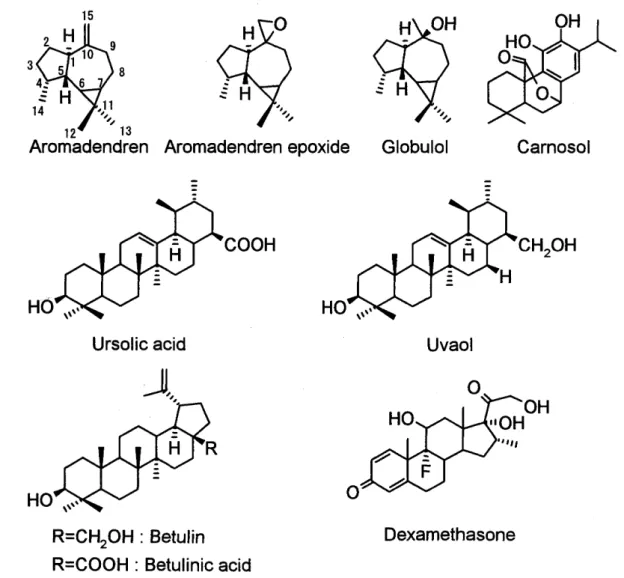
Fig. 1 Chemical structure of various terpenoids
cells/ml) were pretreated with PMA (10nM) for 6h.
After incubation, the culture medium was removed and washed three times with RPMI-1640 without serum. The PMA-pretreated cells were either stimulated by LPS at a concentration of 10p.g/ml or by LPS containing the sesqui, di and triterpenoids at 10p.g/ml. The cultures were incubated for 24h at 37°C. The incubated super- natants were collected and assayed for TNF-a using a commercial ELISA kit.
2.4 Cell Viability Assay
Cell viability was examined using Alamar Blue methods with minor modifications, as previously reported 13). THP-l cells were seeded onto 96-well plates at a cell concentration of 1xl06 cells/ml and then preincubated for 19h. After preincubation, the test compounds (10p.M) were added to each well for a 5h incubation. The fluorescence was measured with a micro-plate reader at 570nm (fluorescence 570-630). The mean value of the fluorescence for 3 wells was used for calculating the viability (% of control).
2.5 Statistical analysis
The data are presented as means ± S.E.M.
Statistical significance was tested by Student's t -test. A probability value of less than 0.05 was considered significant.
3. Results
3.1 LPS induced TNF-a release from human monocyte cells
The chemical structures of the various terpenoids are shown in Fig. 1. To determine the anti- inflammatory properties of these compounds, the study of TNF-a release from the THP-l cells induced by LPS-stimulation was used. In the preliminary experiments, the concentration and incubation time of LPS to obtain the appropriate TNF-a release were examined. Consequently, an incubation in the absence of LPS and lOp.g/ml of LPS for 24h resulted in the release of 5.4 ± 1.3 and 231.7 ± 22.3 pg/ml, respectively. As shown in Table 1, aromadendrene, aromadendrene epoxide and globulol belonging the sesquiterpene inhibited the TNF-a release and the values were 27.3, 12.7
Table 1. Inhibition of LPS-stimulated TNF-
ex
products from human monocyte THP-1 cells in various terpenoidsCompound TNF-
ex
(pg/ml) Inhibition('% )Spontaneous 5.4+ 1.3
Control 231.7+22.3##
Aromadendren 168.3+ 1.8*
Aromadendren oxide 202.3+12.8
Globulol 185.9+15.8
Camosol 255.3+21.2
Ursolic acid 187.1 +18.2
Uvaol 221.0+18.3
Betulin 244.5+36.1
Betulic acid 256.5+27.8
Dexamethazone 103.0+ 5.2**
Each value represents the mean+S.E.M. for 3-4 experiments.
##; p<0.01 compared with the spontaneous group.
*; p<0.05, **; p<0.01 compared with the control group.
100.0 27.3 12.7 19.7 -10.2 19.2 4.6 -5.6 -10.7 55.5
and 19.7%, respectively. Among these compounds, only aromadendrene showed a significant inhibition of the TNF-a release. In the triterpene, ursolic acid and uvaol had an inhibitory effect of this response, although these compounds had no significant effect on the TNF-a release. On the other hand, carnosol (diterpene), betulin and betulinic acid (triterpene) had no effect on the TNF-a release from THP-1 cells induced by LPS stimulus. In addition, dexamethsone, which showed an anti-inflammatory effect, significantly inhibited the TNF-a release and its value was 55.5%.
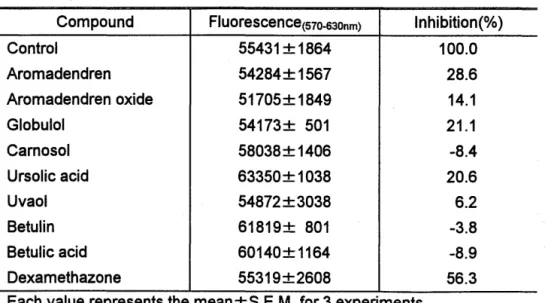
3.2 Effects of various terpenoids on the viability The viabilities of the THP-1 cells are shown in Table 2. Each compound was not cytotoxic at the concentration of 10pM. The value of the viability did not change when compared with the control.
4. Discussion
In the present study, human monocytes were used as an in vitro model to evaluate the anti-infla- mmatory effect of various terpenoids. THP-1 cells activated by a stimulant released various mediators including TNF-a, cytokines and prostaglandines.l 4}
Hart et al. described that TNF-a is known as the most important cytokine for the development and
maintenance of chronic inflammation; this was evidenced by the ability of anti -TNF-a antibodies to reduce inflammatory diseases such as rheumatoid arthritis.s) Therefore, the study of TNF-a released from THP-1 cells induced by LPS- stimulation was used.
In this study, we demonstrated that aromadendren and its derivatives inhibited the TNF-a release from human monocyte cells by LPS stimulus. The common feature of these compounds is that they possess a tricyclic skeleton. Hwang et al. and Jae et al. reported that sesquiterpene lactones inhibited the release of TNF-a from macrophages induced by LPS, however, we found for the first time that a sesquiterpene hydrocarbon inhibits TNF-a secretion. 7,15) On the other hand, among the tested sesquiterpene hydrocarbons, modification of C-10 as seen in the aromadendren epoxide and globulol resulted in loss of the inhibitory effect. These results suggest that the C-10 moiety participates in the inhibitory ability of these tricyclic sesquiterpenes.
We also revealed the inhibitory effect of triterpenoids on the TNF-a release from THP-1 cells. Among the triterpenes tested, ursolic acid and uvaol (ursane skeleton) showed inhibitory activity.
However, betulin and betulic acid (lupane skeleton) had no inhibitory effect. Therefore, it seems that the six membered ring E of the pentacyclic structure (the ursane skeleton) is necessary for the activity against
Table 2. Effects of various terpenoids on the viability ofTHP-1 cells
Compound Fluorescence(570-630nm) Inhibition(%)
Control 55431 +1864 100.0
Aromadendren 54284+1567 28.6
Aromadendren oxide 51705+1849 14.1
Globulol 54173+ 501 21.1
Carnosol 58038+1406 -8.4
Ursolic acid 63350+1038 20.6
Uvaol 54872+3038 6.2
Betulin 61819+ 801 -3.8
Betulic acid 60140+1164 -8.9
Dexamethazone 55319+2608 56.3
Each value represents the mean+S.E.M. for 3 experiments.
TNF-a release from THP-1 cells induced by LPS.
Moreover, as compared with ursolic acid, uvaol w~
less active. These results suggest that among the ursane skeleton based compounds, a substituent group at C-28 has a remarkable influence. Huguet et al.
have found that as most of the triterpenoids are inactive against the inflammation induced by arachidonic acid and in the neurogenic inflammatory model, their effects may depend on the in vivo inhibition of PKC.16) On the other hand, Lior et al.
reported that TNF-a secretion after LPS stimulation of human monocytes requires the activation of protein tyrosine kinase and PKC.17) Therefore, our results suggest that the tested triterpenoids may depend on the inhibitory effect of PKC.
In conclusion, terpenoids showed an inhibitory effect on TNF-a release induced by LPS without any cytotoxic effects. These results suggested that terpenoids might be effective in alleviating inflammatory diseases in clinical trials. However, each inhibitory effect of the terpenoids was relatively weak when compared with dexamethazone. Further studies are needed.
REFERENCES
1) Lee G.I. and HaJ.Y, PlantaMed, 61, 26-30 (1995).
2) Tona L. and Kambu K., J. Ethnopharmacol, 61, 57-65 (1998).
3) Santos F.A. and Rao V.S., Phytother. Res., 14, 240-244 (2000).
4) Yasumoto M., Mada K., Ooi T. and Kusumi T., J.
Nat. Prod, 63, 1534-1536 (2000).
5) Suh N., Honda T., Finlay H.J., Barchowsky A, Williams C., Benoit N.E., Xie Q.w., Nathan C., Gribble G.W and Sporn M.R, Cancer Res., 58, 717-723 (1998).
6) Hart P.H., Brand C., Carson C.F., Riley T.V., Prager R.H. and FinlayJones J.J., InDamm. Res., 49, 619-626 (2000).
7) Daniel H. and Nikolaus H., Biochem. Biophys. Res.
Comm., 226, 810-818 (1996).
8) Jaattela M., Lab. Invest., 64, 724-742 (1991).
9) Sherry B. and Cerami A., J. Cell BioJ., 107, 1269-1277 (1988).
10) Beutler R, Krochin N. and Milsark LW., Science,
232, 977-980 (1986).
11) Nomura M., Kyouda M., Inoue T., Hamada T. and Fujiliara Y., Mhon Nougei Kagakukaishi, 69, 23- 31 (1995).
12) Nomura M. and Fujiliara Y, Aromatopia, 24, 56-60 (1997).
13) Ahmed S.A and Gogal Jr. R.M., J. Immunological Methods, 170,211-224 (1994).
14) Seatter S.C., Li M.H., Bubrick M.P. and West M.A, Shock, 3, 252-258 (1995).
15) Jae YC., Kyong V.R, Jee H.J. and Myung H.P., Eur. J. Pharmacol, 398, 399-407 (2000).
16) Huguet A, del Carmen Recio M., Manez S, Giner R. and Rios J., Eur. J. Pharmacol, 410, 69-81 (2000).
17) Shapira L, Takashiba S, Champagne C, Amar S.
and Van Dyke T.E., J Immunol, 153, 1818-1824 (1994).