Ab initio Molecular-Dynamics Study of Structural and Electronic
Properties of Liquid MgSiO3 under Pressure
RyoYOSHIMURA、Satoshi OHMURA and Fuyuki SHIMOJO Department of Physics, Kumamoto University, Kumamoto 860-8555
(Received September 30, 2010)
The structural and electronic properties of liquid MgSiC>3 under pressure are investigated by ab initio molecular-dynamics simulations. At ambient pressure, most Si atoms have the same coordination even in the liquid state as in the crystalline phase, i.e., each Si atom is bonded to two bridging oxygens twofold-coordinated to Si, and two nonbridging oxygens onefold-coordinated to Si. It is found that the structural defects, such as fivefold- or threefold- coordinated Si atoms, are always formed with the rearrangement of Si-0 covalent bonds in the atomic diffusion processes. The population analysis clarifies that maximum of the diffusivity in the pressure dependence is originated from the increasing of the number of defects under compression.
§1. Introduction
The structural and dynamic properties of liquid silicates have been attracted the interest of many scientists because of the importance in the earth's mantle. In addition, the magnesium-rich silicate minerals are the primary constituents of the
earth mantle,1) and are also present as major phases in chondrite meteorites and interplanetary dust.2)'3)
In ambient conditions, crystalline magnesium silicate (MgSiOa) has a SiC>4 tetra- hedral unit in which each silicon atom is coordinated to four oxygen atoms with
single bonds.4) A high-pressure phase appears at a pressure of about 25 GPa under
compression. There is a SiC>6 octahedral unit in this structure. Each Mg atom is
coordinated to 12 oxygens with bond lengths ranging from 2.014 to 3.12 A and O- Mg-0 angles ranging from 52.19° to 70.89°.5) The ideal value of an O-Mg-0 angle
for a regular MgOi2 polyhedron is 60°. The small variations in the Si-0 distances and the small deviation of the O-Si-0 angles from 90° (88.5° - 91.5°) show that the SiO6 octahedron is much more regular than the MgOi2 polyhedron.
Since it would be difficult to clarify the diffusion mechanism in liquid MgSiC>3 experimentally, theoretical studies would be needed. However, only a few theoretical
studies of atomic diffusion have been reported so far,6) while their crystalline phases have been extensively investigated.7) Molecular dynamics (MD) simulations6) with
empirical interatomic potentials have been used for the diffusion mechanism of oxy gen ions in Me2OSi02 (Me = Li, Na, K, Cs) melts at 2000 K. Although effects of alkali ions have been examined on the structure of transient complexes temporarily formed in alkali silicate systems, the effects of electronic properties are still unclear.
In this paper, we carry out ab initio MD simulations of liquid MgSiC>3 under
pressure. We obtain the atomic forces quantum mechanically from the electronic-
structure calculations. The purpose of our study is to clarify the microscopic mech-
294 R. Yoshimura, S. Ohmura and F. Shimojo
Table I. Pressure P, temperature T and number density p used in this study.
P (GPa) 0.1 9.5 21.1 48.9 97.8 149.1 198.2
T(K) 2500 2900 3300 4500 5500 6000 7000
9 (A"3) 0.068 0.086 0.099 0.113 0.132 0.146 0.156
anism of atomic diffusion in the liquid state from first principles. We are unaware of investigations of the diffusion mechanism in liquid silicates based on first-principles theories though some first principles studies of liquid MgSiC>3 under pressure have already been reported.8)'9) We discuss how Si-0 bonds are exchanged, accompa nying the diffusion of atoms in detail. Such findings are important not only for imderstanding the equilibrium properties of liquid MgSiC>3 but also for properties of basic liquids in the earth's mantle.
§2. Method of calculation
In our MD simulations, a system of 120 (24 Mg + 24 Si + 720) atoms in a cubic supercell is used under periodic boundary conditions. The equations of mo
tion for atoms are solved via an explicit reversible integrator10) with a time step
of At = 1.2 fe. The atomic forces are obtained from the electronic states cal
culated by the projector-augmented-wave method11)'12) within the framework of density-functional theory. The generalized gradient approximation13) is used for
the exchange-correlation energy. The plane wave cutoff energies are 30 and 250 Ry for the electronic psedo-wave-functions and the pseudo-charge-density, respectively.
The energy functional is minimized using an iterative scheme.14)'15) Projector func
tions are generated for the 3s, 3p and 3d states of Mg and Si, and the 2s and 2p states of O.
For each pressure (0 - 200 GPa), the temperature is set to be the melting point plus about 500 K. To determine the density of the liquid state under compression,
constant-pressure MD simulation16) is performed for 2.4 ps at given pressure. The
static and diffusion properties are investigated by MD simulations in the canonical
ensemble.17)'18)
§3. Results and discussion
3.1. Structure factor
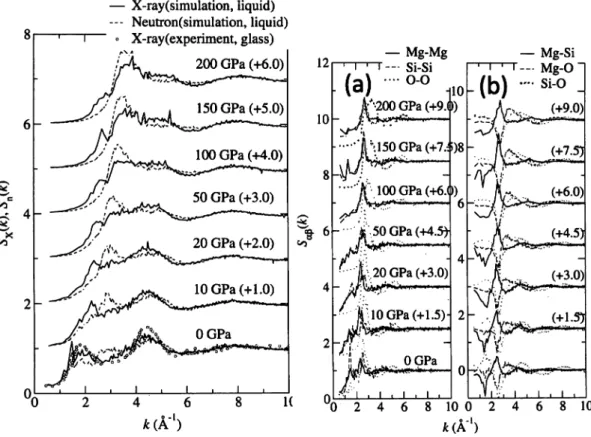
Figure 1 shows the pressure dependence of the structure factor of liquid MgSiC>3.
The solid and dashed lines display the X-ray and neutron structure factors, Sx(k)
and Sn(fc), respectively. Sx(fc) is obtained from the partial structure factors 5Q^(fc),
shown in Fig. 2, with the X-ray scattering factors, and Sn(k) is calculated from
Sap{k) with the neutron-scattering lengths. At pressures below 10 GPa, clear peaks
exist at about k = 2.0 and 4.4 A""1 in the profiles of Sx{k) and Sn(k). Note that the
overall profile of Sx(k) at 0 GPa is consistent with the experimental Sx(k) of the
vitreous state.19) While only <Sn(A;) has another peak at 3.0 A""1 at lower pressures,
the corresponding peak grows in Sx(k) at higher pressures. With increasing pressure,
the peak at about A; = 2.0 A"1 in both Sx(k) and Sn(k). A remarkable feature exhibited in Sx(k) and Sn(k) is the small peak at about A; = 1.2 A"1 at 0 GPa, which means that the spatial correlation exists on an intermediate distance ~ 6 A.
This peak disappears under pressure.
3-
— X-ray(simulation, liquid) --- Neutron(simulation, liquid)
• X-ray(experiment, glass)
200 GPa (+6.0) — Mg-Mg - Si-Si
oo 110
1(
— Mg-Si - Mg-0
_(b)- si-o_
~J\i'
0 2 4 6 8 10 0 2 4 6 8 10
Fig. 1. Pressure dependence of the total struc- Fig. 2. Pressure dependence of the partial struc
() (d) S
ture factors Sap(k). (a) 5m8m8 (solid), (dashed) and Soo (dotted), (b) SMgSi (solid), SMgo (dashed) and Ssio (dotted).
ture factors. The solid and dashed lines indi- cate the X-ray and neutron structure factors, Sx(fc) and Sn(fc), respectively. The open cir- cles at 0 GPa are the experimental values for glass MgSiO3. The curves are shifted verti cally as indicated by the figures in parenthe
ses.
Figure 2 shows the Ashcroft-Langreth partial structure factors Sap(k). The pres sure dependence of the profiles of Sx(k) and Sn(k) is well understood from Sap{k).
At 0 GPa, Ssisi(fc) has Peaks at about k = 1.2 A"1, which gives the corresponding
peak in Sx(k) and Sn(k). At lower pressures, SMgMg(fc), SSiSi(*0 ^d Soo(k) have
the peak at about k = 2.3 A"1. Because of the cancellation due to the existence
296 R. Yoshimura, S. Ohmura and F. Shimojo
of a negative dip in Sugo(k) and Ssio(*0> no clear Peak appears in Sx(k) aroimd k = 2.3 A"1. With increasing pressure, all peaks shift to larger k in SMgMg(*0>
SsiSi(fc) and Soo(k), whereas the negative dip changes only a little in SMgo(fc) and Ssio{k). Therefore, the peaks of Sx(k) and Sn(k) grow at the corresponding k when the pressure increases. At higher pressure, the main peak of SuSMg(k) is as high as that of SsiSi(k).
3.2. Diffusivity
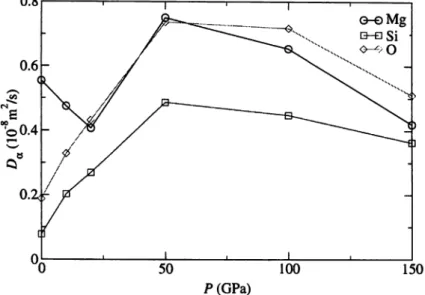
The diffusion coefficients Da for a = Mg, Si, and 0 atoms are defined as
(3.1) where r»(*) is the position of the i-th atom at time t. Figure 3 shows Da as a function of pressure. Whereas Ds» Do and DMg have maxima at 50 GPa, DMg has a minimum at 20 GPa. While DMg has larger values than Do under pressures up to about 10 GPa, Do becomes comparable with £>Mg at about 20 GPa.
P (GPa)
Fig. 3. Pressure dependence of the diffusion coefficients Da for a = Mg (circles), Si (squares) and O (diamonds) atoms.
3.3. Mechanism of atomic diffusion
It is found, from the distribution of coordination numbers, that Si atoms are
mainly coordinated to four O atoms; two O atoms bridge two adjacent Si atoms,
and the other two O atoms are coordinated to only one Si atom, as in the crystalline
phase even though atoms diffuse in the liquid state. However, it is unclear how Si-0
bonds are exchanged with the diffusion of atoms in the liquid state while retaining
the covalent bonds. To clarify the mechanism of atomic diffusion, we investigate the
time evolution of the bonding nature by utilizing population analysis. The bond-
overlap population Ojj(t), which gives a semiquantitative estimate of the strength of
thsccvalentlikBbondmgbetw巳enthBj-thandj-thatoms$iscalCulatCdasafim鰹tiDn
oftimeo
rhediHilsicnev巳ntsmsshovminFigS、4and5,whsrecov塾l蓬ntbondj9areex- chang⑧daroundtheintermediated鐙fbctstrn廷tnrewiththefiv巴ml4andsixfnld- coordinatedSi,鑓spectivelybAsshowninthetoppanelofFigo4#Csi-o,(#)begi唾 tcinc斑asgatabou力67ユ5psi灘hichmBansthatacovHlBntbondisfhrmBdbetlバンeen Si塾ndOLWbcanseethisnBw雛ObondinthBsnapshotat57感25psoD11BtCthB fbrmationofthsbond,Siisovmmordin誠sdtoiiveOatoms.Sin“thBov心rccordina戸 tion通eneZgeticzullyunstab雌?。n忽。fmvalentbondsamundth患five1℃1.戸coordillELtsd Siatomisbmken、Itisseenth菌tCSi-O2(t)becommesalmost透emfbr#>67.70p圏,
andthecov通lentbondbBtlH短enSianflO2diSappearsinthssnapsh⑪tat67o75Ps。
I、5
lfiiPILllX
I 畠1甑
鳥 亀・0
、 mも
脆~二. ̄鮎,錨6,68-7.錨9.5dQ
.?
J(PS)
57.Z5pS 爪P3)
BH65pS
5701日pS 57口7日p日 6日`45p9 GaBOpH
Fig.4。(mpp…1)ThetimSevnlutimofbondFi9.5.(Tbppanel)SameaBFig、4butfbrsixfbld-
…rlappopulatimsCij(#)錘ボーSiand⑪oprdinatedSMBottompaneJ)AtcmiccoL
jEOintheprOCeISSDf鋤・miCdiHiLSiOnwithHguratinns誠t=68.45,68.65,and68.8qps・
tF盆爾FntfivBfbld-co征dli耐誠⑨dSi・ThethidK
sOIidandthidfdashednnesindinatSOsi-oz(#)
andOgi-cl(t),respectivdyh(B⑪ttompanel)
AtomicconhgumtionBatf=67ユ5,67.25and
67.75p8.
AbovC10GPa,anumberofSiatomshavBhy巳hDldcoordination殿slmvvninthB snapshotat68,45psinthBbcttompanelofFig、5.Dsi-m(#)bBginstoincrBaseat about68o50ps,becauseO1approachss‘8i,tohnnane撫廼ovaJsntbondW篭can seethisnBwSi-O1bondinthBsnap目hotat68.65p8oThBnthso域敬hBdmnjioe。,
sixfbld-comdinatedSi,isfbrmedoThBsixfbldcoordimm⑨nismaintainedfbrabout Oo2Ps・鋤68.80ps,theSi-O2bondisbmkenas蝿i-O2(#)becom鶴alnQostzeromi
t>68.8npso
Figure6showB乱diHnsinnev⑧nt,inwhinhmvHl息ntbondsareexchapgedaround
at閲,TlRifmtdBfもctstructurewiththreefbldcoordi、‘t紐dSiatom・As8eeninthBtop
298
Rori,s羅銅醗迩,g・ひh…”迅蝿風鍛j、噸pajn鯵1,initiallyOsi-ol(#)andCsi-o2〔#)…almo3tzero乱ndnnite,r巴spectivE1yjfbr t<6Go55pSoNotethatO1isovercoodinatedtothreeSiatoms(seethes】mpshotat 66、55ps)蝿i-o,(#)andOSi-o2(#)crosseachotheE勘tabout66.63p8,andhnally CSi-oz(#)becomesalmostzero,whil鱈DSi-O,(t)晦finitefbrt>6f70psoThism鱈ans thatacovalsntbondbetw巳enSiandO1isbroken,andth燈Sip2bond通fbrmed,as 5eenmmthetimBevolution㎡CBi-cl(オ)andosi-o2(f).NotealsothatthBtw。fbld coordin乱tionDfO1isrecov巴redafterthisev℃nt・EspeciallytheSi-Obondsexcept theSi-C1andSi-O2bondSareretainBdwhileSwitchingth心mvalBntbnndsoArDund 66、63p愚,theSiatomhaSthmeefbIdcoordinationwithsP2-1ikebOndingoInthiswayi theSi-Obondsmecqmhfmgedwiththefbrmationofund名rcocrdin誠edSiatomsin liquidnIgSiO3oItis1lm蕪心vcr,necessarytogene唾ut巳adj誠entovcrcoordinatedO atoms,suchaBthr⑧efbld-ov⑬rcoordinatedO1inthBinitialstage。ftheevent。
’.5
舎蕗。
:0
【(PS)
Bn63p白 E5D7Up日
56.5日鰯
ロ西I
IIJ
Fig.6.価ppan燈l)SameasFig、4butfbrthzeefbldPcoDrdinatedSi.(Bcttcmpand)Atomicco亟 丘gur帥iong鉱#=66.55,66.63〕a、66.70pS.
§4.Suxnmary
Th燈mi心roscopicmechanismof誠0m正diHilfii⑪ninliquidMgSiO3hH遇beeninP vBstigat⑧dbya6鈍雄。moIBcul渉dynami⑪s急imnl鉱ions,IthasbeenconfirmBdthat,
evmintheliqUidstate,siliconatom;ar心predominantly蝿urliDldPm0rdmatedto h必tematomswithsinglB⑪OvalBntbondsat⑬mbientconditions,asinthGcryst錨llinB andvitreougstates.Wもh誠巴fbundthatth⑬reappearsastru⑯tumlde比ctwh心nevcr atDmicdiHilsionoccursn心compani⑧dwiththecovalent-bondexchangesoThBfbrm針
tiDnm垣(、h麺i釘nofsuchdefbctstructurehasbeendiscussdind巳tailusingthCtimB