マクロファージ活性化抑制作用を 持つフラボノイドの創製
Design and synthesis of flavonoids that inhibit the macrophage activation
日本大学大学院薬学研究科 蒋 文君
Wen-Jun Jiang
Contents
I. Introduction ... 1
II. Chapter 1. Design of active flavones which have inhibitory effects on nitric oxide production in RAW264.7 cells by using a CoMFA model ... 12
2.1.
Abstract... 12
2.2.
Building a CoMFA model... 13
2.3.
Synthesis of the flavones positively predicted by the CoMFA model17 2.4.
Effects of the synthesized flavones on nitric oxide production... 18
2.5.
Conclusion... 20
III. Chapter 2. Synthesis of the active flavanonols having diversity in the B ring. Stereospecific inhibition on nitric oxide production in RAW 264.7 cells... 21
3.1.
Abstract... 21
3.2.
Synthesis of 5,7-dihydroxyflavanonols... 22
3.3.
Isolation of enantiomers by HPLC with a chiral column... 23
3.4.
Effects of the synthesized flavanonols on nitric oxide production... 24
3.5.
DPPH radical scavenging activity of the synthesized flavanonols... 26
3.6.
Structure-activity relationship of the flavanonols which carry diverse substitution in the B ring on the nitric oxide production inhibitory activity... 28
3.7.
Conclusion... 29
IV. Chapter 3. Synthesis of the active flavanonols which carry diverse substitutions in the A ring and their stereospecific inhibition on nitric oxide production in RAW 264.7 cells ... 30
4.1.
Abstract... 30
4.2.
Synthesis of 2’,3’-dihydroxyflavanonols... 31
4.3.
Isolation of enantiomers by HPLC with a chiral column... 32
4.4.
Effects of the novel flavanonols on nitric oxide production... 34
4.5.
DPPH radical scavenging activity of the novel flavanonols... 37
4.6.
Structure-activity relationship of the flavanonols which carry diverse substitution in the A ring on the nitric oxide production inhibitory activity... 38
4.7.
Conclusion... 39
V. Results and Discussion ... 40
VI. Experimental ... 42
6.1.
General experimental procedures... 42
6.2.
The separation of enantiomers by a chiral column... 42
6.3.
Nitric oxide assay (anti-inflammatory assay)... 42
6.4.
Cell viability test... 43
6.5.
DPPH assay (radical scavenging assay)... 44
6.6.
Chemical synthesis... 44
6.6.1.
Synthesis of flavones... 44
6.6.2.
Synthesis of flavanonols... 48
6.6.3.
Synthesis of 2’,3’,6,7-tetramethoxy-3-O-p-chlorobenzoyl- flavanonols... 65
VII. References ... 67
VIII. Publications ... 73
Acknowledgements ... 74
Abbreviations
IR midinfrared absorption spectrum
UV-Vis ultraviolet and visible absorption spectrum
CD circular dichroism
Mp melting point
EI-MS electron impact ionization mass spectrum
HR-EI-MS high resolution EI-MS
NMR nuclear magnetic resonance
HMBC
1H-heteronuclear multiple-bond correlation
HMQC
1H-detected heteronuclear multi-quantum coherence
HPLC high performance liquid chromatography
NO nitric oxide
LPS lipopolysaccharide
IFN interferon
FBS fetal bovine serum
DPPH 1,1-diphenyl-2-picrylhydrazyl
DMSO dimethylsulfoxide
DMF N,N-dimethylformamide
THF tetrahydrofuran
SAR structure-activity relationship
CoMFA comparative molecular field analysis
AG Aminoguanidine hydrochloride
I. Introduction
Flavonoids
Flavonoids have been studied over several decades but are still interesting compounds. Flavonoids are widely distributed in plants, such as vegetables, fruits, teas, and herbs. People have found more than 8000 flavonoids until now.
Flavonoids have many biological activities. It is well known that flavonoids have anti-inflammatory[1-4], antioxidative[5-10], anti-allergic[1,11], anti-microbial[12-14], anti-viral[15-17], anti-diarrhea[18], anti-cancer[2,19-22], anti-diabetes[23] effects.
Anti-inflammatory and antioxidant activities are the most important and versatile functions of flavonoids.
Flavonoids are polyphenolic compounds having a basic scaffold (C6-C3-C6) composed of two phenyl rings connected by three-carbon units including an oxygen-containing pyrone ring.
Plants produce flavonoids through biosynthesis[24] (Fig. 1). It has been found that
Figure 1. Biosynthesis of various flavonoids. CHS: chalcone synthase, CHI: chalcone isomerase, FNS: flavone synthase, IFS: isoflavone synthase, F3H:
flavanone-3-hydroxylase, FLS: flavonol synthase.
chalcone, the basic skeleton of flavonoids, is formed from three molecules of malonyl-CoA and one molecule of acid-CoA by the chalcone synthase (CHS).Chalcone is converted to flavanone by chalcone isomerase (CHI). Flavone is biosynthesized by flavone synthase (FNS), and isoflavone is biosynthesized by isoflavone synthase (IFS) from flavanone. The flavanonol is synthesized under the action of flavanone-3-hydroxylase (F3H). Flavonol is synthesized by a participation of flavonol synthase (FLS).
Inflammation
Inflammation is a physiological response which contains redness, fever, pain and other symptoms refers to biological tissue by trauma, bleeding, or pathogen infection and other stimuli. Inflammatory response is the innate immune system to remove harmful stimuli or pathogens, and is a protective response involving immune cells, distinctive from the acquired immune system that works with specific pathogens.
Although inflammation often occurs with an infection, but it is not equivalent to infection. Infection describes the interaction between the action of microbial invasion and the body’s inflammatory response. Usually inflammation protects body from infection and is beneficial, it is an automatic defense response, but sometimes inflammation can cause self-destructive response invoking the immune system to attack its tissues and cells, such as allergies, rheumatoid arthritis[25] and lupus erythematosus disease[26].
Macrophages are a type of white blood cell located in tissue derived from monocytes. Macrophages and mononuclear cells are phagocytic cells which can engulfs and digests cellular debris, microbes, foreign substances, cancer cells and cells that express a foreign protein or peptide fragment on its surface.
Besides phagocytosis, macrophages play a key role in nonspecific defense and also recruit other immune cells (such as lymphocytes) to initiate specific defense mechanism. Macrophages not only increase inflammation and stimulate the immune system, but also play an important anti-inflammatory role and can release cytokines to
decrease immune reactions. Macrophages which encourage inflammation are called M1 macrophages, whereas those which suppress inflammation and encourage tissue repair are called M2 macrophages[27]. The macrophages addressed in this study were M1 macrophages.
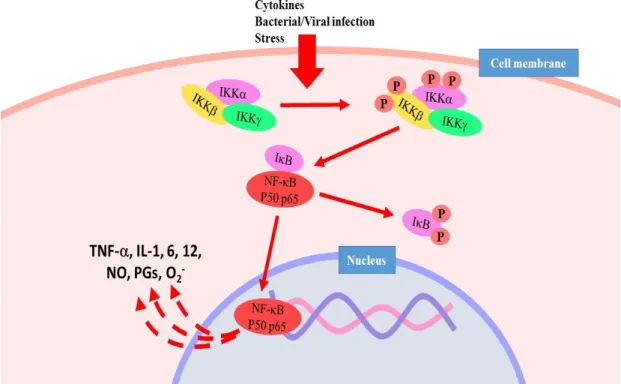
In the inflammation processes, nuclear factor-kappa B (NF-B), regulates host inflammatory and immune responses[28-31]. NF-B is a protein complex playing a key role in activating transcription that relate with inflammation in macrophages and lymphocytes. When one of several stimuli activates the immune cells, the inflammation process begins. The expression of cytokines or mediators such as tumor necrosis factor-α (TNF-α), and interleukin-1, 6 and 12 (IL-1, 6 and 12) as well as nitric oxide synthase (NOS), are release by exogenous (lipopolysaccharide, LPS) or endogenous (interferon-γ, IFN-γ) stimulation of immune cells through activating NF-B related genes (Fig. 2).
Figure 2. Activation of NF-B pathway.
Nitric oxide (NO), a relatively stable free radical and one of the cellular mediators involved in the pathological processes of inflammatory events, is thought to be a mediator of inflammation and is produced once the NF-B complex has been activated by extracellular stimuli. NO plays an important physiological role as a defense molecule in the immune system, while the excess production of NO by macrophages contributes to numerous pathological processes. NO is biosynthesized from L-arginine catalyzed by nitric oxide synthase isoforms[32,33]. In particular, NO itself is not extremely reactive, but when NO reacts with superoxide anion radicals, it produces peroxynitrite anions (ONOO-), which are strongly reactive. NO promotes oxidation and gives oxidative damage to tissues[34-36]. Aside from this direct action, the production of NO is one of the primary indicators of macrophage activation.
Therefore, production of NO is a good measure of macrophage activation. These compounds that suppress NO release from macrophage are of interest.
Anti-inflammatory activity of flavonoids
Anti-inflammatory effect is a very important activity of flavonoids. Many researches have shown that the flavonoids have strong inhibitory effects on NO production. The inhibitory effects of flavonoids on NO production were often examined in RAW 264.7 cell (a murine macrophage-like cell line) which were activated by LPS.
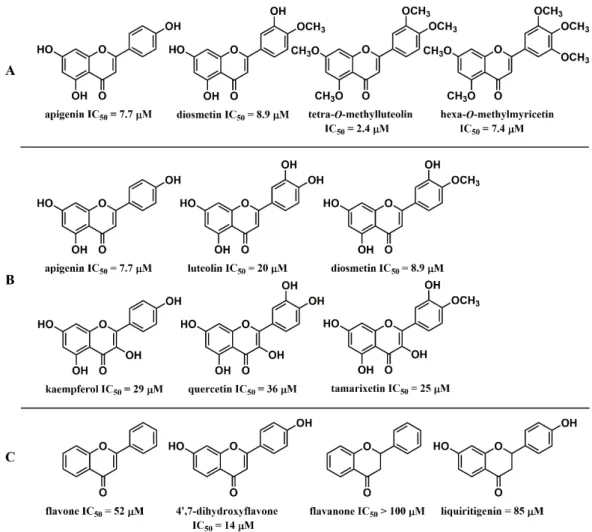
Matsuda et al[37], used the LPS-activated peritoneal exudate cells to explore the structural requirements of flavonoids for NO production inhibitory activity. They examined the inhibitory effects of 73 flavonoids on NO production, and found that apigenin (IC50 = 7.7 M), diosmetin (IC50 = 8.9 M), tetra-O-methylluteolin (IC50 = 2.4 M) and hexa-O-methylmyricetin (IC50 = 7.4 M) showed the strong NO production inhibitory activity whose IC50 were less than 10 M (Fig. 3-A).
Figure 3. Structures and NO production inhibitory activity of flavonoids
They found these 4 active flavonoids suppressed iNOS expression but did not affect iNOS enzyme activity directly. When compared, flavones (C2-C3 single bond, C-3 methylene) showed stronger activity than flavonols (C2-C3 double bond, C-3 vinyl alcohol); apigenin (IC50 = 7.7 M) > kaempferol (IC50 = 29 M), luteolin (IC50
= 20 M) > quercetin (IC50 = 36 M), diosmetin (IC50 = 8.9 M) > tamarixetin (IC50
= 25 M), and pilloin (IC50 = 11 M) > ombuine (IC50 > 30 M) (Fig. 3-B).
They also claimed flavanones (C2-C3 single bond, C-3 methylene) were weaker than flavones (C2-C3 double bond structure), flavone (IC50 = 52 M) > flavanone (IC50 >100 M), 4’,7-dihydroxyflavone (IC50 = 14 M) > liquiritigenin (IC50 = 85 M) (Fig. 3-C). They found that the flavonoids glycosides did not show inhibitory activity on NO production, and the same result was reported by Kim et al[38].
Daikonya et al[39,40], isolated some flavonoids from Chinese herbs, Sophora yunanensis and Rhodiola sacra S.H.Fu (Fig. 4). These compounds were tested for the
inhibitory potency against NO production in RAW 264.7 cells stimulated by LPS/IFN-. They found that the flavones carry 5,7-dihydroxyl structure showed the strong activity. They also found that flavones carry R3’ or R5’ with methoxy groups showed the stronger activity. They found flavonoids having the C2-C3 double bond showed stronger inhibitory potency than ones with C2-C3 single bond.
Figure 4. Structures and activity of flavonoids isolated from Sophora yunnanensis and Rhodiola sacra.
As will be discussed in chapter 1, we revealed the structure-activity relationship that flavones which have 3’,4’-dimethoxy groups in B ring show strong activity on NO production inhibitory effects. In chapter 2, we describe that the 2’,3’-dihydroxyl groups in B ring of flavanonols are conductive to the inhibition of NO production and the differential activities of the enantiomers. And in chapter 3, effect of substituents in A ring was examined.
Oxidative stress
Oxidative stress arises from disturbance in the balance between the production of
reactive oxygen species (ROS) and antioxidant defenses. ROS can be beneficial as a means of attacking pathogens, but under conditions in which ROS and antioxidant potential is imbalanced, the excessive function of ROS brings self-destructive effects, which can lead to inflammatory infiltration of neutrophils, an increase protease secretion, and production of large amounts of intermediate oxidative products.
Oxidative stress is caused by the free radicals and is considered to be an important factor that promotes aging process and some diseases such as Parkinson’s disease[41], Alzheimer’s disease[42], Asperger syndrome[43], cancer[44], heart failure[45], vitiligo[46]
etc.
Free radicals and peroxides ROS including superoxide anion (.O2-), hydroxyl radical (.OH), and hydrogen peroxide (H2O2)[47] will occur and these radicals damage cell components including lipids, proteins and DNA in the cell. Therefore inhibiting the excessive production of ROS to achieve good balance between the ROS and antioxidants would prevent some diseases.
Antioxidant activity of flavonoids
Antioxidant activity is another important effect of flavonoids. Humans and animals ingest flavonoids from some plants that would help the redox state balance in the body.
1,1-Diphenyl-2-picrylhydrazyl (DPPH), a stable artificial free radical, is a dark-purple crystalline, it is often used as a free radical to radical scavenging activity test.
The antioxidant activity of flavonoids and mechanism involved in their action are extensively introduced by Pietta[10] and Amic et al[48]. The total number and configuration of hydroxy groups on flavonoids are the main factors determining the antioxidant activity. In particular, the B ring hydroxyl configuration is significant as a scavenger for ROS.
Pandurangan et al[49], synthesized several flavonoids, and determined their radical scavenging activity using DPPH. They found that, the B ring with 3’,4’-dihydroxyl
configuration of flavanonols and flavonols have the stronger activities than the methoxy moiety. Flavonols such as quercetin (EC50 = 14.4 g/mL), kaempferol (EC50
= 14.6 g/mL) and isorhamnetin (EC50 = 26.2 g/mL) showed strong inhibitory activities. On the other hand, flavanonols (C2-C3 single bond), dihydroquercetin (EC50 = 24 g/mL), dihydrokaempferol (EC50 > 100 g/mL) and dihydroisorhamnetin (EC50 > 100 g/mL) showed weak inhibitory activities than flavonols with C2-C3 single bond (Fig. 5). In chapter 2 and 3, we synthesized flavanonols which carry C2-C3 single bond structure. We found that the hydroxy groups in A and B rings show significant effect on the antioxidant assay.
Comparative Molecular Field Analysis (CoMFA)
In recent years, new methodologies for studying quantitative structure-activity analysis are developed with computer technology. Comparative Molecular Field Analysis (CoMFA) invented in 1988[50] is one of such novel technologies.
CoMFA describe three-dimensional quantitative structure-activity relationship (3D-QSAR). In a CoMFA a most important precondition is that all molecules must
Figure 5. Structures and DPPH radical scavenging activity of flavonoids. (Data were taken from ref [49])
interact in the same manner with the same kind of receptor, i.e., with identical binding site in the same relative geometry. The interactions between a biological receptor and ligand molecules are usually described by non-covalent interactions such as van der Waals interactions, electrostatic interactions, hydrogen-bonding interactions, and so on.
In practice, the molecules are positioned in a large box filled with grid points with certain intervals. Different atomic probes (such as carbon atom, positively or negatively charged atom, hydrogen bond donor or acceptor and lipophilic probe) are used to calculate the field values of each molecules at each gird point, i.e.. These
“field” values make several thousands of columns in “a molecular tables” (Fig. 6).
The binding affinities or other biological activities values are correlated with the field values. The most suitable method for this purpose is the Partial Least Squares (PLS) analysis method[51]. The internal predictivity of the derived model is often checked by cross-validation (r2).
A regression equation with thousands of coefficients is established by the PLS analysis. The regression equation is often presented as a set of contour maps. These contour maps show the favorable and unfavorable steric regions around the molecules as well as the favorable and unfavorable regions of the positively or negatively charged substituents at certain positions. The activity of a compound can be predicted
Figure 6. The process of CoMFA
by qualitative examination of these contour maps or quantitatively by calculating the fields of these molecules by using the PLS model.
Design of the active flavonoids based on a CoMFA model
In this research we not only explored the structure-activity relationship of flavonoids regarding inhibitory potency on NO production and antioxidant activities but also tried to design and synthesize flavonoids of the stronger activities than the natural flavonoids.
We built a 3D-QSAR (CoMFA) study of flavonoids on NO production inhibition in macrophage cells, and proposed a 3D-pharmacophore model for NO production inhibitory activity.
We will present two subjects; (1) Designing flavones based on the CoMFA model;
(2) Trial to enhance inhibitory potency of flavanonols.
Chapter 1: Based on the CoMFA model, we selected some flavones, which were predicted to be active by the CoMFA model from a virtual flavone library (Fig. 7). I synthesized five of them and succeeded to obtain compounds of high potency on NO production inhibitory.
Chapter 2: To our knowledge, no flavanonol is known to exhibit high inhibitory activity on NO production. Since flavanonols have two chiral carbon (C2-C3), a pair of enantiomers (2R,3R and 2S,3S) can be obtained by chemical synthesis. The enantiomers can be separated by using chiral column chromatography. We were interested in the activities of the stereoisomers. I synthesized 19 flavanonols (Fig. 8),
Figure 7. Structures of synthesized flavones
from which 32 stereoisomers were separated by chiral column chromatography. They shared a common 3,5,7-trihydroxychromane scaffold but differ to the B ring.
I found flavanonols that have 2’,3’-dihydroxyphenyl ring as the B ring exhibited inhibitory activity for NO production, and the (2R,3R)-enantiomers are more potent than (2S,3S)-enantiomers.
Figure 8. Structures of synthesized 5,7-dihydroxyflavanonols
Chapter 3: In order to explore the SAR of the flavanonols, I examined the effects of A ring substitution of 2’,3’-dihydroxyflavanonols. I synthesized 13 flavanonols (Fig. 9) which have the same scaffold (2’,3’-dihydroxy configuration in B ring) but differ in the A ring substitution. Eighteen stereoisomers were prepared. Inhibition of NO production in RAW 264.7 cells and DPPH radical scavenging ability of the synthesized flavanonols were measured.
Figure 9. Structures of synthesized 2’,3’-dihydroxyflavanonols
II. Chapter 1. Design of active flavones which have inhibitory effects on nitric oxide production in RAW 264.7 cells by using a CoMFA model
2.1. Abstract
Daikonya et al[39,40] had isolated flavonoids from herbal specimens from the Tibetan region (Sophora yunnanensis and Rhodiola sacra) that suppress nitric oxide (NO) production in macrophages stimulated by lipopolysaccharide and interferon-.
The isolated flavonoids carry symmetric substitutions in the B ring (R3’ = R5’). We analyzed the quantitative structure-activity relationship of the inhibitory activity by comparative molecular field analysis (CoMFA) using this series of flavonoids. Use of flavonoids with symmetrical substitutions in the B ring made it simpler to align molecules because it was not necessary to consider a huge number of combinations due to the B-ring conformation. The CoMFA model, whose cross-validated q2 value was 0.705, suggested the existence of a 5-hydroxy group, and the choice of the A/C-ring scaffold (chromane or chromene) and electrostatic field around the B ring are important for NO inhibitory activity. Flavonoids synthesized based on the CoMFA model exhibited significant inhibitory potential against NO production, validating the predictive capability of the CoMFA model.
2.2. Building a CoMFA model
During research into anti-inflammatory flavonoids in Sophora yunnanensis and Rhodiola sacra, Daikonya et al isolated the flavonoids[39,40] shown in Fig. 10. Tricin 1 and apigenin 2 are flavones (chromen-4-one scaffold). Compound 3, laurentinol 4, kaempferol 5 and robinetin 6 are flavonols (3-hydroxychromen-4-one scaffold).
Sepinol 7, sophorayunnanol 8, dihydrokaempferol 9 and dihydrorobinetin 10 are flavanonols (3-hydroxychroman-4-one scaffold). Naringenin 11, compound 12 and robitin 13 are flavanones (chroman-4-one scaffold). The B ring of these flavonoids happens to possess symmetrically arranged substituents (R3’ = R5’). We determined their potential to inhibit NO production in RAW 264.7 cells, a murine macrophage
Figure 10. Structures and activity of flavonoids isolated from Sophora yunnanensis and Rhodiola
sacra. Flavonoids are categorized based on the skeleton and substitution pattern of the B ring. IC50
values of the flavonoids for NO production in RAW 264.7 cells are also indicated. Flavonoids 1, 2, 5, 9, 11 and 12 were isolated from R. sacra, and flavonoids 3, 4, 6, 7, 8, 10 and 13 were isolated from S. yunnanensis. Atom numbering is shown in the structure of apigenin 2. The absolute configuration of flavanonols 7-10 and of flavanones 11-13 are (2R, 3R) and (2S), respectively.
cell line, and intended to build a quantitative structure-activity relationship (QSAR) model.
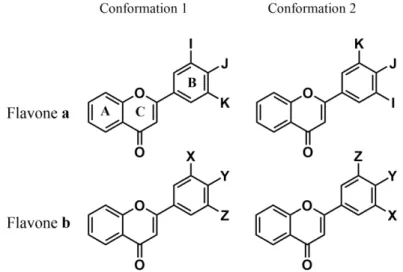
One reason making a structure-activity study of flavonoids difficult is the complexity caused by the conformation of the B ring. For example, as shown in Fig.
11, there are four possible combinations to overlap or align flavonoids a and b.
However, if A = C and X = Z, only one alignment is available for overlapping the two flavonoids. Thus, the use of flavonoids having symmetrically substituted B rings reduces the number of possible combinations of B-ring alignments and is advantageous for 3D structure-activity relationship studies. We conducted a comparative molecular field analysis (CoMFA) study.
CoMFA requires molecules to be aligned properly in space[52]. Our approach to find such alignment was as follows. First, we built several conformational models for each of the 13 flavonoids. Then, considering possible combinations of conformers,
Figure 11. Symmetric B rings make alignment of molecules simpler.
Provided that flavones a and b have asymmetrically substituted B rings (A ≠ C and X
≠ Z), we need to consider two conformers each from which four possible combinations arise when the flavonoid molecules are aligned (or superimposed) in space. The number of combinations grows drastically when multiple molecules are to be aligned. If both flavonoids carry symmetric B rings, such complexity is nonexistent.
we created 32 alignments. We submitted the 32 alignments to CoMFA and selected an alignment that gave the best partial least square evaluation, i.e., a high cross-validated q2 value and regression coefficient r2 with a lower number of components.
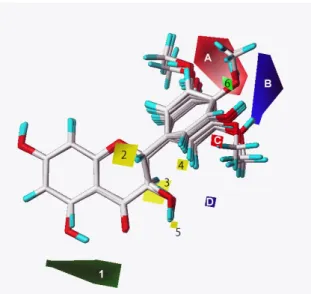
Fig. 12 depicts the CoMFA field mapping. Steric repulsive regions exist above the 2-position and below the 3-position of the C ring (regions 2 and 3). These regions indicate that the chromane scaffold is less favored for higher potency because the chromane scaffold carries hydrogen atoms at the 2- and 3-positions whereas in the chromene scaffold, the 2- and 3-positions are unsaturated, and no atom exists to interfere with the steric regions. There is a sterically favored region near the 5-position of the A ring (region 1). Flavonoids that carry a substitution at the 5-postion is advantageous for the inhibitory potency. Electrostatic mappings exist around the B ring (regions A and B). The region A is an electrostatically positive mapping and the approach of negatively charged surface of a ligand molecular is favorable for the inhibitory potency. Thus, within the scope of the 13 compounds, the
Figure 12. CoMFA model.
A-D regions show the field of electrostatic interaction which effect the activity of the compounds. Red contours indicate electropositive regions. Blue contours indicate electronegative regions. Regions 1-6 show the field of molecular volume which effect the activity of the compounds. Green contours indicate favorable regions for steric interaction. Yellow contours indicate unfavorable regions for steric interaction.
inhibitory potency of flavonoids on NO production is basically explained by the electrostatic property of the B ring, the choice of the scaffold and the presence of a hydroxy group at the 5-position.
2.3. Synthesis of the flavones positively predicted by the CoMFA model
The preparation of flavones were carried out as illustrate in Scheme 1. The anhydrous phloroglucinol 14 and chloroacetonitrile were reacted with ZnCl2 as catalyst under HCl gas condition to give an imine intermediate 15. The intermediate 15 was hydrolyzed with HCl aqueous to provide ketone 16. The ketone 16 and benzaldehyde 17 were treat with KOH in ethanol followed by hydrolysis with HCl gave flavones 18a-18d.
Scheme 1. Synthesis of flavones.
Reagents and conditions: (i) (1) ZnCl2, Et2O (2) HCl gas, 0-5 °C; (ii) 1 M HCl aqueous, rt; (iii) (1) KOH, EtOH, rt; (2) HCl aqueous, 55 °C.
2.4. Effects of the synthesized flavones on nitric oxide production
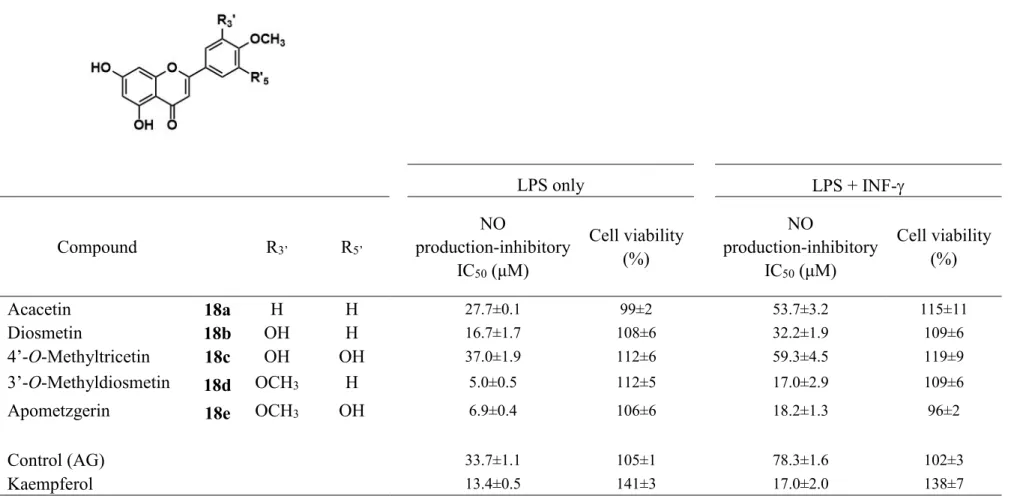
The inhibitory potency for NO production of compounds 18a-18e are summarized in Table 1. I carried out two types of assay, the RAW 264.7 cells are stimulated by LPS only and also by LPS and IFN-.
IC50 value of diosmetin 18b, was 16.7 µM (LPS)/32.2 µM (LPS/IFN-). The NO production inhibitory potency of this compound have already been determined by Matsuda et al[37] and they reported its IC50 value as 8.9 M. Assay procedure of Matsuda et al is different from ours. They used peritoneal exudate cells from the peritoneal cavities of male ddY mice and stimulated them with LPS only.
Compounds 18d (3’-O-methyldiosmetin) and 18e (apometzgerin) showed higher potency than 18b in our assay: IC50 5.0 µM (LPS)/17.0 µM (LPS/IFN-) and 6.9 µM (LPS)/18.2 µM (LPS/IFN-), respectively. It seemed that the existence of the 3’-methoxy group on the B ring was important for the inhibitory activity of 5,7-dihydroxyflavanones. Actually, tricine (1) has an IC50 value of 8 µM (LSP/IFN-) as shown in Fig. 4. IC50 values of compounds 18a and 18c were 27.7 µM (LPS)/53.7 µM (LPS/IFN-) and 37.0 µM (LPS)/59.3 µM (LPS/IFN-), respectively. Compounds 18a-18d did not show any significant cell toxicity at 100 µM.
LPS only LPS + INF-
Compound R3’ R5’
NO
production-inhibitory IC50 (μM)
Cell viability (%)
NO
production-inhibitory IC50 (μM)
Cell viability (%)
Acacetin 18a H H 27.7±0.1 99±2 53.7±3.2 115±11
Diosmetin 18b OH H 16.7±1.7 108±6 32.2±1.9 109±6
4’-O-Methyltricetin 18c OH OH 37.0±1.9 112±6 59.3±4.5 119±9
3’-O-Methyldiosmetin 18d OCH3 H 5.0±0.5 112±5 17.0±2.9 109±6
Apometzgerin 18e OCH3 OH 6.9±0.4 106±6 18.2±1.3 96±2
Control (AG) 33.7±1.1 105±1 78.3±1.6 102±3
Kaempferol 13.4±0.5 141±3 17.0±2.0 138±7
Table 1. NO production inhibitory activity of the designed compounds. All data are expressed as the mean ± S.D. (n = 3).
2.5. Conclusion
We carried out a CoMFA study on the inhibitory activity of flavonoids against NO production. We constructed the possible alignments of 13 flavonoids systematically. For this process, the use of symmetrically substituted analogues was the key to reduce the possible numbers of alignments to a feasible size. The CoMFA model reasonably explained the structure-activity relationship. The preference of the chromene scaffold over the chromane scaffold was expressed as sterically unfavorable regions above the 2-position and below the 3-position. The preference for the existence of a hydroxy group at the 5-position was expressed as a sterically favorable region between the 4- and 5- positions. The CoMFA fields around the B ring are mostly electrostatic fields, suggesting that electrostatic features of the B-ring substitutions are important. Because the topology of the B ring alters depending on the scaffold, the effects of the B-ring substitutions on inhibitory potency would differ scaffold by scaffold, and this rendered CoMFA a robust methodology in this study.
The CoMFA model exhibited a predicTable 3apability, and this model rationally helped us to obtain very potent compounds 18d and 18e. To our knowledge, their inhibitory potential against NO production has not been reported so far, and this study appears to be the first to report the inhibitory potency of these compounds.
III. Chapter 2. Synthesis of the active flavanonols having diversity in the B ring. Stereospecific inhibition on nitric oxide production in RAW 264.7 cells
3.1. Abstract
In the chapter 1, the SAR of B ring was investigated. In this chapter we applied the information to design some new compounds. To our knowledge, no flavanonol is known to exhibit high inhibitory activity on NO production. On the other hand, flavanonol has two chiral centers, thus it is interesting to examine whether stereoisomers exhibit different NO production inhibitory effects. Therefore, I try to synthesize an active flavanonol that suppress NO production in immune cells. I synthesized flavanonols which shared a common 3,5,7-trihydroxychroman scaffold. A range of substitutions were included in the B ring in order to investigate the structure-activity relationship. I also succeeded in isolating 16 pairs of enantiomers from 19 synthesized flavanonols (racemic mixture) using chiral column chromatography. The inhibitory effects of these compounds on NO production were examined.
Obvious inhibitory activity against NO production was observed among (2R,3R)-enantiomers, while (2S,3S)-enantiomers were significantly less active. I also evaluated the free radical scavenging potential of the flavanonols using 1,1-diphenyl- 2-picrylhydrazyl (DPPH). Each enantiomer indicated the equivalent DPPH scavenging potential as expected, because this scavenging process involves only chemical reaction without any biological responses. The radical scavenging activity was not correlated with the inhibitory activity against NO. The inhibition of NO production by flavanonols is stereospecific and cannot simply be explained by their radical scavenging activity. I propose the possible existence of a ‘target’ molecule for flavanonols which is involved in the production and/or regulation of NO.
3.2. Synthesis of 5,7-dihydroxyflavanonols
The preparation of 5,7-dihydroxyflavanonols series were carried out as illustrated in Scheme 2. Phenolic hydroxyl groups on 2,4,6-trihydroxyacetophenone were protected with chloromethyl methyl ether (MOMCl) and the product compound 19, was yielded (80-95%). Phenolic hydroxyl groups on benzaldehydes were also protected with MOMCl and the product, compound 20 was yielded (80-95%).
Compounds 19 and 20 were treated with KOH in ethanol at room temperature for 3 h to give compound 21 (60-90%). Compound 21 was converted to be an epoxide with H2O2 under alkaline condition (NaOH aqueous) in ethanol and yielded compound 22 (60-95%). Finally compound 23a-23s (30-55%) obtained by treating compound 22 with HCl in methanol at 55°C.
Scheme 2. Synthesis of 5,7-dihydroxyflavanonols.
Reagents and conditions: (a) NaH, MOMCl, DMF, 0°C; (b) K2CO3, MOMCl, Me2CO, rt; (c) KOH, EtOH, rt; (d) 30% H2O2, NaOH aq, MeOH, rt; (e) MeOH-HCl, 55°C.
3.3. Isolation of enantiomers by HPLC with a chiral column
I isolated 32 enantiomers (Table 3) from the racemic mixtures using chiral column chromatography. The isolation of compounds 23k, 23n and 23r were not satisfactory. Thus 23k, 23n and 23r were used as racemic mixtures.
The absolute configurations of the stereoisomers were determined by circular dichroism (CD) and the coupling constant (J) between H-2 and H-3 measured by
1H-NMR (Table 2). Positive Cotton effect around 320 nm and negative Cotton effect around 290 nm indicates that the C-2 is in R configuration [53,54]. The coupling constant of 10-12 Hz indicates that H-2 and H-3 are in trans configuration.
Table 2. Flavanonol C2 and C3-geometry and configuration
NMR: J2,3 Result Cotton at
300-340nm
Result Absolute configuration 10-12 Hz
H2,H3 trans
(2R,3R) or (2S,3S)
Positive Negative
2R 2S
(2R,3R) (2S,3S)
CD spectra of 2’,4’,5,7-tetrahydroxyflavanonol
-30 -20 -10 0 10 20 30
250 270 290 310 330 350 370 390
CD (mdeg)
(nm)
2R,3R 2S,3S
3.4. Effects of the synthesized flavanonols on nitric oxide production
The (2R,3R)-isomer of 23f, with a 2’,3’-dihydroxyl substitution in the B ring, indicated the highest inhibitory potential among the 35 specimens (70% inhibition at 100 µM). Its inhibitory potential was comparable with the positive control, aminoguanidine HCl (AG). The (2R,3R)-isomers of 23b and 23c, with hydroxy group at 2’- or 3’-position in the B ring, respectively, showed weak but significant inhibitory activity (35% inhibition at 100 µM). The (2R,3R)-isomer of 23h, with hydroxy groups at 2’- and 5’- positions , also showed weak inhibitory activity (30% inhibition at 100 µM). Their enantiomers (i.e. the (2S,3S)-isomers) indicated very weak activity (Fig 13-A and Table 3). The inhibitory activity of the other compounds was not detectable at 100 µM. Thus the hydroxy group at the 2’- and 3’-positions of the B ring is concluded to be important for the inhibition of NO production. The methylation of the 2’-methoxy group (23k), 3’-methoxy group (23l) and both groups together (23o) resulted in a loss of activity, also suggesting the importance of the hydroxy groups at 2’- and 3’-positions for the inhibitory activity. The substitution at the 4’-position lowered the inhibitory potential (compounds 23d, 23g and 23i). The potent flavanonols were not toxic to RAW 264.7 cells at 100 µM. Note that no significant difference was found in the toxicity between each stereoisomers (Fig 13-B).
The steric configuration of the all of the potent flavanonols was (2R,3R). The inhibition of NO production by the flavanonols was stereospecific. Most flavanonols from natural sources have a (2R,3R) configuration [55].
Figure 13. The effects of the 5,7-dihydroxyflavanonols on the NO production (A) and the cell viability of RAW 264.7 cells (B).
23f: 2’,3’,5,7-Tetrahydroxyflavanonol, 23b: 2’,5,7-Trihydroxyflavanonol, 23c:
3’,5,7-Trihydroxyflavanonol, 23h: 2’,5’,5,7-Tetrahydroxyflavanonol, AG:
Aminoguanidine hydrochloride. The final concentration of the tested specimen including AG was 100 μM. All data are expressed as the mean ± S.D. (n = 3).
3.5. DPPH radical scavenging activity of the synthesized flavanonols
Table 3 shows the results (EC50) of a radical scavenging potential assay of the flavanonols. The most potent compounds were the (2R,3R)- and (2S,3S)-stereoisomers of 2’,3’-dihydroxy analogue 23f, and 3’,4’-dihydroxy analogue 23i. The EC50 value of the (2R,3R)-stereoisomer of 2’,3’-dihydroxyflavanonol 23f was found to be 12.5 µM, while that of the (2S,3S)-stereoisomer of 23f was 13.5 µM. The (2R,3R)-stereoisomer of 23i, called dihydroquercetin, is often used as a standard specimen for DPPH assays.
Dihydroquercetin and its enantiomer (2S,3S)-23i had EC50 values of 13.9 and 12.6 µM, respectively.
The activity of 2’,5’-dihydroxy analogue 23h (25 µM) was half that of 23f and 23i.
Again, both the (2R,3R)- and (2S,3S)-stereoisomers were found to have equivalent radical scavenging potential (EC50: 24.5 µM and 25.4 µM, respectively).
Radical scavenging activity was not detected in any compounds other than 23f, 23i and 23h. In short, the flavanonols with catechol or hydroquinone structure in the B ring showed radical scavenging activity. The stereochemistry was irrelevant to the radical scavenging potential.
Table 3. The structures and activity of the 5,7-dihydroxyflavanonols.
Compound Substitution in the B ring
NO production inhibitory % @100 M
DPPH radical scavenging EC50 (M)
(2R,3R) (2S,3S) (2R,3R) (2S,3S)
23a None <10 <10 >100 >100
23b 2’-OH 40 <15 >100 >100
23c 3’-OH 35 <15 >100 >100
23d 4’-OH <10 <10 >100 >100
23e 2’,6’-OH <10 <10 >100 >100
23f 2’,3’-OH 70 45 12.5 13.5
23g 2’,4’-OH <10 <10 >100 >100
23h 2’,5’-OH 30 <15 24.5 25.4
23i 3’,4’-OH <10 <10 13.9 12.6
23j 3’,5’-OH <10 <10 >100 >100
23k 2’-OCH3 Racemic mixture <10 Racemic mixture >100
23l 3’-OCH3 <10 <10 >100 >100
23m 4’-OCH3 <10 <10 >100 >100
23n 2’,6’-OCH3 Racemic mixture <10 Racemic mixture >100 23o 2’,3’-OCH3 <10 <10 >100 >100 23p 2’,4’-OCH3 <10 <10 >100 >100 23q 2’,5’-OCH3 <10 <10 >100 >100 23r 3’,4’-OCH3 Racemic mixture <10 Racemic mixture >100 23s 3’,5’-OCH3 <10 <10 >100 >100 Positive control: Aminoguanidine HCl (AG), 72% (NO inhibitory rate at 100M).
Gallic acid, EC50 = 10-12 M (DPPH radical scavenging). All data are expressed as the average. (n = 3)
3.6. Structure-activity relationship of the flavanonols which carry diverse substitution in the B ring on the nitric oxide production inhibitory activity
The (2R,3R)-stereoisomers of 23b, 23c, 23f and 23h were found to be the most potent flavanonols for the inhibition of NO production. Compounds 23f and 23h were also found to have radical scavenging potential. However, none of the NO inhibitory compounds other than 23f and 23h were found to have radical scavenging potential.
Compound 23i, which demonstrated strong radical scavenging potential, did not inhibit the NO production potential. The radical scavenging potential was not depended on the stereostructure of flavanonols, but was depended on the geometric relation of hydroxy groups on B ring. These results support the long-speculated hypothesis that the radical scavenging potential of flavanonols might simply be explained by the oxidation-reduction potential of the B ring moiety. Our study supports this hypothesis and confirms that it is also valid for unnatural flavonoids. In contrast, the inhibitory potential of NO production in RAW 264.7 cells was stereospecific and irrelevant to the radical scavenging potential. This suggests that flavanonols were stereospecifically recognized by RAW 264.7 cells and that a biological target that plays a role in the production and/or regulation of NO may exist.
3.7. Conclusion
Many studies have been carried out about the anti-inflammatory activity of flavonoids using RAW 264.7 cells [37,39,56,57]. Analyses of the complied results suggest that, in general, flavonoids having C2-C3 double bond show stronger NO production inhibitory activity as well as DPPH radical scavenging activity than C2-C3 is single bond. In our knowledge, no flavanonol was recognized as a strong inhibitor for NO-production in RAW 264.7 cells. This may due to the fact that number of natural occurring flavanonols is much smaller than that of other flavonoids. Moreover there was no report that flavononols’ stereoisomers have different effects on NO production inhibitory activity.
I prepared 35 flavanonols which are unnatural, rare or new, with an identical chroman scaffold in the A and C rings but with differences in their B ring structure and stereochemistry. Nineteen of the flavanonols were newly synthesized. I carried out an NO production inhibitory assay and a DPPH radical scavenging assay. The NO production inhibitory activity was stereospecific and the (2R,3R)-configuration was required for this activity. 2’3’-Dihydroxy substitution in the B ring is favorable for flavanonols to have the activity. The flavanonols with catechol or hydroquinone structures in their B ring exhibited radical scavenging activity. No correlation was found between the inhibition of NO production and the radical scavenging activity.
Taken together the inhibitory effect of flavanonols against NO production cannot solely be explained by anti-oxidative potential. Existence of a biological target is likely to explain the inhibitory effect.
IV. Chapter 3. Synthesis of the active flavanonols which carry diverse substitutions in the A ring and their stereospecific inhibition on nitric oxide production in RAW 264.7 cells
4.1. Abstract
In chapter 2, I synthesized 5,7-dihydroxyflavanonols with different substituents in their B ring. I found that flavanonols whose B ring carries dihydroxyl groups at 2’- and 3’-positions have the strong inhibitory activity on NO production and the stereochemistry of the hydroxy groups (2R,3R)-isomer is relevant for the activity in macrophage RAW 264.7 cells. In this chapter, I synthesized a series of flavanonols which have diversity in the A ring with the 2’,3’-dihydroxyphenyl substructure at B ring. All compounds have not been synthesized or found in the natural resources.
Eighteen enantiomers and 4 racemic mixtures were tested for NO production inhibitory activity. I observed inhibitory activity in (2R,3R)-stereoisomers as well as in some of the (2S,3S)-stereoisomers. I also found that presence of a hydroxy at the 7-postiion is essential for the activity and the additional substitutions at the 6- or 8-position in A ring helped to increase inhibitory activity.
4.2. Synthesis of 2’,3’-dihydroxyflavanonols
The preparation of 2’,3’-dihydroxyflavanonols were carried out as illustrated in Scheme 3. The synthetic method is similar to the procedure written in section 3.2.
Hydroxy group(s) on acetophenone were converted to methyl methyl (MOMO) ether, the product compounds 19 yielded (80-95%), and hydroxy groups on benzaldehyde were also derivatized with MOMCl to compounds 20 (yield 90%).
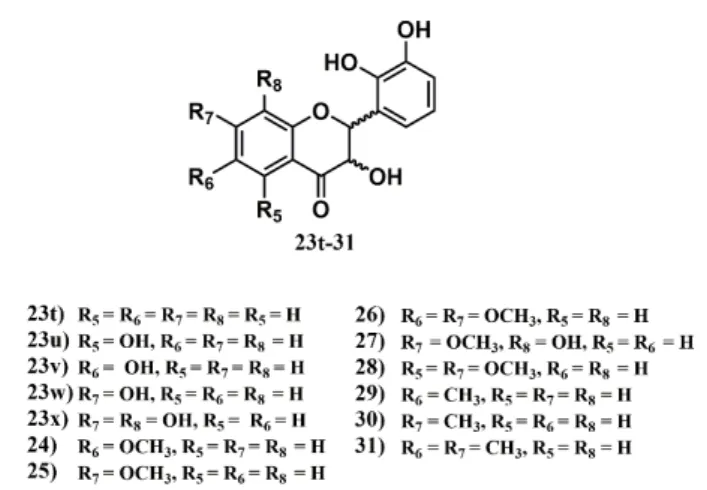
Condensation of compounds 19 with 20 by treatment with KOH in ethanol gave intermediates 21 (yield 60-90%), which were then oxidized with H2O2 under alkaline condition and epoxides 22 were yield (yield 95%). Flavanonols 23t-31 (yield 30-55%) were obtained by hydrolysis of the epoxides.
Scheme 3. Synthesis of 2’,3’-dihydroxyflavanonols.
Reagents and conditions: (a) NaH, MOMCl, DMF, 0°C; (b) K2CO3, MOMCl, Me2CO, rt; (c) KOH, EtOH, rt; (d) 30% H2O2, NaOH aq, MeOH, rt; (e) MeOH-HCl, 55°C.
4.3. Isolation of enantiomers by HPLC with a chiral column
Nine pairs of enantiomers were successfully isolated from the racemic mixtures by HPLC with a chiral column. However, 4 racemates (28, 29, 30, 31) were inseparable. Thus 28, 29, 30 and 31 were used as racemic mixtures to measure the NO assay and DPPH radical scavenging assay.
I estimated the absolute configurations of the stereoisomers (24,25,26 and 27) which carries methoxy groups in the A ring by circular dichroism (CD) and the coupling constant (J) of 1H-NMR between H-2 and H-3 applying the same procedure written in section 3.3. But I found the estimated (2S,3S)-isomers showed stronger NO production inhibitory activity than the estimated (2R,3R)-isomers in case of flavanonols (24,25,26 and 27) that carries methoxy group(s) in the A ring. In our experience, the (2R,3R)-isomers of flavanonols would show stronger NO production inhibitory activity. Therefore we doubt our procedure for determining the absolute configuration in case of flavanonols that have methoxy groups in A ring. In order to determine the absolute configuration of the compounds (24,25,26 and 27), we prepared 2’,3’,6,7- tetramethoxyflavanonol-3-O-p-chlorobenzoate 26b from 26 and determined its absolute configuration.
The preparation of 2’,3’,6,7-tetramethoxyflavanonol-3-O-p-chlorobenzoate were carried out as illustrated in Scheme 4. The 2’,3’-dihydroxy groups of Compounds 26 were methoxylated by CH2N2, then the product 26a was reacted with p-chlorobenzoyl chloride in pyridine to give compound 26b. (total yield 50-60%)
Scheme 4. Synthesis of 2’,3’,6,7-tetramethoxy-3-O-p-chlorobenzoylflavanonols Reagents and conditions: (i) EtOH, CH2CN-Et2O solution, 4°C; (ii) pyridine, RT.
The positive cotton effect at 248 nm (+3.26) and the negative cotton at 233 nm (-13.82) in the CD spectrum of the compound 26b were consistent with 3R, so C-2 also possessed the R configuration (Fig. 14). So we concluded the flavanonols that have methoxy groups in the A ring (24,25,26 and 27) shows the opposite cotton effect in CD spectra that is generally effective to determine the absolute configuration of flavanonols.
Figure 14. CD spectra of 2’,3’,6,7-tetramethoxy-3-O-p-chlorobenzoylflavanonols
-40 -30 -20 -10 0 10 20 30 40
200 250 300 350 400
CD (mdeg)
(nm)
2R,3R 2S,3S
4.4. Effects of the novel flavanonols on nitric oxide production
(2R,3R)-2’,3’,7,8-Tetrahydroxyflavanonol 23x, indicated highest inhibitory activity (95 % inhibition at 100 M, IC50 = 17.0 ± 1.1 M) (Fig 15 and Table 4). Its inhibitory activity was comparable with the positive control, kaempferol (IC50 = 13.4
± 0.5 M). (2R,3R)-2’,3’,7-Trihydroxyflavanonol 23w showed the comparative potency (70 % inhibition at 100 M, IC50 = 70.7 ± 7.4 M). It should be noted that the (2R,3R)-enantiomer of 23x and 23w exhibited much higher inhibitory activity than their (2S,3S)-enantiomers. 2’,3’-Dihydroxy-6,7-dimethoxyflavanonol 26 (93 % inhibition at 100 M, IC50 = 50.3 ± 1.4 M) and 2’,3’,8-trihydroxy- 7-methoxyflavanonol 27 (93 % inhibition at 100 M, IC50 = 49.7 ± 2.3 M), their (2R,3R)-isomers also showed the higher inhibitory potency than the (2S,3S)-isomers.
The analogues 23t (with no substitution in the A ring), 23v (6-hydroxy) and 24 (6-methoxy) are less activity.
The racemic mixtures of compounds 28, 29, 30, and 31 also showed the high NO production inhibitory activities (IC50 = 57.6 ± 2.9 M, IC50 = 45.3 ± 3.1 M, IC50 = 31.8 ± 0.6 M, IC50 = 20.7 ± 2.4 M).
Table 4. The structures and activity of the 2’,3’-dihydroxyflavanonols.
Compound Substitution in the A ring
NO production inhibitory IC50 (M)
DPPH radical scavenging EC50 (M)
(2R,3R) (2S,3S) (2R,3R) (2S,3S)
23t None >100 >100 12.6 ± 1.2 12.8 ± 1.4
23u 5-OH 77.7 ± 0.9 >100 13.0 ± 1.3 13.1 ± 1.2
23v 6-OH >100 >100 16.7 ± 0.8 16.9 ± 0.6
23w 7-OH 70.7 ± 7.4 >100 12.3 ± 1.3 12.5 ± 1.4
23x 7,8-OH 17.0 ± 1.1 >100 7.2 ± 0.6 7.7 ± 0.4
24 6-OCH3 >100 >100 12.1 ± 0.4 12.5 ± 0.6
25 7-OCH3 24.6 ± 2.0 30.3 ± 0.8 11.4 ± 0.2 11.2 ± 0.2 26 6,7-OCH3 50.3 ± 1.4 >100 12.5 ±1.1 12.0 ± 0.7 27 7-OCH3,8-OH 49.7 ± 2.3 88.5 ± 4.9 13.5 ± 0.3 13.5 ±0.3 28 5,7-OCH3 Racemic mixture
57.6 ± 2.9
Racemic mixture 12.9 ± 0.8
29 6-CH3 Racemic mixture
45.3 ± 3.1
Racemic mixture 11.5 ± 0.5
30 7-CH3 Racemic mixture
31.8 ± 0.6
Racemic mixture 12.0 ± 1.0
31 6,7-CH3 Racemic mixture 20.7 ± 2.4
Racemic mixture 11.3 ± 0.5
Positive control: Kaempferol (kp), IC50 = 13.4 ± 0.5 M (NO production inhibitory activity). Gallic acid, EC50 = 10-12 M (DPPH radical scavenging). All of tested compounds’ Cell viability > 100%. All data are expressed as the mean ± S.D. (n = 3).
Figure 15. The effects of the 2’,3’-dihydroxyflavanonols on the NO production.
23t: 2’,3’-Dihydroxyflavanonol, 23u: 2’,3’,5-Trihydroxyflavanonol, 23v:
2’,3’,6-Trihydroxyflavanonol, 23w: 2’,3’,7-Trihydroxyflavanonol, 23x: 2’,3’,7,8- Tetrahydroxyflavanonol, 24: 2’,3’-Dihydroxy-6-methoxyflavanonol, 25: 2’,3’- Dihydroxy-7-methoxyflavanonol, 26: 2’,3’-Dihydroxy-6,7-dimethoxy- flavanonol, 27:
2’,3’,8-Trihydroxy-7-methoxyflavanonol, 28: 2’,3’-Dihydroxy-5,7-dimethoxy- flavanonol, 29: 2’,3’-Dihydroxy-6-methylflavanonol, 30: 2’,3’- Dihydroxy- 7-methylflavanonol, 31: 2’,3’-Dihydroxy-6,7-dimethylflavanonol. Kp : Kaempferol (positive control). The final concentration of the tested specimen including Kp was 100 μM. All data are expressed as the mean ± S.D. (n = 3).
4.5. DPPH radical scavenging activity of the novel flavanonols
Among the synthesized flavanonols, 2’,3’,7,8-tetrahydroxyflavanonol 23x was the most active compound on radical scavenging assay. The (2R,3R)-isomer and (2S,3S)-isomer of 23x showed identical radical scavenging activity (EC50 7.2 µM and 7.7 µM, respectively). Other compounds 23t-27 also exhibited identical radical scavenging activity between the enantiomers. Compounds 28-31, which have the same B ring (catechol) and carry no hydroxy substitution on the A and C rings, showed the similar radical scavenging potency. It is evident that compounds having catechol substructure are strong radical scavengers.
4.6. Structure-activity relationship of the flavanonols which carry diverse substitution in the A ring on the nitric oxide production inhibitory activity
As shown in Fig 15, compounds 23t (no substitution in A ring), 23u (5-hydroxy), 23v (6-hydroxy), and 25 (7-methoxy) indicated no stereospecificity on NO production inhibitory effects. On the other hand, the evident stereospecificity was found in 23w (7,8-dihydroxy), 23x (7-hydroxy). Compound 23x (2R,3R)-isomer showed the highest inhibitory potency, while, the (2S,3S)-isomer did not (0% at 100
M). Comparing the structures of 23x with 23w, introduction of a hydroxy group at the 8-position, would increase stereospecificity and inhibitory activity. Compound 24 (6-methoxy) showed a very weakly activity on NO production inhibition. But the compound 26 which have the 6,7-dimethoxy groups in A ring showed a stronger inhibitory potential with stereospecificity. Presence of a 7-methoxy group in A ring would enhance inhibitory effects on NO production as well as stereospecificity.
Compound 25 which have a 7-methoxy group in A ring showed a strong inhibition, but have no stereospecificity. But further addition of a hydroxy group at the 8-position to 25, the compound 27, exhibited evident stereospecificity. Thus, we conclude that, the substituent at 7-position is required for activity, and it was considered that stereospecificity will be increased if additional substituent is introduced to the 6- or 8-positions.
4.7. Conclusion
I prepared 2’,3’-dihydroxyflavanonol series with diversity in the A ring structures and stereochemistry. All compounds are new. (2R,3R)-2’,3’,7,8- Tetrahydroxyflavanonol 23x was found to be a potent inhibitor for NO production (IC50 = 17.1 M). As discussed in chapter 3, hydroxy groups at the 2’- and 3’-positions in the B ring is most favorable substitution of identified 3,5,7-trihydroxy- flavanonols for the inhibitory activity. In this chapter, 7,8-dihydroxy substitution in the A ring is as most optimized structure. It should be noted that absence of 4’-substitution in the B ring is favorable for the activity. Most of flavonoids from natural origin carry either a hydroxyl or a methoxy substitution at the 4’-position. This is presumably a reason that flavanonol scaffold has been regarded as an inactive framework for inhibitory effect on NO production. Isolation and synthesis of 23x have not been reported so far. This is the most active flavanonol ever reported to our knowledge. Different substituents in A ring show different stereospecificity and inhibitory potency.
As shown in Fig 15 and Table 4, (2R,3R)-enantiomers generally show the stronger NO production inhibitory activity than (2S,3S)-enantiomers. Different substituents at the same position in A ring showed the different stereospecificity and activity inhibitory. These facts strongly suggest that the existence of a biological target that interacts with the flavanonols in RAW 264.7 cells.
V. Results and discussion
In chapter 1, we successfully built a CoMFA model. Depending on the model, I synthesized 5 flavones (18a-18e) which actually showed the strong NO production inhibitory effects in RAW 264.7 cells. Especially compounds 18e and 18d showed the stronger activity (IC50 = 5.0 ± 0.5 M, IC50 = 6.9 ± 0.4 M) than the 13 flavonoids based on which the CoMFA model was retrieved. This success in designing active flavones convinced that the CoMFA model is effective. The model suggested that the property of the B ring would affect on NO production inhibitory and the presence of a hydroxy group at the 4’-position is unfavorable (Fig 16). It was also confirmed that flavones with 3’,4’-dimethoxy groups in B ring show the strong NO production inhibitory activity.
In chapter 2, I chose flavanonol as a scaffold to study structure-activity relationship, because their inhibitory activity against NO production by flavanonols were rarely reported. In addition, as they have two chiral center, they enable us to examine stereospecificity of flavanonols on the NO production inhibitory activity.
Our synthesis method allows us to get (2R,3R)-isomers and (2S,3S)-isomers as a racemic mixture which were isolated by a chiral column chromatograph.
Many of the naturally occurring flavanonols have the dihydroxyl groups at 5- and 7-positions in A ring. Base on the results obtain in chapter 1, we assumed the B ring is very important for the NO production inhibitory activity. So I synthesized 5,7-dihydroxyflavanonols (35 compounds, including 19 new compounds) which have different functional groups in B rings. I isolated the enantiomers by HPLC with a chiral column. I found that dihydroxyl groups at 2’- and 3’-positions in B ring are essential for NO production inhibitory activity. Especially, the (2R,3R)-configuration is favorable for flavanonols to have the activity. Such stereospecificity in the NO production inhibitory effect have not been reported. The flavanonols with hydroquinone moiety in their B ring exhibited radical scavenging potential regardless of the configuration. The DPPH radical scavenging assay is chemical reaction based evaluation, while the NO assay is cell-based evaluation.
In chapter 3, in order to explorer the structure-activity relationship of flavanonols of widen chemical space, I synthesized derivatives of the 2’,3’-dihydroxyflavanonol. I isolated 18 pairs of isomers by HPLC with a chiral column, and the other 4 compounds were used as racemic mixtures. I evaluated the effect of the substituents in A ring of flavanonols for the NO inhibitory activity. The substitution at 7-position is required for the activity. Stereospecificity will be increased when further substituents are introduced to the 6- or 8-positions (Fig 16). Compound 23x, 2’,3’,7,8- tetrahydroxyflavanonol showed the strongest NO production inhibitory activity. To our knowledge, 23x exhibits the strongest activity among the flavanonols ever-reported. I propose that there is at least one biological target exist in the RAW 264.7 cells for the NO production. I hope in the future, we can find and confirm the target to develop a new drug for the inflammation.
Figure 16. Structure and NO production inhibitory activity relationship of substitutions for flavanonols.
The absence of substitution at the 4’-position enhances potency for the inhibition.
The presence of a substitution (OH, OCH3) enhances the stereo- specificity for the inhibition.
The presence of a substitution (OH, OCH3) enhances the stereo- specificity for the inhibition.
The presence of a hydroxy group at the 7-position is essential for the inhibitory activity.
VI. Experimental
6.1. General experimental procedures
Optical rotations were measured using a JASCO P-1020 polarimeter. The
1H-NMR (600 MHz) and 13C-NMR (150 MHz) spectra were recorded on a JEOL JNM-ECX600 spectrometer. Mass spectra were obtained on a JEOL GCmate mass spectrometer. IR spectra were recorded on JASCO FT/IR-4200 spectrometer. UV spectra were recorded on JASCO V-730 spectrometer. CD spectra were recorded on JASCO J-600 spectrometer. Melting points were determined by using AS-ONE ATM-02. CoMFA available in the SYBYL-X2.0 software package[58] was used to build QSAR models. The standard procedure of CoMFA, i.e., using grid space of 2 Å and the probe atom type being sp3-carbon, was employed. All of synthesized compounds were identified by NMR (1H, 13C, HMQC, HMBC), HR-MS, UV, Mp, IR, and CD.
6.2. The separation of enantiomers by a chiral column
All of the synthesized flavanonols were further submitted to purification by a
enantiomers using a high performance liquid chromatography system (JASCO PU-1580, UV-1575). The elution solvent was ethanol-hexane and the flow rate was 5 mL/min (except 2’,3’,3,7,8-pentaflavanonol 3mL/min). Detection wave-length was 254 nm.
6.3. Nitric oxide assay (anti-inflammatory assay)
The amount of released nitrite (NO) was quantified by the Griess method[59]. RAW 264.7 cells were cultured in F-12 Ham medium (Sigma Aldrich, N4888) containing 200 mM L-glutamate (Sigma Aldrich, G7513), penicillin (100 U/mL)–streptomycine (0.1 mg/mL) (Sigma Aldrich, P4333) and immobilized fetal bovine serum (10 v/v%) (Biowest, S1780). One hundred fifty microliters of cell
suspension (1.6 x 10⁶ cell/mL culture medium) was dispensed in a well of a 96-well plate (Sumitomo Bakelite, #8096R) and 40 µL of test compound solution was added.
The test compound solution was prepared by diluting the DMSO solution of the flavanonols by a ratio of 1:100 with culture medium. The cells were incubated for 2 h at 37°C in a CO2 incubator. Cells adhered to the culture well during this process. Ten microliters of LPS (Sigma Aldrich, #L-2880) solution was then added to each well.
The final concentration of LPS was 100 ng/mL. After 16 h of incubation, 100 µL of supernatant medium was transferred to another plate. The remaining cells were submitted to a cell viability test as described in section 6.4. Fifty microliters of sulfanilamide solution (50 mg of sulfanilamide dissolved in a mixture of 250 µL of phosphoric acid and 5 mL of water) was added to each well. A few minutes later, 50 µL of 0.1% N-1-naphthylethylnediamine (Wako Pure Chemical Inc, 147-04141) solution was added and incubated at room temperature in the dark for 10 min.
Absorbance at 540 nm (reference wavelength: 655 nm) was then measured using a microplate reader (BioRad Model 3550/FLUOstar Omega BMG LABTECH).
Aminoguanidine hydrochloride (Wako Pure Chemical Inc, 328-26432) was used as a positive control. The concentrations of the test compounds were precisely determined from ultraviolet absorption at λmax using a UV spectrometer (JASCO V-730).
Inhibitory rate (%) = {1-(A-B)/(C-B)}×100%, A: LPS (+), sample (+), B: LPS (-), sample (-), C: LPS (+), sample (-).
6.4. Cell viability test
Cell viability was measured using AlamarBlue® reagent (Bio-Rad AbD Serotec Ltd.). Ten microliters of AlamarBlue® solution was added to the RAW 264.7 cells left in each well of the 96-well plate from the above-mentioned NO assay, which was then incubated at 37°C for 4h. Absorbance was measured at 570 nm (reference wavelength:
600 nm). Cell viability rate (%) = A/B×100%, A: LPS (+), sample (+), B: LPS (+), sample (-).
6.5. DPPH assay (radical scavenging assay)
One hundred twenty microliters of ethanol-buffer solution (ethanol-0.5 M sodium acetate buffer pH 5.6, 105:15) was added to each well of a 96-well plate (Sumitomo Bakelite, #8096R). Forty microliters of compound solution (in ethanol) was added.
Next, 40 µL of DPPH solution (1,1-diphenyl-2-picrylhydrazyl, Tokyo Chemical Industry. D4313, 0.5 mM ethanol solution) was added. The plate was shaken on a shaker for 1 min and kept in the dark at room temperature for 30 min. Absorbance was measured at 517 nm (reference wavelength: 655 nm). Gallic acid monohydrate (Wako Pure Chemical Inc, 077-06092) was used as the standard compound (EC50 = 10-12 µM). Radical scavenging rate (%) = (1-A/B)×100%, A: sample (+), B: sample (-).
6.6. Chemical synthesis 6.6.1. Synthesis of Flavones
2’,4’,6’-Trihydroxy-2-chloroacetophenone 16
Anhydrous ZnCl2 (1.1 g, 8.0 mmol) was added with stirring at 0-5 °C (ice-water bath) to a mixture of anhydrous phloroglucinol (5.0 g, 40 mmol) and chloroacetonitrile (3.8 mL, 60 mmol) in ether (50 mL). When the solution was cooled to 0-5 °C, anhydrous HCl gas was bubbled through the reaction until there were lots of thick yellow solid precipitated. After 6 h the precipitated imine was filtered off and washed with ether three times. Twenty five mL 2M HCl aqueous was added to the solution of imine in water, and stirred for 8 h at room temperature. Water was filtered off and solid was washed three times with water then dried under a vacuum to get a pale white powder (6.6 g, 82% yield).
1H NMR (600 MHz, methanol-d4) δ: 4.91 (2H, s, H-2), 5.84 (2H, s, H-2’, H-6’). 13C NMR (150 MHz, methanol-d4) δ: 51.9 (C-2), 96.0 (C-3’, C- 5’), 104.1 (C-1’), 165.8 (C-2’, C-6’), 167.3 (C-4’), 196.7 (C-1). HR-EI-MS: m/z 202.0033 [M]+ (Calcd 202.0033 for C8H7O4Cl).


![Figure 5. Structures and DPPH radical scavenging activity of flavonoids. (Data were taken from ref [49])](https://thumb-ap.123doks.com/thumbv2/123deta/6039911.2075387/13.892.154.741.445.776/figure-structures-dpph-radical-scavenging-activity-flavonoids-data.webp)