Ef f ect s of Cont i nuous Epi dural I nf us i on of Neos t i gmi ne on Pos t operat i ve Pai n St at us and I nf l ammat ory Res pons es
Hirokazu SAITO,Kazuhiro SHOJI,and Eiji MASAKI
Department of Anesthesiology, The Jikei University School of Medicine
ABSTRACT
Epidural neostigmine has antinociceptive effects. We hypothesized that continuous epidural infusion of neostigmine might have beneficial effect s on postoperative pain status and inflammatory responses. This study was conducted in a randomi zed,double‑blind fashion. Thirty women with American Society of Anesthesiologists physical s tatus I undergoing abdominal surgery were ran- domly divided into three groups:a control group(group C),a neostigmine bolus group(group N), and a continuous neostigmine infusion group(group CN). All patients received 10‑ml epidural bolus of 1% mepivacaine followed by continuous epidural infusion of 0.25% bupivacaine at 4 ml/ hour. In addition,patients in groups N and CN received an epidural bolus of 0.3 mg neostigmine, and patients in group CN received continuous epidural infusion of neostigmine at 0.04 mg/hour. The patientsʼpain was assessed with a visual analogue scale(VAS)2,24,and 72 hours after surgery.
The VAS scores in group N (2 hours:median,0.5[25 ‑75 percentile,0‑3.5];24 hours:1.3[0‑
2.5])and CN (2 hours:1[0‑3];24 hours:2[0‑2];n=10)were significantly(p<0.05)lower than those in group C(2 hours:7[4.5‑8];24 hours:4 [2‑5]). The times for first rescue analgesics in group N (11.5[2‑24])and CN (10[2‑24])were al so longer than that in group C(2[2‑2.5])but did not differ significantly between groups N and CN. Bol us administration of epidural neostigmine produced postoperative analgesic effects,but cont inuous infusion of neostigmine provided no additional benefit. (Jikeikai Med J 2005;52:7‑13)
Key words:neostigmine,epidural,continuous infusion,postoperative pain,stress response
INTRODUCTION
Epidural neostigmine is a useful for treating perioperative pain. The ant inociceptive effects of neostigmine result from i ts inhibition of the break- down of spinally released acethylcholine(ACh). The accumulated ACh activates inhibitory interneurons in the spinal cord to modul ate sensory input. One advantage of the epidural route of administration of neostigmine over the intr athecal route is the lower incidence of adverse events ,such as nausea and vomit- ing . Epidural neostigmine administered with lidocaine produces an anal gesic effect and reduces
postoperative rescue analgesic use in patients under- going minor orthopedic procedures. Analgesia lasts longer in patients who recei ve epidural neostigmine with bupivacaine than i n patients who receive bupivacaine alone after abdomi nal hysterectomy.
We have also reported that preincisional administra- tion of epidural neostigmine reduces postoperative pain scores and decreases plasma levels of cortisol early after surgery in pat ients undergoing lower abdominal surgery. However ,the effects of prein- cisional neostigmine are short‑lived and insufficient and plasma levels of interl eukin(IL)‑6 are not effect- ed. These findings suggest that the effects of neostig-
Received for publication,November 24,2004 齋藤 洋一,庄司 和広,正木 英二
Mailing address:Eiji MASAKI,Department of Anesthesiology,The Jikei University School of Medicine,3‑25‑8,Nishi‑Shimbashi, Minato‑ku,Tokyo 105‑8461,Japan.
Email:ejmasaki@jikei.ac.jp
7
mine would not last long enough to suppress the inflammatory responses fol lowing surgical incision.
The unsatisfactory results of our previous study led us to contemplate an al ternative technique.
Although its pharmacokinetics are not completely understood,epidural neosti gmine is reported to relieve pain for 5 to 6 hours. We hypot hesized that the continuous epidural infus ion of neostigmine would enhance the effects of prei ncisional neostigmine and decrease the inflammatory r esponse. Therefore,we examined the effects of cont inuous epidural infusion of neostigmine on patient sʼpain scores by using a visual analogue scale (VAS)pos toperatively. We also measured plasma concent rations of IL‑6 and cortisol perioperatively.
MATERIALS AND METHODS
After we obtained the approval of The Jikei University School of Medici neʼs Ethics Committee for Biomedical Research and wr itten informed consent from each subject,30 women under going lower abdominal surgery for beni gn gynecological diseases
(abdominal total hysterectomy,myomectomy,salpin- go‑oophrectomy,or ovarian cystectomy)were ran- domly divided into three groups as follows:a control (group C),a neostigmine bolus group(group N),and a continuous neostigmine group( group CN). Exclusion criteria were age greater t han 50 years;a history of corticosteroid use;hypers ensitivity to mepivacaine, bupivacaine,or neostigmine;a history of sensory deficits;and surgical blood loss greater than 1,500 ml.
All patients had American Society of Anesth- esiologists physical status I. Patients received instructions on the use of t he VAS,which consisted of a 10‑cm line with 0 equali ng“no pain at all”and 10 equaling“the worst possi ble pain,”for pain assess- ment preoperatively. The study was conducted in a randomized,double‑blind f ashion.
Patients received oral premedication consisting of 7.5 mg of zopiclone(ult rashort‑acting benzodiaze- pine receptor agent)and 150 mg of ranitidine 90 minutes before arriving in t he operating room. After the epidural space had been i dentified with the loss‑ of‑resistance method, an epidural catheter was
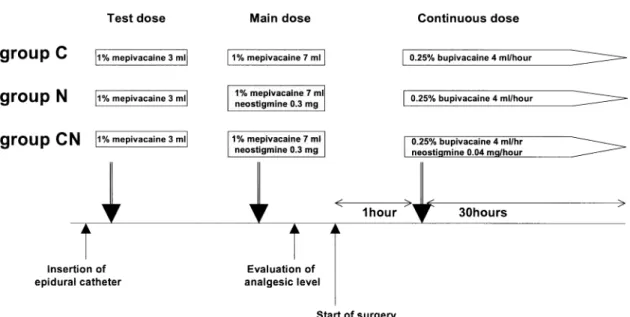
placed through a 17‑gauge Tuohy needle at the L1‑L2 interspace. After receiving a negative test dose con- sisting of 3 ml of 1% epidural mepivacaine,all patients received a bolus of 7 ml of 1% mepivacaine before the induction of gener al anesthesia,then received a continuous epi dural infusion of 0.25%
bupivacaine at 4 ml/hour for 30 hours starting 1 hour after the start of surger y. Patients in group N received an additional bol us dose of 0.3 mg neostig- mine before the induction of general anesthesia,and patients in group CN received both an additional bolus dose of 0.3 mg neostigmine and an additional continu-
ous infusion of neostigmine at 0.04 mg/hour(Fig.1). The preincisional dose of 0.3 mg of neostigmine was chosen because of the uns atisfactory results of the previous study and becaus e of a desire to minimize side effects. The continuous infusion dosage of 0.04 mg/hour for 30 hours was selected on the basis of neostigmineʼs putative phar macokinetics.
The dermatomal analgesic level was evaluated with an alcohol swab 10 mi nutes after the administra- tion of epidural anesthesia. General anesthesia was induced with propofol(2 mg/kg) ,and vecuronium (0.1 mg/kg)was used to faci litate tracheal intubation.
Anesthesia was maintained with 1.0% to 2.0% sevo- flurane in 33% O ,67% N O,intermittent doses of vecuronium (1 to 2 mg)as cl inically indicated. Upon the earliest sign of pain( i.e.;increasing blood pres- sure,heart rate,and pupil size),additional epidural 1% mepivacaine(3 to 5 ml )was administered by an anesthesiologist blinded to the patientʼs group assign-
ment.
For postoperative pain relief,drip infusion of 2 mg of butorphanol over 1 hour at an interval of at least 6 hours was ordered by the patientʼs gynecologist and given upon patient reques t. If patients still com- plained of pain,a 50‑mg dicrofenac suppository was available.
The postoperative pain status of patients at rest was assessed with a VAS 2,24,and 72 hours after the conclusion of surgery. Anal gesic demand and side effects,such as nausea,vomi ting,and pruritus,were recorded during the first 24 hour s after surgery.
Nausea and vomiting were treated with 10 mg of intravenous metoclopramide.
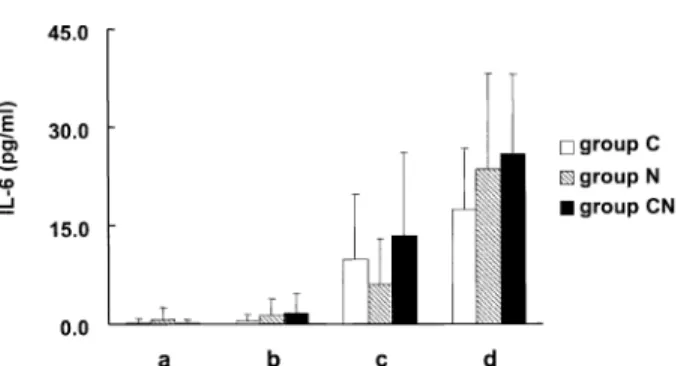
Blood samples were obtained to measure plasma levels of IL‑6 and cortisol upon arrival at the operat- ing room,30 minutes after the start of surgery,upon admission to the postanes thesia care unit,and 24 hours after the conclusion of s urgery. The blood samples were subjected to cent rifugation at 1,600 g for 15 minutes,and the separ ated plasma samples were stored at−80°C until assayed. Pl asma level of IL‑6 and cortisol were determined with an enzyme‑linked immunosorbent assay ki t (Amersham Pharmacia Biotech Inc,Piscataway,NJ,USA)and an enzyme immunoassay kit(Diagnos tic Systems Laboratories,
Inc,Webster,TX,USA),respectively.
A sample size of 10 patients in each group was calculated with the STATA s tatistical software pro-
gram (version 8.0;Stata Corp.,College Station,TX, USA)to have at least 80% power withαvalue of 0.017 to detect reduction of pai n scores from 5.9±2.5 to 1.8±1.3(mean±SD)between groups. These numbers were selected with the as sumption that neostigmine had the same effects as in our previous study. This assumption would require f ive patients in each group.
To further increase the power,we studied 10 patients in each group. The dat a were analyzed using repeated‑measure analysi s of variance,with subse-
quent intragroup comparisons made with Scheffeʼs F‑
test. The VAS scores and the time for first rescue analgesics were analyzed wi th the Mann‑Whitney U‑
test. A p value<0.05 was considered to indicate significance.
RESULTS
Patient characteristics,duration of operation, the total amount of 1% mepivacaine used,and der- matomal analgesic level did not differ between groups (Table 1).
The types of surgical procedures performed dur- ing the study are shown in Table 2.
Additional mepivacaine in the first 30 minutes after surgical incision was administered to 6,9,and 7 patients in groups C,N,and CN,r espectively. No patient required further epi dural administration of
Fig.1. Design of the study in each group
Table 1. Summary of treatment groups
group group C group N group CN
Age(years) 38±7 37±9 40±9 Body weight(kg) 55±7 53±9 48±6 Height(cm) 161±7 158±6 159±7 Surgery duration
(minute)
85±19 78±19 84±38
Total amount of
mepivacain(ml) 15.0±4.3 16.4±3.8 14.0±2.9
Dermatomal
analges ic level(range)
7.4±0.7 (Th7‑9)
7.1±0.9 (Th6‑9)
7.2±0.9 (Th6‑9) Data are expressed mean±SD (n=10)
There were no differences between groups
mepivacaine after the start of continuous epidural infusion of bupivacaine.
The VAS pain scores 2 and 24 hours after the completion of surgery wer e significantly lower in groups N and CN than in gr oup C (Table 3). How-
ever,the addition of continuous infusion of neostig- mine(group CN)did result in pain scores lower than those achieved with preinci sional neostigmine(group N). Although bolus admi nistration of epidural neos- tigmine(groups N and CN)increased the time before first rescue analgesics,cont inuous infusion of neostig-
mine(group CN)had no effect.
Use of the analgesic butorphanol during the first 24 hours postoperatively di d not differ among the groups(3.8±1.9,2.4±2.4,and 2.8±2.6 mg in groups C, N,and CN,respectively.n=10,mean±SD). How- ever,two patients in group C required only additional diclofenac.
Levels of IL‑6 increased during and after the operation;however,IL‑6 l evels did not differ among the groups(Fig.2).
Although cortisol levels increased after surgery in group C,the increases in cor tisol levels 30 minutes after the start of surgery wer e not observed in group N and CN (Fig.3). Level s of cortisol were signifi-
cantly lower in group N and CN than group C.
Nausea and vomiting,were observed in 1,0,and
1 patient in groups C,N,and CN,respectively,and either required no treatment or were easily treated with 10 mg metoclopramide( 0,0,and 1 patient). The patients complained of no ot her side effects.
DISCUSSION
The findings of the present study were similar to those of our previous study :pr eincisional epidural neostigmine decreased pos toperative pain scores but did not affect IL‑6 levels . In addition,contrary to our hypothesis,the continuous epi dural infusion of neostigmine did not enhance the analgesic effects of preincisional epidural admi nistration of neostigmine
Table 2. Operative Procedures Performed
group group C group N group CN
Total abdominal hysterectomy 4 1 5 Salpingo‑oophorectomy 1 2 0 Myomectomy 4 5 3 Ovarian cystectomy 1 2 2
Table 3. Postoperative VAS pain scores and the time for first rescue analgesics
group C group N group CN
2 hours 7[4.5‑8] 0.5[0‑3.5] 1[0‑3]
24 hours 4[ 2‑5] 1.3[0‑2.5] 2[0‑2]
72 hours 1[ 0‑2.5] 0[0‑0.5] 0[0‑0.5]
Time for first rescue analgesics(hour s)
2[ 2‑2.5]11.5[2‑24] 10[2‑24]
Data are expressed median[25th‑75th percentile](n=10) p<0.05 vs group C
Fig.2. Plasma levels of IL‑6. Blood samples were obtained:a,upon arrival at the operating room ; b,30 minutes after the start of surgery;c,upon entering the postanesthes ia care unit;and d,24 hours after the conclus ion of surgery. Plasma levels of IL‑6 were det ermined with using enzyme‑linked immunos orbent assay. Data are expressed as mean±SD ( n=10). There were no differences between groups .
Fig.3. Plasma levels of cortisol. Blood samples were obtained:a,upon arrival at the operating room ; b,30 minutes after the start of surgery;c,upon entering the postanesthes ia care unit;and d,24 hours after the conclusion of surgery. Data are expressed as mean±SD ( n=10). p<0.05 vs group C
and did not decrease inflammatory responses,as assessed with levels of IL‑6. Ther efore,continuous infusion of neostigmine does not enhance the effects of preincisional neostigmine.
There are several possible explanations why con- tinuous epidural infusion of neostigmine did not lead to further improvements i n postoperative pain status and inflammatory and str ess responses. First,two types of nociceptive inputs are produced after a surgi-
cal procedure. Inputs from incisional injury are foll- owed by inputs from inflammatory responses.
These inputs result in complicated pain responses, such as spontaneous pain,hyperalgesia,and allodynia, which are extremely difficult to treat with conven- tional analgesics . Therefore,both types of input must be controlled to impr ove the analgesic status of patients postoperatively. The effectiveness of neos- tigmine for treating acute incisional pain has been demonstrated by several s tudies,including ours . We attempted to use continuous epidural infusion of neostigmine to control noci ceptive responses produced by both incisional injury and inflammatory responses.
However,this treatment did not improve the pos- toperative pain status,suggesting that the nociceptive input from inflammator y responses cannot be controlled with epidural neos tigmine.
A second possible explanation is that long‑term exposure to ACh due to cont inuous infusion of neostig-
mine can desensitize the ACh receptor. The activa- tion of both muscarinic and nicotinic receptors are intimately involved in the mechani sm of antinocicep-
tion in the spinal cord . Agonist‑induced desensit- ization occurs with both types of receptor . Although the implications for desensitization in physi- ological,pathological,and pharmacological states are diverse ,desensitization l eads to loss of response during periods of repetitive stimulation . The desen- sitization of ACh receptors in the spinal cord might contribute to the unsucces sful attempts to enhance analgesia with continuous i nfusion of epidural neostig-
mine.
A third possible explanation for the lack of fur- ther improvement with continuous epidural infusion of neostigmine is that the dos age might have been insuf- ficient. In our previous study,we examined the
effect of preincisional epidural neostigmine at doses as high as 0.15 mg. For the present study we chose a higher preincisional dose of 0. 3 mg because of the unsatisfactory results and no s ignificant side effects of the previous study. Cont rary to our expectations, increasing the dose of preincisional neostigmine did not enhance its antinocicept ive effects,suggesting the analgesic effects reach a pl ateau;therefore,the dose of preincisional neostigmi ne is sufficient. However,
we have not examined the dose‑dependence of contin- uously infused neostigmine. The continuous infusion dosage of 0.04 mg/hr for 30 hours was selected on the basis of neostigmineʼs put ative pharmacokinetics.
Increasing the dosage for continuous infusion of neos- tigmine may lead to better analgesic effects.
In this study,epidural neostigmine,even when continuously infused,did not affect plasma levels of IL‑6. This finding suppor ts the notion that nocice- ptive inputs from the inflammatory response by the surgical incision could not be controlled with epidural neostigmine,as mentioned above. The el evation of IL‑6 after abdominal hys terectomy can be success- fully suppressed by preoperative administration of oral clonidine and preempt ive epidural analgesia with bupivacaine and fent anyl. However,Moor et al. have reported that bl ockade of painful stimuli with extradural analgesia does not regulate the pro- duction of IL‑6 . Whether blocking pain helps decrease the production of pr oinflammatory cyto-
kines or whether reduced production of proinflam- matory cytokines results in less severe pain being experienced is difficult to det ermine . However,the control of IL‑6 production is an important considera- tion because IL‑6 is involved in the mechanisms of allodynia and postoperative neuropathic pain . An alternative technique,such as co‑admi nistration of neostigmine and anti‑inflammat ory agents,may sup- press IL‑6 production after surgery. Indeed,an antinociceptive synergistic interaction between neos-
tigmine and anti‑inflammatory agents has been repor- ted in mice .
Milder and less frequent side effects could be an advantage of administer ing neostigmine via the epidural route rather than t he intrathecal route. In the present study only two pat ients complained of
nausea and one patient was given metoclopramide.
We did not observe any other side effects,such as hemodynamic instability,even i n group CN. The severe gastrointestinal si de effects of neostigmine after intrathecal injection l imit its routine clinical use. Because neostigmine i s hydrophilic,the dura mater and the arachnoid hel p slow its entry into the cerebrospinal fluid and spi nal cord and minimize side effects.
Additional epidural injection of mepivacaine was needed in 73% of patients( 22 of 30 patients)in the present study. The cortis ol level in group C was also increased 30 minutes af ter the start of surgery.
These results indicate that basal epidural anesthesia with 10 ml of mepivacaine is not sufficient to block nociceptive inputs from inci sions for lower abdominal gynecologic surgery. Prei ncisional administration of epidural neostigmine result ed in postoperative analge-
sia under these conditions. However,whether epidur- al neostigmine has further antinociceptive effects when administered with local anesthetics in surgical concentrations is uncertai n. Additional studies are necessary to evaluate the ef fects of epidural neostig-
mine on perioperative analgesia.
In summary,epidural neostigmine had postoper- ative analgesic effects but had no effect on the inflam- matory and stress responses. The continuous infu- sion of neostigmine during and after surgery failed to enhance the preincisional ef fects of neostigmine.
Alternative techniques,such as co‑administration of other types of drug,may i ncrease the clinical useful- ness of epidural neostigmine.
Acknowledgement:This work was supported in part by a Grant‑in‑Aid for Sci entific Research from the Ministry of Education,Sci ence,Sports and Culture of Japan to H.S.(No.15790838)and K.S.(No.15790836).
Presented in part at the annual meeting of the Amer- ican Society of Anesthesiologists,Orlando,Florida, USA,October 2002. The authors thank Dr.Salim Hayek(Cleveland Clinic Foundat ion,Cleveland,OH, USA)for his help with manuscript preparation.
REFERENCES
1. Roelants F,Rizzo M,Lavandʼhomme P. The effect of
epidural neostigmine combined with ropivacaine and sufentanil on neuraxial anal gesia during labor. Anesth Analg 2003;96:1161‑6.
2. Lauretti GR,Oriveira R,Perez MV,Paccola CJ. Pos- toperative analgesia by intra‑articular and epidural neostigmine following knee s urgery. J Clin Anesth 2000;12:444‑8.
3. Lauretti GR,Oliveira R,Reis MP,Reis MP,Juliao MC, Pereira NL. Study of three different doses of epidural neostigmine coadministered wi th lidocaine for postoper- ative analgesia. Anesthesiology 1999;90:1534‑8.
4. Nakayama M,Ichinose H,Nakabayashi K,Nakabaya- shi K,Satoh O,Yamamoto S,et al. Analgesic effect of epidural neostigmine after abdomi nal hysterectomy. J Clin Anesth 2001;13:86‑9.
5. Masaki E,Saito H,Shoji K,Matsushima M. Postoper- ative analgesic effect of epidural neostigmine,and the responses of plasma cortisol and IL‑6. J Clin Anesth 2004;16:488‑92.
6. Kissin I. Preemptive analgesia. Anesthesiology 2000;
93:1138‑43.
7. Bian D,Nichols ML,Ossipov MH,Lai J,Porreca F.
Characterization of the antiallodynic efficacy of mor- phine in a model of neuropathic pain in rats. Neurore- port 1995;6:1981‑4.
8. Arner S,Meyerson BA. Lack of analgesic effect of opioids on neuropathic and i diopathic forms of pain.
Pain 1988;33:11‑23.
9. Kirdemir P,Özkoçak I,Demir T,Goguus N. Compari- son of postoperative analgesic effects of preemptive used epidural ketamine and neost igmine. J Clin Anesth 2000;
12:543‑8.
10. Bernardini N,Roza C,Sauer SK,Gomeza J,Wess J,Reeh PW. Muscarinic M receper s on peripheral nerve end- ings:a molecular target of antinociception. J Neurosci 2002;22:229.
11. Hama AT,Lloyd GK,Menzaghi F. The antinociceptive effect of intrathecal admini stration of epibatidine with clonidine or neostigmine in t he formalin test in rats. Pain 2001;91:131‑8.
12. Krudewig R,Langer B,Vogler O,Nicole M,Martin E, Karl HJ,et al. Distinct internalization of M muscar- inic acetylcholine recepters confers selective and long‑
lasting desensitization of signaling to phospholipase C.
J Neurochem 2000;74:1721‑30.
13. Quick MW,Lester RAJ. Desensitization of neuronal nicotinic receptors. J Neur obiol 2002;53:457‑78.
14. Paradiso K,Brehm P. Long‑term desensitization of nicotinic acetylcholine recept ors is regulated via protein kinase A‑mediated phosphor ylation. J Neurosci 1998;
18:9229‑37.
15. Zhong H,Nurse CA. Nicotinic acetylcholine sensitivity of rat petrosal sensory neurons in dissociated cell culture.
Brain Res 1997;766:153‑61.
16. Weiland S,Witzemann V,Villarroel A,Propping P, Steinlein O. An amino acid exchange in the second
transmembrane segment of a neuronal nicotinic receptor causes partial epilepsy by al tering its desensitization kinetics. FEBS Lett 1996;398:91‑6.
17. Jones MV,Westbrook GL. The impact of receptor desensitization on fast synapt ic transmission. Trends Neurosci 1996;19:96‑101.
18. Kim MH,Hahn TH. The effect of clonidine pretreat- ment on the perioperative proinflammatory cytokines, cortisol,and ACTH responses in patients undergoing total abdominal hysterectomy. Anes th Analg 2000;90:
1441‑4.
19. Beiin B,Bessler H,Mayburd E,Genady S,Arie D,Isarael Y,et al. Effect of preempt ive analgesia on pain and cytokine production in t he postoperative period.
Anesthesiology 2003;98:151‑5.
20. Moore CM,Desborough JP,Powell H,Burrin JM,Hall GM. Effects of extradural anesthesia on interleukin‑6 and acute phase response to surgery. Br J Anesth 1994;
72:272‑9.
21. Sweitzer SM,Colburn RW,Rutkowski M,DeLeo JA.
Acute peripheral inflammation induces moderate glial activation and spinal IL‑1β expr ession that correlates with pain behavior in rat. Br ain Res 1999;829:209‑21.
22. Cui JG,Holmin S,Mathiesen T,Meyerson BA,Linderoth B. Possible role of inflammat ory mediators in tactile hypersensitivity in rat model of mononeuropathy. Pain 2000;88:239‑48.
23. Miranda HF,Sierralta F,Pinardi G. Neostigmine inter- actions with non steroidal anti‑inflammatory drugs. Br J Pharmcol 2002;135:1591‑7.