Acta Med. Nagasaki 36: 252-257
Investigation on the Mode of HMG Administration -especially on the prevention of side effects -
Tadayuki ISHIMARU, M.D.
Department of Obstetrics and Gynecology, Nagasaki University School of Medicine, Nagasaki, Japan
Received for Publication, June 24, 1991
ABSTRACT : In HMG-HCG therapy, the FSH level in serum increases gradually by administering HMG every day. Such an unphysiological phenomenon develops and matures many follicles simultaneously, leading to OHSS and multiple pregnancy.
Contrarily in the every-other-day administration, the FSH level in serum remains almost unchanged or increases only slightly and less mature follicles are developed. The risk of causing OHSS and multiple pregnancy is lowered in this way. The every-other-day administration is therfore considered to be a valuable method causing less side effects.
The demerit of lower ovulation rate in the every-other-day administration could be amended by some methodological improvement. It is concluded that this a promising therapy.
INTRODUCTION
Serious side effects of HMG-HCG therapy are multiple pregnancy and ovarian hyperstimula- tion syndrome (DHSS). At present it is difficult to prevent multiple pregnancy. While a rapid measurements' of blood estrogen and ultrasonic tomography" are reported to be useful for prevention of OHSS. In the present study an equal dose of HMG was administered every other day for comparison with the every-day administration in terms of the rate of ovulation, that of pregnancy and the incidence of OHSS.
MATERIALS AND METHODS
1. Eleven anovulatory women received 781U, 1501U or 2251U of HMG per day every day or every other day in a total of 10 times, LH and FSH levels in serum were measured by radioim- munoassay.
2. This trial was carried out in 64 anovulatory women (253 cycles) in total: 2 cases of
anovulation (5 cycles), 17 cases of 1st grade amenorrhea (64 cycles), 45 cases of 2 nd grade amenorrhea (184 cycles). Humegon' (HMG) was adiministered ten times at 751U, 1501U or 2251U per day every day into 42 cases (198 cycles) and every other day into 22 other cases (55 cycles), and subsequently HCG was adminstered once to three times every other day at 5,000IU to 10,0001U per day, that is 30,0001U or less in total.
Administration of HMG was planned to be started on the fifth day of hormone withdrawal bleeding in principle, but in some cases of every-other-day administration the onset was on its second day. At the time when the cervical mucus became more than 0.3 ml during HMG therapy, HCG was administered. In both me- thods of the every-day and every-other-day administration, the ovulation rate, incidence of OHSS and pregnancy rate were examined. In 18 of the every-day administration cases, every- other-day administration was also tried with the same dosage after an interval of several months and the ovulation rate, incidence of OHSS and the days till the ovulation (the period from the
onset day of hormone withdrawal bleeding to the final day of the hypothermic phase of the basal bldy temperature) were compared between the 2 methods. All the cases where the ovary measured 5cm or more in diameter by ultrasonic tomography using a Toshiba SAL-30A Electric Scan, were decided to have OHSS, regardless of the presence of subjective or objective symp- toms, according to the criteria of Jewelewicz3'.
3. Estimation of the nuumber of follicles The total number of follicles per treatment cycle and that of the follicles of 15mm or more in diameter were estimated through delineation by ultrasonic tomography in 42 cases (78 cycles) administered every day and in 22 cases (39 cycles) administered every other day.
RESULTS
1. Changes in serum LH and FSH levels during HMG administration
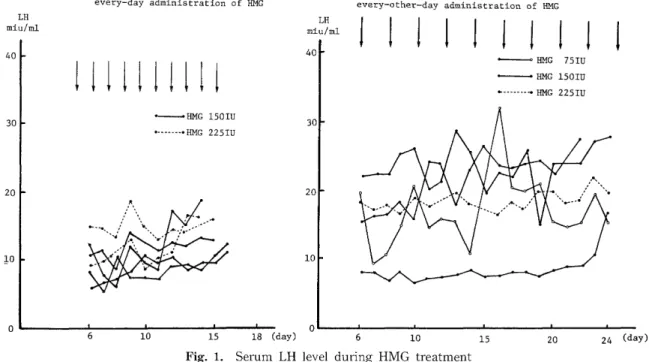
1) Changes in serum LH level (Fig. 1) No significant difference was observed bet- ween the 2 methods of every-day and every- other-day administration. Generally, in both methods, serum LH level remained constant although it slightly increased in a few cases.
2) Changes in serum FSH level (Fig. 2)
A gradual increase of serum FSH level was observed in cases administered every day and the degree of increase was more remarkable in 225 IU cases than in 1501U cases. Cases administered every other day with 2251U showed a tendency of gradual increase in much less degree compared to those ad- ministered every day with the same dose. In cases administered every other day with 751U or 1501U per day, an undulatory change was seen in the serum FSH level, indicating a tendency of little or no increase.
2. Ovulation rate, incidence of OHSS and pre- gnacy rate (Table 1)
The ovulation rate and incidence of OHSS by cycle were 69.2% and 22.2% respectively in the every-day administration, and 38.2% and 3.6%
respectively in the every-other-day administra- tion. It means that the ovulation rate was hig- her in the former method (p<0.001) while the incidence of OHSS was definitely lower in the latter (p<0.005). As to the pregnancy rate, the every-day administration showed a higher rate (52%) compared with the every-other-day ad- ministration (10%) (p<0.1). Multiple pregnancy was observed only in 3 cases (23.1%) adminis- tered every day and all were twins. In the 18
Fig. 1. Serum LH level during HMG treatment
Fig. 2. Serum FSH level during HMG treatment
Table 1. The Results of HMG administration with uniform daily and every-other daily dose
ovulation ovarian hypersti- Incidence of Incidence of
mulation syndrome pregnancies multiple pregnancies
A B A B A B A B
(cycle) (cycle) (cycle) (cycle) (cycle) (cycle) (cycle) (cycle)
Anovulatory 2/3 1/2 0/3 0/2 1/1 0/1 0/1
cycle (66.7%) (50.0%) (0%) (0%) (100%) (0%) (0%)
1st grade 35/45 8/19 15/45 2/19 1/7 1/3 0/1 0/1
amenorrhea (77.8%) (42.1%) (33.3%) (10.5%) (14.3%) (33.3%) (0%) (0%)
2nd grade 100/150 12/34 29/150 0/34 11/17 0/6 3/11
amenorrhea (66.7%) (35.3%) (19.3%) (0%) (64.7%) (0%) (27.3%)
Total 137/198° (69 21/55° 44/198°° 2/55°° 13/25"°Y 1/10*** 3/13 0/1 .2%) (38.2%) (22.2%) (3.6%) (52.0%) (10.0%) (23.1%) (0%)
*P<0 .001, **P<0.005, .,<** P<0.1
A : every-day administration
B : every-other-day administration
cases administered every day, the every-other- day administration was done several months later and the ovulation rate, incidence of OHSS and the days till the ovulation were examined in the respective administration methods (Table 2). The ovulation rate per treatment cycle was 70.1% in cases administered every day and 43.6%
in those administered every-other-day, showing
a significant difference between them(p<0.01).
The incidence of OHSS was 27.8% in the every- day administration and 2.6% in the every-other- day administration with a significant difference between them (p<0.005). The period till the ovulation was 15.3±3.4 days in cases admin- istered every day and 24.0±5.2 day in those administered every other day. The period till
Table 2. The Results of HMG administration on the same case with uniform daily and every-other daily dose
ovulation ovarian hyperstimu- l ation syndrome period till ovulation
case cycle case cycle
every-day 18/18* 68/97" 14/18"' '` 27/97'°15
.3±3.4 (69cycle)
administration (100%) (70.1%) (77.8%) (27.8%)
every-other-day 11/18: 17/39 1/39""""" 24.0±5.2 (9cycle)
administration (61.1%) (43.6%) (5.6%) (2.6%) 17.9±3.1 (9cycle)
P<0.025, P<0.01, P<0.001, P<0.005
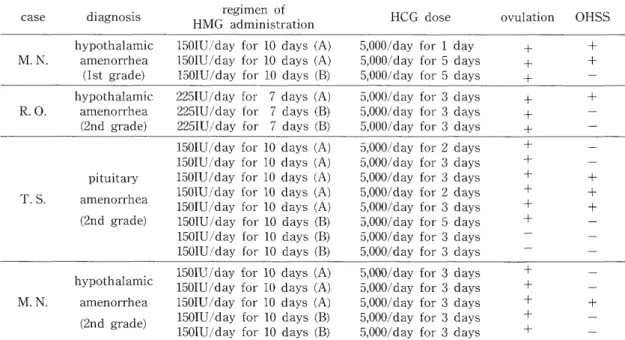
Table 3 Correlation between regimen of HMG administration and ovarian hyperstimulation syndrome (OHSS)
case diagnosis HMG regimen of HCG dose ovulation OHSS
administration
hypothalamic 1501U/day for 10 days (A) 5,000/day for 1 day + + M. N. amenorrhea 1501U/day for 10 days (A) 5,000/day for 5 days + +
(1st grade) 1501U/day for 10 days (B) 5,000/day for 5 days + -
hypothalamic 2251U/day for 7 days (A) 5,000/day for 3 days + +
R. 0. amenorrhea 2251U/day for 7 days (B) 5,000/day for 3 days + -
(2nd grade) 2251U/ /day for 7 days (B) 5,000/day for 3 days + -
1501U/day for 10 days (A) 5,000/day for 2 days + -
1501U/day for 10 days (A) 5,000/day for 3 days + -
pituitary 1501U/day for 10 days (A) 5,000/day for 3 days + +
T. S. amenorrhea 1501U/day for 10 days (A) 1501U/d 5,000/day for 2 days + + ay for 10 days (A) 5,000/day for 3 days + +
(2nd grade) 1501U/day for 10 days (B) 5,000/day for 5 days + -
1501U/day for 10 days (B) 5,000/day for 3 days - -
150IU/day for 10 days (B) 5,000/day for 3 days - -
1501U/day for 10 days (A) 5,000/day for 3 days + - hypothalamic 1501U/day for 10 days (A) 5
,000/day for 3 days + -
M. N. amenorrhea 150IU/day for 10 days (A) 5,000/day for 3 days + +
(2nd grade) 1501U/day for 10 days (B) 1501U/d 5,000/day for 3 days + -
ay for 10 days (B) 5,000/day for 3 days + -
A : every-day administration
B : every-other-day administration
Table 4. Number of follicles due to HMG-HCG Treatment No. of follicles No. of follicles R
egimen over 15mm in diameter
-
Every-day 5
.2±3.7 (78cycles)' 2.2±1.6 (78cycles) "*
administration
Every-other-day 3
.7±2.4 (39cycles)* 1.2±1.0 (39cycles)'k:k administration
P<0.05, * P<0.001 the ovulation in the every-other-day administra-
tion was shortend to 17.9±3.1 days when the administration of HMG was started on the se- cond day of hormone withdrawal bleeding.
Seeking the relation between the dosage of HCG and the incidence of OHSS, the dosage of HCG, ovulation and incidence of OHSS were examined in 4 cases where the dosage per day of HMG
and the total dose were equal (Table 3). As a result, the occurrence of OHSS was observed only in cases treated every day and it showed a tendency of repetition. There was found no definite difference in the dosage of HCG between cases with and without OHSS.
3. The number of follicles (Table 4)
The number of follicles observed in cases with every-day administration and those with every- other-day administration was 5.2±3.7 and 3.7--1- 2.4, respectively, showing a significant difference between them (p <0.05). The number of follicles of 15mm or more in diameter was significantly increased in cases administered every day (2.2--4- 1.6) than in those administered every other day (1.2±1.0) (p<0.001).
DISCUSSION
Yen et al.'' '' reported that the disapperance curve of serum FSH could be divided into two parts ; the early portion of fast process (initial component) and the subsequent later portion of slower process (second component) and its half-life was 3.9 hours in the early portion and 70.4 hours in the latter. The half-life of LH was 21 minutes and 3.9 hours, respectively. FSH has a much longer half-life than LH and this means that when HMG is administered, FSH in serum maintains a high level for a longer time than LH. It is predicted, therefore, that FSH and LH (especially FSH) accumulate gradually by ad- ministering HMG every day. As a matter of fact, FSH in serum clearly increased gradually by administering HMG every day. Above all, in cases administered with 2251U per day, the increasing curve was very sharp (Table 2).
This gradual increase of FSH level is. an un- physiological phenomenon, being not seen in the natural ovulatory cycle, and supposedly causes OHSS by developing and maturing a number of follicles simultaneously. On the other hand, serum FSH in cases treated with HMG every other day remained at the same level and such a remarkably rapid increase seen in cases administered every day was not observed even when the dosage was as large as 2251U per day (Fig 1). This fact suggests a possibility that administering HMG every other day may reduce the incidence of OHSS. Hereupon, the ovula-
tion rate and the incidence of OHSS were investigated in both administration methods.
As a result, the incidence of OHSS by the every-other-day administration was definitely lower than by the everyday administration (p<
0.005). Considering the individual difference, both administration methods were tried in the same cases, where similar results were obtain- ed. The incidence of OHSS was clearly lower in the every-other-day administration (p<0.001).
The incidence of OHSS per treatment cycle in the every-day administration in the present study (22.2%) was much higher than that of a nation-wide survey in Japan (5.3%), where the ovary larger than a goose egg size was judged as OHSS. The reasons why the rate was so high in the present study are at first that the subjects were not only cases not responding to clomiphene and secondly that the lowest limit of the ovarian diameter for OHSS was set to be 5cm. Even though no selection was made on cases and the criteria for OHSS was severe in this way, the incidence was only 3.6% in cases administered every-other-day. This fact means that this administration method is excellent from the viewpoint of preventing the occurrence of OHSS. The mode of administration and dosage of HCG could also be the cause of OHSS in the HMG-HCG therapy. Therefore, the rela- tion among the dosage of HCG and the in- cidence of HCG and the incidence of OHSS was examined in 4 cases where the dosage and administration method of HCG were identical to one another among cases treated by both administration methods. No specific relation ship has been observed in this respect, sug- gesting that the administration method of HMG rather than the dosage of HCG affects the occurrence of OHSS more closely. From what has been mentioned above, it is concluded that the every-other-day administration of HMG is a very useful method with less incidence of OHSS. On the other hand, it has a demerit of low ovulation and pregnancy rate. However, the ovulation rate gets higher by increasing the dosage of HMG per day in the every-other-day administration, i. e., increasing from 751U per day to 1501U or 2251U. In the every-other-day administration, a tendency of delayed ovulation was observed, supposedly lowering the preg-
nancy rate. Regarding this point, the period till the ovulation may approach that in the every- day administration method by starting the dose in an early stage such as on the 2nd day of hormone withdrawal bleeding.
Another side effect of HMG-HCG therapy is multiple pregnancy which is due to multiple ovulation. For its prevention it is necessary to reduce the development of mature follicles as much as possible. The number of ovulatable follicles of 15mm or more in diameter was def- initely smaller in the every-other-day adminis- tration than in the every-day administration (p<
0.001). This means that the possibility of mul- tiple pregnancy is lower in the every-other-day administration method. Considering the serious influences of multiple pregnancy on mothers and fetuses, the every-other-day administration could be the first choice in spite of its lower ovulation rate.
2) Morisaki M, Okamoto S, Ishimaru T , Kajimuta H, Yamabe T. Prevention of the ovarian hyper-
stimulation syndrome (apply the ultrasonogra-
phy on the estimation of cut surface area of follicles). Obstetrics & Gynecology Jap., 50: 365-
369, 1983.
3) Jewelewicz, R. and Vande W. R. L.: Acute hy- drothorax as the only symptom of ovarian hy-
perstimulation syndrome. AM J. Obstet. Gyne-
col., 121 : 1121, 1975.
4) Yen, S. S. C., Llerena, L. A. and Pearson, O. H.:
Disappearance rates of endogenous luteinizing
hormone and chorionic ganadotropin in man.
J. Clin. Endocrinol., 28: 1963, 1968.
5) Yen, S. S. C., Llerena, L. A. and pearson, 0. H.
and Littell, A. S.: Disappearance rates of
endogenous follicle stimulating hormone in
serum following surgical hypophysectomy in
man. J. Clin. Endocrinol., 30: 325, 1970.
REFERENCES
1) Donald, R.: Monitoring induction of ovulation with human menopausal gonadotropin by a
rapid estrogen radioimmunoassay. Am. J Obstet.
Gynecol, 120: 1035, 1974.