• 検索結果がありません。

Studies on Sex Chromatin in Thyroid Diseases - Especially Tumors of Thyroid Gland -

N/A
N/A
Protected

Academic year: 2021

シェア "Studies on Sex Chromatin in Thyroid Diseases - Especially Tumors of Thyroid Gland -"

Copied!
17
0
0

読み込み中.... (全文を見る)

全文

(1)

Acta med. Nagasaki 16 : 12-28

Studies on Sex Chromatin in Thyroid Diseases - Especially Tumors of Thyroid Gland -

Jituhiro ISHIGAKI * Second Department of Surgery, Nagasaki University School of Medicine,

Nagasaki, Japan

Received for Publication, October 1, 1971

Thyroid tissues obtained from 360 cases by means of operation were classified pathohistologically into normal thyroid, benign thyroid diseases and malignant thyroid tumors and stained by FEULGEN' S method. Sex chromatins of follicular epithelial cells (tumor cells) and interstitial cells were counted for each case and incidence of sex chromatin was compared among those groups.

The specimens used in the present study were all obtained from female subjects ranging in age from 15 to 77. In most cases of normal thyroid and benign thyroid diseases, incidence of sex chromatin showed more than 30%.

However, in 2/3 of the cases of so-called malignant adenoma where capsular invasion was verified, incidence of sex chromatin was less than 30% in the very region of the capsular invasion but over 30% in the uninvaded region.

In the cases of thyroid cancer, incidence of sex chromatin was less than 30%. It was higher in papillary adenocarcinoma and follicular adeno- carcinoma than undifferentiated carcinoma. There was hardly noted any difference in incidence of sex chromatin between the primary lesion and the metastasized lesion in the lymph node.

Variation in incidence of sex chromatin by age was not recognized in the disease groups but only in the group of normal thyroid.

INTRODUCTION

In 1959, BARR and BERTRAMO found nucleoli measuring 1,a in size in the nucleus of the hypoglossal nerve cells of the cat. Since the nucleoli were found only in the female cat, they considered these nucleoli related to sex and named them as sex chromatins.

Sex chromatins are generally basophile and show strong positive reaction to FEULGEN'S 'staining. They are hemispheric or flat in shape

*石 垣 実 弘

(2)

and are either attached to the inside of the nuclear membrane of free within the nuclear substance.

Sex chromatins have been verified in the epithelial cells of the oral cavity, vagina and urinary tract and in various tissues of the skin, leukocyte and others of animals and man.

Sex chromatins are frequently found in the cell nucleus of females and rarely in the cell nucleus of males. In this respect, sex chroma- tins are used clinically for sex distinction particularly , for intersex and are considered indispensable for sex determination of ndividuals .

The idea of sex determination has been introduced,: to character of

tumor by examination of the rate of content of sex chromatins in the tumor cells. However, as HUNTER and LENNOx9) observed in teratoma in 1954, the sex of the host and the sex determined by the incidence of sex chromatin are not always identical.

Concerning sex chromatin in tumor, many studies have been made since then by TAVARES24> , CRUICKSHANK3>, SOHVAL22) , EMERY and

MCMILLAN5), LEHMAN11), BARR and MOORE2., HIENZ and EHLER8) , ZANNELLA28) , GRAF6), MYERSI %. and other investigators. As the result,

it has been clarified that the sex of the host of tumor and the sex determined from the incidence of sex chromatin in tumor are generally

identical but in tumors of endocrine organs such as pheochromocyto- ma, mammary tumor and prostatic tumor, they are not identical with a fairly high frequency.

Furthermore, studies are being made to see whether or not incidence of sex chromatin is useful as an index to determine the adaptability of hormone therapy for tumors of endocrine organs parti- cularly for mammary tumor and prostatic tumor. It has been conside- red to be available as a means to estimate the degree of the dependency of cancer cells on hormone. In order to examine if incidence of sex chromatin is a useful index of horomone therapy for thyroid tumor, the author counted sex chromatins in the thyroid in various conditions, and studied the relationship between incidence of sex chromatin in tumor cells and the nature (malignancy or benignity) of tumor.

MATERIALS AND METHODS

The materials used in the present study were specimens of thyroid tissue obtained from 360 cases by operation at the Second Department of Surgery of NAGASAKI UNIVERSITY HOSPITAL and the NOGUCHI HOSPITAL

in BEPPU CITY during the four-year period from 1965 to 1968. Patho- histological diagnosis was established for all these cases.

These 360 cases consisted of 36 cases of normal thyroid, 60 cases

of diffuse goiter with hyperthyroidism, 16 cases of chronic thyroiditis,

8 cases of adenomatous goiter, 60 cases of adenoma, 60 cases of

(3)

so-called malignant adenoma and 120 cases of thyroid cancer. For these cases, pathohistological

diagnosis was first established upon HE stain and incidence of

sex chromatin was calculated with sections of FEULGEN'S stain.

(Table 1)

For calculation of sex chro- matins, 1000x oil immersion microscopy was used and 100 cell nuclei each at three different areas , , of a section, totalling 300 cell nuclei, were examined for the presence of sex chromatin and the percentage of sex chro-

Table I .

Incidence o` Sex Chromatin in Various Thyroid Diseaes (360 Cases)

Pathological Diagnosis No. of C ases Range (%) Mean (%) Normal Thyroid Gland 36 35-80 50

Chronic Thyroiditis 16 26-46 34

Adenomatous Goiter 8 29-52 41

Diffuse Goiter with 60 31-63 45 Hyperthyroidism

Adenoma 60 29-78 44

Malignant Adenoma 60 11-68 30

Thyroid Cancer 120 5-42 21

matin positive cells was used as incidence of sex chromatin.

At the time of microscopic examination, those cells which were clearly visible and whose nuclei were not overlapped with. others were selected as the objects of calculation. Those nucleoli measuring 1 V in size attached to the nuclear membrane and shaped somewhat rounded or flattened hemispheric were calculated as chromatins ; those which were free in the nucleolus and nuclear substance, vaguely demarcated or irregular-shaped were excluded from calculation. (Photo 2)

Photo. 2 Many Sex Chromatin are present in the follicular epithelial cells in a -patient s ith "adenoma of thyroid gland. (Feulgen's stain, x 1000)

A picture on the upper right side is that in high po-.2 er, Sex Chro-

matins are rounded or hemispheric in shape and tightly attached to

the unclear menbrane. (x 1400, Feulgen's stain)

(4)

The calculation of such sex chromatins was conducted , separately for follicular epithelial cells (tumor cells) and interstitial- cells.

RESULTS

In the 36 cases of normal thyroid, the function and histo- logical findings were normal and the specimens were obtained mostly by incisional biopsy. The incidence of sex chromatin in the follicular epithelial cells ranged from 35% to 80%, the mean value being 50%. The incidence in the interstitial cells was bet- ween 29% and 57% with the mean of 39%. Thus the former was higher than the latter show- ing statistically significant dif- ference (P=0.05). (Fig. 1)

As to the relationship bet- ween age and incidence of sex chromatin in the cases of normal thyroid, the mean incidence in the follicular epithelial cells was 66.1% in teenage, 59% in 20's, 54% in 30's, 42.5% in 40's, 44.2

% in 50's and 46.2% in 60's or more. The incidence of sex chromatin gradually decreased

as the age advanced up to 40's and thereafter remained almost constant ranging from 40% to 45

%. On the other hand, the mean incidence of sex chromatin in the interstitial cells of normal thyroid was 41.5% in teenage, 59% in 20's, 42% in 30's, 37%

in 40's, 42% in 50's and 40% in 60's or more. Whereas nearly 60% was indicated for 20's, the values for other age groups were almost constant, being approxi- mately 40%. (Fig. 2)

Fig. 1. Incidence of Sex Chromatin in Normal Thyroid Gland

1: Follicular Epithelial Cells

2: Interstitial Cells

(5)

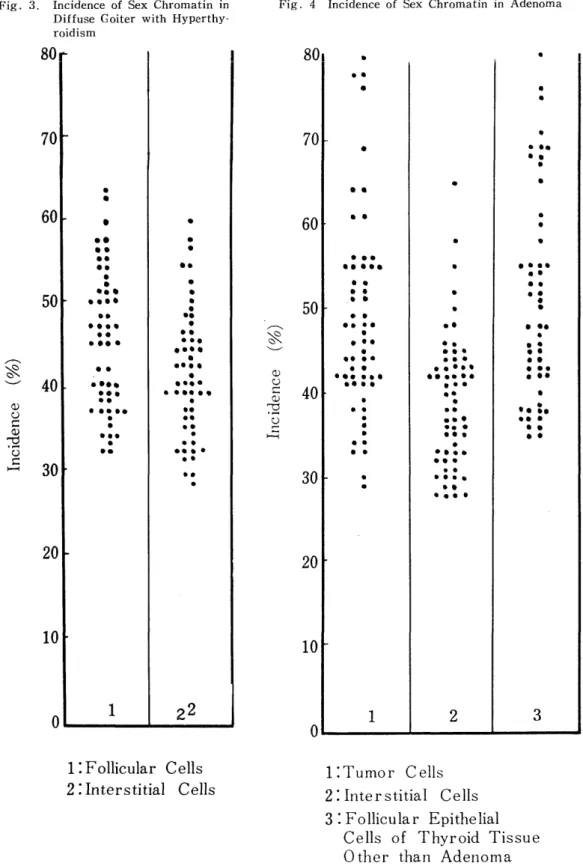
In the 60 cases of diffuse goiter with hyperthyroidism, the inci- dence of sex chromatin in the follicular epithelial cells ranged from 31% to 63%, the mean value being 45%. The incidence in the interstitial cells ranged from 28% to 60% with the mean of 39%. No significant difference was noted between the two incidences nor was observed any specific change due to age. (Fig. 3)

The incidence of sex chromatin in the 16 cases of chronic thyroi- ditis was calculated only in the follicular epithelial cells and it ranged from 26% to 46% with the mean of W/o.

The incidence of sex chromatin in the 8 cases of adenomatous goiter was calculated in the follicular epithelial cells and it ranged from 29% to 52% with the mean of 41%. Calculation in the interstitial cells was not performed. (Table 2)

Fig. 2. Variation in Incidence of Sex Chromatin by Age

(6)

Fig. 3. Incidence of Sex Chromatin in Diffuse Goiter with Hyperthy-

roidism

Fig. 4 Incidence of Sex Chromatin in Adenoma

1: Follicular Cells 2:Interstitial Cells

1:Tumor Cells 2: Interstitial Cells 3 : Follicular Epithelial

Cells of Thyroid Tissue

Other than Adenoma

(7)

In the 60 cases of adenoma of the thyroid, sex chromatins were calculated in three constitu- ent parts of thyroid, namely, tumor cells, interstitial cells of the capsule of adenoma and folli- cular epithelial cells of normal thyroid tissue other than adeno- ma, and the incidence was com- pared among the three parts.

Table 2.

Tissue Type and Sex Chromatin in Thyroid Cancer

Tissue Type No. of Range Mean Cases (/

o) (/o) Papillary Adenocarcioma 63 53-32 19 Follicular Aeenocarcinoma 49 10-42 22 Undifferentiated Carcinoma 8 10-20 15

The incidence in the tumor cells of adenoma ranged from 29% to 78%

but in most of the cases from 40% to 60% indicating the mean value of 44%. The incidence of sex chromatin in the interstitial cells of the capsule of adenoma showed the mean value of 39% ranging from 28%

to 65%. In the follicular epithelial cells of normal thyroid tissue other than adenoma, the mean value was 49% ranging from 34% to 80%. No significant difference (P= 0.05) was noted between the incidence of sex chromatin in the tumor cells of adenoma and that in the follicular epithelial cells of the normal part. However, the inci- dence in the interstitial cells of the capsule was significantly lower

(P=0.05) than the incidence in the other two parts. (Fig. 4)

Fig. 5. Schema of So-Called Malignant Adenoma

1 : Tumor Cells with Capsular Invasion 2 Tumor Cells without Capsular Invasion

3 : Follicular Epithelial Cells of Normal Parts outside the Capsule

(8)

The author has heretofore described the ranges and mean values of incidence of sex chromatin in the follicular epithelial cells and interstitial cells of the normal thyroid and the thyroid tissue of benign

Fig. 6. Incidence of Sex Chromatin in So- Called Malignant A- enoma

1 : Tumor Cells with Capsular Invasion

2 : Tumor Cells without Capsular Invasion

3 : Follicular Epithelial Cells of Normal Parts outside the Capsule

thyroid diseases such as diffuse goiter with hyper- thyroidism, chronic thy- roiditis, adenoma and adenomatous goiter. The mean value of the inci- dence of sex chromatin in the follicular epithelial cells was 50% in normal thyroid, 45% in diffuse goiter with hyperthyroidi- sm, 44% in adenoma, 41

% in adenomatous goiter and 34% in chronic thy- roiditis; the value was the highest in the normal thyroid and the lawest in chrodic thyroiditis. The relationship between the age and incidence of sex chromatin is as stated previously in this paper.

In the. follicular epithelial cells of normal thyroid, the incidence of sex chro- matin gradually decreased as the age advanced but afer age 40 it remained almost constant indicating the value of approximate-

ly 40% . No specific

rleation between age and

incidence of sex chroma-

tin was noted in the

follicular epithelial cells

or tumor cells as well

as in the interstitial cells

of benign thyroid diseas-

es. Anyhow, the inciden-

ce `of sex chromatin in

the follicular epithelial

cells and the interstitial

(9)

cells of benign thyroid diseases was over 30% in most of the cases.

(Table 1, Fig. 2)

In 60 cases of so-called "malignant adenoma of the thyroid" which was diagnosed because of the evidence of capsular invasion, the incidence of sex chromatin in the follicular epithelial cells of seeming- ly normal parts outside the capsule showed the mean value of 48%

ranging from 30% to 67%.

The incidence of sex chromatin in the tumor cells of the region without capsular invasion within so-called malignant adenoma of the thyroid was 37% in mean value ranging from 20% to 58%. There

Photo. 1 This picture shows a capsular invasion (arrow) of so-called Maliguant Adenoma. (x 100. H-E stain)

Photo. 3 Sex Chromatin is seldom seen in the nuclei of papillary adenocarcinoma

cells of thyroid gland (X1400. Feulgen s stain)

(10)

were only 9 cases out of 60 that showed the value less than 30% . The incidence in the tumor cells with capsular invasion in the cases of so-called malignant adenoma of the thyroid ranged widely from 11%

to 68'% but the incidence less than 30% was noted in 39 cases out of 60 or in 2/3 of the cases,

The difference in inci- dence of sex chromatin among three regions in the follicular epithelial cells of so-called malignant adenoma was significant.

The incidence was lower in the region of malig- nant adenoma than in the seemingly normal region.

Within the regions of malignant adenoma, the incidence was the lowest in the region of capsular invasion. (Fig. 5, 6 ) (Photo. 1)

For calculation of sex chromatins in the cases of thyroid cancer, which was classified by UICC (International Union against Cancer) classifica- tion into papillary adeno- carcinoma, follicular ade- nocarcinoma and undiffe- rentiated carcinoma, sex chromatins were counted in cancer cells and inter- stitial cells respectively.

Sex chromatins were also counted in the follicular epithelial cells of normal regions without cancer invasion. For the cases of metastasized thyroid cancer, calculation of sex chromatins was made in the primary lesions and metastasized lesion in the lymph nodes and the

Fig. 7 Incidence of Sex Chromati in Thyroid Cancer

1: Cancer Cells 2:Interstitial Cells 3 : Follicular Epithelial

Cells outside Thyroid

Cancer

(11)

incidence in the two lesions were compared.

The incidence of sex chromatin in the cancer cells in 63 cases of papillary adenocarcinoma was 19% in mean ranging from 5% to 32%.

The incidence in the cancer cells in 49 cases of follicular adenocarcino- ma ranged from 10% to 42% with the mean of 22% which was some- what lower than that in the cases of papillary adenocarcinoma.

However, there was no significant difference (P=0.05) between two

Fig. 8. Incidence of Sex Chromatin in Occult Sclerosing Carcinoma

Present in Diffuse Coiter with

Hyperthyroidism

Eig. 9. Incidence of Sex Chromat in Metstasized Carcinoma to

Lymph Node (60 Cases)

1: Cancer Cells

2 : Hyperfunctional Follicular Epithelial Cells Surrounding

the Cancer

1: Primary Lesion

2 : Nodal Metastasis

(12)

groups. (Photo. 3)

In the 8 cases of undifferentiated carcinoma of the thyroid, the incidence was from 10% to 20% with the mean of 15%. This value in the undifferentiated cases was lower as compared with that in the differentiated cases of papillary and follicular adenocarcinomas.

(Table 2)

The incidence of sex chromatin in the interstitial cells in the total cases of thyroid cancer ranged from 20% to 61% with the mean of 37%. The incidence in the follicular epithelial cells of normal region without invasion of thyroid cancer ranged from 26% to 58% with the mean of 45%. (Fig. 7)

For the 19 cases of occult sclerosing carcinoma of the thyroid accompanied by BASEDOw's disease, the incidence in the cancer cells ranged from 11% to 37% with the mean of 21% and that in the hyperfunctioned follicular epithelial cells surrounding the concer ranged from 39% to 62% with the mean of 51%. The difference between the two incidences was significant, the former being lower. (Fig. 8)

For the 56 cases of metastasized thyroid cancer to the lymph nodes, the incidence of sex chromatin in the primary lesion was compared with that in the metastasized lesion. The former ranged

from 4% to 37% with the mean of 21% and the latter ranged from 2%

to 36% with the mean of 18%. There was no significant difference (P=0.05) between the two. (Fig. 9)

Upon classifying thyroid cancer into papillary adenocarcinoma, follicular adenocarcinoma and undifferentiated carcinoma according to the UICC classification of thyroid cancer tissue, the incidence of sex chromatin was compared among these groups. Of the three, undiffe- rentiated carcinoma showed evidently lower value than papillary and follicular adenocarcinomas which are differentiated carcinomas. There was no significant difference in incidence of sex chromatin between the primary lesion and the metastasized lesion.

In the cases of occult sclerosing carcinoma of the thyroid occur- ring in diffuse goiter with hyperthyroidism, the incedence of sex chromatin was high in the region of hyperfunction without carcinoma and markedly low in the region of carcinoma as compared witn the former .

DISCUSSION

Sex chromatin was first discovered by BARRu in 1949 and since then it has been used for the determination of sex in genetics.

Concerning the origin of sex chromatin, MOORE, GRAHAM and BARR13)

described that the two X chromosomes in the cell or static nucleus are

fused mutually at the heterochromatic region and sex chromatin is

(13)

dense and large in females because of the presence of XX but is hardly recognized in males because of the presence of only one X chromosome.

On the other hand, ON019) and STEWART23) explained thet one of the two X chromosomes is metabolically active and enlarged so as not to be recognizable but the other one is in pause and entirely condensed to form a sex chromatin. This theory is in compliance with the report of JACOBS10) and others that the number of sex chromatins is always one less than that of sex chromosomes with two or more X chromosomes.

DAVIDSON and SMITH°U) recognized sex chromatin or "Dramstick" in neutrophile leucocyte and reported that the incidence was 2-3% in females and nearly zero in mals.

As to the incidence of sex chromatin in various normal tissues of man, it has been reported to be 62-82% in females and 2-21% in males by MOORE and BARR2); 13-39% in females and 0-4% in males by GRAF and MAZOLI6); 0-9% in males but 0-5% in the overwhelming majority of males and 25-54% in females by EMERY and MCMILLAN5).

RODERMUND21) reported the incidence to be 29-50% in females and mean of 10% in males with no case over 20%. TAYLOR26) reported that incidence of sex chromatin in female infants was 10-20% being lower than that in adults; EMERY5) reported that there was no differen- ce in incidence of sex chromatin between infants and adults.

At present, there is no adequate explanation for the fact that the incidence of sex chromatin in females is actually less than 100% while it should be 100% theoretically. This may be due to various factors such as staining, thickness of section, different distribution of sex chromatins within the nucleus, various stages of mitosis and chromo- some aberrations.

Specimens were stained by FEULGEN'S method. Since this method is generally difficult, the stained specimens may be considered satis- factory as long as sex chromatins in the interstitial cells are countable.

However, if it is difficult to count the sex chromatins in any specimen due to unsatisfactory staining, the specimen should be excluded from calculation and should be restained.

The specimens of thyroid cancer showed poor reaction to Feulgen's stain often requiring restaining. Those of undifferentiated carcinoma generally showed satisfactory staining.

JAMES11) found nucleoli (sex chromatins) larger than other nucleoli in 70-80% of cell nuclei and stated that those nucleoli attached to the nuclear membrane are the typical sex chromatins which occupy 51%

and free nucleoli within the nuclear substance occupy as much as 28% .

MYERS17) reported that sex chromatins attached to the nuclear

membrane were found in 50 out of 61 fibroblasts and those free within

(14)

the nuclear substance or adjacent to the karyosome were quite rare and difficult to distinguish from other nucleoli, and hence these were not actually, counted. For the same reason, the author also excluded these free sex chromatins from calculation and counted only those typical ones attached to the nuclear membrane.

JAMES11) confirmed that, in the process of mytosis, sex chromatin is recognized up to the prophase but disappears in the metaphase and appears again in the telephase.

The incidence of sex chromatin may vary by the thickness of histological specimen ... if the specimen is too thick, cells will be overlapped and sex chromatins will not be clearly seen ; and if the specimen is too thin, the number of sex chromatins to be counted will be small. Hence it is necessary to prepare all specimens at the same thickness. In the present study, the thickness was maintained to be 6a.

With the smears of exforiative cells of the oral mucous membrane which require no consideration of the thickness of section, the values of the incidence of sex chromatin should be more accurate than those with the other specimens mentioned above. However, even with the smears of the oral mucous membrane, the incidence of sex chromatin in the cells of females has been reported to be 40 - 60% by Moore and BARR13) and 20-79% by NELSON18). Thus, there seems to be some factor which causes the incidence in females to be less than 100%

irrespective of the thickness of section.

Some reports indicated that the incidence of sex chromatin varies by menstrual cycle and administration of antibiotics.

In 1954, HUNTER and LENNOX9) reported that the incidence of sex chromatin in the 12 female cases of teratoma showed as high value as that in normal females; and that 4 out of the 9 male cases of teratoma showed low value of 0-5% which is identical to the value in normal males but 5 other cases were of female type, thus indicating discre- pancy in sex between the host and tumor cells. This report was followed by the studies on sex chromatin of tumors by TAVARES25), BARR and MOORE13. Subsequently, studies were made on sex chromatin in prostate hypertrophy and mammary cancer and sex chromatin has been examined as the index of hormone dependency and hormone therapy of mammary cancer. At present it is still unknown as to under what condition of tumor particularly of cancer cells the inciden- ce of sex chromatin decreases. However, direct effect of sex hormone on cancer cells, and quantitative and qualitative aberration of chromo- somes in the tumor cell nucleus are considered as big factors causing decreased incidence of sex chromatin in cancer cells.

It has also been reported by HIENZ and EHLER8), WANKE, GRAF and

MAZOLI27), MYERS17), and HARADA7j that the incidence of sex chromatin

in mammary cancer is related to the degree of morphological differen-

(15)

tiation and moreover, even within the same type of tissue, low inci- dence of sex chromatin results in poor prognosis but high incidence generally results in good prognosis. Thus, the incidence of sex chromatin in cancer cells was studied in relation to the degree of histological differentiation and further to the degree of functional differentiation, and it has been considered to be available as a means to estimate the degree of the dependency of cancer cells on hormone.

From this point of view, the author carried out a survey on the incidence of sex chromatin in tumors which frequently occur in the

thyroid of females. The normal thyroid specimens used in the present

study were those obtained mostly by incisional biopsy from the patients who visited the hospitals with some complaint but whose histological examination revealed no abnormality. The incidence of sex chromatin in the follicular epithelial cells of normal thyroid was 50% in mean indicating a higher value than that in the cases of benign thyroid diseases: 45% in diffuse goiter with hyperthyroidism, 44% in adenoma and 41% in adenomatous goiter. However, no significant difference (P=0.05) was noted among all these groups.

As to the relationship between the incidence of sex chromatin in the follicular epithelial cells (or tumor cells) and age, the mean value under age 19 was 61% and gradually decreased along with the advance- ment of age marking approximately 40% over age 40. In the cases of benign or malignant thyroid diseases other than normal thyroid, there was no specific relationship between the incidence of sex chromatin and age.

In the interstitial cells, survey on the incidence of sex chromatin was made mostly for f ibroblast and f ibrocyte . The mean values were 39% in normal thyroid, 39.9% in diffuse goiter with hyperthyroidism, 39.1% in adenoma, and 37.1% in cancer. Though the last value was somewhat lower than the others, there was no significant difference among these various groups.

Adenoma was diagnosed to be malignant when pathological exami- nation revealed capsular invasion. For these cases, the incidence of sex chromatin was calculated in the region of copsular invasion but not in the region of vascular invasion nor in the region of metastasis to the lymph nodes. In the region of capsular invasion in malignant adenoma, the value was as low as 30% or less in 2/3 of the cases.

In the cases of thyroid cancer, the incidence of sex chromatin was 21% in mean. Of the 120 cases, only 7 cases consisting of 3 follicular type cases and 4 papillary type cases indicated the incidence over 30%.

In other words, the incidence of sex chromatin in cancer cells in most of the cases of thyroid cancer is under 30% being remarkably low as compared with the value for adenoma. The value of 30%

being the border, most of the cases of bening adenoma indicate values

over 30% and most of the cases of cancer indicate values under 30%.

(16)

CONCLUSION

The incidence of sex chromatin in thyroid tissues in various con- ditions showed histological relationship to, the degree of morphological differentiation. It was over 30% in benign thyroid diseases and under 30% in malignant diseases.

The incidence of sex chromatin in thyroid diseases may be an auxiliary guide to classify the diseases and may also be used for the determination of prognosis.

ACKNOWLEDGEMENT

The author wishes to express his sincere gratitude to Professor Ryoichi TSUCHIYA for his kind review of the paper. Gratitude is also due to Dr.

Takashi HIRAI, former professor of the department, and Asst Professor

Yoshiyuki SHO for their guidance, Dr. Akito NOGUCHI, director of the Noguchi Hospital, for his presentation of materials, and Dr. Noboru HARADA

for his continued cooperation.

REFERENCES

1) BARR, M.L. and BERTRUM, E. G. : A Morphological Distinction between Neurons of the Male and Female and Behaviour of the Nucleolar Satellite during Accelerated

Nucleoprotein Synthesis. Nature 163: 676-677, 1947.

2) BARR, M. L. and MOORE, K. L. : Chromosome, Sex-Chromatin, and Cancer.

Cand. Cancer ConF. 2 : 3-16, 1957.

3) CRUICKSHANK, D. B. Sex of Mediastinal Teratoma. Lancet 1 : 253, 1953.

4) DAVIDSON, W. M. and SMITH, D. R. : A Morphological Sex Difference in the Polymorphonuclear Neutrophil Leucocytes. Brit. Med. J. 2 : 6-7, 1954.

5) EMERY, J. and MCMILLAN, M. : Observation on the Female Sex Chromatin in Human Epidermis and on the Value of Skin Biopsy Determinating Sex. J. Path. Bact.

LXVIII : 17-22, 1954.

6) GRAF, R. and MAZOLI, G. P. : Das Zellkernmorphologische Geschlecht von Tumo- ren endokrinbeeinflussbaren Organe. Bruns' Beit. KGin. Chir. 202 : 242-252, 1954.

7) HARADA, N. : Observation on Sex Chromatin in Breast Diseases, Particularly with

Regard to Breast Cancer. : Nagasaki Med. J. 43 : 932-951, 1968.

8) HIENZ, H.A. and EHLERS, P.N. : Das zellmorphologische Geschlecht von Mamma- und Prostata-Carcinomen. KGin, Wschr. 35 : 985, 1957.

9) HUNTER, W. F. and LENNOX, B. : The Sex of Teratoma. Lancet 2 : 633-634, 1954.

10) JACOB, P. J. et al. : Cytogenic Studies in Primary Amenorrhoea. Lancet I : 1183 -1189, 1961.

11) JAMES, J. : Observation on the So-called Sex-Chromatin. Zellforschun,- 51 596- 597, 1960.

12) LEHMAN, T. H . , HODGES, C. V. and OYAMADA, A. : Nuclear Sex-Chromatin

Differentiationin Benign and Malignant Prostatic Tumors. J. Uro'ojy 81 : 172-177, 1959.

13) MOORE, K. L., GRAHAM, M. A. and BARR, M.L. : Detection of Chromosal Sex in Heterophroditis from the Skin. Sirg. Gyn. Obst. 96 : 641-648, 1953.

14) MOORE, K. L., GRAHAM, M. A. and BARR, M. L. : A Sex Difference in the

Morphology of Metabolic Nuclei in Somatic Cell of the Cat. Anat. Res. 112: 709-

(17)

723, 1952.

15) MOORE, K. L. and BARR, M. L. : Morphology of the Nerve Cell Nucleus in Mammals, with Special Reference to the Sex Chromatin. J. Compt. Neurol. 93

213-231, 1953.

16) MOORE, K. L. and BARR, M. L. : Smear from the Oral Mucosa in the Detection of Chromosomal Sex. Lan^et 11 : 57-58, 1955.

17) MYERS, L. M. : Sex-Chromatin in Normal Tissue and Non-Teratomatous Tumors.

J. Path. Bact. 78 29-42, 1959.

18) NELSON, W. O. Sex Differences in Nuclei with Particular Reference to the Kleinfelter's Syndrome. Acta. Endocr..27 : 277-280, 1956.

19) ONO, S. and MAKINO, S. : The Single X-Nature of Sex Chromatin in Man. Lancet 1 : 78-79, 1961.

20) PEARSON, O. H., WEST, C. D., MCLANE, J. P. and LIOSETT, M. B. : Endocrine Treatment of Metastatic Breast Cancer. Amer. S.trg. 11 : 1075-1083.

21) RODERMUND, O. R. : Ueber das "Geschlechtschromatin" in Geschwuelsten. Zschr.

Krebsforsch. 61 : 259-262, 1952.

22) SOxvAL, A. R. and GAINES, J. A. : Sexual Difference in Nuclear Morpology of Tumors, Inflammation, Hyperplasia, and Swuamous Metaplasia. Cancer 8 : 896-

902, 1955.

23) STWART, S. 5. and SANDERSON A. R. : Sex-Chromatin Body in Normal Human Testis. Lancet II : 79-80, 1961.

24) TAVARES, A. S. : On the Sex of Cancer and Teratoma Cells. Lancet I : 948-949, 1955.

25) TAVARES, A. S. Nuclear "Sex" in undifferentiaed-Cell Carcinoma. J. Path. Bact.

LXXIV : 25-29, 1957.

26) TAYLOR, A. I. Sex-Chromatin in the Newborn. Lancet I : 912-914, 1963.

27) WANKE, R., GRAF, R. and MAZOLI-KIEL, G. P. : Grundsatzliches zur endo-krinen Chirurgie and Therapie maligner Tumoren. Langenbeck's Arch. Klin. Chir. 295

96-101, 1960.

28) ZANNELLA, E., PERCHIA, A. and CAMPO, L. : Ueber die Bedeutungslosigkeit des Geschlechtschromatins fuer die Behandlung von Tumoren abhangiger Organe. Zschr.

Krebsfo rsch . 64 : 83 :87, 1961.

Fig.  1.  Incidence  of  Sex  Chromatin  in         Normal Thyroid Gland
Fig.  2.  Variation  in  Incidence  of  Sex  Chromatin  by  Age
Fig.  3.  Incidence  of  Sex  Chromatin  in         Diffuse Goiter with
Fig.  6.  Incidence  of  Sex  Chromatin  in  So-         Called Malignant A-  enoma
+3

参照

関連したドキュメント

According to immunohistochemical studies of gastric carcinomas, MT-MMP-1 is predominantly localized in and on carcinoma cells {30). On the other hand, gelatinase A is

Contrast-enhanced computed tomography revealed a 20 mm polypoid tumor in the dilated distal bile duct, which exhibited early enhancement and papillary

of ISE

Two grid diagrams of the same link can be obtained from each other by a finite sequence of the following elementary moves.. • stabilization

Although the holonomy gives infinitely many tight contact structures up to isotopy (fixing the boundary), this turns out to be a special feature of the nonrotative case. This

The main problem upon which most of the geometric topology is based is that of classifying and comparing the various supplementary structures that can be imposed on a

Then it follows immediately from a suitable version of “Hensel’s Lemma” [cf., e.g., the argument of [4], Lemma 2.1] that S may be obtained, as the notation suggests, as the m A

類内膜腺癌 Endometrioid adenocarcinoma 8380/3 明細胞腺癌 Clear cell adenocarcinoma 8310/3 粘液型腺癌 Mucinous adenocarcinoma 8480/3 中腎性腺癌 Mesonephric