
学位論文
Dark Matter in the Minimal U(1)X Extended Standard Model (最小U(1)X拡張標準模型におけるダークマターの研究)
March, 2018
Graduate School of Science and Engineering Yamagata University
Satomi Okada
Doctoral thesis
Dark Matter in the Minimal U(1)X Extended Standard Model
March, 2018
Graduate School of Science and Engineering Yamagata University
Satomi Okada
Abstract
The Standard Model (SM) of particle physics is the best theory to describe elementary particles and fundamental interactions among them (strong, weak, and electromagnetic interactions), and agrees with a number of experimental results in a high accuracy. Despite of its success, there are some observational problems that the SM cannot account for.
There are two missing pieces in the SM. One is the neutrino masses and neutrino flavor mixings, which are observed through the neutrino oscillation phenomena. The other is a dark matter candidate. Current cosmological observations have established the existence of dark matter in the universe. However no suitable dark matter candidate is not included in the SM particle content. We need to extend the SM to supplement these missing pieces into the SM.
In this thesis, we first consider a dark matter scenario in the minimal gauged B −L extension of the SM, where the global B − L (baryon number minus lepton number) symmetry in the SM is gauged, and three generations of right-handed neutrinos and a B−LHiggs field are introduced. Associated with theB−Lgauge symmetry breaking by a vacuum expectation value of theB−LHiggs field, the seesaw mechanism for generating the neutrino mass is automatically implemented after the electroweak symmetry breaking in the SM. In this model context, we introduce a Z2 symmetry and assign an odd parity for one right-handed neutrino while even parities for the other fields. The dark matter candidate is identified as the right-handed Majorana neutrino with Z2-odd. The so- called minimal seesaw is implemented in this model with only two Z2-even right-handed neutrinos. When the dark matter particle communicates with the SM particles mainly through the B −L gauge boson (ZB′ −L boson), its relic density is determined by only three free parameters, theB−Lgauge coupling (αB−L), the ZB′ −Lboson mass (mZ′) and the dark matter mass (mDM). With the cosmological upper bound on the dark matter relic density, we find a lower bound on αB−L as a function of mZ′. On the other hand,
we interpret the recent LHC Run-2 results on search forZ′ boson resonance to an upper bound on αB−L as a function of mZ′. Combining the two results we identify an allowed parameter region for this ZB′ −L portal dark matter scenario, which turns out to be a narrow window with the lower mass bound of mZ′ ≥3.6 TeV.
Next, we generalize the minimal B −L model to the minimal U(1)X model. Intro- ducing the Z2 symmetry, the Z2-odd right-handed neutrino serves as a dark matter in the universe. The Z′ portal right-handed dark matter scenario is controlled by only four free parameters: theU(1)X gauge coupling (αX), theZ′ boson mass (mZ′), the dark matter mass (mDM), and the U(1)X charge of the SM Higgs doublet (xH). We consider various phenomenological constraints to identify a phenomenologically viable parameter space. The most important constraints are the observed dark matter relic density and the LHC Run-2 results on the search for a narrow resonance with the dilepton final state.
We find that these are complementary with each other and narrow the allowed parameter region, leading to the lower mass bound ofmZ′ ≥2.7 TeV. Future LHC experiments will fully cover the current allowed region, and the Z′ boson of the minimal U(1)X extended SM might be discovered in the near future.
Acknowledgements
First, I would like to greatly appreciate my supervisor, Professor Ryusuke Endo, for valu- able discussions and helpful comments. I also appreciate Professor Masato Arai for helpful comments and encouragements. I would like to thank Professor Minoru Eto for useful comments and feedback. I also thank Professor Takashi Sano for helpful comments. I would like to sincerely appreciate Professor Shinsuke Kawai at Sungkyunkwan Univer- sity for constructive advices and considerable encouragements. I would like to express my gratitude to Professor Nobuhito Maru at Osaka City University, Takashi Miyaji, and Digesh Rant at the University of Alabama for research collaborations. I would like to thank Daisuke Takahashi, Dr. Satsuki Oda at Okinawa Institute of Science and Tech- nology Graduate University, Dr. Arindam Das at Korea Institute for Advanced Study, and Desmond Villalba at the University of Alabama for valuable discussions and useful comments. I would like to thank all members of the particle theory group at Yamagata University for useful comments. I am very grateful to FUSUMA Alumni Association at Yamagata University for travel supports for my visit to the University of Alabama. I would also like to thank the Department of Physics and Astronomy at the University of Alabama for hospitality during my visit for collaborations.
Finally, I would like to deepest appreciate my husband and collaborator, Professor Nobuchika Okada at the University of Alabama, for extensive discussions, tremendous supports, and continuous encouragements. Without him, this thesis would not have been possible. I am also deeply grateful to Andy Okada for constant encouragements.
Notation
• Natural units:
ℏ=c=kB = 1,
where cis the speed of light, ℏ=h/(2π) (h is the Planck constant) is the reduced Planck constant, andkB is the Boltzmann constant.
• Pauli matrices:
σ1 =
( 0 1 1 0
)
, σ2 =
( 0 −i i 0
)
, σ3 =
( 1 0 0 −1
) .
• γ matrices (chiral representation):
γ0 =
( 0 1 1 0
)
, γi =
( 0 σi
−σi 0 )
,
where0 is the 2×2 zero matrix, 1is the 2×2 unit matrix, and i= 1,2,3.
• Chirality:
ψL=PLψ = 1−γ5 2 ψ, ψR=PRψ = 1 +γ5
2 ψ, where
γ5 =iγ0γ1γ2γ3 =
( −1 0 0 1
) .
• Dirac adjoint:
ψ =ψ†γ0.
• Charge conjugation:
ψC =Cψ∗, where
C =iγ2γ0 =
( iσ2 0 0 −iσ2
) .
Contents
Abstract 1
Acknowledgements 3
Notation 4
1 Introduction 9
2 Particle cosmology 13
2.1 Big Bang cosmology . . . . 13
2.2 Thermal history . . . . 15
2.2.1 Equilibrium thermodynamics . . . . 17
2.2.2 Era of dark matter physics . . . . 19
2.3 Decoupling from the equilibrium system . . . . 20
2.4 Dark matter physics . . . . 22
2.4.1 Evidences of dark matter . . . . 22
2.4.2 Weakly Interacting Massive Particle as dark matter candidate . . . 24
2.4.3 Thermal relic density of WIMP . . . . 24
3 The Standard Model 30 3.1 Particle content and Lagrangian . . . . 30
3.2 Higgs mechanism . . . . 32
3.3 Spontaneous symmetry breaking in the Standard Model . . . . 34
3.3.1 Weak gauge boson masses . . . . 34
3.3.2 Fermion sector . . . . 36
3.4 Quark flavor mixing and CP violation . . . . 39
3.4.1 Cabibbo angle . . . . 39
3.4.2 Cabibbo-Kobayashi-Maskawa matrix . . . . 40
3.5 Observational problems . . . . 42
3.5.1 Neutrino masses and mixings . . . . 42
3.5.2 Dark matter . . . . 46
4 The minimal U(1)X extended Standard Model 48 4.1 The minimal B−L model . . . . 48
4.1.1 Gauge sector . . . . 49
4.1.2 Scalar sector . . . . 49
4.1.3 Yukawa sector . . . . 51
4.2 The minimal U(1)X model . . . . 52
4.2.1 Scalar sector and Yukawa sector . . . . 53
5 Large Hadron Collider physics 55 5.1 Overview of Large Hadron Collider . . . . 55
5.2 Basics of LHC physics . . . . 55
6 ZB′ −L portal dark matter in the minimalB−Lextended Standard Model 58 6.1 The minimal B−L model with Z2 symmetry . . . . 58
6.2 Cosmological constraints on ZB′ −L portal dark matter . . . . 60
6.3 LHC Run-2 constraints . . . . 65
7 Z′ portal dark matter in the minimal U(1)X extended Standard Model 71 7.1 The minimal U(1)X model with Z2 symmetry . . . . 71
7.2 Cosmological constraints on Z′ portal dark matter . . . . 73
7.3 LHC Run-2 constraints . . . . 76
7.4 Complementarity between the cosmological and the LHC constraints . . . 83
8 Conclusions and future plans 87 8.1 ZB′ −L portal dark matter in the minimal B−L extended Standard Model . 87 8.2 Z′ portal dark matter in the minimal U(1)X extended Standard Model . . 88
8.3 Future plans . . . . 89
A Rephasing of quarks 90
References 93
Chapter 1 Introduction
In 2012, the Higgs boson, which is the last piece of the Standard Model (SM), was discovered by the A Toroidal LHC ApparatuS (ATLAS) and Compact Muon Solenoid (CMS) experiments at the Large Hadron Collider (LHC) [1, 2]. The SM is the best theory to describe elementary particles and fundamental interactions among them (strong, weak, and electromagnetic interactions), and agrees with a number of experimental results in a high accuracy. For example,W andZ gauge bosons in the SM had been discovered by the Underground Area 1 (UA1) and the UA2 experiments at the Super Proton Synchrotron Proton-Antiproton Collider in 1983 [3, 4], whose properties such as masses and couplings with quarks and leptons were measured at the Large electron-positron collider (LEP) with a very high degree of precision [5, 6]. Properties of the Higgs boson have also been measured to be consistent with the SM predictions at the LHC [7].
Despite of its success, there are some observational problems that the SM cannot account for. One of major missing pieces in the SM is the neutrino mass matrix. Right- handed neutrinos are not included in the SM particle content in contrast to the other fermions, so that neutrinos do not have their masses. However neutrino oscillation phe- nomena among three neutrino flavors have been confirmed by the Super-Kamiokande experiments in 1998 [8] and the Sudbury Neutrino Observatory (SNO) in 2001 [9]. Neu- trino oscillation phenomena require neutrino masses and flavor mixings, and therefore we need a framework beyond the SM. The seesaw mechanism [10, 11, 12, 13, 14] is probably the most natural way to incorporate the tiny neutrino masses and their flavor mixing, where right-handed neutrinos with Majorana masses are introduced.
Another major missing piece in the SM is the candidate of the dark matter particle.
Based on the recent results of the precision measurements of the cosmic microwave back ground (CMB) anisotropy by the Wilkinson Microwave Anisotropy Probe (WMAP) [15]
and the Planck satellite [16, 17], the energy budget of the present universe is determined to be composed of 73% dark energy, 23% cold dark matter and only 4% from baryonic matter. It is a prime open question in particle physics and cosmology to identify the properties of the dark matter particle, although the SM has no suitable candidate for it. Therefore, we need to extend the SM to incorporate the cold dark matter particle.
One of the most promising candidates for the dark matter in the present universe is the weakly interacting massive particle (WIMP) [18]. The WIMP was in thermal equilibrium in the early universe and its relic density is determined by the interactions with the SM particles. Note that the calculation of the relic density is independent of the history of the Universe before the dark matter has gotten in thermal equilibrium.
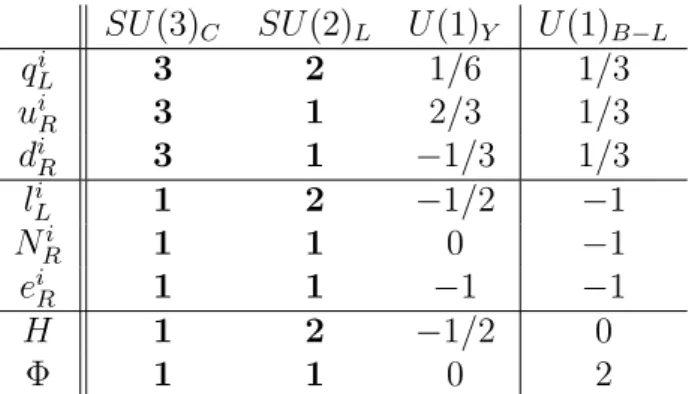
The minimalB−Lextended SM [19, 20, 21, 22, 23] is a very simple extension of the SM to naturally incorporate the seesaw mechanism. In this model, the accidental globalB−L (baryon number minus lepton number) symmetry in the SM is gauged, and an introduction of three generations of right-handed neutrinos is required to keep the model from the gauge and gravitational anomalies. Associated with the B −L gauge symmetry breaking, the right-handed neutrinos acquire Majorana masses, and the SM neutrino Majorana masses are generated through the seesaw mechanism after the electroweak symmetry breaking.
The mass spectrum of new particles introduced in the minimal B−L model, the B−L gauge boson (ZB′ −L boson), the right-handed Majorana neutrinos and the B −L Higgs boson, is controlled by the B −L symmetry breaking scale. The B −L model can be tested at the LHC, if the breaking scale lies around the TeV scale.
Although the minimal B −Lmodel incorporates the neutrino masses and mixings, a candidate for the cold dark matter is still missing in the model. A simple and concise way to introduce a dark matter candidate in the context of the minimalB−Lmodel has been proposed in [24], where only a Z2 symmetry is introduced without any extensions of the particle content of the model. An odd parity is assigned to one right-handed neutrino, while the other particles have even parties. Because of the Z2 symmetry conservation, the Z2-odd right-handed neutrino cannot decay into other particles and hence plays a role of dark matter. The neutrino oscillation data can be reproduced by the so-called minimal seesaw [25, 26], where only two generations of the right-handed neutrinos are
involved, predicting one massless neutrino. Dark matter phenomenology in this model context has been investigated in [24, 27, 28]. The right-handed neutrino dark matter can annihilate into the SM particles through its interactions with (i) theZB′ −L boson and (ii) two Higgs bosons which are realized as linear combinations of the SM Higgs and theB−L Higgs bosons. The case (i) and (ii) are called Z′ portal and Higgs portal dark matter scenarios, respectively. The Higgs portal dark matter scenario has been extensively studied in [24, 27, 28].
Recently, the Z′ portal dark matter has atracted a lot of attention [29, 30, 31, 32, 33, 34, 35, 36, 37, 38, 39, 40, 41], where a dark matter particle is introduced along with an extra gauge extension of the SM, and the dark matter particle communicates with the SM particles through an electric charge neutral gauge boson (Z′ boson), associated with an extra gauge group. The Z′ boson as a mediator allows us to investigate a variety of dark matter physics, such as the dark matter relic density and the direct and indirect dark matter search. Interestingly, the search forZ′ boson resonance at the LHC provides information that is complementary to dark matter physics.
The minimal B − L model with the right-handed neutrino dark matter discussed above is a very simple example of the Z′ portal dark matter model. In this thesis, we first investigate the Z′ portal dark matter in the minimal B−L model. Because of the simplicity of the model, dark matter physics is controlled by only three free parameters, the B − L gauge coupling (αB−L), the ZB′ −L boson mass (mZ′) and the dark matter mass (mDM). We will identify allowed parameter regions of the model by considering the cosmological bound on the dark matter relic density and the recent results by the LHC Run-2 on search forZ′ boson resonance with dilepton final states [42, 43].
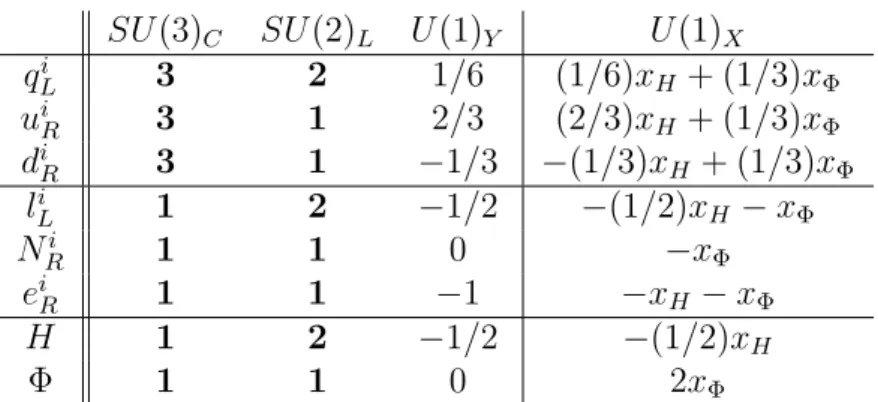
Next, we generalize the minimal B −L model to the so-called nonexotic U(1)X ex- tension of the SM [44]. The U(1)X model is the most general extension of the SM with an extra anomaly-free U(1) gauge symmetry. A new parameter xH, which is the U(1)X charge of the SM Higgs doublet, is introduced. The minimal B−L model corresponds to the limit of xH = 0. The particle content of the model is the same as the one in the minimal B −L model except for the generalization of the U(1)X charge assignment for particles. Hence, we can easily extend the minimal B −L model with right-handed neutrino dark matter to the U(1)X case. In this context, we perform detailed analyses to identify a phenomenologically viable parameter region through the complementarity
between dark matter physics and the LHC Run-2 results. Because of the U(1)X gener- alization, the Z′ boson couplings with the SM particles are modified for xH ̸= 0 and the allowed parameter region is found to be quite different from the one obtained in theB−L model (xH = 0).
This thesis is organized as follows. In Chapter 2, we briefly review particle cosmology, in particular, we focus on WIMP dark matter physics. We begin with the Big Bang cosmology, which is the standard cosmological theory of the expanding universe. Based on the evolution of the Big Bang cosmology, we discuss the thermal history of the early universe, and how the WIMP dark matter decouples from the thermal plasma. We present the procedure to calculate the relic density of the WIMP dark matter. In Chapter 3, we give a review on the basic structure of the SM. Particle content and Lagrangian of the SM are presented. We discuss the spontaneous symmetry breaking and the Higgs mechanism to generate the masses for weak gauge bosons, quarks and leptons. We also discuss the flavor mixing and CP violation in the quark sector. Observational problems on the SM, in particular, the neutrino oscillation phenomena and the existence of dark matter are introduced. In Chapter 4, we review the minimalU(1) extended SM as a simple extension of the SM to incorporate the neutrino masses and flavor mixings. We first discuss the minimal B−L model, and give detailed structure of the model. Next, we generalize the B−Lmodel to the minimalU(1)X model. In Chapter 5, LHC physics is briefly reviewed.
We present the cross section formula of a process to produce a dilepton final statel+l−at the LHC. Chapter 6 and 7 are our original works in [45, 46]. In Chapter 6, we discuss one of the main topics in this thesis: ZB′ −L portal dark matter in the minimalB−Lextended SM. We discuss a complementarity between the cosmological and the LHC constraints, and identify the allowed parameter region. In Chapter 7, the other main topic is discussed:
Z′ portal dark matter in the minimalU(1)X extended SM. Here, we generalize the B−L gauge symmetry to the U(1)X gauge symmetry. We discuss a complementarity between the cosmological and the LHC constraints, and identify the allowed parameter region.
Chapter 8 is devoted to conclusions and future plans. In Appendix A, we discussed the rephasing of quarks to eliminate unphysical degrees of freedom from the quark mass matrices.
Chapter 2
Particle cosmology
2.1 Big Bang cosmology
Edwin Powell Hubble measured the distances and the red shifts of spectra for twenty four galaxies, and led to the so-called Hubble law in 1929 [47]:
v =H0d, (2.1.1)
wherev and dare recession velocity and distance of a galaxy, and the constant of propor- tionalityH0 is called the Hubble constant. This is the discovery of the expanding universe and also suggests the universe is isotropic and homogeneous. The Hubble law is well de- scribed by the Big Bang cosmology, the standard cosmological model of the expanding universe, developed in the twentieth century. Based on the theory, the early universe was in an extremely hot and dense state, and the present universe, which is cold and dilute, is a result from the expansion. In the following, we briefly review the Big Bang cosmology.
The evolution of the universe is described by the Einstein equation given by (for a review, see, for example, [48])
Rµν− 1
2gµνR+ Λgµν = 8πGTµν, (2.1.2) where Rµν, R, gµν and Tµν are the Ricci tensor, the scalar curvature, the metric and the energy-momentum tensor, respectively. G= 1/Mpl2 is the gravitational constant with the Planck mass (Mpl = 1.22×10¹⁹ GeV) and Λ is a cosmological constant. The left- hand side of (2.1.2) describes a geometry of the universe, which is determined by the energy-momentum tensor.
Since the universe is observed to be isotropic and homogeneous in large scales over 100 Mpc [49], we adopt the Friedmann-Robertson-Walker metric in the spherical coordinates [48],
ds2 =dt2−a(t)2
[ dr2
1−Kr2 +r2dΩ2 ]
, (2.1.3)
and solve (2.1.2). Here, a(t) is the so-called scale factor, which parametrizes the size of the universe,K is the curvature constant (K = +1, 0, −1 correspond to open, flat, closed universe, respectively), anddΩ is the solid angle,dΩ2 =dθ2+ sin2θdϕ2. In the following, we set K = 0 according to the observational results that our universe is very flat [17]. In the perfect fluid approximation, the energy-momentum tensor is given by
Tνµ = diag(ρ,−p,−p,−p), (2.1.4) whereρ and pare the energy density and the pressure of the universe, respectively.
Non-vanishing components in (2.1.2) turn out to be the (0,0)- and (i, i)-components.
The (0,0)-component leads to the Friedmann equation, (a˙
a )2
=H2 = 1
3Mp2ρ+Λ
3, (2.1.5)
where H is the expansion rate called the Hubble parameter, and Mp = Mpl/√ 8π ≃ 2.44×10¹⁸ GeV is the reduced Planck mass. The (i, i)-components (i= 1,2,3) lead to
2 (¨a
a )
+ (a˙
a )2
=− 1
Mp2p+ Λ. (2.1.6)
Combining (2.1.5) and (2.1.6), we obtain the energy conservation law, dρ
dt + 3H(ρ+p) = 0. (2.1.7)
(2.1.5) and (2.1.7) are the fundamental equations for the Big Bang cosmology.
We define the critical density as
ρcrit = 3Mp2H2, (2.1.8)
which coincides with the total energy density of the flat universe. Using the critical density, the density parameter of a state X (X = radiation, matter and cosmological constant) is defined by
ΩX ≡ ρX
ρcrit, (2.1.9)
radiation w= 1/3 ρ∝a−4 a ∝t12 matter w= 0 ρ∝a−3 a ∝t23 cosmological constant w=−1 ρ= constant a∝eHit
Table 2.1: Solutions to the Friedman equation (2.1.5), when the total energy density is dominated by one state withw= 1/3,0,−1.
whereρX is the energy density ofX. We suppose that the total energy density of the uni- verse consists of the energy densities of radiation (ρrad), matter (ρmatter) and cosmological constant (ρcc = ΛMp2) such that
ρtotal =ρrad +ρmatter+ρcc, (2.1.10) and then we express the Friedmann equation (2.1.5) in terms of the density parameters as
Ωrad+ Ωmatter+ Ωcc = 1. (2.1.11)
2.2 Thermal history
We specify an equation of state by
p=wρ (2.2.1)
with a constantw. Substituting (2.2.1) into (2.1.7), we obtain
ρa3(1+w) = constant → ρ∝a−3(1+w). (2.2.2) The values ofw= 1/3, 0 and−1 correspond to the equation of state for radiation, matter and cosmological constant, respectively. When the total energy density is dominated by only one state with a fixedw, we can easily find a solution to the Friedmann equation as a∝eHit (w=−1), where Hi =√
Λ/3, anda ∝tα (w̸=−1) with α = 2
3(1 +w). (2.2.3)
These results are summarized in Table 2.1.
10 100 1000 104 105 106 10-4
1 104 108 1012 1016
T@KD
energydensity
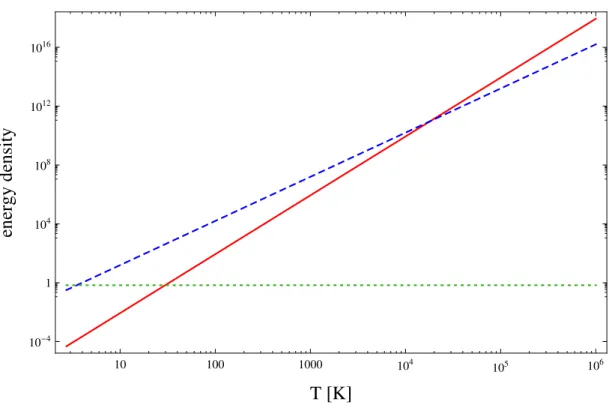
Figure 2.1: The evolutions of the energy densities of radiation (solid line), matter (dashed line) and cosmological constant (horizontal dotted line), as a function of temperature of the universe.
From Table 2.1, the energy densities in the early universe are given by ρcc = ρ0cc,
ρmatter = ρ0matter (a0
a )3
, ρrad = ρ0rad
(a0 a
)4
, (2.2.4)
where quantities with subscript/superscript 0 are the values in the present universe. From the results of the Planck satellite observation (Planck 2015 results) [50], the ratio of the energy densities in the present universe is determined as
ρ0cc :ρ0matter :ρ0rad ≃ 0.68 : 0.32 : 4.8×10⁻⁵. (2.2.5) According to (2.2.4), the relations among ρrad, ρmatter and ρcc evolve from the early time to the present as follows:
1. ρrad ≫ρmatter ≫ρcc
2. ρrad =ρmatter ≫ρcc 3. ρmatter ≫ρrad ≫ρcc 4. ρmatter ≫ρrad =ρcc 5. ρmatter ≫ρcc ≫ρrad 6. ρmatter =ρcc ≫ρrad
7. ρcc > ρmatter ≫ρrad (at present)
Since a becomes smaller back in time, it is clear from (2.2.4) that ρrad dominates in the very early time. This era between 1 to 2 is called the radiation dominated era. After the so-called equal epoch, 2, the era between 2 to 6 is called the matter dominated era. The present universe is in the epoch 7 (see (2.2.5)), and the expansion is accelerated. Figure 2.1 shows the evolution of the energy densities.
2.2.1 Equilibrium thermodynamics
As mentioned previously, the early universe was in a very hot and dense thermal plasma state, where all SM particles were in thermal equilibrium. In the following, let us discuss the properties of thermodynamic variables of a particleXin thermal equilibrium: number density, energy density, pressure and entropy density.
The phase space distribution of the particle X is given by f(⃗p) = 1
eET−µ ±1, (2.2.6)
whereE and µare the energy and the chemical potential of the particle X,T is the tem- perature of the system, and the + and− signs are for fermions and bosons, respectively.
In the following discussion, we neglect the chemical potential µ, since E ≫ |µ| in the early universe. The number density (nX), energy density (ρX) and pressure (pX) of the particleX are given in terms off(⃗p):
nX = gX (2π)3
∫
d3pf(⃗p), ρX = gX
(2π)3
∫
d3pE(⃗p)f(⃗p), pX = gX
(2π)4
∫
d3p |p⃗|2
3E(⃗p)f(⃗p). (2.2.7)
Here, gX is the number of degrees of freedom of the particle X. For example, gX = 2 for photon, andgX = 1 for a real scalar. Rewriting d3p= 4π√
E2−m2XEdE, we have nX = gX
2π2
∫ ∞
mX
EdE
√E2−m2X eET ±1 , ρX = gX
2π2
∫ ∞
mX
E2dE
√E2−m2X eET ±1 , pX = gX
6π2
∫ ∞
mX
dE(√
E2−m2X)3
eET ±1 . (2.2.8)
In the relativistic limit,T ≫mX, nX =
ζ(3)
π2 gXT3 (Bose-Einstein) 3
4 ζ(3)
π2 gXT3 (Fermi-Dirac), ρX =
π2
30gXT4 (Bose-Einstein) 7
8 π2
30gXT4 (Fermi-Dirac), pX = 1
3ρX, (2.2.9)
whereζ(3) is the Riemann zeta function at 3 given byζ(3) ≃1.20206. In non-relativistic limit, T ≪mX,
nX = gX
(mXT 2π
)32
e−mXT , ρX = mXnX,
pX = nXT. (2.2.10)
Using the fundamental thermodynamic relation for an equilibrium system,
dU =T dS−pdV, (2.2.11)
where U, S and V are the total energy, the total entropy and the volume of the system, respectively, we have
dρ−T ds= (T s−ρ−p)dV
V . (2.2.12)
Here, ρ=U/V and s=S/V are the energy density and the entropy density, respectively.
Since ρ(T) and s(T) are functions of T, the left-hand side is proportional to dT,
dρ−T ds∝dT. (2.2.13)
On the other hand, the right-hand side is proportional todV independent ofdT, and hence (2.2.12) can be satisfied only if the coefficients ofdT (left-hand side) and dV (right-hand side) vanish. Thus, we express the entropy density as
s= ρ+p
T = 2π2
45 g∗T3, (2.2.14)
where in the last equality we have used (2.2.9) in the radiation dominated era, and g∗ is the effective number of degrees of freedom given by
g∗ =∑
i
gBi +7 8
∑
i
gFi . (2.2.15)
Here,gBi andgiF are the degrees of freedom of bosons and fermions ofispecies, respectively.
For the SM, g∗ = 106.75 when all the SM particles are in the relativistic limit. Taking a variation of (2.2.11) with respect tot,
dS
dt = 1 T
(dU
dt +pdV dt
)
= V
T (dρ
dt + 3H(ρ+p) )
= 0, (2.2.16)
where in the last equality, we have used (2.1.7). Therefore, the total entropy of the universe is conserved. Combining S ∝ sa3 = constant with (2.2.14), we find a relation between the scale factor (a) and the temperature of a radiation (T) such thata∝T−1, and the temperature decreases along with the expansion of the universe. Using this relation, the scale of the universe can be measured by the temperature of a radiation, for example, photon, independently of what dominates the energy density of the universe.
2.2.2 Era of dark matter physics
Since we have founda ∝T−1 (from now on, T is the temperature of photon), we consider the evolution of the universe in terms of the photon temperature of the universe. Using the ratio of the energy densities (2.2.5) and the temperature (T0 = 2.73 K= 2.35×10⁻⁴ eV) [51] in the present universe, let us calculate the temperature at typical epochs in the thermal history of the universe. At the epoch of ρmatter = ρcc, we find T = 3.50 K= 3.02×10⁻⁴ eV, while T = 29.7 K= 2.56×10⁻³ eV at the epoch of ρrad = ρcc. The equal epoch is defined as ρrad(Te) =ρmatter(Te), at which Te = 1.82×10⁴ K= 1.56 eV.
σ
v
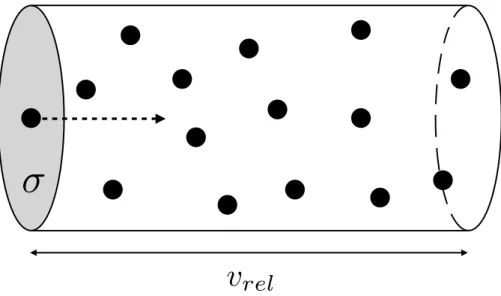
relFigure 2.2: Schematic picture of the annihilation rate of X particles (black dots). The leftmost X particle moves to the right with a velocityvrel in the frame where the others are at rest. Here, σ (shaded area) is the annihilation cross section of X particle, and vrel is a traveling distance ofX per unit time. The leftmost X collides (annihilates) withXs inside the cylinder per unit time.
In this thesis, we consider the radiation dominated era (T > Te) for discussion about Weakly Interacting Massive Particle (WIMP) dark matter, since a typical scale of WIMP dark matter physics is around the TeV scale (see the following sections). The total energy density of the universe in the radiation dominated era is approximately
ρtotal=ρrad = π2
30g∗T4, (2.2.17)
and hence the Friedmann equation is given by H2 = π2
90g∗ T4
Mp2. (2.2.18)
2.3 Decoupling from the equilibrium system
In the radiation dominated era at a very high temperature, particles are in thermal equilibrium. Due to the expansion, the temperature of the universe goes down and some

![Figure 2.3: The rotation curve of galaxy NGC 6503 [53]. The dark matter halo contribu- contribu-tion is shown by the dashed-dotted line.](https://thumb-ap.123doks.com/thumbv2/123deta/6514280.2160187/25.892.149.677.162.679/figure-rotation-galaxy-matter-contribu-contribu-dashed-dotted.webp)
![Figure 2.4: Numerical solutions for σ 0 [GeV − 2 ] = 10 − 10 (upper (green) solid line), 10 − 9 (middle (red) solid line), and 10 − 8 (lower (blue) solid line), respectively, along with Y DMeq (dashed line).](https://thumb-ap.123doks.com/thumbv2/123deta/6514280.2160187/30.892.138.750.135.557/figure-numerical-solutions-upper-green-middle-respectively-dashed.webp)
![Figure 5.1: Overall view of the LHC [https://home.cern/].](https://thumb-ap.123doks.com/thumbv2/123deta/6514280.2160187/58.892.134.756.126.623/figure-overall-view-the-lhc-https-home-cern.webp)
