Situation of empathy among preclinical medical student in Faculty of Medicine, Yamagata University- A longitudinal study
*General Medical Education Center, Faculty of Medicine, Yamagata University
**Department of Health Informatics, Faculty of Healthcare Management, Niigata University of Health and Welfare
(Accepted November 9, 2020)
Toshimi Nakanishi*, Hirotaka Ito**
Empathy education is being addressed as an important part of medical education. However, many researchers have suggested decline in empathy during the course of medical school. Therefore, we examine situation in empathy level among preclinical medical students in Faculty of Medicine, Yamagata University in Japan.
A longitudinal study was carried out. Empathy level in the first year and again on their fourth year was measured by the Japanese version of the Jefferson Scale of Physician Empathy consisting of total 20 questions. Each question composes of a 5-point Likert scale. Statistical analysis was performed with Mann-Whitney U test and multivariate analysis.
No significant decrease in mean empathy scores was shown between first-year(scores: 66.4, n=105)and fourth-year students(scores: 68.4, n=62).Factor analysis identified four factors: “building good patient-doctor relationship”, “importance of empathetic care”, “understanding patients’ view”
and “compassionate care”. A weak correlation(r=-0.271)was observed between “understanding patients’ view” and “importance of empathetic care.”
Decline in empathy was not revealed. However, an inverse weak correlation between cognitive empathy and emotional empathy was revealed among preclinical medical students. This may imply the necessity for emotional empathy education before clinical practice.
Keywords: preclinical students, Jefferson scale of physician empathy, situation of empathy
Introduction
Empathy,which is defined as the ability to think,
feel,and act from the perspective of the other’s framework of cognition,is crucial in enhancing the relationship and communication between a doctor and a patient1).Importantly,doctors’ empathy can even lead to better treatment outcomes.When doctors are more empathic,their patients show greater treatment adherence2).On the other hand,
when doctors lose empathy,they are more prone to making medical errors3).The role of empathy
in medical performance is already observable during medical school,where more empathic medical students have been rated as more clinically competent and perform better at exams4), 5). Even medical students themselves are aware of the importance of empathy: first-year students have reported that empathy is the second most desirable quality of future doctors6).
As empathy seems to be one of the determinants of doctors’ success,it would be expected that it be a fundamental component of education for medical students.However,not only is there is a lack of teaching of empathy in medical schools,but some ABSTRACT
DOI 10.15022/00004904
studies have suggested that an erosion of empathy occurs during the course of medical school7)-11)and during internships12).Several cross-sectional studies in the U.S.,Iran,and India have found that first- year medical students have the highest levels of empathy,while those in the final fourth year have the lowest levels7),9),10),11).A longitudinal study in the U.S.found the same decline and discovered that it began in the third year of medical school8). However,in 2010,a meta-analysis of studies that measured empathy in medical students was published and it noted that the observed decline,
although statistically significant,was so weak that it did not have a clinical value13).Several studies have also found that a decline in empathy did not occur14)-17).These studies were conducted in the UK,Korea,China,and Japan.When juxtaposed alongside those that have found a decline in empathy among medical students,it suggests that there are cross-cultural differences at play.
The current state of research on empathy in medical students is inconclusive,with several gaps that need to be addressed.First,the majority of the findings are based on cross-sectional research designs.Thus,these differences could have been influenced by the baseline differences among students in different years of medical school.Therefore,
it is necessary to conduct more longitudinal studies because they provide stronger conclusions than cross-sectional studies.This will eventually enable a more rigorous meta-analysis comprising longitudinal studies only to be conducted.Second,
previous studies have shown that empathy has many components18).This phenomenon has been well described in the literature19)-21).But some studies have suggested that social and personals factors may contribute to changes in empathy,similar to the model of reasons reported by Neumann 201122).
Cognitive empathy is considered to be a central component of medical education.For example,
empathy requirements have been included in Chinese residency programs since 199923),and the calm and unemotional style of Japanese physicians has been a frequent subject of studies in recent years24). Yamagata University Faculty of Medicine teaches effective communication for building relationships
of trust with patients.A total of 3.6 hours of the curriculum is related to medical mediation.This medical mediation is intended to foster effective empathetic communication in the context of patient safety and quality25).That is,empathy is considered to be an essential part of a doctor’s foundational training.Emotional empathy is also important for doctors to rebuild or maintain relationships of trust with patients who harbor negative feelings toward doctors,as well as in adverse situations25),26). Unfortunately,personal and social factors,hidden agendas,and student stress may become barriers to learning empathy27),28).
This longitudinal study focused on the status in empathy levels from the first to the fourth year of Faculty of Medicine,Yamagata University using the Japanese version of the Jefferson Scale of Physician Empathy.
Methods
Ethics approval and consent to participate
This study was approved by the ethical review board of the Yamagata University Faculty of Medicine,and written informed consent was obtained from the students after they were told that their participation in the survey and their answers would not affect their grades or other assessments.
In addition,their data were anonymized,further ensuring that participants’ identities would not be revealed.Students who agreed to participate were requested to fill out the survey using their own judgment.
Participants
The survey was administered to 126 first-year medical students at the Faculty of Medicine,
Yamagata University School of Medicine,in June 2010 and again three years later,in 2013,to 108 students.
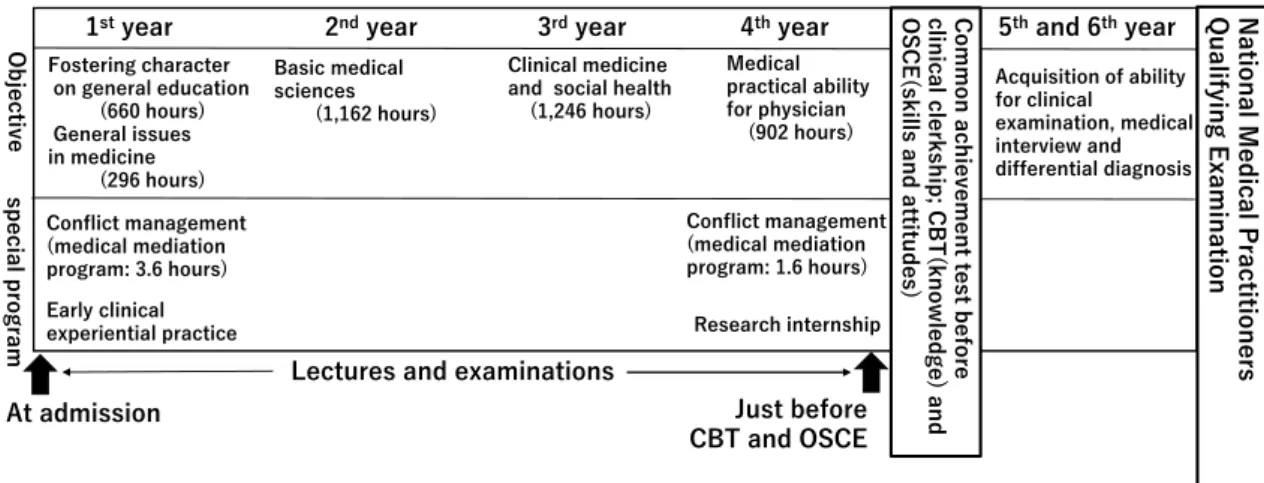
Outline of medical education program(Figure S1)
Supplementary Figure S1 shows the program.
The medical students start their training after high school,with a strong focus on their general education first,shifting to medical education over the years.Although they have communication training from the start of training,they only begin
approaching patients in their fourth year.
The medical mediation program mentioned above teaches a conflict management method for dispute resolution.It attempts to minimize emotionally hostile conflicts and improve less satisfactory outcomes,for example,in litigation cases,
in which the issues are narrowly defined and the need for sincere emotional responses is ignored.
Students participating in these sessions learn about the concept through lectures,role-plays,and group discussions 25),29).The program consists of behavioral and recognition skills,acceptance of negative feelings,disclosure of information with expressions of the doctor’s sincere attitude,and sharing of information between the doctor and the patients and their families.
Instruments
Empathy was investigated using the Japanese version of the Jefferson Scale of Physician Empathy
(JSPE)30).The Japanese instrument consists of a 20-item,self-administered questionnaire,
which is answered according to a 5-point Likert scale that ranges from 1 – “Don’t agree at all” to 5 – “Completely agree.” The total scores ranged from 20 to 100.The validity and reliability of the instrument were verified earlier by Abe et al.30). Participants were additionally asked to report their gender,age,school year,and presence/
absence of experience as a patient(outpatient and inpatient treatment).The final two items related
to experience as a patient were newly added as they were considered as possible factors relating to understanding patients’ emotions.
Statistical analysis
The mean total scores of empathies were shown as mean ± standard deviation,95% confidence intervals [CI] of the means because the descriptive statistics of the samples were shown as mean values for the purpose of comparison with previous studies.However,the distribution of the scores of the two grades in this study was non-normal(tested with the Shapiro-Wilk test) so that parametric tests with means and variances were not appropriate.In addition,the data sets of the first- and fourth-year students were not paired.Therefore,the median of them was statistically tested using the non- parametric Mann-Whitney U test.We conducted a factor analysis of the scores of all the respondents by generalized least squares,rotating the axes by the direct oblivion method.The numbers of factors were decided in accordance with the scree plot criterion(eigenvalues: 1 or higher).Next,a logistic regression analysis was performed for factors 1 through 4 derived from the factor analysis.
We did not employ a multiple regression analysis because all of the factor scores were not normally distributed.The dependent variable was set to(1)
if the factor score for each factor was positive and(0)
if it was negative.The four independent variables were gender,age,school year,and experience as
Fostering character on general education
(660 hours) General issues in medicine
(296 hours)
Basic medical sciences
(1,162 hours)
Clinical medicine and social health (1,246 hours)
Medical practical ability for physician
(902 hours)
Acquisition of ability for clinical examination, medical interview and differential diagnosis
Early clinical experiential practice
1styear 2ndyear 3rdyear 4thyear 5thand 6thyear
Research internship
Objectivespecial program
Conflict management (medical mediation program: 3.6 hours)
Conflict management (medical mediation program: 1.6 hours)
Common achievement test before clinical clerkship; CBT(knowledge) and OSCE(skills and attitudes)
Figure S1. Outline of medical education program
CBT: Computed Based Testing, OSCE: Objective Structured Clinical Examination. Each arrow indicates evaluation of empathy scores performed.
Lectures and examinations
National Medical Practitioners Qualifying Examination
At admission Just before
CBT and OSCE
Figure S1. Outline of medical education program
CBT: Computed Based Testing, OSCE: Objective Structured Clinical Examination. Each arrow indicates evaluation of empathy scores performed.
a patient(outpatient and inpatient treatment).The level of statistical significance was set at p < 0.05.
Results
Participants and mean empathy score
There were 105 out of 126 respondent participants in the first- year students and 62 out of 108 respondent participants in the fourth-year students.
The participant characteristics are shown in Table1.
The participants were,on average,19.8 years old for the first-year students and 23.6 for fourth.
In the first-year student,52.4% were male and in the fourth,72.6%.Most of them had experience as outpatients,but not as inpatients(in the first- year students,64.7%,31.1% respectively).The
mean and median empathy scores by school year and gender are shown in Tabl2.There was no significant difference in gender scores between school years.
Factor analysis and correlations among factors
The Kaiser-Gattman and scree plot criteria were shown to be valid.The Kaiser-Meyer-Olkin measure of sampling adequacy was 0.914 and Bartlett’s test was p < 0.01,confirming the validity of this factor analysis.Four factors were identified in Table3.
Factor 1 was composed of nine items(10,13,7,
15,8,18,20,9,and 4) and,because it was related to interpersonal relations between doctors and patients,it was called “building good patient-doctor relationships.” Factor 2 comprised four items(16,
Variables n % n %
Sex
Male 55 52.4 45 72.6
Female 45 47.6 17 27.4
Total 105 100.0 62 100.0
Age (years)
Mean 19.8 23.6
SD 2.6 4.5
Experience as patients outpatient treatment
Yes 68 64.8 40 64.5
No 37 35.2 22 35.3
Total 105 100.0 62 100.0
inpatient treatment
Yes 30 28.6 22 35.5
No 75 71.4 40 64.5
Total 105 100.0 62 100.0
School Year
1st 4th
School year Sex n Ave. SD 95% CI Mdn p
1st Male 55 65.0 10.2 62.3 - 67.8 66.0
Female 50 68.0 10.2 65.1 - 70.9 70.5
Total 105 66.4 10.3 64.5 - 68.4 67.0
4th Male 45 68.8 6.2 67.0 - 70.7 69.0
Female 17 68.8 6.2 65.6 - 72.0 68.0
Total 62 68.8 6.1 67.3 - 70.4 69.0
Total Male 100 66.8 8.8 65.0 - 68.5 68.0
Female 67 68.2 9.3 65.9 - 70.5 69.0
Total 167 67.3 9.0 66.0 - 68.7 68.0
Ave.: Average SD: Standard Deviation CI: Confidential Interval Mdn: Median
0.144
0.797
0.527 Table 1.Participants’characteristics by school year(n = 167).
Table 2.Mean total-scores of Physician Empathy Scale by school year and sex.
Factor 1 Factor 2 Factor 3 Factor 4
Asking after what is happening in the patient's life is as
important as asking about physical complaints. (10) 0.813 -0.024 0.05 -0.048
The patient who feels that the doctor has understood his or her
feelings is left with a good impression. (13) 0.622 -0.044 -0.066 0.18
For more effective treatment, a doctor must pay careful attention
to individual patients' experience. (7) 0.617 0.051 0.02 -0.023
Conveying that the doctor has understood the patient's feelings is an important factor in conducting a medical interview and
taking down the patient's medical history. (15) 0.608 0.126 -0.247 0.051
A patient who feels that someone else has made an effort to understand him or her can have enhanced self-efficacy and can
heal on his or her own. (8) 0.507 -0.061 0.207 0.499
Trying to imagine oneself in the position of the other person
contributes to the quality of care. (18) 0.49 0.077 -0.228 0.041
One important factor in the success of the doctor-patient relationship is the doctor's ability to understand the patient's
feelings as well as those of the family. (20) 0.449 0.012 -0.357 0.139
Understanding body language is as important as verbal
communication in the doctor-patient relationship. (9) 0.413 0.106 -0.088 0.279
It is basically impossible for a doctor to see things from the
patient's perspective when people are so different. (4) 0.23 -0.103 -0.162 0.096
Empathy is a therapeutic skill without which the success of the
doctor will be limited. (16) 0.037 0.786 0.175 0.358
Empathy is an important therapeutic practice in the medical
field. (11) 0.285 0.406 -0.176 0.06
The best method for caring for the patient is something that
should be considered from the patient's point of view. (12) 0.287 0.332 -0.295 -0.054
When the emotional scene taking place between the patient and his/her family is viewed, even the physicians may be
emotionally moved, which is a good thing. (17) -0.034 0.332 -0.009 -0.043
A doctor who can consider things from the viewpoint of the
other person is able to provide better medical care. (1) 0.068 -0.016 -0.702 0.323
The ability of a doctor to understand the feelings of the patient
and the patient's family is a positive treatment factor. (5) 0.213 0.192 -0.361 0.13
Emotional matters have nothing to do with the patient's medical
treatment. (6) -0.001 0.116 -0.089 0.633
Medical treatment alone has the ability to cure the patient's condition. Even when the doctor makes an effort to forge a good relationship with the patient, this does not have an important role in the curing of the illness. (19)
0.146 0.069 -0.006 0.55
Reading books and enjoying art can improve the doctor's ability
to provide better care. (14) 0.097 -0.036 0.043 0.55
The doctor's humor can contribute to a better treatment
outcome. (3) -0.1 0.011 -0.087 0.519
A doctor needs to carefully observe what is going on in the mind of the patient, which is expressed through non-verbal
messages like facial expressions and body language. (2) 0.196 0.046 -0.26 0.434
Extraction Method: Generalized Least Squares.
Rotation Method: Oblimin with Kaiser Normalization.
Rotation converged in 18 iterations.
Reversed items were (4), (6) and (19)
(Building good patient-
doctor relationships) (Importance of
emphatic care) (Understanding
patients’ views) (Compassionate care)
Table 3.Factor Analysis of Physician Empathy Scale.
11,12,and 17) that were related to responding to patients’ emotional needs; thus,factor 2 was called the “importance of emphatic care.” Factor 3 was composed of two items(1 and 5) and,because it was related to acknowledging patients’ points of view while practicing medical therapy,it was called
“understanding patients’ views.” Factor 4 was composed of five items(6,19,14,3,and 2)31) and,
because responding to patients’ emotional needs is also an important aspect of medicine,it was called
“compassionate care.” The cumulative contribution ratio was 38.58% for factor 1,42.74% for factor 2,
45.87% for factor 3,and 49.22% for factor 4.An inverse weak relationship of the correlation between factors 2 and 3 was revealed in Table4.
Logistic regression analysis
Table5 shows the results of the logistic regression analysis for each factor with gender,age,school year,and experience as a patient.The odds ratio of the female participants was significantly higher
than the male participants in factor 2,“importance of empathic care”(p<0.05).For factor 4,
“compassionate care,” statistically significant differences were noted for gender(p< 0.05) and age(p< 0.05),and the effect of gender differences was larger compared to age.
Discussion
This study found that empathy in the preclinical medical students of Faculty of Medicine,Yamagata University does not decrease from the first to the fourth year; instead,the mean empathy score increased slightly in fourth-year students in Table2.
These findings accord with studies that have measured empathy in medical students in the U.K.,
Korea,China,and Japan14)-17),while studies conducted in the U.S.,Iran,and India have found that medical students show greater empathy in the first year of medical school than later on7)-11).This means that when comparing changes in empathy Table4.Factor correlation of physician empathy.
Table5.Multivariate analysis of Physician empathy scales factor
Factor 1 2 3 4
1 (Building good patient-doctor relationships) 1.000
2 (Importance of emphatic care) 0.256 1.000
3 (Understanding patients’ views) -0.500 -0.271 1.000
4 (Compassionate care) 0.595 0.244 -0.378 1.000
Extraction Method: Generalized Least Squares.
Rotation Method: Oblimin with Kaiser Normalization.
OR 95% CI p OR 95% CI p OR 95% CI p OR 95% CI p
Sex: female versus male 1.83 (0.93 - 3.59) 0.081 2.11 (0.59 - 2.21) 0.032 0.53 (0.26 - 1.07) 0.078 2.58 (1.26 - 5.27) 0.01 Age 1.05 (0.94 - 1.17) 0.369 1.03 (0.93 - 1.13) 0.611 0.99 (0.89 - 1.09) 0.811 1.04 (0.93 - 1.16) 0.048 School year: 4th versus 1st 1.35 (0.64 - 2.84) 0.433 1.59 (0.75 - 3.34) 0.226 0.74 (0.35 - 1.61) 0.456 1.68 (0.76 - 3.69) 0.51 Experience as patients
Outpatient treatment:
yes versus no 1.34 (0.66 - 2.72) 0.422 1.22 (0.60 - 2.50) 0.575 0.82 (0.40 - 1.71) 0.604 1.81 (0.87 - 3.77) 0.379 Inpatient treatment:
yes versus no 1.25 (0.62 - 2.67) 0.504 1.49 (0.71 - 3.12) 0.29 0.73 (0.34 - 1.57) 0.419 1.34 (0.62 - 2.89) 0.159 OR: odds ratio
CI: confidential interval
Factor 1: Building good patient-doctor relationships Factor 2: Importance of emphatic care
Factor 3: Understanding patients’ views Factor 4: Compassionate care
Factor 1 Factor 2 Factor 3 Factor 4
scores,it is necessary to consider differences in personal and social factors,as well as differences in the design of medical training in different countries.
Possible explanations for the stability of the empathy scores could be since participants received sufficient empathic training.It has been noted that the intervention of empathic education increases cognitive empathy32)-35).The curriculum for the medical mediation concept,which emphasizes empathy education in this study,was short(about five hours) and may be insufficient to justify the reasons for the lack of empathy.In such a case,
medical mediation may offer impactful content that focuses on the conflict resolution of negative feelings toward doctors by enhancing the empathetic competence of students.Another explanation is the differences in admission processes,curricula,and cultural factors.Further study is needed to identify which program may foster the growth of cognitive empathy in medical students.
Previous studies have revealed that the empathy scores of females were higher than those of males7),9),11),14),15),36),37).Our results(Table2) does not support these findings.On the other hand,
in Table5,female influence was significantly seen in the second and fourth factors.This difference is due to be small number of female respondents in the fourth school year being 27.4%.
As the results in Table3 show,in the opinion of the medical students,factor 1,concerning empathy,is about “building good patient-doctor relationships,” which refers to the factor of
“understanding patient’s view”(factor 3).
However,what was chosen as factor 4(compassionate care) in this study was placed in the second position(factor 2) in other studies9),14),17) that were conducted on first to sixth-year medical students.
This difference may indicate that there is little recognition of the importance of emotional empathy in fourth-year students before they begin their clinical experience.Although cognitive empathy increases with medical education,from dissection practice in the second year to bedside learning(BSL)
in the fourth year,if emotional empathy is the ability to share the emotional state of others while finding it difficult to control one’s own emotions(e.g.,
seeing someone in distress and feeling distressed and wanting to help),it is conceivable that the ability of emotional empathy does not change significantly with medical education through to fourth year in Table4.It is possible that the use of cognitive empathy has increased and that relative emotional empathy has decreased because it is difficult to make the best decisions and recommend the best treatments if only emotional empathy is felt,and it is difficult to make appropriate decisions and form responses if one does not try to understand the other person’s condition with regard to cognitive empathy.In other words,it has been shown that cognitive empathy is stronger,but emotional empathy is relatively weaker.The students did not understand that “compassionate care” is an important,necessary communication skill for doctors.Therefore,between the time students are in their first and fourth years,it is necessary to create an awareness of empathetic emotions and strengthen the understanding that others’ individual emotional perspectives are equally important32).
For the independent variables,gender and age,factor 2(importance of empathetic care)
and factor 4(compassionate care) displayed significant differences in odds ratios(Table5).
Female medical students were shown to have a higher recognition of emotional empathy than male students,which is consistent with previous findings10),14).Age showed a weaker effect compared to gender for “compassionate care.” This implies that gender was the main variable in emotional empathy in this study.There was no significant correlation between experience as a patient(outpatient and inpatient treatment) and any empathy factor in Table5.This means that an experience as patient did not affect any empathetic factors in preclinical students.A survey of medical students undergoing clinical training is also required to confirm the result.
Our longitudinal study has limitations.First,
because of the small sample size and that first and fourth-year students from only one Japanese medical school were involved,it is difficult to apply our results to students in other medical schools in Japan and other countries.Second,our study does not
reveal a reason for the lack of a decline in empathy scores.It implies that a program of medical mediation for first and fourth-year students may be required.Further longitudinal design studies of medical schools in Japan and other countries are needed to confirm these hypotheses.Nevertheless,
these results demonstrate the importance of incorporating empathy education in medical schools for creating empathetic doctors and improving patients’ satisfaction and treatment adherence.
In conclusion,we did not detect decrease in the empathy scores of the students at Yamagata University in Japan between their first and fourth years in medical school.We found a weak correlation between factor 2(importance of empathic care) and factor 3(understanding patients’ views).Empathy education that reinforces the awareness that the emotional perspectives of others are just as important as one’s own is necessary in preclinical medical students.
Acknowledgments
The authors thank all the students who participated in this study and Dr.Ivana Buric for the comments on the manuscript.
Declaration of Interests The authors declare no conflicts of interest.
References
1. Hojat M, Louis DZ, Markham FW, Wender R, Rabinowitz C, Gonnella JS: Physicians’ empathy and clinical outcomes for diabetic patients. Acad Med. 2011;
86: 359-364
2. Mercer SW, Reilly D, Watt GC: The importance of empathy in the enablement of patients attending the Glasgow Homoeopathic Hospital. Br J Gen Prac. 2002;
52: 901-905
3. West CP, Huschka MM, Novotny PJ, Sloan JA, Kolars JC, Habermann TM, et al.: Association of perceived medical errors with resident distress and empathy: a prospective longitudinal study. JAMA. 2006; 296: 1071- 1078
4. Hojat M, Gonnella JS, Mangione S, Nasca TJ, Veloski
JJ, Erdmann JB, et al.: Empathy in medical students as related to academic performance, clinical competence and gender. Med Educ. 2002; 36: 522-527
5. Colliver JA, Willis MS, Robbs RS, Cohen DS, Swartz MH: Assessment of empathy in a standardized-patient examination. Teach Learn Med. 1998; 10: 8-11
6. Hurwitz S, Kelly B, Powis D, Smyth R, Lewin T:
The desirable qualities of future doctors – A study of medical student perceptions. Med Teach. 2013; 35:
e1332-1339
7. Chen D, Lew R, Hershman W, Orlander J: A cross- sectional measurement of medical student empathy. J Gen Intern Med. 2007; 22: 1434-1438
8. Hojat M, Vergare MJ, Maxwell K, Brainard G, Herrine SK, Isenberg GA, et al.: The devil is in the third year: a longitudinal study of erosion of empathy in medical school. Acad Med. 2009; 84: 1182-1191 9. Shariat SV, Habibi M: Empathy in Iranian medical
students: measurement model of the Jefferson Scale of Empathy. Med Teach. 2013; 35: 913-918
10. Khademalhosseini M, Khademalhosseini Z, Mahmoodian F: Comparison of empathy score among medical students in both basic and clinical levels. J Adv Med Educ Prof. 2014; 2: 88-91
11. Nair, S, Shetty RS, Guha S, Anjum Z, Kamath A:
Assessing empathy among undergraduate medical students: a cross sectional analysis using the Jefferson scale in a medical school in Coastal Karnataka. Int J Community Med Public Health. 2018; 5: 953-956
12. Bellini LM, Shea JA: Mood change and empathy decline persist during three years of internal medicine training. Acad Med. 2005; 80: 164-167
13. Colliver JA, Conlee MJ, Verhulst SJ, Dorsey JK:
Reports of the decline of empathy during medical education are greatly exaggerated: a reexamination of the research. Acad Med. 2010; 85: 588-593
14. Kataoka HU, Koide N, Ochi K, Hojat M, Gonnella JS:
Measurement of empathy among Japanese medical students: psychometrics and score differences by gender and level of medical education. Acad Med. 2009;
84: 1192-1197
15. Quince TA, Parker RA, Wood DF, Benson JA:
Stability of empathy among undergraduate medical students: a longitudinal study at one UK medical school.
BMC Med Educ. 2011; 11: 90
16. Hong, M, Lee WH, Park JH, Yoon TY, Moon DS, Lee SM, et al.: Changes of empathy in medical college and medical school students: 1-year follow up study. BMC Med Educ. 2012; 12: 122
17. Wen D, Ma X, Li H, Liu Z, Xian B, Liu Y: Empathy in Chinese medical students: psychometric characteristics and differences by gender and year of medical education. BMC Med Educ. 2013; 13: 130
18. Hojat M: Empathy in patient care: antecedents, measurement, and outcomes. New York: Springer; 2007 19. Kohut H: The Analysis of the Self. New York:
International Universities Press; 1971
20. Eisenberg N, Mussen PH: The Roots of Prosocial Behavior in Children(Cambridge Studies in Social and Emotional Development).Cambridge: Cambridge University Press; 1989
21. Davis MH: Measuring individual differences in empathy evidence for a multidimensional approach. J Pers Soc Psychol. 1983; 44: 113-126
22. Ren Q, Awasaki, T, Huang YF, Liu Z, Lee T: Cell Class-Lineage Analysis Reveals Sexually dimorphic lineage compositions in the Drosophila brain. Curr Biol.
2016; 26: 2583-2593
23. Blatt B, Kallenberg G, Lang F, Mahoney P, Patterson J, Dugan B, et al.: Found in translation: exporting patient-centered communication and small group teaching skills to China. Med Educ Online. 2009; 14: 113- 126
24. Kondo K: Clinical empathy in medical consultations in Japan: An exploration of the medical education context. PiLaCS. 2019; 2: 46-64
25. Nakanishi T: New communication model in medical dispute resolution in Japan. Yamagata Med J. 2013; 3:
1-8
26. Nakanishi T: Disclosing unavoidable causes of adverse events improves patients’ feelings towards doctors. Tohoku J Exper Med. 2014; 234: 161-168 27. Neumann M, Edelhäuser F, Tauschel D, Fischer MR,
Wirtz M, Woopen C, et al.: Empathy decline and its
reasons: a systematic review of studies with medical students and residents. Acad Med. 2011; 86: 996-1009 28. Ludwig AB, Burton W, Weingarten J, Milan F,
Myers DC, Kligler B: Depression and stress amongst undergraduate medical students. BMC Med Educ. 2015;
15: 141
29. Halpern J: Empathy and patient-physician conflicts. J Gen Int Med. 2007; 22: 696-700
30. Abe K, Wakabayashi H, Saiki T, Kawakami C, Fujisaki K, Niwa M, et al.: Validity and reliability of the Japanese versions of the trait Emotional Intelligence questionnaire-short form and the Jefferson Scale of Physician Empathy. Igaku Kyoiku / Med Educ
(Japan).2012; 43: 351-359(In Japanese)
31. Mercer SW, Reynolds WJ: Empathy and quality of care. Br J Gen Pract. 2002; 52(Suppl): S9–12
32. Charon R: The patient-physician relationship.
Narrative medicine: a model for empathy, reflection, profession, and trust free. JAMA. 2001; 286: 1897-1902 33. Lancaster T, Hart R, Gardner S: Literature and
medicine: evaluating a special study module using the nominal group technique. Med Educ. 2002; 36: 1071-1076 34. Rosenthal S, Howard B, Schlussel YR, Herrigel
D, Smolarz BG, Gable B, et al.: Humanism at heart:
preserving empathy in third-year medical students.
Acad Med. 2011; 86: 350-358
35. Hojat M, Gonnella JS, Nasca TJ, Mangione S, Vergare M, Magee M: Physician empathy: definition, components, measurement, and relationship to gender and specialty. Am J Psychiatry. 2002; 159: 1563-1569 36. Vinay KM, Swanand P: Assessment of empathy
among undergraduate medical students. J Educ Technol Health Sci. 2016; 3: 23-27
37. Szanto T, Krueger J: Introduction: empathy, shared emotions, and social identity. Topoi. 2019; 38: 153-162