• 検索結果がありません。

Statistical study of solar activiy and seasonal dependence of semidiurnal tide in the polar lower Thermosphere on quiet days using EISCAT radar data

N/A
N/A
Protected

Academic year: 2021

シェア "Statistical study of solar activiy and seasonal dependence of semidiurnal tide in the polar lower Thermosphere on quiet days using EISCAT radar data"

Copied!
2
0
0

読み込み中.... (全文を見る)

全文

(1)

Statistical study of solar activiy and seasonal dependence of semidiurnal tide in the polar lower Thermosphere on quiet days using EISCAT radar data

Hirotaka Koyama

1

, Satonori Nozawa

1

, Yasunobu Ogawa

2

, Asgeir Brekke

3

1

Institute for Space-Earth Environmental Research, Nagoya University, Nagoya, Aichi, Japan

2

National Institute of Polar Research, Tachikawa, Tokyo, Japan

3

UiT The Arctic University of Norway, Tromsø, Norway

Atmospheric gravity waves, atmospheric tidal waves, and planetary waves propagate upward in the polar MLT region, and play an important role in the dynamics there. Solar irradicance and solar wind energy is injected from above. Therefore, it can be said that the polar MLT region is a unique region. Understanding of the Polar MLT region is important for the vertical atmosphere coupling as well as magnetosphere-ionosphere-thermosphere coupling. In the polar lower thermosphere, the semidiurnal tide becomes dominant in the atmospheric dynamics with its strong amplitude (say 50-100 m/s) (see Nozawa and Brekke, 1999a; Wu et al., 2003, etc.). Amplitude variation of the semidiurnal tide have a great influence on vertical propagation of gravity wave and atmospheric stability near the mesopause (Zhao et al., 2003). Many studies have been conducted on semidiurnal tide (Murphy et al., 2006; Aso, 2007, etc.), however our understanding of this has not yet been sufficient. For example, understanding of altitude variations of the amplitude and phase of the semidiurnal tide from the mesosphere to the lower thermosphere is still insufficient. More observations are needed for further understanding of the variation. In previous studies in terms of neutral wind variation using EISCAT radar (Brekke, Nozawa, and Sparr, 1994;

Nozawa and Brekke, 1995; Nozawa and Brekke, 1999a,b), dependence of season, geomagnetic disturbance, and solar activity for tidal wave are presented. However, the three factors could not be separated because of shortage of data. The purpose of this study is to reveal the variations of the semidiurnal tide with season, geomagnetic disturbance, and solar activity.

The averaged neutral wind velocities were calculated with 6 minutes and 3 km of temporal resolution and spatial resolution, respectively, for several categories (season, geomagnetic disturbance, and solar actibity), and then tidal components were derived. The number of data in geomagnetically quiet time (Kp ≤ 3) was 46 days in summer and 144 days in winter during the observation period from November 1986 to February 2019. F10.7 index was used to classify wind data into three categories of 75 or less, 75 to 150, and 150 or more.

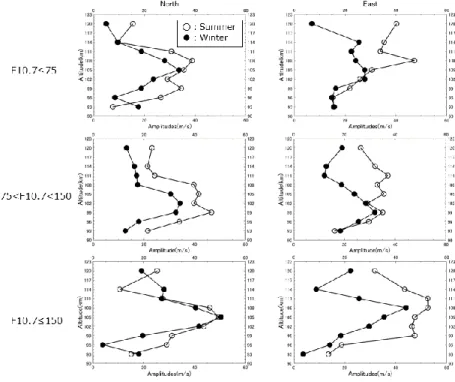
Figure 1 shows seasonal comparison of semidiurnal tidal amplitude for each solar activities. The open circles show summer and the solid circles shows winter, respectively. From the results, it was found some characteristics of season and solar activity for semidiurnal tide. Results of solar activity and seasonal variations are summarized as follows;

(1) In the northward direction, the amplitude of semidiurnal tide is stronger in summer than in winter, indicating that there is seasonal dependence under the condition of F10.7≤150. On the other hand, the seasonal dependence could not be seen and the amplitudes of summer are similar to amplitudes of winter under the condition of F10.7≥150. (2) In the eastern direction, as the solar activity increases, the altitude at which seasonal dependence appears descend, and seasonal dependence can be seen at all observational altitudes (say 93 - 120km) under the condition of F10.7 ≥ 150. (3) The phase variations of semidiurnal tide about 1 hour in summer and about 2 hours in winter.

SSWs occurred relatively often during the observationnal period. The number of data in the same month when a SSW onset occurred is 36 days out of 60 days the observation data under the conditions of winter, Kp ≤ 3 and F10.7 ≤ 75. Comparisons of the amplitudes were conducted to evaluate effects of SSWs. Figure 2 shows altitude variations of the amplitude under conditions of winter, Kp ≤ 3 and F10.7 ≤ 75. Dot lines shows the amplitude profile that includes the influence of SSW, and the solid line shows the amplitude profile that excludes the influence of SSW. From this result, it found that SSW has the effect of increasing the amplitude of semidirnal tide.

(2)

Figure 1. Height variations of semidiurnal tidal amplitude

Figure 2. Height variations of Amplitude of semidiurnal tide for solar acitivity in winter.

References

Aso, T., A note on the semidiurnal non-migrating tide at polar latitudes, Earth Planets Space, 59, 21–24, 2007.

Brekke, A., S. Nozawa, and T. Sparr, Studies of the E-region neutral wind in the quiet auroral ionosphere, J. Geophys. Res., 99, 8801-8825, 1994.

Murphy, D. J., et al., A climatology of tides in the Antarctic mesosphere and lower thermosphere, J. Geophys. Res., 111, D23104, 2006.

Nozawa, S., and A. Brekke, Studies of the E region neutral wind in the disturbed auroral ionosphere, J. Geophys. Res., 100, 14,717-14,734, 1995.

Nozawa, S., and A. Brekke, Studies of the auroral E region neutral wind through a solar cycle: Quiet days, J. Geophys. Res., 104, 45 -66, 1999a.

Nozawa, S., and A. Brekke, Seasonal variation of the auroral E region neutral wind for different solar activities, J. Atmos. Sol.

Terr. Phys., 61, 585 – 605, 1999b.

Wu, Q.,Killeen,T.L.,Nozawa,S.,McEwen,D.,Guo,W.,Solomon,S.C., Observations of mesospheric neutral wind 12-hour wave in the Northern Polar Cap. J. Atmos. Sol. Terr. Phys., 65,971–978, 2003

Zhao, Y., A. Z. Liu, and C. S. Gardner, Measurements of atmospheric stability in the mesopause region at Starfire Optical

Range, NM, J. Atmos Sol. Terr. Phys., 65, 219 – 232, 2003.

Figure 1. Height variations of semidiurnal tidal amplitude

参照

関連したドキュメント

We use lower and upper solutions to investigate the existence of the greatest and the least solutions for quasimonotone systems of measure differential equations.. The

At Geneva, he protested that those who had criticized the theory of collectives for excluding some sequences were now criticizing it because it did not exclude enough sequences

If condition (2) holds then no line intersects all the segments AB, BC, DE, EA (if such line exists then it also intersects the segment CD by condition (2) which is impossible due

In [6], some necessary conditions of multihomomorphisms from any group into groups of real numbers under the usual addition and multiplication were given.. Communicated by Lee

Then it follows immediately from a suitable version of “Hensel’s Lemma” [cf., e.g., the argument of [4], Lemma 2.1] that S may be obtained, as the notation suggests, as the m A

In this section we state our main theorems concerning the existence of a unique local solution to (SDP) and the continuous dependence on the initial data... τ is the initial time of

Classical definitions of locally complete intersection (l.c.i.) homomor- phisms of commutative rings are limited to maps that are essentially of finite type, or flat.. The

Yin, “Global existence and blow-up phenomena for an integrable two-component Camassa-Holm shallow water system,” Journal of Differential Equations, vol.. Yin, “Global weak