CARBONACEOUS CHONDRITES IN THE THERMAL INFRARED: WHAT WE MIGHT EXPECT TO SEE WITH THE OSIRIS-REX THERMAL EMISSION SPECTROMETER.
V. E. Hamilton, Southwest Research Institute, 1050 Walnut St. #300, Boulder, CO 80302 USA;
Introduction: The Origins, Spectral Interpretation, Resource Identification, Security-Regolith Explorer (OSIRIS-REx) mission will arrive at the primitive, B-type (carbonaceous), asteroid Bennu in 2018 [1]. OSIRIS- REx is the first planetary mission to carry complementary visible to near infrared (VNIR) and thermal infrared (TIR) spectrometers, which will characterize the asteroid’s regolith composition. The OSIRIS-REx Thermal Emission Spectrometer (OTES) is a Michelson interferometer based on the heritage Mars Exploration Rovers Miniature Thermal Emission Spectrometer (MER Mini-TES) design. OTES will characterize the thermophysical and mineralogical properties of Bennu from 1820 – 200 cm-1 (5.5 - 50 µm). This presentation will review the thermal infrared spectroscopy of carbonaceous chondrites (CCs), present new measurements of individual phas- es in CCs, and discuss the spectral signatures OTES might find on the surface of Bennu.
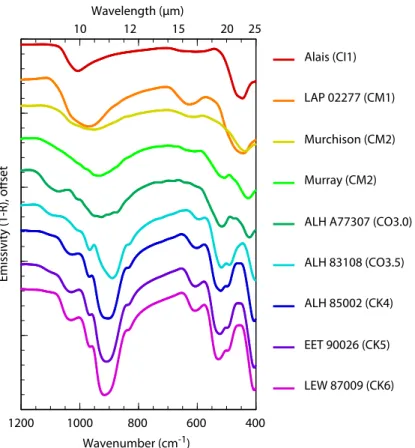
Carbonaceous chondrites in the TIR: Suites of TIR carbonaceous chondrite bulk (whole rock) spectra gen- erally have been measured in transmission [e.g., 3-4] and show, for example, that silicate-dominated spectral features vary with petrologic type as the dominant mineralogy shifts from hydrous silicates in types 1-2 to anhy- drous silicates in types >3.0. These data also have been used to document spectral differences between phyllosil- icate-dominated bulk meteorite spectra and the spectra of terrestrial phyllosilicate phase separates [4-5]. Emis- sion and reflectance data are more analogous to planetary surface spectra but have not been measured as com- monly [e.g., 6]. Spectra of individual CC phases are rarer but are available from discrete microspectroscopic measurements [e.g., 7]. Mapping microspectroscopy offers a means of obtaining both bulk meteorite spectra and phase-specific spectra and also allows for a detailed examination of the TIR properties of CC meteorites in pet- rologic context [e.g., 8]. In this presentation, I will show TIR reflectance spectra of carbonaceous chondrites representing petrologic types 1 – 6 (e.g., Figure 1) as well as phase-specific spectra that can be compared directly to the spectra of mineral analogue separates and used for quantitative determination [9] of carbonaceous chondrite mineralogy from TIR spectra.
What OTES may see at Bennu: Comparison of Bennu telescopic spectra and carbonaceous meteorite spec- tra in the VNIR suggests that CI and CM meteorites (petrologic types 1 - 2) are the most likely analogues for Bennu at those wavelengths [2]. The-
se meteorites contain anhydrous sili- cates, hydrated phyllosilicates, organ- ics, magnetite, and sulfides. In this case, OTES should see spectra domi- nated by these phases. Within these two petrologic types, there is signifi- cant variability in bulk spectral char- acter that is directly related to varia- tions in mineral proportions and solid solution chemistry within and be- tween different meteorite groups (e.g., Figure 1, top four spectra), which will enable us to further con- strain the composition of the asteroid.
References: [1] Lauretta, D. S. et al. (2015) Meteorit. Planet. Sci., 50, 834-849. [2] Clark, B. E. et al. (2011) Icarus, 216, 462-475. [3] Sandford, S.
A. (1984) Icarus, 60, 115-126. [4]
Beck, P. et al. (2014) Icarus, 229, 263-277. [5] Beck, P. et al. (2010) GCA, 74, 4881-4892. [6] Salisbury, J.
W. et al. (1991) Icarus, 92, 280-297.
[7] Morlok, A. (2008) Meteorit. Plan- et. Sci., 43, 1147-1160. [8] Hamilton, V. E. and Connolly, H. J. (2012) LPSC, 43, Abstract #2495. [9] Ram- sey, M. R. and Christensen, P. R.
(1998) JGR, 103, 577-596.
1200 1000 800 600 400
Emissivity (1-R), offset
Wavenumber (cm-1) Wavelength (µm)
Alais (CI1) LAP 02277 (CM1) Murchison (CM2) Murray (CM2) ALH A77307 (CO3.0) ALH 83108 (CO3.5) ALH 85002 (CK4) EET 90026 (CK5) LEW 87009 (CK6)
10 12 15 20 25
Figure 1. TIR spectra of carbonaceous chondrites ranging from petro- logic type 1 – 6 showing the range from aqueous alteration (phyllosili- cate-dominated) to thermal metamorphism (olivine-dominated).