Efficacy and Safety of Transcranial Magnetic Stimulation in Patients with Depression
Yu KAWAGUCHI*1) and Akira IWANAMI2)
Abstract : Transcranial magnetic stimulation (TMS) could be a helpful addition to pharmacotherapy in treating depression ; however, more evidence of its efficacy and safety is needed. This single-arm, open clinical study tested the efficacy and safety of TMS in 46 patients diagnosed with major depression or bipolar disorder. TMS was performed 30 times in total, with treatment frequencies of 3-5 times weekly.
Patients were examined at the 10th and 20th treatments, after completion of TMS treatment, and at 2 and 4 weeks after completion of treatment. Primary efficacy endpoints were changes in Hamilton Depression Scale (HAMD-17) and Patient Health Questionnaire (PHQ-9) scores from baseline. Mean scores and changes in HAMD-17 and PHQ-9 were significantly decreased from baseline. The response rate at completion of treatment was 68.57%. Systolic blood pressure was signifi- cantly decreased at 4 weeks after completion of treatment. Adverse events were observed in 10 patients (21.74%), including headache, discomfort, and fatigue. The present study found that patients with major depression or bipolar disorder who received TMS showed significant improvement in HAMD-17, PHQ-9, and Clinical Global Impression Scale scores.
Key words : transcranial magnetic stimulation, TMS, major depression, bipolar disorder
Introduction
The number of people in Japan diagnosed with depression has increased rapidly in the past decade. According to reports by the Japanese Ministry of Health, Labour and Welfare, 960,000 patients had mood disorders in 2011 compared to 440,000 in 19991,2). This>2-fold increase could be attributed to better methods for the diagnosis and classification of depression, but also to higher levels of stress in daily life.
Numerous clinical studies have analyzed the pathogenesis of depression, and many drugs targeting those mechanisms have been developed3,4). While such drugs play a major role in treating depression, multiple dosing is required when single-agent therapy is ineffective, with side effects and the development of tolerance becoming major problems associated with the treat- ment5). The determination of a non-pharmacological means of treating depression is therefore of Original
1)Department of Medicine, Division of Psychiatry, Showa University School of Medicine, 1-5-8 Hatanodai, Shinagawa-ku, Tokyo 142-8666, Japan.
2)Department of Medicine, Division of Psychiatry, Showa University Karasuyama Hospital.
* To whom corresponding should be addressed.
increasing importance and interest.
Transcranial magnetic stimulation (TMS) was originally established as a test method in neuro- physiology6), based on findings that cerebral cortex activity could be controlled by adjusting the amount of stimulation applied. TMS was reported as an effective treatment for depression in the mid-1990s7); however, a lack of consensus regarding the most effective stimulation conditions limited the adoption of TMS as an approved treatment for depression8). Despite this, many clinical studies have reported its efficacy with a low incidence of adverse effects9). In 2008 once the appropriate stimulation conditions were identified and established, the US Food and Drug Administration (FDA) approved the NeuroStar TMS Therapy System for the treatment of depression10).
In Japan, TMS therapy has recently been studied for the treatment of depression in combination with antidepressants ; however, evidence of its efficacy and safety remains insufficient. We there- fore undertook an exploratory clinical study using the NeuroStar TMS Therapy System to confirm the efficacy and safety of TMS as a new therapeutic option for the treatment of depression.
Subjects and methods Patients
This study protocol was approved by all Institutional Review Boards of the external institutions
(Hattori Clinic Ethics Review Committee, Approval number : 73-1) and registered with the Japan Agency for Medical Research and Development (IRB No. 11000859). Patients who met the fol- lowing inclusion criteria were enrolled in this study : 1) satisfied the diagnostic criteria of major depressive disorder or bipolar depressive episodes according to the DMS-Ⅳ-TR (Diagnostic and Statistical Manual of Mental Disorders 4th text revision); 2) aged between 12 and 70 years, with the consent of a legal guardian as well as that of the patient required for those<20 years of age ; 3) experienced episodes of depression within the past 3 years ; and, 4) gave written consent for participation. Our lower age limit of 12 years was based on previous reports surrounding the safety and effectiveness of TMS treatment in child and adolescent psychiatry11). Exclusion criteria were : 1) past history of schizophrenia, obsessive-compulsive disorder, posttraumatic stress disorder, and/or eating disorder ; 2) history of convulsive disorders such as epilepsy ; 3) history of neurological disease or idiophrenic insanity ; 4) drug or alcoholic abuse ; 5) use of magnetic devices such as a pacemaker, cochlear implant, or intracranial clip ; 6) diagnosed with serious metabolic or endocrine disease ; 7) pregnancy or possible pregnancy ; 8) strong suicidal ideation ; and 9) judged as ineligible by the physicians in charge. The eligible participants provided writ- ten informed consent following an explanation by the physicians in charge of the purpose, meth- ods, duration, study population size, and possible benefits and risks of the study protocols. After a final assessment by the physicians in charge, background information on the study patients was entered into the electronic data capture (EDC) system in accordance with the case registration form, and then sent to the clinical data management center.
TMS treatment
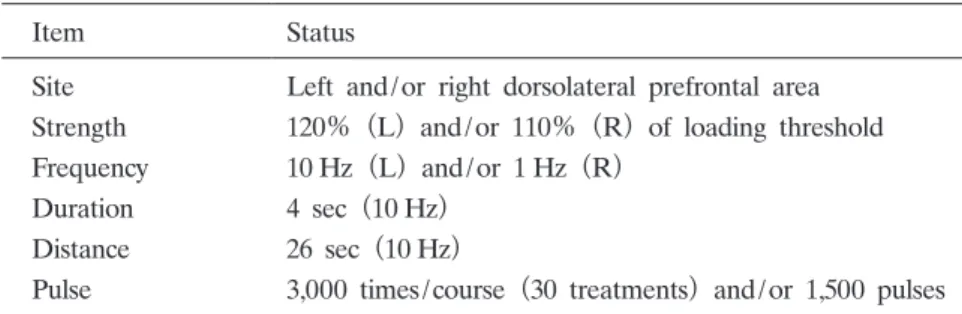
TMS treatment was performed in accordance with the standard protocol described in the NeuroStar userʼs manual (Table 1). During TMS therapy, drugs for the treatment of depres- sion, and for conditions other than depression, could be continued after consultation with the physicians in charge. Such drugs were used without changing the dosage and administration ; if changed or withdrawn, the details were recorded on the case reporting form.
TMS therapy was discontinued in the following cases : 1) a patient who requested discontinu- ation ; 2) continuation was not possible due to adverse events ; 3) depressive symptoms were aggravated ; 4) no improvement was observed and the physicians in charge judged that no benefit would be achieved with additional TMS ; 5) remission of symptoms was observed and the physicians in charge judged that further therapy was not required ; 6) a patient became pregnant ; 7) a serious protocol violation occurred ; and 8) discontinuation of treatment was judged necessary for other reasons.
Assessment of efficacy and safety
Assessment scale scores obtained when monitoring patient background were used as baseline scores for comparison with the assessment scale scores obtained during treatment and the obser- vation period after completion of treatment.
The primary endpoints were the amount of change in the first 17 items of the Hamilton Depression Scale (HAMD-17) and in the first 9 items of the Patient Health Questionnaire
(PHQ-9) at completion of TMS treatment compared with baseline. Secondary endpoints were the levels of change in HAMD-17, PHQ-9, Clinical Global Impression Scale (CGIS), and Young Mania Rating Scale (YMRS) scores at each observation time point compared with baseline ; response (defined as>50% improvement in the HAMD-17 score); and the recurrence rate at each observation time point. Safety evaluation was based on the occurrence of adverse events, incidence of adverse events, and incidence of side effects.
Statistics
The target number of patients was 30 based on the feasibility limitations of this study. The populations for whom efficacy and safety were evaluated consisted of all registered patients, and the analysis was conducted based on the intention-to-treat population. Primary analysis involved
Table 1. Stimulation conditions
Item Status
Site Left and/or right dorsolateral prefrontal area Strength 120% (L) and/or 110% (R) of loading threshold Frequency 10 Hz(L) and/or 1 Hz (R)
Duration 4 sec (10 Hz)
Distance 26 sec (10 Hz)
Pulse 3,000 times/course (30 treatments) and/or 1,500 pulses
calculating the amount of change in each assessment scale score at the termination of TMS treatment compared with baseline. Based on the amount of change and laboratory test results, descriptive statistics were calculated and the 2-tailed Wilcoxon rank-sum test was performed with regard to baseline and each observation time point. The level of significance level was set at 5%, and multiplicity was not considered because this was an exploratory analysis. Changes in laboratory test results were subjected to the Friedman test.
Calculation of adverse events and their incidence
For blood pressure, pulse rate, and laboratory test data, descriptive statistics of the amount of change and change over time were calculated. Measured values at baseline and each observa- tion time point were examined using the 2-tailed paired t-test. The significance level was set at 5%, and multiplicity was not considered because this was an exploratory analysis.
Study flow
Figure 1 illustrates the study flow. After obtaining written informed consent for study partici- pation from patients, their backgrounds were investigated and eligibility was assessed. Necessary information on eligible patients was entered into the EDC system for registering with the clinical data management center. The data were checked for eligibility. If judged as eligible, registration was completed. Registered patients received TMS treatment according to the study protocol.
During treatment, patients were monitored and examined at the 10th treatment, 20th treatment, at the completion of treatment, and at 2 and 4 weeks thereafter to determine their condition and monitor any adverse events. This study ended after the 4-week follow-up.
Results
Study population and patient background
Details of the patient enrolment process are shown in Table 2. We evaluated 46 patients, comprising 32 men (68.6%) and 14 women (30.4%), in the efficacy and safety analysis. The mean age ( standard deviation) of study participants was 34.7 12.9 years, with a mean
Fig. 1. Participant flow
( standard deviation) onset age of 32.0 13.2 years. No pregnancies occurred during treatment.
Twenty-five patients (54.3%) were diagnosed with major depression and twenty-one (45.7%)
with bipolar disorder (Table 3). The mean duration from the start to the completion of TMS treatment was 82.2 days, and thus the mean number of treatments per week was 2.55.
Primary efficacy outcomes
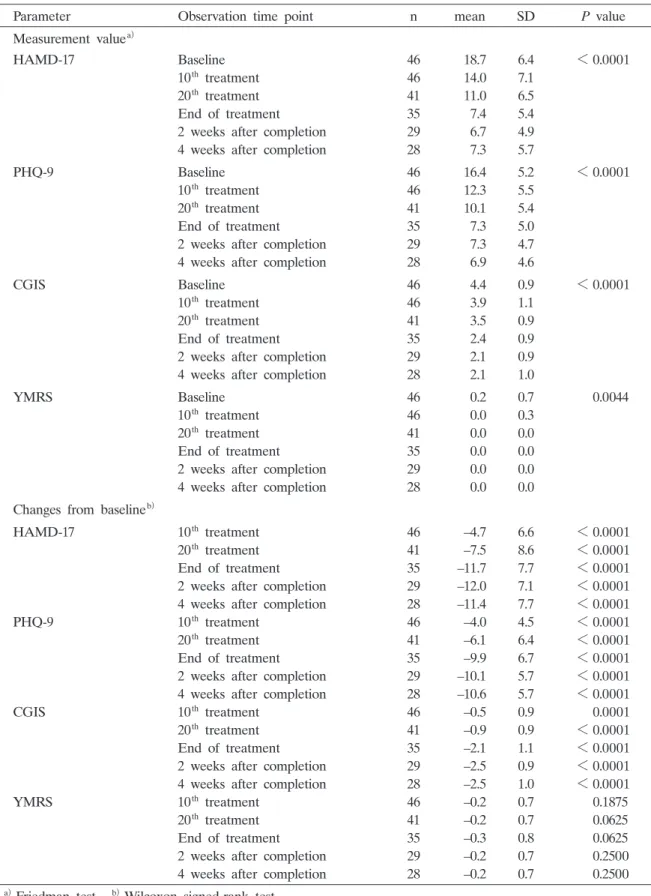
The efficacy outcomes (HAMD-17, PHQ-9, CGIS, and YMRS scores) at each observation time point and changes from baseline are shown in Table 4. All efficacy outcomes decreased significantly with time (baseline to 4 weeks after TMS treatment ; Friedman test P<0.001, P< 0.001, P<0.001, and P=0.004 for HAMD-17, PHQ-9, CGIS, and YMRS scores, respectively). Furthermore, changes from baseline measurements were significantly decreased for HAMD-17, PHQ-9, and CGIS scores (P<0.001), but not for YMRS scores.
Table 2. Patient enrollment procedure n
Total patients enrolled 67
Screening eligible 50 Completion 35 Discontinuation 15 Screening failure 17
Efficacy analysis set 46
Safety analysis set 46
Table 3. Patient characteristics
Parameter n %
Gender Male 32 69.6
Female 14 30.4
Pregnancy
None 14 100.0
Pregnant 0 0.0
Possibly pregnant 0 0.0
Type of depression Major depressive disorder 25 54.3
Bipolar disorder 21 45.7
Mental disorder No 46 100.0
Yes 0 0.0
Adjuvant treatment
No 0 0.0
Yes 46 100.0
Antidepressant 25 54.4
1 antidepressant 20 43.5 2 antidepressants 3 6.5 More than 3 antidepressants 2 4.3
Other 32 69.6
Table 4. Efficacy outcomes and changes in scores compared with baseline
Parameter Observation time point n mean SD P value
Measurement valuea)
HAMD-17 Baseline 46 18.7 6.4 <0.0001
10th treatment 46 14.0 7.1
20th treatment 41 11.0 6.5
End of treatment 35 7.4 5.4
2 weeks after completion 29 6.7 4.9
4 weeks after completion 28 7.3 5.7
PHQ-9 Baseline 46 16.4 5.2 <0.0001
10th treatment 46 12.3 5.5
20th treatment 41 10.1 5.4
End of treatment 35 7.3 5.0
2 weeks after completion 29 7.3 4.7
4 weeks after completion 28 6.9 4.6
CGIS Baseline 46 4.4 0.9 <0.0001
10th treatment 46 3.9 1.1
20th treatment 41 3.5 0.9
End of treatment 35 2.4 0.9
2 weeks after completion 29 2.1 0.9
4 weeks after completion 28 2.1 1.0
YMRS Baseline 46 0.2 0.7 0.0044
10th treatment 46 0.0 0.3
20th treatment 41 0.0 0.0
End of treatment 35 0.0 0.0
2 weeks after completion 29 0.0 0.0
4 weeks after completion 28 0.0 0.0
Changes from baselineb)
HAMD-17 10th treatment 46 –4.7 6.6 <0.0001
20th treatment 41 –7.5 8.6 <0.0001
End of treatment 35 –11.7 7.7 <0.0001
2 weeks after completion 29 –12.0 7.1 <0.0001
4 weeks after completion 28 –11.4 7.7 <0.0001
PHQ-9 10th treatment 46 –4.0 4.5 <0.0001
20th treatment 41 –6.1 6.4 <0.0001
End of treatment 35 –9.9 6.7 <0.0001
2 weeks after completion 29 –10.1 5.7 <0.0001
4 weeks after completion 28 –10.6 5.7 <0.0001
CGIS 10th treatment 46 –0.5 0.9 0.0001
20th treatment 41 –0.9 0.9 <0.0001
End of treatment 35 –2.1 1.1 <0.0001
2 weeks after completion 29 –2.5 0.9 <0.0001
4 weeks after completion 28 –2.5 1.0 <0.0001
YMRS 10th treatment 46 –0.2 0.7 0.1875
20th treatment 41 –0.2 0.7 0.0625
End of treatment 35 –0.3 0.8 0.0625
2 weeks after completion 29 –0.2 0.7 0.2500
4 weeks after completion 28 –0.2 0.7 0.2500
a)Friedman test. b)Wilcoxon signed-rank test.
HAMD-17 ; 17 items in the Hamilton Depression Scale. PHQ-9 ; 9 items in the Patient Health Question- naire. CGIS ; Clinical Global Impression Scale. YMRS ; Young Mania Rating Scale.
Secondary outcomes
The response rate and recurrence rate at each visit are shown in Table 5. The response rate at the 10th TMS treatment was 23.9%, and at the end of treatment it increased to 68.6%. The response rate was maintained (67.9%) at 4 weeks after treatment completion. In addition, no recurrence was seen during the study period.
Safety assessment
Safety was evaluated in all patients who received TMS treatment. Patient visits with no objec- tive findings exceeded 90%. Furthermore, except for 94.3% at the end of treatment, the safety rate exceeded 95% for the other measurements. Although 93.5% of patients had subjective symptoms at baseline, that decreased to 82.9% at the end of treatment and to 71.4% at 4 weeks after treatment completion.
Changes in blood pressure are shown in Table 6. Systolic blood pressure was significantly
Table 5. Recurrence and remission rates in 46 patients who received TMS
Observation time point Remission Recurrence rate
n % n %
10th treatment 11 23.91 0 0.0
20th treatment 18 43.90 0 0.0
End of treatment 24 68.57 0 0.0
2 weeks after completion 20 68.97 0 0.0
4 weeks after completion 19 67.86 0 0.0
Table 6. Changes in blood pressure (BP) and pulse rate from baseline
Parameter Observation time point n Mean SD Median Range P valuea)
Systolic BP 10th treatment 45 3.1 10.8 3.0 24-35 0.0631
20th treatment 40 0.3 10.8 1.5 25-24 0.8731
End of treatment 35 3.2 10.4 3.0 35-14 0.0760
2 weeks after completion 27 3.2 13.0 6.0 29-29 0.2088
4 weeks after completion 27 7.5 16.5 8.0 14-56 0.0254
Diastolic BP 10th treatment 45 5.0 9.9 5.0 21-36 0.0015
20th treatment 40 3.7 7.8 5.0 16-21 0.0051
End of treatment 35 0.7 10.5 1.0 29-20 0.7123
2 weeks after completion 27 5.2 10.1 6.0 15-27 0.0130
4 weeks after completion 27 8.9 9.7 9.0 15-26 <0.0001
Pulse rate 10th treatment 45 1.4 12.3 1.0 35-27 0.4619
20th treatment 40 1.9 11.6 0.0 33-21 0.3057
End of treatment 35 2.5 15.7 3.0 37-22 0.3515
2 weeks after completion 27 0.3 12.9 1.0 28-25 0.9179
4 weeks after completion 27 2.6 15.0 2.0 24-35 0.3775
a)P value : Paired t-test.
decreased at 4 weeks after treatment completion. Diastolic blood pressure was significantly decreased at the 10th and 20th treatments, and at 2 and 4 weeks after treatment completion.
There was no significant change in pulse rate during the study and follow-up period.
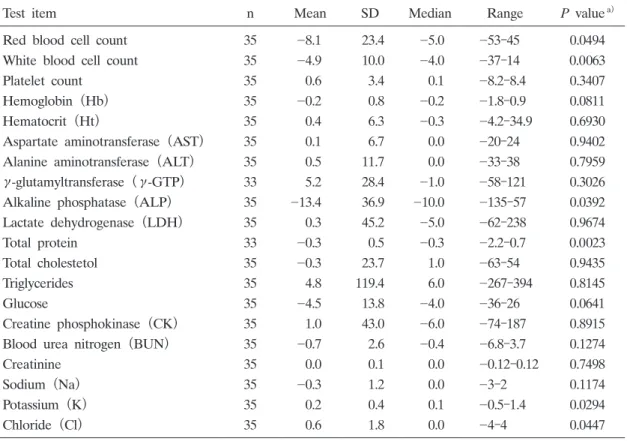
Changes in laboratory blood test values are shown in Table 7. Red and white blood cell numbers and the levels of alkaline phosphatase (ALP) and total protein significantly decreased during the study period, while levels of potassium and chlorine significantly increased. No abnormal electrocardiograms or exacerbation of manic episodes were observed.
Adverse events
No serious adverse events were recorded including seizures during or after TMS treatment, nor was there any exacerbation of manic episodes. The most commonly reported adverse effects were headache (n=3, 6.5%), tiredness (n=2, 4.3%), and discomfort (n=4, 8.7%). Two patients (4.3%) reported drowsiness. One patient (2.2%) reported concentration impairment, and 1 (2.2%) reported a strange sensation in the scalp.
Discussion
This was the first study evaluating the efficacy and safety of TMS treatment in Japanese patients with depression. One important characteristic of this study was that TMS treatment was
Table 7. Changes in laboratory blood test values from baseline to the end of treatment
Test item n Mean SD Median Range P valuea)
Red blood cell count 35 8.1 23.4 5.0 53-45 0.0494
White blood cell count 35 4.9 10.0 4.0 37-14 0.0063
Platelet count 35 0.6 3.4 0.1 8.2-8.4 0.3407
Hemoglobin (Hb) 35 0.2 0.8 0.2 1.8-0.9 0.0811
Hematocrit (Ht) 35 0.4 6.3 0.3 4.2-34.9 0.6930
Aspartate aminotransferase (AST) 35 0.1 6.7 0.0 20-24 0.9402
Alanine aminotransferase (ALT) 35 0.5 11.7 0.0 33-38 0.7959
γ-glutamyltransferase (γ-GTP) 33 5.2 28.4 1.0 58-121 0.3026
Alkaline phosphatase (ALP) 35 13.4 36.9 10.0 135-57 0.0392
Lactate dehydrogenase (LDH) 35 0.3 45.2 5.0 62-238 0.9674
Total protein 33 0.3 0.5 0.3 2.2-0.7 0.0023
Total cholestetol 35 0.3 23.7 1.0 63-54 0.9435
Triglycerides 35 4.8 119.4 6.0 267-394 0.8145
Glucose 35 4.5 13.8 4.0 36-26 0.0641
Creatine phosphokinase (CK) 35 1.0 43.0 6.0 74-187 0.8915
Blood urea nitrogen (BUN) 35 0.7 2.6 0.4 6.8-3.7 0.1274
Creatinine 35 0.0 0.1 0.0 0.12-0.12 0.7498
Sodium (Na) 35 0.3 1.2 0.0 3-2 0.1174
Potassium (K) 35 0.2 0.4 0.1 0.5-1.4 0.0294
Chloride (Cl) 35 0.6 1.8 0.0 4-4 0.0447
a)P value : Paired t-test.
not conducted daily, differing from the daily regimen approved by the US FDA. Therefore, we could assess the effectiveness of TMS treatment without placing a schedule burden on patients requiring them to miss work or other obligations.
Diagnostic and severity scores for depression were improved with each TMS treatment during this study, suggesting that repeated non-daily TMS treatment as well as conventional daily treat- ment have good therapeutic effects in patients with depression. Of note, among the many TMS treatment reports at 5 days a week, our study showed efficacy at treatment less than 5 days a week. Based on these promising results, further study into the benefits and scheduling of TMS treatment with a larger population is recommended.
TMS treatment yielded only a minor improvement in the YMRS score compared with the other scores examined in this study. This might be attributable to the low scores at baseline, because this study did not include patients in a manic state. On the other hand, no exacerba- tion of manic episodes was observed, suggesting that the improvement of depression after TMS treatment does not result in a shift to a manic state.
A decrease in blood pressure was observed after treatment in this study. Previous studies reported that TMS treatment could improve cerebral blood flow, thereby possibly leading to a reduction in blood pressure12,13). Accordingly, our results support the possible hypotensive effects of TMS treatment. Alternatively or additionally, the beneficial effects of TMS treatment on depression itself and/or autonomic nervous function might affect the mechanisms underlying the decrease in blood pressure observed in this study14). In any case, it is highly likely that the TMS treatment regimen used in this study is safe, because the blood pressure fluctuation observed was within the medically acceptable range. In addition, the changes in laboratory blood tests, including the number of red and white blood cells and levels of ALP, total protein, potassium, and chlorine, were statistically significant but within the medically acceptable range, suggesting no/very low risk of impairment of several organs and metabolism associated with TMS treatment. Finally, no serious adverse events were observed in this study, and the com- monly reported side effects were similar to those in previous studies15,16).
This study had several limitations. Since the treatment was open label and all patients were taking medications, the improvement of depression might be partly attributable to the additive effects of TMS treatment and medications rather than to TMS treatment alone. In addition, the follow-up period was 4 weeks and although the improvement of depression with few adverse effects was observed and maintained during the course of this study, longer-term follow-up would help to clarify the clinical significance of these results. Accordingly, further study with a larger patient population and longer follow-up will be necessary to corroborate our findings on the efficacy and safety of non-daily TMS treatment.
Conclusion
We evaluated the efficacy and safety of treating depression using the NeuroStar Transcranial Magnetic Stimulation system in patients with depression including major depressive disorder and bipolar depressive episodes. In the 46 patients who met the inclusion criteria, HAMD-17, PHQ-9,
and CGIS scores, which were the primary outcomes, showed significant decreases with TMS treatment, indicating improvement of depression. The finding that treatment 5 times weekly had equivalent effectiveness to 2 or 3 times weekly is important, since it raises the possibility of flex- ible treatment intervals.
Conflict of interest disclosure
We have no conflicts of financial interest to declare in relation to this study.
References
1) Ministry of Health, Labour and Welfare. Patient survey 1999. (in Japanese). 2) Ministry of Health, Labour and Welfare. Patient survey 2011. (in Japanese).
3) Fitzgerald PB, Oxley TJ, Laird AR, et al. An analysis of functional neuroimaging studies of dorsolateral prefrontal cortical activity in depression. Psychiatry Res. 2006;148:33-45.
4) Hecht D. Depression and the hyperactive right-hemisphere. Neurosci Res. 2010;68:77-87.
5) Drasch G, Dahlmann F, von Meyer L, et al. Frequency of different anti-depressants associated with suicides and drug deaths. Int J Legal Med. 2008;122:115-121.
6) Ridding MC, Rothwell JC. Is there a future for therapeutic use of transcranial magnetic stimulation? Nat Rev Neurosci. 2007;8:559-567.
7) George MS, Wassermann EM, Williams WA, et al. Daily repetitive transcranial magnetic stimulation (rTMS)
improves mood in depression. Neuroreport. 1995;6:1853-1856.
8) Gross M, Nakamura L, Pascual-Leone A, et al. Has repetitive transcranial magnetic stimulation (rTMS) treatment for depression improved? A systematic review and meta-analysis comparing the recent vs. the earlier rTMS stud- ies. Acta Psychiatr Scand. 2007;116:165-173.
9) Janicak PG, OʼReardon JP, Sampson SM, et al. Transcranial magnetic stimulation in the treatment of major depressive disorder: a comprehensive summary of safety experience from acute exposure, extended exposure, and during reintroduction treatment. J Clin Psychiatry. 2008;69:222-232.
10) OʼReardon JP, Solvason HB, Janicak PG, et al. Efficacy and safety of transcranial magnetic stimulation in the acute treatment of major depression: a multisite randomized controlled trial. Biol Psychiatry. 2007;62:1208-1216.
11) Paul E. Croarkin, Christopher A. Wall, Jon Lee. Applications of transcranial magnetic stimulation (TMS) in child and adolescent psychiatry. Int Rev Psychiatry. 2011;23:445-453.
12) Kito S, Fujita K, Koga Y. Changes in regional cerebral blood flow after repetitive transcranial magnetic stimula- tion of the left dorsolateral prefrontal cortex in treatment-resistant depression. J Neuropsychiatry Clin Neurosci.
2008;20:74-80.
13) Kito S, Fujita K, Koga Y. Regional cerebral blood flow changes after low-frequency transcranial magnetic stimula- tion of the right dorsolateral prefrontal cortex in treatment-resistant depression. Neuropsychobiology. 2008;58:29-36.
14) Remue J, Vanderhasselt MA, Baeken C, et al. The effect of a single HF-rTMS session over the left DLPFC on the physiological stress response as measured by heart rate variability. Neuropsychology. 2016;30:756-766.
15) Rossi S, Hallett M, Rossini PM, et al. Safety, ethical considerations, and application guidelines for the use of tran- scranial magnetic stimulation in clinical practice and research. Clin Neurophysiol. 2009;120:2008-2039.
16) Connolly KR, Helmer A, Cristancho MA, et al. Effectiveness of transcranial magnetic stimulation in clinical prac- tice post-FDA approval in the United States: results observed with the first 100 consecutive cases of depression at an academic medical center. J Clin Psychiatry. 2012;73:e567-e573.
[Received December 1, 2017 : Accepted December 22, 2017]