1
厚生労働科学研究費補助金(化学リスク研究事業)
免疫毒性評価試験法Multi-ImmunoTox assayの国際validationへ向けての検討 分担研究報告書
国際バリデーションの施行
分担研究者 小島 肇 国立医薬品食品衛生研究所
研究要旨
新たなin vitro免疫毒性評価試験法(Multi-ImmunoTox assay:MITA)の一つである
IL-2レ ポ ー タ ー ア ッ セ イ を 、 経 済 協 力 開 発 機 構 (
Organisation for EconomicCo-operation and Development
:OECD)の試験法ガイドラインとしての公定化するた
め、国際バリデーション研究を施行した。本年度に実施されたバリデーション研究
phase Iの結果を受け、昨年度同様、国際的な専門家を招聘してバリデーション結果に対して意見を求めた。その結果、phase Iバリデーション研究が適切に実施された ことを確認できた。
キーワード:免疫毒性、バリデーション、OECD
研究協力者氏名・所属機関名及び所属機関におけ る職名
相場節也 東北大学医学系研究科・医学部・皮 膚科学分野教授
木村 裕 東北大学医学系研究科・医学部・皮 膚科学分野助教
A.研究目的
相場らにより、新たに開発された
in vitro免疫毒 性評価試験法(Multi-ImmunoTox assay:MITA)の 一つである
IL-2レポーターアッセイを、経済協力 開発機構(Organisation for Economic Co-operation
and Development:OECD)の試験法ガイドライン(Test Guideline:TG)としての公定化するため、
国際バリデーション研究を施行する。
B.研究方法
B-1.
バリデーション研究の支援
B-1-1.
バリデーション被験物質の送付
IL-2レポーターアッセイのバリデーション研究
Phase I (以下、Phase I
と記す)にて、施設内および
施設間再現性を求めるために用いた5物質を、コー ド化して各施設に送付した。
B-1-2. バリデーション研究の被験物質選択 B-2-2.に示す第2回会議にて、より広範な物質を
用いて施設間再現性を評価するためのIL-2レポー ターアッセイのバリデーション研究Phase II (以下、
Phase IIと記す)の被験物質を選択した。
B-1-3.
バリデーション結果の記録確認
Phase I
で用いられた各施設の記録用紙および
データを回収し、バリデーションが適切に実施さ
2
れたかを確認した。
B-2.
国際的な専門家との意見交換
B-2-1. IL-2レポーターアッセイのバリデーション
研究Phase 0 (以下、Phase 0)後の電話会議
Phase 0
終了後の平成28年9月に電話会議を開催
し、Phase I の開始について議論した。
B-2-2.
第2回対面会議
本年度に実施されたMITAに関する国際バリデ ーション結果を検証するため、平成29年2月に国際 バリデーション第2回実行委員会の会議を企画し た。
C.結果
C-1.
バリデーション研究の支援
C-1-1.
バリデーション被験物質の送付
Phase I
で用いた5物質を、施設内再現性を求め
るために、15物質(5物質
×3セット)にコード化して リード施設を含む参加4施設に送付した。コード化 して実施していることもあり、本報告書には物質 名を記載していない。
実験の終了まで、被験物質に関するトラブルは 生じなかった。
C-1-2. バリデーション研究の被験物質選択 C-2-2.に示す第2回対面会議にて、施設間再現性
を確認するため、phase II の25物質を選定した。
コード化して実施することもあり、本報告書には 物質名を記載していない。In vivo結果が明確な物 質を中心に選択した。
この25物質から、国内在庫、価格等を考慮して
20物質に被験物質を絞った。C-1-3.
バリデーション結果の記録確認
Phase I
終了後に回収した記録用紙の一覧を表1
に示した。施設によって一部不備はあったが、
GLP(Good Laboratory Procedure)の精神に則り、適切 に実験が実施され、その記録が残されていること を確認した。
なお、装置のバリデーションは各施設では行わ
ず、添付資料1に従うことになった。
C-2. 国際的な専門家との意見交換 C-2-1. Phase 0後の電話会議
Phase 0
終了後の平成28年9月に電話会議を開催
し、結果を確認するとともに、Phase I の開始につ いて議論した。
Phase 0
には表2に示す5物質が4施設で実施され
た。そのうち、産総研四国は経験の浅い施設とし て、本年度よりバリデーションに参加することに なった。データ解析は複数の判別式で解析された。
電話会議に使用されたAgendaおよび会議後の結論 を添付資料2にまとめた。
Phase 0
の結果では、経験の浅い施設の初期の実
験を除き、4施設の結果は同様の反応パターンを示 した。実際には、nSLO-LAおよびnSLG-LAという 生データを用いた場合、4施設で異なっていた が、%suppressionを計算した場合、4施設間に有意 な差はなかった。これらの原因を探るため、細胞 を集めるための遠心スピード、抗生物質の選択、
T細胞を活性化するPMA(phorbol myristate acetate
) /Ionomysinの作成法を検討したが、いずれも原因ではなかった。nSLO-LAはルミノメーターの特性に よりばらつきを引き起こすので、受け入れ基準
(fold induction)としてnSLO-LA>1.5を設定してい る。なお、nSLG-LAには受け入れ基準はない。
nSLG-LAがルミノメーターに依存しているので、
溶媒で処理された細胞と化学物質で処理された細 胞のnSLG-LAによって求められる%suppressionの データを解析に用いている。判別式の選択は現時 点では保留となり、phase I 終了後に決定すること になった。
今後、一部の計画を修正して、平成28年9月より、
phase I
に移行することで合意された。
C-2-2.
第2回対面会議
国際バリデーション研究における第
2回対面会
議には、免疫毒性およびその試験法に関する専門
3
家として、海外から
Dr. Emanual Corsini (Milan Univ.)、Dr. Erwin L. Roggen(3Rs Management and Consulting ApS)およびDr. Dori Germolec(NTP/NIEHS)を、国内からは、日本免疫毒性学 会の推薦者である井上智彰博士(中外製薬)を外 部専門家として招聘し、研究班の班員を含む表
3に示すメンバーにて
2日間掛けて、MITA バリデ ーション結果の確認、判別式の選択を含む試験法 プロトコルの改訂などについて討論した。会議の 議事次第を添付文書
3および議事概要を添付文書
4に示す。
以下に結果の概要を示す。
1)細胞毒性
細胞毒性が
II-SLR-LA活性の低下と無関係とい える根拠について意見交換がなされた。
II-SLR-LA
は細胞死の初期を示すとの仮説が東北
大より示され、細胞死が弱い濃度で免疫抑制また は増強を評価するとの見解で合意を得た。
2)プロトコル改訂 2-1)
溶解性
最高適用濃度で沈殿が見られた被験物質もあっ たが、低濃度で評価できている。改訂なし。
2-2)細胞密度
3x10⁵/mL
で播種され、培養
4または
5日目で評 価することが最適である。
2-3)nSLO-LA
Fold induction
を
1.5から
3に変更する。
3)施設内再現性
Phase I
の結果においても、どの判別式を用い
ても、施設内再現性は良好であった。
4)判別式
複数の判別式を用い、それぞれの解析結果か ら、適切な評価法について議論された。その結 果、以下の判別式をプロトコルに組み込むこと で合意を得た。
判別式:Dunnet テストで検定された
3回の独立 した実験の%suppression を使用する。その際に
3
濃度以上で濃度依存性が見られ、その中で
1点でも有意差がある場合を陽性とする。
以上の議論の末、phase Iバリデーション研究 が適切に実施されたことを確認できた。さらに、
新判別式を含むプロトコールの改訂に合意が得 られ、より広範な被験物質を用いて施設間再現 性を確認するためのphase IIを実施することにな った。
添付文書5に示すバリデーション計画案を、外部 専門家の意見をもとに、一部改訂した。
D.
考察
in vitro免疫毒性評価試験法(MITA)の一つであ
るIL-2アッセイの技術移転性および再現性の確認 を目的としたバリデーション研究が施行された。
トレーニングにあたるphase 0を経て、
phase Iの5物質で施設内再現性および施設間再現性が確認され た。国際的な専門家との会議では、
Phase Iおよび
IIの解析に用いる判別式についても合意が取れ、プロトコールがほぼ固まった。Phase IIの円滑な実施 により、より広範な被験物質を用いて施設間再現 性の確保に務めたい。
E.結論
相場らにより、新たに開発されたMITAの一つで あるIL-2レポーターアッセイの公定化を目指すた め、国際的なバリデーション研究が施行された。
このバリデーションの客観性を確保するため、被 験物質のコード化および配布、実験記録の回収お よび確認を担当し、適切な実験が実施されている ことを確認できた。
F. 添付文書
1) Verification of luminometer 2) Teleconference for the MITA assay 3) Agenda:2nd meeting for the MITA assay 4) Minutes of MITA at 2nd meeting,
4 5)Study plan for the validation trial on multicolor
reporter assay using IL-2 Luc as a test evaluating the immunotoxic potential of chemicals
5
表1.記録用紙確認リスト
LabB (AIST-TSUKUBA) LabC (FDSC) LabD (AIST-TAKAMATSU) LabA
Code try1 try2 exp1 exp2 exp3 Code exp1 exp2 exp3 Code exp1 exp2 exp3 exp4 (TOHOKU univ.)
1 MIB014A × × ○ ○ ○ MIC027A ○ ○ ○ MID036A ○ ○ × ○ MIA003A
2 MIB017A × × ○ ○ ○ MIC029A ○ ○ ○ MID038A ○ ○ × ○ MIA005A
setA 3 MIB018A × × ○ ○ ○ MIC021A ○ ○ ○ MID310A ○ ○ × ○ MIA007A
4 MIB110A × × ○ ○ ○ MIC023A ○ ○ ○ MID037A ○ ○ × ○ MIA009A
5 MIB012A × × ○ ○ ○ MIC025A ○ ○ ○ MID034A ○ ○ × ○ MIA001A
1 MIB017B ○ ○ ○ MIC026B ○ ○ ○ MID033B × ○ ○ ○ MIA004B
2 MIB019B ○ ○ ○ MIC028B ○ ○ ○ MID035B × ○ ○ ○ MIA007B
setB 3 MIB011B ○ ○ ○ MIC210B ○ ○ ○ MID037B × ○ ○ ○ MIA008B
4 MIB013B ○ ○ ○ MIC027B ○ ○ ○ MID039B × ○ ○ ○ MIA010B
5 MIB015B ○ ○ ○ MIC024B ○ ○ ○ MID031B × ○ ○ ○ MIA002B
1 MIB016C ○ ○ ○ MIC023C ○ ○ ○ MID034C × ○ ○ ○ MIA007C
2 MI0018C ○ ○ ○ MIC025C ○ ○ ○ MID037C ○ ○ × ○ MIA009C
setC 3 MIB110C ○ ○ ○ MIC027C ○ ○ ○ MID038C ○ ○ × ○ MIA001C
4 MIB017C ○ ○ ○ MIC029C ○ ○ ○ MID310C ○ ○ ○ MIA003C
5 MIB014C ○ ○ ○ MIC021C ○ ○ ○ MID032C × ○ ○ ○ MIA005C
○ passed × failed needless
6
表
2.Phase 0トレーニング用物質
Chemical CAS No. MW Physical
state MITA IL-2 result
2-Aminoanthracene 613-13-8 193.24 Solid S(-/-/-)
CH3HgCl 115-09-3 251.08 Solid +-
Chloroquine diphosphate salt 50-63-5 515.86 Solid S(-/-/-)
Citral 5392-40-5 152.23 Liquid S(+-/+-/+-*)
Dexamethasone 50-02-2 392.46 Solid S(-/-/-)
表3.MITA第2回国際バリデーション対面会議 参加者リスト
No. Name Affiliation Country
1 Emanuela Corsini Universit.AN` degli Studi di Milano Italy 2 Erwin L. Roggen 3Rs Management and Consulting ApS Denmark
3 Tomoaki Inoue Chugai Pharmaceutical Co., Ltd. Japan
4 Setsuya Aiba Tohoku University Graduate School of Medicine Japan 5 Yutaka Kimura Tohoku University Graduate School of Medicine Japan 6 Nakajima National Institute of Advanced Industrial Science
and Technology Japan
7 Rie Yasuno National Institute of Advanced Industrial Science
and Technology Japan
8 Kohji Yamakage Food and Drug Safety Center, Hatano Research
Institute Japan
9 Takashi Omori Kobe University Japan
10 Hajime Kojima JaCVAM, National Institute of Health Sciences Japan
11 Steven Venti
Translator Japan
7 G.
研究発表
G-1.
論文発表
1)
小島 肇: 日本で開発または評価され た
OECDテストガイドライン, 生物化 学的測定研究会年報, 20 (2016)
2) Yamamoto N, Kato Y, Sato A, Hiramatsu N, Yamashita H, Ohkuma M, Miyachi E, Horiguchi M, Hirano K, Kojima H:
Establishment of a new immortalized human corneal epithelial cell line (iHCE-NY1) for use in evaluating eye irritancy by in vitro test methods, In Vitro Cell.Dev.Biol.-Animal.2016;
Aug;52(7):742-8
3) Yamaguchi H, Kojima H, Takezawa T:
Predictive performance of the Vitrigel-eye irritancy test method using 118 chemicals, J Appl Toxicol. 2016 Aug;36(8):1025-37.
4)
小島 肇: 皮膚毒性評価に関する最近 の話題, 評価方法, 第
17回日本毒性学 会生涯教育講習会テキスト, 89-108
(2016)5) Uchino T, Kuroda Y, Ishida S, Yamashita K, Miyazaki H, Oshikata A, Shimizu K, Kojima H, Takezawa T, Akiyama T, Ikarashi Y: Increase of β2-integrin on adhesion of THP-1 cells to collagen vitrigel membrane, Biosci Biotechnol Biochem.
2016; Jul 4:1-6
6) Marx U, Andersson TB, Bahinski A, Beilmann M, Beken S, Cassee FR, Cirit M, Daneshian, Fitzpatrick S, Frey O, Gaertner C, Giese C, Griffith L, Hartung T, Heringa MB, Hoeng J, Jong WH, Kojima H, Kuehnl J, Leist M, Luch A, Maschmeyer I, Sakharov D, Sips AJAM, Steger-Hartmann T, Tagle DA, Tonevitsky A, Tralau T, Tsyb
S, Stolpe A, Vandebriel R, Vulto P, Wang J, Wiest J, Rodenburg M, Roth A:
Biology-inspired microphysiological system approaches to solve the prediction dilemma of substance testing. ALTEX.
2016; 33(3):272-321
7) Barroso J, Ahn IY, Caldeira C, Carmichael PL, Casey W, Coecke S, Curren R, Desprez B, Eskes C, Griesinger C, Guo J, Hill E, Roi AJ, Kojima H, Li J, Lim CH, Moura W, Nishikawa A, Park H, Peng S, Presgrave O, Singer T, Sohn SJ, Westmoreland C, Whelan M, Yang X, Yang Y, Zuang V.:
International Harmonization and Cooperation in the Validation of Alternative Methods, Advance in Experimental Medicine and Biology.
Validation of Alternative Methods for Toxicity Testing, Springer, 2016, pp.793-803
8) Kojima H., Safety Assessment of Cosmetic Ingredients, COSMETIC SCIENCE AND TECHNOLOGY: THEORETICAL PRINCIPLES AND APPLICATIONS, Elsevier 2017; 343-386
9)
小島 肇: 医薬品に係わる新添加物の 安全性評価, 月刊ファームステージ,
16(6),1 (2016)
10)
小島 肇:皮膚細胞を用いた最新の
invitro
皮膚安全性評価研究, 月刊コスメ
ティックステージ, 12, 1-4 (2016)
11)小島 肇,西川秋佳:日本動物実験代替
法評価センター(JaCVAM)平成
27年 度報告書. AATEX-JaCVAM, ,5(1), 45-56
(2016)G-2. 学会発表
1) Kojima H: View and suggestion about how to promote progress and cooperation in Asia, 2016
上海化粧品科学フォーラ ム
(2016.4) (Shanghai, China)2)
小島 肇: 国際機関で承認されている
in vitro試験法, 日本組織培養学会 第
89回大会(2016.5) (大阪)
3)
山本直樹,平松範子,加藤義直,佐藤
淳,中田 悟,松井優子,真野陽介,
8
原 和宏,増藺夕紀子,中村政志,小 島 肇: ヒト不死化角膜上皮細胞を用 いた三次元角膜モデルの有用性, 日本 組織培養学会 第
89回大会(2016.5)
(大阪)
4)
小島 肇: 医薬品に係わる新添加剤の 安全性評価における諸課題, 第
43回日 本毒性学会学術年会(2016.6) (名古屋)
5)
小島 肇: 経済産業省プロジェクト
「石油精製物質等の新たな化学物質規 制に必要な国際先導的有害性試験法の 開発:Arch-Tox」の計画概要, 第
43回 日本毒性学会学術年会(2016.6) (名古 屋)
6)
伊藤浩太,榊原隆史,古川正敏,奥村 宗平,越田 美,川村公太郎,松浦正 男,小島 肇: 牛摘出角膜を用いた混 濁度及び透過性試験(BCOP 法:眼刺 激性代替法試験)における角膜病理学 的検査により弱刺激性物質の評価, 第
43回日本毒性学会学術年会(2016.6)
(名古屋)
7) Kojima H: Japanese activities for alternative to animal testing around the world, 6th Workshop & Training of Alternative Methods (2016.6) (Guangzhou, China)
8)
小島 肇: 皮膚毒性評価に関する最近 の話題, 評価方法, 第
17回日本毒性学 会生涯教育講習会テキスト(2016.7)
(名古屋)
9)
小島 肇: 代替法試験の基礎から最新 知見まで, マツモト交商 安全性試験 セミナー(2016.7) (東京)
10)
小島 肇: 動物実験代替法の国内外 の動向, 皮膚基礎研究クラスターフォ ーラム第
11回教育セミナー(2016.7)
(東京)
11) Kojima H: Strategy on the OECD TG in Japan, 13th Annual meeting of Korean Society for Alternatives to Animal Experiments (2016.8) (Seoul, Korea) 12) Kojima H: The current status of
non-animal test methods and prospects for Asian cooperation, 17th Annual Congress of European Society for Alternative to Animal Testing (2016.8) (Linz, Austria) 13)
小島 肇: AOP の考え方,
OECDによる
AOP
プロジェクトの目的,経緯と最終 的なゴール, 第
23回日本免疫毒性学会 学術年会(2016.9) (北九州,福岡)
14) Kojima H: International validation study on Hand1-Luc Embryonic stem cell test (Hand1-Luc EST): A reporter gene assay using engineered mouse ES cells evaluate embryotoxocity in vitro, 5th Annual meeting of American Society for Cellular and Computational Toxicology (2016.9) (North Carolina, USA)
15)
伊藤浩太,榊原隆史,古川正敏,奥村 宗平,越田 美,河村公太郎,松浦正男,
小島 肇: 牛摘出角膜を用いた混濁度 及び透過性試験法(BCOP 法:眼刺激 性代替法試験)における角膜の病理組 織学的検査による弱刺激性物質の評価, 日本動物実験代替法学会第
29回大会
(2016.11) (福岡)
16)
小島 肇: JaCVAM における3Rs 原 則と動物実験代替法, 日本動物実験代 替法学会第
29回大会(2016.11) (福岡)
17)
萩原沙織,篠田伸介,仲原 聡,小島 肇,大森 崇,遠藤麻衣,佐竹真悠子,
池田英史,西浦英樹,笠原利彦,山本
祐介,加藤雅一,菅原 桂: 培養角膜
9
上 皮 モ デ ル
LabCyteCORNEA-MODEL24
眼刺激性試験の多
施設バリデーション研究, 日本動物実 験代替法学会第
29回大会(2016.11) (福 岡)
18)
加藤義直,山本直樹,佐藤 淳,中田 悟,小島 肇: 不死化ヒト角膜細胞株
(iHCE-NY)を用いて作製した三次元 角膜再構築モデルの眼刺激性試験代替 法 〜再構築ヒト角膜様上皮(RhCE)
試験法用性能標準の
30物質(TG492PS)
に対する回復性を取り入れた予測性〜,
日本動物実験代替法学会第
29回大会
(2016.11) (福岡)
19)
藤田正晴,笠原利彦,山本裕介,渡辺 真一,菅原経継,若林晃次,田原 宥,
堀江宣行,藤本恵一,高橋寛明,黒川 嘉彦,小野 敦,小島 肇: Cys および
Lys誘導体を用いた皮膚感作性試験代 替法(ADRA 法)のバリデーション研 究のための技術移転結果報告,日本動 物実験代替法学会第
29回大会(2016.11)
(福岡)
20)
松成夏美,九十九英恵,謝 丹,岡 朱 音,小島 肇,板垣 宏: タンパク質 のアレルギー性を評価する
in vitro試 験法の開発,日本動物実験代替法学会 第
29回大会(2016.11) (福岡)
21)
内野 正,宮﨑 洋,山 邦彦,竹澤 俊明,小島 肇,秋山卓美 ,五十嵐良 明:改良型コラーゲンビトリゲル膜チ ャンバーでの
THP-1細胞の細胞接着性 及びサイトカイン産生量,日本動物実 験代替法学会第
29回大会 (2016.11) (福 岡)
22) VO P.T.H, Narita K, Nakagawa F, Kojima H, Itagaki H: Reducing false negative
results in an in vitro skin sensitization test:
The human cell line activation test,日本
動 物 実 験 代 替 法 学 会 第
29回 大 会
(2016.11) (福岡)
23) Kojima H: Guidance on use of alternative methods for testing in the safety assessment of cosmetics and quasi-drug,
Asian Congress on Alternatives and Animal Use in the Life Sciences (Asian Congress) 2016, (2016.11) (Karatsu, Saga) 24)
小島 肇: 医薬品食品領域での動物
愛護管理法の現在と未来,NPO 法人 動物実験関係者連絡協議会 第
5回 シンポジウム 「動物愛護管理法」の 過去・現在・未来(2016.12)(東京)
25) Furukawa, M., Sakakibara, T., Kouta I., Kawamura, K., Matsuura, M., Kojima, H.:
Special stain for detection of corneal histopathological changes in BCOP (Bovine Corneal Opacity and Permeability) assay, 56th
Annual meeting of Society of Toxicology, March 12-16, Baltimore USA
26)
小島 肇: 日本における動物実験代替 法研究の胎動, シンポジウム「日本に おける動物実験代替法の新たなる技術 展 開 」
,第
90回 日 本 薬 理 学 会 年 会
(2017.3) (長崎)
3.
知的所有権の取得状況
G−1)特許取得特になし
G−2)実用新案登録特になし
G−3)その他特になし
10
F.
添付文書
1) Verification of luminometer
Reference light source (LED plate)
ATTOCo.
Linear dynamic range and detec on sensi vity of luminometers in the test laboratories.
R² = 1
100 1,000 10,000 100,000 1,000,000
0.0001 0.001 0.01 0.1 1
Counts/sec
Lightintensity(rel.) Green(λmax=524nm)
FDSC AIST-Shikoku AIST-Tsukuba
R² = 0.99987
100 1,000 10,000 100,000 1,000,000
0.0001 0.001 0.01 0.1 1
Counts/sec
Lightintensity(rel.) Red(λmax=624nm)
FDSC AIST-Shikoku AIST-Tsukuba
11
F.
添付文書
2) Teleconference for the MITA assay
12
F.
添付文書
3)
Agenda
:
2nd meeting for the MITA assayDraft agenda
2nd meeting for the MITA assay
Date : February 3, 2017, 14:00 - 17:00 February 4, 2017, 10:00 - 17:00
Venue:Nayamachi community hall (http://nayamachi.or.jp/community_hall/) Participants: Corsini, E., Roggen, E., Germolec, D, Inoue, T
Aiba, S., Kimura, Y., Yamakage, K., Watanabe, M., Kobayashi Mayumi., Yasuno, R., Omori, T., Nakajima,Y., Kojima, H., Mori, A., Kobayashi Miwako, Venti, S.
February 3
Introduction (14:00-17:00) Chair: Nakajima, Y.
1. Welcome address and house keeping (Kojima, H.) 2. Outline and protocol of the MITA assay (Aiba, S.)
3. Study plan for the MITA assay validation study (Kojima, H.) 4. Results of the MITA assay (Omori, T.)
5. QC check (Kojima, H.)
6. Comments from the participated laboratories
February 4 Chair: Aiba, S.
Discussion and suggestion (10:00-13:30) Working Lunch
Chair: Omori, T..
Discussion and suggestion (13:30-16:00) 7. Revised protocol (If need)
8. Study plan for the next phase
Chair: Dr. Kojima, H.
Closing remark (16:00-17:00) 9. Wrap-up on discussion (Venti, S.) 10. Any other business
11. Closing remark (Aiba, S.)
13 Draft agenda
2nd meeting for the MITA assay
Date : February 5, 2017, 10:00 - 12:00
Venue:Nayamachi community hall (http://nayamachi.or.jp/community_hall/) Participants: Corsini, E., Rogen, E., Germolec, D, Inoue, T
Aiba, S., Kimura, Y., Omori, T., Mori, A., Kobayashi, M., Kojima, H., Venti, S.
Chemical selection meeting 1. Confirmation of study plan 2. Code open for phase I
3. Chemical selection for phase II 4. Closing remark
14
F.
添付文書
4) Minutes of MITA at 2nd meeting,
2nd MITA Validation Study meeting
Date : February 4, 2017, 10:00 - 17:00
Venue:Nayamachi community hall (http://nayamachi.or.jp/community_hall/) Participants: Corsini, E., Roggen, E., Germolec, D, Inoue, T, Aiba, S.,
Kimura, Y., Yamakage, K., Watanabe, M., Kobayashi Mayumi., Yasuno, R., Omori, T., Nakajima, Y., Kojima, H., Mori, A., Kobayashi Miwako,
Nana Mashimo, Venti, S.
Kojima: Opening remarks and self-introductions, followed by review of documentation Aiba: Presentation
Omori: Lower left result of criteria 2 should be immunoaugmentation not immunostimulation Roggen: Were these groups 1 to 6 defined by yourself?
Aiba: It s not based in vivo effects but rather on in vitro LOEL effect levels in the IL-2 assay.
Corsini: When a chemical shows both an increase and a decrease, do you also look at cytotoxicity?
Roggen: And what is an acceptable cell viability?
Aiba: When looking at concentrations that show 80% viability, there was very low II-SLR-LA activity. Chemicals with high PI-exclusion often have a low II-SLR-LA.
Nakajima: We recently published a paper correlating SLR and viability Roggen: Did you separate the dead cells from the living cells?
Aiba: Most test chemicals exhibit some decrease in cell viability. The II-SLR-LA indicates cells that will die sooner.
Roggen: When you separate the living and dead cells, you might see a decrease in the population but no decrease on the cellular level. In other words, the decrease in the population was due to the cells dying.
Corsini: But you can t expect all the cells to be activated.
Aiba: This is a very common way to normalize. We use IL-8 promoter activity normalized by GAPDH promoter activity to overcome the concern. We have examined the correlation many times. It is difficult to understand the meaning, but we are sure the correlation exists. The assumption is the II-SLR-LA is the early stage of cell death.
Roggen: My concern is discerning between the effects of cytotoxicity and suppression.
Germolec: So how do you use these classes when you see an increase and decrease? If you just use the low level, you might be misclassifying.
Aiba: We accept the most significant effect.
Corsini: So, you are assuming that the lower concentrations are the most significant?
15 Nakajima: Let s look at the study plan next
Kojima: We have new criteria that is not included in the study plan yet. And after the teleconference, Shihori Tanabe left the VMT. So, we will update the study plan. We coded five chemicals for distribution in Phase 1. Each replicate was coded separately, so 15 samples were sent to each laboratory.
Omori: What is the difference between try and exp at Lab B?
Lab B: It should be Exp. 1 to 5.
Omori: Were the Labs told they were testing 15 chemicals or three replicates of five chemicals?
Lab B: Three replicates of five chemicals.
Omori: They were aware they were testing WLR with three replicates of five chemicals.
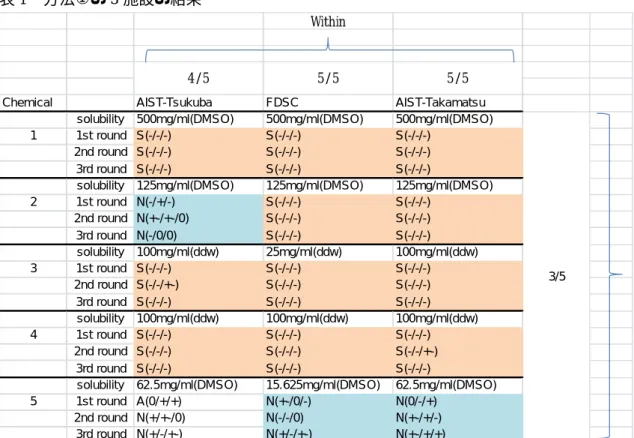
We now have three different criteria, which are difficult to understand. Criteria 1 is based on three independent test results. If all three results are concordant, we can make a call. If there are non-concordant results, we calculate % suppression using the Student t-test.
Roggen: What does + and – mean?
Omori: A single test result showed both significant augmentation and significant suppression.
I wanted to simplify Criteria 1, so we used an adjusted mean for nSLG-LA from three independent test results for Criteria 2. Which we explained during the teleconference in September. But it was suggested that it would be better to use % suppression. So, Criteria 3 uses an adjusted mean for % suppression from three independent tests.
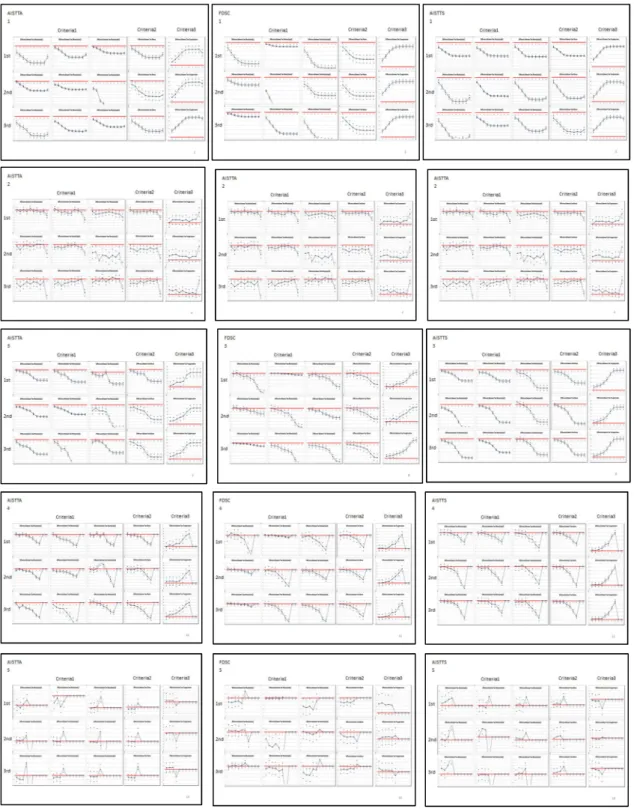
Perhaps we need to discuss which Criteria we should use, but before we do, I would like to look at the dose-response curves.
Germolec: Some immunosuppressants are very consistent but maybe chemicals that do not have a clear usage are not so consistent.
Omori: Chemical 3 shows good WLR at all three Labs. Chemical 4 does too. For Chemical 2, WLR is good. Chemical 5 has good WLR but maybe BLR is not as good.
The WLR appears to be good at all labs.
Roggen: Does the problem with Chemical 5 have to do with solubility?
Aiba: It shows precipitation in higher concentrations, but the significant effects are at
16 lower concentrations.
Roggen: Would it be useful to address solubility in the protocol?
Yamakage: Solubility is judged visually.
Germolec: Results at the two AIST labs appears consistent but some variability between those two and FDSC.
Kojima: We want to finalize the experiment data. We checked the record sheets from each Lab and we will make them available on the JaCVAM website.
Roggen: If cells are more responsive from Day 4, perhaps that should be noted in the protocol.
Germolec: Instead of optimizing to a particular day, would it be better to optimize to PMA or some other indicator of cell response?
Inoue: What does the protocol say?
Yamakage: At least two days. Page 11 of the protocol says cell passage … two to four days before the assay. Maybe this should say four days before the assay.
Aiba: The lead lab is studying this issue and we will revise the protocol. We had different cell densities and the cell functionality appears to be best on Day 4 or Day 5 when seeded at a cell density of 3 × 10⁵.
Germolec: Perhaps you can normalize cell density. The question might be that, since there will be slight differences in doubling times even at the same lab, how to quantify cell density.
Aiba: We looked at data for SLO-LA and SLG-LA. We think we might have change the criteria to exclude data if fold induction of nSLO-LA is less than 3. I would like to discuss this issue.
Nakajima: Another QC issue involved the luminometer at each laboratory. LED plate is easy to check. These figures show that the luminometers used at each lab are equivalent.
Roggen: When transferring this test to another lab, can their luminometer be calibrated?
Nakajima: Yes.
Aiba: We need to be able to exclude certain results, so we want to revise the acceptance criteria on page 36 of the protocol. We want to change the value for fold induction from 1.5 to 3.
Omori: We now have three proposed criteria, which we should discuss.
Corsini: Looking at the dose response curves, the error bar for each data point has to be either completely above or completely below the threshold line to be considered significant. Classification of Chemical 2 needs to be revised.
Omori: Using Criteria 2 gives immunosuppression but Criteria 3 gives both immunosuppression and immunoaugmentation.
Roggen: I don t trust classification based on a single point. I think maybe classification should be based on two successive significant values. Or you could do a trend analysis.
Aiba: Looking at pages 2 and 7, we see the response varies between laboratories.
17 Roggen: Is there any in vivo data for Chemical 2?
Kojima: It is positive.
Roggen: Chemical 5?
Kojima: It is negative.
Germolec: Criteria 1 seems to provide the best transparency and is very consistent, with only one non-concordant result out of 15. And if Chemical 5 is negative, then Criteria 1 is the most acceptable from a biological perspective.
Omori: I think we can agree to use Criteria 1 for the study.
Kojima: We will revise the protocol to use Criteria 1. For Phase 2, we will use 20 chemicals to evaluate BLR. Is that acceptable? Also, when will Phase 2 begin?
Aiba: The end of April or beginning of May.
Kojima: How long will it take to test 20 chemicals?
Roggen: One way to check solubility would be to centrifuge the test chemical solution once it appears fully dissolved. Also, add instructions in the protocol about what to do if precipitation is found after centrifuging.
Inoue: Precipitation after mixing in final concertation with culture medium is also important.
Aiba: We will revise the protocol to include checking the concentration of the stock solution, using a centrifuge to check solubility in DMSO, and making notes of any changes in appearance that are observed in the well.
Kojima: It will take three months for the participating labs to do Phase 2 testing, so we can expect testing in May to July and then data will be available for analysis around August.
Omori: Please give us two months for analysis, so August and September. The purpose of Phase 2 is to verify BLR and predictive capacity with 25 chemicals.
Germolec: Is there are minimum number of concentrations needed to make a judgment?
Aiba: We need at least four valid data points of different concentrations.
Roggen: You could test for maximum concentration at which you have 90% viability and then select concentrations below that. You have to do three runs, so you could use the first run for dose finding using a broad range of concentrations, which can be narrowed in the second and third runs as necessary. It is not necessary to change the dilution ratio, just slide the window to where there is immuno-modulatory response.
Nakajima: I am worried about some chemicals that might show immunosuppression but only in a very narrow range of concentrations.
Aiba: There might be some cases where we get 4 valid data points during the first run but then get only 3 valid data points in a subsequent run. But I think that is a very rare case.
18
Since we have adopted Criteria 1, we have to discuss what to do when a chemical shows two distinct tendencies.
Corsini: Citral shows two tendencies, so you can t call it negative.
Roggen: The question is, is it ever immunosuppressive? And you have to say yes.
Germolec: I think you need to call is A/S, because it shows both.
Aiba: So, what procedure should we use to make a call in a case like Citral?
Inoue: You do a statistical analysis for both % suppression and % augmentation.
Aiba: We have to revise Criteria 1 to include this situation.
Omori: It is possible that Chemical 5 will no longer be No Effect if we revise Criteria 1 this way. I would like to check how to implement this revision to the data sheet, after which we might need a teleconference to review it.
Dori: If you bear in mind that you need successive data points to make a call, then Chemical 5 won t change because there is only one valid data point.
Roggen: Dori s suggestion is good. If it shows both, call it modulation. But it will make the assay stronger if you could show a way to discriminate between augmentation and suppression.
2nd MITA Validation Study meeting—Day Two
Date : February 5, 2017, 10:00 - 12:00
Venue:Nayamachi community hall (http://nayamachi.or.jp/community_hall/) Participants: Corsini, E., Rogen, E., Germolec, D, Inoue, T, Aiba, S.,
Kimura, Y., Omori, T., Mori, A., Kobayashi, M., Kojima, H., Venti, S.
Kojima: Today we would like to select chemicals for Phase 2 and then discuss the Acceptance Criteria.
Germolec: We know there is standardized in vivo data for the NTP chemicals.
Kojima: I will check the cost of the twenty-five proposed chemicals this week.
And then the VMT will finalize a list of 20 chemicals for Phase 2 by the end of this month.
Omori: We have modified Criteria 1 and Criteria 3 to require either
1) two consecutive statistically significant points
or
2) one statistically significant point as well as a trend in which 3 or more
19
points above the red line are increasing or 3 or more points below the red line are decreasing.
Roggen: The call is based on two out of three runs, in which case nothing changes. Chemical 2 at Tsukuba is the only non-concordant call.
Inoue: The old Criteria 3 was too sensitive, but the new Criteria 3 is good.
Germolec: Criteria 1 is less relevant to Phase 2 because you won t be looking at multiple rounds of each chemical.
Aiba: Criteria 3 has an advantage in that data is normalized and is not affected by the different luminometers.
Germolec: I worry a little about normalizing data, but as long as you show the data from each independent run together with the final normalized data, you will have all the information you need.
Omori: We will show individual dose-response curves and normalized curves.
The final call for each chemical will be based on the normalized curve, per Criteria 3 but we will also show statistical analysis for all data.
Roggen: I recommend that you present this process step by step to ESAC, so that they can see the details of how it works for themselves.
20
F.
添付文書
5
)
Study plan for the validation trial on multicolor reporter assay using IL-2 Luc as a test evaluating the immunotoxic potential of chemicalsStudy plan
for the validation trial on multicolor reporter assay using IL-2 Luc (IL-2 Luc assay) as a test evaluating the immunotoxic potential of chemicals
Version 1.4 February, 2017
Conducted by:
IL-2 Luc assay Validation Management Team
21
INDEX
1. Background
2. Objective of the trial
3. Validation Management Team 4. Protocol
5. Chemical
6. Records and archiving 7. Study timeline
22
1. Background
The use of multicolor reporter assay using IL-2 Luc, Jurkat cell (IL-2 assay) is an important for evaluating the immunotoxic potential of chemicals as a part of Multi-ImmunoTox assay (MITA), because of its technical simplicity, short-term test period and accuracy of test result based on a mechanism of immunotoxicity.
The aim of this trial is to (pre)validate the IL-2 Luc assay method to assess transferability and inter-laboratory variability, in order to incorporate this test for screening the immunotoxic chemicals.
The IL-2 Luc assay for the validation trial will be undertaken i) in accordance with the principles and criteria documented in the OECD No. 34 Guidance Document on the Validation and International Acceptance of New or Updated Test Methods for Hazard Assessment [OECD, 2005], ii) according to the Modular Approach to validation [Hartung et al., 2004], iii) according to the concept discussed on the validation trials with participation of GLP Test Facilities [Cooper-Hannan et al., 1999] where the whole concept of the validation trials is described in the context of GLP, iv) and in line with the
ISO procedure JRC.I.03.GP.01v.01
(http://ihcpnet.jrc.it/quality-safety/quality-documents/unit-03-ivm/doc/JRC.I.03.GP.01v.01.pdf).
The studies part of a validation trial should ideally be performed in accordance with GLP [OECD, 1998-2007; FDA, 1999; EPA, 1998a&b; JSQA, 2010; SCC, 2010]. As a minimum, but not necessary limited, use of standard operating procedures (SOP), adequate data recording, reporting and record keeping are essential.
A general conceptional framework [Hartung et al., 2004; OECD, 2005] will be used for documenting all the study to assess the validation status of a test method, called “modular approach”
to validation. In this approach, the information needed to support the validity of the method is organized into modules that provide the following information:
Module 1: Test Definition
Module 2: Within-laboratory repeatability and reproducibility Module 3: Between-laboratory transferability
Module 4: Between-laboratory reproducibility Module 5: Predictive capacity
Module 6: Applicability domain Module 7: Performance standards
The Modular approach as introduced by Hartung et al., allows using datasets from various data sources and studies. This advantage is used in the following proposal to assess the scientific validity of the IL-2 Luc assay. This IL-2 Luc assay for the validation trial has performed under the GLP principle.
2. Objective of the trial
The validation trial will assess the reliability (reproducibility within and between laboratories) and relevance (predictive capacity) of the IL-2 Luc assay with a challenging set of test substances (test items) for which high quality in vitro and in vivo data are available.
23
3. Validation Management Team (VMT)
The VMT encompasses collective expertise with the test, in the underlying science and the scientific design, management and evaluation of a validation trial.
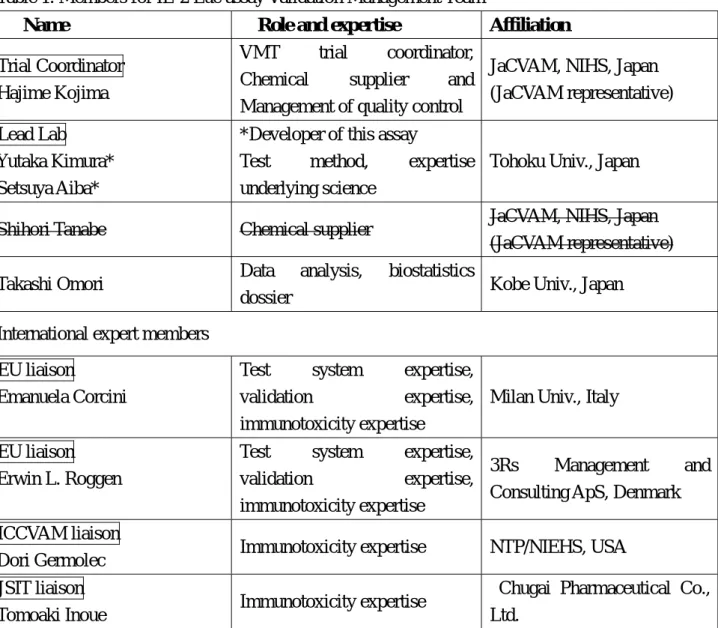
The VMT, which plays a central role overseeing the conduct of the validation trial, includes:
Table 1. Members for IL-2 Luc assay Validation Management Team
Name Role and expertise Affiliation
Trial Coordinator Hajime Kojima
VMT trial coordinator, Chemical supplier and Management of quality control
JaCVAM, NIHS, Japan (JaCVAM representative) Lead Lab
Yutaka Kimura*
Setsuya Aiba*
*Developer of this assay
Test method, expertise underlying science
Tohoku Univ., Japan
Shihori Tanabe Chemical supplier JaCVAM, NIHS, Japan
(JaCVAM representative) Takashi Omori Data analysis, biostatistics
dossier Kobe Univ., Japan
International expert members EU liaison
Emanuela Corcini
Test system expertise, validation expertise, immunotoxicity expertise
Milan Univ., Italy EU liaison
Erwin L. Roggen
Test system expertise, validation expertise, immunotoxicity expertise
3Rs Management and Consulting ApS, Denmark ICCVAM liaison
Dori Germolec Immunotoxicity expertise NTP/NIEHS, USA
JSIT liaison
Tomoaki Inoue Immunotoxicity expertise Chugai Pharmaceutical Co., Ltd.
3.1 Participating Test Facilities
The laboratories participating in the trial are defined as follow:
Test Facility 1: Hatano Res. Inst., FDSC. Study Director (SD): Kohji Yamakage Test Facility 2: AIST, Tsukuba SD: Yoshihiro Ohmiya
Test Facility 3: AIST, Takamatsu SD: Yoshihiro Nakajima
Information relevant for Modules 1, 2, 3 performed by all laboratories. Data obtained by these laboratories have demonstrated that the IL-2 Luc assay is transferable and reproducible between
24
experienced laboratories. The all facility will be the laboratory participating in this validation trial acting as unexperienced laboratory to assess between laboratory transferability, reliability and relevance of the IL-2 Luc assay method under non-GLP conditions (GLP principle).
3.2 Trial management structure
1) Chemical management group
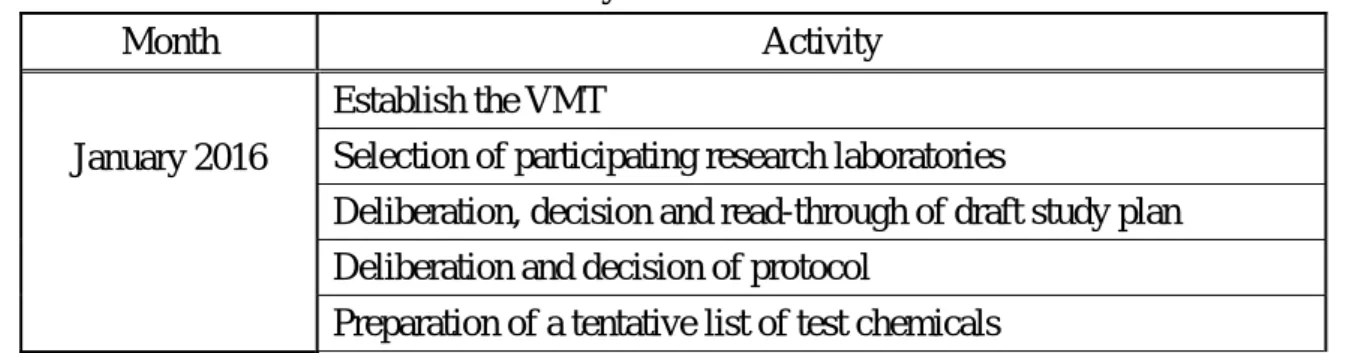
The members of chemical management group are elected by recommendation of the IL-2 Luc assay VMT. They prepare a tentative list of test chemicals and works with the VMT to make a final decision on the test chemicals to be used in the validation trial. The coded test chemicals listed are distributed by JaCVAM.
2) Data analysis group
The members of data analysis group are elected by recommendation of the IL-2 Luc assay VMT, and check and analyze the data obtained in this validation trial from a third-party standpoint. They also take charge of statistical processing in this validation trial.
3) Quality assurance group
The members of record management group are elected by recommendation of the IL-2 Luc assay VMT. They prepare protocol, test chemical preparation record forms, blank data sheets, etc.
and distributes them to the research laboratories participating in this validation trial. They also collect filled out forms and data sheets after completion of experiments, pointing out omissions or flaws in recording, if any, and requesting correction of such errors.
4) Lead laboratory
The lead laboratory representing the test method is responsible for providing the test method protocol and the eventually necessary data recording or calculation templates. The Trial
Coordinator has to ensure that such data recording or calculation templates have been validated before distribution to the test facilities involved in the validation trial. The lead laboratory is also responsible for providing, if necessary, new versions of the protocols during the entire validation trial.
The lead lab and the other participating test facilities might be contacted by the VMT for technical issues.
3.3 Sponsor
The validation trial for assessing the validity of IL-2 Luc assay will be financed by the Ministry of Health, Labour and Welfare (MHLW), Japan.
The lead laboratory will support the IL-2 Luc assay validation trial by assuring that reliability is assessed. At the same time, preliminary results of the test method can be evaluated. For this purpose, Lead laboratory will support:
- the financial aspects related to the coordination of a validation trial (e.g. organization of
25
VMT meetings where also the involved test facilities can be invited for technical clarifications to the VMT, the publication of the validation trial results)
- the test, reference and control item purchase, coding and distribution to the test facility - the availability of the test systems to the participating laboratories by supporting the Lead
laboratory with the logistics for delivering the test system to the facility
- the independent data analysis and statistical support (biostatistician) based on the study reports generated
- the other costs for participating laboratories
3.4 Trial coordination
Dr. Hajime Kojima was appointed as the Trial Coordinator with well-defined roles and responsibilities to coordinate the trial and to establishment of a VMT by supporting of JaCVAM.
The name and location of the Trial Coordinator should be identified in each individual study plan.
For the IL-2 Luc assay validation trial, the Trial Coordinator has direct access to the test item coding.
The Trial Coordinator’s responsibilities include:
a) Establishment of/support to lead laboratory, including meeting organization b) Trial communication and coordination with test facilities
c) Recording of document and data flow between test facilities
d) Assessing and documenting the impact of any amendments and/or deviations from the trial plan and study plans on the quality and integrity of the validation trial
e) Ensuring that the individual study reports are forwarded, in a timely manner, for data and statistical analysis
f) Preparing the trial plan and report, which can be based on the study reports from the lead laboratories and other test facilities involved in the validation trial, and should reflect the overall trial
g) Approval with date and signature of all protocols, Study Plans and Study Reports h) The communication of the results of the trial into the public domain
The role of Trial Coordinator (as the formal representative of the VMT and the single contact point with the SDs) is of fundamental importance. The Trial Coordinator is the single critical point of trial control and must ensure clear lines of communication between the involved test facilities in the trial. The communication line of the Trial Coordinator is with the SDs of the different test facilities. The SDs are the single point of contact with the Trial coordinator (unless otherwise communicated by the participating Test Facilities) to assure a transparent and recorded documentation flow during the trial. The Trial Coordinator should also ensure that appropriate arrangements have been made for the supply of the test systems, and test, control and reference items, which meet the requirements of the trial, and that there are appropriate test method protocols (dated
26
signature by the trial coordinator and the Lead Laboratories) and, if appropriate, validated data recording, data analysis, data reporting sheets for the test method.
It is the responsibility of the Trial Coordinator to approve the study plans send for approval by the test facilities, and any amendments to the study plan, by dated signature.
3.5 Training
The lead laboratory will be responsible for issuing a training agenda to the Trial Coordinator for further distribution to the all test facility giving details what training aspects will be covered during the training of the other SDs and Study Personnel at the lead laboratory. Furthermore, after the training as Phase 0 study, the lead laboratory will issue to the Trial Coordinator a training report and indicating if critical observations are made by the other test facilities regarding the IL-2 Luc assay protocols. In case any critical observations are made a new version of the IL-2 Luc assay protocols might necessary be issued to the other test facilities before initiating the between-laboratory transferability.
3.6 [Module 2] Within-laboratory reproducibility
The within-laboratory reproducibility of the all test facility has been done by an independent biostatistical analysis using coded five chemicals, under the VMT. The proportion of concordance should be equal or more than 80% as tentative acceptance criteria for phase I study.
3.7 [Module 3] Between-laboratory transferability
This between-laboratory transferability (Module 3) is performed in order to assess the successful transfer of the assay to a test facility unexperienced with that particular test method but having knowledge of similar test systems and endpoint detection methods.
For the transfer of IL-2 Luc assay to the all test facility, the Phase 0 study using -coded five chemicals were performed. A few concentrations of each test item will be tested in triplicate in 3 independent runs according to the IL-2 Luc assay protocol describing the details of the experimental design.
The five test items selected for the phase I study are coded as follows: A, B, C, D, and E. The all facility will prepare a study according to internal GLP principle. This plan will be submitted to the Trial Coordinator and lead laboratory for approval.
The results of the between-laboratory transferability will be reviewed before progressing with module 4 on the between laboratory reproducibility. If the transferability data do not meet test acceptance criteria, the Trial Coordinator representing the VMT will try to identify the problems and make corrections where needed. At the end of the testing, the test facilities will submit a QC certified copy of whole study dossier to the Trial Coordinator (study plan in GLP principle, raw data, records and data analysis, study report in GLP principle).