九州大学学術情報リポジトリ
Kyushu University Institutional Repository
食用カラスウリ における育種技術の確立と栽培法の 改善に関する研究
ジャヒドル, ハッサン
https://doi.org/10.15017/2534492
出版情報:Kyushu University, 2019, 博士(農学), 課程博士 バージョン:
権利関係:
Studies on the Establishment of Breeding Techniques and Improvement of Cultivation Methods in Pointed Gourd (Trichosanthes dioica Roxb.)
Jahidul Hassan
2019
Studies on the Establishment of Breeding Techniques and Improvement of Cultivation Methods in Pointed Gourd (Trichosanthes dioica Roxb.)
By
Jahidul Hassan
A thesis submitted in partial fulfillment of the requirements for the degree
DOCTOR OF PHILOSOPHY
Graduate School of Bioresource and Bioenvironmental Sciences Kyushu University
Japan 2019
Dedicated to
1. Mrs. Peyara Begum (My Mother) 2. Late Kazi Abdul Noman (My Father) 3. Mrs. Rashida Akter (My Mother-in-law) 4. Late Md. Golam Sarwar (My Father-in-law) 5. Mrs. Asma Mohsin (My elder Sister)
6. Late Kazi Mohammad Mohsin (My elder Brother-in-law)
CONTENTS
List of Figures ………..………... iii List of Tables ………..………... v
Chapter 1. General Introduction……….. 1
Chapter 2. Morphological and Ecological Characteristics of Pointed Gourd 8 2.1. Introduction
2.2. Materials and Methods 2.3. Results
2.4. Discussion
Chapter 3. Hermaphrodite Flower Induction by Silver Nitrate (AgNO3) Application and Possibility of Crossbreeding in Pointed Gourd 24 3.1. Introduction
3.2. Materials and Methods 3.3. Results
3.4. Discussion
Chapter 4. Induction of Parthenocarpy in Pointed Gourd by Application of Plant Growth Regulators……… 40 4.1. Introduction
4.2. Materials and Methods 4.3. Results
4.4. Discussion
Chapter 5. Tetraploid Induction by Colchicine Treatment in Pointed Gourd 50 5.1. Introduction
5.2. Materials and Methods 5.3. Results
5.4. Discussion
Chapter 6. Flowering Habit and Fruit Setting of Pointed Gourd Influenced by Seasonal Temperatures……….. 62 6.1. Introduction
6.2. Materials and Methods 6.3. Results
6.4. Discussion
Chapter 7. Establishment of Pollen Storage Method for Pointed Gourd…... 76 7.1. Introduction
7.2. Materials and Methods 7.3. Results
7.4. Discussion
Chapter 8. General Discussion and Conclusion………. 86
Acknowledgements……….91 Literature cited………...94
LIST OF FIGURES
Chapter 1
Figure 1.1 Pointed gourd (Potol) cultivation in Bangladesh (A), Young green fruit at edible stage (B)………... 2 Figure 1.2 Pointed gourd fruits at edible stage……… 4
Chapter 2
Figure 2.1 Collection sites of pointed gourd genotypes used in this study……… 10 Figure 2.2 Flesh content ratio of 14 pointed gourd accessions cultivated in
glasshouse……… 16 Figure 2.3 Flesh content ratio of 10 pointed gourd accessions cultivated in open
field……….. 16 Figure 2.4 Fruit yield/plant (g) of 14 pointed gourd accessions cultivated in
glasshouse……… 17 Figure 2.5 Fruit yield/plant (g) of 10 pointed gourd accessions cultivated in open
field……….. 17 Figure 2.6 Treatments effect on pointed gourd seed germination………. 18
Chapter 3
Figure 3.1 Schematic illustration of crossings in this experiment………... 28 Figure 3.2 Normal female, male and AgNO3 induced hermaphrodite flower of
pointed gourd………. 30
Figure 3.3 Pollen grain viability (A) and pollen size (B) of normal male (PGM03) and hermaphrodite flowers (PGF01, PGF02, PGF03) induced by different concentration of silver nitrate (50, 100, 200ppm)……….. 34
Chapter 4
Figure 4.1 Fruit characteristics of hand pollinated and parthenocarpic fruits induced by plant growth regulators in pointed gourd at edible stage………. 46 Figure 4.2 Fruits and seeds of hand pollinated and parthenocarpic fruits induced
by plant growth regulators in pointed gourd at ripening stage……….. 47
Chapter 5
Figure 5.1 Flow cytometric histogram of pointed gourd……….. 56 Figure 5.2 Morphological variation of diploid and tetraploid pointed gourd
seedling……… 58
Chapter 6
Figure 6.1 The average maximum, mean, and minimum day and night temperatures in the (A) glasshouse and (B) open field……….... 66 Figure 6.2 Day length of flowering season of pointed gourd in 2017………….. 67 Figure 6.3 Seasonal variations in flowers of pointed gourd grown in (A)
glasshouse and (B) open field……….. 69 Figure 6.4 Seasonal variations in fruit set rate (A), and fruit weight (g) (B) of
pointed gourd grown in glasshouse and open field……….. 70 Figure 6.5 Seasonal variations in pollen germination rate of male pointed
gourd……… 72
Chapter 7
Figure 7.1 Pollen viability of pointed gourd at different storage durations under different temperatures……… 81 Figure 7.2 Pollen germination rate (%) of pointed gourd at different storage
durations under different temperatures……….. 82
LIST OF TABLES
Chapter 2
Table 2.1 Characteristics of 14 pointed gourd accessions cultivated in glasshouse……….. 13 Table 2.2 Characteristics of 10 pointed gourd accessions cultivated in open
field……… 14 Table 2.3 Treatments effect on germination timing attributes of pointed gourd
seed……… 20
Chapter 3
Table 3.1 Effect of different concentration of silver nitrate application on the days and node of hermaphrodite flower induction in three pointed gourd accessions……… 31 Table 3.2 Effect of different concentration of silver nitrate application on
number of hermaphrodite flower induction in three pointed gourd accessions………... 32 Table 3.3 Fruit characteristics of normal, self, homo and heterosexual
crossings among different sex types of pointed gourd……… 35 Table 3.4 No. of seeds and seed germination of normal, self, homo and
heterosexual crossings among different sex types of pointed gourd……….. 36
Chapter 4
Table 4.1 Effect of plant growth regulators on fruit set rate (%) of three different pointed gourd accessions……… 43 Table 4.2 Parthenocarpic fruit characteristics induced by application of
different plant growth regulators on three pointed gourd accessions……… 45
Chapter 5
Table 5.1 Effect of colchicine treatments on germination rate and surviving seedlings rate in pointed gourd……….. 53 Table 5.2 Effect of colchicine treatments on induction of polyploid seedlings
in pointed gourd………. 55 Table 5.3 Comparison of morphological characteristics of colchicine treated
pointed gourd seedlings with different ploidy levels………. 57
Chapter 6
Table 6.1 Seasonal variations in fruit characteristics of pointed gourd grown in glasshouse and open field………... 71
Chapter 7
Table 7.1 Percentage of fruits settings after pollination using fresh and stored pollen at different temperatures………. 84
CHAPTER 1 General Introduction
Pointed gourd (Trichosanthes dioica Roxb.) locally named as “parwal”, “palwal”
or “potol” is one of the most popular summer vegetables in Bangladesh and India (Kumar and Singh, 2012). It belongs to the cucurbitaceae family. Trichosanthes is a large genus of Indo-Malayan distribution, with about 44 species, of which 22 are found in India (Chakravarty, 1982). Choudhury (1996) concluded that the Assam-Bengal region of India and Bangladesh are the primary center of origin because these regions exhibit a rich species diversity of this crop.
Pointed gourd is distinct from other cucurbits due to its well-established dioecism where male and female flowers appear in separate plants. It has tuberous roots and a long tap root system. Plants grow as vine, which can extend up to 5-6 m. Vines require training on some form of aerial support system to achieve maximum fruit production (Figure 1.1) (Prasad and Singh, 1987; Yadav et al., 1989). The stem is generally 0.5-1.0 cm thick with simple tendrils, and the dark green leaves are simple and cordate. Typically, each node on the staminate plant bears a leaf on a long pedicel, a simple bifid or sometimes unbranched tendril, and a glandular bract; it may also have one or sometimes two solitary staminate flowers. Staminate flowers contain three stamens with short filaments deeply inserted on calyx tube; anthers are syngenesious, rarely free, without any staminodes (Pathak and Singh, 1950). Pollen grains are round with three weak pores (3-zonoporate), oblate spheroidal (diameter 52-56 µm), and pores are circular (diameter 4.2 µm), provided with an annulus (Awasthi, 1961). In pistillate plants, flowers are present in leaf axils.
Inflorescence is racemose, flowers are sessile, solitary, bracteate with oblong-cylindrical calyx tube (Pandit and Hazra, 2008). Pistillate flowers have slender styles ending in 3
Figure 1.1. Pointed gourd (Potol) cultivation in Bangladesh (A), Young green fruit at edible stage (B). Scale bar 2 cm (fruit).
A B
papillate stigmas, where the gynoecium has 5 carpels (Pandit and Hazra, 2008). The ovary is oblong, ovoid, fusiform, globose with many horizontal, semipendulous ovules. The fruits are globose, oblong and smooth, which is the main edible portion (Pandit and Hazra, 2008).
Fruits are harvested about 15-18 days after pollination and each fruit contains 18-20 seeds (Koley et al., 2009; Ara et al., 2011). These seeds are limiting factor during consumption because of unpalatability with hard seed coat. Therefore, genetic parthenocarpic lines development that set fruit without seed or chemically induced seedless or less seeded fruit production technique would be desirable. Meanwhile, considerable variation exits in fruit shape, size and striation patterns. It has 22 (2n=2x=22) chromosomes with 11 bivalents in pollen mother cells (Sinha et al., 2003).
Pointed gourd is well known for its economic, nutritional value and wide range of uses. Immature fruits at green stage can be used as fried, boiled, curry, pickled and candied (Paris and Maynard, 2008) (Figure 1.2). In addition, the immature succulent green leaves and twigs can also be used as like as other leafy vegetables. Regarding nutritional point of view, it has higher nutrient content than other cucurbits (Pandit and Hazra, 2008).
According to Choudhury (1996), 100 g (fresh weight) of edible fruits contains vitamin A (153 µg), protein (2 g), P (40 mg), Ca (30 mg), Mg (9 mg), Na (2.6 mg), K (83 mg), Cu (1.1 mg), S (17 mg), and Cl (4 mg) and also provides 20 kcal energy (Seshadri 1990). Every 100 g of fresh leaves contains 5.4mg proteins, 4.2mg fiber, 531mg Ca, and 73mg P (Gopalan et al., 1989) and also provides 55 kcal energy (Seshadri, 1990). In addition, seed extract possesses hemagglutination activity that may have some diagnostic applications (Sathe et al., 1967). Besides, in the traditional ayurvedic system of medicine, T. dioica fruits have been described to possess antihelminthic, antipyretic, diuretic, appetizing, digestive, expectorant, and antirheumatic effects (Sharma and Pant, 1988a; Seshadri 1990).
Leaves and tuberous roots of pointed gourd are also used in Ayurvedic medicine
Figure 1.2. Pointed gourd fruits at edible stage (Bar = 1 cm) Harvested at 18 days after crossings.
(Chandrasekar et al., 1989).
Traditionally, pointed gourd is multiplied through stem (vine) or root cuttings (Singh, 1989; Som et al., 1993). Seeds are generally not used for commercial propagation owing to poor germination, unpredictable sex expression and delay in flowering.
Micropropagation is also done using shoot-tips, nodal segment, immature and mature cotyledons explants (Hoque et al., 1998) in MS media (Murashige and Skoog, 1962).
In Bangladesh, vegetable production is not uniformly distributed according to the area and season of a year due to the climatic and ecological variations. Most of the vegetables are confined to grow in winter season. As a result, there is a profound scarcity of vegetables during summer season and only small amount of vegetables are produced during the months of April to October. In this context, pointed gourd contributes a significant portion to meet up the vegetable requirement in the lean period of summer season. Because, it remains available in the market for around nine months (from February to October) (Banu et al., 2007; Shivhare et al., 2010).
Like any other crops, yield of pointed gourd is complex component that remarkably influenced by environment factors. It is a day-neutral, perennial plant that thrives well in moderately warm to hot humid climates with abundant rains. High humidity favors growth and fruit development. The optimum temperature for plant growth and fruiting is 30-35°C while restrict growth at below 20°C (Peter et al., 1998). Frost and severe cold are detrimental to its growth. Sandy-loam to loam soils rich in organic matter and having a pH of 6-7 with good moisture reserves are the best. The crop can withstand water stress but not waterlogging, so heavy soils are unsuitable. It becomes dormant during winter but will sprout and begin growing from the perennial base in the spring when the average soil temperature reached above 12.5°C (Singh and Whitehead, 1999). Based on these phenomena, it is considered as the tropical and subtropical vegetable but recently becoming
popular in other Asian countries and in some temperate countries as well. It has been reported that pointed gourd is productive during the summer in Georgia, United States, and the yields were comparable to those from India and Bangladesh (Singh and Whitehead, 1999).
In 2013-2014 growing season pointed gourd was produced in about 9987 hectares of land with total production of 83825 metric tons with an average yield of only 8 tons per hectare (BBS, 2014). Several problems are existing in the production of this crop, among these, poor yield due to unavailability of suitable variety with maximum no. of fruits and fruit size is the most important one. In addition, development of hard seeds in the fruits at 3-4 weeks after pollination deteriorates its palatability and consumer acceptance. Besides, lack of seed germination techniques by which segregation analysis of sexual progenies can be done is considered to be an important barrier in breeding new variety. According to the previous reports, a wide range of quantitatively and qualitatively inherited phenotypic and genotypic variations in plant vigor, morphology, reproductive traits, fruit size and shape were observed in pointed gourd (Dora et al., 2001; Sarkar et al., 1999). The exploitation of this variation may be creating the opportunity for the varietal improvement program and subsequent selection of elite clones. However, diversity analysis, seed germination problem, sex conversion, parthenocarpic or seedless fruit production, cytology of sex determination is still remaining to address properly for the betterment of this important and promising vegetable.
Keeping the necessity of initiating improvement approaches of pointed gourd, the present study was carried out based on the following different aspects:
1. Morphological and ecological characteristics of pointed gourd.
2. Propose an effective and efficient seed germination technique.
3. Sex modification in strictly maintained dioecism plant for recombination of desirable traits between genetically female genotypes.
4. Chemical induced parthenocarpy (seedless) fruit production
5. Tetraploid induction to accelerate triploid breeding for seedless fruit production 6. Flowering habit and fruit setting in context with the growing season temperature in
Japan.
7. Pollen storage to overcome pollination problem under adverse condition.
The possible achievements in relation to the stipulated objectives are presented and discussed according to the following chapters.
Outline of the dissertation
In Chapter 1, general introduction and objectives of the study are presented. Chapter 2 denotes the morphological and ecological characteristics of pointed gourd (Trichosanthes dioica Roxb.) cultivated in Japan. Chapter 3 includes sex modification of genetically female flowers to hermaphrodite flowers by silver nitrate application for crossbreeding among female genotypes of pointed gourd. Chapter 4 focused on the parthenocarpy induction by plant growth regulators. Chapter 5 implies polyploidization of pointed gourd for triploid breeding. Chapter 6 contains flowering habit and fruit setting scenario over flowering time temperature. Chapter 7 express the pollen storage method of pointed gourd.
Chapter 8 describes the general discussion and comprehensive conclusion of the study. The last parts outline the acknowledgement and references.
CHAPTER 2
Morphological and Ecological Characteristics of Pointed Gourd
2.1 Introduction
Young fruit of pointed gourd which is 10~12cm length and 30~50g at green stage is the main edible part and rich in vitamin A, proteins, minerals and also claimed to lower total serum cholesterol and blood sugar (Pandit and Hazra, 2008 and Rai et al., 2008).
Leaves and tuberous roots of this species are used in Ayurvedic medicine (Chandrasekar et al., 1989) and seeds for acid-dyspeptic disease treatment (Harit and Rathee, 1996).
Pointed gourd is usually grown in open field as trellis training under high temperature condition (30-35°C) of its origin countries, but able to be produced in temperate regions due to its adaptive potentiality (Singh and Whitehead, 1999). In India, it is extensively growing in ‘diara’ lands in North Bihar and in eastern Uttar Pradesh, however in Assam, Bengal, Orissa, it is also grown in loamy soils and in places with hot and humid climate (Bose and Som, 1986). The main precaution is to prevent waterlogging. In Bangladesh, it is widely cultivated in the districts of Rajshahi, Bogra, Rangpur, Pabna, Jessore and Kustia (Rashid, 1993). Since this species is a vegetative propagated crop, there are several clones with distinct characters met with in different States. However, the morphological characteristics of pointed gourd under different ecological conditions than that of their origins have never been investigated apart from Singh and Whitehead (1999) report.
Selection of suitable genotypes with desired traits would be very essential for the improvement of this crop. However, seed germination is poor in pointed gourd (Bose and Som, 1986). Thus, lack of the information of seed germination technique in pointed gourd is a bottleneck for genetic improvement studies. Therefore, a standard seed germination
protocol would be helpful to provide a rational contribution for the advancement breeding efforts of pointed gourd.
This chapter illustrates the investigation carried out under the open field and glasshouse conditions to select a suitable genotype in response to the morphological and ecological characteristics and propose an efficient seed germination technique for large scale multiplication of pointed gourd species.
2.2 Materials and Methods Plant sample collection and cultivation
Mature vine cuttings of 24 female and 9 male genotypes of pointed gourd were collected from different locations of Bangladesh (Figure 2.1). Among the collected vines, 14 female genotypes and 4 male genotypes were planted in the 30 cm diameter plastic pot with 1:1 (pamis sand : akadama soil) growing mixture and placed in the unheated glasshouse. Remaining 10 female and 5 male genotypes were planted in the experimental open field of Kyushu University, Hakozaki campus (lat. 33° 37¢ N; long. 130° 25¢ E) at a spacing of 2×1m. Female accessions were denoted as PGF01~PGF24 and PGM01~PGM09 for male. Only three emerged shoots per accession were grown after germination of respective vine cuttings to further growth those considered as three replications.
Morphological and ecological characteristics
The accessions were recorded for three ecological characters such as days to first flowering, number of flowers (both male and female), number of fruits. To determine fruit traits, we harvested 3-5 mature fruits at green edible stage and fruit length, fruit diameter, fruit weight, flesh weight and seed weight were measured immediately after harvest.
Figure 2.1. Collection sites of pointed gourd genotypes used in this study.
Division Accession No.
Chittagong
Bandarban PGF024
Rangamati PGF021
Rangamati PGF022
Rangamati PGF023
Dhaka
Gazipur PGF001
Narsingdi PGF017
Narsingdi PGF018
Narsingdi PGF019
Narsingdi PGF020
Narsingdi PGM06
Narsingdi PGM07
Khulna
Jessore PGF009
Jessore PGF010
Jessore PGM04
Jessore PGM05
Mymensingh
Kishoregonj PGF014
Kishoregonj PGF015
Kishoregonj PGF016
Kishoregonj PGM01
Kishoregonj PGM02
Kishoregonj PGM03
Rangpur
Dinajpur PGF011
Dinajpur PGF012
Dinajpur PGF013
Dinajpur PGM08
Rangpur PGF004
Rangpur PGF005
Rajshahi
Iswardi PGF006
Iswardi PGF007
Iswardi PGF008
Iswardi PGM09
Rajshahi PGF002
Rajshahi PGF003
PGF- Pointed gourd Female, PGM-Pointed gourd Male
(Source: www.freeworldmaps.net)
Seed germination test
Fully mature and ripened fruits (55-60 days after anthesis) of pointed gourd were harvested from plants grown in the glasshouse and open field in Hakozaki campus, Kyushu University. The extracted seeds were washed with running tap water to fully removal of placental hairs. Moreover, seeds were still covered with mucilaginous layer at outside of the seed coat. To remove this layer, seeds were gently scrubbed on the rough surface of steel made sieve without causing external injury in the seed coat. Thoroughly cleaned seeds were spread onto paper towels and kept at room temperature to dry. The dry seeds were kept in a plastic zip lock bag and stored in a freezer at 4°C until use for germination.
For germination test, thirty seeds were used for each treatment and primed with nineteen (19) treatments. Physical scarification of the seeds was done by shaking in a plastic bottle with quartz sand for 30 and 60 sec, tap water soaking for 6, 12 and 24 hours, hot water treatment at 60, 80, 100°C temperature for 10, 30, 60 sec. Concentrated H2SO4
soaking for 10, 30 and 60 sec was used as chemical scarification techniques. Gibberellic acid (GA3) at 100 ppm for 24 hours soaking was taken as hormone regulation treatment.
No treatments were applied in case of control sample seeds. After applying the treatments, seeds were rinsed in running tap water and put on paper towels at room temperature to air dry. The treated seeds were soaked in GA3 solution (100 ppm) for 24 hours excluding control and water treated samples. After 24 hours, seeds were rinsed properly with running tap water and placed on 90 mm diameter petri dishes with two layers of filter paper (ADVANTEC No. 2) which were moistened with 5 ml fungicide solution (Benlate 1000 ppm) to prevent fungal contamination. All petri dishes were placed in incubator (SANYO Incubator, MIR-154, Japan) at 30°C in dark condition. Germination was defined as emergence of the radicle through the seed coat (≥ 1mm) (International Seed Testing Association ISTA, 1999). Germinated seeds were counted daily and continued for 30 days.
The first and last day of germination from seed sowing, germinating period and final germination percentage was calculated. The test was replicated three times. Each replication contains 19 treatments and 30 seeds were used for each treatment.
2.3 Results
Morphological and ecological characteristics of pointed gourd
Morphological characteristics of 14 female pointed gourd accessions cultivated in glasshouse are shown in Table 2.1. The flower which appeared earliest was in PGF01 with 76 days after planting, whereas it required more than 90 days in PGF03, 04, 05 and 10.
Other remaining accessions produced first flowers within 80~90 days after planting. More than 80% of fruit set rate (%) were observed in PGF06 (83.8%) and 08 (88.4%), though PGF01 showed the lowest fruit set rate (37.7%). Remarkable variations were observed among the accessions according to fruit length. The longest fruit (13.3 cm) was produced by PGF04 followed by PGF03 (12.5 cm) and PGF01 produced the shortest one (7.5 cm).
Although, there was no significant variation observed for fruit diameter (data not shown), the fruits more than 55 g were obtained in PGF03, 04, 08 and 12 which had relatively long shape fruits.
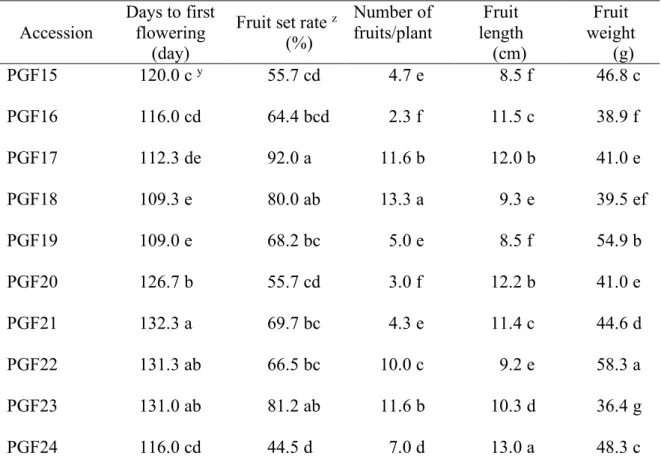
Morphological and ecological characteristics of 10 pointed gourd accessions cultivated in the open field are shown in Table 2.2. Early flowering was noticed in PGF19, which took comparatively short time 109.0 days then others and statistically similar results were observed in PGF18 and PGF17. Meanwhile, delayed flowering was found in PGF21 (132.3 days) followed by PGF22 (131.3 days) and PGF23 (131.0 days). 44.5 % fruit set rate was found in PGF24 while more than two times higher of it fruit set was produced by PGF17 (92%). The highest fruit length (13.0 cm) was appeared in PGF24 whereas PGF15 and PGF19 produced the shortest (8.5 cm) compared to other accessions produced fruits.
Table 2.1. Characteristics of 14 pointed gourd accessions cultivated in glasshouse.
Accession Days to first
flowering (day) Fruit set rate z
(%) Number of
fruits/plant Fruit length
(cm) Fruit
weight (g)
PGF01 76.0 e y 37.7 g 6.3 h 7.5 h 42.9 f
PGF02 88.0 bcd 58.3 ef 10.3 fg 12.0 bc 52.1 c
PGF03 91.6 ab 68.6 cde 6.7 h 12.5 ab 57.7 ab
PGF04 94.3 a 73.0 bcd 9.7 g 13.3 a 60.4 a
PGF05 95.6 a 78.2 abc 4.7 h 9.5 ef 51.7 c
PGF06 87.0 cd 83.8 ab 20.6 c 10.6 d 39.0 g
PGF07 86.0 cd 71.9 bcd 23.0 b 9.4 f 47.6 de
PGF08 88.0 bcd 88.4 a 30.3 a 11.5 c 55.9 b
PGF09 87.0 cd 68.8 cde 17.0 d 10.1 def 44.8 ef
PGF10 95.0 a 70.9 bcde 14.6 e 10.5 d 37.8 g
PGF11 87.6 bcd 71.4 bcde 28.3 a 10.2 de 50.6 c
PGF12 83.6 d 53.6 f 12.0 f 11.4 c 58.9 a
PGF13 86.6 cd 62.4 def 11.6 fg 10.2 de 49.2 cd
PGF14 89.0 bc 60.0 def 12.0 f 8.5 g 39.5 g
z Fruit set rate (%) = (Number of fruits/Total number of pollinated flowers) × 100.
y Means followed by the different letters within a column are significantly different (P <
0.05) by Honestly significant difference test using R-software.
Table 2.2. Characteristics of 10 pointed gourd accessions cultivated in open field.
Accession Days to first flowering
(day)
Fruit set rate z (%)
Number of
fruits/plant Fruit length
(cm)
Fruit weight
(g)
PGF15 120.0 c y 55.7 cd 4.7 e 8.5 f 46.8 c
PGF16 116.0 cd 64.4 bcd 2.3 f 11.5 c 38.9 f
PGF17 112.3 de 92.0 a 11.6 b 12.0 b 41.0 e
PGF18 109.3 e 80.0 ab 13.3 a 9.3 e 39.5 ef
PGF19 109.0 e 68.2 bc 5.0 e 8.5 f 54.9 b
PGF20 126.7 b 55.7 cd 3.0 f 12.2 b 41.0 e
PGF21 132.3 a 69.7 bc 4.3 e 11.4 c 44.6 d
PGF22 131.3 ab 66.5 bc 10.0 c 9.2 e 58.3 a
PGF23 131.0 ab 81.2 ab 11.6 b 10.3 d 36.4 g
PGF24 116.0 cd 44.5 d 7.0 d 13.0 a 48.3 c
z Fruit set rate (%) = (Number of fruits/Total number of pollinated flowers) × 100.
y Means followed by the different letters within a column are significantly different (P <
0.05) by Honestly significant difference test using R-software.
Individual fruit weight was also distinguished from each other, which ranged from 36.4 g (PGF23) to 58.3 g (PGF22).
Flesh content and fruit yield
The highest flesh content (19.9) was measured in PGF02 followed closely by that of PGF03, PGF05 and the lowest was in PGF06 (6.4) in the glasshouse (Figure 2.2).
Similarly, the maximum flesh content (19.1) was observed in PGF24 produced fruit and the minimum (8.4) was in PGF17, which was followed closely by that of PGF22 in open field (Figure 2.3).
The fruit yield per plant exceeded 1000 g/plant for PGF08, PGF11 and PGF07 in the glasshouse (Figure 2.4). In particular, PGF08 accession produced the highest yield, with 1695 g/plant. In contrast, PGF14, PGF03, PGF01 and PGF05 had the yield of less than 500 g/plant and PGF05 had markedly the lowest yield of 241 g/plant. Meanwhile, similar tendencies were also observed in open field (Figure 2.5) where PGF22 and PGF18 accessions were produced 584.0 and 527.8 g fruit/plant, respectively. However, other accessions were produced less than of that amount and notably PGF16 had produced only 90.9 g fruit yield per plant.
Seed germination test
The highest germination percentage (98.8%) was obtained from seeds scarified with con. H2SO4 for 30 sec (Figure 2.6). The germination percentage was more than 70% when seeds were treated with water soaking for 12 to 24 h and hot water soaking at 60 and 80°C for 60 and 10 sec. Specifically, 74.4% seeds were germinated with the treatment of immersing of seeds in tap water for 12 h, which was identical with hot water at 80°C for 10 sec treatment. There was no germination for the hot water at 100°C for 60 sec and
Figure 2.2. Flesh content ratio of 14 pointed gourd accessions cultivated in glasshouse.
z Different letters indicate significantly different (P < 0.05) by Honestly significance difference test. Bars represent mean ± SE.
Figure 2.3. Flesh content ratio of 10 pointed gourd accessions cultivated in open field.
z Different letters indicate significantly different (P < 0.05) by Honestly significance difference test. Bars represent mean ± SE.
d
a ab b
ab
e d
b c
b ab
c c c
0 4 8 12 16 20
PGF01 PGF02
PGF03 PGF04
PGF05 PGF06
PGF07 PGF08
PGF09 PGF10
PGF11 PGF12
PGF13 PGF14
Flesh content ratio
Accessions Glasshouse
de d
e bc
de b
c
e d
a
0 4 8 12 16 20
PGF15 PGF16
PGF17 PGF18
PGF19 PGF20
PGF21 PGF22
PGF23 PGF24
Flesh content ratio
Accessions Open field
z
z
Figure 2.4. Fruit yield/plant (g) of 14 pointed gourd accessions cultivated in glasshouse.
z Different letters indicate significantly different (P < 0.05) by Honestly significance difference test. Bars represent mean ± SE.
Figure 2.5. Fruit yield/plant (g) of 10 pointed gourd accessions cultivated in open field.
z Different letters indicate significantly different (P < 0.05) by Honestly significance difference test. Bars represent mean ± SE.
h
ef g e
h d
c a
d ef
b
d
ef fg
0 200 400 600 800 1000 1200 1400 1600 1800
PGF01 PGF02
PGF03 PGF04
PGF05 PGF06
PGF07 PGF08
PGF09 PGF10
PGF11 PGF12
PGF13 PGF14
Fruit yield/plant (g)
Accessions Glasshouse
ef g
bc ab
de
g f
a c
d
0 100 200 300 400 500 600 700
PGF15 PGF16
PGF17 PGF18
PGF19 PGF20
PGF21 PGF22
PGF23 PGF24
Fruit yield/plant (g)
Accessions Open field
z
z
Figure 2.6. Treatments effect on pointed gourd seed germination.
Sand: Quartz sand, HW: Hot water
z Different letters indicate significantly different (P < 0.05) by Honestly significance difference test. Bars represent mean
± SE.
e de
ab abc bc
cde abc
bcd bc abc ab
bc cde abc
de e
abc a
bcd
0.0 20.0 40.0 60.0 80.0 100.0
Control Water (6 hrs) Water (12 hrs) Water (24 hrs) GA3 (100 ppm) Sand 30sec Sand 60sec HW60°C-10sec HW60°C-30sec HW60°C -60sec HW80°C -10sec HW80°C -30sec HW80°C-60sec HW100°C-10sec HW100°C -30sec HW100°C -60sec conc. H2SO4-10sec conc. H2SO4-30sec conc. H2SO4-60sec
Germination rate ( %)
Treatments
z
control seed samples.
The response of seeds to germinate and how quickly they would be germinated was significantly differing based on the pre-sowing treatments (Table 2.3). However, seeds of pointed gourd started to germinate within 5-10 days after sowing, for most of the pretreatments but sand quartz shaking for 60 sec, tap water soaking for 12 h and H2SO4
scarification for 30 sec treated seeds were displayed exception to take less than 5 days to first response of germination. In addition, about 3 weeks were required to complete the whole germination process for most of the treated seeds, except for tap water soaking for 6 h, 12h and hot water soaking at 100°C for 30 sec where they only took less than 1 week to complete. Meanwhile, H2SO4 (30 sec) treated seeds took less than three weeks.
The results also indicated that, among 19 pretreatments investigated, tap water for 12 h, hot water at 80°C for 10 sec and H2SO4 scarification for 30 sec were found as effective to provide maximum germinated seeds than others. But the response of these seeds was varied due to the pretreatment differences. Seeds treated with tap water soaking for 12 h had faster response by 4 days and less than one week required to complete germination, which was followed closely by H2SO4 scarification for 30 sec to response while it took two weeks to complete. Besides, first germination response was the slowest and two times higher days (8.3) were required for seeds treated with hot water soaking at 80°C for 10 sec compared with the aforementioned treatments. In addition, it required more than three weeks (21.3 days) to compete the germination process.
2.4 Discussion Morphological and ecological characteristics
The variation observed for all the studied morphological, ecological and yield attributes was significant among the evaluated accessions in glasshouse and open field
Table 2.3. Treatments effect on germination timing attributes of pointed gourd seed.
Treatments z
First day of germination from seed
sowing (day)
Last day of germination from
seed sowing (day)
Germinating period
(day)
Control (without treat.) - y - -
Water (6 h soaking) 7.0 ab x 8.0 c 1.0 c
Water (12 h soaking) 4.0 b 8.0 c 4.0 c
Water (24 h soaking) 7.3 ab 26.0 ab 18.6 ab
GA3 (100 ppm 24 h soaking) 6.6 ab 26.0 ab 19.3 ab
Sand 30sec+ GA3 5.0 ab 24.6 ab 19.6 ab
Sand 60sec+ GA3 3.6 b 24.6 ab 21.0 a
HW60°C -10sec+ GA3 10.0 ab 29.0 a 19.0 ab
HW60°C -30sec+ GA3 8.6 ab 29.3 a 20.6 ab
HW60°C -60sec+ GA3 5.6 ab 25.3 ab 19.6 ab
HW80°C -10sec+ GA3 8.3 ab 29.6 a 21.3 a
HW80°C -30sec+ GA3 6.3 ab 26.3 ab 20.0 ab
HW80°C -60sec+ GA3 10.6 ab 20.6 abc 10.0 bc
HW100°C -10sec+ GA3 6.0 ab 21.3 ab 15.3 ab
HW100°C -30sec+ GA3 12.3 a 15.3 bc 3.0 c
HW100°C -60sec+ GA3 - - -
conc. H2SO4 -10sec+ GA3 8.3 ab 23.6 ab 15.3 ab
conc. H2SO4 -30sec+ GA3 4.3 b 19.6 abc 15.3 ab
conc. H2SO4 -60sec+ GA3 6.6 ab 27.0 ab 20.3 ab
z All seeds were soaked in GA3 solution (100ppm) for 24 h after each treatment except control and water treatments. Sand: Quartz sand, HW: Hot water.
y No seed germination.
x Means followed by the different letters within a column are significantly different (P <
0.05) by Honestly significant difference test using R-software.
condition and this finding agree with the earlier findings (Sharma et al., 1988). El-Hamed and Elwan (2011) stated that the higher the proportion of the phenotypic variation attributed to the genotypic differences, the greater the feasibility of genetic manipulation to improve crop performance. Similar trends were also portrayed in this present finding where there was no consistency observed among the investigated accessions for all the evaluated characters at both glasshouse and open filed. Jena et al. (2017) observed fruit length range from 5.1-11.2 cm, fruit weight 20.0-42.0 g, flesh seed ratio 4.5-17.9 among 22 genotypes of pointed gourd evaluated in India and 8.1-11.9 cm, 24.3-56.3 g, 7.7-20.3 among 24 genotypes evaluated in Bangladesh by Kabir (2007). The average fruit length ranges from 7.5-13.3 cm, individual fruit weight 37.8-60.4 g, flesh seed ratio 6.4-19.9 at glasshouse (Table 2.1, Figure 2.2) and 9.2-13 cm, 41.0-58.3 g, 8.4-19.1 at open field (Table 2.2, Figure 2.3) was obtained in the present study. It clearly demonstrated that pointed gourd accessions were successfully adapted in northern Kyushu, Japan. Razim (2011) claimed that the accessions may exhibit superior yield in one location or environment, but this may not be constant in other environment with different agro-ecologies because the performance of a genotype mainly depends on environmental interaction. Wide differences between phenotypic and genotypic variation were indicating their sensitiveness to environmental fluctuations whereas narrow difference showed less environmental interference on the expression of these traits (Jena et al., 2017). The present study findings are mostly concerned about the phenotypic variability however; further precise investigation should be made to find out the environment influence on flowering habit, fruit setting and yield at both glasshouse and open field condition.
Seed germination test
There is no scientific information on the seed propagation of pointed gourd apart
from Kumar et al. (2008), where they concluded that mature seeds failed to germinate scarified with 1N HCl for 15-30 min or 1N H2SO4 for 15 min. Meanwhile, this observation contradicts with the present findings, where 98.8% seeds were germinated scarified with conc. H2SO4 for 30 sec. It indicates that H2SO4 may have additional effects on seed coat chemistry to cracks, which permit water and gases into the seed resulting in enzymatic hydrolysis and thus transforming the embryo into a seedling (Wada et al., 2011). Besides, the author also noticed 74.4% germination when seeds soaked in tap water for 12 h and hot water at 80°C for 10 sec. The possible fact is that it may be stimulates series of biochemical change in the seed that are essential to initiate the emergence process like softening seed- coat, hydrolysis, metabolism of growth inhibitors, imbibition, activation of enzymes (Ajouri et al., 2004). Surprisingly, in this study 55.5 and 65.5% seeds were germinated with GA3 (100ppm for 24 h soaking) and sand quartz shaking (60 sec) treatments those are lower than that of water soaking and H2SO4 scarification. These results indicate that pointed gourd seed has neither physical imposed dormancy by the testa nor physiological dormancy.
Similar results were also observed in Artemisia herba-alba Asso seed germination process (Bakali, 2015).
Moreover, conc. H2SO4 scarified for 30 sec treated seeds were reached their maximal germination at 15.3 days after sowing followed by water soaking technique for 12 h while both treated samples were responded faster at 4 days after sowing. On the contrary, hot water at 80°C for 10 sec treated seeds were provided the similar amount of germination but it took maximum time to first response as well as completion of whole germination process. Based on the possibility of improving the germination and acceleration capabilities of this process, tap water soaking for 12 h and conc. H2SO4
scarification for 30 sec can be selected as the best suited techniques for pointed gourd seed germination. It has been reported that acid scarification, is commonly not preferred due to
its cost, safety risk, environmental precautions and operationally not applicable by the farmers deal with large seed lots (Chavez et al., 2010). From these findings, seed soaking in tap water for 12 h would be the most effective and convenient option compared to others.
In conclusion, it can be stated that though pointed gourd belongs to tropical and subtropical regions crop, but it is successfully cultivated in glasshouse and open field condition in northern Kyushu of Japan. Among the investigated accessions, PGF01, PGF02, PGF04, PGF08 and PGF17 can be selected regarding early flowering, maximum flesh content, fruit weight, fruit yield and fruit set rate respectively for further improvement of this crop. Soaking in tap water for 12 h has been proposed as a cost effective and safe technique for large scale seed germination of pointed gourd.
CHAPTER 3
Hermaphrodite Flower Induction by Silver Nitrate (AgNO3) Application and Possibility of Crossbreeding in Pointed Gourd
3.1 Introduction
Among the cucurbitaceous vegetables, probably, pointed gourd has not been received much more attention for its breeding and subsequent improvement. However, as mentioned in chapter 2, phenotypic variability was found in this crop. Thus, this vegetable seems to have a potential to become a valuable vegetable after breeding. Furthermore, this species is a dioecious plant, therefore it is impossible to make selfing or crossing among female plants. Dioecious characteristics bring the difficulties of the advancement of genetics and breeding. Thus, this obstacle can be overcome by the sex modification to induce hermaphrodite flowers in female plants.
Sex modification in plants can often be achieved by application of plant growth regulators (Das and Mukherjee, 1986; Marchetti et al., 1992). Ethylene is the principal hormone regulating sex expression in the Cucurbitaceae family. Thus, treatments with inhibitors of ethylene biosynthesis and controlling ethylene action, such as aminoethoxyvinylglycine or silver nitrate or silver thiosulphate have been reported as to increase the number of male flowers per plant and converted sex expression from female flowers into hermaphrodites (Byers et al., 1972; Beyer, 1976; Den Nijs and Visser, 1980;
Rudich 1990; Payan et al., 2006). Ali et al. (1991) and Sanwal et al. (2011) worked on Momordica dioica and Momordica cochinchinensis as dioecious species and reported that crossing between two female genotypes is possible through the induction of hermaphrodite flowers in one or both of the female plants by application of silver nitrate. Hoque et al.
(2002) first reported that the success of the conversion of female flowers to hermaphrodite
flower by application of 800 or 1000 mg·L-1 AgNO3 treatment in pointed gourd. However, the crossings among female plants were not able to be carried out because the hermaphrodite flowers didn’t produce any pollen grains. Thus, further studies should be done not only considering AgNO3 concentration but also suitable plant growth stage and frequency of application.
The author collected and investigated 33 (24 female, 9 male) accessions of pointed gourd, distributed in different locations of Bangladesh. Among these, some accessions showed early flowering, large fruit, high yield and high fruit set rate (unpublished). Thus, the silver nitrate application might be expected to induce hermaphrodite flower with viable pollen in pointed gourd for the recombination of desirable characters.
In this chapter, the effect of the application of silver nitrate for hermaphrodite flower induction and the possibility of crossbreeding among female plants in pointed gourd were investigated.
3.2 Materials and Methods Plant materials
Mature vines of one male (PGM03) and three female accessions (PGF01, PGF02, and PGF03) of pointed gourd were collected from North-Eastern part of Bangladesh on November 2016 and used for this study. The vines were planted on the soil in a plastic tray and kept on the electric-heated hotbed in the glasshouse in Hakozaki campus (lat. 33° 37¢
N; long. 130° 25¢ E), Kyushu University, Japan. The vines began to sprout at the end of March 2017. The sprouted vines of each accession were transplanted to the individual plastic pot on first week of May 2017 for further growth.
Silver nitrate application
In the previous report in pointed gourd, silver nitrate (50–2000 ppm) were applied on the female plants with 12–22 leaves (from the tip) at the time of flowering (Hoque et al., 2002). Consequently, very few hermaphrodite flowers (2–6) were produced without viable pollen at 800 and 1000 ppm. Therefore, a modification was done in this study for application frequency and plant growth stage of application with three silver nitrate concentrations.
The female vines were treated two times with three concentrations of silver nitrate (50, 100, and 200 ppm) added a few drops of Tween20. First spray was done as foliar spray at 4–5 leaf of fully expanded stage when the 4th leaf size was about 3 cm in diameter. The second spray was done 7–10 days after first spray. It was done manually with a plastic hand sprayer aimed to ensure the solution ran off the shoots properly. Silver nitrate solutions were prepared with deionized distilled water.
The total number of female and hermaphrodite flowers appearing on each node were recorded daily until the end of the trial. Period from the first spraying date to the initial and final date of hermaphrodite flower induction per accession was also recorded.
Pollen grain viability and crossing among different sex types for hybridization
Fresh pollen grains were collected from the induced hermaphrodite and normal male flowers and stained with 1% acetocarmine for 10–15 minutes on a glass slide. The slides were observed under an optical microscope (Leica DM2500; Leica Microsystems GmbH, Wetzlar, Germany). The percentage of viable pollen was determined from three (3) randomly focused fields and 100 pollen grains were counted in each microscopic field. A total of 300 pollen grains were evaluated for their viability assessment.
Homo and heterosexual crossing among flowers of different sex forms (male, female, and induced hermaphrodite) was conducted as following hybridization technique
(Hussain and Rashid, 1974). Normal crossing was done between the female flowers of female plant and male flowers of male plant (Figure 3.1). Selfing within and between the flowers of the same clone was done using female and hermaphrodite flowers (Figure 3.1).
Homosexual crossing was done between the female flowers and the pollen from different hermaphrodite flowers induced in other female accessions (Figure 3.1). Heterosexual crossing was done between the emasculated hermaphrodite flower and the pollen of normal male flower (Figure 3.1). Ten (10) female flowers were used for each crossing and repeated for three times. The edible stage fruits were harvested at 15–18 days after crossing and several fruit characteristics (fruit length, fruit diameter and fruit weight) were measured.
Seed germination test
The germination test of the seeds obtained from self, homosexual, heterosexual and normal crossing was conducted in the incubator at 25°C under 24h dark condition. Fruits were harvested at fully ripening stage and seeds were taken out manually, washed and dried at room temperature before storage. Thirty seeds of each crossing were used for germination test. Seeds were soaked overnight (about 12 h) in tap water. Afterwards, seeds were air dried and placed in the petri dishes with two layers of whatman filter paper (No.
2, 90mm diameter) moistened with benlate solution (3–5mL) to avoid fungal contamination.
Number of germinated seeds were counted at daily and continued up to 30 days after sowing.
3.3 Results Silver nitrate application
Though the normal female and male flower has only stigma and ovary and anther, respectively (Figure 3.2A, B), the application of silver nitrate successfully induced male
Figure 3.1. Schematic illustration of crossings in this experiment.
: male (♂), female (♀) and hermaphrodite (☿) flowers.
organ in the female flowers regardless of the concentration in all the treated vines (Figure 3.2C).
The onset of hermaphrodite flowers started 13–20 days after silver nitrate spray and continued up to 5–36 days, depending on the silver nitrate concentrations and accessions variations (Table 3.1). Hermaphrodite flowering continued at the best for 36, 22 and 19 days in the PGF03, PGF01, and PGF02 accessions treated with 50 ppm silver nitrate and sharply declined that duration with the increase of silver nitrate concentration in case of all accessions (Table 3.1). Furthermore, the node number of the first hermaphrodite flower and the last hermaphrodite flower was ranged from 14–21 and 27–54, respectively (Table 3.1). Application of 50 ppm silver nitrate showed significantly superior to provide hermaphrodite flowers at higher position of nodes at 54, 46, and 42 and the range of nodes of hermaphrodite flower induced was 38, 26, 21 in PGF03, PGF01, and PGF02, respectively (Table 3.1).
The number of induced hermaphrodite flowers in PGF03 was the highest (23.7) when treated with 50 ppm silver nitrate followed by PGF01 (22.3) and PGF02 (19.0) (Table 3.2). The consistent of this result was also reflected in hermaphrodite induction (%) ability where 31.5% flowers were altered to hermaphrodite in PGF03 with 50 ppm silver nitrate whereas only 11.3% altered flowers were observed in PGF01 with 200 ppm silver nitrate (Table 3.2).
From these findings, it has been realized that with an increase in concentration from 50 to 200 ppm of silver nitrate, there was a dramatic reduction observed in the number of induced hermaphrodite flowers, hermaphrodite induction ability (%) and total number of female flower production in all the accessions with the exception of female flower production in PGF03.
Figure 3.2. Normal female, male and AgNO3 induced hermaphrodite flower of pointed gourd
(A) Normal female flower, (A1) Stigmas, (A2) Vertically bisected female flower, (A3) Female flower without petals;
(B) Normal male flower, (B1) Anthers, (B2) Vertically bisected male flower, (B3) Male flower without petals;
(C) Hermaphrodite flower induced by 50 ppm AgNO3 treatment, (C1) Stigma and anthers present in the same flower, (C2) Vertically bisected hermaphrodite flower, (C3) Hermaphrodite flower without petals
A
B
C
A1 A2 A3
B2
C2 B1
C1
B3
C3
Stigma
Ovary
Anther
Anther
Stigma
31 Table 3.1.Effect of different concentration of silver nitrate application on the days and node of hermaphrodite flower induction in three pointed gourd accessions.
Accessions Silver nitrateconcentration(ppm) Days toDuration ofhermaphroditeflowerinduction(days) Node no. ofRange ofnodes ofhermaphroditeflowerinduced The firsthermaphroditeflower induced The last hermaphroditeflower induced The firsthermaphroditeflowerappeared The last hermaphroditeflowerappeared
PGF01 0 - z- - -
5019.6 ± 0.5 a y41.3 ± 1.5 b 21.7 ± 1.5 b 20.3 ± 1.5 ns46.0 ± 1.0 b 25.7 ± 0.5 b
10018.0 ± 4.0 ab30.0 ± 2.6 cd12.0 ± 2.6 bc17.0 ± 1.0 40.0 ± 1.0 cd23.0 ± 2.0 b
20018.7 ± 1.1 ab23.3 ± 2.5 d 4.6 ± 1.5 c 14.3 ± 2.0 30.0 ± 1.5 f 15.7 ± 3.0 c
PGF02 0 - - -
5017.6 ± 2.0 ab36.7 ± 3.0 bc19.1 ± 1.0 b 21.0 ± 1.7 ns42.6 ± 2.0 bc21.6 ± 3.7 b
10013.3 ± 0.5 b 31.0 ± 4.5 bcd 17.7 ± 5.0 b 16.0 ± 3.6 35.6 ± 1.5 e 19.6 ± 2.0 bc
20013.3 ± 1.1 b 28.3 ± 3.7 cd15.0 ± 4.3 b 14.3 ± 2.5 29.6 ± 1.1 f 15.3 ± 1.5 c
PGF03 0 - - -
5016.6 ± 1.5 ab53.0 ± 3.6 a 36.4 ± 4.6 a 16.3 ± 1.5 ns54.0 ± 1.7 a 37.7 ± 2.5 a
10015.6 ± 2.5 ab36.7 ± 5.0 bc21.1 ± 2.6 b 17.6 ± 1.5 37.0 ± 2.0 de19.4 ± 0.5 bc
20013.6 ±2.0 b27.3 ± 3.5 cd13.7 ± 3.7 bc14.6 ± 3.0 27.3 ± 0.5 f 12.7 ± 3.2 c Mean ±Standard Error, ns = Not significant. z Not hermaphrodite flower blooming. y Different letters within a column are significantly different at P< 0.05, according to HSD Tukey’s test.
32 Table 3.2.Effect of different concentration of silver nitrate application on number of hermaphrodite flower induction in three pointed gourd accessions.
Accessions Silver nitrateconcentration(ppm) No. of hermaphrodite flower/ plant No. of female flower/ plant Hermaphrodite flower induction rate z(%)
PGF01 0 - y- -
5022.3 ± 2.0 ab x52.3 ± 4.5 abc30.0 ± 3.4 a
10014.3 ± 2.0 cd50.0 ± 1.0 bc22.2 ± 2.6 abc
2005.0 ± 2.6 e 39.0 ± 2.0 d 11.3 ± 5.7 d
PGF02 0 - - -
5019.0 ± 1.0 abc59.0 ± 4.0 a 24.4 ± 2.2 ab
10012.0 ± 2.0 cde51.6 ± 2.0 abc18.7 ± 2.4 bcd
2007.0 ± 2.0 e 44.6 ± 3.5 cd13.4 ± 2.9 cd
PGF03 0 - - -
5023.7 ± 2.0 a 51.3 ± 2.5 abc31.5 ± 1.2 a
10015.7 ± 2.0 bcd 55.3 ± 3.0 ab22.0 ± 1.4 abcd
2009.3 ± 4.5 de48.6 ± 1.5 bc15.6 ± 6.3 bcd Mean ± Standard Error, z Hermaphrodite flower induction rate (%) = (Number of hermaphrodite flower / Total number of flower) × 100. y Not hermaphrodite flower blooming. x Different letters within a column are significantly different at P< 0.05, according to HSD Tukey’s test.
Pollen grain viability and crossing among different sex types for hybridization
Pollen grain viability of 100 ppm silver nitrate induced hermaphrodite flowers in PGF01 (92.6%), PGF02 (94.0%) and PGF03 (93.0%) were statistically identical with that of normal male (95.3%) (Figure 3.3A). The pollen size of hermaphrodite flowers (60–63 µm) induced by 50 and 100 ppm silver nitratewas also very close to normal male flower pollen (65.4 µm) while remarkably smaller size pollen (53–57 µm) was observed in 200 ppm silver nitrate application (Figure 3.3B).
Among the 15 cross combinations, 9 crosses were made by pollen from hermaphrodite flowers (as selfing and homosexual cross) and 6 were made by pollen from the normal male flower (as heterosexual cross). The highest fruit setting rate (96.6%) was observed when PGF03 was crossed with PGM03 normal male pollen and it was statistically identical with PGF02 × PGM03 (90.0%) followed by PGF01 × PGM03 (86.6%) (Table 3.3). The similar pattern of fruit setting rates was also found in the hermaphrodite flowers produced female parents PGF01, PGF02, PGF03 crossed with normal male pollen PGM03 (Table 3.3). Moreover, selfing and homosexual crossing among the combinations of hermaphrodite flower producing female genotypes had the lower fruit setting rates ranging from 20.0–23.3% and 50.0–73.3%, respectively (Table 3.3).
Homosexual crossings produced maximum fruit length and fruit diameter compared to that of normal crossing (Table 3.3). Fruit weight was also recorded higher in homosexual crossings than normal crossing. Meanwhile, comparatively minimum fruit length, fruit diameter and lower fruit weight was observed in selfing (Table 3.3).
Seed germination test
Number of seeds per fruit were almost same between normal crossing and homosexual crossing, whereas few seeds were obtained by selfing (Table 3.4). The
Figure 3.3. Pollen grain viability (A) and pollen size (B) of normal male (PGM03) and hermaphrodite flowers (PGF01, PGF02, PGF03) induced by different concentration of silver nitrate (50, 100, 200ppm). Straight line on each bar is
± standard error of mean.
70 75 80 85 90 95 100
50 100 200 50 100 200 50 100 200
PGM03 PGF01 PGF02 PGF03
Pollen grain viability (%)
0 10 20 30 40 50 60 70
50 100 200 50 100 200 50 100 200
PGM03 PGF01 PGF02 PGF03
Pollen size (µm)
B A
35 Table 3.3. Fruit characteristics of normal, self, homo and heterosexual crossings among different sex types of pointed gourd.
Type ofcrossing Pistillate parent zPollen parent y% of fruits obtained Fruit length (cm) Fruit diameter (cm) Fruit weight(g) Normal crossing PGF01PGM0386.6 (8.6 ± 0.5 ) x10.2 ± 0.1 efg w4.1 ± 0.2 ab44.6 ± 1.2 bc
PGF02PGM0390.0 (9.0 ± 1.0)10.7 ± 0.5 def 3.2 ± 0.2 def 33.3 ± 1.3 ef
PGF03PGM0396.6 (9.6 ± 0.5)9.5 ± 0.5 fg2.9 ± 0.2 f 32.6 ± 2.0 ef
Selfing PGF01-HPGF01-H20.0 (2.0 ± 1.0)9.7 ± 0.3 fg3.4 ± 0.2 cdef 27.5 ± 1.3 fg
PGF02-HPGF02-H33.3 (3.3 ± 1.1)7.5 ± 0.3 h 3.0 ± 0.1 ef 21.6 ± 1.6 g
PGF03-HPGF03-H23.3 (2.3 ± 0.5)9.1 ± 0.1 g 3.2 ± 0.1 def 24.6 ± 1.3 g
Homosexual crossing PGF01 PGF02-H50.0 (5.0 ± 1.0)13.2 ± 0.2 a 4.3 ± 0.1 a 59.3 ± 1.4 a
PGF03-H60.0 (6.0 ± 1.0)12.8 ± 0.2 ab3.9 ± 0.2 abc58.4 ± 1.7 a
PGF02 PGF01-H63.3 (6.3 ± 0.5)12.5 ± 0.1 abc4.2 ± 0.1 a 48.9 ± 1.3 b
PGF03-H53.3 (5.3 ± 0.5)11.7 ± 0.1 bcd 3.4 ± 0.2 cdef 37.7 ± 0.8 de
PGF03 PGF01-H73.3 (7.3 ± 0.5)12.3 ± 0.1 abc 3.7 ± 0.1 abcd 44.9 ± 2.3 bc
PGF02-H60.0 (6.0 ± 1.0)11.3 ± 0.1 cde3.4 ± 0.3 cdef 40.5 ± 3.6 cd
Heterosexual crossing PGF01-HPGM0387.7 (8.7 ± 0.5)13.4 ± 1.2 a 3.6 ± 0.1 bcde 46.5 ± 2.2 b
PGF02-HPGM0390.0 (9.0 ± 1.0)11.4 ± 0.5 cde3.4 ± 0.3 cdef 31.0 ± 3.3 f
PGF03-HPGM0393.3 (9.3 ± 1.1)10.0 ± 0.1 fg3.4 ± 0.2 cdef 30.8 ± 1.3 f
z PGF: Normal female flower, PGF-H: Hermaphrodite flowers whose anthers were removed.y PGM: Normal male flower, PGF-H: Pollen from hermaphrodite flowers. x Ten (10) flowers were used for each cross and repeated for three times. wDifferent letters within a column are significantly different at P< 0.05, according to HSD Tukey’s test.
36 Table 3.4. No. of seeds and seed germination of normal, self, homo and heterosexual crossings among different sex types of pointed gourd. Type ofcrossing Pistillate parent zPollen parent yNo. of seeds/fruit % of seeds germinated Normal crossing PGF01PGM0323.0 ± 1.0 bcd w74.4 (22.3 ± 6.9) x
PGF02PGM0330.3 ± 1.5 a 80.0 (24.0 ± 5.7)
PGF03PGM0324.6 ± 2.5 abc72.2 (21.7 ± 5.0)
Selfing PGF01-HPGF01-H13.0 ± 1.0 f 65.5 (19.7 ± 6.9)
PGF02-HPGF02-H16.3 ± 1.5 ef 68.8 (20.7 ± 8.3)
PGF03-HPGF03-H13.3 ± 3.0 f 55.5 (16.7 ± 3.8)
Homosexual crossing PGF01 PGF02-H25.6 ± 1.5 ab47.7 (14.3 ± 1.9)
PGF03-H26.6 ± 2.0 ab35.5 (10.7 ± 5.1)
PGF02 PGF01-H24.6 ± 3.5 abc50.0 (15.0 ± 10.0)
PGF03-H21.6 ± 3.0 bcde33.3 (10.0 ± 6.6)
PGF03 PGF01-H24.6 ± 2.5 abc44.4 (13.3 ± 10.1)
PGF02-H18.0 ± 2.0 def 48.8 (14.7 ± 13.8)
Heterosexual crossing PGF01-HPGM0322.3 ± 1.1 bcde63.3 (19.0 ± 5.7)
PGF02-HPGM0321.0 ± 1.0 bcde66.6 (20.0 ± 3.3)
PGF03-HPGM0318.3 ± 1.5 cdef 68.8 (20.7 ± 12.6)
z PGF: Normal female flower, PGF-H: Hermaphrodite flowers whose anthers were removed.y PGM: Normal male flower, PGF-H: Pollen from hermaphrodite flowers. x Thirty (30) seeds were sown for germination of each cross and repeated for three times. wDifferent letters within a column are significantly different at P< 0.05, according to HSD Tukey’s test.
germination of the seeds obtained from normal crossing was 72.2 to 80.0% (Table 3.4).
Seeds of heterosexual crossing showed 63.3 to 68.8% of the germination rate and it was similar with those of self pollinated seeds (55.5 to 68.8%), whereas homosexual crossing had the lowest germination ranging from 33.3 to 50.0% (Table 3.4).
3.4 Discussion
Beyer (1976) postulated that silver nitrate induced staminate flower production by blocking ethylene action in cucumber. Ethylene has been described as the principal regulator of sexual expression in different cultivated species of the Cucurbitaceae family, including cucumber, melon, watermelon and zucchini (Rudich, 1990; Tongjia and Quinn, 1995; Yamasaki et al., 2005). This hormone is able to control the duration of the sexual phases of development in the species, as well as the proportion of male and female flowers per plant (Manzano et al., 2011). Current findings indicate that all female accessions were sensitive to silver nitrate and successfully altered female flowers to hermaphrodite flower.
This fact is that silver ion (Ag+) is not an inhibitor of ethylene biosynthesis, but is an action repressor for ethylene. Consequently, it decreases ethylene concentration and promotes to produce male sex organ in genetically female plant as hermaphrodite flower (Hossain et al., 1996; Tolla and Peterson, 1979). This action might be varied depending on the strength of silver nitrate. As it observed, the proportion of induced hermaphrodite flowers, hermaphrodite induction rate (%) and duration of induction were found as the highest in all accessions when treated with 50 ppm silver nitrate. On the other hand, there was a sharp decline observed in the foresaid traits with an increase in concentration and the lowest result was found at 200 ppm silver nitrate. The present findings contradict Hoque et al. (2002), who observed a shift of female flowers to hermaphrodite in pointed gourd treated with 800 and 1000 ppm silver nitrate at flowering time. However, the induced anther of
hermaphrodite flowers had no viable pollen grain. Failure of pollen-grains development in the induced anther of hermaphrodite flowers might be due to failure of Ag+ ion in reducing ethylene concentration, or due to inhibition effect of Ag+ ion upon activities of pollen-grain development hormones (Hoque et al., 2002). In contrast, author applied silver nitrate (50–
200 ppm) at 4–5 leaf stage for the first time and the second spray was done at 7–10 days after first spray. It seems that it might be helpful to successfully controlled the ethylene action for sex expression and extended its action period. This observation substantiated that the exogenous application of chemicals can alter the sex if applied with optimal concentrations at the two and four leaf stage, which is considered the critical stage at which the suppression or promotion of either sex is possible (Kasrawi, 1988; Hossain et al., 2006).
Besides, in silver nitrate induced hermaphrodite flowers, the tri-furcated stigma fused together to form a single compact structure (Figure 3.2A, C) which is similar with Hoque et al. (2002) proposed results. However, induced hermaphrodite flowers produced appropriate size and viable pollen comparable with normal male in the present study, whereas it is not occurred in former study (Hoque et al., 2002). These pollen grains were subsequently applied in conducting hybridization among the different accessions. In that case, crossing among female genotypes (homosexual crossing) produced better fruit size and weight than selfing and heterosexual crosses. A similar observation has also been made for sweet gourd (Sanwal et al., 2011) while disputes for kakrol (Hossain et al., 1996).
In addition, seeds obtained from the all crossings among female genotypes in pointed gourd were successfully germinated and the seedlings were grown vigorously (data not shown). According to this study, application of silver nitrate at 200 ppm showed stunted growth or sunburn in the treated leaves or vines as toxic effect. However, these symptoms were resumed after 10–14 days of application. But, Hoque et al. (2002) noticed the toxicity
where the treated vines were died at 1200–2000 ppm silver nitrate and it was quite different compared to the current observation.
In conclusion, silver nitrate at 50 ppm appears to be the best for induction of hermaphrodite flowers with maximum viable pollen at 100 ppm in pointed gourd.
Therefore, the crossbreeding of the varieties having suitable characteristics and heat tolerance seems to be possible through the induction of hermaphrodite flower in pointed gourd.