On Distribution and Morphology of Cultivated Rice in Liberia Akinori Nakagama, Akio Sumi* and Tadao C. Katayama
(Received for Publication October 19, 1987)
Introduction
During the period of October in 1985, the writers were sent to Liberia for collecting the wild and cultivated rices under the project, "Studies on the Distribution and Ecotypic Differentiation of Wild and Cultivated Rice Species in Africa", supported by a Grant.from the Ministry of Education, Science and Culture of the Japanese Government. In this opportunity, cultivated rices distributed in Liberia were studied.
On the distribution of cultivated rice in Liberia, some reports have already been publish-edl,3)一In this trip, various types of cultivated rice, distributed and under the cultivation, were collected in Liberia. In this report, only the habitat and record of morphological characters of unhusked grains of the cultivated rice collected in Liberia were described. Based on the analyses of the data obtained in the further morphological characters, varietal
●
variations are going to be informed in the following papers.
● ●
The writers are most grateful to the government officials in Liberia. Thanks are
also due to the following persons ; Mr. S. Gblorzuo Toweh, Dr. Sadi Coulibaly, Dr. J. E.
JOHNSTONE, Dr. A. 0. Abifarin, Dr. J. 0. Olufowote, Mr. H. Miyaishi.
Abstract of distribution and habitat of cultivated rice
Geographical distributions and habitats of cultivated rice collected in Liberia were briefly illustrated in Fig. 1, in which the routes of trip and the collection-sites of seed samples are given, too.
●
I. Oryza sativa L.
Seed samples of the species were collected from the following districts ; Kpatawee, Gayea, Baila, Gbalatuai, Palala and Gbedin. Those were found in irrigated paddy fields, shifting fields and swampy low lands.
II. Oryza g/aberrima Steud.
Seed samples of the species were collected from the following districts ; Gayea, Blefuanai, Gbalatuai, Palala, Ble, Sanniqullie and Gboi-Darvoryee. Those were found in shifting fields, upland fields and swampy low lands.
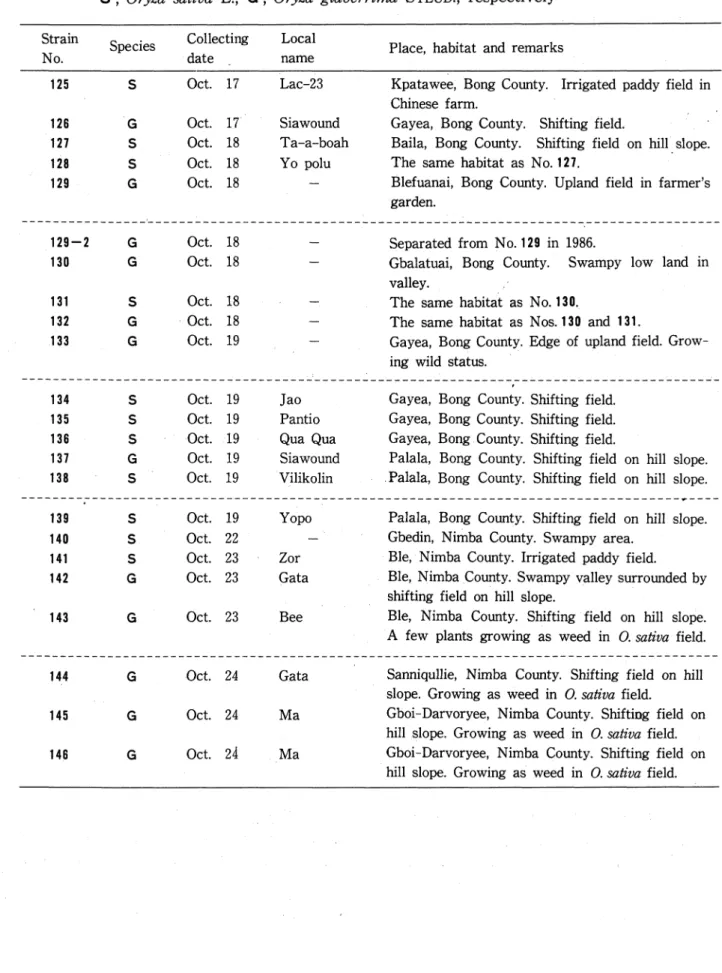
Distributions of cultivated rices collected were listed up in Table 1. In this table, the strain number, the species name, the date of collection, the local name, the locality and some informations of the habitat were described.
*Laboratory of Tropical Crop Science
-41-* S 9 j q B } 9 i j } u i p a s n J 9 q u i n u u i b i ; s a i p o ; 加 u i p u o d s a ヒ 0 0 9 J B 9 J H 加 i i 9 m i n p a s n s j a q E n i I -9 p C Q ' S U M O } U I E U I ⋮ S 9 p J I D U 9 d O . S 9 J I S U O p D 9 J { O D ⋮ s a p j i o p a m j . S U O I } B A i 9 S q O 1 0 S 9 ^ n O J 川 S 9 U I I p 9 } } O Q * H I J 9 q コ I l l p 9 p 9 { J O O 9 J 9 M S 9 D U p 9 ; B A p { n D 9 1 f 1 9 J 9 1 J A V S 9 q i ^ ^ > O T T H J 9 A 9 S S u T M O U S d B T A T * T ' 加 ! h
Table 1. Distribution and habitat of cultivated rice collected in Liberia, 1985. Abbreviations ; S ; 0り塚a sativa L., G ; Oryza glaberrin∽ Steud., respectively
StrainsoeciesCollectingLocal No.datename S < 3 ( / ) < / ) ( D
Place, habitat and remarks
Oct. 17 Lac-23
Oct. 17 Siawound Oct. 18 Ta-a-boah Oct. 18 Yo polu Oct. 18
Kpatawee, Bong County. Irrigated paddy field in Chinese farm.
Gayea, Bong County. Shifting field.
Baila, Bong County. Shifting field on hill slope. The same habitat as No. 127.
Blefuanai, Bong County. Upland field in farmer's garden. 一 山 リ [ L I n H 此 rH二 いいュ H i i ri 巨 [山n H山L H山n [山ユ ーー rJil G G S G G 8 8 日 H H H ● 川 川 い 川 u C C 0 0 8 8 9 日二 ● ● ● 川 川 L 川 川 u 上 川 L C C C 0 0 0
Separated from No. 129 in 1986.
Gbalatuai, Bong County. Swampy low land in valley.
The same habitat as No. 130.
The same habitat as Nos. 130 and 131.
Gayea, Bong County. Edge of upland field. Grow-ing wild status.
* a - i o c o r -^ ○ リ C O C O C O C O C O 1 1 1 1 1 i f ) i f ) i f ) C D i f ) Oct. 19 Jao Oct. 19 Pantio Oct. 19 Qua Qua Oct. 19 Siawound Oct. 19 Vilikolin
Gayea, Bong County. Shifting field. Gayea, Bong County. Shifting field. Gayea, Bong County. Shifting field
Palala, Bong County. Shifting field on hill slope. Palala, Bo喝County. Shifting field on hill slope.
e n o v c m C O ォ e f - * d - ォ r ド ㍗ . 1 「 . -< / > ( / ) < / ) C D G Oct. 19 Yopo Oct. 22 Oct. 23 Zor Oct. 23 Gata Oct. 23 Bee
Palala, Bong County. Shifting field on hill slope. Gbedin, Nimba County. Swampy area.
Ble, Nimba County. Irrigated paddy field.
Ble, Nimba County. Swampy valley surrounded by shifting field on hill slope.
Ble, Nimba County. Shifting field on hill slope. A few plants growing as weed in O. sativa field
●
Oct. 24 Gata
Oct. 24 Ma
146 Oct. 24 Ma
Sanniqullie, Nimba County. Shifting field on hill slope. Growing as weed in O. sativa field.
GboトDarvoryee, Nimba County. Shifting field on hill slope. Growing as weed in 0. sativa field. Gboi-Darvoryee, Nimba County. Shifting field on hill slope. Growing as weed in O. sativa field.
-43-Table 2. Some morphological characters of unhusked grains of 0. sativa collected in Liberia
Strain Length Width Thickness
(L) (W) (T) L/W L/T W/T No. ( mm) (mm) ( mm) L O t ^ O O i -I ^ L O ^ O O O O O r H N N N CO PO CO CO CO OO 1"* ^ 1 1 1 1 1 1 1 1 1 1 1 9.41 ±O^" 3.42±0.07 9.86±0.29 3.53±0.06 9.42 ±0.30 3.39 ±0.08 9.80 ±0.29 3.76 ±0.07 9.35±0.34 3.40±0.08 9.45 ±0.24 3.45 ±0.09 9.77 ±0.25 3.46 ±0.07 9.27±0.22 3.41 ±0.07 8.01±0.24 3.30±0.10 9.75±0.33 3.39±0.08 8.29±0.16 3.19±0.09 2.29±0.042.75±0.114.11±0.131.50±0.05 2,39±0.062.80±0.104.13±0.141.48±0.05 2.39±0.042.78±0.113.95±0.121.42±0.05 2.4.0±0.052.61±0.084.09±0.121.57土0.05 2.30±0.052.75±0.124.07±0.171.48±0.05 2.27±0.052.74±0.104.17±0.091.52±0.06 2.35士0.072.83土0.084.16±0.121.47土0.06 2.17±0.092.72土0.064.27±0.231.57±0.08 2.ll±0.042.43土0.083.81±0.101.51±0.04 2.33±0.0720 .0±0.134.19±0.141.46±0.06 2.09±0.062.60±0.083.97士0.141.53±0.07 Grand2>O,i meany-^-1±0.583.43±0.142.28±0.112.72±0.124.08士0.121.51±0.05 1) Mean of 20 grains and standard deviation.
2) Mean of means in the respective strains (n-ll) and standard deviation.
Eleven strains of 0. glaberrima were collected in this trip. However, strain No. 129-2 was separated from No. 129 in cultivation for seed propagation in 1986.
Some morphological characters of unhusked grains
●
Eleven strains of 0. sativa and 12 strains of O.glaberrima were collected in this trip and those were used for morphological investigations of unhusked grains.
Investigations were done for length, width and thickness of unhusked grains, using
●
20 grains of each strain. Measurements were done at the largest position of the respective
characters. Moreover, of the unhusked grains, calculations were done on the ratios of
the following components, namely, `length to width'了Iength to thickness', and `width to
●thickness', using average values of the respective characters. I. O. sativa
The results are given in Table 2. Lengths of grains were observed to be between 8.01 mm and 9.86 mm. The shortest grain was obtained in strain No. 139. The longest grain was obtained in No.127. Average value was found to be 9.31 mm. The standard deviations of each strain, i. e., showing intra-strain variation, were noted to be between
●
0.16 and 0.34.
Widths of grains were observed to be between 3.19 mm and 3.76 mm. The narrowest gram was obtained in No. 141. The widest grain was obtained in No. 131. Average value was found to be 3.43 mm. The standard deviations of each strain were noted to be between 0.06 and 0.10.
grain was obtained in N0.141. The thickest grain was obtained in No.131. Average value was found to be 2.28 mm. The standard deviations of each strain were noted to be between 0.04 and 0.09.
To make clear the relationships of the three components, i e., length and width, length and thickness, and width and thickness of unhusked grains, correlation coefficients were calculated. The correlation coefficient between length and width of unhusked grains was ascertained to be 0.72 showing significant correlation among them at 0.1 % level. The correlation coefficient between length and thickness of unhusked grains was ascertained
/
to be 0.90 showing significant correlation among them at 0.1 % level. The correlation
coefficient between width and thickness of unhusked grains was ascertained to be 0.73,
showing significant correlation among them at 0.1 % level.
Ratios of grain-length to grain-width of unhusked grains were observed to be between 2.43 and 2.88. The smallest value was obtained in No. 139. The largest value was obtained m No.140. Average value was found to be 2.72. The standard deviation of the whole strains, i. e., showing inter-strain variation, was 0.12.
●
Ratios of grain-length to grain-thickness of unhusked grains were observed to be between 3.81 and 4.27. The smallest value was obtained in No. 139. The largest value was obtained m No.138. Average value was found to be 4.08. The standard deviation of the whole strains was 0.12.
Ratios of grain-width to grain-thickness of unhusked grains were observed to be between 1.42 and 1.57. The smallest value was obtained in No.128. The largest values were obtained in Nos. 131 and 138. Average value was found to be 1.51. Standard deviation of the whole strains was 0.05.
■l
As shown in Fig. 2, based on the data obtained concerning the length.and grain-width of unhusked grains, the whole strains of 0. sativa used were classified into two grain types, i. e., B (large type) and C (slender type), according to the tripartite classification by Matsuo2). In this figure, code-numbers used are corresponding to the strain number used in Table 1. Nine strains of those belonged to the B type and 2 strains to the C type, respectively. As shown in Table 3, average values of grain-length were found to be 9.56mm in 9 strains belonging to the B type and 8.15mm in 2 strains to the C type, respectively. Average values of grain-width were found to be 3.47 mm in the B type and 3.25 mm in the C type, respectively. Strains belonging to the C type were remarkably long in view of grain-length. In grain-length, standard deviations of the whole strains belonging to the B and C types, i. e., showing inter-strain variations, were 0.21 in the B type and 0.14 in the C type, respectively. In grain-width, standard deviations of the whole strains belonging to the B and the C types were 0.ll and 0.06, respectively. II. Oryza glaberrfma
The results are given in Table 4. Lengths of grains were observed to be between 7.99 mm and 9.77 mm. The shortest grain was obtained in No. 129-2. The longest grain was obtained in No. 129. Average value was found to be 8.76 mm. The standard deviations
-45-( w w ) i p S u a q 129-21 0.0 2.5 3.0 3.5 4.0 Width (mm)
Fig. 2. Classification of grain type of unhusked grains in cultivated rice collecト ed in Liberia according to the tripartite classification by Matsuo2).
Vertical axis ; length of grain, abscissa ; width of grain, open circle ; 0クyza
sativa L., filled circle ; 0. glaberrima Steud., respectively. Code-numbers used in the figure are corresponding to the strain number used in Tables 2 and 4.
Table 3. Number of strains and average values of length and width of unhusked grams of O. sativa belonging to the respective gram types
Grainl* No. of Length Width
type strains ( mm) ( mm)
B 9.56士0.21 3.47±0.ll 8.15±0.14 3.25±0.06 1) For explanation, refer to Fig. 2.
Table 4. Some morphological characters of unhusked grains of 0. glaberri〝∽ collected in
Liberia Strain Length a No. (mm) Width Thickness (W) (T) (mm) (mm) L/W L/T W/T 126 8.89±0.20" 129 9.77±0.33 129-2 7.99 ±0.18 130 9.12士0.22 132 9.03 ±0.28 133 8.72士0.10 137 8.96土0.25 142 8.36±0.17 143 9.14±0.17 144 8.25±0.12 145 8.50土0.16 146 ′ 8.35±0.18 3.01 ±0.09 1.96±0.05 2.87±0.11 1.75±0.05 2.70土0.10 1.60土0.09 3.27±0.08 1.96土0.07 3.15±0.08 1.96±0.05 3.04 ±0.06 1.97土0.05 2.98土0.06 2.00士0.04 3.41 ±0.08 2.09±0.07 3.14士0.08 2.03 ±0.06 3.20土0.08 1.99士G.05 2.78 ±0.07 1.72±0.05 3.03土0.06 1.95 ±0.05 2.95±0.08 4.54±0.12 1.54 ±0.06 3.40 ±0.13 5.59士0.24 1.64 ±0.08 2.96 ±0.14 5.02 ±0.26 1.70 ±0.10 2.79士0.07 4.65±0.15 1.67±0.07 2.87 ±0.11 4.61土0.16 1.61 ±0.06 2.87士0.05 4.44 ±0.10 1.55±0.03 3.01 ±0.08 4.49±0.10 1.49士0.04 2.45±0.05 4.01 ±0.13 1.63±0.06 2.91 ±0.09 ′51 ±0.17 1.55±0.06 2.58±0.08 4.16土0.10 1.61土0.05 3.06±0.09 4.95±0.14 1.62 ±0.07 2.76 ±0.07 4.28土0.14 1.55 ±0.06 Grand*' mean--'-±0.473.05±0.191.92±0.142.88土0.234.60土0.411.60土0.06 1) Mean of 20 grains and standard deviation.
2) Mean of means in the respective strains (n-12) and standard deviation.
of each strain, i e., showing intra-strain variation, were noted to be between 0.10 and 0.33.
Widths of grains were observed to be between 2.70 mm and 3.41 mm. The narrowest grain was obtained in No. 129-2. The widest grain was obtained in No.142. Average value was found to be 3.05 mm. The standard deviations of each strain were noted to be between 0.06 and 0.ll.
Thicknesses of grains were observed to be between 1.60 mm and 2.09 mm. The thinnest grain was obtained in No. 129-2. The thickest grain was obtained in No. 142. Average value was found to be 1.92 mm. The standard deviations of each strain were noted to be between 0.04 and 0.09.
To make clear the relationships of the three components, i. e., length and width, length
-47-Table 5. Number of strains and average values of length and width of unhusked grains in 0.glaberrin∽ belonging to the re-spective grain
Grain" No. of Length Width
type strains ( mm) ( mm)
B 8.91±0.32 3.24±0.ll 8.68±0.51 2.95±0.15 1) For explanation, refer to Fig. 2.
and thickness, and width and thickness of unhusked grains, correlation coefficients were calculated. The correlation coefficient between length and width of unhusked grains was
ascertained to be 0.08 showing no significant correlation even at 5 % level. The correlation coefficient between length and thickness of unhusked grains was ascertained to be 0.13
showing no significant correlation even at 5 % level The correlation coefficient between
width and thickness of unhusked grains was ascertained to be 0.87 showing sigimficant co汀elation among them at 0.1 % level. This relation indicated that the wider was the grain-width, the thicker was the grain-thickness.Ratios of grain-length to grain-width were observed to be between 2.45 and 3.40. The smallest value was obtained in No. 142. The largest value was obtained in No. 129. Average value was found to be 2.88. The standard deviation of the whole strains, i. e., showing inter-strain variation, was 0.23.
●
Ratios of grain-length to grain-thickness were observed to be between 4:01 and 5.59. The smallest value was obtained in No. 142. The largest value was obtained in No. 129. Average value was found to be 4.60. The standard deviation of the whole strains was 0.41.
Ratios of grain-width to grain-thickness were observed to be between 1.49 and 1.70. The smallest value was obtained in No. 137. The largest value was obtained in No. 129-2. Average value was found to be 1.60. The standard deviation of the whole strains was
0.06.
As shown in Fig. 2, based on the data obtained concerning the length and
grain-●
width of unhusked grains, the whole strains of 0. glaberrima used were classified into two grain types, ie., B and C types. Four strains of those belonged to the B type and 8 strains to the C type, respectively. As shown in Table 5, average values of grain-length were found to be 8.91 mm in 4 strains belonging to the B type and 8.68mm in 8 strains
●
belonging to the C type, respectively. Average values of grain-width were found to be 3.24 mm in the B type and 2.95 mm in the C type, respectively. In grain-length, standard deviations of the whole strains belonging to the B and the C types, I e., showing inter-strain variation, were 0.32 and 0.51, respectively. In grain-width, standard deviations of the whole strains of the B and the C types were 0.ll and 0.15, respectively.
Summary
During the trip of October in 1985 in Liberia, 23 strains of cultivated rice, i. e., ll strains of 0. sativa and 12 strains of 0. glaberrima, were collected. Their localities and habitats were reported (Table 1). Locality names are as follows ; Kpatawee, Gayea, Baila, Blefuanai, Gbalatuai, Palala, 、 Gbedin, Ble, Sanniqullie and Gboi-Darvoryee.
In the whole strains of 0. sativa collected, average values of length, width and thickness of unhusked grains were 9.31 mm, 3.43 mm and 2.28 mm, respectively. Of unhusked grains, correlation coefficients between length and width, length and thickness, and width and thickness were 0.72, 0.90 and 0.73, respectively. Of unhusked grains, ratios of length to width, of length to thickness and of width to thickness were 2.72, 4.08 and 1.51, in average values, respectively.
Using grain-length and grain-width, the whole strains of 0. sativa used were classified into two grain types. Nine strains belonged to the B type and 2 strains to the C type, respectively.
In 0.glaberrima, length, width and thickness of unhusked grains were 8.76 mm, 3.05 mm and 1.92 mm, in average values, respectively. Of unhusked grains, correlation coeffi-cients between length and width, length and thickness, and width and thickness were 0.08, 0.13 and 0.87, respectively. Of unhusked grains, ratios of length to width, of length to thickness and of width to thickness were 2.88, 4.60 and 1.60, in average values, respectively. Using grain-length and grain-width, the whole strains of 0.glaberrima used were classified into two grain types. Four strains belonged to the B type and 8 strains to the C type, respectively.
References
1 ) Katayama, T.C. 1987. General remarks on cultivated rice in Africa concerned. Kagoshima Univ. Res. Center S.Pac. 0cc. Papers 10: 91-102.
2 ) Matsuo, T. 1952. Genecological studies on cultivated rice (in Japanese with English summary). Bull, Natl. Inst. Agr. ScL.Ser. D3 : 1-111.
ヽ
3 ) Perez, A二T. 1977. Plant exploration in Liberia (Sep. 24-0ct. 20, 1977). Genetic Resouces