Rearing of Prawn Penaeus japonicus with
Reference to Ecological Succession
著者
HIRATA Hachiro, MARCHIORI Marcos, SHINOMIYA
Akihiko
journal or
publication title
鹿児島大学水産学部紀要=Memoirs of Faculty of
Fisheries Kagoshima University
volume
27
number
1
page range
295-303
別言語のタイトル
クルマエビの種苗生産における生態遷移
Rearing of Prawn Penaeus japonicus with
Reference to Ecological Succession5*
**iHachiro Hirata*2, Marcos Marchiori*2 and
Akihiko Shinomiya*8
Abstract
The present experiments were conducted to establish a rearing method of prawn
with reference to ecological succession.
Special facilities were prepared to obtain the homeostasis in an experimental eco system during the rearing experiments. A 30 m3 concrete tank was used for rearing the prawn, Penaeus japonicus Bate. A 4 m3 tank was equipped with honeycomb for promoting bacterial activities. A zigzag stream unit, 20 m long was designed for the growth of macro-algae. The water was re-circulated through these tanks by a pump at the rate of once a day.
The results were compared with that of the control tank (30 m3) which was oper
ated by the routine method without water change. Energy flow and ecological suc
cession in the prawn hatchery are discussed in this paper.
Introduction
The rearing methods of prawn Penaeus japonicus Bate have been rapidly de veloped during the last ten years (Furukawa, 1972; Hirata et al., 1975; Hirata and Wada, 1969; Hudinaga and Kittaka, 1966 and 1967; Kureha and Nakanishi, 1972). Recently, Hirata (1975) and Shigeno (1970) have reviewed the rearing techniques established in Japan.
Most of the techniques, however, have been based on the "drain-off" system. That is, the rearing water enriched by the faeces and uneaten foods are drain ed off from the hatchery tanks into the natural sea during rearing period and after harvesting the postlarvae. Consequently, the natural seawater then be comes slightly polluted.
On the other hand, many biologists worry about the water pollution by the industrial wastes. However, they do not care about the wastes from their own culture system. If we want to continue the fishery industries in a favourable
*x Contribution No. 4 of the Fishery Research Laboratory, Faculty of Fisheries, Kagoshi ma University.
*2 Lab. of Cultivation Physiol., Fac. Fish., Kagoshima Univ., Shimoarata 4, Kagoshima 890, Japan.
296
Mem. Fac. Fish., Kagoshima Univ. Vol. 27, No. 1 (1978)
condition forever, the marine biologists must demonstrate how to maintain ho
meostasis in the artificial ecosystem of their hatchery or culture systems.
The present experiments were conducted to establish a rearing method for
prawn without any water pollution based on the principle of a feedback culture
system (Hirata, 1977).
The rearing water in the system was re-circulated
through a zigzag stream unit designed for growth of macro alga in order to
purify the water.
The results obtained in the experiment might be applicable to the mass pro
ductions of fish and prawn larvae.
Materials and Methods
The prawn rearing experiments were carried out at the Marine Laboratory
for Fishery Sciences of the Kagoshima University mainly in summer 1977, and
additional experiment was done in the early summer 1978 to confirm the results
of the previous one.
Materials used in the experiments were Penaeus japonicus
Bate obtained from the Usui Fish Market near the Laboratory.
Schematic diagrams of the experimental tanks used in the experiments are
Water Re-circulation
4_ Air Supply
1. Schematic diagrams of the rearing system in experimental
culture and control tank.
(A); 30-t concrete tank with rotary aeration (a) and net straner
(b), (B); 4-t decomposer tank with honeycomb (c), (C); zigzag
stream unit covered with 16-meshes net for growth of Enteromor-pha, and (D); 30-t concrete tank same as (A), but with routine air-stone.
EGGS NAUPLIUS (ChloreluT) X
V
\S0Y-CAKE /YEAST V-T—«-f
[ROTIFER( DIATQMS^)-
]COPEPODA ZOEA MYSIS>i
-./NECK CLAMMEATS-JXPELLETS /[
P-I P-5 P-5 P-25
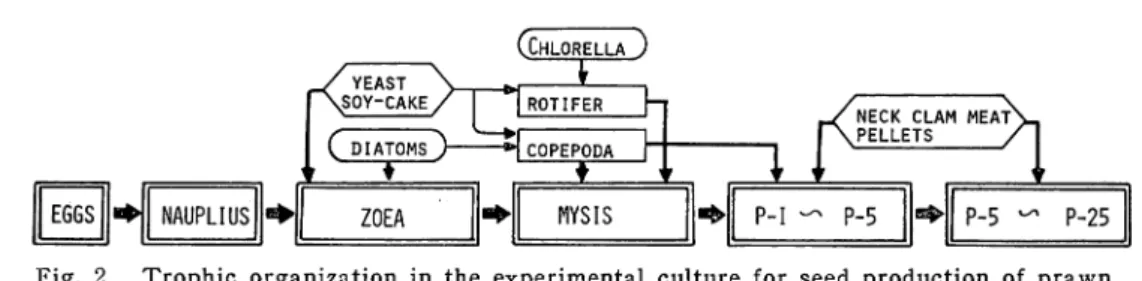
Fig. 2. Trophic organization in the experimental culture for seed production of prawn.
presented in Fig. 1. The experimental culture tank was composed of three sub
systems; namely, prawn rearing tank (A), decomposer tank (B) for mineraliza tion by bacterial organisms, and zigzag stream unit (C) for denitrification by macro-alga, Enteromorpha intestinalis. All the tanks were made of concrete, and sizes of tank A, B and C were 30-t, 5-t and 3-t, respectively. The water was re-circulated by a 400-W stainless pump at the rate of about once a day from tank C to A. The water flow was made by means of gravity from tank A to B, and also tank B to C. A polyethylene net strainer with 32-meshes was set
at the outlet pipe in the tank A to keep larvae from leaving the tank. Later,
one more siphon with the strainer was added, because the net of the former one was immediately clogged with wastes such as prawn faeces.
Aeration in the rearing tank A was accomplished by rotating arms moved by compressed air getting out from holes of 1 mm diameter and located every 20 cm
on the pipe. The air was directed about 45° towards the bottom of the tank in
order to impede the depositions of organic matter on the bottom, and also to
maintain the pipe 5 or 10 cm from the bottom to avoid attrition. Velocity of
rotation was 7. 5 rph at the beginning, and decreased to about 4. 0 rph at the end of the experiments.
Decomposer tank B was equipped with 16 mm size honeycomb (Itami and Yoshinori. 1977) for bacterial attachment. Strong air was provided through air
stones on the floor of the tank in order to maintain aerobic conditions for promoting mineralization.
Zigzag stream unit C was composed of 5 steps having different lengths: 1 st step 8.1m, 2nd step 8.9m, 3rd step 9.6m, 4th step 10.2m and 5th step 10.7m. Depth and width of the steps were about 0.1m and 0.2 m, respectively. Size of
storage tank connected the 5 th step of the zigzag stream was 0. 5x0. 5x12. 8 m.
All the steps were equipped with polyethylene nets (16-meshes) for algal fix
ation.
Shape and size of control tank D was same as the experimental tank A. The water was kept in stagnant condition during the experiments. The routine aera
tion system with large air-stone was used in tank D.
The feeding regimes illustrated in Fig. 2 were adapted from Hirata (1975),
298 Mem. Fac. Fish., Kagoshima Univ. Vol. 27, No. 1 (1978)
Results
1. Succession of Organisms in the Rearing Tanks
Ecological succession of organisms in the rearing tanks observed in both ex
perimental culture and control tank are presented in Figs. 3 and 4, respective
ly. 10
2
5
LL. CD 100 * s O CO £ O Z^ §1001
o 50 fe 500 o 0 200 100 3 2i CD CD ° 10 d N|Z0EA IMYSISy
POSTLARVA 5 I I i i I P-10 P-15 P-20 P-25 ' ' • • • • » » • • . . ! . . . . I . . . . I -——..^. PRAWN LARVAE DIATOMS CHLORELLA ROTIFER COPEPODA 10 20 TIME IN DAYFig. 3. Ecological succession of living organisms in experimental culture tank.
10-l
5
CD O 100 50 ^ CD O =p 0Z ?iooo
CD O 500 0 200 100 CD t— ^ ^ 5 Q_ CD CD 10 Fig.N ZOEA MYSIS POSTLARVA 5 P-10 i i i I i i i i I i PRAWN LARVAE *•—#—•«.•« DIATOMS CHLORELLA ROTIFER COPEPODA -i-P-15 • i • P-20 P-25 • • • • • • i I 10 20 30 TIME IN DAY
4. Ecological succession of living organisms in control tank.
Phytoplankton such as Chaetoceros sp., Nitszchia sp. and Chlorella sp. grew well
in the rearing tanks especially in control tank at the beginning of the experi
ments. Zooplankton, mainly Brachionus plicatilis and Tigriopus japonicus subordi nated to the blooming of phytoplankton from the 5 th day after the culture. The population density of zooplankton in control tank was slightly higher
than that in the experimental culture tank. That is, the maximum density of B. plicatilis was 160 individuals per ml in control and 100 individuals per ml in
300 Mem. Fac. Fish., Kagoshima Univ. Vol. 27, No. 1 (1978)
the experimental culture tank.
During the second part of the experimental period, all the plankton disappear
ed in the rearing tanks. E. intestinalis, then, started to bloom in the zigzag
stream of the experimental culture system. On the contrary, the Chlorella grew
up again from the 20th day after culture and showed the highest density, 750 x
103 cells per ml, during the last period of culture.
2. Survival, Growth, and Food Conversion of the Prawn Larvae
The survival, growth and food conversion rates of the prawn larvae cultured
in each tank are presented in Table 2 and Figs. 5 and 6.
The results of survival and growth rates were divided into two parts at P-10*
old: the first half period until the 18th day of culture (=P-10) and the last
half period. 100 r 80 3 60 10 20 0 5 10 15 20 T I H E I N D A Y
Fig. 5. Survival rates of the prawn larvae in experimental culture and control tank.
Experimental ^"^ c u l t u r e • • fr-9. Q^» » • » « *-i'S-O..Q Com tox 25 30
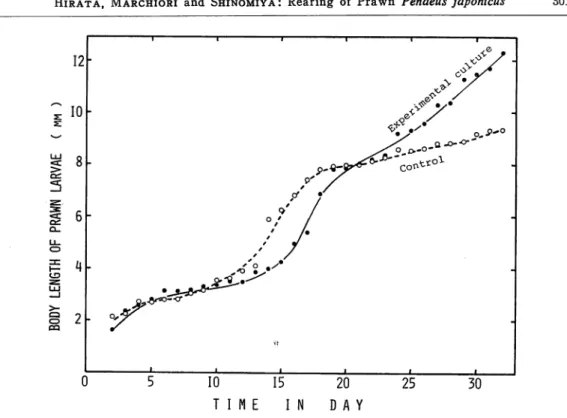
During the first half period, the growth rates of the larvae in the experimen
tal culture and control were 0. 23mm/day and 0.37 mm/day, respectively.
How
ever, such tendency was entirely reversed during the last half period. That is,
the growth rates in former tank was 0. 50 mm/day which is extremely faster than
that of latter which was calculated to be 0.13 mm/day. Average body lengths
of the larvae at the end of experiment were 12.5 mm in the experimental cul
ture and 9. 0 mm in control tank.
Survival rate in the former tank decreased suddenly to about 20^ during the
first half period. Thereafter, a stable survival rate was observed until the end
of the experiments. On the contrary, the relative higher survival rate, about
12 10 3 <a: Cd U3 > -^<o-cr 0 5 10 15 20 TIME IN DAY
Fig. 6. Growth of the prawn larvae in experimental culture and control tank. o ^ °
Co*^3-25 30
40^ was kept in control tank until the P-12 old, but the rate decreased gradu
ally from 40 to 16 % through the last half period. The final survival rates in the former and latter tanks were estimated to be 20. 4 % and 16.1 %, respective
ly.
The food conversion rates are calculated by following formulas: Apparent food conversion rate (A. F. C.)
= (animals harvested) x 100
total foods supplied Total food conversion rate (T. F. C.)
= (animals harvested+algae produced) x 100
total foods supplied
The apparent food conversion rates were 8. 5 % in the experimental culture and 5.1 % in control tank. Amount of algae E. intestinalis harvested were 8300
g from the zigzag stream in the experimental culture system and 162.3 g of
marine Chlorella in the latter one. Therefore, a great difference in the total
food conversion (T. F. C.) was found. When the amounts of algae were includ ed, the T. F. C. rates were 65.1 % in the former and 6. 9 % in the latter one.
The results are summarized in the Table 1.
Average dissolved oxygen content in both tanks were about same, namely
302 Mem. Fac. Fish., Kagoshima Univ. Vol. 27, No. 1 (1978)
Table 1. Survival,
conversion
growth, apparent food conversion (A. i (T. F. C.) in the experimental culture
F. C.) and total food
and control tank.
Survival N-P26
(5»
Growth Food Larvae supplied harvested
(g)
(g)
Algae produced (g) AFC « 0 TFC daily final Gu/day) (mg) OK) Exp. culture Control 20.4 16.1 345 18.0 243 8.8 14500 1143 9050 462 8300* 162** 8.5 5.1 65.1 6.9 * Enteromorpha removed from the zigzag stream.** Chlorella discharged finally into the sea. The amount was estimated by population
density in the control tank.
The highest value of pH was 9. 5 which was found in zigzag stream at around
noon time, but lower values were observed at night time.
Average pH value in
the experimental culture was 8. 26, and it was 8. 26 in control tank too on aver
age.
The organic phosphates were 0. 03 (0.01 to 0. 06) ug-Rt/l in the former culture
and 0. 05 (0. 02 to 0. 09) /ig-at/1 in latter one.
Discussion
It is well known that the prawn P. japonicus changes feeding habit according to the larval stages; namely, herbivorous in zoeal stage, omnivorous in mysis stage, and carnivorous in postlarval stage (Hudinaga and Miyamura, 1962).
In the present experiments, the succession of living organisms in the rearing tanks were nearly synchronized to the development of larval feeding habits. That is, when the larvae developed to zoeal stage, phytoplankton such as
Chaetoceros and Chlorella were propagated in the tanks through zoeal stage. When the larvae developed to mysis stage, phytoplankton and zooplankton were sim ultaneously propagated in the tanks. Thereafter, population of phytoplankton decreased gradually, and then, the larvae developed to postlarval stage and con
sumed the zooplankton.
All the zooplankton, however, were consumed by the postlarvae at around
P-5 old. The larvae were fed frozen clam meat and artificial diet, thereafter.
During the last half period of the experiments in control tank, Chlorella bloom ed again, but zooplankton such as B. plicatilis or T. japonicus were not propaga ted anymore. It might be considered that rotifers and copepods were eaten
by the postlarvae.
About 30-t of rearing water enriched with excess nutrients and Chlorella cells, faeces, particles like detritus in the control tank were discharged directly into
the natural sea near the Laboratory. The amount of Chlorella cells drained off were estimated to be about 162 g in wet weight, but the cells were too few to
be harvested from the water. The natural sea water was, slightly polluted by the wastes of the prawn seed production.
On the contrary, all the excess nutrients in the experimental culture system
were removed by transforming them into macro-alga E. intestinalis. About 8300 g
of E. intestinalis were harvested in the zigzag stream of the experimental culture
system.
Therefore, the natural seawater was not polluted.
Studies to improve the efficiency of the feeback cultre system for seed produc
tion are still being carried on at the Marine Laboratory for Fishery Sciences of
Kagoshima University. We hope that more efficient and simpler methods could
be devised for practical use in the near future.
Acknowledgements
We wish to express our sincere thanks to Mr. S. Kadowaki, Mr. T. Nakazo-no and Mr. T. Kasedo, the Marine Laboratory for Fishery Sciences, Kagoshima University, who kindly assist the experimets. We are also grateful to Mr. K.
Mae, Mr. A. Marrocco, Mr. T. Yamauchi, Mr. P. Gabasa and Mr. M. Kodama,
graduate students of the Faculty of Fisheries, Kagoshima University, for prepa
ring the manuscript.
References
Furukawa, I. (1972) : Rearing methods of prawn, Penaeus japonicus, fed marine yeast. Yooshoku, 9(9), 38-42.
Hirata, H. (1975): An introduction to the rearing methods of prawn, Penaeus japonicus
Bate, in Japan. Mem. Fac. Fish., Kagoshima Univ., 24, 7-12.
Hirata, H. (1977) : Zooplankton cultivation and prawn seed production in an artificial
ecosystem. Helgolander wiss. Meeresuntefs., 30, 230-242.
Hirata, H., Y. Mori and M. Watanabe (1975): Rearing of prawn larvae, Penaeus japonicus Bate, fed soy-cake particles and diatoms. Mar. Boi., 29, 9-13.
Hirata, H. and T. Wada (1969) : Seed production of prawn, Penaeus japonicus in a 1800 m3 pool and feeding rates of postlarvae. Saibai-Gyoyo, 6(2), 44-49.
Hudinaga, M. and J. Kittaka (1966): Studies on food and growth of larval stage of a prawn, Penaeus japonicus, with reference to the application to practical mass culture.
Inf. Bull Planktol. Japan., 13, 83-94.
Hudinaga, M. and J. Kittaka (1967): The large scale production of the young Kuruma prawn, Penaeus japonicus Bate. Inf. Bull Planktol Japan. (Commemoration Vol., Dr. Matsue's 60 th Birthay), 35-46.
Hudinaga, M. and M. Miyamura (1962) : Breeding of the Kuruma prawn, {Penaeus japonicus
Bate). /. Oceanogr. Soc. Japan. (20 th Anniv. Vol.), 694-706.
Itami, K. and H. Yoshinori (1977) : Studies on the cultivation of marine copepods-III. On
the cultivation of Tigriopus japonicus in the water tanks with honeycomb. Bull. Hyogo Pref.
Fish. Exp. St., 17, 53-68.
Kureha, N. and T. Nakanishi (1972): Seed production of the prawn Penaeus japonicus by a
2800m3 rearing tank in the Shibushi Station. Sea Farm. Technol Develp. Res., 1(2),41-46.
Miyamura, M. (1965) : The Kuruma prawn, Penaeus japonicus Bate. uFish Culture of 60 marine species", 83-93, (Taisei-Shuppansha, Tokyo, Japan).