Can RTA labor provisions prevent the
deterioration of domestic labor standards? :
the cases of statutory minimum wages and
employment protection regulations
著者
Kamata Isao
権利
Copyrights 日本貿易振興機構(ジェトロ)アジア
経済研究所 / Institute of Developing
Economies, Japan External Trade Organization
(IDE-JETRO) http://www.ide.go.jp
journal or
publication title
IDE Discussion Paper
volume
716
year
2018-05
INSTITUTE OF DEVELOPING ECONOMIES
IDE Discussion Papers are preliminary materials circulated to stimulate discussions and critical comments
†Isao Kamata, Research Center of International Economy and Industry, University of Niigata Prefecture; 471 Ebigase, Higashi-ku, Niigata City, Niigata, 950-8680,
IDE DISCUSSION PAPER No. 716
Can RTA Labor Provisions Prevent the
Deterioration of Domestic Labor Standards?:
the Cases of Statutory Minimum Wages and
Employment Protection Regulations
Isao Kamata
†April 2018
AbstractThis study investigates whether labor clauses in regional trade agreements (RTAs) are effective to maintain or improve the domestic labor standards in the signatory countries. The effects of RTA labor clauses on two measures of labor standards, statutory minimum wages and the strictness of employment protection, are empirically analyzed using a unique dataset that classifies the population of effective RTAs into those with and without labor clauses, together with multi-year data on minimum wages and the indicator of employment-protection strictness for a wide variety of countries. The result shows that having labor-clause-free RTAs with more or larger trading partners are associated with lower statutory minimum wages although this negative association is not found for labor-clause-inclusive RTAs. The separate estimation for countries in different income groups further demonstrates that this result is chiefly driven by middle-income countries that sign RTAs with high-income partners, implying that signing RTAs with more or larger high-income trading partners would create to the government of a middle-income country, which has a comparative advantage over the high-middle-income partners in labor-intensive sectors, a downward policy pressure on statutory minimum wages whereas labor clauses could alleviate such a negative policy effect of RTAs on minimum wages. This finding is also contrasted with the case of actual wages for which no evidence is found for the impact of RTAs with or without labor clauses to reaffirm that labor-clause-free RTAs could create downward policy pressure on statutory minimum wages but RTAs might not bring market pressure on actual wages regardless of whether or not the RTAs include labor clauses. Finally, unlike this case of statutory minimum wages, the empirical analysis finds no clear evidence for the potential impacts of RTAs either with or without labor clauses on the strictness of employment protection in the signatory countries.
Keywords: International trade, Regional trade agreements, Labor clauses, Minimum
wages, Employment protection
The Institute of Developing Economies (IDE) is a semigovernmental, nonpartisan, nonprofit research institute, founded in 1958. The Institute merged with the Japan External Trade Organization (JETRO) on July 1, 1998.
The Institute conducts basic and comprehensive studies on economic and related affairs in all developing countries and regions, including Asia, the Middle East, Africa, Latin America, Oceania, and Eastern Europe.
The views expressed in this publication are those of the author(s). Publication does not imply endorsement by the Institute of Developing Economies of any of the views expressed within.
INSTITUTE OF DEVELOPING ECONOMIES (IDE), JETRO
3-2-2, WAKABA,MIHAMA-KU,CHIBA-SHI
CHIBA 261-8545, JAPAN
©2018 by Institute of Developing Economies, JETRO
No part of this publication may be reproduced without the prior permission of the IDE-JETRO.
Can RTA Labor Provisions Prevent the Deterioration of Domestic
Labor Standards?: the Cases of Statutory Minimum Wages and
Employment Protection Regulations
Isao Kamata†
University of Niigata Prefecture
April 12, 2018
Abstract
This study investigates whether labor clauses in regional trade agreements (RTAs) are effective to maintain or improve the domestic labor standards in the signatory countries. The effects of RTA labor clauses on two measures of labor standards, statutory minimum wages and the strictness of employment protection, are empirically analyzed using a unique dataset that classifies the population of effective RTAs into those with and without labor clauses, together with multi-year data on minimum wages and the indicator of employment-protection strictness
for a wide variety of countries. The result shows that having labor-clause-free RTAs with more
or larger trading partners are associated with lower statutory minimum wages although this negative association is not found for labor-clause-inclusive RTAs. The separate estimation for countries in different income groups further demonstrates that this result is chiefly driven by middle-income countries that sign RTAs with high-income partners, implying that signing RTAs with more or larger high-income trading partners would create to the government of a middle-income country, which has a comparative advantage over the high-income partners in labor-intensive sectors, a downward policy pressure on statutory minimum wages whereas labor clauses could alleviate such a negative policy effect of RTAs on minimum wages. This finding is also contrasted with the case of actual wages for which no evidence is found for the impact of RTAs with or without labor clauses to reaffirm that labor-clause-free RTAs could create downward policy pressure on statutory minimum wages but RTAs might not bring market pressure on actual wages regardless of whether or not the RTAs include labor clauses. Finally, unlike this case of statutory minimum wages, the empirical analysis finds no clear evidence for the potential impacts of RTAs either with or without labor clauses on the strictness of employment protection in the signatory countries.
Keywords: International trade, Regional trade agreements, Labor clauses, Minimum wages,
Employment protection
JEL classification: F13, F14, F16, F66, J81, J88
This study has been conducted as a part of the Project “Labor in Global Value Chains” undertaken at the Institute of Developing Economies (IDE-JETRO), and was supported by JSPS KAKENHI Grant Number JP17H02523. I acknowledge Hitoshi Sato and all the other members of the Project for invaluable discussions in a series of meetings for the Project at the IDE-JETRO. I am also thankful to assigned discussant and other
participants to sessions at the JSIE’s 76th Annual Meeting, the Midwest International Economic Groups’s Fall
2017 Conference, and the WEAI’s 14th International Conference for their valuable comments on an earlier
stage of this work. The usual disclaimer applies.
1 Introduction
One of the remarkable aspects of development in the world trading system for the last 20 years is a rapid increase in the number of bilateral and plurilateral trade agreements such as free trade areas (FTAs) and customs unions. The rapid spread of these regional trade agreements or RTAs has presented a sharp contrast to the fact that multilateral trade negotiations under the World Trade Organization (WTO) system have long been deadlocked during the same 20-year period. This increase of RTAs should thus be, at least partly, because countries have found or tried to find in RTAs a way to promote their trade after being tired of inconclusive multilateral trade negotiations that have become (much) more difficult than were they under the former GATT system, due to various reasons.
Another notable phenomenon that should also characterize the last 20-year development in the international trade environment is growing concerns about possible negative impacts of globalization, particularly on social values such as workers’ rights/conditions or the natural environment. These concerns are often expressed as fears of “races to the bottom” through which domestic labor or environment standards in countries will erode due to cost-saving pressures in keener global competition brought by growing international trade and investment. Also have there been persistent arguments against the possibility of “social dumping” through which some countries “unfairly” lower labor or environment standards and conditions to create or maintain a cost advantage over other producers in the international markets. Some governments have found a way to respond to these public, commercial or political concerns by providing in trade agreements “social clauses” that are provisions requiring, urging, or requesting the signatories of the trade agreements to maintain a certain level or degree of their domestic labor or environment standards. (In what follows, I will focus on the issues in labor standards or labor clauses.) Having these two notable features in recent development in the world trading system, the total number of RTAs as well as the number of RTAs with labor clauses have been rapidly growing since the late 1990s, as shown in Figure 1.
To discuss the labor clauses in trade agreements and their relevance, it is important to examine the following two questions: (i) Does globalization really deteriorate domestic labor standards or working conditions in countries in the world—i.e., have either races to the bottom or “dumping” practices in labor standards really been the case?; and (ii) Are labor clauses in trade agreements—or is ruling or
handling domestic labor issues in trade agreements—effective for a case in which domestic labor standards and conditions erode in relation with globalization? On the first of these two questions, there is a large volume of research. The theoretical studies are overall skeptical about the view in which low or weak labor standards create or improve export competitiveness of a country. Empirical studies have failed to find evidence supporting the race-to-the-bottom hypothesis that low or weak labor standards are brought by export-competition pressure. Some pieces of literature have rather found evidence supporting an opposite possibility, that is, better or stricter labor standards will be linked to a larger volume of exports or the attraction of inward foreign direct investment (FDI). Further review of the literature is left to Brown et al. (2011) and Kamata (2014) that offer a more comprehensive and detailed literature review on the issues in trade and labor standards.
However, some pieces of more recent literature have indeed found evidence for the race-to-the-bottom hypothesis in relation with growth in international trade or FDI, particularly in the labor rights of freedom of association and collective bargaining, or the FACB rights. Mosley and Uno (2007) use a unique cross-country and time-series dataset of the indicator of collective labor rights constructed based on Kucera’s (2002) approach. They find that the flows and stock of inward FDI (as the shares in a country’s GDP) improves the FACB rights in the country, while more openness to trade (measured as trade ratio to GDP) deteriorates the rights. Davies and Vadlamannati (2013) also use this FACB-right data by Mosley and Uno and find that the FACB rights in a country are correlated with the rights in its neighboring countries, which they interpret as an indication of a downward pressure on the FACB rights due to international competition.1 In addition to these studies focusing on the FACB rights, the study by Olney (2013) uses the OECD’s indicator of the strictness of employment protection and finds evidence for a possibility that countries are competing in relaxing employment-protection regulation to attract inward FDI.
In contrasts, the literature is slim on the second of the two questions presented above. There are a small number of theoretical pieces that present skepticism about the effectiveness or appropriateness of trade sanctions against possible deterioration in domestic labor standards or non-compliance practices. The empirical literature has been even thinner, and I was not able to find other empirical than my own earlier work
1
Davies and Vadlamannati conjecture that this intra-regional correlation in the FACB rights may be due to “races to the bottom” in labor standards (they indeed use this phrase in the title of the paper), but they do not test the conjecture at all.
(Kamata, 2014) until recently. (See Brown et al., 2011, and Kamata, 2014 for a more detailed review of the literature up to the earlier 2010s.) However, more recently have arisen some empirical studies that examine the effects of labor provisions in trade agreements on domestic labor standards, mainly by researchers affiliated with the International Labour Organization (ILO) such as ILO (2016, 2017) and Sari et al. (2016). Sari et al. (2016) should be especially noted since they investigate what types of labor provisions are effective to maintain or improve the FACB rights in signatory countries using a very careful and detailed classification of RTAs.2
The purpose of the current study is to address the second question of the two mentioned above: that is, whether labor clauses in RTAs are effective to prevent the domestic labor standards in RTA signatory countries from deterioration. For my macro-level empirical analysis, it is important to find a labor-standard measure for which data are available for a wide variety of countries for multiple years. I thus employ the following two measures of domestic labor standards: statutory minimum wages and the strictness indicator of employment protection, since these should be, at least to date, only labor-standard measures for which international data are readily available in a comparable form in both cross-country and time-series dimensions. The impacts of RTA with and without labor clauses as well as the trade presence of the RTA partners for a signatory are estimated using the RTA classification proposed in my own previous study (Kamata, 2016) together with data on minimum wages and the indicator of the strictness of employment protection for a wide variety of countries for multiple years. The results show that having labor-clause-non-inclusive RTAs with more or larger trading partners are associated with lower statutory minimum wages although that negative association is not found for labor-clause-inclusive RTAs. The separate estimation for countries in different income groups further demonstrates that the above-mentioned results are chiefly driven by middle-income countries that sign RTAs with high-income partners. This should imply that signing RTAs with more or larger high-income trading partners would create to the government of a middle-income country, which has a comparative advantage over the high-income partners in labor-intensive sectors, a downward policy pressure on statutory minimum wages, while labor clauses could alleviate such a negative policy effect of RTAs on minimum wages in the middle-income country.This finding also exhibits an interesting contrast with the empirical finding of my preceding study in which no systematic relationship has been found between RTA-partner trade
2
It is unfortunate that they do not present the catalogue of their RTA labor-clause classification, which should be worth comparing with the catalogue that I have proposed (Kamata, 2016).
concentration and actual labor earnings regardless of whether or not RTAs include labor provisions. This potentially asymmetric effects of RTA labor clauses on statutory minimum wages and actually-paid wages are confirmed through the estimation with a “common” sample, which should suggest that although signing RTAs with more or larger partners would not bring a market pressure on wages regardless of whether or not the RTAs have labor clauses, signing RTAs with more or larger partners could create some policy pressure onto the signatory government to maintain statutory minimum wages being low, unless the RTAs include labor clauses. Unlike this case of statutory minimum wages, however, the empirical analysis finds no evidence for positive impacts of labor-clause-inclusive RTAs or negative impacts of labor-clause-free RTAs on the strictness of employment-protection regulations in the signatory countries.
The rest of this paper is structured as follows: the next section 2 describes the empirical approach and data used for the analysis, followed by section 3 that presents the results of the empirical analysis. The final section 4 concludes the paper with discussion of possible extension of the current study.
2 Empirical Approach and Data for the Analysis of the Impacts of
RTA Labor Clauses on Labor Standards
To empirically analyze the effects of RTA labor provisions on the domestic labor standards in the RTA member countries, I employ two types of empirical specification, or models, following my own previous work (Kamata, 2016). The first “benchmark” empirical model is to investigate whether and to what degree signing labor-clause-inclusive RTAs with a country’s trading partners affects the country’s domestic labor standards, compared to the case of signing RTAs without labor provisions. The second and alternative model focuses on the potential impacts of the first RTA with labor clauses for a country on its domestic labor standards.
2.1 Empirical Models
2.1.1 Benchmark Model for Impacts of RTAs with vs. without Labor Clauses
The benchmark empirical model is constructed under the assumption that a country’s domestic labor standards will be higher or stricter as the country signs a labor-clause-inclusive RTA(s) with more trading partners or with a larger and thus more
commercially important trading partner(s) for the country, or that although signing a labor-clause-non-inclusive RTA(s) with more and/or larger trading partners will deteriorate the country’s domestic labor standards, such negative impacts of RTAs will be alleviated when the RTAs include labor clauses. The benchmark model is expressed as the following equation:
LSit = α + β1TCLCi, t-a + β2TCNLi, t-a + Xitγ + ui + Ttδ + εit (1)
LSit on the left side of this Equation (1) expresses the domestic labor standards in
country i at time (year) t. As described in the later subsection 2.2.1, two measures for
LSit are employed in the current study: statutory minimum wages and the strictness of
employment protection.
Among the variables on the right side of Equation (1), the first two variables
TCLCit and TCNLit are the key variables: TCLCit is an indicator of country i’s trade
concentration with partner countries with which the country i signs a RTA(s) with labor clauses; and TCNLit is the trade-concentration indicator with the partners of a RTA(s)
without labor clauses. The construction of these indicators will be described in the
subsection 2.2.2 below. The two TC indicators are lagged by a years, varying lag-year a from one through four, to capture a potential time lag in the impacts of signing RTA labor clauses on the country’s domestic labor clauses.
The vector Xit on the right side of Equation (1) contains other control variables for country i at time t that are potentially influential on the domestic labor standards in the country. In the current study, the vector contains the following variables: the natural log of real GDP per capita and its square, assuming that a country’s income level will push up the country’s statutory minimum wage but its marginal effect is diminishing; employment in the industry sector as the share in the country’s total employment; manufacturing value added as the share in the country’s GDP; and indexes indicating overall political-right and civil-liberty conditions in the country. In addition, ui indicates
country dummies representing country-specific and time-invariant factors, and Tt
indicates time (year) dummies representing time-specific factors that are common across countries, to capture potential factors that affect country i’s labor conditions but are not observable for researchers. Finally, εit represents the idiosyncratic error term.
2.1.2 Alternative Specification for Impacts of the First RTA with Labor Clauses
The second model is to particularly analyze the impacts of the first labor-clause-inclusive RTA for a country on the country’s domestic labor standards. It
could be the very first RTA with labor clauses for a country that is really influential on the country’s domestic labor standards, and signing more labor-clause-inclusive RTAs with other partners might not give or add to the signatory country crucial incentive to adjust its domestic labor standards after being pressured by the first labor-clause-inclusive RTA to comply. To capture this potential impact of the first RTA with labor clauses, the alternative empirical model is constructed as expressed as Equation (2) below:
LSit = α + ∑s∈{1,2,3,4+}{β1,s Di,t-s + β2,s (Di,t-s∙xsharei)} + Xitγ + ui + Ttδ + εit (2)
As in the preceding Equation (1), the left-side variable LSit is a measure of country i’s
domestic labor standards. Di,t-s on the right-side of the equation is indicator variables
expressing when country i signed the first labor-clause-inclusive RTA for the country, in terms of how many years (s =1, 2, 3, or 4+) prior to the current data year t. That is, Di,t-1
= 1 if country i signed its first labor-clause-inclusive RTA one year before t (and = 0 otherwise); Di,t-2 = 1 if the country signed in two previous years, Di,t-3 = 1 if in three
previous years, and Di,t-4+ = 1 if the country signed its first labor-clause-inclusive RTA
four or more years earlier. The variable xsharei indicates the share of the partner(s) of
that first labor-clause-inclusive RTA for country i in the country’s total manufacturing exports as of the initial year of that RTA into force.3 Therefore, the product term of Dit
and xsharei is to capture the potential impact of the size of the first
labor-clause-inclusive RTA partner: the compliance pressure on the signatory country to adjust to the domestic labor standards would be greater as the partner of the first RTA is larger and thus more important as an export market for the signatory country.
2.2 Data
2.2.1 Labor-standard Measures: Statutory Minimum Wages and the Strictness of Employment Protection
The key variable for the empirical analysis in the current study is the domestic labor standards (LSit) as the dependent variable in both empirical models Equations (1) and
(2). For the purpose of the current study, it is important to find and employ the measures of labor standards for which time-series data for as a wide variety of countries as
3
The export share of the RTA partner(s) as of the year 1995 is applied when the first labor-clause-inclusive RTA became into force in 1994 or earlier, since trade data are available only for 1995 or later years.
possible. Although such multi-country and multi-period data on labor standards are not very widely and readily available, I employ the following two measures for which time-series information for multiple countries are available: statutory minimum wages and the indicator of the strictness of employment protection.
Data on statutory minimum wages are obtained from ILOSTAT, an on-line database provided by the ILO.4 The ILOSTAT reports data on statutory nominal gross monthly minimum wage effective as of December 31 of each data period for 139 countries and for the years 1995 through 2013 (data are not available for every year for all countries, however). From this ILOSTAT information, I employ and compute three versions of statutory monthly minimum wage measures. The first is the nominal minimum wage in local currency, which is identical to the data provided in the ILOSTAT. This is the primary measure of minimum wages in the current study, as the governments set statutory minimum wages basically as nominal values in their local currencies. The second measure is the real minimum wage in local currency, which is converted from the ILO-reported nominal value using the GDP deflator of each country obtained from the World Bank’s World Development Indicators.5 This measure is to see changes in inflation-adjusted minimum wages since governments may have been adjusting the statutory minimum wages to inflation. The third measure is statutory monthly minimum wage in the constant 2005 US dollar (i.e., real dollar-denominated minimum wage), which is converted from the ILO’s original nominal local-currency value using the current market exchange rate and US GDP deflator (base year 2005) that are also obtained from the World Development Indicators.
For the strictness of employment protection, I employ data from the OECD’s Employment Protection Database.6 The OECD database provides summary indicators of employment protection that are constructed from the quantitative and qualitative evaluations of the employment protection regulations for the strictness of regulation on dismissals and use of temporary contracts. The regulations of each country are assessed from a variety of aspects to construct the summary indicators. The data are primarily for OECD members but also cover some non-OECD countries. The virtue of this data is that they cover long time periods from the years 1985 through 2015. From this OECD data I particularly employ their “version 1” summary indicator that measures the strictness of regulations of individual dismissal of employees on regular or indefinite 4 http://www.ilo.org/ilostat/ 5 http://data.worldbank.org/data-catalog/world-development-indicators 6 http://www.oecd.org/els/emp/oecdindicatorsofemploymentprotection.htm
contracts (EPR_V1).
2.2.2 RTAs with vs. without Labor Clauses and the Construction of RTA-partner Trade-concentration Indexes
The two trade-concentration indexes in the benchmark model Equation (1), TCLCit and
TCNLit, are constructed as follows:
TCLCit = ∑jN(RTALCijt × TradeShareij,1995) for i ≠ j
TCNLit = ∑jN(RTANLijt × TradeShareij,1995) for i ≠ j
RTALCijt and RTANLijt are dummy variables that take the value one if countries i and j are
both members of a common RTA(s) with and without labor clauses as of year t, respectively; and TradeShareij is the volume of manufacturing trade (imports plus
exports) between countries i and j as the share in country i’s total manufacturing trade with all other countries in the world. Thus, TCLCit (TCNLit) takes a larger value as country
i signs more RTAs with (without) labor clauses, or signs a labor-clause-(non-)inclusive
RTA(s) with a larger trading partner(s). On constructing these indexes, I use the fixed share of RTA partner(s) in each country’s total manufacturing trade as of the year 1995 (TradeShareij,1995), which is the earliest period in the data used for the current study.
This is to address an issue of possible endogeneity between signing an RTA and trade share of the RTA partner(s) (for instance, TCLCit could take a larger value when country
i’s trade with the partner of a previously-signed labor-clause-inclusive RTA increased,
even though country i did not sign an additional labor-clause-inclusive RTA with other partner), and to examine the impact of the size of RTA partners at or prior to the signing of the RTA. However, I also construct and use for estimation the trade-concentration indexes based on the current-year RTA-partner trade share to see whether any difference appears in the result. Data on bilateral manufacturing trade flows that are used to compute the trade share of RTA partners for each country are obtained from the
UNCTADstat, an on-line database provided by the UNCTAD.7
To construct these RTA trade-concentration indexes, also is needed the information on bilateral (and plurilateral) RTAs and whether those RTAs do or do not include labor provisions. I use the catalogue and classification of RTAs that have been made through my other studies (Kamata, 2014 and 2016). The catalogue covers 223 bilateral or plurilateral RTAs (excluding the Generalized System of Preferences of
7
GSPs) that have been in force and notified to the WTO as of the end of June 2013.8 These RTAs varies in terms of whether the RTAs include any provision mentioning labor standards or worker rights as well as to what degree those standards and/or rights are ruled or mentioned. I thus selected RTAs that satisfy the following two conditions and defined them as “RTAs with labor clauses” (or labor-clause-inclusive RTAs) and all else as “RTAs without labor clauses” (or labor-clause-non-inclusive RTAs): (i) the RTA has provisions that demand, urge, or at least expect the signatory countries to harmonize their domestic labor conditions and regulations with the internationally recognized standards such as the ILO’s “core” standards or an equivalent set of labor standards, and (ii) the RTA has an extensive set(s) of articles that stipulates the items/issues for which the signatory countries shall cooperate and the procedures for consultations and/or dispute settlement on issues concerning labor conditions, as a part (chapter(s) or title(s)) of the main body of the RTA or a separate side agreement or MOU. For robustness-check purposes, I also consider the condition (ii) only as another definition of “RTAs with labor clauses” and call it the ‘liberal’ definition/classification of labor-clause-inclusive RTAs. In contrast, I call the benchmark definition with the two conditions (i) and (ii) the ‘conservative’ definition/classification. There are 22 labor-clause-inclusive RTAs under the conservative classification, while 31 are defined as labor-clause-inclusive RTAs under the liberal classification, as listed in Table 1.
2.2.3 Data for Other Control Variables
Data for other control variables contained in vector Xit in both Equations (1) and (2) are obtained as follows. For the linear and square terms of the (log-scaled) real income, GDP per capita in constant 2005 US dollars from the World Development Indicators is employed. Data for both employment in the industry sector as the share in the total employment and manufacturing value-added as the share in GDP are also taken from the World Development Indicators and computed as the percent values. The indexes of political rights and civil liberties are sourced from the Freedom House’s Freedom in the
World. The indexes are scaled from 1 through 7, and a smaller number indicates a
higher degree of freedom. The data for the current paper are obtained from an on-line database provided by the International Institute for Democracy and Electoral Assistance
8
There are 259 RTAs that have been in force and notified to the WTO as of the end of June 2013, but I have been able to find the texts of only 223 of those RTAs to examine the existence and contents of their labor provisions or worker-right-related provisions.
(International IDEA).9
2.2.4 Constructed Dataset for Empirical Analysis
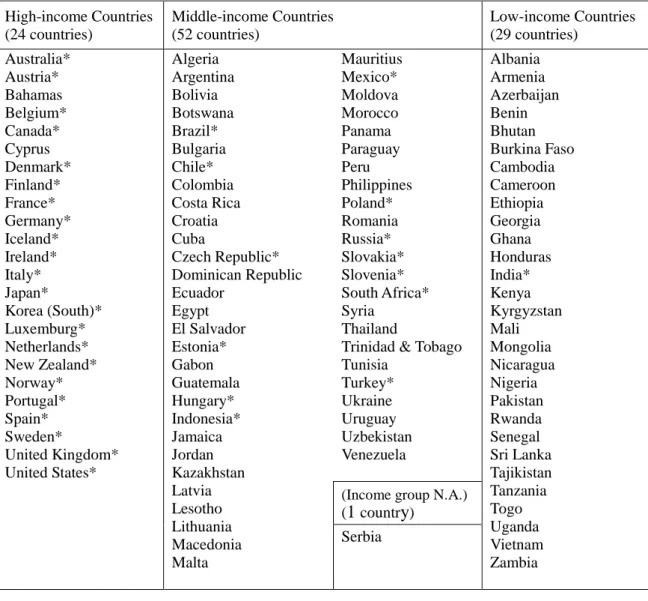
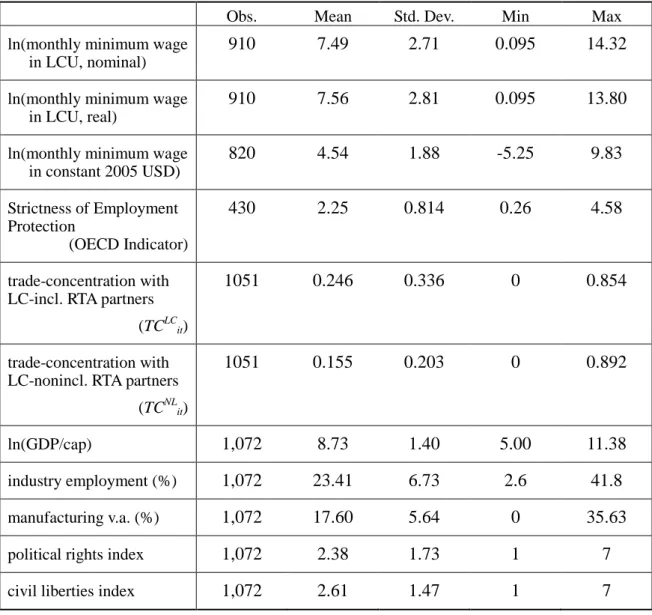
The dataset for the empirical analysis is constructed by combining the various data from different sources that have been described above. The constructed dataset covers 106 countries for the years 1995 through 2011 (but the observation periods are from only 1996 through 2011, since the earliest-period data for 1995 are used as lagged variables for the period of year 1996 or later). Table 2 lists the countries covered by the dataset, and Table 3 presents the summary statistics of the dependent variables (labor-standard measures) of the two empirical models, RTA trade-concentration indexes in the benchmark model, and other control variables in both models, contained in the dataset.
3 Estimation Results
3.1 Effects of RTA Trade on Labor Standards: Results of Estimation of Benchmark Model
3.1.1 Estimation with the Whole Sample
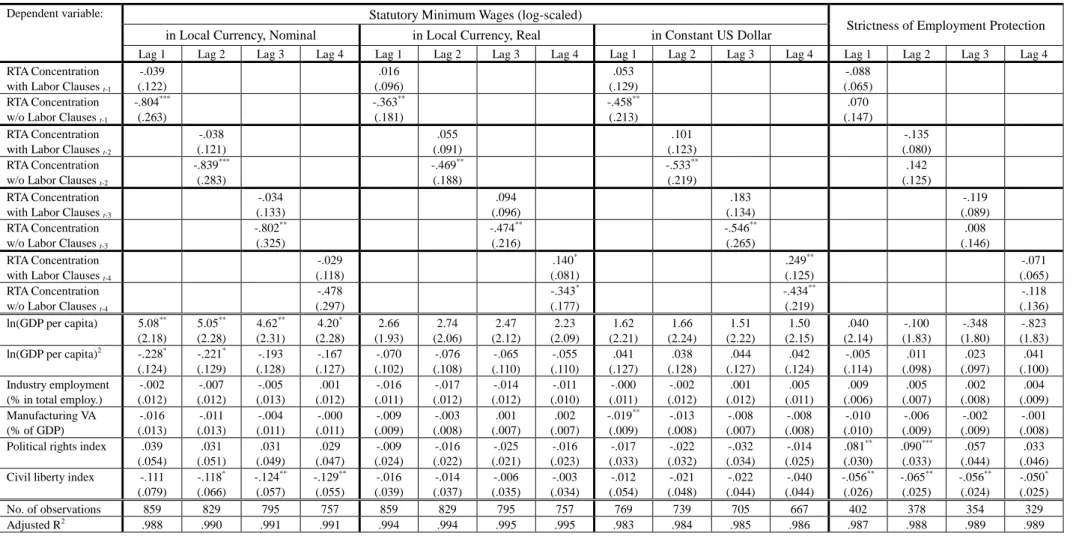
First, the benchmark empirical model Equation (1) is estimated using the fixed-effect regression. The results of the estimation are presented in Table 4. Numbers in parentheses are robust (clustered) standard errors of the coefficient estimates.
Statutory Minimum Wages
The second through thirteenth columns show the results of estimation for the three measures of statutory minimum wages. The first four of these 12 columns are for the local-currency nominal, the next four are for the local-currency real, and the last four are for the constant US-dollar versions of the minimum wages. In each group of four columns, the first column shows the result of the estimation with one-year-lagged
9
http://www.idea.int/. The Freedom House conducts the evaluation and rating for a country with an interval of a few to several years, and thus for each country there exist “non-surveyed years” for which updated indexes are not available. For these non-surveyed years, I have filled in the data in the following manner: the non-surveyed years are basically filled in with the indexes for the previous survey year; but the data in non-surveyed years are kept unfilled/missing when (i) the survey interval is significantly long, (ii) the scores/ratings are very different between the two survey years, or (iii) it is somewhat obvious that human-right condition of a country was affected by a significant political event that occurred in that country during a survey-interval period .
RTA trade-concentration indexes (TCs), the second shows the estimation with two-year-lagged TCs, the third is with three-year-lagged TCs, and the fourth is the estimation result with four-year-lagged TCs. The table shows a clear picture in the estimation result for any of the three minimum-wage measures: basically for any of the one- through four-year-lagged variables, the coefficient estimate on the trade-concentration index for RTAs without labor clauses (TCNL) is negative and statistically significant.10 This could be interpreted as that a country tends to lower its statutory minimum wage as the country has signed a labor-clause-non-inclusive RTA(s) with more and/or larger trading partners. The coefficient estimates indicate that, on average, as a country’s trade concentration with a partner(s) of labor-clause-free RTA increases by 1% (by signing a RTA with a new partner(s) or with a larger partner), the statutory minimum wage in that country will fall by about 0.8% in the nominal value or 0.5% in the real term. In contrast, the coefficient estimate on the trade-concentration index for RTAs with labor clauses (TCLC) is neither significantly positive nor negative in most of the cases, except for the cases of the real minimum wages in local currency (the 9th column) and US dollar (the 13th column) where the 4-year-lagged TCLC indicates a positive and significant effect on the minimum wage. These results should suggest that labor clauses could at least null/cancel the potential negative impact of labor-clause-free RTAs on statutory minimum wages.
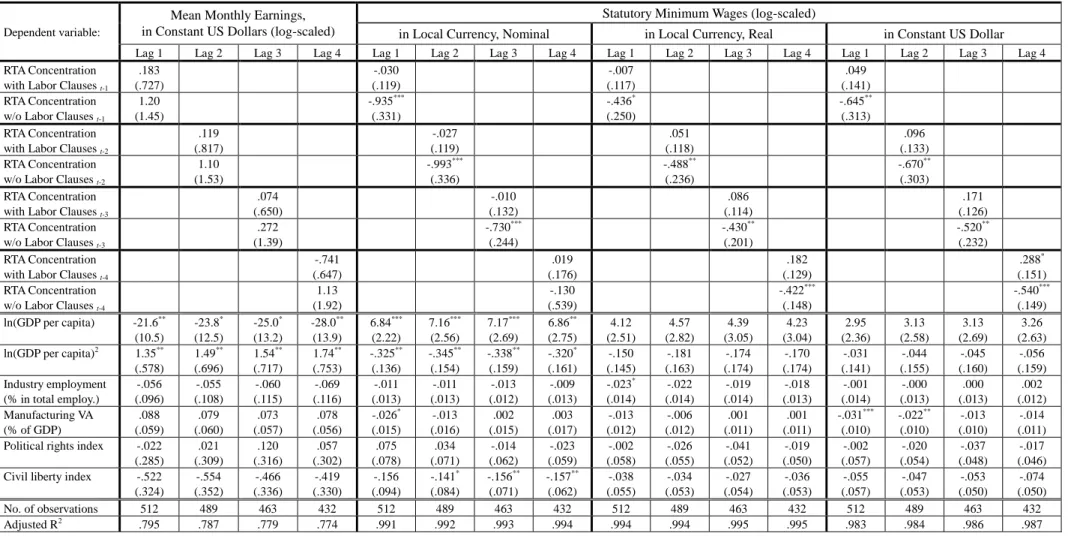
Statutory Minimum Wages vs. Actual Wages
The estimation result provided above demonstrates an interesting contrast with the empirical finding in my own other work (Kamata, 2016) in which no evidence have been found for positive or negative impacts of RTAs with or without labor clauses on
actual wages (labor earnings). To confirm this potential asymmetric impacts of RTAs
with and without labor clauses, I estimate the benchmark model for actual wages, and also (re-)estimate Equation (1) for the three measures of statutory minimum wages (measured in local currency nominal, local currency real, and US dollar real), using a “common” sample comprising observations for which data for both actual wages and statutory minimum wages are available. The data for (the log of) actual wages are sourced from LABORSTA,11 another on-line database by the ILO, and I take the reported values of the mean monthly earnings of manufacturing workers in the nominal
10
The only exception is the 4-year-lagged TCNL for the local-currency nominal value of the
minimum wage. Although the sign of the coefficient estimate is negative as in all other estimation, it is not statistically significant.
11
local currency unit and covert them to the real values in constant 2005 US dollars using the current market exchange rates (annual average) and the US GDP deflator reported in the World Development Indicators. As Table A1 presents, the findings are indeed (re-)confirmed through the estimation with the common sample. As shown in the last twelve columns of the table, the coefficient estimate on the trade-concentration index for labor-clause-free RTAs (TCNL) is negative and statistically significant for virtually all cases, and that on the index for labor-clause-inclusive RTAs (TCLC) is insignificant for any case. The sizes of these coefficient estimates are also very similar to those in Table 4. In contrast, the estimation for the actual wage gives no positive or negative significant coefficient estimates as shown in the second through fifth column of Table A1, implying that signing RTAs with more and/or larger partners would not have significant impacts on actually-paid wages. These empirical results overall may imply that (i) signing RTAs with more or larger partners would not bring a market pressure on wages regardless of whether or not the RTAs have labor clauses; but that (ii) signing labor-clause-free RTAs with more/larger partners might create some policy pressure onto the signatory government to maintain statutory minimum wages being low; while (iii) labor clauses in RTAs could alleviate such downward policy pressure on minimum wages created by RTAs.
Strictness of Employment Protection
The last four columns of Table 4 present the result of estimation of the benchmark Equation (1) for the OECD indicator of the strictness of employment protection. Unlike the case of the statutory minimum wages, the estimation shows no evidence for the positive or negative impacts of RTA trade on employment protection in terms of dismissal regulations, regardless of whether the RTA has labor clauses or not: the coefficient estimate on neither TCLC nor TCNL is statistically significant with any lag. A possible reason for the suggested no impacts of RTA labor clauses on the strictness of employment protection might be due to the fact that most labor clauses deal with the core labor standards such as child-labor prohibition and the FACB rights of workers or “decent work” in terms of wages and work hours, but do not directly deal with the employment protection regulations. Alternatively, it might be merely due to technical issues in estimation such as that the sample for employment-protection estimation concentrates on the OECD members and includes few non-OECD countries.
Notes on Other Control Variables
variables. First, although the estimation shows that a country’s income level is associated with the country’s statutory minimum wage in the nominal local-currency value, this positive association is not significant when the minimum wage is measured in real values.
Secondly, the estimation for the employment-protection index gives a negative and significant coefficient on the civil-liberty index, which should understandably indicate that more civil freedom is associated with stricter labor protection. However, the estimated coefficient on the political-right index is positive and significant, which should counter-intuitively indicate that a lower degree of political rights is associated with stricter employment protection.12 Although a possible reason for this puzzle should be worth examining, I leave it to future investigation to focus on the main theme of the current study: the impacts of RTA labor clauses.
3.1.2 Estimation with Samples Separated in terms of Country Income Groups
The policy effects of RTA labor clauses on the domestic labor standards can be different for countries in different income levels. For instance, labor clauses might not be so important when an RTA is signed between high-income countries that both have high labor standards, but labor clauses might be effective when an RTA is signed between a high-income country with high labor standards and a lower-income country with weaker labor standards. The estimation with the whole sample presented above can hardly capture such difference.
To analyze the potential difference in the impacts of RTA labor clauses for countries in different income levels, I extend the benchmark model and estimate it with separated samples for countries in different income groups. More specifically, the original Equation (1) is modified to the following Equation (1e):
LSit = α + ∑g∈{H,M,L} (β1,g TCLC,gi, t-a + β2,g TCNL,gi, t-a) + Xitγ + ui + Ttδ + εit (1e)
The partner-income-separated TC indexes are constructed as follows:
TCLC,git = ∑jN(RTALCijt × TradeShareij,1995 × Igj) for i ≠ j
TCNL,git = ∑jN(RTANLijt × TradeShareij,1995 × Igj) for i ≠ j
Index g = {H, I, L} indicates the income group of each country: H represents high-income, M represents middle-income, and L represents low-income country groups,
12
As mentioned earlier, the Freedom House’s political-right and civil-liberty indexes are scaled in a way that a smaller score means greater freedom.
respectively. The country income groups are classified according to the World Bank’s classification based on gross national income (GNI) per capita as of the year 1995: the country is high-income if its 1995 GNI per capita is $9,386 or above, middle-income if between $766 and $9,385, or low-income if $765 or below. The indexes Igj indicate the
income categories of the RTA partners for each country i: IHj = 1 when the country’s
RTA partner j is high-income (and = 0 otherwise), IMj = 1 when the RTA partner j is
middle-income, and ILj = 1 when the RTA partner j is low-income. Equation (1e) thus
includes six trade-concentration (TC) indexes: a pair of TCLC and TCNL for three income groups (high, middle, and low) of the RTA partners of each country i. This extended empirical model is separately estimated for three subgroups of the sample countries separated in terms of the income groups (high, middle, and low).
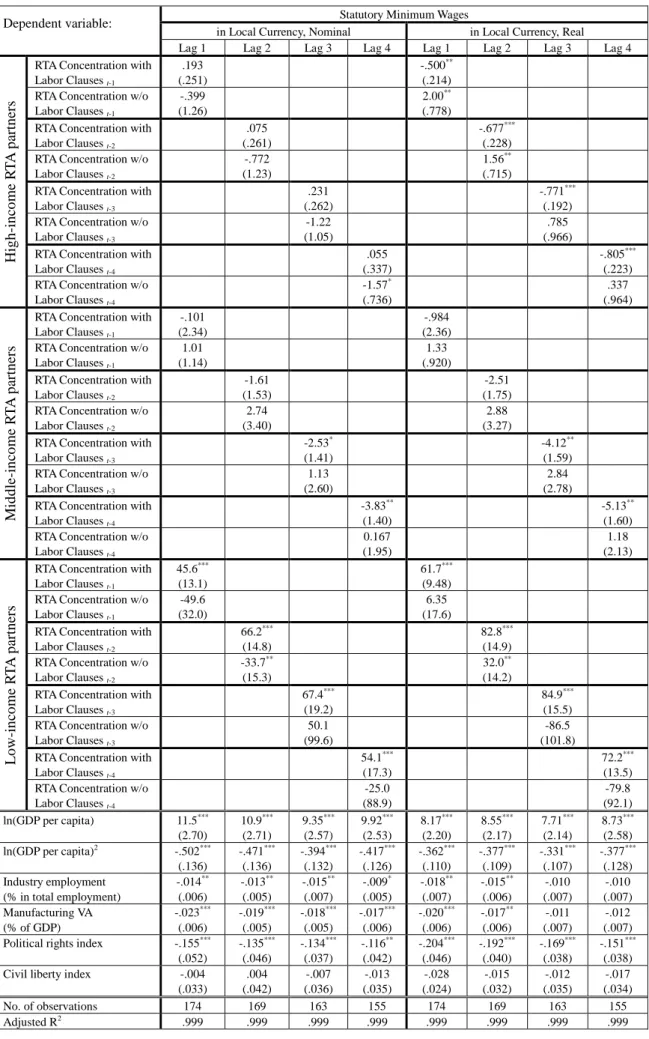
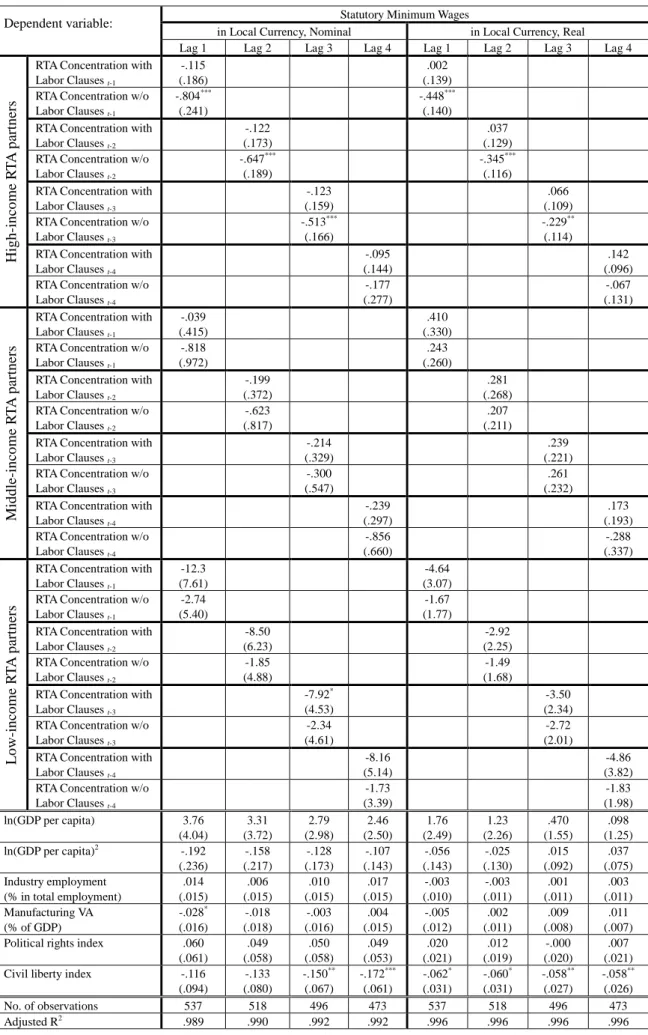
The estimation results of the extended model are presented in Tables 5 through 7: Table 5 shows the results for high-income countries, Table 6 shows the results for middle-income countries, and Table 7 shows the results for low-income countries. These results suggest an overall finding that the negative and significant impact of signing labor-clause-non-inclusive RTAs with more and/or larger trading partners on statutory minimum wages as well as labor clauses’ “nulling” or canceling effect against this negative RTA impact, which have been found through the whole-sample estimation, should mainly be driven by middle-income countries that sign RTAs with high-income partners (see Table 6, the first 8 rows for “High-income RTA partners”). For other cases such as high-middle or middle-middle country pairs, the estimated coefficients on the two RTA-trade-concentration indexes are mostly statistically insignificant or not consistent across the measurement units of the minimum wages. However, it should be noted that the estimation also gives a negative and significant coefficient on the TC index for labor-clause-inclusive RTAs consistently for high income countries with high-income partners (and for some cases with middle-income partners) for the real minimum wages (see the 6th through 13th columns of Table 5). Observing that many of the RTA with labor clauses are between high-income countries, this result might imply the possibility that in high-income countries, signing RTAs with more and/or larger trading partners creates a negative pressure on statutory minimum wages in the real term despite labor clauses in the RTAs, perhaps in a “passive” manner that the minimum wages are nominally maintained unrisen.13
13
The estimation also gives some significant coefficients on the TC indexes estimates for low-income countries, while the reliability of these estimates should be skeptical due to a limited-sample issue: among the RTAs dealt with in the current study, only one
From this set of the results of the pairwisely-income-separated estimation, we might be able to derive a finer picture about what the set of empirical findings based on the benchmark model imply: Signing RTAs with more and/or larger high-income trading partners would create to the governments of middle-income countries, which have a comparative advantage over the high-income partners in labor-intensive sectors, a downward policy pressure on statutory minimum wages, while labor clauses could alleviate such a negative policy effect of RTAs on minimum wages in middle-income countries.
In terms of the impacts on the strictness of employment protection, the results presented in Tables 5 and 6 indicate that the result of no evidence for positive or negative effects of RTAs on employment-protection strictness in the whole-sample estimation may be common for countries in different income groups.14 It should however be noted that, for the case of RTAs between high-income countries, the estimated coefficient on the TC index for labor-clause-inclusive RTAs is negative and significant (while the coefficient on the index for labor-clause-free RTATs is insignificant), as shown in the last four columns of Table 5. This is similar to the above-mentioned finding for real minim wages, and a similar possibility might thus be implied: i.e., in high-income countries, signing RTAs with more and/or larger trading partners creates a negative pressure, despite labor clauses in the RTAs, on employment-protection regulations perhaps in a passive manner that the regulations are maintained untighten. At the same time, the estimation also shows that the coefficient on the TCLC index is less negative and less significant with a longer lag, and this might imply that RTA labor clauses could have an improving effect on the strictness of employment protection slowly, reflecting time required for the governments to adjust the regulations to comply with the signed RTA labor clauses.
3.1.3 Estimation with Alternative Measures for RTA Trade-concentration Indexes
Finally, I estimate the benchmark model with the whole sample but using two different measures of the RTA trade-concentration indexes (TCLC and TCNL) to examine whether
labor-clause-inclusive RTA (CAFTA-DR) involves low-income countries (or, if following the ‘liberal’ RTA classification, four more labor-clause-inclusive RTAs involve low-income countries: CARICOM (2002 revised), EU-CARIFORUM States, New Zealand-China, and Nicaragua-Taiwan).
14
As indicated in the last four columns of Table 7, the sample for the current study includes no low-income-country observations valid for the estimation for the strictness of employment protection.
the construction of the TC indexes affects the estimation results.
First, I re-construct the TC indexes based on the ‘liberal’ definition of RTAs with labor clauses instead of the ‘conservative’ definition that has been employed originally, in order to see whether the definition of a labor-clause-inclusive RTA matters to the results of estimation. As described in a previous subsection 2.2.2 and shown in Table 1, the ‘conservative’ definition classifies 22 RTAs as labor-clause-inclusive RTAs while the ‘liberal’ definition adds nine other RTAs and classifies 31 as RTAs with labor clauses. The two RTA-trade-concentration indexes are re-computed accordingly and used to re-estimate Equation (1). The results are as presented in Table A2, and these results are almost exactly identical to the results of the original estimation presented in Table 4. The estimation results are not sensitive to the definition of labor-clause-inclusive RTAs, and thus the empirical findings presented earlier in subsection 3.1.1 should be robust to the classification of RTAs with labor clauses.
Secondly, I re-construct the TC indexes using the current-year share of RTA partners in a country’s total manufacturing trade, instead of the fixed share as of the year 1995 originally employed. The TC indexes are thus re-computed in the following manner (notice that the time script on TradeShare is now t, instead of the original “1995”):
TCLCit = ∑jN(RTALCijt × TradeShareijt) for i ≠ j
TCNLit = ∑jN(RTANLijt × TradeShareijt) for i ≠ j
The benchmark model Equation (1) is re-estimated using this alternative version of TC indexes, and the results are presented in Table A3. The results are not qualitatively different from those of the original estimation shown in Table 4, the statistical significance of the negative coefficient estimate on the index for labor-clause-non-inclusive RTAs (TCNLit) is now weaker, particularly for the real values
of statutory minimum wages. As mentioned earlier in subsection 2.2.2, this alternative version of the TC indexes can pick up the effect of post-RTA growth in trade with the RTA partners. Thus, the results of the original estimation (Table 4) and this re-estimation with the alternative TC measures (Table A3) together imply that what is crucial for the potential negative impact of labor-clause-free RTAs on a signatory’s minimum wages is may be the pre-signing size or importance of the RTA partners (as well as the number of signed RTAs and partners), and the negative policy pressure on minimum wages may not be intensified even though the significance of the partners of the already-signed RTAs increases. The results might rather suggest a possibility that
post-RTA growth in trade with the RTA partners could improve the minimum wages in the real term, which could mitigate the initial negative impact of signing a labor-clause-free RTA on the nominal (and real) minimum wages.
3.2 Results of the Estimation of the Second Model
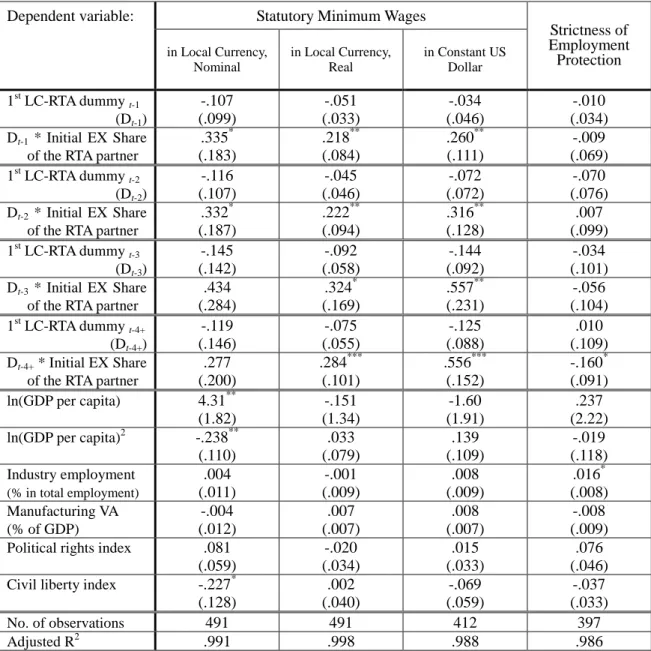
The estimation is also performed for the second empirical model expressed as Equation (2) that focuses on the importance of the first labor-clause-inclusive RTA for a country. Table 8 presents the results of the estimation through the fixed-effect regression. As in the previous tables, numbers in parentheses indicate the robust (clustered) standard errors of corresponding coefficient estimates.
The results of estimation for statutory minimum wages are shown in the second through fourth columns of the table. The estimated coefficient on the dummies indicating the timing of signing the first labor-clause-inclusive RTA (Dt-1 through Dt-4+)
are statistically insignificant for any measure of minimum wage or for any year dummy. On the other hand, the estimated coefficient on the product term of the first-RTA dummy and the size of the first-RTA partner(s) as the share in the country’s total manufacturing export is positive and significant consistently in almost all cases. This result might suggest that the first labor-clause-inclusive RTA for a country could have a positive effect on the country’s minimum wages only when that first RTA is signed with a large-market trading partner. In other words, the first labor-clause-inclusive RTA would not be very influential on the country’s minimum wages when the RTA is signed with a small partner or minor export market for the country. Finally, the result of the estimation for the strictness of employment protection that is shown in the last column of the table provides no evidence for the impacts of the first labor-clause-inclusive RTA on the signatory’s employment-protection regulations, which is consistent with the estimation result of the benchmark model that has found no evidence for the effects of RTAs with (and without) labor clauses on the employment protection strictness.
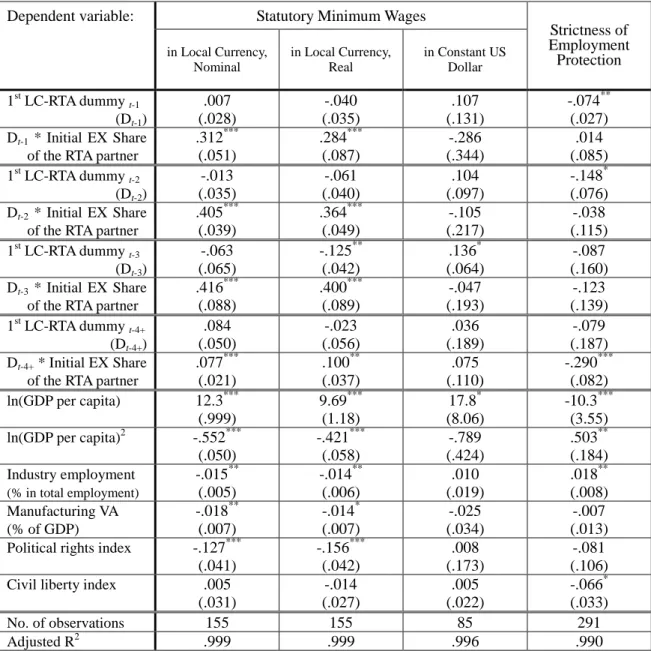
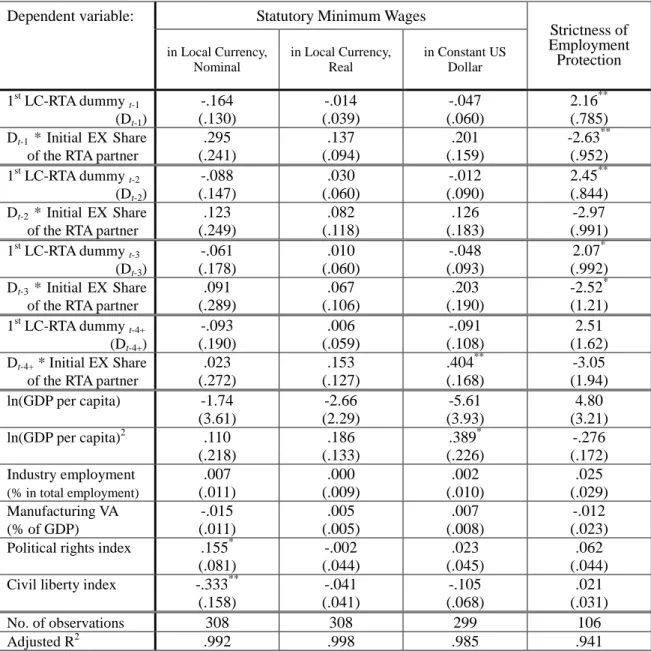
The impacts of the first labor-clause-inclusive RTA on a country’s domestic labor standards can differ across countries with different income levels. To analyze this potential difference, the second empirical model is also estimated with subsamples for high-income countries and middle-income countries.15,16 The estimation results for
15
The estimation results are not presented for low-income countries, as the current dataset contains no low-income-country observations valid for the estimation of the second model.
16
high-income countries are presented in Table 9 and those for middle-income countries are shown in Table 10. These two tables show that the above-mentioned results of the estimation with the whole sample for statutory minimum wages (i.e., insignificant coefficients on the timing dummies and positive and significant coefficients on the product terms of the dummies and the size of the RTA partner) should be driven by the high-income countries in the sample as shown in Table 9,17 and Table 10 indicates that virtually none of the coefficient estimates is significant for the middle-income countries. At the same time, these results might indicate other possibility on the interpretation of the empirical findings through the second model, which might be due to reversed causality: i.e., a high-income country whose statutory minimum wage is originally high(er) is less hesitant or more willing to sign a labor-clause-inclusive RTA even with a partner with large(r) market.18
As an overall message from these results of the estimation of the second empirical model, it should be fair to conservatively conclude that having one labor-clause-inclusive RTA by itself may not have significant impacts on the signatory’s statutory minimum wages or employment-protection regulations, and that it is not necessarily the first RTA with labor clauses that could influence on these labor standards in the signatory country.
4 Conclusion and Discussion
The current study has addressed the question of whether labor clauses in regional trade agreements or RTAs are effective to maintain or improve the domestic labor standards in the signatory countries. This study has empirically analyzed the effects of RTA labor clauses on two measures of the signatories’ domestic labor standards: statutory minimum wages and the strictness of employment protection. The impacts of RTA with
but not for the partners’, unlike the case for the benchmark model.
17
For the minimum wage in the real US-dollar value, however, no significant coefficients are found even in the estimation for high-income countries (see the fourth column of Table 9) although the coefficients on the product terms of the first-RTA dummies and the partner size are positive and significant in the estimation with the whole sample. This might be due to the small sample size (N = 85) in the high-income subsamples for the estimation.
18
For the employment-protection strictness, unlike the estimation with the whole sample or high-income subsample, the estimation with the middle-income subsample gives significant coefficient estimates on the first-RTA dummies (positive) and the product term of the dummies and the size of the first-RTA partners (negative). However, this may also be due to the small sample size (N = 106).
and without labor clauses as well as the trade presence of the RTA partners for a signatory have been estimated using the RTA classification proposed in my own previous study (Kamata, 2016) together with data on minimum wages and the indicator of the strictness of employment protection for a wide variety of countries for multiple years. The results show that having labor-clause-non-inclusive RTAs with more or larger trading partners are associated with lower statutory minimum wages although that negative association is not found for labor-clause-inclusive RTAs. The separate estimation for countries in different income groups further demonstrates that the above-mentioned results are chiefly driven by middle-income countries that sign RTAs with high-income partners. This should imply that signing RTAs with more or larger high-income trading partners would create to the government of a middle-income country, which has a comparative advantage over the high-income partners in labor-intensive sectors, a downward policy pressure on statutory minimum wages, while labor clauses could alleviate such a negative policy effect of RTAs on minimum wages in the middle-income country.This finding also exhibits an interesting contrast with the empirical finding of my preceding study in which no systematic relationship has been found between RTA-partner trade concentration and actual labor earnings regardless of whether or not RTAs include labor provisions. This potentially asymmetric effects of RTA labor clauses on statutory minimum wages and actually-paid wages have been reaffirmed through the estimation with a “common” sample, which should suggest that although signing RTAs with more or larger partners would not bring a market pressure on wages regardless of whether or not the RTAs have labor clauses, signing RTAs with more or larger partners could create some policy pressure onto the signatory government to maintain statutory minimum wages being low, unless the RTAs include labor clauses. Unlike this case of statutory minimum wages, however, the empirical analysis has found no evidence for positive impacts of labor-clause-inclusive RTAs or negative impacts of labor-clause-free RTAs on the strictness of employment-protection regulations in the signatory countries. It should also be noted that the empirical analysis has found some evidence for potential negative effects of RTAs between high-income countries on their domestic labor standards even in the case of RTAs with labor clauses.
To conclude the current paper, I discuss what could be done for further investigation of the current research question. One is to estimate the impacts of RTA labor clauses on the FACB rights of workers. As mentioned in the introductory section of this paper, some recent studies have pointed out a possibility of “races to the bottom” in the FACB rights of workers due to globalization, or a possible negative impact of
growing international trade or foreign direct investment on workers’ FACB rights. It should thus be valuable to extend the current empirical approach to investigate whether RTA labor clauses could prevent the possible deterioration of the FACB rights, which are included in the internationally recognized core labor standards to which a number of RTAs refer in their labor provisions. Another is to perform more detailed investigation of the function of RTA labor provisions in affecting the domestic labor standards in the signatory countries. This might be an important theme to explore, as Sari et al. (2016) points out that the effectiveness of RTA labor clauses could be different by the types of the provision. Considering restriction and difficulty in obtaining macro-level data for this theme, however, one feasible and hopefully promising approach could be a case study of a particular RTA with labor clauses that has relatively a long history, such as the NAFTA.
References
Brown, Drusilla K., Alan V. Deardorff, and Robert M. Stern (2011), “Labor Standards and Human Rights: Implications for International Trade and Investment,” IPC Working Paper Series No. 119, University of Michigan.
Davies, Ronald B. and Krishna Chaitanya Vadlamannati (2013), “A Race to the Bottom in Labor Standards? An Empirical Investigation,” Journal of Development Economics, 103, pp. 1-14.
ILO (2016), Assessment of Labour Provisions in Trade and Investment Arrangements, International Labour Organization, Geneve.
ILO (2017), Handbook on Assessment of Labour Provisions in Trade and Investment
Arrangements, International Labour Organization, Geneve.
Kamata, Isao (2014), “Regional Trade Agreements with Labor Clauses: Effects on Labor Standards and Trade,” RIETI Discussion Paper Series 14-E-012, Research Institute of Economy, Trade and Industry.
Kamata, Isao (2016), “Labor Clauses in Regional Trade Agreements and Effects on Labor Conditions: An Empirical Analysis,” IDE Discussion Paper No. 609, Institute of Developing Economies (IDE-JETRO).
Kucera, David (2002), “Core Labour Standards and Foreign Direct Investment,”
International Labour Review, 141(1-2), pp. 31-69.
Mosley, Layna and Saika Uno (2007), “Racing to the Bottom or Climbing to the Top? Economic Globalization and Collective Labor Rights,” Comparative Political Studies, 40(8), pp. 923-948.
Olney, William W. (2013), “A Race to the Bottom? Employment Protection and Foreign Direct Investment,” Journal of International Economics, 91(2), pp. 191-203.
Sari, Dora, Damian Raess, and David Kucera (2016), “Do PTAs Including Labor Provisions Reduce Collective Labor Rights Violations? The Role of Labor Cooperation Provisions,” mimeo.
Table 1. List of Regional Trade Agreements with Labor Clauses
(RTAs with * are included only according to the liberal classification.)
USA-Australia USA-Bahrain USA-Chile USA-Colombia USA-Jordan
USA- Korea (South) USA-Morocco USA-Oman USA-Panama USA-Peru USA-Singapore
North American Free Trade Agreement (NAFTA) USA-CAFTA-Dominican Republic (CAFTA-DR) Canada-Chile Canada-Colombia Canada-Costa Rica Canada-Jordan Canada-Peru
European Economic Area (EEA) EU- Korea (South)
Chile-Turkey
Trans-Pacific Strategic Economic Partnership (TPSEP or P4)
* EFTA-Hong Kong * EFTA-Montenegro * EU-CARIFORUM States
* Carribean Community and Common Market (CARICOM, 2002 revised) * Chile-China * Chile-Colombia * New Zealand-China * New Zealand-Malaysia * Nicaragua-Taiwan
No. of RTAs with labor clauses:
22 according to the conservative classification 31 according to the liberal classification
Notes:
1. RTAs with labor clauses are defined as RTAs, according to the conservative classification, that satisfy both of the following two criteria:
(i) The RTA has provisions that demand, urge, or at least expect the signatory countries to harmonize their domestic labor conditions and regulations with the internationally recognized standards such as the ILO’s “core” standards or an equivalent set of labor standards,
(ii) the RTA has an extensive set(s) of articles that stipulates the items/issues for which the signatory countries shall cooperate and the procedures for consultations and/or dispute settlement on issues concerning labor conditions, as a part (chapter(s) or title(s)) of the main body of the RTA or a separate side agreement or MOU.
RTAs with labor clauses under the liberal classification are those that satisfy the criterion (ii). (This classification includes the RTA with * in the list above, which satisfy (ii) but not (i).) 2. The labor-clause-inclusive RTAs listed above are classified from the population of 223
RTAs that had entered in force and are notified to the WTO as of July 2013. The Generalized System of Preferences (GSP) are not included in the RTA populations.
Table 2. Countries in the Data for Empirical Analysis (106 countries) High-income Countries (24 countries) Middle-income Countries (52 countries) Low-income Countries (29 countries) Australia* Austria* Bahamas Belgium* Canada* Cyprus Denmark* Finland* France* Germany* Iceland* Ireland* Italy* Japan* Korea (South)* Luxemburg* Netherlands* New Zealand* Norway* Portugal* Spain* Sweden* United Kingdom* United States* Algeria Argentina Bolivia Botswana Brazil* Bulgaria Chile* Colombia Costa Rica Croatia Cuba Czech Republic* Dominican Republic Ecuador Egypt El Salvador Estonia* Gabon Guatemala Hungary* Indonesia* Jamaica Jordan Kazakhstan Latvia Lesotho Lithuania Macedonia Malta Mauritius Mexico* Moldova Morocco Panama Paraguay Peru Philippines Poland* Romania Russia* Slovakia* Slovenia* South Africa* Syria Thailand
Trinidad & Tobago Tunisia Turkey* Ukraine Uruguay Uzbekistan Venezuela Albania Armenia Azerbaijan Benin Bhutan Burkina Faso Cambodia Cameroon Ethiopia Georgia Ghana Honduras India* Kenya Kyrgyzstan Mali Mongolia Nicaragua Nigeria Pakistan Rwanda Senegal Sri Lanka Tajikistan Tanzania Togo Uganda Vietnam Zambia
(Income group N.A.)
(1 country) Serbia
Notes:
1. The numbers of data years are different for different countries, ranging from 1 to 16 of the entire 16 time points (between years 1996 and 2011, with lagged variables).
2. Countries with asterisks (*) are those included in the data for estimation for the strictness of employment protection (36 countries).
3. Income groups are based on the World Bank’s income classification as based on the country’s gross national income (GNI) per capita as of 1995, defined as follows:
High income: $9,386 or more
Middle income: $ 766 to $9,385
Table 3. Summary Statistics for Variables in Benchmark Model; for observations valid for the estimation
Obs. Mean Std. Dev. Min Max
ln(monthly minimum wage in LCU, nominal)
910 7.49 2.71 0.095 14.32
ln(monthly minimum wage in LCU, real)
910 7.56 2.81 0.095 13.80
ln(monthly minimum wage in constant 2005 USD) 820 4.54 1.88 -5.25 9.83 Strictness of Employment Protection (OECD Indicator) 430 2.25 0.814 0.26 4.58 trade-concentration with LC-incl. RTA partners
(TCLCit)
1051 0.246 0.336 0 0.854
trade-concentration with LC-nonincl. RTA partners
(TCNLit)
1051 0.155 0.203 0 0.892
ln(GDP/cap) 1,072 8.73 1.40 5.00 11.38
industry employment (%) 1,072 23.41 6.73 2.6 41.8
manufacturing v.a. (%) 1,072 17.60 5.64 0 35.63
political rights index 1,072 2.38 1.73 1 7