A Socio-Economic
Analysis
of Mangrove
Degradation
in Samoa
Juliet Mavis BOON
Graduate Student, Geography Department, Ochanomizu University, Bunkyo, Tokyo 112-8610, Japan
Abstract: Urbanization and monetization systems have contributed to the reclamation and exploitation of mangroves, which have had some significant effects on the livelihood of those who rely on it. Informal uses of mangroves have received very little attention because they do not contribute to national revenue, and the inextricably linked effects of urbanization and monetary systems on mangrove degradation is lacking. The purpose of this study is to examine the socio-economic impacts of development on mangrove ecosystems and those who depend on it in four coastal villages of Samoa. Fifty households' questionnaire-assisted interviews were conducted first, to provide the social, cultural and economic value of man groves to the local inhabitants. Second, to identify activities that have changed mangrove ecosystems, and then, to examine how these activities have changed the local inhabitants' social, cultural, and economic relationships with their environment. Findings suggest that, in two cases, land reclamation has strictly and seriously degraded mangrove resources particu larly in terms of marine food supplies. For two other cases, increased accessibility to town and the monetization of the rural economy are also factors involved in the decline in quantity and size of fish catch due to the increasing reliance on sales of mangrove food resource for cash. This study supports the position that modern developmental initiatives must be carefully monitored to ensure that they do not undermine the social and economic well-being of resident communities, particularly in areas such as Samoa where a large proportion of the population relies on land and marine resources for their survival.
Key words: mangrove degradation, coastal reclamation, socio-economic analysis, Samoa
Introduction
Within the last two decades, the status of mangroves has elevated so rapidly that it has gained public attention in the face of a per ceived impending global environmental crisis. Manifestations of this concern include exten sive studies on Southeast Asian mangroves by Aksornkoae et al. (1986), Ajiki (2000), Ong (1982), and in the Pacific by Lal (1983), Thaman and Ravuvu (1989), and Thaman (1994). Most of the studies revealed that mangroves possess a very important function, which extends far beyond the geographical immediate areas they occupy, not only in sustaining their physical environments but also the human populations. Contrary to this view, the case studies do not reflect the consequences of mangrove degrada tion in the case of Samoa. Furthermore, infor mal uses of mangroves have received very little attention because they do not contribute to national revenue, and literature on the effects
of urbanization and monetary systems being conducive to mangrove degradation is lacking.
Pressures on mangrove forest areas are often great because they may appear to be relatively low-cost sites for construction through recla mation for a variety of facilities as discussed by Kunstadter (1986). Problem in assessing the costs and damage control in the mangroves may be difficult because the consequences are often geographically and socially remote from the places where the decisions are made and the environmental interventions take place. In effect, development strategies encouraging mangrove destruction through reclamation cre ates poverty among those who are overlooked but whose social, cultural, basic subsistence and economic livelihood is dependent on these eco systems. This is what the author regards as inappropriate development.
At the turn of this century, impact studies concerned with social, cultural and economic effects due to over-fishing in mangroves or con version of mangroves to other land uses are
160 J. M, Boon
addressed and confined only to public symposi ums with intentions to discuss sustainable measures of mangrove use.1 Recognizing that the impacts of the decrease in mangrove forest will lead to flooding-affecting development projects-and a decline in fish catches, timber, firewood and charcoal production, it is not sur prising that they are only evaluated as being economically devastating to national economic returns. Redclift (1987: 49) argues that it should be remembered that those who are con cerned with the fixed limits of resources are the ' urban bureaucrats' who are more concerned at the cost to the quality of their life posed by flooding, pollution, industrial waste, food pov erty, and particularly profit reduction.
Just recently, in Teruya and Kishimoto (2000) for instance, reafforestation schemes are pro moted because Thailand mangrove forests has decreased due to over-logging for charcoal and firewood production, and conversions into shrimp cultural ponds and tin mining. Fleeting references were made to those informal socio economic variables without monetary value, which are always indiscriminantly misrepre sented in these formal figures. Furthermore, exploitation and conversion of mangroves by capitalists are promoted by government public policy as in the Southeast Asian cases (Aksorn koae et al. 1986; Ajiki 2000; Ong 1982). Pursu ance of economic development poses a contra diction to sustainable development as ex pressed at the symposiums.
Symposium documents as such, adequately review the promotion of economic development through deforestation and conversion of man grove forests, which is the principal factor be hind mangrove degradation particularly in Southeast Asian countries. Therefore, inade quate studies attribute mangrove destruction to be inextricably linked to the forces and the global expansion of urban and monetization systems. As Redclift (1987: 4) puts it `the envi ronment has suffered more neglect at the hands of social scientists than any other comparable subject.' In the absence of theoretically refined work on environmental issues, when geogra phers enter the field, they have been content simply to collect data, and to provide criteria for land use classification. Thus, available stud
ies on impact on mangrove environment are divorced from social and economic theory. Evi dently, mangrove literatures are abundant, from physiological, taxonomical, geomorpho logical nature to biogenic researches exten sively conducted by Chapman (1976), MacNae (1974), and Saenger et al, (1983), and in the case of Samoa, Nakamura (1992), Liu (1992), and Taule'alo (1993). Studies concentrating on so cio-economic impacts have been limited and therefore academics' contribution in minimiz ing mangrove destruction has made little pro gress.
On a more optimistic note, attempts at dis cussing how ecologically destructive it is to convert mangroves through aquaculture eco nomic ventures have been conducted in Malay sia by Ong (1982). One attribution to this is the reconnaissance of ecological theoretical para digms, which has given rise to environmental, social, cultural, spiritual, and economic vari ables in relation to the survival of natural eco systems in synergy with humans, likewise, the importance of mangrove ecosystems to those who depend on it. Studies conducted within these parallels include Thaman (1994), Thaman and Ravuvu (1989), Olson (1997), and Bird (1986) within the Pacific, and Silva (1986) in Sri Lanka. An impact research study on particular social, cultural and economic aspects in relation to the converted land uses of mangroves upon the lives of those who dwell in and live from them is needed to clarify these relationships. In considering the absence of an adequate method ology in the literature reviewed above, it is only appropriate that at this point in time an evalua tion of how mangroves can be recognized as a beneficial and important ecosystem to the live lihood of the coastal communities be under taken. Following this, an assessment is pro vided on the residents' socio-economic effects on areas where development activity has oc curred, degrading mangrove areas.
The basis of this research can be a methodo logical means of showing how developers should manage and conserve mangroves for the well-being of the indigenous people who rely on them. Cox and Elmqvists (1982) argue that this is a way towards sustainable social, economic and environmental development. The purpose
of this study is to provide an analysis of man
grove degradation in four coastal villages of Upolu Island in Samoa: Pata, Sataoa, Vaitoloa, and Fugalei. Development activities have been undertaken without prior assessment of their
potential impact on the mangroves, therefore the author hypothesizes they have effects on
the livelihood of mangrove-dependent commu
nities. Mangroves' natural ecosystems will be
proved as an important foundation for the so cial, cultural, and economic activities of coastal
communities. In transforming mangrove eco
systems through modern activities, and in pol
luting them, villages' livelihood becomes
threatened. Since Samoa is not well endowed with mangroves, it is imperative to identify the social and economic importance of mangroves to the Samoans and then to evaluate and under stand the effects of deteriorating mangrove eco systems so as to minimise further destruction.
Background to Samoa
Location, population, and landf orm
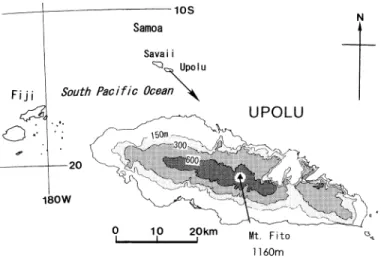
Samoa, which forms part of the Samoan vol canic archipelago, lies in the South Pacific Ocean (Figure 1). The total land area is approxi mately 2,800sq km and its two main islands are Savaii and Upolu. In 1991, Samoa had a popu lation of about 160,000 residing mostly on Sa vaii (45,000) and Upolu (116,000) where the
capital of Apia is located (GWS 1991a). Eighty percent of Samoan land is customary owned, while only fifteen percent is private land. The remaining land is government owned (GWS
1990).
Geologically, Samoa is relatively a young vol canic island country controlled by five distinct volcanic episodes (Wright 1962). Each episode has produced extensive lava flows cascading seaward from high volcanic cones character ized by Upolu's central highlands, which gradu ally decline towards the coast. Upolu is densely populated particularly on these fertile and flat coastal areas, where swamp and mangrove communities are a common feature in drowned valleys and barrier impounded river/stream mouths. The high population density of about 742 person per sq km, along the coastline, has placed increasing pressure on coastal areas for the destruction and reclamation of mangroves for residential housing, road expansions, build ings, industries, and businesses (Taule'alo
1993).
Climate, soils, and vegetation
Southeast trade winds, specifically dominant atmospheric circulation features of the South Pacific Convergence Zone (SPCZ), makes Sa moa's climate generally hot and wet through out the year (Curry 1962). Average annual rainfall varies from 2,500mm to over 6,000mm in the highlands, while mean annual
tempera-Figure 1. Location and relief map of Samoa.
162 J. M. Boon
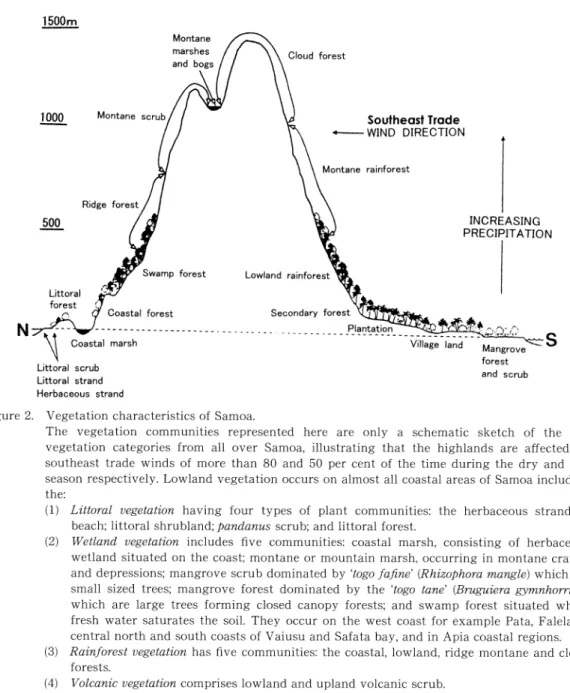
Figure 2. Vegetation characteristics of Samoa.
The vegetation communities represented here are only a schematic sketch of the five vegetation categories from all over Samoa, illustrating that the highlands are affected by southeast trade winds of more than 80 and 50 per cent of the time during the dry and wet season respectively. Lowland vegetation occurs on almost all coastal areas of Samoa including
the:
(1) Littoral vegetation having four types of plant communities: the herbaceous strand or beach; littoral shrubland; pandanus scrub; and littoral forest.
(2) Wetland vegetation includes five communities: coastal marsh, consisting of herbaceous wetland situated on the coast; montane or mountain marsh, occurring in montane craters and depressions; mangrove scrub dominated by 'togo fafine' (Rhizophora mangle) which are small sized trees; mangrove forest dominated by the 'toga tane' (Bruguiera gymnhorriza), which are large trees forming closed canopy forests; and swamp forest situated where fresh water saturates the soil. They occur on the west coast for example Pata, Falelatai, central north and south coasts of Vaiusu and Safata bay, and in Apia coastal regions. (3) Rainforest vegetation has five communities: the coastal, lowland, ridge montane and cloud
forests.
(4) Volcanic vegetation comprises lowland and upland volcanic scrub. (5) Disturbed vegetation
Source: Adapted from Taule'alo (1993: 13).
tares range from 20 to 30 degrees Celsius at the coast. A distinctive dry season appears from May to October, and two major cyclones within the last decade have caused widespread de struction in Samoa in the rainy season. The cyclone damages have had disastrous effects on loss of biodiversity for some period of time within the conservation areas, catchments and have resulted in increased soil and coastal ero
sion on reef and lagoon systems, including man
groves (SPREP/EAJ/OECC 1993).
Soils of Samoa are formed from basalt, most of which are generally clay in texture, free draining and relatively shallow (Wright 1962). In the coastal areas, marsh soils are not exten sively found in Samoa, but where they occur they are inundated by sea at high tide, which supports mangrove forests such as those on
Upolu.
Whistler (1992) categorised six vegetation types illustrated as in Figure 2: littoral, wetland, rainforest, upland scrub, volcanic, and disturbed vegetations. Mangrove scrubs and forests are part of the wetland community dominated by the Togo fafine (female mangrove) or Rhizo phora mangle and the Togo tane (male man grove) or Rruguiera gymnorrhiza. Although it has been stated that much of the mangrove ecosystems had been disturbed by human ac tivities, an accurate estimate of the total area that has decreased over the last century is un available, which is a manifestation of its negli gence.
Social economic situation
Like many South Pacific Island nations, Sa moa has endeavoured, since independence, to develop a modern economy and to diversify from traditional village agriculture and pri mary products. However, seventy to eighty percent of Samoa's population are still rural based and rely upon a subsistence lifestyle (GWS 1990). Primary economic resources in rural villages include; fish and shellfish caught in lagoon, reef and mangrove areas; coconuts, bananas, yams and breadfruit from plantations; domestic animals; and other produce from household gardens, with the majority of re sources harvested by villagers becoming part of the village subsistence economy (GWS 1990; Fairbairn 1993). The balance of the primary resources is sold in Apia, forming part of the cash economy (Zann 1991).
The significance of the primary sector is shown by the fact that related activities ac count for 50% of the Gross Domestic Product (GDP), 60% of the workforce, and 80% of export earnings of the national economy (World Bank
1991). In this respect, Samoa, since European contact, is no longer a society of self-sufficient local units (Meleisea 1988). Imported food and other items are now established as basic house hold necessities. These changes are reflected in the way locals use the mangroves for both sub sistence and for earning cash. Cash income is used to purchase some of what are now basic necessities such as soap, sugar, tea, flour and other foodstuffs.
The Status of the Mangrove Environment in Samoa
The mangrove ecosystems of Samoa
Samoa mangroves are at the eastern limit of the Indo-Pacific mangrove distribution and are confined to a few suitable places where sand spits cut off stretches of shore and terrigenous sediments accumulate in swamps, or in shel tered rivers and stream mouths in the coastal areas of Upolu (Lafaele 1993; Park et al. 1992; Vodonaivalu (undated); Whistler 1992). There are two dominant mangrove species-Rhizo phora mangle grows at the seaward edge with
canopies ranging from 5 to 10 metres, and Rru guiera gymnorrhiza is more common inland and grows up to 15 metres or more (Sasaki 1992). Other exclusive mangrove related species are appended in detail in Vodonaivalu (undated), Whistler (1992), and Lafaele (1993).
Within the two large mangrove areas of Vai usu Bay and Sataoa-Saanapu of Safata Bay, Thollot (1993) found thirty-five species from about twenty-two families, predominantly mul let catches of Liza melinoptera. In Sataoa Saanapu, there were five dominant species Chanos chanos, Therapon jerboa, Caranx papuen sis, Upeneus vittatus, and Liza melinoptera. These species have also been commonly re corded in mangroves of other South Pacific countries such as Vanuatu, Fiji, New Caledonia, and American Samoa.
Mangrove utilization and modification
Mangroves provide; food; firewood and char coal; timbers for boats, poles for fish traps, pipes, and tool handles; dye and tannin; and medicinal herbs for the local inhabitants (GWS 1994; Thaman 1993; Whistler 1996). However, Samoa's mangrove environments are undergo ing considerable modification which threaten the elimination of mangroves for traditional uses (Nakamura 1992). As early as the 1960s, Cumberland and Fox (1962) reported mangrove deforestations and reclamation for settlements, while Richmond (1991) recorded the reduction of almost all mangroves due to harvesting by local inhabitants for firewood use. East of Apia, at Moataa, a major portion of its mangroves
164 J. M. Boon
was also reclaimed in the early seventies for the purpose of constructing a major hotel (Polu 1994). The area is now barren and deserted, and in a FAO/UNDP fisheries survey by Zann (1991), this reclamation resulted in a rapid de cline in mullet (anae) finfish catches, which the local inhabitants relied upon as a major source of food. A more important effect has been the loss of the mangroves as a barrier from cy clones and destructive storm surges.
According to Liu (1992), about five percent of Vaiusu mangrove area has also been converted to other uses and most of the remaining stands are severely disturbed by adjacent and on-site land use conversion, rubbish disposal and con sequent pollution. Furthermore, the second largest Government expenditure is in infra structure improvement such as road construc tion in which mangroves situated along the coasts are destroyed to build roads, evidenced by the main road running from Apia to all inland areas (GWS 1992; SPREP/OLSS 1993). The destruction has encouraged widespread erosion on the coastal areas through direct wave attack, shoreline adjustment, sand mining and poorly designed sea walls (Zann 1991).
In view of the significant role that mangrove communities have on coastal productivity, it is clear that one of the main reasons for the low fish yield (28kg/ha/yr) of the urban reefs of Upolu is the indiscriminant development and degradation of associated urban mangroves. Given the small community and limited range of species of mangroves, the destruction of these ecosystems will be economically devas tating, given that seventy to eighty percent of the population still rely on fish as a source of protein (Zann 1991; GWS 1991b).
Growing awareness of mangrove degradation
and its effects
Despite low population growth of about 0.6%, limited industrial and mining activities on Upolu, signs of mangrove deterioration are progressing. Early in 1994, public concern was expressed in a petition signed by over 800 con cerned residents and environmentalists' soci ety, Siosiomaga Society (Polu 1995: 13). The petition, which called for a halt to the develop ment and destruction of the mangrove swamps,
was ignored. Fugalei region proceeded to be subdivided and sold with plans to construct a road through Vaitoloa in Vaiusu Bay to serve the anticipated settlers on the new subdivision.
Land lying below high water mark, including mangroves is public or government owned land and this gives them the authority to halt the destruction or construction that is taking place. Yet, instead of ordering the cessation of large scale reclamations in the Fugalei regions, the government declared the Sataoa-Saanapu man groves as a reserve. This region is susceptible to low levels of degradation whereas the de struction at Fugalei is intense. In fact, the Sataoa-Saanapu conserved mangrove area is a follow up of a local environment Conservation Area Scheme funded by the Global Environ ment Facility under the South Pacific Regional Environment Programme in Apia as a South Pacific Biodiversity Conservation Programme. This scheme, administered by the Lands and Environment Department, is to preserve the mangroves' biological diversity as attested by the World Convention on conserving Biological Diversity at the Earth Summit, in Brazil, 1992. The government, being more interested in fuel ling economic growth, extended this agenda to capitalise on the project by developing the area as part of an eco-tourist project for the Samoa Visitors Bureau. It was considered that in this way, attempts to preserve mangroves could also generate income for the local inhabitants.
Other attempts at inculcating awareness of the importance of mangroves are already pro gressing. Colourful posters published by the SPREP are available as educational resources for primary and secondary schools, to support environmental education agendas incorporated into the social studies and geography curricula. Strangely, despite these concerns, planned schemes to destroy mangroves are increasing. There is a need to review environmental legisla tions regarding mangroves otherwise they will always be vulnerable to any form of exploita tion.
So far, efforts toward conserving mangroves are currently merely token gestures purporting to participate in the international awareness of the fragility and preciousness of the environ ment. Genuine efforts at protecting the
man-grove environment can be carried out if only
those in positions of power empathize with
those whose lives are dependent on the man groves. Making an inventory of the country's mangroves is not enough. Thus, if the elimina tion of mangroves continues, sustainability and survival of subsistence societies like Samoa will seriously deteriorate and poverty levels will increase. The importance of understanding the
impact of development on the mangrove eco
system cannot be overstated since it is the first
step in working towards minimising their de
struction.
Method of the Study
Surveyed locations
The areas selected for this study have the largest mangrove concentration, but ones which are susceptible to destruction and exploi tation. Selection of Fugalei and Vaitoloa sites was based on the need to find out if such devel opment related projects have had adverse effects on the local community. They were then compared to areas of Sataoa and Pata with relatively limited mangrove destruction. Each of these villages has experienced different lev els of degradation as outlined in Table 1.
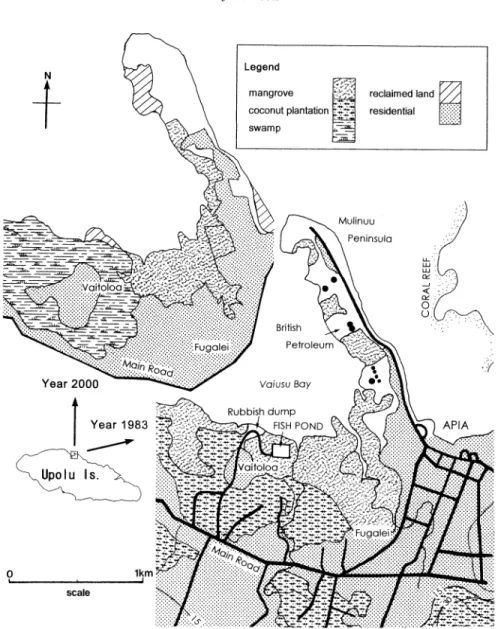
Fugalei, which lies in the heart of Apia, re flects mangrove degradation resulting from land reclamation into increased residential and commercial settlements in the transforming pe riods from years 1983 to 2000 in Figure 3. Most of the settlements are now turning into shanty towns, and there is flooding due to obstruction of the mangroves through landfill for the new commercial activities. The relocation of the new market recently has led to health hazards from the overflow of septic tanks (Polu 1995). According to the leader of the Siosiomaga Soci ety, an environmentalists' group, these prob lems are evident of improper planning on the part of the local authority (To'o 1996).
In the same vein, Vaitoloa is an area sub jected to various forms of pollution. In the early 1970s, it was a refuse and waste disposal site for the urban residents of Apia, and pollu tants flowing from the Vaitele industrial sites. A fishpond had started but was abandoned.
Although the dump is closed to further dump ing, by reclaiming it as shown in Figure 3, secondary growth of different plant species are currently colonizing and depleting the man
grove area, thus changing the breeding
grounds for marine organisms that use to grow and live there. Vast swamps have also capti vated the area and settlements have grown spo radically.
Conversely, Pata is a rural site subjected to limited degradation but was selected to provide an assessment of the full potential of an undis turbed mangrove area therefore there are no alterations in terms of the areal extent of man groves in these two areas as depicted by Figure 4. Sataoa mangrove site is an eco-tourist re serve established in the early 1990s.
The respondents and questions
Interviews in Samoan language and a recon naissance survey were conducted on the most experienced fishers in the village, chosen in the course of casual conversation, during a house to-house survey about the role mangrove play in their lives. Selection of the respondents was acquired from asking 'who are the best fisher men in the village?' Most of those fishermen referred to by the contacts were the elderly people and the heads of the households known as matais or chiefs who were thought reliable in the provision of the responses. Selection of the best fishers is an approach that is deemed ef fective by other scholars. Johannes explicitly stated that "for the marine environment of the tropical Pacific Islands it is the local fishermen who possess this knowledge" (1982: 258). Local fishermen's traditional knowledge and skill "constitute an encyclopedic reservoir of practi cal sea lore of a stupefying richness" (P. ®ttino and Y. Plessis (1972) quoted in Johannes (1982). Kundstadter (1986) also observed that if man groves deteriorate, it will be the fishermen, not the mangrove developers, who suffer directly from the loss of spawning grounds of the man groves areas, converted for economic gains. However, some of the other family members interviewed had some contact with the man groves through other mangrove-related activi ties. This approach of using traditional knowl edge facilitated the identification of appropriate
166 J.M. Boon
Figure 3. Mangrove distribution in the study areas of Vaitoloa and Fugalei, Upolu Island, Samoa in 1983 and 2000.
Source: Map 1983 was adapted and compiled from N. Z. M. S 174.3rd edition, May 1983. Published by Department of Lands and Survey, Government of Western Samoa by arrangement with the Surveyor General of New Zealand. Map 2000 was adapted and compiled from Topographic Map Samoa-U1 Upolu West. Published by Lands, Survey and Environment. Apia, Samoa.
Table 1. Activities influencing different levels of degradation in the selected study villages of Pata, Sataoa, Vaitoloa, and Fugalei of Upolu Island in Samoa
a: available na: not available
Figure 4. Mangrove distribution in the rural study areas of Pata and Sataoa, 2000.
Source. Compiled and adapted from Topographic Map 2000 of Samoa-U1 Upolu West. Published by Lands, Survey and Environment, Apia, Samoa.
subjects who had either current use of the man groves, or have had some interaction with the mangroves sometime in their lifetime, even if they no longer have the use of it.
This study, which was conducted in Decem ber 1995 to January 1996, was largely based on a survey of the behavioural responses of people in relation to mangrove degradation and other uses. In the sites, fifty households were sur veyed and in the urban mangrove villages of Fugalei and Vaitoloa a higher proportion of fifteen households were investigated since they were the major mangrove areas affected by urban development, through reclamation, be lieved to be the main factor causing mangrove destruction. Ten respondents were interviewed from the rural areas of Pata and Sataoa, as sumed unaffected by development, and serving as a means of control for the purpose of this study. The questions asked were categorised in the following three sections of A, B, and C de scribed below.
Section A involved the respondents' sources or means of income, investigated to identify the degree of reliance of the respondents in the selected mangrove sites. This represents what Walsh (1996) terms 'background information.'
Questionnaire-assisted interviewing was con ducted through casual or informal conversation (on a one-to-one basis) in the vernacular tongue of the respondents.
Section B concerned the respondent's knowl edge of the activities relating to the utilisation of the mangrove and an analysis of the changes that may have existed in the times devoted to these uses. Information gathered was also based on the knowledge of the finfish and non finfish species found in the mangroves. The proportion of catches sold or distributed, and changes that have occurred, changes in average catch in finfish and non-finfish organisms found in the mangroves, and changes in abundance or size of these products were also collected. De
velopment-related activities, which have
affected these uses in a negative or beneficial way as imposed on the people and the man groves were also queried. It was hoped that the responses to these questions would provide a picture of the impacts of mangrove reclamation and other development on the livelihood of the villagers.
Section C included an open-ended query on any further comments or opinions of the re spondents regarding the mangroves and
devel-168 J.M. Boon
opment related activities.
Results and Discussions
Residents' awareness of mangroves
Since on average 54% of the respondent no longer use the mangrove resource, the focus here is to discover the reasons for non-use and the extent of these relative to the socio economic and cultural activities supported by an undisturbed mangrove environment. The following were the residents' awareness of the importance of mangroves elicited through the uses they perceived as beneficial to their envi ronment.
Beneficial functions of the mangrove ecosys
tem
The result in Figure 5 illustrates that the villagers living in and around the mangroves recognised at least seven distinct functions of mangroves that are beneficial to the commu nity as a whole in Samoa. Relative importance of a use was estimated by comparing its fre quency of being cited as important by the total number of respondents.
Cyclone and wind barrier All the Sataoa and Pata rural respondents and some of the Vaitoloa residents (28%) viewed that the most
important function of the mangroves was the reduction of damage to settlement by cyclones, harsh waves, strong winds and storms. The mangroves' location at the interface of the land and sea protects homes, crops, vegetable gar dens and livestock. This function was strongly emphasised by all Pata villagers, who claimed that they were spared the ravages of cyclones and strong winds because of the barrier afforded by mangroves. Similarly, at Vaitoloa and Sataoa, villagers claimed that it was the removal of a large area of mangrove for a major road construction that has exposed houses to the destructive forces of cyclones. It can be argued that the perceived importance of such a function can be influenced by the occurrence of two successive cyclones in the early 1990s.
The natural resilience of mangroves to func tion as a cyclone and wind defence is widely discussed in Chapman (1976) and others. Miya gi (1992) and Mochida (1992) also respectively demonstrated through illustrations how the physical, geomorphic and biogenic factors con trol the processes of land and silt succession enabling mangrove to act as buffer zones. These were supported by comparative studies conducted in Okinawa and Iriomote mangroves of Japan, in relation to mangroves of Microne sia in Pohnpei and East Kalimantan, Indonesia. Habitat for marine/terrestrial organisms
Figure 5. Responses on the beneficial functions and the relative importance of mangroves to Samoa from 50 households in Pata, Sataoa, Vaitoloa, and Fugalei, Upolu Island, Samoa.
The second most frequently cited function is as a habitat for marine and terrestrial organisms (22%), illustrated by the variety of finfish, shell fish, and crab species cited by the respondents in Table 2. Of particular importance are the alogo (Acanthurus lineatus), pone (Ctenochaetus striatus), tuna (Anguilla marmorata) lupo (Alectis ciliaris), malauli (Carans ignobilis) anae (Liza me linoptera, Mugil cephalus, Valamugil engeli spp.), to (Siganus fuscescens), and avaava (Therapon jarbua) finfishes; tugane and pipi (Gafrarium tu
midum) shellfishes; and the ua, (Scsarma erythro dactyla), tupa (Cardisoma carnifex) and paali mago (Scyllar paramamosian) mangrove crabs. The Siphonosoma australe worm or ipo, which was uniquely reported in Vaitoloa was not re ported by the other respondents.
Finfish of a similar Family have been found in Okinawan mangroves such as the Lutjanus, Mugil cephalus, Siganus and Therapon family although the particular species varied (Shokita 2000), In contrast to the Thai finfishes,
Aksorn-Table 2. Composition of finfish, shellfish, and crab species identified by the respondents in the local study areas
Finfish and eel species
Shellfish species
Crab species
170 J. M. Boon
koae et al. (1986) stated that the most common one is the Chanos chanos, surprisingly identified mainly by the rural villagers of Pata and Sa taoa. Crabs of a similar family species (Scyllar serrate) have been also noted as far as Dar es Salaam in Tanzania, Africa by Hartnoll (Mai noya et al. 1986), in Okinawa, Japan by Shokita (2000), and also again by Aksornkoae et al. (1986) in Thailand. Particularly in Thailand, where the mangrove genera of about 27 species exist, more diverse marine organisms of fi nfishes, crustaceans and molluscs have been identified from fishing trips in the surrounding mangrove villages of Ko Lao and Had Sai Khao, Ranong Province, southern Thailand (Aksorn koae et al. 1986). Interestingly, the presence of Helice leachi crab species, proven through ex
periments by Shokita (2000) most commonly found feeding on the Bruguiera gymnorrhiza mangrove leaf, was not identified by any of the respondents or of the studies that have been undertaken in Samoa, despite the vast growth of the B. gymnorrhiza. The importance of man groves in offering an area of refuge and spawn ing ground for marine organisms has been ex tensively recognised in Kunstadter (1986), Hamilton and Snedaker (1984), MacNae (1974), Saenger et al. (1983), and many others. In the case of the ipo, the only other two areas that a worm has been evident is the latju (Teredo spp) reported by the Australian Aborigines in Bird (1986), and the Sipunculid worm of the Thai and Malay mangals in Shokita (2000).
With regard to terrestrial birdlife organisms, only two Sataoa and a Vaitoloa respondent ac knowledged that three types of birds were com monly seen feeding on fish from the mangroves. At Sataoa, these are the toloa (Areas superciliosa or 'grey duck'), matu'u (Egretta sacra or 'Pacific reef heron'), and the seu (Rhipidura nebulosa or fantail). At Vaitoloa, glimpse of the gogosina (Sterna sumatrana or Black-naped tern) was re ported. The toloa, seu and gogosina have cul tural significance in some of the Samoan prov erbs and songs (Taule'alo 1993). In the three villages of Vaitoloa, Sataoa and Pata, most of the families rear domesticated pigs and chicken. They also reported that mangroves are where some of their pigs and chicken roam to find food like earthworms for the chickens while the
pigs like to burrow in the mud swamps. Presence of fish eating birds such as egrets, cormorants, storks, sea gulls, herons and kites have been also reported as far afield as the mangrove areas of the Indus delta and the Ka rachi area of Pakistan (Qureshi 2000: 33). This is an interesting finding despite the vast dis tance of these places in the far east of the Asian borders from Samoa.
Shades for domestic animals Mangroves, in the provision of shade (15.3%) was also seen as vital for sheltering and protecting these terres trial livestock and poultry animals not only for domestic use but also as a source of local con sumption and income for the dwellers. On occa sions, neighbouring families would come to buy these products but the sales are very informal, and were most significant in Vaitoloa and Pata. This is a significant observation because in the 1989 Agriculture Census of Samoa, 91% of all households keep some type of livestock, that is, 42% have cattle, 83% have pigs and 86% rear chickens (GWS 1990). Taule'alo (1993) en dorses that livestock is primarily raised for home consumption and for ceremonial occa sions.
Use of mangrove areas for shade is also recog nized by the Australian Aborigines. In associa tion with the terrestrial animals of the Samoa villagers, it is the Aboriginal people of the Yolngu tribe in Arnhem Land north of Austra lia, who move to the cool, shady environment of the mangroves particularly in the dry season. This is most common when strong southeast trade winds bring heat and dust to the coastal plains enabling Aboriginal people to escape and seek refuge in the mangroves (Bird 1986).
Other beneficial uses Mangrove mud and litter was also noted as an important food pro vider for the organisms depending upon it in the case of Vaitoloa and Sataoa. Mud obtained from the swamps above the high water mark provides soil for farmland improvement in the case of Vaitoloa and Pata for the growing of crops and vegetables. Landfill, including the prevention of front and backyards from erosion and natural disaster, in the form of a paepae (landfill), were particularly reported by the Fugalei and Vaitoloa residents. The mud swamp is also stated to have healing properties
for the pigs that roam in the mangrove areas of Vaitoloa, Pata and Sataoa as reported earlier.
Socio-economic and cultural uses of mangrove products
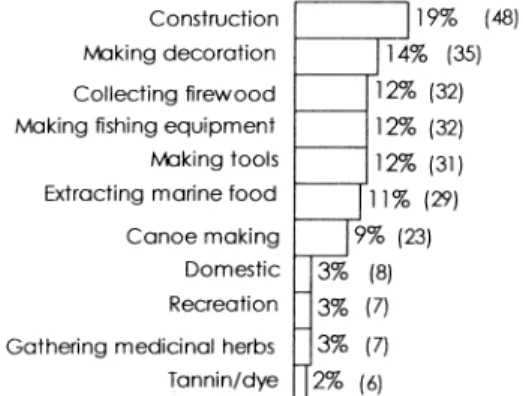
As expected, the significance of the functions reported above of mangroves in its physical state influences socio-economic and cultural ac tivities, therefore it is not surprising that the data in Figure 6 showed that mangroves had a range of socio-economic and cultural impor tance. Villagers residing in and around the mangrove area use mangrove trees for their basic subsistence, cultural and socio-economic living in the form of three most important uses for construction (19%), decoration (14%), and fuel and fishing equipment (12%) materials. Co incidentally, in the village of Ko Lao, Thailand, with the exception of decoration, mangrove for ests are predominantly a source of wood for fuel, house construction, fishing gear, and for catching marine animals (Aksornkoae et al. 1986). Yet, in contrast to Samoa, in the South east Asian countries, particularly the peninsu lar of Malaysia and Thailand, mangrove prod ucts are manufactured on a large scale. In Malaysia for instance, nipa fronds from the mangrove areas are cut and processed to make
Figure 6. Responses on the socio-economic and cultural uses of mangroves from 50 households at Pata, Sataoa, Vaitoloa, and Fugalei, Upolu Island, Samoa. All percentage figures were rounded off to their nearest whole numbers.
nipa shingles for roof thatching and sold while the younger nipa leaf sheaths are used for ciga rette-wrapper manufacturing (Chan 1986). As for Thailand, mangrove forest wood is proc essed for charcoal, timber and lumber, and the marine organisms form the basis of the fishing industries, which in turn form the primary em ployment sectors providing a formal income (Aksornkoae et al. 1986). Conversely, Samoa mangrove uses are more on a small scale, serv ing only the local coastal communities and the town market (in terms of selling marine man grove products and leis).
Construction uses Specific constructional usage involved the provision of mangrove tim ber for posts to build houses, kitchens, and pig sty(s) while thinner wood is used for roof raf ters. This is most common in the rural areas of Pata and Sataoa and to some extent in Vaitoloa. Most of the dwellings in Samoa have kitchens or umukuka separate from the main house, which is usually made of commercial timber. The traditional rural housing or Samoan cot tage (fale Samoa) is open and has no walls so the poles are those from the mangroves. This type of dwelling is common in the villages and is commonly used only for leisure or relaxation because of its coolness.
The separate kitchens have similar architect attributes of a Samoan cottage but are enclosed with fences and sometimes with a built-in com partment to keep animals from entering. How ever, poles for posts and thinner wood for fences are also extracted from the mangroves. Even in the urban villages these housing styles and kitchens do exist as evident in Vaitoloa. Pig sty(s) are also located separately outside the housing compounds, and the fences are con structed from either the Rhizophora or Bru gueira woods. The woods are hard, according to
the respondents and therefore such a use is very convenient, particularly in the case of the Bruguiera since they are taller. Fish traps in all three areas of Pata, Sataoa and Vaitoloa, which are installed further out into the sea in a circu lar fashion, are made of mangrove wood sticks.
Using mangrove wood for house construction is also a common practice in Laut villages of Java except that they do not have separate kitchens (Mantra 1986). In a similar fashion
172 J. M. Boon
with regards to pig sty(s) and fish traps, Mai noya et al. (1986) reported that coastal people of Tanzania also use mangrove products for their pig pens and fish traps. On the other hand, wood is mass produce and exported to other countries or even on the local market, as men tioned earlier, in Southeast Asia. For instance, in the case of Malaysia, a Rhizophora pole is felled and sold for US$0.40 for those near the river. The rate increases progressively to US$0.60 per pole inland. The worker can cut and transport about 30 to 40 poles a day and normally works 15 to 20 days a month. Yet at the jetty, poles are sold to consumers at a price of US$0.70-$1.50 each (Chan 1986). At the mo ment there are signs of deterioration yet still these mangroves are exploited on a macro level. Therefore, their sustainability level cannot meet the exploitative measures.
In Samoa, changes of a different nature are evident. All of Sataoa, for example, has been restricted in that their mangrove area is being strictly allocated for preservation. Many had used other forests inland to obtain posts par ticularly for housing and kitchen surroundings. Lands are mainly communal or customary land and so the families also have access to forests inland. Conversely, all of the residents in Fugalei and 14 out of 15 residents of Vaitoloa stated that these uses have been replaced to
some extent by commercial timber. The
change, according to the Fugalei respondents, was not by choice, as the reclamation of man groves had removed their traditional timber supply. However, in some cases, for those who cannot afford commercial timber, the rubbish dump has become their source of timber, hence the condition of housing in Fugalei is very poor and reflects the poverty of the region.
A similar situation has been acknowledged in the coastal village of Segara Anakan, southern Java, Indonesia, where large areas of man groves have been lost to land reclamation and there is obviously a decline of timber resources (Mantra 1986). In Thailand, the destruction of mangrove trees has led to decline over a 10 year period by concessionaires, whom the villagers called "the owners of the charcoal kilns", for charcoal production (Aksornkoae et al. 1986). In a similar vein, Chan (1986) and Silva (1986)
reported that the Ko Lao and Had Sai Khao villagers of Malaysia and Sri Lanka are also suffering from the decline of mangrove timber attributed to felling and logging for forest tim ber commercialisation.
Making decoration Decorative flowers are a popular form of personal adornment with some families having made it a source of income in Vaitoloa and Sataoa. The use of the mangrove flower for decoration and long flower necklace is quite unique since none of the studies have reported such a use. In general lei (ula) made from mangrove flowers and other flowers are sold by a number of families, since it is seen as an important facet of Samoan celebrations in village feasts, ceremonial activities, school graduation or prize giving, or any other func tion.
Even around Christmas, Vaitoloa dwellers of ten improvise by extracting branches or young plants of mangrove to substitute for a Christ mas tree. Flowers and ferns are also used for church decorations for Sunday services as in the case of Sataoa. Ferns obtained from the mangrove, are also potted and sold. According to the respondents, pot plant sale is a recent activity, which came about with the establish ment of the Sataoa-Saanapu eco-tourist reserve project. None of the Fugalei respondents claimed to rely on the mangrove for their deco rative needs, besides their mangroves were lit tered with broken glasses and hence, dangerous to enter.
Firewood Fuel in the form of firewood, and the provision of material for making fishing equipment, are perceived as equal in impor tance. Pata and Sataoa respondents all relied on the mangroves for firewood, as the main source of fuel for cooking. Sometimes, women and children are involved in gathering and col lecting firewood. At Vaitoloa, although some depended on mangrove firewood, many pre ferred charcoal and kerosene bought from the shops out of convenience rather than necessity. Fugalei respondents bought firewood from the nearby market because mangroves were al ready demolished but for those available, it was unbearable to enter. Firewood is a prerequisite for the performance of the Sunday umu or ground oven traditionally held every Sunday,
or preparation for a big feast or celebration that involves food giving, hence the importance of firewood as one of the socio-economic and cul
tural importance.
The use of mangrove wood for charcoal espe cially for commercialisation, commonly re ported in Southeast Asian countries, is not a practise among the Samoan mangrove resi dents in this study or any other study con ducted in Samoa. However, the use of man grove for firewood fuel namely the Rruguiera and Rhizophora species is being reported in the mangrove dwellers of Thailand although no data on the amount of firewood consumed is available (Aksornkoae et al. 1986). Whilst the Samoans did not distinguish the effectiveness of the species for firewood, people in Thailand as well as Fiji (Lal 1983) recommend the Rhizo phora as an effective firewood and source for
charcoal production. Similar changes are oc curring in using kerosene as an energy source for cooking and lighting, along with fuel wood and charcoal from the mangroves evident in the homes of Tanzanian people in a study con ducted by Nkonoki (Mainoya et al. 1986).
Making fishing equipment Fishing equip ment made from mangroves includes crab and fishing traps, fences, and lines, as expected mainly from the rural mangrove dwellers. The respondents from Vaitoloa and Fugalei respec tively said that they did not make fishing equipment anymore, partly due to its replace ment by modern fishing equipment. Yet, they also chose not to fish in the mangroves for fear of food poisoning from garbage pollution at Fugalei and discarded industrial machinery waste at the former rubbish dump at Vaitoloa. Making tools Tool making is an integral part of sustaining a livelihood and ranks fourth in terms of cultural uses of mangroves for mak ing digging sticks and garden stakes. This was most common for Pata and Sataoa respondents. Pata and Sataoa residents were also farmers in that they also cultivated land for subsistence and commercial means. This is quite significant in that about 80% of land in Samoa is custom ary owned. The villagers had customary land cultivated for growing banana, taro, yams, and other staple crops. Even surrounding their tra ditional housing were evidence of similar crops
being planted with digging sticks, and sur rounded by garden stakes to protect the crops and gardens from pests such as dogs, pigs and chickens. The growth of crops in the front and backyards of Samoan houses is a terminology that was referred to as 'garden crops' by Tha man and Ravuvu (1989), common in Tongan and Samoa front and backyards. Hence the importance of garden stakes and digging sticks manifested in the rural dwellers responses. Vai toloa had garden crops to a small extent but Fugalei respondents had limited space for planting, reflected in the lack of responses.
Extracting marine food For those engaged in fishing, one or more of the following prod ucts are extracted from mangrove swamps: fi nfishes including eels, shellfishes and crabs. In this survey, extraction of marine food products from the mangrove swamps ranks fifth in im portance, serving as an important source of protein. Fnnfishing and non-finfishing, like flower collecting and making leis, have similar characteristics in the division of labour regard ing who is involved in which activity. With reference to the fishermen counterparts of Vai toloa, Sataoa and Pata, finfishing usually takes place at night and it requires greater physical strength because of the net-fishing method. This often excludes women who also have the responsibility of looking after the children and attending to domestic duties at night. At times, crabs are caught or collected by men, particu larly in Sataoa, and also Pata at night, but collecting shellfish is predominantly a female activity. Women are seen to collect crabs when the need is there to obtain cash for children's school fees or to meet other immediate obliga tions such as paying electricity bills before the deadlines.
Conversely, in Vaitoloa and Fugalei, the fear of food poisoning has been the deterrent to fishing in the mangrove swamps. Fugalei pos sessed the added disadvantage of distance (about one hour's walk) from the shoreline, a result of the reclamation of land from the man groves. Tinned fish, corned beef, frozen meats and chicken from the market and general stores have become substitutes.
In contrast to the coastal mangrove villages of Thailand (Aksornkoae et al. 1986), Malaysia
174 J. M. Boon
(Chap 1986), Java in Indonesia (Mantra 1986), and Sri Lanka (Silva 1986), fishing, like char coal and wood production, from the mangrove forests is a significant primary resource indus try contributing to the national revenue in come. In the local region, shrimp and prawns are a major high-price income earner for the mangrove dwellers. However, Samoa, like Tan zania (Mainoya et al. 1986), does not commer cially exploit mangrove marine resources on a large scale but only for local consumption and to periodic sale in the local market only when cash is required. In fact in Sri Lanka, the re ported high average income varies with the prawn season, whilst fishing is regarded as a more stable income throughout the year in the
mangrove fringed lagoon communities of
Rekawa and Kalametiya, Sri Lanka (Silva 1986). Prawn and shrimp was more of a fresh water organism found in the head river streams, not in the mangroves, as considered by some Samoan respondents.
Other socio-cultural uses Mangrove wood is also used for outriggers and connectives of canoes. Canoe timber itself is obtained not from the mangroves but carved from other trees found along the inner margins of the man groves such as the fau (Hibiscus tiliaceus), talie (Terminalia catappa), mosooi (Cananga odorata), tamaligi (Samanea saman), and niu (Cocos nucifera). Interestingly, Tanzania also uses mangrove wood for boat hulls, masts, and oars (Mainoya et al. 1986). Respondents who did not rely on the mangrove for outrigger material were no longer engaged in finfishing, such as a hundred percent in Fugalei.
Streams flowing through the mangroves were of little use for domestic activities, such as bathing, washing clothes and dishwashing be cause of the reliable supply of reticulated water and stored rainwater. However, in the event of a prolonged interruption in the domestic water supply most claimed that they would fall back on mangrove stream water. Awareness of pol lutants in the swamps has discouraged respon dents in using mangroves for recreation and domestic use. In fact, Sataoa, Vaitoloa, and Fugalei respondents reported that they did not swim in the mangrove streams anymore. While Vaitoloa respondents blamed this on the un
sanitary conditions of the mangroves streams due to rubbish pollution, Fugalei respondents said that the reclamation has been so extensive that areas once suitable for swimming disap peared. Even at Pata, some of the respondents refrain from using the mangroves for swim ming. The deterrent in this case is the fear of the supposed effects of 'ava Niu Kini' (Derris malaccensis) natural poison used for fishing.
From a different viewpoint, recreation of mangroves is manifested in tourist conserva tion attraction as in the case of Okinawa be cause it is regarded as an exotic ecosystem according to Miyawaki (1986). This function is offered not to the local dwellers but to the national tourists. This is a function that has been recently developed as a formal use of the
Sataoa mangroves known as a Community
- based conservation project with the assistance of the local government departments such as the Lands and Environment and Conservation section in Samoa. Due to this, local dwellers of Sataoa mangroves abstained from using the
mangrove resources abundantly and exces
sively.
The use of mangroves for medicine is indirect since most of the medicinal plants are non - exclusive species such as laugasese, pualulu or
lauauta (Phymatosorus scolopendria), fueselela (Hoya australis), nonu (Morinda citrifolia), mati (Ficus tinctoria), fuesina (Vigna marina), matalafi (Psyuchotria insularum), togotogo (Cantella asia tica) and milo (Thespesia populnea). Only a few respondents utilized these in their remedies, and used their knowledge as a means of earning money.
This finding suggests limited knowledge of the mangrove dwellers in Samoa in using man grove species in healing and treatment in con trast to the residents of Thailand, where Bru guiera mangrove plant species is used to relieve constipation, the Acanthus species for treating kidney stones, while the Avicennia species is to treat thrush in children and others for men strual fevers (Aksornkoae et al 1986). Beyond Asia in the continent of Africa, the Rhizophora species is well recognised by the Tanzanians as a remedy for hernia (Mainoya et al. 1986).
Last, but not least, the tannin from the bark of the Bruguiera was once important as a dye
used on bark or tapa cloths. Only a few of the respondents still obtain dye or tannin from the mangroves. This has been replaced with mod ern artificial dyes, screen-printing, tie-dyes, and is no longer popular. On the other hand, the bark cloths are seldom worn these days despite Yamamoto's (1990) discussion, and in ceremo nial exchange they have been substituted with modern cloth obtained from the stores. Yama moto (1997) proposed in her analysis that the introduction of western imported material is supposedly the reason for this transformation. Like Samoa mangrove dwellers, Aksornkoae et al. (1986) observed that the practise of obtain ing tannin is also becoming rare in the case of Thailand, although the reason for their usage differs. With modern equipment available, dy ing of fishing nets with tannin is rare since traditional nets are now substituted with nylon nets.
Residents' evaluation of mangrove reclama
tion
This evaluation attempts to provide a picture of the four study communities' degree of reli ance on their respective mangroves. It aims to examine how the destruction of mangroves has affected the villagers in terms of the time spent in the mangroves for the satisfaction of their
socio-economic and cultural needs. The re
search provided the following general picture of the level of affluence among the inhabitants in the four locations studied.
Residents' socio-economic status
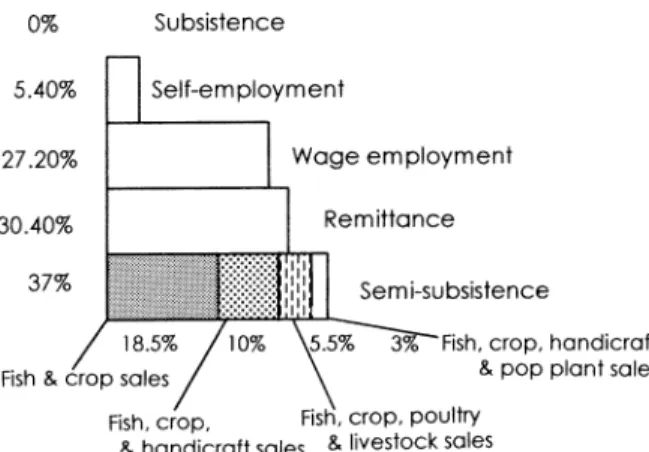
Figure 7 shows that 37% of the respondents' income derives mainly from semi-subsistence means. This involves living off the land and sea and selling part of the products of their efforts -for instance, selling of staple crops, handicrafts, poultry, pigs, flowers and pot-plants, finfish, shellfish and crabs-in order to obtain cash for the purchase and satisfaction of other needs. Half of this percentage proportion (18.5%) is derived predominantly from selling marine products and crops. This aspect, suggesting a transition from subsistence to cashing in on marine and land resources, is a significant trend also acknowledged and supported by Yama moto (1990), Meleisea (1988), and GWS (1990). As such, 30.4% of the respondents' total in come is also obtained from remittances abroad,
27.2% from wages, and 5.4% from self
- employed ventures. Those who had incomes
from wages were found predominantly in
Fugalei and Vaitoloa because of their proximity to Apia whilst the incomes from self-employed activities were found only at Fugalei. Many
Figure 7. Sources of incomes of 50 respondents from the villages of Pata, Sataoa, Vaitoloa, and Fugalei, Upolu Island, Samoa.
176 J. M. Boon
respondents had multiple sources of income, which was quite common among the house holds.
Of the four study areas, Fugalei's economy is the least. Although there were incomes derived from wage employment those employed were involved in blue collar jobs with incomes of $90-$60 tala2 per week, but not from selling mangrove fish or related products. In retro spect, those who received cash from abroad had a monthly remittance of $200 tala, which was the only source of income for a mother of five. Others who received less had remittances of $100 tala only twice in a year. There were very few food gardens or 'garden crops' in the area.
Self-employment in Fugalei invariably in volved petty trade such as operating a barbecue stand, a flea market stall or a small general store selling daily basic food and sundry neces sities. According to a Fugalei respondent who operates a barbecue stand, the income derived is meagre, and "the monies from day to day sales goes back into purchasing the goods for the barbe cue stand. If we get $150 talc, $100 alone would be spent on meat and $30-40 will go into buying other ingredients. So we save about $10 or $20 if were lucky..." The same family, make ends meet by receiving remittances additionally from relatives abroad. Parallel to this, many of the families could barely have any supplemen tary income left for any means other than try ing to meet sufficient basic necessities.
Vaitoloa respondents are better off economi cally than those in Fugalei because most of the residents are white collar, therefore more highly paid. Others had additional incomes from semi-subsistence means from fish, garden crops, poultry, and pig sales. None of the re spondents are self-employed and a few also re ceived remittances.
The general economic status of Pata is similar to that of Sataoa, and being rural communities, the pattern of sources of income is very differ ent from either their Vaitoloa or Fugalei coun terparts. None were self-employed and the ma jority received regular remittances from over seas. Only a couple were also wage earners and all were semi-subsistence farmers. Everyone at Pata and Sataoa sold marine food products (in cluding finfish, shellfish and crabs), as well as other products such as crops, handicrafts , poul try, livestock, and pot plants. Added to this, is the claim by all respondents at Pata and Sataoa , that need of extra cash to meet personal, family , village or community obligations known as fa'alavelave 3 beyond daily needs is satisfied
through the sale of fish from the mangroves as in Figure 8. All families at Pata and Sataoa (10 each) and 9 respondents from Vaitoloa satisfy their extra cash needs from the mangroves . Thus we see the heavy reliance of Pata and Sataoa on their mangrove environment relative to Vaitoloa, and the comparative absence of mangrove-derived income at Fugalei. Pata and
Figure 8. Responses on the special occasions or ceremonies for which respondents would make more than the normal use of mangroves from 50 households at Pata, Sataoa, Vaitoloa , and Fugalei, Upolu Island, Samoa.
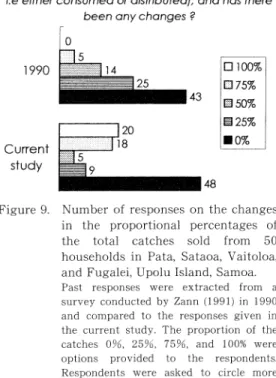
Sataoa villagers for instance, enter the man groves every day, especially for firewood and food. Yet when it is mangrove marine products for income, it is about 4 to 5 times a week. This is a higher average compared to Vaitoloans. They only enter the mangroves during the weekends 'when they have time,' or if they really need extra income particularly for imme diate fa alavelave. The heavy reliance of the two rural areas on income from mangrove ma rine products is further supported by the in crease in the proportion of fish sold at present compared to earlier, as reported by the survey.
A significant fact is that whereas about ten years ago, no respondent sold 100% of his total catch, today, 20 of them do so. Similarly, those who reportedly sold 75% of their finfish catch earlier were only about 5. This has increased to about 18. Consequently, the percentage of those who sold 25% and 50% of their catch has declined. Figure 9 respectively supports the allegation made by rural respondents (Sataoa and Pata) that in recent years, there has been an increase in fishing effort and a very significant increase in the sale of mangrove marine food
Figure 9. Number of responses on the changes in the proportional percentages of the total catches sold from 50 households in Pata, Sataoa, Vaitoloa, and Fugalei, Upolu Island, Samoa. Past responses were extracted from a survey conducted by Zann (1991) in 1990 and compared to the responses given in the current study. The proportion of the catches 0%, 25%, 75%, and 100% were options provided to the respondents, Respondents were asked to circle more than one option if appropriate.
stuffs. Respondents said that the pressure for increased monetary income to satisfy newly required needs and traditional family and com munity obligations has been the cause of this. Generally, the sale of finfish and shellfish infor mally occurs by the roadside or door-to-door, whereas crabs are usually transported to the fish market in Apia, where they fetch a higher price. This is most pronounced in Pata. Changes in residents' life
with the exception of Pata, all respondents experienced impacts and therefore a change in their relationship with their mangroves as a result of development-related activity. The beneficial effects may be summed up as im proved accessibility to Apia, since all lauded improved accessibility to urban services such as banks, airports, hospitals, post offices, and especially markets to sell their marine products, food crops and handicrafts. Respondents also said that improved accessibility has allowed them to take advantage of cheaper basic food stuffs in town.
Sataoa, Vaitoloa, and Fugalei respondents re ported four development-related activities: road constructions, commercial activities, eco tourism, and industrial expansion. The per ceived negative effects in Figure 10 by the re spondents were: destruction of the habitat and spawning grounds for marine organisms on which the local inhabitants were once reliant or are still reliant for their dietary protein and income; relocation or displacement of homes; restriction/deprivation of use to a freely avail able resource; and land alienation. Although not common to all areas, other less frequently cited negative effects were; unsanitary environ ment, retreat of shoreline, noise and air pollu tion, and increased flooding. The following elaborates the four most common negative effects of development related activities at Sa taoa, Vaitoloa and Fugalei.
Habitat destruction
when respondents were asked about their awareness of changes in the duration of time they spend in the mangroves compared to the days prior to their area's particular develop ment-related activity, they reported an increase