Factors Affecting the Adoption of E-government
in Saudi Arabia
学位名
博士 (先端マネジメント)
学位授与機関
関西学院大学
学位授与番号
34504甲第670号
URL
http://hdl.handle.net/10236/00027328
Doctoral Dissertation
For Doctoral Degree
Kwansei Gakuin University
Factors Affecting the Adoption of E-government in
Saudi Arabia
Doctoral research advisor: David T. Methé
December, 2017
Graduate Department of Advanced Management (Ph.D.)
Institute of Business and Accounting
73015903 AKBAR HANAA HUSSAIN A
[文書の要約をここに入力してください。要約は一般に、文書の内容を短くまとめたものです。文書の要約をここに入力してください。要約は一般に、文書の内容を短くまとめたもので す。]
I
ABSTRACT
The application of the ICT in government gains more and more attention from researchers. Understanding the challenges that likely confront the adoption of e-government by citizens is important for the continuity of successful e-government diffusion. Previous studies have attempted to study the main factors influencing the diffusion of e-government by focusing on the e-government performance and did not adequately study other direct and indirect factors that affect the citizen’s decision to adopt its services. The main research question investigated in this study was; what are the underlying factors that influence citizens’ intention to use e-government services in Saudi Arabia. In order to answer the research question, a conceptual model was developed in this study to explain the relationships between these factors and the behavioral intention to use e-government services. The conceptual model integrates constructs from the Technology Acceptance Model (perceived ease of use and perceived usefulness), UTAUT model (social influence), and trustworthiness constructs (trust of government and trust of the Internet) adopted from Carter and Belanger’s (2005) acceptance model, and introduces the factor of perceived corruption. The model was tested from three aspects; the intention to use e-government in a mandatory environment and in a voluntary environment, and the intention to not use e-government. A quantitative approach was applied to empirically test the proposed model. An online survey questionnaire was conducted on a broad diversity of Saudi Arabia’s citizens. A total of 349 responses collected through a convenience sampling technique. The responses were evaluated using multiple regression analysis, using SPSS 24, and mediation analysis using PROCESS macro 2.16 in SPSS. The results show that in a voluntary environment, the factors that are related to the e-government performance, such as perceived ease of use, perceived usefulness, and the trust in the Internet, have a direct effect on the citizens’ behavioral intention to use e-government. While the factors that are not related directly to the performance of the e-government, such as the trust in the government and social influence, have an indirect effect on their behavioral intention to use e-government. The study also shows that the social influence variable has a strong effect on citizens’ behavioral intention to use e-government in a mandatory environment. While their perception of the ease of use is the only factor that significantly affects their intention to not use e-government.
II
ACKNOWLEDGEMENTS
I am greatly thankful to many people who helped in the completion of this journey.
First and foremost, I would like to express my sincere gratitude and appreciation to my extraordinary and kind supervisor professor David Methe. Thank you very much for your excellent supervision, guidance, invaluable feedback, and encouragement during my Ph.D. journey. It has been an honor to be your student. Your patience, critical advice, insightful comments, and immense knowledge gave me the confidence to keep pushing the boundaries of my work.
I would like to extend my thanks to my thesis committee members; professor Yutani Hiroshi and professor Norlia Ahmad for all of their guidance; your discussion, ideas, and feedback have been absolutely invaluable.
My greatest indebtedness is to my mother for the love, support, and constant encouragement I have gotten over the years. I cannot find adequate words to express how essential her continuous prayers and support were to bring me to this point.
I owe a special thanks to my friends for their support and encouragement. In particular, I would like to thank my friend Sabaa Talal and Abeer Alharbi for their help in distributing the survey and their assistance during the process of the development of my research work.
Special thanks to my sponsor - Ministry of Education, Culture, Sports, Science and Technology, for their financial support during the third year of my PhD study.
Lastly, I offer my regards and blessings to all people who have supported me by participating in the survey or given me assistance in any respect during the completion of the dissertation.
III
Table of Contents
Abstract... I
Acknowledgements ... II
List of Tables ... VIII
List of Figures...XII
Chapter 1: Introduction ...1
1.1 Introduction ... 1
1.2 Research Background ... 3
1.3 Research Problem Statement ... 4
1.4 Research Objective ... 5
1.5 Research Questions ... 5
1.6 Significance of the Study ... 6
1.7 Research Methodology Overview ... 7
1.8 Research Structure ... 8
Chapter 2: Literature Review ...9
2.1 Introduction ... 9
2.2 Definition of E-government... 9
2.3 Types of E-government... 12
2.3.1 Government to Government (G2G) ... 13
2.3.2 Government to Business (G2B) ... 14
2.3.3 Government to Employee (G2E) ... 14
2.3.4 Government to Citizen (G2C) ... 15
2.4 E-government Initiative in Saudi Arabia ... 15
2.4.1 E-government Strategies in Saudi Arabia ... 16
2.4.2 Saudi Citizens and E-government ... 17
2.5E-government Acceptance Models ... 18
2.5.1 Diffusion of Innovation Theory (DOI) ... 19
2.5.1.1 Diffusion of Innovation (DOI) Theory in E-government Research ... 21
2.5.2 The Theory of Reasoned Action (TRA) ... 22
2.5.3 The Theory of Planned Behavior (TPB) ... 24
2.5.4 Technology Acceptance model (TAM) ... 24
2.5.4.1 The Technology Acceptance model (TAM) in E-government Research ... 26
2.5.5 The Technology Acceptance Model 2 (TAM 2) ... 27
2.5.6 The Unified Theory of Acceptance and Use of Technology (UTAUT) ... 28
IV
2.6 The Influencing Factors on The Citizens’ Behavioral Intention to Adopt E-government ... 32
2.6.1 Trust ... 33
2.6.2 Perceived Corruption ... 36
2.6.3 Perceived Ease of Use (PEOU) and Perceived Usefulness (PU) ... 39
2.6.4 Social Influence (SI) ... 42
2.7 Research Conceptual Model ... 44
Chapter 3: Research Methodology ...46
3.1Introduction ... 46
3.2 Research Method ... 46
3.3 Selection of Research Method ... 47
3.4 Research Design ... 48
3.5 Instrument Development ... 49
3.5.1 Survey Questionnaire Development ... 49
3.5.2 Pilot Study ... 55
3.5.3 Sample ... 56
3.5.4 Data Collection ... 58
3.5.5 Data Analysis ... 58
3.5.5.1 Reliability Analysis ... 59
3.5.5.2 Exploratory Factor Analysis ... 60
3.5.5.3 Collinearity Statistic ... 61
3.5.5.4 Multiple Regression Analysis ... 62
3.5.5.5 Mediation Analysis ... 63
Chapter 4: Data Analysis ...65
4.1 Introduction ... 65
4.2 Survey Questionnaire and Demographic Profile ... 65
4.2.1 General Demographic Profile... 65
4.2.1.1 Gender of All Respondents ... 65
4.2.1.2 Age of All Respondents ... 66
4.2.1.3 Hometown of All Respondents ... 66
4.2.1.4 Education Level of All Respondents ... 67
4.2.1.5 Occupation of All Respondents ... 68
4.2.2 The Use of E-government ... 68
4.2.3 Demographic Profile for E-government Users ... 69
4.2.3.1 Age of the E-government Users ... 69
4.2.3.2 Gender of E-government Users ... 69
V
4.2.3.4 Education Level of the E-government Users ... 70
4.2.3.5 Occupation of the E-government Users ... 71
4.2.4 E-government Experience ... 72
4.3 Reliability Analysis ... 73
4.3.1 Internal Consistency ... 73
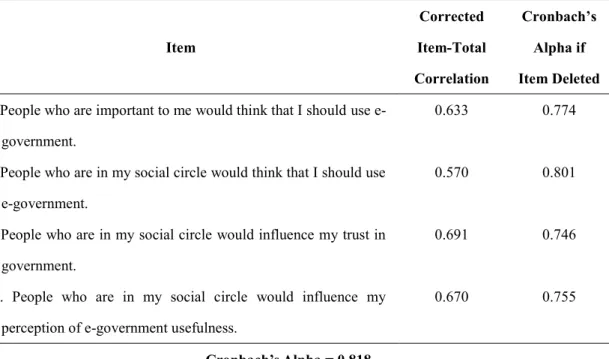
4.3.2 Item-total Correlation ... 76
4.4 Exploratory Factor Analysis (EFA) ... 83
4.4.1 Data Factorability ... 83
4.4.2 EFA for the Constructs ... 84
4.4.2.1 Trust in the Internet ... 85
4.4.2.2 Trust in the Government ... 87
4.4.2.3 Perceived Corruption... 89
4.4.2.4 Social Influence ... 91
4.4.2.5 Perceived Usefulness... 93
4.4.2.6 Perceived Ease of Use ... 95
4.4.2.7 Behavioral Intention ... 97
4.4.3 Summary of EFA ... 99
4.5 Regression Analysis ... 99
4.5.1 The Multiple Regression Analysis (The Dependent Variable is BI) ... 100
4.5.2 The Multiple Regression Analysis (The Dependent Variable is BI 4) ... 103
4.5.3 The Mediation Analysis ... 106
4.5.3.1 The Relationship between PEOU and BI as Mediated by PU ... 107
4.5.3.2 The Relationship between SCI and BI as Mediated by PU ... 110
4.5.3.3 The Relationship between SID and BI as Mediated by PU ... 113
4.5.3.4 The Relationship between SCI and BI as Mediated by TOG ... 116
4.5.3.5 The Relationship between SID and BI as Mediated by TOG ... 119
4.5.3.6 The Relationship between TOG and BI as Mediated by PC ... 122
4.5.3.7 The Relationship between SCI and BI as Mediated by TOG and PC ... 124
4.5.3.8 The Relationship between SID and BI as Mediated by TOG and PC ... 128
4.6 Additional Analysis ... 132
4.6.1 Simple Regression Analysis (TOG and TOI) ... 132
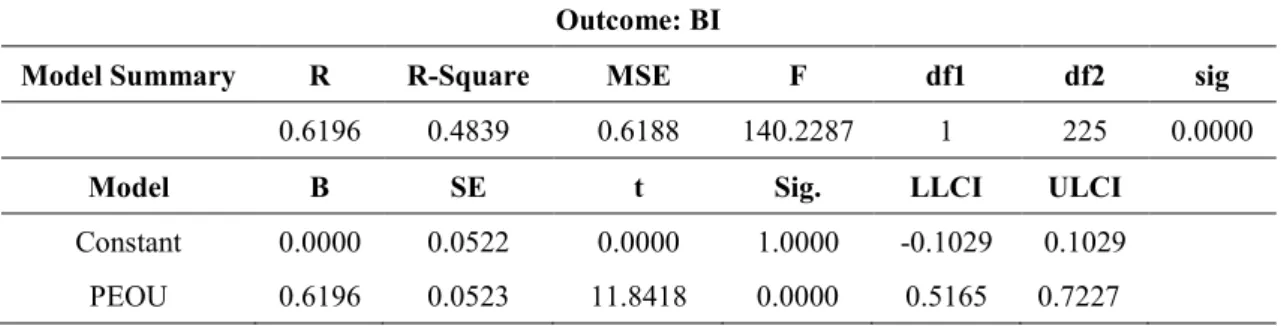
4.6.2 Regression Analysis of SI and PEOU ... 133
VI
Chapter 5: Analysis for Non-use of E-government. ... 136
5.1 Introduction ... 136
5.2 Demographic Profile for E-government Non-users ... 137
5.2.1 Gender of E-government Non-users... 137
5.2.2 Age of E-government Non-users ... 137
5.2.3 Hometown of E-government Non-users ... 138
5.2.4 Education Level of E-government Non-users ... 138
5.2.5 Occupation of All Non-users ... 139
5.3 Perceived Usefulness ... 140
5.4 Perceived Ease of Use ... 142
5.5 Perceived Corruption ... 144
5.6 Trust of Government ... 146
5.7 Trust of the Internet ... 148
5.8 Social Influence ... 149
5.9 Summary of Findings ... 150
Chapter 6: Discussion and Conclusion ...151
6.1 Introduction ... 151
6.2 Findings from the Demographic Analysis ... 151
6.3 E-government Experience ... 155
6.4 E-government Adoption Construct ... 156
6.4.1 The Role of Citizens’ Trust in E-government ... 156
6.4.2 The Role of Perceived Corruption in E-government ... 160
6.4.3 The Role of Perceived Usefulness in E-government ... 161
6.4.4 The Role of Perceived Ease of Use in E-government ... 162
6.4.1 The Role of Social Influence in E-government ... 164
6.5Citizens’ Adoption of E-government ... 167
6.6The Empirical Model for E-government Adoption ... 169
6.7Citizens’ Adoption of E-government: Guidelines for the Government ... 170
6.8 Research Contributions and Implications ... 173
6.8.1 Theoretical Implication ... 173 6.8.2 Practical Implication ... 174 6.9 Conclusion ... 177 6.10 Research Limitation ... 179 6.11 Future Research ... 181
References ...184
Appendix A ...196
VII
Appendix B ...210
Appendix C...224
VIII
List of Tables
Table 2.1: Factors of TAM 2 (Venkatesh and Davis, 2000) ... 28
Table 2.2: Constructs of UTAUT (Venkatesh et al., 2003) ... 29
Table 3.1: Survey Constructs Measurement ... 49
Table 3.2: Survey Items ... 52
Table 3.3: Scale Reliability for the Pilot Study ... 56
Table 3.4: Demographic Distribution of Respondents ... 57
Table 3.5: The Internal Consistency of Cronbach’s Alpha Value ... 59
Table 3.6: Sobel Product of Coefficients Approach ... 64
Table 4.1: Gender of All Respondents ... 66
Table 4.2: Age of All Respondents ... 66
Table 4.3: Hometown of All Respondents ... 67
Table 4.4: Education Level of All Respondents ... 67
Table 4.5: Occupation of All Respondents ... 68
Table 4.6: The Use of E-government ... 68
Table 4.7: Age of E-government Users ... 69
Table 4.8: Gender of E-government Users ... 69
Table 4.8: Hometown of the E-government Users ... 70
Table 4.9: Education Level of the E-government Users ... 71
Table 4.10: Occupation of the E-government Users ... 72
Table 4.11: The Last Use of E-government ... 72
Table 4.12: Access to E-government Services ... 73
Table 4.13: Scale Reliability (All Items) ... 74
Table 4.14: Scale Reliability after Items’ Elimination ... 75
Table 4.15: Item-total Correlation of TOI ... 76
Table 4.16: Item-total Correlation of TOG ... 77
Table 4.17: Item-total Correlation of PC ... 78
Table 4.18: Item-total Correlation of PU ... 79
Table 4.19: Item-total Correlation of PEOU ... 80
Table 4.20: Item-total Correlation of SI ... 81
Table 4.21: Item-total Correlation of SI after the Items Removal ... 82
Table 4.22: Item-total Correlation of BI ... 83
Table 4.23: KMO and Bartlett’s Test ... 84
IX
Table 4.25: Correlation Matrix of TOI ... 85
Table 4.26: Total Variance Explained of TOI ... 86
Table 4.27: Component Matrix of TOI... 86
Table 4.28: Correlation Matrix of TOG ... 87
Table 4.29: Total Variance Explained of TOG... 88
Table 4.30: Component Matrix of TOG ... 89
Table 4.31: Correlation Matrix of PC ... 89
Table 4.32: Total Variance Explained of PC ... 90
Table 4.33: Component Matrix of PC ... 91
Table 4.34: Correlation Matrix of SI ... 91
Table 4.35: Total Variance Explained of SI ... 92
Table 4.36: Rotated Component Matrix of SI ... 93
Table 4.37: Correlation Matrix of PU... 93
Table 4.38: Total Variance Explained of PU ... 94
Table 4.39: Component Matrix of PU ... 95
Table 4.40: Correlation Matrix of PEOU ... 95
Table 4.41: Total Variance Explained of PEOU ... 96
Table 4.42: Component Matrix of PEOU ... 97
Table 4.43: Correlation Matrix of BI ... 97
Table 4.44: Total Variance Explained of BI ... 98
Table 4.45: Component Matrix of BI ... 98
Table 4.46: Model Summary (BI) ... 100
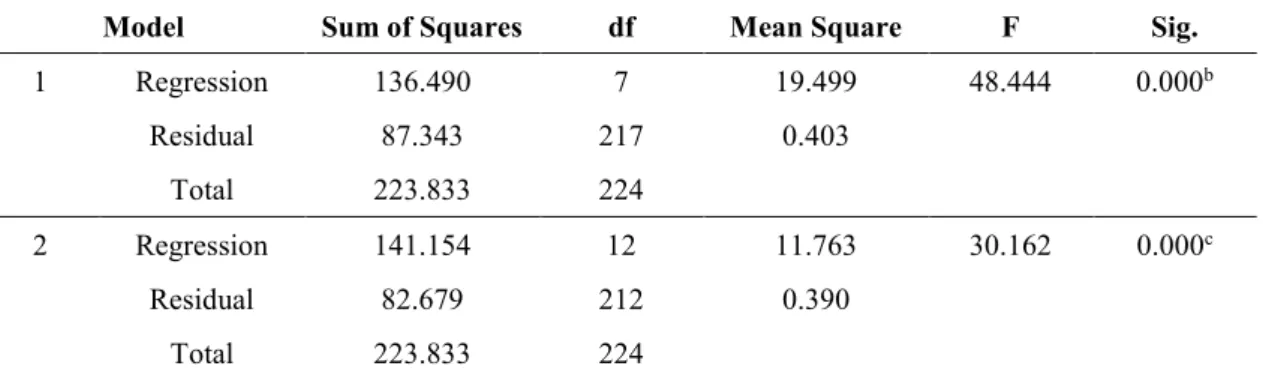
Table 4.47: ANOVA of BI ... 101
Table 4.48: The Multiple Regression Analysis of BI ... 103
Table 4.49: Model Summary (BI 4) ... 104
Table 4.50: ANOVA of BI4 ... 104
Table 4.51: The Multiple Regression Analysis of BI 4 ... 106
Table 4.52: The Relationship between PEOU and BI as Mediated by PU (Model 1) ... 108
Table 4.53: The Relationship between PEOU and BI as Mediated by PU (Model 2) ... 109
Table 4.54: The Relationship between PEOU and BI as Mediated by PU (Total Effect Model) ... 109
Table 4.55: The Indirect Effect of PEOU on BI ... 110
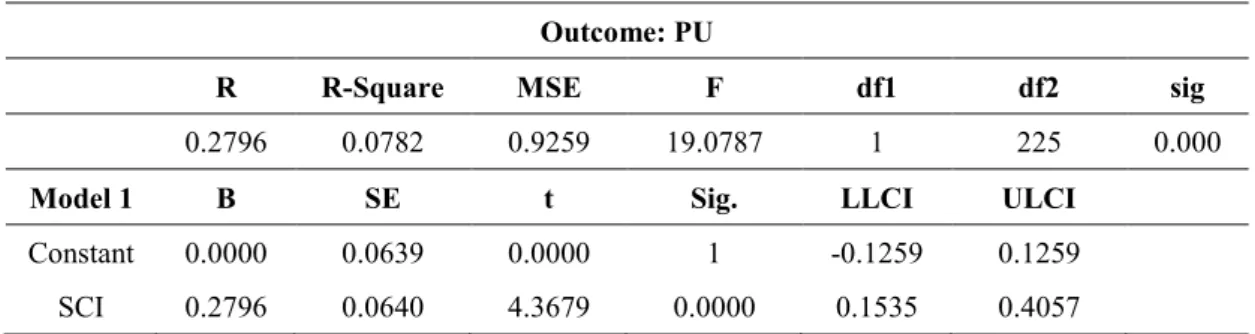
Table 4.56: The Relationship between SCI and BI as Mediated by PU (Model 1) ... 111
Table 4.57: The Relationship between SCI and BI as Mediated by PU (Model 2) ... 112
Table 4.58: The Relationship between SCI and BI as Mediated by PU (Total Effect Model) ... 112
Table 4.59: The Indirect Effect of SCI on BI ... 113
X
Table 4.61: The Relationship between SID and BI as Mediated by PU (Model 2) ... 115
Table 4.62: The Relationship between SID and BI as Mediated by PU (Total Effect Model) ... 115
Table 4.63: The Indirect effect of SID on BI ... 116
Table 4.64: The Relationship between SCI and BI as Mediated by TOG (Model 1) ... 117
Table 4.65: The Relationship between SCI and BI as Mediated by TOG (Model 2) ... 118
Table 4.66: The Relationship between SCI and BI as Mediated by TOG (Total Effect Model) ... 118
Table 4.67: The Indirect effect of SCI on BI ... 119
Table 4.68: The Relationship between SID and BI as Mediated by TOG (Model 1) ... 120
Table 4.69: The Relationship between SID and BI as Mediated by TOG (Model 2) ... 120
Table 4.70: The Relationship between SID and BI as Mediated by TOG (Total Effect Model) ... 121
Table 4.71: The Indirect effect of SID on BI ... 121
Table 4.72: The Relationship between SID and BI as Mediated by TOG (Model 1) ... 122
Table 4.73: The Relationship between TOG and BI as Mediated by PC (Model 2) ... 123
Table 4.74: The Relationship between TOG and BI as Mediated by PC (Total Effect Model) ... 123
Table 4.75: The Indirect Effect of TOG on BI ... 124
Table 4.76: The Relationship between SCI and BI as Mediated by TOG and PC (Model 1) ... 125
Table 4.77: The Relationship between SCI and BI as Mediated by TOG and PC (Model 2) ... 125
Table 4.78: The Relationship between SCI and BI as Mediated by TOG and PC (Model 3) ... 126
Table 4.79: The Relationship between SCI and BI as Mediated by TOG and PC (Total Effect Model) ... 127
Table 4.80: The Indirect Effect of SCI on BI ... 127
Table 4.81: The Relationship between SID and BI as Mediated by TOG and PC (Model 1) ... 129
Table 4.82: The Relationship between SID and BI as Mediated by TOG and PC (Model 2) ... 129
Table 4.83: The Relationship between SID and BI as Mediated by TOG and PC (Model 3) ... 130
Table 4.84: The Relationship between SID and BI as Mediated by TOG and PC (Total Effect Model) ... 130
Table 4.85: The Indirect effect of SCI on BI ... 131
Table 4.86: Model Summary (TOI and TOG) ... 132
Table 4.87: The Regression Analysis of TOI and TOG ... 132
Table 4.88: Model Summary (SI and PEOU) ... 133
Table 4.89: The Regression Analysis of SI and PEOU ... 133
Table 4.90: Hypotheses Testing (direct relationships) ... 135
Table 4.91: Hypothesis Testing (indirect relationships) ... 135
Table 5.1: Survey Items for No Use of E-government ... 136
Table 5.2: Gender of All Respondents ... 137
XI
Table 5.4: Hometown of Non-users... 138
Table 5.5: Education Level of Non-users ... 139
Table 5.6: Occupation of Non-users ... 139
Table 5.7: Government Websites Do Not Provide A Service That I Would Use ... 140
Table 5.8: Using Government Online Services is A Waste of Time ... 141
Table 5.9 : E-government Services Are Not Useful ... 141
Table 5.10: The Average of the Three Items of PU ... 142
Table 5.11 : Government Websites Are Not Easy to Use... 142
Table 5.12: Government Websites Have Performance Issues ... 143
Table 5.13: E-government Services Are Not Clear and Not Understandable ... 143
Table 5.14: The Average of the Three Items of PEOU ... 144
Table 5.15: The Decision Making Process is Not Transparent ... 145
Table 5.16: E-government Makes the Boundaries of Responsibility Less Clear... 145
Table 5.17: The Average of the Two Items of PC ... 146
Table 5.18: I Do Not Trust the Government ... 146
Table 5.19: Government is Not Capable to Protect The Privacy Via Website ... 147
Table 5.20: Government Websites Are Easy to Hack ... 147
Table 5.21: The Average of the Three Items of TOG... 148
Table 5.22: The Internet Has Not Enough Protections ... 149
XII
List of Figures
Figure 2.1: E-government Interaction Dimensions ... 13
Figure 2.2: Five Stages Model in the Innovation-decision Process ... 20
Figure 2.3: The Theory of Reasoned Action (TRA) ... 22
Figure 2.4: The Theory of Planned Behavior (TPB) ... 23
Figure 2.5: Technology Acceptance Model (TAM) ... 25
Figure 2.6: Technology Acceptance Model 2 (TAM 2) ... 27
Figure 2.7: Unified Theory of Acceptance and Use of Technology (UTAUT) ... 30
Figure 2.8: Carter and Belanger’s (2005) Model of E-government Acceptance ... 31
Figure 2.9: Research Conceptual Model ... 45
Figure 3.1: Research Design ... 48
Figure 3.2: The Mediation Model ... 63
Figure 4.1: Gender of All Respondents ... 66
Figure 4.2: Age of All Respondents ... 66
Figure 4.3: Hometown of All Respondents ... 67
Figure 4.4: Education Level of All Respondents ... 67
Figure 4.5: Occupation of All Respondent ... 68
Figure 4.6: The Use of E-government ... 68
Figure 4.7: Age of E-government Users ... 69
Figure 4.8: Gender of E-government Users ... 69
Figure 4.8: Hometown of the E-government Users ... 70
Figure 4.9: Education Level of the E-government Users ... 71
Figure 4.10: Occupation of the E-government Users ... 72
Figure 4.11: The Last Use of E-government ... 72
Figure 4.12: Access to E-government Services ... 73
Figure 4.13: Screen Plot of TOI ... 86
Figure 4.14: Screen Plot of TOG ... 88
Figure 4.15: Screen Plot of PC ... 90
Figure 4.16: Screen Plot of SI ... 92
Figure 4.17: Screen Plot of PU ... 94
Figure 4.18: Screen Plot of PEOU ... 96
Figure 4.19: Screen Plot of BI ... 98
Figure 4.20: The Coefficient for the Relationship between PEOU and BI as Mediated by PU ... 110
Figure 4.21: The Coefficient for the Relationship between SCI and BI as Mediated by PU ... 113
Figure 4.22: The Coefficient for the Relationship between SID and BI as Mediated by PU ... 116
XIII
Figure 4.24: The Coefficient for the Relationship between SID and BI as Mediated by TOG... 122
Figure 4.25: The Coefficient for the Relationship between TOG and BI as Mediated by PC ... 124
Figure 4.26: The Coefficient for the Relationship between SCI and BI as Mediated by TOG and PC 128 Figure 4.27: The Coefficient for the Relationship between SID and BI as Mediated by TOG and PC 131 Figure 5.1: Gender of All Respondents ... 137
Figure 5.2: Age of Non-users ... 137
Figure 5.3: Hometown of Non-users ... 138
Figure 5.4: Education Level of Non-users ... 139
Figure 5.5: Occupation of Non-users ... 139
Figure 5.6: Government Websites Not Provide Services I Would Use ... 140
Figure 5.7: Using Government Online Services is A Waste of Time ... 141
Figure 5.8: E-government Services Are Not Useful ... 141
Figure 5.9: Government Websites Are Not Easy to Use ... 142
Figure 5.10: Government Websites Have Performance Issues ... 143
Figure 5.11: E-government Services Are Not Clear and Not Understandable ... 143
Figure 5.12: The Decision Making Process is Not Transparent ... 145
Figure 5.13: E-government Makes the Boundaries of Responsibility Less Clear ... 145
Figure 5.14: I Do Not Trust the Government ... 146
Figure 5.15: Government is Not Capable to Protect the Privacy via Website ... 147
Figure 5.16: Government Websites Are Easy to Hack ... 147
Figure 5.17: : The Internet Has Not Enough Protections... 149
Figure 5.18 : Social Influence Has No Effect on the Intention to Use E-government ... 149
Figure 6.1: Comparison of the E-government Usage among Males and Females ... 152
Figure 6.2: Age Comparison of the E-government’s Users and Non-users ... 153
Figure 6.3: Comparison of the E-government Users’ and Non-users’ Hometown ... 154
Figure 6.4: A Comparison of the Educational Level of E-government’s Users and Non-users ... 155
Figure 6.5: The Empirical Model for E-government Adoption ... 170
Figure 6.6: A Conceptual Model of Citizens’ Adoption of E-government Services in A Mandatory Environment ... 182
Figure 6.7: A Conceptual Model of Employees’ Adoption of E-government Services in a Mandatory Environment ... 183
1
Chapter 1: Introduction
1.1 Introduction
Continued globalization has driven many countries to move towards increased use of new technologies. The rapid improvement of Information and Communication Technology (ICT) led to transformations in the method of delivering businesses and governments’ services to citizens. This improvement reveals electronic services (e-services) as a great opportunity to provide better services, and better communication channels adapted to people’s needs. People have gained more knowledge and experience through utilizing the Internet and using e-services from the private sector. This increases citizens’ expectations for higher standards and better services from their related governments (Silcock, 2001). For citizens, electronic government (e-government) means that the interaction with public administration becomes much easier and at lower cost. Therefore, governments adopted the concept of e-government to emulate the private sector by offering more efficient public services to citizens and businesses.
E-government represents a fundamental change in the whole structure of the public sector by utilizing ICT, which in turn enhances the transparency, the efficiency and the effectiveness of government services’ delivery, and improves communication and access to information for citizens (Fang, 2002; Gonzalez et al., 2007; Bannister and Connolly, 2015).
In the last decade, many governments wanted to capitalize on the tempting potential of revolutionizing the relationship between governments and citizens through emerging web-based technology, therefore e-government has been identified as one of the top priorities for e-governments across the world (Chen et al., 2006).
Many countries are making an effort for improving e-government to ensure that public institutions are more efficient, effective, accountable and transparent (United Nations, 2016). According to United Nations’ survey of e-government sustainable development in 2016, there has been a significant rise in the number of countries that are adopting e-government and provide strategies to provide public services online. In 2003, only 33 out of 193 countries provided online transactions, however, this number has increased to 148 out 0f 193 countries in 2016.
Saudi Arabia is one of these countries that initiated the process of implementing its concept of e-government, aiming to simplify and make-work easier, and to facilitate the interaction and communication with citizens as well as government agencies. Under the context of globalization, the government of Saudi Arabia has been prompted to pursue global-scale developments in the quest to elevate the country to the
2
status of the developed nations. Although the country continues to experience rapid growth in terms of economy, education, population, and technology (Jadwa Investment, 2017), the rapid development of the technology was not the only reason drives Saudi Arabia to adopt the concept of e-government. The fact that the oil revenues are shrinking has created a need for alternative solutions. One of the most key strategies pursued is to identify ICT as a key strategic long-term plan for cost-effective solutions and consistent with the vision of 2030 (Saudi Vision 2030, 2016). The introduction of e-government is a qualitative leap makes the economy based on knowledge instead of being oil production-based economy.
Saudi Arabia is the biggest ICT market in the Middle East. However, according to a recent report from the United Nations (UN), Saudi Arabia ranked 44th in providing e-government services (United Nations, 2016), despite government investment that made in e-government services, the ranking decline compared to 39th rank in 2014. This reflects a slow process of improving e-government and keeping pace with new technology, which may lead to a low level of citizen participation in e-government activities. At the global scale, lack of citizens’ participation of e-government services is problematic requires further studies (United Nations, 2016). Lack of citizens’ participation is a sign of not accepting the service, and thus one of the challenges facing governments.
From the citizens’ perception, the availability of IT infrastructures is not the only reason for accepting e-government services, but other factors, such as organizational and social readies play a role in their decision (Bannister and Connolly, 2011; Weerakkody et al., 2007; Weerakkody et al., 2008). There is a large gap in the understanding of the engagement of citizens in e-government services. Therefore, it is very important for governments to understand the factors influencing their citizens’ decision to adopt e-government. The success of e-government services not only depend on government support, but also depends on the citizens’ willingness to accept and adopt these services (Carter and Belanger, 2004). The successful adoption of e-government by citizens requires an in-depth multi-dimensional understanding and analysis of e-e-government issues from the citizens’ perspective in order to face the lack of success from a managerial outlook.
This study investigates underlying factors that influence the citizens’ decision to use e-government services in Saudi Arabia. The purpose of this chapter is to present an outline of why this research is being undertaken along with discussing the research motivations and significance.
3
1.2 Research Background
E-Government is about delivering improved services to citizens and businesses through using ICT to manage information (Jain Palvia and Sharma, 2007). Although many might think that the technology itself would be a major hindrance to the diffusion of government, in reality, the user’s acceptance of e-government is the biggest hurdle for the adoption of e-e-government. The success of e-e-government diffusion largely depends on the number of citizens using the service. The users’ acceptance of e-government is regarded as one of the success criteria for e-government (Hwang et al., 2004; Kurfali et al., 2017). Understanding and identifying key factors that play a role in the citizens’ acceptance of e-government is important to enrich literature has been produced regarding e-government adoption.
Several studies have discussed the key factors that lead to acceptance of e-government. In literature, there are a number of models and theories that have been proposed to explain these factors and their role in influencing the acceptance of e-government by citizens. The most common models that have been used to explain the acceptance of e-government are TAM, TPB, DOI, and UTAUT. Moreover, some studies have modified these theories or introduced a new factor to match their research content. For instance, Sahari et al. (2012), Al-Hujran et al., (2011), and Hung et al, (2006) adopt the TAM in their studies to examine the citizens’ intention to use e-government. To serve the same purpose, Kurfali et al. (2017) examine the citizens’ acceptance using UTAUT but with several modifications. On the other hand, Carter and Belanger (2005) study the citizens’ acceptance by integrating both DOI theory and TAM with an introduction to trustworthiness factors.
Some of the studies mentioned above have applied one of the technology acceptance theories as it, i.e. without any modifications, ignoring that each society has its own needs. Hence, the factors that likely affect one society may not affect other societies. The factors that may have an impact on the citizens’ acceptance of e-government in a developed country are likely being different from those affecting the citizens’ acceptance from a developing country. Therefore, it is important for researchers to consider that some modifications have to be made in the theory they employed to suit the purpose of the research. This helps researchers to gain better results that determine the factors that affect the citizen's intention to adopt e-government.
4
1.3 Research Problem Statement
According to E-Government Development Index (EGDI is a composite measure of; the provision of online services, telecommunication connectivity, and human capacity) of United Nations, Saudi Arabia has shown remarkable progress in the development of e-government. Its ranking improved from 80 in 2005 to 36, and then 44 in 2014 and 2016 respectively (UN E-government Knowledge Database, 2016). However, the E-Participant Index (EPI), which is the use of online services to facilitate the provision of information by governments to citizens, showed variation between improvement and decline in its ranking. In 2005, the ranking was 83, while it declined significantly to 102 in 2008, and then improved then declined again in the following years. It is clear that despite the efforts made in the development of e-government, however, it is still difficult for the government to provide the necessary needs to make the citizens satisfied with the use of services. In spite the fact that e-government services provide several advantages, the number of citizens using these services is a fundamental component to evaluate a certain country well utilization of e-government’s offering (Hwang et al., 2004). Based on the E-Participant indicator, the most important points are to enable citizens to access services and information without demand and involve citizens in the decision-making process (UN E-government Knowledge Database, 2016). However, Saudi Arabia is still unable to adequately study citizens’ behavior and influences that may affect their decision. Thus, many challenges may face e-government in the diffusion process, and in encouraging more citizens to adopt government services.
Although, the usage of some e-government services became mandatory as a solution, introduced by the government of Saudi Arabia, to expand e-government and disseminate the culture of e-transaction, in fact, a number of citizens did not accept the usage of these services. Furthermore, some of the citizens who already have used these mandatory services have no desire to use them again, or continuously. This would negatively affect their decision and their future intention to use any e-government services even if it was implemented properly.
Therefore, it is important that the government becomes aware of the challenges that are likely to be faced it in the process of e-government diffusion amongst citizens. It is important to know the reasons and indirect factors that will motivate citizens not only to use e-government services but to continue to use them for long-term. Due to the lack of research that investigating the multidimensional factors influences citizens’ intention to adopt e-government services, we shed light in this study on these key factors from the viewpoint of the citizens.
5
1.4 Research Objective
E-government adoption is an emerging and attracted the attention of many researchers in term of understanding users’ point of view. The aim of this study is to investigate underlying factors that influence citizens’ intention to use e-government services in Saudi Arabia. To meet this aim, this study has the following objectives.
To identify the factors that affect e-government adoption from the citizens’ perspective by investigating factors from TAM, trustworthiness factors, social influence factor, and perceived corruption factor.
To develop a conceptual framework explaining the relationships between the factors that affect citizens’ adoption of e-government.
To empirically test the conceptual model in the context of Saudi Arabia e-government.
To increase the theoretical understanding of e-government adoption by extending the existing research. To reveal the Saudis citizens’ expectations from e-government services.
To provide guidelines for the Saudi Arabian government about what it should do to satisfy citizens so they can revise and develop e-government services.
1.5 Research Questions
This research answers the following main question:
What are the key factors that influence citizens’ intention to use e-government services in Saudi Arabia?
This research question is further divided into sub-questions with regard to adoption of e-government by citizens. The relevant sub-questions are as follows:
1. What is the relationship between the citizens’ trust in the government and their intention to use e-government services?
2. What is the relationship between the citizens’ trust in the Internet and their intention to use e-government services?
3. What is the relationship between the citizens’ trust in government and their perception of government corruption?
6 4. What is the relationship between the citizens’ perception of government corruption and their intention
to use e-government services?
5. What is the relationship between the citizens’ perception about the usefulness of e-government services and their intention to use these services?
6. What is the relationship between the citizens’ perception of the ease of using e-government services and their intention to use these services?
7. What is the relationship between the social influence and the citizens’ intention to use e-government services?
1.6 Significance of the Study
E-government has been studied from different aspects. One of the aspects that most of the studies investigate is the factors contributing to the success of e-government adoption. Most of these studies adopt factors from one or two of these models, the theory of reasoned action, the technology acceptance model, the theory of planned behavior, or diffusion of innovations theory. Some of these studies have introduced new factors to these theories in order to better identify the influences that affect the citizens’ behavior. However, to the best of our knowledge, very few studies have introduced indirect factors, that are not related directly to the performance of e-government, such as the trust in the government, government corruption, and the social influence, that would affect the citizen’s intention to adopt e-government.
The other aspect of e-government studies is evaluating the performance of e-government services directly through evaluating factors from TAM such as; the ease of use and usefulness and efficiency and profitability, in order to understand the citizens’ intention to use e-government services. Previous studies have failed to examine the factors that are not directly related to the performance of e-government; however, have a relationship with individuals’ perceptions of government and the extent of individuals’ trust in the government and the performance of the Internet. This research examines the factors that directly concern with e-government usage (the factors that related to the performance of e-government), and the factors that not directly related to e-government performance (the factors that influence individuals’ decisions). This study not only focuses on investigating the individual’s intention to use e-government services, but also investigating the continuity of using the services, Which has not been adequately studied in previous research.
7
In this study, a new conceptual model has been presented by introducing new factors that have not been studied in previous research, which will constitute to the existing research content in the field of e-government and benefit the researchers for further studies. That is to say, there has not been any research which investigates the effect of factor such as the perceived corruption in the adoption of e-government in developing country like Saudi Arabia. The significance of this study is as follows.
This study contributes to identifying the factors that play a key role in the adoption of e-government from the potential users’ point of the view, which contributes to the managerial need in understanding the factors influence the citizens’ intention to adopt e-government in order to face any challenges that may hinder the success from a managerial perspective.
This study contributes to determining the challenges that may face e-government in Saudi Arabia through understanding the citizens’ point of view.
This study contributes to improving the performance of Saudi Arabia e-government in order to make it more successful through determining the factors that affect the citizens’ decision to use the service. The results of this study will benefit the Saudi’s government in planning for solutions that contribute to maintaining e-government sustainability, in line with the Saudi’s vision of 2030 to make the economy based on information technology instead of oil.
1.7 Research Methodology Overview
The research method of this study is quantitative method. This research follows three stages: Model Development➝Instrumental Development➝Data Analysis
In order to achieve the objective of this research, firstly, a conceptual model was developed after a comprehensive literature review. This model has been developed based on TAM, UTAUT, and perceived trustworthiness (trust in the government and trust in the Internet) with some modifications and an introduction of new hypotheses to suit the research context. The model was tested in the developing country of Saudi Arabia.
The second step involved the instrumental development, including an explanation of the questionnaire development. The questionnaire was developed in English and then was translated to Arabic. For The questionnaire development, a pilot study was conducted; the questionnaire was reviewed and pre-tested by nine Saudi participants to evaluate the clarity and accuracy of the items’ intended meaning. For the data
8
collection, the survey questionnaire was distributed online through emails, SMS messages applications, and social media platforms.
After collecting the data, a demographic analysis was conducted. Then the reliability analysis was conducted to confirm the consistency of the data, and then exploratory factor analysis was conducted to reduce the dimensionality and to confirm the validity of the model. Finally, the regression analysis and the mediation analysis were conducted in order to determine the direct and the indirect relationships between the factors and to test the hypotheses that are proposed in the conceptual model. The results and the conclusion were discussed after analyzing the data.
1.8 Research Structure
The research consists of six chapters. Chapter 2 provides a review of the literature relevant to the subject of e-government, as well as reviews the relevant theories on the acceptance of technology, discusses the theories most suitable for this research, and then proposes a conceptual model for explaining the citizens’ acceptance. In addition, an overview of the e-government in Saudi Arabia will be provided in this chapter. Chapter 3 explains the research approach adopted and the methodology of this research. Chapter 4 and chapter 5 present the data preparation, and report the results of the data analysis examination. Chapter 6 discusses the results, the significant and non-significant relationships, of the data analysis based on the research questions and hypotheses. In addition, this chapter discusses the conclusion of this research and presents the theoretical and the practical implications, the research limitations, and recommendations for future research.
9
Chapter 2: Literature Review
2.1 Introduction
The main objective of this chapter is to present a background of the e-government system. This chapter covers the characteristics of government including; a) the definition of government; b) the types of e-government; c) the stages of the development of e-government. Then, this chapter discusses the initiatives of e-government in Saudi Arabia. Therefore, to provide a foundation on which to build the research model, relevant theories of-government acceptance models (TAM, DOI, TRA, TPB, UTAUT, and the perceived trustworthiness) are reviewed. Furthermore, relevant literature are reviewed on the various factors that affect the citizens’ intention to engage in e-government. Then, the developed conceptual model is proposed.
2.2 Definition of E-government
E-government, which is also known as the online or digital government is a phenomenon that has been defined from different perspectives based on the priorities in the government strategies. Despite the increase of the recognition of ICT role in developing government, there is no standard definition of the term e-government (Yildiz, 2007; Gil-Garcia, 2012). Al-Sebie and Irani (2005) state that there is no specific definition that explains the concept of e-government among practitioners and public administrations. Riley (2001) and Moon (2002) support this argument stating that the concept of e-government has no specified agreed-upon definition. Due to the variety of practices of e-government in different countries, the concept of e-government is barely defined and even the few established definitions are mostly based on realistic experiences and visions (Bekkers, 2003). The perception of the concept of e-government varies from one individual to another and from one country to another (Al-Sebie and Irani, 2005). According to Al-Sebie and Irani (2005), the definition of e-government differs based on beneficiaries and based on the cultural value. However, it is very important for the government to define the e-government properly when it is planning to implement it. Poor multidimensional or narrow definition of e-government may lead to the failure of some e-government initiatives (Ndou, 2004). For example, Muir and Oppenheim (2002) define e-government as digital government information and services that are delivered through the Internet. However, this definition is quite general and the question of how to achieve a better government is not sufficiently tackled. In other words, this definition gives no clear vision of the concept of e-government. The World Bank (2015) defines e-government as the use of information technology, such as Wide Area Networks, the Internet, and mobile computing, to improve accessibility for information and delivery of services to citizens, improve interactions with business and industry, and improve efficiency, effectiveness,
10
transparency, and accountability of government. This definition focuses on the impact of e-government without giving a clear explanation of how a better e-government is actually achieved. Generally, these two definitions, stated above, have focused on the outcome rather than the tools.
Furthermore, Al-Shafi (2009) argues that the concept of e-government is classified for both broad and narrow perspectives, based on technology, process, benefits, citizen’s point of view, single point access (i.e. the Internet), and phenomenon (i.e. social, economic and political phenomena). For instance, Srivastava and Teo (2007) define e-government as the ICT usage and the ability of the Internet to enhance the accessibility and the delivery of government services and operations for the benefit of citizens, businesses, employees and other stakeholders. Similarly, Layne and lee (2001) refer to e-government as the use of technology, such as the Internet, by the government to aid the delivery of information and services to citizens, businesses, employees and other stakeholders. In these cases, the definitions have concentrated mainly on the relationships between the government and citizens. E-government has also been defined from a technological perspective, political perspective, administration perspective, and citizens’ perspective. For example, The United Nations (2003) define e-government as the use of the Internet and the World Wide Web to deliver government information and services to citizens. This definition mainly focuses on the technological perspective and also the political perspective, without giving any clarification of the nature of this concept. Therefore, each study defines e-government from a different perspective and focuses on different aspects. These perspectives of defining e-government are discussed further below.
The definition of e-government based on the technological perspective focuses primarily on using ICT to deliver online governmental services. Specifically, it focuses on emphasizing how online services are delivered and how e-government has advanced through technological media (Al-Shafi, 2009). For example,
Jain Palvia and Sharma (2007) and Koh and Prybutok (2003) refer to e-government as the ICT usage in all practices of governmental organizations in an attempt to improve the delivery of services to citizens or businesses. The OECD (2003) defines e-government as the use of ICT, the Internet in particular, as a tool to achieve a better government. Similarly, Lambrinoudakis et al. (2003) refer to e-government as the usage of ICT to provide access to government information. According to Lambrinoudakis et al. (2003), the term of e-government is used to reflect the ICT usage in public administration in an attempt to allow for easier access to government information and services for citizens, business, and governmental agencies. Turban et al. (2002) argue that e-government consists of applications of several technologies to provide a convenient access to government information and services for citizens and organizations and to provide delivery of public services to citizens, business partners and suppliers, and those working in the public
11
sector. Broadly, e-government has been defined by Fang (2002) as “a way for governments to use the most innovative information and communication technologies, particularly web-based Internet applications, to provide citizens and businesses with more convenient access to government information and services, to improve the quality of the services and to provide greater opportunities to participate in democratic institutions and processes” (Fang, 2002). The World Bank (2015) also defines e-government in a broad sense as a web-based information technology system operated by the government that has the ability to engage with citizens, businesses, and other government agencies to improve the services delivery to citizens, improve interactions with business and industry, improve citizen empowerment through access to information, and reduce corruption and increase transparency and accountability. Another broad definition of e-government, which focuses on the effectiveness of services delivered via ICT, is suggested by the United Nations and American Society Public Administration (UN/ASPA) (2001). According to the UN/ASPA (2001), e-government is the employment of all information and communication technologies, from fax machines to wireless palm pilots, to facilitate the daily administration of government. Furthermore, The World Bank (2012) refers to e-government as a set of processes, including the ICT usage, which helps the government to maintain interaction between citizens, businesses, and other government agencies.
The definition of e-government based on the process perspective focuses on the processes of transactions and transformation. The Legislative Analyst’s Office (2001) defines e-government from the process of transaction perspective as the process of transacting business between the public and the government via the Internet network. Another definition, which focuses on using the power of information for transforming accessibility, is presented by Aldrich et al. (2002). They define e-government as the employment of information to help transform the accessibility, quality, and cost-effectiveness of public services and to help strengthening the relationship between citizens and public bodies who work on their behalf. Furthermore, Okot-Uma (2001) defines e-government as the processes and structures of delivery of government electronic services to the public.
Several definitions of e-government focus on the benefits of delivering online governmental services to citizens. Some of these definitions focus specifically on the benefit of cost reduction. According to Whitson and Davis (2001), e-government is the implementation of cost effective models (cost-effective models refer to the received benefits and the incurred cost) for citizens, industry, employees, and other stakeholders to conduct business transactions online. Ke and Wei, (2004) define e-government from the benefits perspective as the use of the Internet and other emerging technologies by government agencies to receive and deliver information and services easily, quickly, efficiently and inexpensively.
12
A number of government definitions consider the citizens and their needs as an important remit of e-government. These definitions consider the citizens point of view as one of the basic components that constructs the meaning of e-government. Waller et al. (2001) define e-government as “a government that makes full use of the potential of technology to help put its citizens at the center of everything it does, and which makes its citizens its purpose”. This definition puts the citizens and their needs at the center of government's focus. Burn and Robins (2003) refer to e-government as the government’s efforts to provide citizens with the information and seamless service delivery they need by using a range of technological solutions.
Several definitions of e-government focus on the concept of delivering government services, without suggesting an alternative way to deliver these government services (Al-Shafi, 2009). Some of these definitions focus on the social, economic and political aspects. Riley, (2001) argues that there is no firm definition for the concept of e-government. Some definitions suggest that e-government is a traditional government with an “e”, which provides an alternative method for delivering government services. Some other definitions represent e-government from social, economic and political perspectives (Riley, 2001). Margetts and Dunleavy (2002) and Caldow (1999) give a definition that focuses on the political aspects. They define e-government as an opportunity for governments to re-organize themselves, and as a method to interact with a variety of societies which allow the government to get closer to citizens (Caldow, 1999; Margetts and Dunleavy; 2002).
The current study focuses on the citizens of Saudi Arabia as the main adopter of e-government services. We will narrow the focus into citizens rather than business or government agencies. In this study, e-government is defined as a method through which services are transferred via ICT, particularly the Internet, to engage with citizens, and to improve government efficiency, effectiveness, transparency, accountability for the benefit of citizens.
2.3 Types of E-government
As mentioned in the previous chapter, the rapid improvement of IT led to transformations in the in the way governments provide services to businesses and citizens. Providing better services to the end users is one of the main objectives of e-government. These services differ according to the end users’ needs. The difference of their needs has produced various forms of the services provided by the government. Therefore, governments around the world adopted various approaches in an attempt to bring the desired benefits to
13
citizens, employees, businesses, and governments (Carter and Belanger, 2005), and to make its interaction with these sectors more efficient, transparent, and effective (Al-Khouri and Bal, 2007). E-government can be classified into four main group; citizens, businesses, governments, and employees based on, as aforementioned, their needs and based on government’s interactional dimensions (Ndou, 2004). This classification consists of four main categories that are: Government to Citizens (G2C), Government to Businesses (G2B), Government to Government (G2G); and Government to Employees (G2E) (Siau and Long, 2006). The following figure shows these categories and each of them are discussed further below.
Figure 2.1: E-government Interaction Dimensions
2.3.1 Government to Government (G2G)
Government to government refers to the online interactions between government organizations, departments, and agencies. The main objective of this dimension is to improve the inter-government organizational processes through streamlining cooperation and coordination (Alshehri and Drew, 2010). This dimension characterizes the relationships between governments, including interagency, intergovernmental linkage and partnership. G2G provides services including data, information sharing, and interactions between governments at two levels; the local governments’ level and foreign governments’ level (Debenedictis et al., 2002). The services of G2G provide transactions between central, national, local government, other government agencies, and department-level, attached agencies and bureaus; in addition, G2G services can be used as instruments of international relationships (Klamo et al., 2006). These services
14
have contributed to the reduction of time and cost consumption in addition to enhancing the efficiency of the services (Gregory, 2007).
2.3.2 Government to Business (G2B)
Government to business refers to the online interactions between the government and the private sectors. The main objective of this dimension is to engage government agencies with the private sectors in order to enhance communication quality, efficiency, transparency of government contracting and projects (Moon,2003: Alshehri and Drew, 2010). G2B provides services such as providing updated business information, new business registration, policies distribution, memos, regulations, and downloading application forms (Alshehri and Drew, 2010). This dimension has received high attention because of the following reasons: 1) the enthusiasm of the private sector, 2) the significant role that G2B transactions play in business development, small and medium businesses in particular, 3) its contribution to cost reduction through improving the procurement practices (Bonham et al., 2001; Pascual, 2003).
2.3.3 Government to Employee (G2E)
Government to employee refers to the online interaction between a government and its employees. Alshehri and Drew (2010) refer to G2E initiative as a combination of governments’ information and services provided to their employees to enhance the interaction between each other as well as enhance the management. G2E is the least dimension of e-government research. Some researchers consider it as a part of the G2G dimension since this dimension represents the relationship between the government and its representatives, which can be considered as government employees. However, some researchers are still considering this dimension as a separate entirely from G2G. The main objective of this dimension is to train government employees and empowering them in order to improve the bureaucracy‘s day-to-day functions and to improve their interaction with citizens efficiently (Chavan and Rathod, 2009). G2E offers services to employees helps them efficiently accessing relevant information regarding compensation, annual leave application, the balance of leave checking, and salary payment records (Alshehri and Drew, 2010).
15
2.3.4 Government to Citizen (G2C)
Government to citizen refers to the online interaction between government and its citizens. Most of the e-government services come under this dimension. A number of researchers considered G2C initiative to be the prime objective of the e-government (Carter and Belanger, 2005). G2C dimension designed to enhance the relationship between governments and citizens through facilitating citizens’ interaction with the government, improving the efficiency of interactions, and making public information more accessible through the Internet (Ndou, 2004). G2C offers citizens free access to government information and allow them to make transactions, such as license renewal, identity card renewal, paying taxes, and applying for benefits, in a short time and an easier way. This dimension has a higher potential outgrowth since it facilitates the interaction between government and citizens, which increase citizens participation and interaction with governments. Furthermore, it enhances the efficiency, communication, and transactions with citizens, and increases the transparency of government (Moon, 2003).
Among the four types of e-government discussed above, G2C and G2B deal with the external interaction, while G2E and G2G deal with the internal interaction. In this study, the focus will be on Government to Citizens (G2C) since it is considered as the backbone for e-government, which would significantly affect the development of e-government. In addition, this study focuses on investigating the citizens’ adoption of government services. Before discussing the factors that affect the citizens’ decision to use with e-government services, we will give a brief introduction of the performance and challenges of e-e-government in Saudi Arabia in an attempt to determine the influences that may play a role in influencing the citizens’ decision to use e-government.
2.4 E-government Initiative in Saudi Arabia
Saudi Arabia has adopted the concept of e-government believing that e-government will cause a significant impact on the country’s economy. According to Bawazir (2006), e-government was implemented initially in the early of 1995 as a project for the Ministry of Labor called Saudi Electronic Data Interchange (Saudi EDI). This project aimed to help the government to interact with businesses online. However, this application of e-government initially failed to provide online services to the public. This failure is due to the government’s lack of the awareness of the challenges it may face the implementation of e-government, such as the management of the process, technology as well as the management of people. As a result, the Ministry of Communications and Information Technology developed long-run strategic
16
plans for the implementation of e-government as an initial step to change the processes of administering services and to provide better government services online. The first plan was implemented in 2005 by establishing the e-government program of “Yesser” from five-year period (Yesser, 2006). Then the second plan was launched in 2012 with improved vision and objectives (Yesser, 2012). These two strategic planes will be discussed in following section.
2.4.1 E-government Strategies in Saudi Arabia
As mentioned previously, the biggest action that Saudi Arabia have taken toward improving e-government services was when the joint Ministry of Information and Communication Technology and Ministry of Finance created the e-government program of “Yesser” in 2005. The establishment of this program comes under the first action plan of five-year duration (2005-2010) that Saudi Arabia has put to improve e-government (Yesser, 2006; Yesser, 2012). The vision of this plan is to digitize government interactions through adopting ICT system. This plan aims to achieve this vision by providing better services and enhancing the productivity, efficiency, and effectiveness of e-government services in addition to increasing the revenue of investments (Yesser, 2012). The e-government framework of the Saudi Arabia action plan consists of three projects; 1) infrastructure project: concerned with constructing a strong and reliable infrastructure that enables to make integration and data exchange between government agencies. 2) E-services project: concerned with providing government online services, such as employment service, expatriate labor request service, work permit service, and payment order service, to citizens, businesses, and other stockholders (Yesser, 2012). 3) National projects: concerned with providing major cross-departmental applications, such as e-procurement, government correspondence, government databases, to increase the efficiency and effectiveness of government (Yesser, 2012). This plan has been achieved in 2010. As a result of the implementation of the first plan, Saudi e-government ranking has significantly increased to 41st out of 190 countries in 2012 according to e-government development index of the United Nations (2016). Despite the progress that Saudi Arabia’s e-government has made compared to its previous ranking, the acceptance and the use of e-government in Saudi Arabia is considered to be low compared to the rest of the world. According to the UN/DESA (2012), only 60% of the government services in Saudi Arabia can be completed online via e-government services, which means the other 40% of government services are not implemented or still in the early stages of implementing online services. Therefore, the Saudi government moved to the second plan to continue its project to improve e-government services.
17
In 2012, the Saudi government started its second plan as an extension of the first plan. The second plan rolled to be implemented over a five-year period (2012-2016). Not like the first action plan which focused more on laying the foundation for the technological side of e-government, this plan focuses more on improving the efficiency of the services and the interaction with citizens. The vision of this plan is to enable citizens to use effective and secure government services in an easy way and through multiple electronic channels (yesser, 2012). This plan continues to invest in the same three projects of infrastructure, e-services, and national projects seeking to achieve the same objectives. In order to ensure that the above objectives are achieved, the second plan focused on applying four strategies: creating a sustainable workforce, enhancing citizens’ experience in the interaction with government agencies, increasing cooperation and innovation, and enhancing the efficiency of government services.
2.4.2 Saudi Citizens and E-government
Saudi Arabia has started to recognize how adopting new technology significantly changes its economy. As mentioned earlier, in order to improve the performance and the participation of e-government, Saudi Arabia has established two strategic plans, each plan includes a five-year duration. These plans caused an increase of Saudi e-government ranking according to UN index. However, despite the main objective of these plans is to provide better government services to citizens that match their expectations, the acceptance of e-government among citizens is still a big challenge. The Saudi government focused on improving its performance through developing the infrastructure, adopting new technologies, and implementing strategic plans, but neglected the citizens’ needs and attitude toward online interaction with governments.
Educating citizens about the benefits of e-government, as well as understanding their expectation, needs, and the influence of their decision to use government is very important for the improvement of e-government performance and then its diffusion afterwards. In other words, citizens’ awareness is the key driven for e-government diffusion. For example, if we take a look at the history of the electronic services initiatives in Saudi Arabia, e-commerce and e-banking initiatives have been one of the very first implementations of e-services. However, these initiatives have encountered several difficulties. It is clear that the citizens’ acceptance of these services was not very promising. One of the reasons is the lack of trusting in the security of websites. Alyabis (2000) discusses the relationship between the commerce and e-banking in affecting citizens’ trust in online transactions in Saudi Arabia. He argues that if the trust of any of those two services is missing, then the other service will be affected, which means that both e-commerce and banking directly affect each other. Such a case affected the online interaction in general and put
e-18
service in a critical situation. With the respect to e-government, users’ lack of trust in one service may affect negatively their acceptance of other services, which poses a threat to the successful diffusion of e-government.
Nevertheless, the continuous evolution of technology led to a significant improvement of the Internet security and websites protection and led to the emergence of laws regulating the Internet, and protecting users’ privacy. Thus, electronic interaction, including e-commerce and e-banking, is no longer a threat as it was before. Still, the Saudi government is facing problems in convincing citizens to conduct online transactions especially through its online services. On the other hand, Saudi citizens are facing difficulty to accept online services in general, including e-government services. The reason is their lack of trust in Internet security, lack of Internet and computer education, and lack of Internet services knowledge (Sait et al., 2004).
Therefore, despite the efforts exerted by the Saudi government in developing e-government services, it is necessary to direct this effort to studying the citizens’ behavior and the factors the influence their acceptance of the e-government. Saudi government needs to understand that technology development may not be the main solution for convincing citizens to adopt e-government.
In order to better understand the citizens’ behavior and the factors that affect their acceptance of new technology, which will help us to develop a conceptual framework for this study, the next section will highlight the main theories of the acceptance of new technology by individuals and discuss their roles in e-government adoption and diffusion research.
2.5 E-government Acceptance Models
Many studies have been conducted on e-government from different aspects. Some of these studies discuss the process of government diffusion among citizens and some other discusses the acceptance of e-government by citizens under the concept of new technology acceptance. These studies attempt to explain the major determinants that play a role in the e-government adoption, whether from the government’s point of view or the citizens’ point of view. Since this study focuses on the citizens’ acceptance and attitude toward e-government, related models of new technology adoption will be discussed in this section.
Several models were developed to explain the individual’s acceptance of new technology. To provide background information of our research model and hypotheses, the theories of acceptance of technology