238
Three Criteria for Selecting Variables
in the
Construction
of Near-Optimal Decision Trees
Masahiro MIYAKAWA and
NobuyukiOTSU
(宮川正弘)
(
大津展之
)
Electrotechnical
Laboratory
1-1-4 Umezono, Tsukuba, Japan 305
Abstract
Forconvertinga decision table toa near-optimal
deci-sion tree in thesense ofthe minimal number ofnodes
of the tree, wepropose threecriteriafor variable
selec-tion: $\Gamma_{A},$ $\Gamma_{H}$ and $\Gamma_{D}$ from three different standpoints
of combinatorial, entropy and discriminant analyses.
First we examine “static“ behaviors of the criteria,
e.g. rejection of nonessential variables (nev-free), se-lection of a totally essential variable (tev-bound) and
selection of a quasi-decisive variable (qdv-bound). It
is shown that $\Gamma_{A}$ is nev-free, tev-bound but not $qdv-$
bound, while$\Gamma_{H}$ and$\Gamma_{D}$ have the complemental
prop-erties. An experiment to evaluate the performance of
the criteriashows that each ofthe criteria gives good
near-optimum trees, indicating that $\Gamma_{D}$ and $\Gamma_{H}$ are
practically comparative and $\Gamma_{A}$ is slightly better. All
the criteria require at most $O(L^{2}2^{L})$ operations with
$O(L2^{L})$ storage, where$L$ is thenumber ofvariablesof
the input table.
1.
Introduction
A decision tableisalist of“rules“. A rule consistsof a
pair of“logical conditions“ andan “action” which
spec-ifies the action tobe executed when the conditions are
satisfied. Taking Boolean values for both conditions
and actions, it represents a Boolean function; taking
feature vectors for conditions and object
names
forac-tions, it gives a description of a pattern. The
occur-rence ofa decision table is rather wide. Identffication
ofa specimenin biologicalscience is apractical
exam-ple ofdecision table. Ifwecountits useas aconceptual
tool, then it appearance is even wider. For example,
a typical situation in knowledge engineering or even
a program, e.g. so called Janov scheme, can also be
schematized in decision tableterms. An important
fea-ture of a decision tableis that it specffies only avery
restricted part oflogical possibilities and leaves the
re-mainingpart as “don’t cares” orunconcerned(inother
wordsmost decision tables specify part\’ial functions).
In a typical use of a decision table to identify an
unknown “input object”, one tests each single property
in sequence until the object is determined uniquely.
This procedure is called a sequential test procedure and
isconveniently representedby a decision tree $[ReS67]$.
In most practical cases a decision may be made by
testingonly some ofthe properties. In addition there
are fairly large tables (e.g. having dozens number of
properties) whichareunable to be manually converted
intoefficient trees. Thus an automatic conversionof a
table into an optimum or near-optimum tree is most
desirable [MTG81] and the central problem being to
determine the order oftesting of the properties.
It is known that the construction problems of
vari-ous optimum decision trees are NP-complete $[HyR76$,
Mor82] when agiven input table is not in ”expanded”
form (most frequent in practice as we mentioned
be-fore). Several heuristicsofconstructing near-optimum
treeshave been proposed; mostly fortreatingthe don’t
care entries (cf. [Ver72]). Given an L-variable
ta-ble, one can construct an optimum,
i.e.
aminimum-cost tree by applying a dynamic programuning
tech-nique which always requires $O(L3^{L})$ operations
(com-parisons) with $O(3^{L})$ storage [Bay73, $ScS76$]. On the
other hand, a simple top-down heuristic method
em-ploying asuccessivevariableselection, viz. VSM
(vari-able selection method) can construct a near-optimum
treeinfarless operations if an efficient selection is
guar-anteed. Moreover, it hasan advantage of applicability
to amost practical caseof partial functions.
In this paper we adopt the number ofinternal nodes
of a tree as a cost of a tree (i.e. as an optimality
cri-terion) and propose three criteria for the VSM: $\Gamma_{A}$
from the combinatorial standpoint, $\Gamma_{H}$ from the
en-tropy standpoint and $\Gamma_{D}$ from the discriminant
anal-ysis standpoint. Naturallywe want to determine their
performance comparing with optimalone and also the
数理解析研究所講究録 第 731 巻 1990 年 238-249
239
best heuristic among the three. Can we prove this by
some
means? As a first approach we investigate theirbehaviors
in typical situations, namely we checkrejec-tion ofnonessential variables (nev-free) and selection
ofa totally essential variable or a quasi-decisive
vari-able (tev- or qdv-bound). Note that $nev$ is a worst
variablewhile $tev$ and $qdv$ are optimal ones. We show
that $\Gamma_{A}$ is nev-free andtev-boundbutnot qdv-bound,
while $\Gamma_{H}$ and $\Gamma_{D}$ have just the complement
proper-ties. Thus, as a next step, this leads us to conduct
an experiment research to compare the performance.
It shows that the criteria actually give near optimum
trees. Also the performance of$\Gamma_{D}$ and $\Gamma_{H}$ practically
coincides (1.05 intheaveragecompared with optimum
one) and $\Gamma_{A}$ is slightly better (1.03 by the previous
measure). All the criteria require at most $O(L^{2}2^{L})$
operations (bit-comparisonsor integer-additions)with
$O(L2^{L})$ storage (this is apolynomial bound ifwetake $2^{L}$ size of an expanded table intoaccount).
The construction ofa tree having a minimum
num-ber ofnodes has been received less attention to
com-pared with that of a tree having a minimum average
path lengths [Gar72, $MiS80$, MTG81, Miy85].
How-ever, the minimum cost is an invariance of the table,
representingtheminimumnumberof“dividing” of the
table necessary to decomposeit intoconstanttables; a
quantity inherently related to a complexity of the table
[Bud85, Lov85, Weg84]. This problem is also directly
related to the design of PLA (programmable logic
ar-ray) in which itis important to obtain complement of
a logical function in the form of asfew product terms
as possible [Cha87, Sas85].
2.
Definitions and
Preliminaries
Let us denote $L$ properties simply by numbers
$\{1, \ldots, L\}$
.
Let $\{a_{1}, \ldots, a_{K}\}$ be the set of$K$ actions.Assume that each property $i$ takes, for simplicity, the
binary value $x_{j}=0$ or 1. We are given a
map-ping $f$ : $\{0,1\}^{L}arrow\{a_{1}, \ldots, a_{K}\}$, called an $L- ary$
-K-action decision table, or simply a table, which maps
the values of the properties into the actions. Let $x=$
$(x_{1}\cdots x_{L})\in\{0,1\}^{L}$
.
A pair $(x, f(x))$ is called a $nAle$.
Often we denote a rule simply by a vector $z$ since it
uniquely determines a rule. We treat a table $f$ as the
set of all $2^{L}$ rules. InTable 1 we give an example of a
table in reduced form (a) and in expanded form (b).
2.1.
Subtables and
fixations
Given an initial table $f$, a subtableis arestriction
$f(x_{1} . . . x_{i_{1}-1}s_{1}x_{i_{1}+1}\ldots x_{i_{h}-1}\ldots s_{h}x_{i_{h}+1}\ldots x_{L})$
$=$ $f|$($x_{\dot{*}m}=s_{m}$ for $m=1,$$\ldots,$ $h$)
Table 1: A decision table: (a) reduced form, (b)
ex-pandedform.
which is an $(L-h)$-ary function. The variables
$x_{i_{m}},$ $m=1,$$\ldots h$) $’ 0\leq h\leq L$ are called
fixed
(to $s_{m}$; $s_{m}=0$or 1), and theremaining variablesarefree.
A subtable consistsof all vectorssome (say h) of their
elements equal fixed constants. The number $L-h$ of
freevariablesis the arity of the subtable. Sometimes it
is convenient to show it explicitly like $L-h$-subtable
(thustheinitial tableis an L-subtable while a rule is a
O-subtable). Since the initial table consistsof$2^{L}$ rules,
we have $2^{2^{L}}$
different subsets, among them $3^{L}$ subsets
are subtables.
The sole type of restrictions $f|(x_{i_{m}}=s_{m}$ for $1\leq$
$m\leq h)$ we deal with is called a
fixation of
$f$andde-noted by $fi_{1^{1}}^{s}\cdots i_{h}^{s_{h}}$ orsimply $f\alpha$, where $\alpha$ denotes a
catenation $i_{1}^{s_{1}}\cdots i_{h^{h}}^{s}$. The null fixation $\lambda$ corresponds
to theinitial table$f$
.
Thisnotationconvenientlyrepre-sents the successive generation ofsubtables in the tree
by means of “dividing“ of a table, which is described
below.
2.2.
Decision
trees
and
Variable
Selec-tion
Method (VSM)
A decision tree [Miy85] for$f$isa binarytree associated
with each internalnode two objects: a subtable and a
variable (called a test variable), and with each leaf a
decision action according to the following algorithm:
If$f$ is a constant (i.e. $f$ consists ofasingle action)
then the decision tree for $f$ issimply asingle leafwith
the decision action. Otherwise it is a tree with a root
associated with the subtable $f$ and with any its free
variable$i$as the test variable,havingtheleft andright
subtrees corresponding to the subtables $fi^{0}$ and $fi^{1}$,
respectively (theedges leading to them are labeled by
$0$ and 1, respectively).
Thuseverytree we deal with
is
an extended binaryin-240
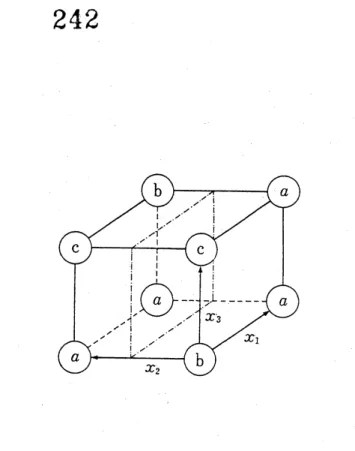
Figure 1: Dividing a table$f$ by avariable $i$. Figure 2: Example trees: (a) non-optimal. (b) optimal.
edge (except the root $R$ which has no in-edge) and
either zero or two out-edges. External nodes (leaves)
arethose withnoout-edges. Theremaining nodes are
called intemal. We call a decision tree simply a tree.
One maythink that each rule $x$ of a table $f$is
iden-tified as belonging to $fi^{0}$ or $fi^{1}$ according to $x;=0$
or 1, respectively, at each internal nodewhere the test
variable$i$is located. A path of the tree represents
suc-cessive such fixations. Thus a tree can be considered
as a device to determine values of a givenfunction by
means ofsuccessivefixations. We denote a tree by$T$,
or$T[f]$whenit isnecessary to indicate the initial table.
Given a criterion to choose a test variable, one can
construct a treebyconsistentlyselecting test variables
according to the criterion. This general algorithm
for constructing a tree is called a Variable Selection
Method (VSM). Thebasic operation ofmaking
L–l-subtables $fi^{0}$ and $fi^{1}$ from $f$ is called (dividing’ ofa
table (this correspondstorefining the action set inthe
table).
A VSM ends in $O(2^{L})$ operations, since possible
number ofsuch dividing of atable is at most$2^{L}-1$
.
2.3.
Minimum decision trees
For an L-ary table $f$, therecan be at most $\prod_{:}^{L_{=1}}i^{2^{-1}}$
equivalent trees $[ScS76]$. To construct “efficient” trees
we adopt the number ofinternal nodes ofatree $T$as
a cost of a tree and denote it by $|T|$
.
Since no test isrequired at leaves, $|T|$ is the cost forrepresenting the
whole test procedures of$T$, assumingthat the
determi-nation ofthe value of each property incurs a uniform
cost. We call a tree minimum(optimum) whenits cost
is aminimum
among
alltrees corresponding totheta-ble $f$
.
InFig.2
we
indicatea tree and a minimum tree
for the table of Table 1.
2.4.
Nonessential,
totally
essential
and
quasi-decisive variables
Beforegoingtovariable selection criteria, we introduce
some notions concerning “good” variables. To do this
we need a notation to represent fixed and free
vari-ables of a subtable. Our discussion usually concerns
an arbitrarily fixedsubtable $f$and itsdirect subtables
$fi^{s}$ for $s=0,1$
.
Let $f$ have all $h$ variables denotedby 1, .
..
,$h-1$ and $j(i\neq j, i=1, \ldots, h-1)$.
Let$u=u(1)\ldots u(h-1),$ $u(i)=i,$ $i=1,$$\ldots$,$h-1$ denote a
sequence (i.e. catenation) ofvariables 1,.
. .
,$h-1$.
Let$x=x(1)\ldots x(h-1),$ $x(i)=0$ or 1 for $i=1,$$\ldots,$$h-1$,
denote a bit sequence of length $h-1$
.
Let usabbrevi-ate a fixation $u(1)^{x(1)}\ldots u(h-1)^{x(h-1)}$ by$u^{x}$ for
sim-plicity. Now, let $u^{x}j$ represent a vector in which the
variables in $u$ are fixed to the values $x$ and avariable
$j$ is free. Finally, let us denote a l-subtable called a
j-parr by $f(u^{x}j)\equiv fu^{x}(u^{x}j)$, which consists of a pair
of rules of $f:(u^{x}j^{0}, f(u^{x}j^{0}))$ and $(u^{x}j^{1}, f(u^{x}j^{1}))$
.
Iftwoactionsof aj-pair coincide, it is a constantj-pair,
otherwise it is a nonconstant j-pair. Each fixation $u^{x}$
which gives constant or nonconstant j-pair is called
inactive or active fixation for$j$, respectively (hereafter
only $x$ is indicated instead of$u^{x}$ since $u$is determined
as the (complement’ sequence of$j$).
Example 2.1. For $x=10$ and $u=23$ thefixation $u^{x}$
denotes $2^{1}3^{0}$. Then l-pair $f(2^{1}3^{0}1)=f2^{1}3^{0}(2^{1}3^{0}1)$
in Table 2.1 is a constant l-pair, while $f(2^{0}3^{0}1)=$
$f2^{0}3^{0}(2^{0}3^{0}1)$ is a nonconstant l-pair. Hence the
fix-ation$2^{0}3^{0}$ is activewhile $2^{1}3^{0}$ is inactive.
A variable $i$ is nonessential in $f$ ifeach fixation $x$
for $i$ is inactive, i.e. $f(u^{x}i)=a_{j}$ for each $x$ (a
con-stant action
$a_{j}$ dependson
$x$). Also,a variable
$i$
is
$24i$
$f(u^{x}i)\neq$ const. for each $x$
.
When all variables arenonessential
then $f$ is a constant. Nonessentialvari-able and totally essential variable are abbreviated to
$nev$ and $tev$, respectively. A minimum tree doesn’t
have nevs as test variables [15]. A $tevi$ is an
opti-mum
variable [6], that is, the tree becomes minimumif we choose $i$ as a test variable and make its left and
right subtrees minimumfor $fi^{0}$ and $fi^{1}$, respectively.
Note that there cpuld be acase that someof the rules
are never executedactually (e.g. they could beimplied
byothersinpractical tables; this can be handledby
as-signing “probability” $0$to them). Theneven “essential
variables” need not be tested at all inthe tree. So in
this case the notion of “essentiality” should be
modi-fiedin an appropriate way. Throughout this paper we
assumethateach ruleisexecutable,i.e. the probability
of each rule is not $0$
.
There is another optimal variable. A variable $i$ is
decisive if$fi^{0}=a$ (cost.), $fi^{1}=b$ (const.) and$a\neq b$
.
A variable $i$ is quasi-decisive (abbreviated to $qdv$), if
$fi^{s}=$ const. and $fi^{i}\neq$ const. for strictly either one
of $s=0$ or 1 [14]. A $qdv$ is an optimalvariable with
respectthe cost definedinthis paper (however,itis not
an optimal variablein general with respect to another
one (e-cost)) [14].
Therefore,itis desirable fora criteriontoreject nevs
and select a $tev$ or a $qdv$ whenever they exist. Let us
callacriterion
nev-free
ifitselects nonevs. Again, letus call acriterion tev-bound or qdv-bound if it selects a
$tev$ or a$qdv$ whenever they exists.
In the next section we propose three VSM criteria
andexamineabovepropertiesfor them. Thisis
impor-tant for understanding the performanceofthe criteria,
since it is extremely difficult to show something
for-mallyabout the performance of thiskind ofheuristics.
3. Three
criteria
for
variable
se-lection
Weshall introduce three criteriafor variable selection
to construct an efficient tree in the sense of minimal
number of internal nodes (i.e. dividing). Our basic
strategy is to “produce constant tables as fast as
pos-sible“,sinceno moredividingis necessaryfor constant
tables. To do thiswe introducethreemeasuresof$(dis-$
tance” between a table and a constant from three
dif-ferent standpoints. Thenour criteriasimplyselectsuch
$i$that the “distance” between$fi$“ and a constant
func-tionfor both $s=0$ and 1 become a
minimum
amongallvariables.
The first criterion $\Gamma_{A}$ is implicit in some literature
$[23,19]$, approaching the problem from
combinatorial
analysis. The second criterion $\Gamma_{H}$ is presented in
[7,13,17]. Also there are several literature inwhich the
notion of entropy is applied for the problem in other
context (mostly with the treatment of “don’t care“
symbols $(-$“$)$ [6]. The entropy approach “views” the
occurrences of the actions as stochastic events. The
third criterion $\Gamma_{D}$ is new [13] and from the
discrimi-nant analysis standpoint [4], which is related to
multi-variate data analysis. In this framework, we use the
notion of((
$mean$ value” of the variable$x$; with respect
to the action $a_{j}$ (denoted by $\mu_{j}^{\dot{*}}$) as well as the total
mean value (denoted by $\mu_{T}^{:}$ whose valueis always 1/2
since wehave thesame number of ruleshaving $x;=0$
and $x;=1$), treating the values $0$and 1 as real
num-bers.
Before giving a detailed explanation of the criteria,
wegive notations and equations. We denoteby $N_{j}$ the
number of theoccurrencesof the action$a_{j}$ in$f$, by$N_{j}^{i}$
thenumber of rules $(x, f(x))$ suchthat $f(x)=a_{j}$ and
$x_{i}=s$for$s=0,1$
.
Further, let class$(j)$denote the setof vectors corresponding to action $a_{j}$
.
There hold thefollowingequations. 1) $N_{j}^{1^{O}}+N_{j}^{*^{1}}=N_{j}$, 2) $\sum_{j}N_{j}:=N^{i}=2^{L-1}=N/2,$ $s=0,1$, $3) \sum_{i}jN_{j}=N=2^{L}$, 4) $p_{j}$ $:=N_{j^{1}}/N^{i}=2N_{j}^{i}/N,$ $s=0,1$, 5) $w_{j}$ $:=N_{j}/N,$ $\sum_{j}w_{j}=1$,
6) $\mu_{j}^{1}$ $:=E_{j}x:= \sum_{class(j)}x_{i}/N_{j}=N_{j}^{i^{1}}/N_{j}$,
7) $\mu_{T}^{:}$ $:=Ex;= \sum x_{i}/N=\sum_{j}N_{i}^{1^{1}}/N=1/2$;
$\mu_{T}^{i}=\sum_{j}w_{j}\mu_{j}^{i}$
.
Now we present the threecriteriatogether withtheir
ranges forall tables.
Activity
criterion
$\Gamma_{A}$.
Define$A$; tobethenumberofactive i-pairsof$f$
.
Anactivei-paircanbeconsideredas alogical unit tobe separated bydividinga table (cf.
Fig 3). Then $A;= \sum_{:}^{n}A_{i}$ represents the total number
of i-pairs of $f$
.
Since $A_{2}$ active i-pairs disappear bydividing $f$ by $i$, we select a variable $i$ which have a
maximumnumber of$A$; among all variables.
Lemma 3.1. The number
of
active i-pair$A$:
ranges$0\leq A;\leq 2^{L-1}$
.
The best value $A_{i}=2^{L-1}$ is attainedif
and onlyif
$i$ is a totally essentialvariableof
$f$, andtheworst value $A_{i}=0$
if
and onlyif
$i$ isa nonessentialvariable
of
$f$.
Proof.
Obvious fromthe definition. $\square$Entropy
criterion
$\Gamma_{H}$.
The actions$a_{j}$
in
ata-ble$f$ can be considered to
occur
with the probabilities$w_{j}=N_{j}/N,$ $j=1,$$\ldots,$$K$
.
Therefore thenondetermi-nacy (ambiguity)
among
themcan
bemeasured
by the242
$H_{:}$ $:=-1/2 \sum_{s=0,1}\sum_{j=1}^{K}p_{j}^{:}\log p_{j}^{i}$
.
(3)Figure 3: Dividing by a variable 2 reduces 2 active
2-pairs.
$H(f)$ $:=- \sum_{j=1}^{K}w_{j}\log w_{j}$
.
(1)Theambiguityremainingaftertestingavariable$i$may
bedefinedastheaverageambiguity of the two fixations
$fi^{S}$ for $s=0$ and 1. The VSM procedure can be seen
as a process of perpetual increase of the determinacy
(equivalently, decreaseofthe ambiguity) of the tables
in each fixation until finallywe getalltables
completely
determined. Thusthe amount ofinformation obtained
by testingthevariable $i$ may be defined by
$H(f)-H(f|i)=H(f)-(- \sum_{\epsilon=0,1}w(fi^{s})\sum_{j=1}^{K}p_{j}^{i}\log p_{j}^{i})$,
(2)
where $w(fi^{S});=p(fi^{s})/p(f)$ denote the conditional
probabilities$p(fi^{s}|f)$of$f^{j}$ under$f,$$p_{j}^{i}$ theconditional
probabilitiesthatan action$a_{j}$ occursunder$x_{i}=s$,i.e.
$p_{j}^{i}=p(a_{j}|fi^{s})$ for $s=0,1$
.
Since the first term is aconstant for all variablesof$f$, only the second term is
sufficient. Also,inourcasethe probability ofanaction
is defined by the ratio of the number of rules having
theaction to the number of whole rules. Hence we have
$w(fi^{S})=1/2$ for $s=0,1$
.
Thus, we select a variable $i$which has the least value of
Lemma 3.2. The entropy $H$; ranges $0\leq H_{i}\leq\log K$
.
The best value $H_{i}=0$ is attained
if
and onlyif
either$f$ is a constant or $i$ is a unique essential vanable
of
$f$, and the worst value $H;=\log K$
if
and onlyif
eachaction $a_{j}$ occurs equip robably
for
$j=1,$$\ldots,$$K$ in bothsubtables $fi$“
for
$s=0$ and 1, $i.e$.
$p_{j}^{\dot{*}}=1/K$for
$j=$$1,$$\ldots K$) and$s=0,1$ (equivalently, $N_{j^{i}}=N/(2K)$).
Proof.
Put $H_{i}=(-1/2) \sum_{s=0,1}\sum_{j=1}^{K}p_{j}^{i}\log p_{j}^{1}$ $=$$0$
.
Since the function $-p\log p(0\leq p\leq 1)$ is anon-negative convex function, $H;=0$ is attained in, and
only in, the following four cases: ($p_{j^{O}}^{1}=0$ or$p_{j^{o}}^{1}=1$)
$a_{i}n_{o}d$ (
$p_{j^{1}}^{:}=0$ or $p_{j^{1}}^{1}=1$) for each$j$
.
However, thecase
$p_{j}=0$ and $p_{j^{1}}^{:}=0$for all$j$ can be excluded, becausethis means that no action
appear
in $f$.
Thus we have$p_{j}^{:}=1$ for some $j_{s}$ for $s=0$ and 1, i.e. $fi‘=a_{j}$
.
(aconstant) for $s=0$and 1. Thus, if$a_{jo}=a_{j_{1}}$ then $f$is
a constant, otherwise $i$isa unique essential variable of
$f$. Itis well-known that the uniquemaximum value of
the entropy function (1) is attained iff the probabilities
of theactions are uniform, i.e. $w_{j}=1/K$
.
In equation(3) this should hold for both $s=0$ and 1 (to assure
this we assumethat $2K$ divides $N$). $\square$
Note 3.3. Under given occurrences of actions:
$N_{1},$
$\ldots,$$N_{K}( \sum_{j}N_{j}=N)$, the maximumvalue $H_{i}=$ $-(1/N) \sum_{j}N_{j}\log N_{j}+\log N$ is attained if and only
if $i$ divides each
$N_{j}$ into equal halves for all $j$, i.e.
$N_{j}^{:^{o}}=N_{j}^{i^{1}}=N_{j}/2$ for 1 $\leq j\leq K$ (further when
$N_{j}=N/K$ we havethe worst value of the lemma).
Discriminant
criterion
$\Gamma_{D}$.
In a decisionta-ble each variable $x_{i}$ contributes to discriminate
dif-ferent actions. Hence one can measure
“discriminat-ing power” ofa variable $x_{i}$ from the standpoint of the
discriminant analysis [4], which presents the following
ratioofvariances as its measure:
$\eta_{i^{2}}$ $:=\sigma_{Bi}^{2}/\sigma_{Wi}^{2}$ (4)
where $\sigma_{Bi}^{2}$ and $\sigma_{Wi}^{2}$ represent the between-action
(in-terclass) and the within-action (intraclas$s$)variances of
the variable $x_{i}$, respectively, and definedby
$\sigma_{Bi}^{2}$
$:= \sum_{j}w_{j}(\mu_{j}^{:}-\mu_{T}^{:})^{2}$, (
$5\rangle$
$\sigma_{Wi}^{2}$
243
To make the point of the theory clear, let us
con-sider
an example that we have a single decisivevari-able
$i$ which separates actions $a$ and $b$, i.e. $fi^{0}=a$and
$fi^{1}=b$. The mean values of$x_{j}$ with respect tothe actions $a$ and $b$ is $\mu_{a}^{:}=0$ and $\mu_{b}^{i}=1$,
respec-tively, discriminating the two actions precisely. If the
twoactionsoccur in both subtables, the values$\mu_{a}^{1}$ and
$\mu_{b}^{i}$ are settled somewhere between $0$ and 1, reflecting
the mixed occurrences of the actions. Again, if the
occurrences
of the two actions are completely random($x_{i}=0$ and $x_{i}=1$ occur the same number for both $a$ and $b$), we have $\mu_{a}^{i}=\mu_{b}^{i}=1/2$
.
This exampleil-lustrates that “mean values” are useful for measuring
(discriminating ability” ofa variable. One may
won-der that the values $0$and 1 assumed by avariable are
(nominal’ entities only to be used to distinguish two
different things. However, as is shown in the
follow-ing Note 3.2 we can use $0$ and 1 in place of any two
different real numbers.
Table 2: Values of the measuresfor the function.
Note 3.4. The $\eta^{2}$ so defined by a
ratio
of twovari-ancesisinvariantunder an affine transformationof
co-ordinate $x$ to $y=b(x+a)$, i.e. shift $a$ and scalefactor
$b$; in other words from $x=0,1$to $y=ab,$ $b(1+a)$.
$\overline{x})^{2}=1/4=con^{1}stSince\sigma_{Bi}^{2}+\sigma_{W}^{2}=\sigma_{\tau:}^{2}an_{\frac{d}{x}}\sigma_{Ti}=_{2^{1/}N^{N\sum_{=}(x_{i}-}}(since=^{2}1/,x_{2}S_{))}^{I}the$
greater $\sigma_{B}^{2}$ , the greater
$\eta_{i}$, and the
$i$ which gives a
maximum$\eta$; alsogivesamaximumvalue for$\sigma_{Bi}^{2}$. Thus
the interclass variance$\sigma_{B_{i}}^{2}$ alone represents the degree
of separation of the classes. Hence we cantake $\sigma_{Bi}^{2}$ as
a selection criterion. Using$\sum w_{j}=1$, finallywe have:
Since $\sigma_{Bi}^{2}=\sum w_{j}(\mu_{j}^{i}-1/2)^{2}\leq\sum w_{j}\cdot 1/4=1/4$ and
thisis attained if and only if$\mu_{j}^{i}=0$or 1 for all$j$
.
From$\sigma_{Bi}^{2}=\sum_{j}w_{j}(\mu_{j}^{i}-\mu_{T}^{i})^{2}=0$ we have $\mu_{j}^{i}=\mu_{T}^{i}=1/2$
for all$j$
.
$\square$We note that thesame situation that $i$ divides each
action class into two halves gives the worst values for
both $H_{i}$ and $\sigma_{Bi}^{2}$ (cf. Note 3.4). Also note that there
are some relevance between situations that give best
values for the twocriteria.
$\sigma_{Bi}^{2}$ $=$ $\sum_{j}w_{j}(\mu_{j}^{:})^{2}-(\mu_{T}^{:})^{2}$ (6) $=$ $\sum_{j}w_{j}(\mu_{j}^{i})^{2}-1/4$ (7) $=$ $(1/N) \sum_{j}(N_{j}:1)^{2}/N_{j}-1/4$ (8)
(thus actually it suffices to calculate the first term).
Lemma 3.5. The between-action variance$\sigma_{Bi}^{2}$ ranges
$0\leq\sigma_{Bi}^{2}\leq 1/4$. The best value $\sigma_{Bi}^{2}=1/4$ is attained
if
and onlyif
$i$ divides the action set into two disjointsets, $i.e$
.
the actionsof
$fi^{0}$ and$fi^{1}$ have no action incommon, and the worst value $\sigma_{Bi}^{2}=0$
if
and onlyif
$i$divides each action class into two halves, $i.e$
.
$N_{j}^{i^{O}}=$$N_{i}^{i^{1}}=N_{j}/_{K}2.(equivalently, \mu_{j}^{\dot{*}}=1/2)$
for
each class$j$,$\gamma=1,$$\ldots$,
Proof.
Since$0\leq\mu_{j}^{1}\leq 1$,wehave$0\leq(\mu_{j}^{i}-1/2)^{2}\leq 1/4$and themaximum isattainedifandonly if$\mu_{j}^{:}=0$or 1.
Example 3.6. In Table 2 we give the values of the
above measuresfor the tablegiven in Table 1. All the
criteria selectthe variables 1or3 asa firsttest variable
and can give theminimumtree indicated
in
Fig. 2.4.
Properties
of
the
criteria
4.1.
Judgement
of
constant
tables
Since we compute values of the criterion for each
vari-able $i$, it is efficient ifwe can decide whether we need
furtherdividing of the table or not solelyfromthe
val-ues of the criterion for all variables of the table. The
most basic such recognition is whether the table is a
constantor not. We present the conditions ofconstant
tables for the three criteria.
Lemma 4.1. $A;=0$
for
all $i$if
and onlyif
$f$ is a244
Proof.
Assume $fu^{x}i=a$. Since $A;=0$ for all $i$,com-plementing a single value $x(j)$ keeps the action
invari-ant, becauseotherwisewe have$A_{j}>0$
.
Thus$fu^{x}i=a$for any$x$
.
Hence $f$ is a con$s$tant. $\square$Lemma4.2.
If
$i$ is a unique essential vanableof
$f$then $H_{l}>0$
for
any$l\neq i$.
Proof.
Since $fl^{0}=fl^{1}\neq$ const, $p_{j^{o}}^{l}\neq 0$ and $p_{j^{0}}^{l}\neq 1$for some $j$
.
Hence $H_{1}>0$ from (3). $\square$Lemma 4.3.
If
$f$ is a constant then $\sigma_{Bi}^{2}=0$for
all$i$.The converse is not true.
Proof.
Assume $f=a_{j}$.
Then $\mu_{j}^{:}=\mu_{T}^{:}=1/2$ for all$i$. Thus from Lemma 3.5 we have the assertion. It is
easy to see that there is a function $f\neq cost$. satisfying
$\sigma_{Bi}^{2}=0$for all $i$ (cf. Example4.1 below). $\square$
Theorem 4.4. The necessary and
sufficient
condi-tions
for
the constant judgementof
the criteria $\Gamma_{A}$;
$\Gamma_{H}$ are$A_{i}=0,$ $H_{i}=0$
for
each $i$, while thatfor
$\Gamma_{D}$ isthat there exists a unique vanable$j$ such that $w_{j}=1$
.
Proof
Theproofs for $\Gamma_{A}$and$\Gamma_{H}$ aredue to Lemma 4.1and Lemma 3.2 and 4.2, respectively. Thecondition for
$\Gamma_{D}$ is trivial. $\square$
Note 4.5. On the basis of Theorem 4.4 a practical
procedure for constant recognition canbe givenby
us-ing $A_{i}$ or $H_{i}$. If$\max_{i}A_{i}=0$ then $f$ is a constant.
Suppose $\min H;=0$
.
Ifthere is a$l$ such that $H_{l}>0$,then $i$ is a unique essential variable of
$f$. Otherwise $f$
is a constant.
4.2.
Rejection
of
nonessential
variables
(nev-free
property)
We show that thecriterion$\Gamma_{A}$do notselect a
nonessen-tial variable, while$\Gamma_{H}$ and $Gamma_{D}$ may doso. This
is done by indicating that extremum values of the
criteria $\Gamma_{H}$ and $Gamma_{D}$ can not be given only by
nonessential variables.
Lemma 4.6. The disc ‘minant criteri on takes a $\min-$
imum (worst) value$\sigma_{Bi}^{2}=0$
if
$i$ is a nonessentialvan-able. The converse is not $tr\eta te$
.
Proof.
Put $H_{*}$. $:=$ $\sum_{j}h_{j}^{i}$, where $h_{j}$ $:=-(1/2)$$(p_{j^{o}}^{i}\log p_{j^{o}}^{:}+p_{j^{1}}^{i}\log p_{j^{1}}^{:})$
.
Since $p_{j^{O}}^{i}+p_{j^{1}}^{i}=2(N_{j}:^{o}+$$N_{j}^{i^{1}})/N=2N_{j}/N=2w_{j}$ does not depend on $i$
.
Wecan consider $h_{j}^{i}$ as a function of$p_{j^{o}}^{1},$ $0\leq p_{j^{o}}^{:}\leq 2w_{j}$
.
Then
the
function$h_{j}^{i}(p_{j^{o}}^{2})$isnon-negativeandhas value$0$ at both boundaries, i.e. $h_{j}^{\dot{*}}(0)=h_{j}:(2w_{j})=0$
.
Fur-ther,it is $u_{P^{ward}}$ convex and symmetric with respect
to $p_{j^{o}}^{i}=p_{j}^{i}$
$=w_{j}$. Hence it has a unique maximum
when $p_{j^{O}}^{i}=p_{j^{1}}^{i}$. Thus $H_{i}$ takes a maximum value if
and only if$p_{j^{o}}^{i}=p_{j^{1}}^{i}$ for all$j$
.
$\square$Now we show that bothconversesofLemma 4.6 and
4.7 are not true by examples. The
reason
for this isthat $N_{j}^{1^{0}}=N_{j}^{i^{1}}=N_{j}/2$ for all $j$ does not imply $i$
to be nonessential. Indeed, in the examples below all
the variables (either essentialor nonessential) give
re-$spective\cdot tie$values with respectto the both criteria$H$;
and $\sigma_{Bi}^{2}$. Thus, we are not sure that we do not select
a worst variable (nonessentialvariableis a worst
vari-able) so far as we are selecting a variable solely onthe
basis of the values of the criterion. The criterion $\Gamma_{A}$
does not have this disadvantage. The unwelcome effect ofthis $nev$ selection on the cost of the resulting trees
is also discussed in [15].
We give 4-ary functions $f$ in the following two
ex-amples (only 3-ary functions $f1^{0}$ are indicated since
we set variable 1 (only) nonessential).
Example 4.8.
$f1^{1}$ $:=f1^{0},$ $f1^{0}(101)=f1^{0}(010)$ $:=b$,
$f1^{0}(x_{2}x_{3}x_{4})=a$
for
other$x_{2}x_{3}x_{4}$.
We have $A_{I}=0,$ $A_{\dot{*}}=2$for $i=2,3,4$. Also we have
$N_{a}^{i}=6$ and $N_{b}:=2$ for $i=1,2,3,4$ and $s=0,1$
.
Thus$\mu_{j}^{\dot{*}}=1/2$ for all $i$ and $j$, leading to $\sigma_{Bi}^{2}=0$ for
all$i$
.
Further,$p_{a}^{1}=3/4$ and$p_{b}^{i}=1/4$for $s=0,1$ and$i=1,2,3,4$ . Thus $H;=-(3/4\log 3/4+1/4\log 1/4)$
$=0.811$for all $i$
.
Example 4.9. The following $f1^{0}$ is a “parity”
func-tion.
$f1^{1}:=f1^{0}$,
$f1^{0}(x_{2}x_{3}x_{4})=\{ba$ $othe^{2}rwiseifx+x_{3}.+x_{4}=0$ $(mod 2)$,
Proof.
Assume that $i$ is nonessential. Then we havethe same number of$x_{i}=0$ and $x;=1$for each action
$a_{j}$. Then obviously $N_{j}:^{o}=N_{j}^{i^{1}}=N_{j}/2$
.
Hence fromLemma3.5 we havethe first assertion. $\square$
Lemma 4.7. The entropy $H_{i}$ takes a maximum
(worst) value
if
$i$ is a nonessentialvanable.
Thecon-verse is not true.
We have $A_{1}=0,$ $A_{i}=4$ for $i=2,3,4$
.
Alsowe have$\sigma_{Bi}^{2}=0$ and $H_{i}=1$ for all $i$.
Thus in these
cases
$\Gamma_{D}$ and $\Gamma_{H}$ may select $nev$$1$ while $\Gamma_{A}$ does not. Note that this crucial
nev-selection occurs only when $\sigma_{Bi}^{2}=0$ (a tie value) and
$H_{i}=H_{\max}$ $:=(1/N) \sum_{j}N_{i}\log N_{i}+\log N$ (atievalue)
245
thereexists $i$such that $\sigma_{Bi}^{2}\neq 0$ or $H_{i}\neq H_{\max}no$
nev-selection occurs. Hence we have:
Theorem 4.10. Only the criterion $\Gamma_{A}$ is nev-free,
while the other criterza $\Gamma_{H}$ and $\Gamma_{D}$ may select a
nonessential variable.
The next example indicates that $\Gamma_{H}$ and $\Gamma_{D}$ do not
give even unique values to totally essential variables.
Example 4.13.
4.3.
Selection
of
a
totally
essential
vari-able (tev-bound property)
Any$tev$ is an optimal variable. Soit is desirablefor a
criterion to select a$tev$ whenever it exists. We show
that this is true for $\Gamma_{A}$ but not true for $\Gamma_{D}$ and $\Gamma_{H}$
.
As we will see below, not only alltevs donot give
ex-tremum values but non-tevs also can give extremum
values with respect to the both criteria $\Gamma_{D}$ and $\Gamma_{H}$
.
Thusin a sense, they are notsensitive to total
essen-tialityofa variable.
We have the following values of the criteria for each
variable.
Theorem 4.11. The criterion $\Gamma_{A}$ is tev-bound, while
$\Gamma_{H}$ and$\Gamma_{D}$ are not.
Proof.
Thisis derived from Lemma 3.1 and theexam-plegiven below. $\square$
In thefollowing example all the variables (either
to-tally essentialornot)give tievalueswith respect to the
both criteria$\Gamma_{D}$ and $\Gamma_{H}$
.
Thus, we are not sure thatwe do select an optimal variableas faras weobey the
criteria $\Gamma_{D}$ or $\Gamma_{H}$
.
Indeed, they may select anon-tev1 which is not optimal. On the contrary the criterion
$\Gamma_{A}$ does not have this disadvantage.
Example 4.12.
In fact we have $H_{2}>H_{3}>H_{4}$ and $\sigma_{B_{2}}^{2}<\sigma_{B_{3}}^{2}<\sigma_{B_{4}}^{2}$
and the variable 3 is not $tev$ while the variables 2 and
4 are tevs. The criteria $\Gamma_{D}$ and $\Gamma_{H}$ select variable 4
(oneof the optimal variables), while $\Gamma_{A}$may select any
oftevs 1, 2 and 4.
4.4.
Selection of
a quasi-decisive
vari-able
(qdv-bound
property)
Lastly we will show that the
criteria
$\Gamma_{D}$ and $\Gamma_{H}$are
qdv-bound while $\Gamma_{A}$ isnot, i.e. $\Gamma_{A}$ may select a
non-qdv even if there are $qdvs$
among
the variables of$f$.
To show the qdv-bound property we mu$st$ show that
$qdvs$ give anextremum (maximumorminimum) value
ofthe criterion and, conversely,if there are $qdvs$, only
they (any of them) give an extremum value.
First we need anotation for treating a table having
qdvs which is used throughout this section. Assume
that $i$ is aO-side-qdv $(fi^{0}=a_{1})$, then $f$ can be
repre-sented asfollows:
We have the following values of the criteria for each
246
So the condition thatthe variable$i$ isa O-side-qdv is:
$N_{1}^{i^{O}}$ $=$ $M$, $N_{j}^{1^{O}}$ $=$ $0$for $j=2,$ $\ldots,$$K$, $N_{1}^{\dot{\iota}^{1}}$ $=$ $N_{1}-M$, $N_{j}^{:^{1}}$ $=$ $N_{j}$ for $j=2,$ $\ldots,$$K$, where $M:=N/2=2^{L-1}(K\geq 2)$
.
Let $k$ be anyvariable of$f(k\neq i)$
.
Put$m_{j}$ $:=N_{j}^{k^{O}},$ $n_{j}$ $:=N_{j}^{k^{1}}$
$(m_{j}+n_{j}=N_{j}, \sum_{j}m_{j}=\sum_{j}n_{j}=M)$, (9)
$j=1,$$\ldots,$$K$.
Now we have a lemma.
Lemma 4.14. The vanable $k$ is also a $qdv$ in $f$
if
and only
if
we have either $m_{j}=0(2\leq j\leq K)$ or$n_{j}=0(2\leq j\leq K)$
.
Proof.
The necessity is easilyseen from the conditionthat $k$ is also a $qdv$
.
Since then we can represent thesame table in the following form assuming that $k$ is
also decisivein O-side:
$qdvs$
.
This is easy to check for $\Gamma_{A}$ and $\Gamma_{H)}$ sinceac-tivities
are
$A;= \sum_{j=2}^{K}N_{j}=A_{k}$, and the entropy $H_{:}$isdetermined by the
occurrence
frequencies ofactionsin the two subtables $fi^{S}$ (independently from its rule
configurations). For discriminant criterion, this is not
obvious. However, we have $N_{1}^{i^{1}}=N_{1}^{k^{1}}=N_{1}-M$,
$N_{j}^{:^{1}}=N_{j}^{k^{1}}=N_{j}(2\leq j\leq K)$ when both $i$ and $k$ are
O-side-decisive or $N_{1}^{k^{1}}=M,$ $N_{j}^{k^{1}}=0(2\leq j\leq K)$
when $k$ is l-side-decisive. In both cases, $\sigma_{Bi}^{2}=\sigma_{B_{k}}^{2}=$
$(1/4)(N/N_{1}-1)$
.
Actually, we prove amore strongerresult for each criterion in the sequel (i.e. every $qdv$
gives an extremum value with respect to each
crite-rion). We also prove that for activity criterion only a
maximum valueis not strictly attained by qdvs. This
property makes the activity criterion not qdv-bound.
Lemma 4.15.
If
$i$ is a $qdv$, then $A_{i}$ is a maximum.Converse is not $trwe$
for
$L>3,$ $i.e$. a maximum$A_{i}$ isgiven not strictly by qdvs assuming there are qdvs, $in$
other words, $i$ may not be a $qdv$ assuming that $A$; is a
maximum and there are qdvs in $f$.
Proof.
Assuming $fi^{0}=a_{1},$$fi^{1}\neq$ const., we show $A_{k}\leq A_{i}$ for any $k$.
Let $D$ denote the set of ruleshaving different actions from $a_{1}$ in $f^{i^{1}}$ (the
comple-ment $\overline{D}=fi^{1}\backslash D$ consists of rules having action
$a_{1})$
.
Then the activity $A;=|D|= \sum_{j=2}^{K}N_{j}$.
Put $s:=|D|$ for simplicity. Foractive k-pairswe aresuffi-cientto consider only $fi^{1}$, sinceno active k-pai’r exists
in $fi^{0}$
.
Assume that there are $t$ active k-pairs within$D$
.
Then the other possibility of active k-pair isbe-tween $D$ and $\overline{D}$
and the number of such k-pairs is at
most$s-2t$
.
Hence total number ofactivek-pairs are at most$A_{k}\leq s-2t+t=s-t\leq A_{i}$. The equality holds ifand only if$t=0$, which is satisfied if (but not only if)
theconditioninLemma 4.14 holds,i.e. $k$ isalsoa$qdv$
.
Forthe second assertionwe give an example below. $\square$
Inthe followingexample weshow that$A_{k}=A_{i}=s$
(a maximumamong all variables) for a$qdvi$ and for a
non-qdv $k$
.
Thus$\Gamma_{A}$ isnot qdv-bound in this case.Then obviously $m_{j}=0$ for $j=2,$$\ldots k$
) The latter
alternativeoccurs when$k$isl-side-quasi-decisive. This
is obtained byexchangingvectors of$x_{k}=0$and$x_{k}=1$
in $fi^{1}$ so that the action $a_{1}$ covers$x_{k}=1$
.
Conversely,assume that $m_{j}=0$for$j=2,$$\ldots$,$K$. Then from (??)
we have $n_{j}$ $:=N_{j}^{k^{1}}=N_{j}$ for $j=2,$$\ldots$,$K,$ $N_{1}^{k^{O}}=M$
and $N_{1}^{k^{1}}=N_{1}-M$
.
This means that $k$ is also a0-side-qdv. $\square$
We note that all the three
criteria
$\Gamma_{A},$ $\Gamma_{H}$ and$Gamma_{D}$ give the same values, respectively, for all
Example 4.16. We represent a 4-ary function
$f(x_{1}x_{2}x_{3}x_{4})$ by giving$f1^{0}$ and $f1^{1}$:
$f1^{0}$ $:=a$, $f1^{1}(000)=b$, $f1^{1}(011)=c$,
$f1^{1}(110)=d$, $f1^{1}(x_{2}x_{3}x_{4})=a$ for other $x_{2}x_{3}x_{4}$
.
Wehave $A;=3$ for all $i=1,2,3,4$ ($t=0$ in all cases)
but only the variable 1 is $qdv$.
Wenote that only for 2-ary tables $(L=2)$ the
con-verse of the lemma holds, i.e. the conditions $A_{1}=$
$A_{2}=a$
maximum
andvariable 1 is $qdv$ implyvariable
$2_{-}4_{-}^{\triangleright}J$
.
Lemma 4.17.
If
$i$ is a $qdv$ then $H_{i}$ is a minimum.Conversely,
if
there are qdvs, then only qdvs give aminimum value
of
$H_{1}$.
Proof.
Let $fi^{0}=a_{1}$ and $k$ be any variable $(k\neq i)$.
We show$H;\leq H_{k}$ and the equality holds (if and) only
if $k$ is also a $qdv$. Denote the number of rules having
action$a_{1}$ and $x_{k}=0$ in$fi^{1}$ by$m_{1}’$ and similarly by$n_{1}’$
for $x_{k}=1$. That is $m1$ $;=$
$|$
{
$(x,$$f(x))$ havingaction$a_{1}$ and $x_{i}=1,$ $x_{k}=0$
}
$|$,$n_{1}’$ $;=$
$|$
{
$(x,$$f(x))$ havingaction$a_{1}$ and $x;=1,$ $x_{k}=1$
}
$|$.
Since rules of $fi^{0}$ consist exactly the same number
$(M/2)$ ofvectors of$x_{k}=0$ and $x_{k}=1$, we have (cf.
(9))
$m_{1}=M/2+m_{1}’,$ $n_{1}=M/2+n_{1}’(N_{1}-M=m_{1}’+n_{1}’)$
.
(10) From$p_{j}^{i}=N_{j}^{i}/M$we have for $i$ and $k$:
$p^{i_{1^{O}}}=1,$ $p_{j^{o}}^{i}=0$ for $j=2,$
$\ldots$,$K$, $p_{1}^{i^{1}}=(N_{1}-M)/M,$ $p_{j^{1}}^{i}=N_{j}/M$ for $j=2,$
$\ldots$,$K$,
$p_{j}^{k^{0}}=m_{j}/M$ for $j=1,$
$\ldots$,$K$,
$p_{j}^{k^{1}}=n_{j}/M$ for $j=1,$
$\ldots,$$K$.
Substituting these into (3), we have (hereafter all the
summation is for $2\leq j\leq K$ unless explicitly stated in
other way):
$s$ $:=-N(H;-H_{k})=(N_{1}-M)\log(N_{1}-M)/M$
$+ \sum(N_{j}\log N_{j}/M)-\sum_{j=1}^{K}(m_{j}\log m_{j}/M$
$+n_{j}\log n_{j}/M)$
$=(N_{1}-M)\log(N_{1}-M)-(m_{1}\log m_{1}+n_{1}\log n_{1})$ $+M \log M+\sum(N_{j}\log N_{j}-m_{j}\log m_{j}-n_{j}\log n_{j})$.
Again, substituting $m_{j}=N_{j}-n_{j},$ $j=1,$$\ldots,$$K$, we
have $s=(N_{1}-M)\log(N_{1}-M)$ $+M\log M-(N_{1}-n_{1})\log(N_{1}-n_{1})-n_{1}\log n_{1}$ $+ \sum((N_{j}-n_{j})\log N_{j}/(N_{j}-n_{j})+n_{j}\log N_{j}/n_{j})$
.
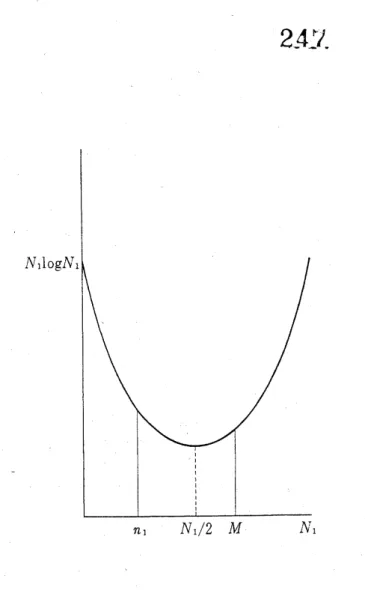
Putting$t(x)=(N_{1}-x)\log(N_{1}-x)+x1ogx$, $s=t(M)-t(n_{1})$ $+ \sum((N_{j}-n_{j})\log N_{i}/(N_{j}-n_{j})+n_{j}\log N_{j}/n_{j})$.
Figure 4: The function $t(x)=(N_{1}-x)\log(N_{1}-x)+$
$x\log x(0\leq x\leq N_{1})$
.
From $N_{j}\geq n$; the last term is non-negative $(\geq 0)$
.
We show that $k$isa$qdv$ ifand only if$t(M)\leq t(n_{1})$.
The function$t(x),$ $0\leq x\leq N_{1}$ is a monotone
symmet-ricwith respect to $x=N_{1}/2$ (cf. Fig. 4). Considering
$n_{1}\leq M,$ $N_{1}/2\leq M\leq N_{1}$, wehave
$n_{1}\leq N_{1}/2-(M-N_{1}/2)=N_{1}-M\Leftrightarrow t(M)\leq t(n_{1})$
.
(11)
Substituting (10) into (11), we conclude $t(M)$ $\leq$
$t(n_{1})\Leftrightarrow M/2\leq m_{1}’$
.
Since there are another $M/2$ruleshaving action $a_{1}$ an$dx_{k}=0$ (amongthe rulesof
$x_{i}=0)$, this means that $k$ is also O-side-decisive, i.e.
$fk^{0}=a_{1}$ (a constant). Hence, if$k$ is not a $qdv$, then
$s>0$
.
Thus, whenever a$qdv$ exists, a $qdv$ is selected(ifthere are many qdvs thenany of them, becausethey
giveatievalue),since weselect a variable$i$whichgives
aminimal value of$H_{i}$
.
$\square$Lemma 4.18.
If
$i$ is a $qdv$, then $i$ gives a maximumvalue
of
$\sigma_{Bi}^{2}$. Conversely,if
there are qdvs then onlyqdvs give a maximum value
of
$\sigma_{Bi}^{2}$.
248
$(1/N) \sum_{j}(N_{j}^{i^{1}})^{2}/N_{j}$
.
Putting $N_{j}’$ $:=N_{1}\cdots N_{j-1}$.
$N_{i+1}\cdots N_{K}$,we have$N \cdot N_{1}\cdots N_{K}\cdot B;=\sum_{j}N_{j}’(N_{j}^{i^{1}})^{2}$
.
Following thenotation (10)for the variable$k$, consider
$h$
$:=N \cdot N_{1}\cdots N_{K}(B_{i}-B_{k})=\sum_{j=1}N_{j}’((N_{j}^{i^{1}})^{2}-n_{j}^{2})$
.
Substituting $N\dot{i}^{1}=N_{1}-N/2$ and $n_{1}=N/2- \sum^{(13)}n_{j}$
into (13), we have thefollowing:
$h=N_{1}’(N_{1}-N/2)^{2}+ \sum N_{j}’N_{j}^{2}$ $-N_{1}’(N/2- \sum n_{j})^{2}-\sum N_{j}’n_{j}^{2}$
$=N_{1} \cdots N_{K}(\sum_{j=1}N_{j}-N)+N_{1}’(N^{2}/4)$
$-(N_{1}’(N^{2}/4-N \sum n_{j}+(\sum n_{j})^{2})-\sum N_{j}’n_{j}^{2}$ $=N_{1}’N \sum n_{j}-N_{1}’(\sum n_{j})^{2}-\sum N_{j}’n_{j}^{2}$
.
Again, substituting $N= \sum_{j=1}^{K}N_{j}=N_{1}+\sum N_{j}$ into
this, we have
$h=N_{1}’N_{1} \sum n_{j}$
$+N_{1}’( \sum n_{j})\sum N_{j}-N_{1}’(\sum n_{j})^{2}-\sum N_{j}’n_{j}^{2}$
.
Using
N\’i
$N_{1} \sum n_{j}=\sum N_{j}’N_{j}n_{j}$, wefinally have$h= \sum N_{j}’N_{j}n_{j}$
$- \sum N_{j}’n_{j}^{2}+N_{1}’(\sum n_{j})(\sum(N_{j}-n_{j}))$
$= \sum N_{j}’n_{j}(N_{j}-n_{j})+N_{1}’(\sum n_{j})(\sum(N_{j}-n_{j}))$
$\geq 0$.
The equality holds strictly either $n_{j}=0$ for $j=$
$2,$
$\ldots,$$K$or $N_{j}=n_{j}$ for$j=2,$$\ldots,$$K$
.
Thismeans thatthe equality$\sigma_{Bi}^{2}=\sigma_{Bk}^{2}$ holds whenand onlywhen the
variable $k$is alsoa $qdv$fromLemma4.14. $\square$
From Lemmas 4.15,4.17,4.18, we have the following
theorem.
Theorem 4.19. The two cmteria$\Gamma_{H}$ and$\Gamma_{D}$ are
qdv-bound, while $\Gamma_{A}$ is not.
5.
Discussions
and
Conclusions
An efficient VSM (variable selection method
accord-ing to a criterion) constructs a near optimum tree in
theaveragemuch less computation than the worstcase
evaluation $O(L^{2}2^{L})$ with $O(L2^{L})$ storage, where $L$ is
the number ofvariables of the table.
Inthis paperwe have developed the threecriteria for
such VSM from three different standpoints: $\Gamma_{A}$
(activ-ity criterion) from combinatorial,$\Gamma_{H}$from entropy and
$\Gamma_{D}$fromdiscriminant analyses, for constructingan
op-timum tree in the sense of the number of nodes ofthe
tree.
The three criteriahave been examined with respect
to the conditions which an optimum criterion should
satisfy: rejection of nonessential variables (nev-free),
selection of a totally essential variable and a
quasi-decisive variable (tev-bound and qdv-bound properties;
both $tev$ and $qdv$ are optimal variables). We have
shown that $\Gamma_{A}$ is nev-free, tev-bound but not
qdv-bound, while the two criteria $\Gamma_{H}$ and $\Gamma_{D}$ are neither
nev-free nor tev-bound but qdv-bound. It is hard to
claim thatonecriterionis better thanothersonlyfrom
these considerations. Consequently, a series of
exper-iments‘was done, comparing the costs of these near
optimum trees also with those of optimum trees. It
shows that activitycriterionis slightly better than
oth-ers(1.03 versus 1.05in terms of optimality coefficient)
with comparable computation; the other two indicates practically identical performance.
Entropy of a variable is defined simply through
oc-currencefrequencies ofall actionsregardless its
struc-ture in the conditional part an$d$ discriminant criterion
inspects the rules in which the bit ((1) is standing in
thecorresponding variable, while activity of a variable
takesintoaccount also the values of the other variables
in the rule to some extent. This difference may have
producedtheslightly better coefficient for the activity.
An extension ofthe criteria to the casethat testing
a variable$i$ incurs a certain cost $C_{i}$ depending on the
variable (general “description cost”) may be to use a
quantity given by dividing the value of the described
criterion by $C_{1}$ as a new criterion. Then, however, for
such criteriaone can not prove any of the formal
prop-erties whichwe have showninthis paper, although the
properties that$nev$ is a worst and$tev$ and $qdv$ are
op-timal variablesremain valid.
VSM criteriafor the case when the cost ofa tree is
definedastheaveragecost oftesting canbeobtainedin
thesameway. We have observed a similar experimental
result concerning the comparative performance of the
threecriteria. The combinatorialcriterionfor this cost
has also been studiedin more detail in [Miy89].
The newly introduced discriminant criterion $\Gamma_{D}$ has
an evident computational advantage over entropic
cri-terion $\Gamma_{H}$, although the required numbers of basic
op-erations (bit-test) remain the same order. This
direc-tion would provide us further development of the
249
Acknowledgement
Thefirst author wishesto dedicate this paper to the
memory of the late Hitoshi Miyakawa.
References
[Bay73] Bayes A.J.: A dynamic programming
algo-rithm to optimise decision table code.
Aus-tralian Computer J. 5, 2 (May 1973), 77-79.
[Bud85] Budach L.: A lower bound for the number of
nodes in a decision trees, Electron Inf. verarb.
Kybern. EIK 21 (1985) 4/5, 221-228.
[Cha87] Chan, A. H.:Using decision trees to derive
the complement of a binary function with
multiple-valued inputs, IEEE Trans. on
Com-put., C-36, 2, 1987, 212-214.
[Fis36] FisherR.A. The use of multiple measurements
in taxonomicproblems, Ann.Eugenics,7, Part
II, 179-188 (1936).
[Gar72] Garey, M.R.: Simple Binary identification
problems. IEEE Tkans. Comput. TC-21, 6,
588-590, June 1972.
[Gan73] Ganapathy.S., Rajaraman, V.: Information
theoryappliedto theconversion of decision
ta-bles to computerprograms. Comm. ACM, 16,
9, 532-539, Sept., 1973.
[HVMG82] Hartman, C.R.P.,Varshney, P.K.,
Mehro-tra,. K.G., Gerberich, C.L.: Application of
in-formation theory to the construction of
effi-cient decision trees. IEEE ’hans. on
Informa-tion theory IT-28,4, 565-577, July 1982.
[HyR76] Hyafil,L.,Rivest,R.L.: Constructingoptimal
binary decision trees is NP-complete. Comm.
ACM 5, 1, 15-17, May 1976.
[Knu73] Knuth, D.E.: The art ofcomputer
program-ming,vol. 1,2nded.Reading,Mass.:
Addison-Wesley, 1973.
[Knu73] Knuth, D.E.: The art ofcomputer
program-ming,vol. 3,Reading, Mass.: Addison-Wesley,
1973.
[Lov85] Loveland, D. W,: Bounds for binary testing
with arbitrary weights, Acta Informatica 22,
101-114, 1985.
[MiS80] Miyakawa, M., Sabelfeld, V.K.: On
mini-mizations of size of logical schemes (in
Rus-sian).Theoretical basisofcompiling (A. P.
Er-shov, ed.), 49-58, Novosibirsk State University,
Novosibirsk 1980.
[MiO82] Miyakawa, M., Otsu, N.: Algorithms for
constructing near-minimum total nodes
de-cision trees from expanded decision tables
(Japanese). TGEC IECE Japan, EC82-33,
July 1982.
[Miy85] Miyakawa, M.: Optimum decision trees - an
optimalvariabletheoremanditsrelated
appli-cations-. Acta Informatica 22, 475-498, 1985.
[Miy89] Miyakawa, M.: Criteriafor selectingavariable
in the construction of efficient decision trees,
IEEE Trans. Comput., to appear.
[MTG80] Moret, B.M.E., Thomason, M.G., Gonzalez,
R.C.: The activity of a variable and its
rela-tionto decision table. ACM Trans. Prog. Lang.
Syst. 2,4, 580-595, Oct. 1980.
[MTG81] Moret, B.M.E., Thomason, M.G., Gonzalez,
R.C.: optimization criteriafor decision trees,
Dept. of Computter Science, Collage of
Engi-neering, University of New Mexico, Technical
Report CS81-6, 1981.
[Mor82] Moret, B.M.E.: Decision trees and diagrams.
ComputingSurveys 14, 4, 593-623, Dec. 1982.
[Res66] Reinwald, L.T., Soland, R.M.:
Conversion
oflimited-entry decision tables to optimal
com-puterprogramsI:minimum average processing
time. JACM 13, 3, 339-358, July 1966.
[ReS67] Reinwald, L.T., Soland, R.M.: Conversion of
limited-entry decision tables to optimal
com-puter programs II: minimum storage
require-ment. JACM 14, 4, 742-755, Oct. 1967.
[Sas85] Sasao, T: An algorithm to derive the
com-plement of a binary function with
multiple-valued inputs, IEEETrans.on Comput.,C-34,
2, February 1985, 131-140.
[ScS76] Schumacher, H., Sevcik, K.:The synthetic
ap-proach to decision table conversion. Comm.
ACM 19, 6, 343-351, June 1976.
[Spr66] Sprague V. G.: On storage space of decision
trees. Comm. ACM 9, 5, 319-319, May 1966.
[Ver72] Verhelst M.: The conversion oflimited-entry
decision tables to optimal and near optimal
flowcharts: two new algorithms. Comm.ACM
15, 11, 974-980, November 1972.
[Weg84] Wegner I.: Optimal decision trees and
one-time-only branching programs for symmetric
Boolean functions. Information and Control