Geometric
Variational Problems
Arising
in
Reaction-Diffusion
Systems
広島大学 坂元国望 (Kunimochi Sakamoto)
Graduate School of Science, Hiroshima University.
モスクワ大学 ニコライ・ネフェドフ (Nikolay N. Nefedov)
Department of Mathematics, Moscow State University.
Reaction-diffusionsystemshave served as apradigm tomodel variouspatternformation
phenomenain nature. Since almost all patterns observed in nature are usually recognized
as an interface between two (or more) bulk states of differing properties, much attention
has been given in recent years to the study of interface dynamics in reaction-diffusion
systesm. In such astudy, oneusually derive systems ofequations governing the dynamics
of $\mathrm{i}\mathrm{n}\mathrm{t}\mathrm{e}\mathrm{r}\mathrm{f}_{\dot{\epsilon}}\iota \mathrm{c}\mathrm{e}\mathrm{s}_{\dot{J}}$ called interface equations. There are many aspects
in dealing with pattern
formation phenomenain terms of interface equations. From amathematical standpoint,
the following are major ones:
(1) How to derive interface equations from the original reaction-diffusion systems
(2) To show the well-posedness ofthe interface equations thus obtained.
(3) To study the quantitative and qualitative behaviors of the solutions tothe interface
equations.
(4) To establish rigorous relationships between the results obtained in item (3) and the
properties ofsolutions to the original reaction-diffusion systems.
In regard to items (1) and (4), one must keep in mind that there may be more than
one set of interface equations, according to the temporal scale employed in the reaction
diffusion system.
Our purpose in this article is toshowanexamplein which interfaceequations arederived
from ageometric variational problem. Wealso show that non-degenerate equilibria of the
interface equations give rise to an equilibrium solution of the original reaction-diffusion
systems with the information on stability being inclusive. Schematically, our results may
be described in the following way.
$\bullet$ Reaction-Diffusion Systcm
$arrow \mathrm{G}\mathrm{e}\mathrm{o}\mathrm{m}\mathrm{e}\mathrm{t}\mathrm{r}\mathrm{i}\mathrm{c}$Variational Problem $arrow \mathrm{F}\mathrm{i}\mathrm{n}\mathrm{d}$ non-degenerate critical points
$arrow \mathrm{E}\mathrm{q}\mathrm{u}\mathrm{l}\mathrm{i}\mathrm{b}\mathrm{r}\mathrm{i}\mathrm{u}\mathrm{m}$ solutions to Reaction-Diffusion System.
In \S 1., we deal with scalar equations with spatially inhomogeneous reaction terms.$\cdot \mathrm{T}11\mathrm{e}$
results in this section are equally valid for gradient systems. In $\S 2\dot,$ we generalize the
results in
\S 1
to non-gradient systems of reaction-diffusion equations with homogeneousreaction terms. In fi3, we outline basic ideas in the proofs of main results
数理解析研究所講究録 1210 巻 2001 年 29-42
1. SCALAR REACTION-DIFFUSION EQUATIONS
Let
us
consider aspatially inhomogeneous reaction-diffusion equation(1.1).
$\{\begin{array}{l}\epsilon^{2}\frac{\partial u}{\partial t}=\epsilon^{2}\Delta u-f(u,x,\epsilon)\frac{\partial v}{\partial \mathrm{n}}=0\end{array}$ $(.\cdot X(l.\in\partial D, t>0)\in D\subset \mathbb{R}^{l\mathrm{V}}.t.>0)’$’
In (1.1), $D$is asmoothbounded domain and$\mathrm{n}$standsfor the inward unit normalvectoron
$\partial D$
.
Thenonlinear term $f(u, x, \epsilon)$ is assumed to be smooth and derived from adouble-wellpotential $\mathrm{I}l^{\gamma}(u, !., \epsilon)$:
(1.2) $f(u,x, \epsilon)=\frac{\partial W(u,\prime \mathrm{r},\epsilon)}{\partial u}$
.
with $u=\phi^{(\pm)}(x, \epsilon)$ denoting the locations of two wells and $u=\phi^{(0)}(x, \epsilon)$ denoting the
intermediate
zero
of$f$, satisfying(1.2-a) $\phi^{(-)}(x, \epsilon)<\phi^{(0)}(x, \epsilon)<\phi^{(+)}(x, \epsilon)$ $x\in\overline{D}$
.
When the layer parameter $\epsilon>0$ is small, it is known [2] that the solution of (1.1) with
an
initial condition in appropriate class develops internal layers in ashort time and thatthe location of the layers (called interfaces)
moves
according to certain law of motion. Inthe latter stage of dynamical behavior, the difference in the values of potential at the two
wells plays an important role. Let us denote the difference at each $x\in\overline{D}$ by $I(!.)$:
(1.3) $I(x):= \int_{\phi \mathrm{t}-)(x)}^{\phi^{(+)}(x)}f(u,x,0)du$
$=W(\phi^{(+)}(x),x, 0)-\mathrm{T}\mathrm{f}^{\gamma}(\phi^{(-)}(x),.x., 0)$
where $\phi^{(\pm)}(x)=\phi^{(\pm)}(!., 0)$ (cf. (1.2-a)).
Under the situation above, it is known that the boundary value problem
(1.4) $\{\begin{array}{l}\frac{el^{2}\tilde{Q}_{0}}{d\tau^{2}}.+c\frac{d\tilde{Q}_{0}}{d\tau}-f(\tilde{Q}_{0},.\tau,0)=0\tau\in \mathbb{R}\lim_{r-\pm\infty}\tilde{Q}_{0}(\tau)=\phi^{(\pm)}(.\prime r),\tilde{Q}_{0}(0)=\phi^{(0)}(x)\end{array}$
has aunique solution $(\tilde{Q}\mathrm{o}(\tau;.\tau), c(x))$, where $x\in\overline{D}$ is regarded
as
apara neter. Thcpotential difference $I(x)$ in (1.3) is related to the local
wave
speed $c(x)$as
follows.(1.5) $I(. \tau\cdot)=c(x)\int_{-\infty}^{\infty}(\frac{\partial\tilde{Q}_{0}(\tau,\tau)}{\partial\tau}\cdot.)^{2}d\tau$
.
Let
us
rescale time in (1.1) such that the differential equationassumes
the followingfor $\mathrm{m}$
.
(l.l-f) $\epsilon\frac{\partial u}{\partial t}$
.
$=\epsilon^{2}\Delta u-f(u, .\tau, \epsilon)$
.
The interface equation for this problem is given by
(IE-f) $\mathrm{V}(.\tau\cdot;\Gamma(t))=c(.’\iota\cdot)$ $x\in\Gamma(t)_{:}$
.
$t>0$.
where $\mathrm{V}(\mathrm{r};\mathrm{I}^{\ovalbox{\tt\small REJECT}}(t))$ stands for the normal velocity of $\mathrm{r}^{\ovalbox{\tt\small REJECT}}(\mathrm{t})$
.
For agiven interface$\mathrm{r}^{\ovalbox{\tt\small REJECT}}$, we
denote by $y)^{\ovalbox{\tt\small REJECT}}\ovalbox{\tt\small REJECT}_{\ovalbox{\tt\small REJECT}}$ )
and 7)$\ovalbox{\tt\small REJECT}^{+)}$ two components of $\mathrm{O}^{\ovalbox{\tt\small REJECT}}\ovalbox{\tt\small REJECT} \mathrm{Y}$, and let $\mathrm{p}(\mathrm{r}\ovalbox{\tt\small REJECT} \mathrm{I}^{\ovalbox{\tt\small REJECT}})$ stand for the unit
normal vecotor on $\mathrm{r}^{\ovalbox{\tt\small REJECT}}$ pointing into $\cdot\ovalbox{\tt\small REJECT}^{+)}$ (cf. Figure 1). The normal velocity $\mathrm{V}(\mathrm{r}\ovalbox{\tt\small REJECT} \mathrm{I}^{\ovalbox{\tt\small REJECT}}(\mathrm{f}))$
is always measured along $\mathrm{p}(\mathrm{r}\ovalbox{\tt\small REJECT} \mathrm{I}^{\ovalbox{\tt\small REJECT}}(\mathrm{f}))$
.
Here and in what follows, we always treat thecases
$D$
FIGURE 1. $\Gamma$ divides $D$ into two parts, $D_{\Gamma}^{(-)}$ and $D_{\Gamma}^{(+)}$
.
where interfaces stay uniformly away from the boundary $\partial D$ ofdoamin.
From the standpoint of investigating the existence of equilibrium internal layer
solu-tions, it is natural to ask the next question:
If the interface equation (IE-f) has asmooth equilibrium solution $\Gamma$, then does
(1.1) have afamily of equilibriumsolutions with transition layerson $\Gamma$for small
$\epsilon>0$?
It turns out that the answerto this question is ratherdelicate. In [3], Fife and Greenlee
prove that the answer is affirmative if the condition
$\nabla_{x}c(x)|_{\Gamma}\cdot\nu(x, \Gamma)<0$ $x\in\Gamma$
is fulfilled, where $\Gamma$ is asmooth equilibrium solution of (IE-f), namely, $\Gamma=\{x\in$
$D|c(x)=0\}$ which, we suppose, is aclosed manifold of codimension 1. Moreover,
the solution thus obtained is astable equilibrium of (1.1). The equilibrium solution
$u(.x., \epsilon)$ has the following behavior for each $d_{0}>0$:
$\epsilon\varliminf_{0}?\mathit{1}(x., \epsilon)=\{\begin{array}{l}\phi^{(-)}(x)x.\in\overline{D_{\Gamma}^{(-)}}\backslash \Gamma^{(d_{0})}\phi^{(+)},(.\tau).\prime \mathrm{r}\in\overline{D_{\Gamma}^{(+)}}\backslash \Gamma^{(d_{0})}\end{array}$ uniformly,
where $\Gamma^{(d_{0})}$ stands for the $d_{0}$-neighborhood of $\Gamma$
.
It is of crucial importance to note thatthe normal vector $\nu$ above is pointing into the regionwhere the solution $u$ assumes values
close to $\Phi^{(+)}$. Since $c(.\tau)\equiv 0$ on $\Gamma$, the condition above says that in the two regions away
from the interface $\Gamma$ the solution takes values close to absolute minima of the potential
$\mathrm{I}\prime \mathfrak{s}/-(u\tau\cdot.0)\dot{\prime}.’$.
On thc other hancl., it is also pointed out in [12], in the context of the
same
questionfor asystem of reaction-diffusion equations, that if., on the other hand., the condition
$\nabla_{x}c(.\tau^{\tau})|_{\Gamma}\cdot\nu(x., \Gamma)>0$ $.\tau\cdot\in\Gamma$
is the case, then there may exist infinitely many internal laryer solutions which exhibit
sharp transitions near$\Gamma$
.
In radially symmetriccases, the validity of the latter statement
has been established in [13]. By examining the proof in [12] and interpreting it in our
situation,
we can
state the following criterion on the existence of equilibrium internallayer solutions.
Criterion 1: Let $\Gamma$ be asmooth equilibrium solution of (IE-f).
If it is
non-degenerate in the
sense
that the spectrum of the linearized operator$L^{\mathrm{e}}\varphi$ $:= \epsilon(\Delta^{\Gamma}+\sum_{j=1}^{N-1}\kappa_{j}(x)^{2})\varphi+(\nabla_{x}c(x)|_{\Gamma}\cdot\nu(x, \Gamma))\varphi$ $x\in\Gamma$,
defined
on
$\Gamma$, isbounded away fromzero
uniformly in$\epsilon\in(0, \epsilon\circ]$ forsome $\epsilon_{0}>0.$,
then (1.1) has afamily ofsolutions with internal transition layer on $\Gamma$. In the
above, $\Delta^{\Gamma}$ is the Laplace-Beltrami
operator
on
$\Gamma$ and $\kappa_{i}(j=1, \ldots, N-1)$stand for principal curvatures of$\Gamma$
.
Since $\Delta^{\Gamma}$ is anon-positive oprator, it
is apparent that if $\nabla_{x}c(x)|_{\Gamma}\cdot\nu(x, \Gamma)<0$then the
spectrum ofthe operator $L^{\epsilon}$ is
bounded away from
zero
uniformly in $\epsilon>0$. Hence thecriterion above is compatible with the result given by Fife and Greenlee [3].
Let
us
consider the following situation.Al $I(x)\equiv 0$
on
$\overline{D}$, orequivalently, $c(x)\equiv 0$ on $\overline{D}$
.
If Al is the case, there arises two kinds of degeneracy:
(1) Any closed
manifold
$\Gamma\subset D$ ofcodimension one is an equilibrium of (IE-f)(2) The corresponding linear operator $L^{\mathrm{e}}$ in the Criterion
1reduces to $\epsilon$ times the
Jacobi-0perator
on
$\Gamma$ and hence it has many small eigenvalues convergingto 0as
$\epsilonarrow 0$, making the criterion above powerless.
Therefore, we need first to establish aselection principle to identify possible equilibrium
interfaces.
Along the line of arguments employed in Nakamura et al. [6],
onc
can show that theinterface equation for (1.1) is given by
(1.6) $\mathrm{V}(x;\Gamma(t))=-\kappa(x;\Gamma(t))-\frac{\nabla_{\nu_{\Gamma}}n\iota(x)}{m(x)}.+\frac{\alpha(\tau)}{nl(\prime \mathrm{r})}.$
.
$x\in\Gamma(t)$, $t>0’$.
where $\kappa(x;\Gamma)$ stands for the
sum
ofprincipal curvature of$\Gamma$ and(1.6-a)
$nl(x)= \int_{-\infty}^{\infty}(\frac{\partial\tilde{Q}_{0}(\tau,x)}{\partial\tau}\cdot)^{2}cl\tau$ $x\in\overline{D}$ (unit transition momentum at
$.\tau\cdot$) $.$
,
(1.6-b)
$\alpha(x)=\int_{-\infty}^{\infty}f_{\epsilon}(\tilde{Q}\mathrm{o}(\tau;x), x, 0)\frac{\partial\tilde{Q}_{0}(\tau\cdot x)}{\partial\tau’}d\tau$ $x\in\overline{D}$ (
$\mathrm{e}\mathrm{x}\mathrm{c}\mathrm{e}\mathrm{s}\mathrm{s}- \mathrm{e}\mathrm{n}\mathrm{e}\mathrm{r}\mathrm{g}\dot{\mathrm{y}}$ of order $\epsilon$).
We
now
assume
that the following conditions are fulfilled.A2 The interface equation (1.6) has asmooth equilibrium solution $\Gamma\subset D$.
A3 The equilibrium $\Gamma$ is non-degenerate in the sense that the linear operator
$A$ defined below does not have
0as
its eigenvalue:(1.7) $A \varphi(.’\tau):=\uparrow?l(x)(\Delta^{\Gamma}+\sum_{j=1}^{N-1}\kappa_{j}^{\sim}(x)^{2})\varphi(x)+\nabla_{\Gamma}n\mathrm{z}(x)\cdot\nabla_{\Gamma}\varphi(x)$
$+(-\kappa(x;\Gamma)\nabla_{\nu_{\Gamma}}m(x)-\nabla_{\nu_{\Gamma}}^{2}m(x)+\nabla_{\nu_{\Gamma}}\alpha(x))\varphi(x)$ $x\in\Gamma$,
where $\nabla_{\Gamma}$ is the gradient operator on $\Gamma$
.
$1\mathrm{t}^{r}\mathrm{e}\mathrm{h}_{\dot{\epsilon}}\iota \mathrm{v}\mathrm{e}$:
Lemma 1.1. The operator $A$ is self-adjoint and its eigenvalues are all real:
(1.8) $\sigma(A)=\{\lambda_{j}\}_{j=0}^{\infty}\subset \mathbb{R}$, $\lambda_{0}>\lambda_{1}>\ldots>\lambda_{j}arrow-\infty$,
where only distinct eigenvalues are listed. The multiplicity
of
$\lambda_{j}$ is denoted by $mj\geq 1$.Let us now define afunctional $F(\Gamma)$ by
(1.9) $\mathrm{F}(\mathrm{T}):=\int_{\Gamma}m(x)dS_{x}^{\Gamma}-\int_{D_{\Gamma}^{(-)}}$ $a(x)dx$ $(\partial D_{\Gamma}=\Gamma’$
.
where $dS_{x}^{\Gamma}$ stands for the
surface
elementon $\Gamma$.
Lemma 1.2. The Euler-Lagrange equation
for
$F$ is given by(1.10) $-\mathrm{k}(\mathrm{x};\Gamma)?n(x)-\nabla_{\nu_{\Gamma}}nl(x)+\alpha(x)=0$ $x\in\Gamma$,
and the second variation
of
$F$ is described byA9
defined
in (1.7).Note that (1.10) is the equation for equilibrium solutions of theinterfaceequation (1.6).
Our main result is
Theorem 1.3 $([\overline{/}])$
.
Under the conditions Al, A2, and A3, there exist $\epsilon_{0}>0$ and $a$family
of
equilibrium solutions $u(x, \epsilon)$of
(1.1),defined for
$\epsilon\in(0., \epsilon_{0}]$, such thatfor
each$cl_{0}>0$
fixed
(1.11) $1\underline{\mathrm{i}\mathrm{n}}11l(.’\iota\cdot., \epsilon)=\epsilon 0\{$
$6^{(-)},(.\mathrm{z}\cdot)$
$x\in\overline{D_{\Gamma}^{(-)}}\backslash \Gamma^{(d_{\mathit{0}})}$
$o^{(+)}(:\iota.)$ $x\in\overline{D_{\Gamma}^{1+)}}\backslash \Gamma^{(d_{0})}$
uniformly,
where $D_{\Gamma}^{(\pm)}a7^{\cdot}\mathrm{C}$ tu)o regions $(\subset D)$ separated by$\Gamma$ and $\Gamma^{(\mathrm{r}l_{0})}$ stands
for
the $cl_{0^{-}}r\iota ei.qhborl\iota ood$$()f\cdot\Gamma$.
Moreover,
if
$\lambda_{0}<\mathrm{t}\mathrm{I}$ then $u(.’\iota\cdot\dot, \epsilon)$ is asymptotically stable, andif
$\lambda_{k}$. $>0>\lambda_{k+1}$for
sornc$inte.c/C\mathit{7}^{\cdot}$$k\geq 0$ then it(.v
$\dot,$
$\epsilon$)is $ur\iota st‘\iota ble$ with instability index equal to $\sum_{j=0j}^{\mathrm{A}}.??l$.
Conclusion. Non-degenerate critical points of the functional $F$in (1.9)., if
reg-ular enough, give rise toequilibrium solutions of(1.1). The index of thc critical
point is equal to the dimension
of
the unstablemanifold
of the equilibriums0-lution. It is an amusing fact that the fornu$\iota \mathrm{l}\mathrm{a}\mathrm{e}$ $(1.6)$ and (1.7) naturally appear
in $11\mathrm{l}\dot{\mathrm{c}}\iota \mathrm{t}\mathrm{c}\mathrm{h}\mathrm{c}\mathrm{d}.\mathrm{a}\mathrm{s}\backslash ’ 1111$)totic expansions
The proof of Theorem 1.3 depends on the methods developed in $[13, 15]$ (matched
asymptotic expansions). When tie(x) $\equiv 1$ and $\alpha(x)\equiv 0$, the same result as Theorem 1.3
was first obtained by [5] for stable case, by using $\Gamma$
-convergence
and related variationaltechniques. Our theorem extends those in [5] to cover unstable
cases.
Theorem 1.3prompts the resolution of the following.
Geometric Variational Problem 1.
Find critical points of the functional F in (1.9).
We call this problem geometric because the unknown $\Gamma$ is ageometric object.
2. SYSTEM OF REACTION-DIFFUSION EQUATIONS
We now move on to deal with reaction-diffusion systems.
(2.1) $\{$
$\frac{\partial u}{\partial t}=\epsilon\Delta u-\frac{1}{\epsilon}f(u, v, \epsilon)$
$(x\in D, t>0)$ ,
$\frac{\partial v}{\partial t}=D\Delta v+g(u, v, \epsilon)$
$\frac{\partial u}{\partial \mathrm{n}}=0=\frac{\partial v}{\partial \mathrm{n}}$ $(x\in\partial D, t>0)$
.
The first equation in (2.1) looks almost identical to (1.1), ifwe replace $.’\iota$
.
in the latter by$v(x)$
.
We assume in this section that the nonlinear term $f(u, x, \epsilon)$ is smooth and derivedfrom adouble-well potential $W(u, v, \epsilon)$:
(2.2) $f(u.v, \epsilon)’=\frac{\partial W(u,v,\epsilon)}{\partial u}$
with $u=h^{(\pm)}(v, \epsilon)$ denoting the locations of two wells, while $u=h^{(0)}(v, \epsilon)$ stands $\mathrm{t}1_{1}\mathrm{e}$
intermediate zero of$f(\cdot, v, \epsilon)$, satisfying
(2.2-a) $h^{(-)}(v, \epsilon)<h^{(0)}(v, \epsilon)<h^{(+)}(v, \epsilon)$ $v\in \mathbb{R}$
.
Similar to scalar case, the difference in the values of potential at the two wells will play
an
important role in describing the dynamics of (2.1). Let us denote the difference ateach $v$ by $J(v)$:
(2.3) $J( \mathrm{t}’):=\int_{h^{(-)_{(1’)}}}^{h^{(+)}}(v)f(u., v, \mathrm{O})du$.
$=\mathrm{T}\prime V(h^{(+)}(u), v.\mathrm{O})-\mathrm{t}\cdot V(h^{(-)}(v), v, 0)$
where $l\iota^{(\pm)}(v)=l\iota^{(\pm)}(\iota’, 0)$ (cf. (2.2-a)).
It is known [2] that the solution of (2.1) with appropriate initial conditions develops
transition layers in short timc., and that thc interface evolves according to the followin$\mathrm{g}$
system of interface equations:
(IE-a) $\mathrm{V}(.\tau.;\Gamma(t))=c(v(x,t))$ $(x\in\Gamma(t), t>0)$,
(IE-b) $v_{t}=D\Delta v+g^{\mathrm{x}}(v\dot,x;\Gamma(t))$ $(x\in D\backslash \Gamma(t), t>0)$,
(IE-c) $\partial v(x.,t)/\partial \mathrm{n}=0$ $(x\in\partial D, t>0)$,
(IE-d) $\Gamma(0)=\Gamma\circ$, $v(x, 0)=v_{0}(x)$ $(x\in D)$,
(IE-e) $v(\cdot,t)\in C^{1}(\overline{D})\cap C^{2}(D\backslash \Gamma(t))$
.
The function $g^{*}$ in (IE-b) is defined by
$g^{\mathrm{x}}(v, x;\Gamma(t))=\{$
$g^{-}(v)$ $:=g(h^{(-)}(v), v)$ if $x\in D_{\Gamma(t)}^{(-)}$
$g^{+}(v)$ $:=g(h^{(+)}(v), v)$ if $x\in D_{\Gamma(t)}^{(+)}$
.
The condidion in (IE-e) is called a $C^{1}$-matching condition.
It is also known [2] that the problem (IE) is well-posed and that its solutions do
ap-proximate the motion of the internal layer solutions of(2.1) on
finte
time intervals $[0, T_{\epsilon}]$(although $T_{\epsilon}arrow\infty$ as $\epsilonarrow 0$). Since for $\epsilon>0$ the approximation is valid only on finite
time intervals in general, some of asymptotic information on the solutions of (2.1) may
not be captured by only analysing the behavior of solutions of (IE-a,b,c,d). For example,
the results in [2] do not answer the following question:
If
$(\mathrm{I}\mathrm{E}- \mathrm{a}_{i}\mathrm{b},\mathrm{c}_{!}.\mathrm{d})$ has an equilibrium solution $(\Gamma_{0}, v(x;\Gamma_{0}))$, then, does (2.1) havea corresponding equilibrium solutions
for
small $\epsilon>0^{Q}$The equilibrium solutions of (IE-a,$\cdot$b.c,d) have to satisfy
$0=c(v(x;\Gamma_{0}))$ $(x\in\Gamma_{0})$,
$0=D\Delta v+g^{\mathrm{x}}(v, x;\Gamma_{0})$ $(x\in D\backslash \Gamma_{0})$, $\partial v(x, \Gamma_{0})/\partial \mathrm{n}=0$ $(x\in\partial D)$
$v(\cdot;\Gamma_{0})\in C^{1}(\overline{D})\cap C^{2}(D\backslash \Gamma_{0})$
.
Let us denote by $v^{*}$ a zero $c(v):c(v^{\mathrm{x}})=0$. Therefore, they are asolution of the following
free
boundary problem:(FB-a) $0=D\Delta v+g^{\mathrm{x}}(v., x;\Gamma_{0})$ (x $\in D\backslash \Gamma_{0})$,
(FB-b) $v(x;\Gamma_{0})=v^{\mathrm{x}}$ on $\Gamma_{0}.$
, $\partial v(x;\Gamma_{0})/\partial \mathrm{n}=0$ on $\partial D$,
(FB-a) $v(\cdot;\Gamma_{0})\in C^{1}(\overline{D})\cap C^{2}(D\backslash \Gamma_{0})$
.
Note $\mathrm{t}1_{1}\mathrm{a}\mathrm{t}$ the nonlinearity$g^{\mathrm{x}}(v., x;\Gamma_{0}).$
, in general, has jump discontinuity along $\Gamma_{0}$
.
Thefree boundary problem can be reformulated as:
Geometric Variational Problem 2.
Find critical points $v(\cdot;\Gamma)$ of the functional $F(v;\Gamma)$:
$\mathcal{F}(v;\Gamma):=\int_{D}(\frac{1}{2}D|\nabla v|^{2}-G^{\mathrm{x}}(v, x,\cdot\Gamma))dx$
$( \mathrm{w}\mathrm{i}\mathrm{t}\mathrm{h}G^{\mathrm{x}}(v., \cdot\tau j.\Gamma):=\int_{v^{*}}^{v}g^{\mathrm{x}}(s, x;\Gamma)ds)$
.
Then identify $\Gamma_{0}$ so that $v(x.\cdot\Gamma_{0})\equiv v^{\mathrm{x}}$ on $\Gamma_{0}$.
For the sake of argument, let us assume that the free boundary problem $(\mathrm{F}\mathrm{B}- \mathrm{a}_{\ovalbox{\tt\small REJECT}}\mathrm{b}_{\ovalbox{\tt\small REJECT}}\mathrm{c})$ has
aregular solution $(\ovalbox{\tt\small REJECT}(\mathrm{x})\rangle’ \mathit{0})\ovalbox{\tt\small REJECT}$ Then it
was
shown in [12] that the linearized eigenvalueproblemdefined for $p(x)$ (rE$\mathrm{I}^{\ovalbox{\tt\small REJECT}}\mathrm{o})$and $q(\mathrm{r})$ (rE$\ovalbox{\tt\small REJECT} \mathrm{D})\ovalbox{\tt\small REJECT}$
(EVP4) $\lambda p=\epsilon(\Delta^{\Gamma_{0}}+\sum_{j=1}^{\mathit{1}\mathrm{V}-1}\kappa_{j}(x)^{2})p+c’(v^{*})\frac{\partial V^{*}(\tau)}{\partial\nu(x)}.|_{\Gamma_{0}}p+c’(v^{*})q|_{\Gamma_{0}}$ x $\in\Gamma_{0}$.
(EVP-2) $\lambda q=D\Delta q+g_{v}^{*}(V^{\mathrm{x}}(x),x;\Gamma_{0})q-[g^{*}]p\otimes\delta_{\Gamma_{0}}$ x $\in D$
plays
an
important role. In (EVP-I), $d(v^{*})$ is thederivative at $v=v^{\mathrm{r}}$of$c(v)$ with respectto $v$
.
In (EVP-2), $[g^{*}]$ stands for the jump of$g^{\mathrm{x}}$ on $\Gamma 0$:
$[g^{*}]=g(h^{(+)}(v^{*}), v^{*})-g(h^{(-)}(v^{*}), v^{*})$,
and thesymbol $\delta_{\Gamma_{0}}$ stands for the Dirac-delta function supported
on
$\Gamma_{0}$.
Therefore(EVP-2) shouldbe interpreted indistributional
sense.
By writingit in weak form and integratingby parts,
one can
recast (EVP-2)as
concisely as(EVP-2’) $\Pi_{\lambda}q|\mathrm{r}_{0}+[g^{*}]p=0$ x $\in\Gamma_{0}$,
where $\Pi_{\lambda}$ is the Dirichlet-t0-Neumann map defined by
$\Pi_{\lambda}q(x):=\Pi_{\lambda}^{-}q(x)+\Pi_{\lambda}^{+}q(x):=\frac{\partial v_{\lambda}^{-}(\prime\iota)}{\partial\nu(x)}.\cdot-\frac{\partial v_{\lambda}^{+}(x)}{\partial\nu(x)}$ $(x\in\Gamma_{0})$
in which $v_{\lambda}^{\pm}(x)$
are
solutions of the following problem:$D\Delta v^{\pm}+g_{v}^{\mathrm{r}}(V^{\mathrm{x}}(x),x;\Gamma_{0})v^{\pm}=\lambda v^{\pm}$ $(x\in D_{\Gamma_{0}}^{(\pm)}, D_{\Gamma_{0}}^{(-)}\cup D_{\Gamma_{0}}^{(+)}=D\backslash \Gamma_{0})$
.
$v^{\pm}(x)=q(x)$ $(x\in\Gamma_{0})$,
$\frac{\partial v^{\pm}(x)}{\partial \mathrm{n}}=0$
$(x\in\partial D)$
.
Under the condition $g_{v}$
.
$<0$,one
can show that $\Pi_{\lambda}$ is invertible for ${\rm Re}\lambda\geq-\lambda_{0}$ for some$\lambda_{0}>0$
.
The following criterion has been established in [12].
Criterion 2Ifthe linear operator $A^{\epsilon}$, defined by
(L) $A^{\mathrm{e}}p:= \epsilon(\Delta^{\Gamma_{0}}+\sum_{j=1}^{N-1}f\dot{\iota}j(x)^{2})p+c’(v^{*})\frac{\partial V(!)}{\partial\nu(\tau)}..\cdot|_{\Gamma_{0}}p-c’(v^{\mathrm{x}})\Pi_{0}^{-1}p$ .x. $\in\Gamma_{0J}$.
is invertible uniformly in $\epsilon>0$, then (2.1) has afamily of equilibrium solutions
exhibiting transition layers
on
$\Gamma_{0}$.
Note that this operator $A^{\epsilon}$ is obtained bysubstituting (EVP-2’) with A $=0$ into (EVP-I).
When $c’(v^{*})<0$, it is in fact shown in [12] that the eigenvalues of (L) are $\mathrm{b}()\mathrm{u}\mathrm{n}(\mathrm{l}\mathrm{e}(1$
away from 0uniformly in $\epsilon>0$
.
If,on
the other hand, $c’.(v^{\mathrm{x}})>0$ is the $\mathrm{c}\mathrm{a}\mathrm{s}.(^{\backslash },.$, then the
opeartor $A^{\epsilon}$ has many small eigenvalues conveging to zero as $6arrow 0$
.
$\backslash 1^{\gamma}\prime \mathrm{e}$denote by $(\tilde{Q}\mathrm{o}(\tau;v), c(v))$ the solution of (1.4) with
$x$, $\phi^{(\pm)}$, and $\phi^{(0)}$ begin replaced
by $\iota’.$
, $h^{(\pm)}(v).$, and $h^{(0)}(v)$
.
Similar to (1.5), $c(v)$ and $J(v)$ are related as$J(v):=c(v) \int_{-\infty}^{\infty}(\frac{\partial\tilde{Q}_{0}(\tau,v)}{\partial\tau}\cdot)^{2}d.\tau$.
Let us now consider the following situation:
Bl $J(v)\equiv 0$ for $v\in \mathbb{R}$, or equivalently, $c(v)\equiv \mathrm{f}\mathrm{o}\mathrm{r}$ $v\in \mathbb{R}$
.
Under the condition Bl, the first equation (IE-a) decouples from others and the inter$\cdot$
face equations reduce to
$(\mathrm{I}\mathrm{E}- \mathrm{a}^{\dot{\prime}})$ $\Gamma(t)\equiv\Gamma\circ$ $(t\geq 0)$,
(IE-b) $v_{t}=D\Delta v+g^{\mathrm{x}}(v,$x;$\Gamma)$ (x $\in D\backslash \Gamma,$t $>0)$,
(IE-c) $\partial v(!.,t)/\partial \mathrm{n}=0$ $(x\in\partial D)$,
(IE-d’) $v(x., 0)=v\mathrm{o}(x)$ $(x\in D)$,
(IE-e) $v(\cdot, t)\in C^{1}(\overline{D})\cap C^{2}(D\backslash \Gamma)$
.
This equation is agradient system associated with the potential
$E(v) \equiv\int_{\mathcal{D}}(\frac{D}{2}|\nabla_{x}v(.\tau)|^{2}-G(v(x), x;\Gamma))dx$
(with
$G(v., x; \Gamma):=\int_{0}^{v}g^{\mathrm{x}}(s, x;\Gamma)ds$),
and hence its solutions converge to an equilibrium solution as $tarrow\infty$.
In order to state our problem succinctly, let us define aset $S$ of interfaces.
(2.4) $S=\{\Gamma\subset D$ $|\Gamma$ is an $N-1$ dimensional, smooth, connected, $\mathrm{c}\mathrm{l}\mathrm{o}\mathrm{s}\mathrm{e}\mathrm{d}.\mathrm{m}\mathrm{a}\mathrm{n}\mathrm{i}\mathrm{f}\mathrm{o}\mathrm{l}\mathrm{d}\}$
.
Lemma 2.1. Under the condition Bl, assurne that
$\frac{l}{d_{1^{f}}}‘ g^{\pm}(v)<0$ $v\in \mathbb{R}$
.
$F_{CJ\mathit{7}}$. each $\Gamma\in S$, the problem
(BVP-I) $\{$
$0=D\triangle.v+g^{\mathrm{x}}(v., \cdot\tau j\Gamma)$ $(x\in D\backslash \Gamma)$
$\partial\iota,,(x)/\partial \mathrm{n}=0$ $(x\in\partial D)$
(BVP-2) $v(\cdot)\in C^{1}(\overline{D})\cap C^{-}’(D\backslash \Gamma)$
.
$l\iota as$ $a$
Ulliclue
solution $\mathrm{t},’ \mathrm{r}(?\cdot)$.$\backslash \backslash ^{\mathrm{v}}\prime \mathrm{e}$ encounter again adegenerate situation.
(1) Le mma 2.1 $\mathrm{S}_{I}^{\sigma}1.\backslash _{J}’.\mathrm{S}$ that under the condition Bl the interface equation
$(\mathrm{I}\mathrm{E}- \mathrm{a}.\mathrm{b}.\mathrm{c}_{\dot{l}}\mathrm{d})\prime\prime$ .
has
21 continuum ofequilibrium solutions $\{\tau_{\Gamma}’|\Gamma\in S\}$.
(2) $\wedge\backslash \mathrm{I}\mathrm{o}1^{\cdot}(^{\backslash }\mathrm{o}\backslash ^{\gamma}\mathrm{c}\mathrm{r}\dot,$ for each menbcr
$\mathrm{v}\mathrm{r}$ of the
$\mathrm{f}\dot{\epsilon}1\mathrm{n}1\mathrm{i}1\mathrm{y}_{\dot{\mathrm{r}}}$ thc operator $A^{\epsilon}$ does not satisfy the
$1^{\cdot}(^{\backslash }\prime \mathrm{c}1n\mathrm{i}\mathrm{r}\mathrm{e}1\mathrm{n}\mathrm{e}11\mathrm{t}$ in Criterion 2.
Therefore, under the condition Bl, the interface equations (IE-a,b,c,d) do not capture
essential dynamics of (2.1). To find arefined set of interface equations, we rescale time
and consider (2.1) in the following version:
(2.5) $\{$
$\frac{\partial u}{\partial t}=\Delta u-\frac{1}{\epsilon^{2}}f(u, v, \epsilon)$
$\frac{\partial v}{\partial t}=\frac{1}{\epsilon}(D\Delta v+g(u, v, \epsilon))$
$(.\tau. \in D, t>0)$
with the
same
boundary conditions as in (2.1).Following the procedures employed in Nakamura et al. [6], one can show that the
interface equation for (2.5) is given by
(2.6) $\mathrm{V}(x;\Gamma(t))=-\kappa(x;\Gamma(t))-\frac{\nabla_{\nu_{\Gamma}}m(v_{\Gamma(l)})}{m(v_{\Gamma(l)})}+\frac{\alpha(v_{\Gamma(l)})}{1n(v_{\Gamma(l)})}$ $x\in\Gamma(t)$, $t>0$,
where
(2.6-a) $nl(v)= \int_{-\infty}^{\infty}(\frac{\partial\tilde{Q}_{0}(\tau,v)}{\partial\tau}\cdot)^{2}d\tau$ $v\in \mathbb{R}$ (unit transition momentum at $v$),
(2.6-b) $\alpha(v)=\int_{h^{(-)}}^{h^{(+)}(v)}(v)f_{\epsilon}(u, v, \mathrm{O})du$ $v\in \mathbb{R}$ (excess-energy of order $\epsilon$).
The well-posedness of (2.6) has been established in [1].
We now assume that the following conditions are fulfilled.
B2 The interface equation (2.6) has asmooth equilibrium solution $\Gamma\in S$
.
B3 The equilibrium $\Gamma$ is non-degenerate in the
sense
that the linear operator$B$ defined below does not have 0as its eigenvalue:
(2.7) $B \varphi(x):=nl(v_{\Gamma})(\Delta^{\Gamma}+\sum_{j=1}^{N-1}\kappa j(.\tau)^{2})\varphi(.\tau.)+\nabla_{\Gamma}rll(vr)$$\cdot$ $\nabla_{\Gamma}\varphi(x)$
$+(m’(v_{\Gamma}) \Delta^{\Gamma}v_{\Gamma}+\frac{/c^{+}(v_{\Gamma})+g^{-}(\uparrow 1\mathrm{r})}{2D}-m’(v_{\Gamma})|\nabla_{\nu_{\Gamma}}v_{\Gamma}|^{2}+\nabla_{\nu_{\Gamma}}\alpha(\iota_{\Gamma},,))\varphi$
$+ \frac{[g]}{D}.(-\kappa(x;\Gamma)m’(v\mathrm{r})-nl’(v\mathrm{r})\nabla_{\nu_{\Gamma}}v_{\Gamma}+\nabla_{\nu_{\Gamma}}\alpha(v\mathrm{r}))\Pi_{0}^{-1}\varphi(.\tau)$
$+ \cdot\frac{[c/]}{D}.\frac{r1l’(v_{\Gamma})}{2}(\Pi_{0}^{-}-\Pi_{0}^{+})\Pi_{0}^{-1}\varphi(.\tau)$ $x\in\Gamma$,
where
$g^{\pm}(v)=g(h^{(\pm)}.(\cdot\iota’), v)$
.
Although the operator $B$ looks quite complicated, it enjoys the following property.
Lemma 2.2. The operator$B$ is self-adjoint and its eigenvalues are all real:
(2.8) $\sigma(B)=\{\lambda_{j}^{s}\}_{j=0}^{\infty}\subset \mathbb{R}$, $\lambda_{0}^{s}>\lambda_{1}^{s}>\ldots>\lambda_{j}^{s}arrow-\infty_{\dot{l}}$
where only distinct eigenvalues are listed. The multiplicity
of
$\lambda_{j}^{s}$ is denoted by ’}$\iota_{j}^{\mathit{8}}\geq 1$.Remark 2.3. The operator $B$ is self-adjoint only when the interface $\Gamma\in S$ is connected.
If $\Gamma$ has more than one connected components, the operator $B$ may not be self-adjoint.
Let us now define afunctional $F_{s}(\Gamma)$ by
(2.9) $F_{s}( \Gamma):=\int_{\Gamma}m(v_{\Gamma})d.S_{x}^{\Gamma}-\int_{D_{\Gamma}^{(-)}}\alpha(v_{\Gamma})dx$,
where $v_{\Gamma}$ is the solution given in Lemma 2.1.
Lemma 2.4. The Euler-Lagrange equation
for
$F_{s}$ is given by(2.10) $-\kappa(x;\Gamma)m(v_{\Gamma})-\nabla_{\nu_{\Gamma}}m(v_{\Gamma})+\alpha(v_{\Gamma})=0$ $x\in\Gamma$,
and the second variation
of
$F_{s}$ is described by $B\varphi$defined
in (2.7).Our main result for system (2.1) is:
Theorem 2.5. Under the conditions Bl, B2, and B3, there eist $\epsilon\circ>0$ and a family
of
equilibrium solutions $(u(x, \epsilon)$,$v(x, \epsilon))$of
(2.1),defined for
$\epsilon\in(0, \epsilon\circ]$, such thatfor
each$d_{0}>0$
fixed
$\varliminf_{\epsilon 0}v(x_{\dot{J}}\epsilon)=v_{\Gamma}(x)$
unifo
rmly on$\overline{D}.$
,
$\varliminf_{0}u(x, \epsilon)=\{\begin{array}{l}h^{(-)}(v_{\Gamma}(x))h^{(+)}(v_{\Gamma}(x))\end{array}$ uniformly on $\{$
$\overline{D_{\Gamma}^{(-)}}\backslash \Gamma^{(d_{0})}$
$\overline{D_{\Gamma}^{(+)}}\backslash \Gamma^{(d_{0})}$
where $D_{\Gamma}^{(\pm)}$ are two regions $(\subset D)$ separated by$\Gamma$ and $\Gamma^{(d_{0})}$ stands
for
the $d_{0}$-neighborhoodof
$\Gamma$.Moreover, the eigenvalues
of
$B$ determine the stabilityof
the equilibrium solutions:$\bullet$
If
$\lambda_{0}^{s}<0$, then the solution is asymptotically stable.$\bullet$
If
$\lambda_{k}^{s}$. $>0>\lambda_{k\cdot+1}^{s}$for
some integer$k\geq 0$, then the solution is unstable withinstability index equal to $\sum_{j=0}^{\mathrm{A}}.m_{j}^{s}$.This theorem makesit meaningful toestablish some methodsto deal with the following
problem.
Geometric Variational Problem 3.
Find critical points of the functional $F_{s}$ in (2.9).
Remark 2.6. Even if the interface $\Gamma$ has more than one connected components, the
state-mcnt of Theorem 2.5 is still $\backslash ^{\gamma}\mathrm{a}1\mathrm{i}\mathrm{d}.$
, except for the stability properties. In such asituation,
thc operator $B$ is not self-adjoint and may have complex eigenvalues. $\mathrm{M}_{\wedge}\mathrm{o}\mathrm{r}\mathrm{e}\mathrm{o}\mathrm{v}\mathrm{e}\mathrm{r}.$
,
consid-ering the diffusion coefficient $D$ as abifurcation parameter, one may be able to detect
Hopf-bifurcations of interfaces. In $\mathrm{f}\mathrm{a}\mathrm{c}\uparrow.$
, it is confirmed in [14] that the Hopf-bifurcation
of interfaces can occur in the following system
(2.11) $\{$
$\frac{\partial u}{\partial t}=\Delta u-\frac{1}{\epsilon^{\underline{)}}}.f(u.v.\epsilon)$ \prime\prime
$.. \frac{\partial\tau\prime}{\partial t}=\frac{1}{\epsilon}(\frac{D}{\epsilon}\Delta v+g(u’.v_{\dot{l}}\epsilon))$
$(.\tau\in D, t>0)$
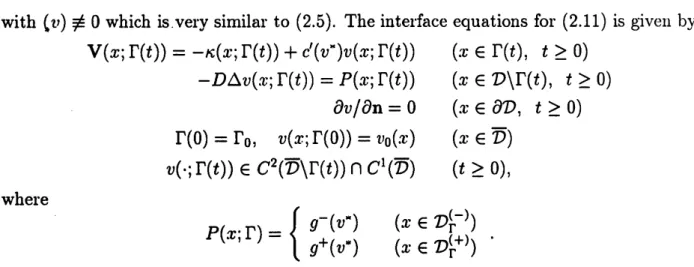
with $(v)\not\equiv \mathrm{O}$ which is very similar to (2.5). The interface equations for (2.11) is given by $\mathrm{V}(x;\Gamma(t))=-\kappa(x;\Gamma(t))+c’(v^{\mathrm{x}})v(x;\Gamma(t))$ $(x\in\Gamma(t), t\geq 0)$
$-D\Delta v(x;\Gamma(t))=P(x;\Gamma(t))$ $(x\in D\backslash \Gamma(t), t\geq 0)$ $\partial v/\partial \mathrm{n}=0$ $(x\in\partial D, t\geq 0)$
$\Gamma(0)=\Gamma\circ$, $v(x;\Gamma(0))=v\mathrm{o}(x)$ $(x\in\overline{D})$ $v(\cdot;\Gamma(t))\in C^{2}(\overline{D}\backslash \Gamma(t))\cap C^{1}(\overline{D})$ $(t\geq 0)$,
where
$P(x;\Gamma)=\{$
$g^{-}(v^{*})$ $(x\in D_{\Gamma}^{(-)})$ $g^{+}(v^{*})$ $(x\in D_{\Gamma}^{(+)})$
In aseriesof works [8, 9, 10, 11] on
one
dimensionalreaction-diffusionsystems, Nishiuraand his $\mathrm{c}\mathrm{o}$-workers have established apowerful method called the Singular Limit
Eigen-value Problem method (SLEP-method, for short) to determine the stability property of
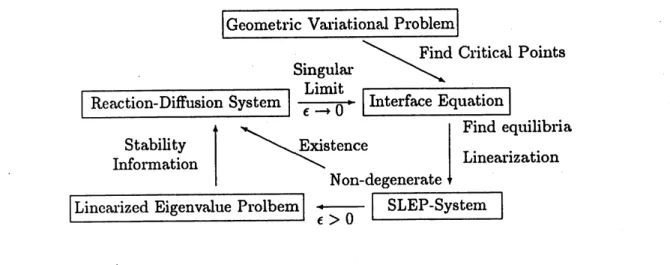
equilibrium transition layer solutions. The basic structure of the method is concisely
expressed in the following diagram.
FIGURE 2. Relationship between reaction-diffusion system and SLEP-system.
First construct
an
equilibrium transition layersolution to the reaction-diffusion systemand linearize the system around it to obtain
an
eigenvalue problem. The singular limitofthe eigenvalue problem is called the SLEP-system which contains full information on
the stability of the equilibrium. Moreover, Nishiura et al. show that the SLEP-system
is also obtained by first passing to the singular limit of the reaction diffusion system to
obtain
an
associated system of interface equations and then linearizing the latter aroundits equilibrium.
Our results fit pricisely into the
same
framework. We first findan
equilibrium to thesystemofinterfaceequations and linearize it to obtain aSLEP-system. Then our assertion
is that if the SLEP-system thus obtained is non-degenerate, then the equilibrium of the
system of interface equations gives rise to an equilibrium transition layer solution of the
reaction-diffusion system. Moreover, the SLEP-systemalso carries the full$\inf_{0\Gamma 111}\mathrm{a}\mathrm{t}\mathrm{i}()\mathrm{n}$ on
the stability ofthe transition layer solution. We also point out the following facts which
are
guiding principles inour
proof.$\bullet$ The interface equations
are
nothing but thc lowest order$C^{1}- \mathrm{m}\mathrm{a}\mathrm{t}\mathrm{c}1_{1}\mathrm{i}\mathrm{n}\mathrm{g}$ conditions
\bullet The
SLEP-s.v
stem is the principal part of the higer order $C^{1}$-matching conditions.FIGURE 3. Non-degenerate equilibra of the interface equations give rise
to transition layer solutions of reaction-diffusion system and their stability
properties are completely determined by SLEP-system.
3. OUTLINE OF Proof
The proofconsists ofthree steps:
(1) Construction ofhighly accurate approximate solutions $U_{\mathrm{a}\mathrm{p}\mathrm{p}}^{arrow\epsilon}$ via the method
ofmatched asymptotic expansion. The conditions A2 ancl A3 (resp. B2 and B3)
allow us to find $C^{1}$-matched approximate solutions with arbitrarily high order of
accuracy. As pointed out at tlie end of the previous section, A2 (B2) is the lowest
order $C^{1}$-matchingcondition, and A3 (B3) allowusto find higher order$C^{1}$-matched
approximations. Once an approximate solution is constructed, the original problem
is then $\mathrm{W}\mathrm{l}\cdot \mathrm{i}\mathrm{t}\mathrm{t}\mathrm{e}\mathrm{n}$ as
(3.1) $\mathcal{L}^{\epsilon_{\acute{\mathrm{Y}}^{\hat{\prime}}}}+N^{\epsilon}(\varphi)+\mathcal{R}^{\epsilon}=0_{\dot{\mathit{1}}}$
where
C’9
is obtained from the original problem by linearization around theapprox-make solutions $N^{\epsilon}(\varphi)$ stands for nonlinear terms containing quadratic and higer
order $\mathrm{t}\mathrm{e}\mathrm{l}\cdot \mathrm{l}\mathrm{n}\mathrm{s}$in
$(_{\hat{\prime}}.$, and 72’ measures how well the approximation satisfies the original
proble$\mathrm{m}$.
(2) The spectral analysis of$\mathcal{L}^{\mathrm{e}}$. The linearoperator$\mathcal{L}^{r}$ ingeneral has small eigenvalues
that go to zero as $\epsilonarrow 0$. called critical eigenvalues. In the present $\mathrm{s}\mathrm{i}\mathrm{t}\mathrm{u}\mathrm{a}\mathrm{t}\mathrm{i}\mathrm{o}\mathrm{n}_{\dot{J}}$ these
critical eigenvalues are of order $O(\epsilon^{2})$. and when divided by $\epsilon^{2}$ they are essentially
the eigenvalues of the SLEP-system. $\mathrm{T}\mathrm{h}\mathrm{e}\mathrm{r}\mathrm{C}^{\backslash }\mathrm{f}\mathrm{o}\mathrm{r}\mathrm{e}\dot,$ A3 (B3) guarantees that thc linear
operator $\mathcal{L}^{c}$ is invertible, although it has small eigenvalues that converge tozero as
$\epsilon$ $arrow 0$.
(3) To establish the solvability of (3.1). Since the linear part $\mathcal{L}^{\epsilon}\varphi$ is small $O(\epsilon^{2}).$
,
one needs to make the contribution of the nonlinear term $N^{\epsilon}(_{\hat{r}}\backslash ’)$ smaller than the
linear part. This., in turn, is possible if the remainder term $\mathcal{R}^{e}$ is small
enough.”say,
$||\mathcal{R}^{\epsilon}||=O(\epsilon^{8})$ in the present situation. Thus one obtains the true solution
$U^{\epsilon}$ very
close to thc approximate one. Now thc linearization of thc original problem around
the genuine solution $U^{-\epsilon}$ is avery small perturbation of $\mathcal{L}^{\epsilon}.$
, and hcnce the stability
properties of U’is completely determined by the SLEP-system which has already
been analized in the previous Step (2).
The stragegy descirbed above
seems
to have awiderange
of applicability in dealingwithtransition layers and interfaces. The
same
idea has bccn successfully applied in othersituations $[4, 15]$
.
REFERENCES
[1 A. Bonami, D. Hilhorst, E. Logak and M. Mimura, Singular limit ofa chemotaxis-growth m.odel,
Preprint 1999.
[2] X-F. Chen, Generation and propagation of interfaces in reaction-diffusion systems, Trans. $\mathrm{A}.\backslash$IS,
334(1992), $87\overline{/}- 913$
.
[3] P.C. Fifeand W.M. Greenlee, Interior transition layersfrom elliptic boundary valueproblems with
a smallparameter, Russian Math. Surveys, 29(1974), No. 4, 103-131.
[4] T. Iibun and K. Sakamoto, Internal layers intersecting the boundary ofdomain in the Allen-Cahn Equation, Preprint 2000 (to appear in J. J. Ind. Appl. Mathemathics).
[5 It. V. Kohn and P. Sternberg, Local minimisers and singular perturbations, Proc. Royal Soc.
Edin-burgh, lllA(1989), 69-84.
[6] K.-I. Nakamura, H. Matano, D. Hilhorst, and R. Schitzle, Singular Limit ofa Reaction-Diffusion
Equationwith a Spatially Inhomogeneous Reaction Tem, J. Stat. Phys., 95(1999),1165- 1184.
[7] $\mathrm{N}.\backslash !^{\mathrm{T}}$
.
Nefedov and K. Sakamoto,Multi-Dimensional Stationary Internal Layersfor Spatially
InhO-mogeneousReaction-Diffusion Equations with Balanced Nonlinearity, In preparation.
[8] Y. Nishiura, Coexistence ofinfintely many stable solutions to reaction diffusion systems in the sin-gular limit, Dynamics Reported, $3(1994)$, 25-103.
[9] Y.Nishiura, Nonlinear Problems 1–MathematicsforPattern Formation-, Vol. 7Iwanami Series
on Developments of Modern Mathematics, Tokyo 1998.
[10] Y. Nishiuraand H. Fujii, Stability ofsingularly perturbed solutions to reaction diffusion equations,
SIAMJ. Math. Anal. 18(1987)m 1726-1770.
[11] Y. Nishiura and M. Mimura, Layer oscillations in reaction-diffusionsystems, SIAMJ. Appl. Math. 49(1989),481-514.
[12] K. Sakamoto, Internal layers in high-dimensional domains, Proc. Royal Soc. Edinburgh,
$128\mathrm{A}(1998)$, 359-401.
[13] K. Sakamoto, Bifurcation ofinfinetely many fine modes from radially symmetric internal layers,
Preprint (1999).
[14] K. Sakamoto, InterfaceEquations with Nonlocal Effects, Preprint 2000.
[15] K. $\mathrm{S}\mathrm{a}\mathrm{k}$
-amoto and H. Suzuki, Symmetry breakingfrom radially symmetric internal layers, Preprint
(1999).