JAIST Repository
https://dspace.jaist.ac.jp/Title EU-FPにおけるイノベーション・システムの変遷 : プ
ログラム編成とプログラム設計をめぐって
Author(s) Lalinorasate, Paveena; 平澤, 泠
Citation 年次学術大会講演要旨集, 30: 26-31
Issue Date 2015-10-10
Type Conference Paper
Text version publisher
URL http://hdl.handle.net/10119/13218
Rights
本著作物は研究・技術計画学会の許可のもとに掲載す るものです。This material is posted here with permission of the Japan Society for Science Policy and Research Management.
1A06
EU-FP におけるイノベーション・システムの変遷
‐プログラム編成とプログラム設計をめぐって‐
○Paveena Lalinorasate(東工大/未来工研),平澤 泠(未来工研)
Abstract – European Framework Programme for Research and Technological Development (FP) has been the main instrument guiding the direction of European research and technological development since the 1980s. The most recent eighth FP, Horizon 2020, has been launched with the hope to upturn the current economic downfall and remedy the societal challenges. We aim to find the logics and mechanisms behind the creation of Horizon 2020, how the course of events affect the programme structure. The creation of Horizon 2020 was found to be based on the experiences gained from earlier FPs, revised rationales and the vision for the future European 2020 – smart, sustainable, inclusive growth.
1. Introduction
EU Framework Programme for Research and Technological Development (FP) is a multi-annual programmes for European science and technology and industrial competitiveness. Revolving around the European Added Value (EAV) - the additional value created compared with action at Member States level - it has been the EU’s main instrument for funding research in Europe since the early 1980s by providing grants and supports to research actors. Along with the change in the global competition and the surroundings, the rationales and structures of the FPs have been evolving over time.
The first two FPs have been an effort to close the perceived ‘technology gap’ between EU and the major competitors such as USA and later Japan. The programmes were rather influenced by the technology-push focused on national champion and an attempt to close the technology gap by leveraging an industrial competence in energy and IT sectors. The mobility and training of researchers, with an effort to integrate the EU market has become an objective in FP3 (1990-1994). Maastricht Treaty (1992) and the White Paper on Growth, Competitiveness and Employment (1993) have brought a major change in the policy thinking, such that more holistic view of innovation was perceived, and that affected the conceptualization of FP4 (1994-1998) and FP5 (1998-2002). The scope of the FPs has become broaden and the ‘Social contracts’ such as an aim to increase socioeconomic values by the mean of job creation, health and quality of life promotion and environment preservation have become the main issues in FP5. The thematic programmes were complemented by horizontal programmes, such as to promote co-operation, dissemination, and training and mobility of researchers. [Kuhlmann, 2001], [DG Research, 2011] FP6 (2002-2006) was centered on the creation of European Research Area (ERA), along with the objectives set by the Lisbon strategy launched in 2000. Lisbon strategy was relaunched in 2005 to help clarify scope and aims together with the midterm review. FP7 (2007-2013) though being a succession of FP6 in supporting the realization of the ERA, its proposal was subjected to several changes, the funding period and budget were greatly increased. By the evaluation of the previous FPs and the Europe 2020 vision, FP8 was launched in 2014 under the name ‘Horizon 2020’
This paper aims to give an overview in the change of the European framework programme structures from FP6 to Horizon 2020, and draw out the rationales that led to such changes and how the Horizon 2020 programme compositions were designed.
2. Background
Launched in the European Council Summit in March 2000, Lisbon strategy was a comprehensive common European strategy for economic and social development, aiming to make the EU “the most dynamic and competitive knowledge-based economy in the world capable of sustainable economic growth with more and better jobs and greater social cohesion and respect for the environment by 2010”. To achieve the goals, knowledge namely R&D, innovation and education, was remarked as a key factor.
The European Research Area (ERA) was proposed by the European Commission in January 2000 and launched at the Lisbon European Council, it was introduced as one of the mean to achieve the transition to a knowledge-based economy by an effort to unite European research to a single entity [EC, 2000].ERA is “a unified research area open to the world based on the Internal Market, in which researchers, scientific knowledge and technology circulate freely and through which the Union and its Member States strengthen their scientific and technological bases, their competitiveness and their capacity to collectively address grand challenges." It was aspired as a way to foster the European excellence, by overcoming the European research weaknesses mainly the lack of resources and fragmentation, by means of 1) establishing a ‘critical mass’ of potential excellence, 2) releasing people from the national barrier to introduce competition, and 3) attracting the best researchers to Europe [Cordis, 2013].
However, a midterm review in 2005, taking stock 5 years after the launch of Lisbon strategy indicated rather disappointing results – European economy had failed to deliver the expected performance in terms of growth, productivity and employment [EC, 2008]. The plan was seen to be too complex, with multiple objectives and unclear divisions of responsibilities and tasks. The European Commission decided that the “action” rather than the “attained target” to be focused and objectives concerning employment rate were no longer priorities. The renew Lisbon strategy had focused its priorities to stimulate more growth, employment and better governance which clearer scopes and aims were created. Reaffirming four priority areas include: investing in knowledge and innovation, unlocking business potential (especially of SMEs), modernizing labour markets, and energy and environment.
2.2 The Sixth Framework Programme
The sixth framework programme was structured as a way to implement the ERA. New features such as new instruments and new project types were introduced.
Unlike the previous FPs that the programmes were divided into several vertical programmes and horizontal programmes that cut across the research areas, FP6 was divided into two main specific programmes with three main objectives: Integrating and Strengthening the ERA and Structuring the ERA. The first objective “Focusing and Integrateing research” was to support research of specific thematic areas that are strategically important and achieved through combinations of scientific disciplines. The second objective “Structuring the ERA” was to tackle the weakness at the foundation of European research structure. The last objective “Strengthening the ERA”, was to reduce the fragmentation of research and innovation in Europe by supporting programme coordination and joint actions.
2.3 The Seventh Framework Programme
Though building ERA was a priority, instead of revolving around the formation of ERA to reinforce the technology foundation of the industrial sector, FP7 aims on the major research subjects with more flexibility to meet the industry requirement. The main structure of the programmes has become more clearly understandable, corresponding to the four major objectives of European research policy. To illustrate, the science and technology objectives namely trans-national cooperation, excellence of European frontier research, human potential in research and technology, research and technology capacities throughout EU were translated to Cooperation, Ideas, People and Capacities programme respectively. Other significant changes are as follows: 1) It encompassed the EU-25 from the start, 2) programme period had been extended by 2 years, 3) increase in budgets and 4) changes in programme and sub-programme structure, included new elements, ERC (European Research Council) and JTI (Joint Technology Initiatives). Some minor changes were observable in the more simplified administrative, the financial rules such as funding rate and procedure, and funding instruments [EC, 2007].
3. Structuring Horizon 2020
3.1 Lessons from the past FPs
The previous FPs were criticized to be ineffective as they lack transparent, clear and robust intervention logic: the programme had too many objectives and higher-level objectives were insufficiently translated into lower-level objectives [Rietschel, 2009]. The ex-post evaluation also revealed that FP6 encompassed too many challenges that were abstract and vague, and the growing number of objectives and themes and diversification of instruments in the FP7 have reduced the capacity to serve a specific EU objective [EC, 2010]. The expert group requested Horizon 2020 to be more simplified in the process, emphasize the Grand Challenges, improve the Knowledge Triangle (research, education, and innovation) or knowledge infrastructure and stress the role of the industry.
3.2 European 2020
In 2010, it was realized that even with a positive picture, Europe was not able to clear the goals set in the Lisbon Strategy, EU still faced the obstructions to become a competitive, knowledge-based economy and sustainable growth and job. Economic recession from 2008 was blamed to be the cause, but not the sole cause. Europe’s structural weaknesses and global challenges existed: the investment in R&D was deficit compared to competitors like US and Japan, the ageing and small number of working population, the education system, single innovation market had not been achieved and knowledge-intensive services were underdeveloped. The European Union had made commitments on Europe 2020 priorities – EU’s growth strategy for a “smart, sustainable and inclusive economy”, in order to deliver high levels of employment, productivity and social cohesion. Five ambitious targets are to be reached be 2020: on employment, innovation, education, social inclusion and climate/energy. The commission put forward seven flagship initiatives to catalyze the progress [EC, 2010].
Table 1 Europe 2020, Seven Flagship Initiatives
Smart Growth
– "Innovation Union" to improve framework conditions and access to finance for research and innovation so as to ensure that innovative ideas can be turned into products and services that create growth and jobs.
– "Youth on the move" to enhance the performance of education systems and to facilitate the entry of young people to the labour market.
– "A digital agenda for Europe" to speed up the roll-out of high-speed internet and reap the benefits of a digital single market for households and firms.
Sustainable Growth
– "Resource efficient Europe" to help decouple economic growth from the use of resources, support the shift towards a low carbon economy, increase the use of renewable energy sources, modernise our transport sector and promote energy efficiency.
– "An industrial policy for the globalisation era" to improve the business environment, notably for SMEs, and to support the development of a strong and sustainable industrial base able to compete globally.
Inclusive Growth
– "An agenda for new skills and jobs" to modernise labour markets and empower people by developing their of skills throughout the lifecycle with a view to increase labour participation and better match labour supply and demand, including through labour mobility.
– "European platform against poverty" to ensure social and territorial cohesion such that the benefits of growth and jobs are widely shared and people experiencing poverty and social exclusion are enabled to live in dignity and take an active part in society.
3.3 Horizon 2020
interim evaluation and midterm review reports of the FP6 and FP7, in line with the Europe 2020 objectives, have grounded the logic in structuring the 8th FP, known as Horizon 2020 – financial
instrument for implementing the Innovation Union, a Europe 2020 flagship initiative. To create an innovation-friendly environment or the true “Innovation Union”, it was suggested that the EU should: tackle major societal challenges, raise competitiveness and generate jobs; prioritise investment in knowledge base, reduce fragmentation and complete ERA within 2014; launch European innovation partnerships to pool resources and expertise. These commitments were translated into more than 30 action points [EC, 2010] which were also reflected in the Horizon 2020 programmes [EC, 2014].
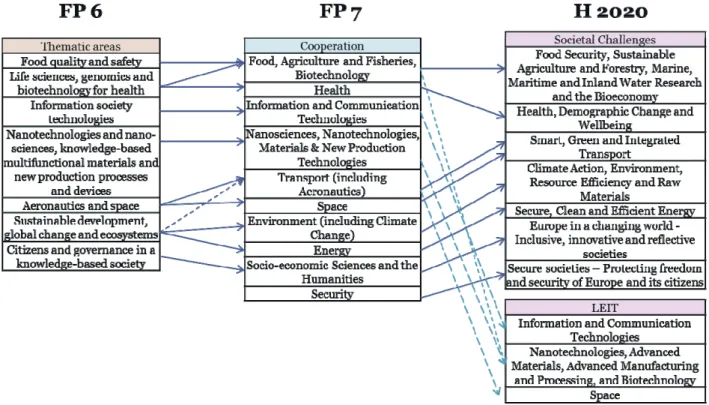
Apart from changes in the main structure and sub-programmes, several changes have taken place in the Horizon 2020, especially in the procedures to be more flexible and simplified and the increase in financial supports. As a result, time-to-grant after the proposal has been submitted is effectively reduced from 12 months to 8 months in average. The maximum funding rate for research action has been increased from 75% in FP7 to 100%, while the demonstration and innovation projects will be supported up to 70% (100% for non-profit organization), compared to 50% in FP7. The focus of the programme has also shifted from research to research and innovation. [CERN, 2015]. Work programmes have been more horizontal, integrating multiple objectives to answer the societal challenges [EC, 2013]. The division of responsibility has also become clearer to understand. Some technological fields were divided into the part to answer societal challenges and the part to enhance Europe strength in key technologies (Figure 1, Figure 2).
4. Summary
The European Framework Programmes, proposed by the European Commission, have been one of the key instruments in building up the foundation of European Union competitiveness and growth by supporting the creation of knowledge and cooperation among member states. The rationales in each FP had been influenced by the course of events from both internally and externally such that the evolution in structures and objectives were evidenced.
Due to the nature of long-term policy instruments, the evaluation of impacts was not timely and subjected to problems of inadequate resources. The situation has been improved after FP5, as an interim evaluation and ex-post evaluation from the external individual experts on each FP have become obliged. These evaluation results and impact study have played a vital role in constructing the consecutive FPs.
The early FPs were rather top-down and bureaucratic, aiming mostly on leveraging the industry competence, while the later ones revealed to be more systematic, simplified and cover more bottom-up approaches, focusing more on science & technology and innovation for more sustainable growth. To effectively achieve the aims, the instruments and protocols have to be consistent, simple and efficient. Horizon 2020 has become much more flexible than the other earlier FPs, the administration procedure is improved to be more flexible, easier for the participants and effective by simplification.
To keep consistency and avoid confusion, most of the evaluation schemes and instruments of Horizon 2020 have been inherited from the early FP6 and FP7. The structure of the main components are modified to answer challenges given in European 2020, but the sub-programmes are largely remained the same.
FP6 was mainly influenced by Lisbon strategy and European Research Area (ERA) objectives and FP7 was to continue the undone jobs set in the objectives of FP6. Novelty from the FP7, ERC (European Research Council) which was introduced to support the frontier research and the simplification process have found to be effective and thus maintained in the Horizon 2020. Hence, the logics behind the creation of Horizon 2020 are lesson learnt from the FP6 and FP7, the aim from Lisbon strategy to create the European Research Area and the objectives set by Europe 2020.
Acknowledgement
本研究は一般財団法人新技術振興渡辺記念会による「科学技術を契機とする我が国未来社会形成のた めの政策的対応に関する調査研究」プロジェクトの一環である。ここに感謝の意を表したい。
References
CERN, 2015. FP7-Horizon 2020 Comparison. [Online]
Available at: http://cerneu.web.cern.ch/horizon2020/fp7-comparison Cordis, 2013. FP6 Step by Step. [Online]
Available at: http://cordis.europa.eu/fp6/stepbystep/era.htm#references
DG Research, 2011. Understanding the Long Term Impact of the Framework Programme, Final Report, Brussels: European Policy Evaluation Consortium (EPEC).
EC, 2000. Towards a European research area. COM.
EC, 2007. FP7 in Brief, How to get involved in the EU 7th Framework Programme, s.l.: EC. EC, 2008. A new start for the Lisbon Strategy (2005). [Online].
EC, 2010. Europe 2020 Flagship Initiative Innovation Union. COM.
EC, 2010. Europe 2020: the European Union strategy for growth and employment. COM.
EC, 2010. Interim Evaluation of the Seventh Framework Programme, Report of the Expert Group,
Brussels: EC.
EC, 2013. The Grand Challenge, The design and societal impact of Horizon 2020, Luxemberg: EU. EC, 2014. H2020 in brief, The EU Framework Programme for Research & Innovation, Luxemberg: EC.
Kuhlmann, S., 2001. Future governance of innovation policy in Europe — three scenarios. Research Policy, 30(6), pp. 953-976.
Rietschel, E. T. e. a., 2009. Evaluation of the Sixth Framework Programmes for Research and Technological Development 2002-2006, s.l.: s.n.