Legendre-Galerkin Method for
Poisson
Equation
on
a
Fan-Shaped
Domain
Narathip Tiangtae (ティアングターナラティップ) $*$
Hiroshi Sugiura (杉浦洋) \dagger
Department of Information Engineering,
School of Engineering, Nagoya University
1
Introduction
Inthispaper
we
considerPoisson’s equation withsingularities causedbythepresenceofa
corner.
Singularities oftenoccur
in modelsof engineeringproblemsdueto discontinuitieson
the boundary conditionsor
abrupt changes in the boundary shape. When usingnumerical methods to solve problems with singularities,
one
must pay special attentionto the singular domains. In both the finite difference and the finite element methods,
local refinement is often employed
near
the singularity to obtain reasonable accuracy.However, it is generally difficult to discretize the equationsdefined
on
the domains withsingularities by
means
ofconventional numerical methods;moreover
by those theerror
would propagate to the whole domain.
The Sinc-Galerkin method is well known
as one
of the most efficient methods totreat those $\mathrm{p}\mathrm{r}\mathrm{o}\mathrm{b}\mathrm{l}\mathrm{e}\mathrm{m}\mathrm{S}[1]$. It is particularly appealing because it
can
be used to solve theproblems with boundary singularities, while maintaining its characteristic exponential
convergence rate. The technique to combine the Sinc-Galerkin method and the
do-main decomposition method for solving the problems with singularities
was
proposedby Nancy J. Lybeck and Kenneth $\mathrm{L}.\mathrm{B}_{\mathrm{o}\mathrm{r}\mathrm{v}\mathrm{e}\mathrm{r}\mathrm{s}}[4][5]$. The Sinc-Galerkin domain
decompo-sition methods
can
be applied to Poisson’s equationon an
$\mathrm{L}$-shaped domain by dividingtheunderlying domain into
some
rectangularsubdomains. However, sincetherestrictionthat the basic shape of subdomains is
a
rectangular domain, it is difficult to partitionthe domain with less than $90^{\mathrm{O}}$ interior angles.
The Sinc-Galerkin domain decomposition method, in which a fan-shaped domain
is added
as a
basic shape,was
proposed to make the way of partitionmore
flexible.However, using the Sinc-Galerkin method it is difficult to determine $h$, which is the mesh
sizeofeach mesh point. Moreover, whensolving the problemswithout singularities, too
many mesh points
near
the boundariescause a
lot ofwasteor
losing accuracy.*email: $\mathrm{n}\mathrm{a}\mathrm{r}\mathrm{a}\Phi \mathrm{t}\mathrm{o}\mathrm{r}\mathrm{i}\mathrm{i}$
.
nuie.nagoya-u.$\mathrm{a}\mathrm{c}$.
jpIn thispaper
we
proposethe Legendre-Galerkin method forsolving Poisson’s equationon
a
fan-shaped domain. Numerical resultsare
presented to show theconvergence
ofthe approximate solutions.
2
Legendre-Galerkin
Method
We consider Poisson’s equation
on
the fan-shaped $\Omega$ given by(1) $\{$
$-\nabla^{2}u(r, \theta)=f(\gamma, \theta)$ , $(r, \theta)\in\Omega$ , $u(r, \theta)=b(\theta)$ , $(r, \theta)\in\gamma$ ,
$u(r, \theta)=0$ , $(r, \theta)\in\partial\Omega\backslash \gamma$
where $\nabla^{2}=\frac{\partial^{2}}{\partial r^{2}}+\frac{1}{r}\frac{\partial}{\partial r}+\frac{1}{r^{2}}\frac{\partial^{2}}{\partial\theta^{2}},$ $f(r, \theta)$ is
an
analytic function ofthe two variables $r$ and$\theta$ in
a
neighborhood ofthe point $P$ and(2) $|u(r, \theta)|$ $=$ $O(\Gamma^{\frac{\pi}{\alpha}})$
where $\frac{\pi}{\alpha}\neq m$($m$
an
integer) while(3) $|u(r, \theta)|$ $=$ $O(r^{\frac{\pi}{\alpha}}\log r)$
when $\frac{\pi}{\alpha}=\frac{1}{m}(m=1,2, \cdots)17]$.
Figure 1: Fan-shaped domain $\Omega$
2.1
Conformal Mapping
First,
we remove
the singularities at point $P$ by using the transformation(4) $r$ $=$ $e^{-()}\eta^{-}\log r0$.
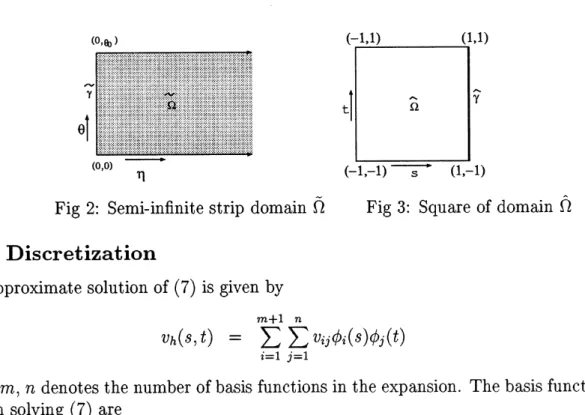
Then, $\Omega$ is mapped onto the semi-infinite strip domain
$\tilde{\Omega}$
as
shown in Fig 2. By thistransformation,
we
obtain(5) $\{$
$-\tilde{\nabla}^{2}\tilde{u}(\eta, \theta)=\tilde{f}(\eta, \theta)$ , $(\eta, \theta)\in\tilde{\Omega}$ ,
$\tilde{u}(\eta, \theta)=b(\theta)$ , $(\eta, \theta)\in\tilde{\gamma}$ ,
where $\tilde{\nabla}^{2}=\frac{\partial^{2}}{\partial\eta^{2}}+\frac{\partial^{2}}{\partial\theta^{2}}$.
Next, the choice of $\eta=\sinh^{2}(\rho)$ is made to transform $\tilde{u}(\eta, \theta)$ to $\tilde{u}(\sinh^{2}(\rho), \theta)$, which
decays double exponentially with respect to $\rho$. Then,
we
find from (2),(3)$,(4)$ that$\max_{0\leq\theta\leq\alpha}|\tilde{u}(\sinh^{2}(\rho), \theta)|$
$\cong$
$0,$ $\rho\geq L$
for sufficiently large $L>0$.
Therefore, since $\iota$$(\sim\theta)\rho,=\tilde{u}(\sinh^{2}(\rho), \theta)$)
can
be regardedas
a
smootheven
functionwith respect to $\rho$ and be given by the cosine transform
(6) $\tilde{v}(\rho, \theta)$ $=$ $\frac{1}{2}c_{0}(\theta)+k=1\sum\infty C_{k}(\theta)\cos\frac{\pi}{L}k\rho$ , $c_{k}( \theta)=\frac{2}{L}\int_{0}^{L}\tilde{v}(\rho, \theta)\cos\frac{\pi}{L}k\rho d\rho$
Thus, using the triangular polynomials, the approximation of {$)(\sim\theta\rho,)$ by the truncated
series is accurate.
Furthermore, applying $\rho=\frac{L}{\pi}\cos^{-1}S$ to (6),
we
obtain$v(s, \theta)$ $\equiv$ $\tilde{v}(\frac{L}{\pi}\cos^{-}s, \theta 1)=\frac{1}{2}c_{0}(\theta)+\sum_{k=1}C_{k}\infty(\theta)Tk(s)$
where $T_{k}(s)$ isthe Chebyshevpolynomial of degree $k$. Consequently, since $c_{k}(\theta),$$k\geq 0$ is
analytic in $\theta\in[0, \alpha]$,
we
find that $\mathrm{t}$)$(S, \theta)$can
be well approximated by the polynomialsin both $s$ direction and $\theta$ direction.
Making
a
coordinate transformation$\eta=\psi_{s}(s)$ $=$ $\sinh^{2}(\frac{L}{\pi}\cos-1\mathit{8})$ ,
$\theta=\psi_{t}(t)$ $=$ $\frac{\alpha}{2}(t+1)$
in (5), $\tilde{\Omega}$
is mapped onto the square of domain $\hat{\Omega}=[-1,1]\cross[-1,1]$
as
shown in Fig 3.Setting $\mathrm{t}\mathit{1}(S, t)=\tilde{u}(\psi_{S}(s), \psi t(t))$,
we
get(7) $\{$
$- \frac{1}{\psi_{s}’}\frac{\partial}{\partial s}(\frac{1}{\psi_{s}^{J}}\frac{\partial v}{\partial s})-\frac{1}{\psi_{t}’}\frac{\partial}{\partial t}(\frac{1}{\psi_{t}’}\frac{\partial_{\mathrm{t}f}}{\partial t})=\hat{f}(S, t),$ $(s, t)\in\hat{\Omega}$,
$v(1, t)=\hat{b}(t),$ $t\in\hat{\gamma}$ ,
$v(s, t)=0$ , $t\in\hat{\Omega}\backslash \hat{\gamma}$
where its solutions
can
be wellapproximated by the polynomial in the variable $s$ and $t$.In the computation, $L$ is determined
so
that$\max_{0\leq\theta\leq\alpha}|\tilde{f}(\sinh^{2}(L), \theta)|$ $\leq$ $\epsilon_{m}$
$(-1,1)$ $(1,1)$
$\mathrm{t}|$
$\hat{\Omega}$
$\wedge\gamma$
$\mathrm{t}^{-1},-1)\overline{\mathrm{s}}$ (1,-1)
Fig 2: Semi-infinite strip domain $\tilde{\Omega}$
Fig 3: Square ofdomain $\hat{\Omega}$
$2.2$
Discretization
The approximate solution of (7) is given by
(8) $v_{h}(s, t)$ $= \sum_{i=1}^{m+}\sum_{1j=}^{n}v_{i}1j\phi_{i}(S)\phi_{j}(t)$
where $m,$ $n$ denotes the number of basis functionsin the expansion. The basisfunctions
used in solving (7)
are
$\phi_{k}(\mathit{8})$ $=$ $\frac{1}{\sqrt{4k+2}}(P_{k-1}(s)-P_{k1}+(s)),$ $k\neq m+1$ ,
$\phi_{m+1}(s)$ $=$ $\omega(s)=(s+1)^{3}(-\frac{3}{16}\mathit{8}+\frac{5}{16})$
where $P_{k}(\mathit{8})$ is the Legendre polynomial of degree $k(\mathrm{S}\mathrm{e}\mathrm{e}[3]15])$.
The boundarybasis functions$\omega(s)$ isnecessary to satisfy thenonhomogeneous
bound-ary conditions at theboundaries. This basisfunction
was
pickedforits smoothnessover
the $\hat{\Omega}$
and its behavior at the boundary $\hat{\gamma}$. Here the basis function $\omega(s)$ is chosen to
satisfy
(9) $\{$
$\omega(1)=1$ $\omega’(1)=0$
$\omega(-1)=\omega^{r}(-1)=\omega\prime\prime(-1)=0$
Now
we
consider the nonhomogeneous boundary conditionon
$\hat{\gamma}$. We arrange thenodes of $\hat{\gamma}$ in
an
order according to the anticlockwise direction. Let the number ofnodes be $n$ and $\{t_{j}\}_{j=1}^{n}$ be the nodes
on
the boundary $\hat{\gamma}$. The nodal valueson
$\{t_{j}\}_{j}^{n}=1$are
also arranged inan
order, whichare
denoted by $\hat{b}_{1},\hat{b}_{2},$$\cdots$,$\hat{b}_{n}$, and they form an-dimensional column vector $\hat{\mathrm{b}}=(\hat{b}_{1},\hat{b}_{2n}, \cdots,\hat{b})^{\tau}$, where by $T$
we
refer to the transposeof
a
matrixor a
vector.We obtain from (7),(8)$,(9)$ that
(10)
’
$\hat{b}_{l}$
Let $\phi_{j}(t_{l})$ be the entries ofthe matrix $\mathrm{H},$ (10)
can
be written in the form(11) $\mathrm{H}^{T}\mathrm{v}_{0}$ $=$
$\hat{\mathrm{b}}$
where $\mathrm{v}_{0}=(v_{m+1,1}, ?)_{m+}1,2,$$\cdots,$$v_{m+}1,n)^{\tau}$. Therefore,
we
can
obtain $\{v_{m+1,j}\}_{j=1}^{n}$ bysolv-ing (11).
Orthogonalizing the residual against basis functions $\phi_{p}(\mathit{8})\phi_{q}(t)$ byusing
a
innerprod-uct yields
(12) $\int_{\Omega}\phi_{p}\phi_{q}\frac{\partial}{\partial s}(\frac{1}{\psi_{s}}, \frac{\partial v_{h}}{\partial s})\psi’tSddt+\int_{\Omega}\phi_{p}\phi_{q}\frac{\partial}{\partial t}(\frac{1}{\psi_{t}}, \frac{\partial v_{h}}{\partial t})\psi_{S}’d_{S}dt$ $=$ $\int_{\Omega}\phi_{p}\phi_{q}\psi s\hat{f}\psi^{l}td\mathit{8}\prime dt$.
Substituting (8) into (12),
we
obtain$\sum_{i=1}^{m+1}\sum^{n}j=1?)ij\int-1d_{\mathit{8}\int_{-1}d}1\phi p\frac{1}{\psi_{S}’}\phi\prime\prime i1\phi_{j}\psi t’\phi_{q}t$ $+$ $\sum_{i=1}^{m+}1j=\sum \mathrm{t}n1)ij\int_{-}1\phi_{p}\psi_{S}\phi_{i}d\mathit{8}\int_{-1}1d\prime 1\phi_{j^{\frac{1}{\psi_{t}’}\phi_{q}’}}’t$
(13) $=$ $\int_{\Omega}\phi_{p}\phi_{q}\psi’s\hat{f}\psi’\iota dd\mathit{8}t$.
Setting $\mathrm{V}=[v_{ij}],$ $1\leq i\leq m,$ $1\leq j\leq n,$ (13)
can
be written in the form(14) $\mathrm{A}\mathrm{V}\mathrm{B}+\mathrm{C}\mathrm{V}\mathrm{D}$ $=\mathrm{F}$
where
A $=$ $\{a_{\dot{\mu}}\}_{p},i=1,2,\cdots,m$
,
$a_{pi}= \int_{-1}^{1}\phi_{p}^{l}\frac{1}{\psi_{s}’}\phi_{i}’d\mathit{8},$ $\mathrm{C}=\{c_{P}i\}_{p},i=1,2,\cdots,m$ , $c_{pi}= \int_{-1}^{1}\phi_{p}\psi’s\phi_{i}d_{\mathit{8}}$ ,$\mathrm{B}$ $=$ $\{b_{jq}\}_{j,2,\cdots,n}q=1,)b_{jq}=\int_{-1}^{1}\phi_{j}\psi t\phi_{q}dt$
’
, $\mathrm{D}=\{d_{jq}\}_{j,2,\cdots,n}q=1,$
,
$d_{jq}= \int_{-1}^{1}\phi_{j^{\frac{1}{\psi_{t}’}\phi d}}’qt’$.The entries $f_{pq},$ $1\leq p\leq m,$$1\leq q\leq n$ of the matrix$\mathrm{F}$
are
given by$f_{pq}$ $=$ $\int_{\Omega}\phi_{p}\emptyset_{q}\psi_{S}’\hat{f}\psi t-d\mathit{8}dt\sum^{n}\prime v_{m+1,j}bj=1jq\int_{-}1n)1\phi p\frac{1}{\psi_{S}’}\omega d\prime r\mathit{8}-\sum\iota j=1m+1,jdjq\int_{-}1\phi_{p}1\psi_{s}\omega d_{S}’$.
$a_{pi},$ $c_{/pi},$ $f_{pq}$ can be given by using Gauss-type quadrature rules. On the other hand,
using the orthogonality relation
$\int_{-1}^{1}P_{i}(t)P_{j(}t)dt$ $=$ $\frac{2}{2j+1}\delta_{ij}$
and the
recurrence
relation$(2j+1)P_{j}(t)$ $=$ $P_{j+1}’(t)-P’-1(jt)$.
leads to
$b_{ji}=b_{ij}$ $=$ $\{$
$c_{i}c_{j}( \frac{\alpha}{2j-1}+\frac{\alpha}{2j+3})i=j$
$-C_{i}C_{j^{\frac{\alpha}{2i-1}}}$ $i=j+2$
$d_{ij}=$
where $c_{j}=1/\sqrt{4j+2}$.
Weconsider the following eigenvalue problem$(\alpha/2)\mathrm{B}\mathrm{x}=\lambda \mathrm{x}$andlet $\Lambda$be the diagonal
matrix formed the eigenvalues and let X be the matrix formed by the corresponding
eigenvectors. Then
(15) BX $=$ $\mathrm{D}\mathrm{X}\Lambda=\frac{2}{\alpha}$XA
Making
a
change of variable $\mathrm{V}=\mathrm{W}\mathrm{X}^{T}$ in (14),we
find(16) $\mathrm{A}\mathrm{W}\mathrm{X}^{T}\mathrm{B}+\mathrm{C}\mathrm{W}\mathrm{X}^{\tau}\mathrm{D}$ $=$ F.
We then derive from (15) that
(17) $\mathrm{A}\mathrm{W}\Lambda+\mathrm{c}\mathrm{W}$ $=$ $\mathrm{G}$
where $\mathrm{G}=(\alpha/2)\mathrm{F}\mathrm{X}$. Let $\mathrm{w}_{j}=(w_{1j}, w_{2}j, \cdots, wmj)^{T}$ and $\mathrm{g}_{j}=(g1j, g2j, \cdots, \mathit{9}mj)T$ for
$j=1,2,$ $\cdots n\}$. Then the$j\mathrm{t}\mathrm{h}$ column ofequation (17)
can
be writtenas
(18) $(\lambda_{j}\mathrm{A}+\mathrm{c})\mathrm{W}_{j}$ $=$ $\mathrm{g}_{j}$.
In summary, the solution of (14) consists of the following step:
1. Compute the eigenvalues and eigenector $\mathrm{s}$ of
$\mathrm{B}$
2. Compute $\mathrm{G}$
3. Obtain$\mathrm{W}$ by solving (18)
4. Set $\mathrm{V}=\mathrm{W}\mathrm{X}^{T}$.
Since $\mathrm{B}$
can
besplit into two symmetric tridiagonal submatrices, the eigenvalues andeigenvectors of$\mathrm{B}$
can
be easily computed in $O(n^{2})$. Steps 2,3,4 take $O(mn^{2}),$ $O(nm^{3})$,$O(mn^{2})$, respectively. Therefore, the system (14)
can
be solved in about $O(mn^{2}+nm^{3})$.3
Numerical Experiments
In thissection,
we
presentsome
numerical experiments. All computationsare
performedin double precistion
on
the Sun $\mathrm{U}\mathrm{l}\mathrm{t}\mathrm{r}\mathrm{a}\mathrm{s}\mathrm{p}\mathrm{A}\mathrm{R}\mathrm{c}2$ workstation.Consider the problem on the fan-shaped domain $\Omega$ with a interior angle $\alpha$
$-\nabla^{2}u(_{X}, y)$ $=$ $f(x, y),$ $(x, y)\in\Omega$ ,
$u(x, y)$ $=$ $0$ , $(x, y)\in\partial\Omega$
where $f(x, y)$ is chosen
so
that the exact solution is given byFig 4: Solution for $\alpha=7\pi/4$
Let $u_{h}(x, y)$ be the approximate solution
on
the domain $\Omega$. We define theLegendre-Galerkin error
norm
by(19) $||E_{U}||$ $=$ $() \max_{x,y\in U}|u(x, y)-uh(_{X}, y)|$
where
$U$ $=$ $\{(0.9^{k}\cos(j\alpha/50), 0.9^{k}\sin(j\alpha/50)):0\leq k\leq 50,0\leq j\leq 50\}$.
We set $\alpha=7\pi/4$ and $m=an$. A mesh plot of the approximate solution is shown in
Fig 4. Comparing the numerical solutions with the exact solutions by (19),
we
obtainthe approximate error
norm as
shown in Fig 5.Let usmake an analysis of the result $\mathrm{s}\mathrm{h}_{0\backslash }\mathrm{v}\mathrm{n}$ in Fig 5. From the result the approximate
error
normobserved to be declining with increasing the valuesof$a$, but if$a$ismore
than5/2, the increasing of$a$ has
no
significantinfluence to the result. Then,we
can
concludethat the values of$n$ and $m$ should be adjusted to each other for reasonable accuracy. In
addition,
as
$\mathrm{s}\mathrm{h}_{0\backslash }\mathrm{v}\mathrm{n}$in Fig 6, when$a$ is
more
than 5/2, the Legendre-Galerkin methodhas the exponential
convergence
rate.When setting $m=3n$ ,
we
can
obtain reasonable accuracy although the angle $\alpha$becomes bigger
as
shown in Fig 6.4
Conclusion
We proposed the Legendre-Galerkin method for solving Poisson’equation
on
afan-shaped domain. Our proposed method leads to high accuracy and in conjunction with
the domain decomposition method it
can
be applied to solve the problems withrlg $0$:
vonvergence
rates wlrn $n$rlg $\mathfrak{o}$:
vonvergence
rates wlrn $\alpha$References
[1] F.Stenger. Numerical Methods Ba8ed on Sinc and Analytic Function8, volume 20
of Computational Mathematics. Springer-Verlag, 1993.
[2] $\ovalbox{\tt\small REJECT}\hslash,$ $\mathrm{p},\ovalbox{\tt\small REJECT}_{\backslash },$ 2
$\ovalbox{\tt\small REJECT} \mathrm{f}\mathrm{f}\mathrm{i}\mathfrak{F}\ovalbox{\tt\small REJECT}\Re\ovalbox{\tt\small REJECT}_{\mathrm{A}\mathrm{a}^{\ovalbox{\tt\small REJECT}}\Phi}^{\ovalbox{\tt\small REJECT}}\mathrm{x}\xi \mathrm{f}\mathrm{f}\mathrm{l}’)r.arrow$Sinc-Galerkin
g,
$\mathrm{B}*r\llcorner\backslash \mathrm{f}\mathrm{f}\mathrm{l}\mathrm{a}\Phi \mathrm{F}$$\infty\ulcorner’=^{\overline{\backslash _{\underline{\backslash }}}}\ulcorner\Re 8\not\in_{\mathrm{x}}\mathrm{P}\not\in_{\mathrm{r}\mathfrak{F}^{\backslash }}^{\infty}\mathrm{g}\#\ovalbox{\tt\small REJECT}\ovalbox{\tt\small REJECT}$ , 1996,
p142-143
[3] J. Shen,Efficient Spectral-Galerking 1. Direct solvers
for
second- andfourth-order
equation by using Legendre$polynomail\mathit{8}_{i}$ SIAM J.Sci. Comput., 15(1994), pp.
[4] Nancy J. Lybeck, Kenneth L.Bowers, Sinc Methods
for
Domain $DecomP^{O}\mathit{8}iii_{\mathit{0}}n$,Applied Mathematics and Computation, Vol. 75, 13-41(1996)
[5] Nancy J. Lybeck, Kenneth L.Bowers, Domain Decompo8ition in Conjuction with
Sinc Methods
for
Poisson’s Equation, Numerical Methods for Partial DifferentialEquation, Vol. 12, 461-486(1996)
[6] ナラーティップ, 杉浦, 三角形領域における Poisson方程式に対する Sinc-Galerkin
Schwarz Alternating法について, 第28回数値解析シンポジウム講演予稿集