Pattern dynamics of
a
reaction-diffusion-advection
system
with
bistable
growth
*Tohru
Tsujikawa\dagger
Faculty of Engineering, University
of
Miyazaki
Miyazaki
889-2192
1
Introduction
From
a
viewpoint of the pattern formation in Biology, reaction diffusion systems aretreated. In this paper we consider the following chemotaxis-growth model $(e.$ $g.$ $[2],$ $[8],$
[20]).
$\{\begin{array}{ll}u_{t}=\mathcal{D}\{u_{x}-\alpha uv_{x}\}_{x}+f(u) , in I\cross \mathbb{R}_{+},v_{t}=dv_{xx}+u-v, in I\cross \mathbb{R}_{+},u_{x}(x, t)=0, v_{x}(x, t)=0, on \partial I\cross \mathbb{R}_{+},u(\cdot, O)=u_{0}\geq 0, v(\cdot, 0)=v_{0}\geq 0, in I\end{array}$ (1)
where $\mathcal{D},$ $d$, a are positive constants and $I=(O, 1)$. In the absence of growth term $f(u)$,
this system becomes Keller-Segel type and many people study about steady states, blow
up etc.. On the other hand, for (1) it is known several spatio-temporal patterns due to the
Turing and Hopf instability induced by the chemotaxis effect $(e. g. [7], [12], [3])$. In order
to understand mechanism of these pattern formations, we show the existence of global
solutions and an exponential attractor with finite dimension of (1) $(e.$ $g$. [1], [9], [11],
[17]) Moreover, the existence and stability of stationary solutions of (1) is discussed
for several growth terms [4, 5, 6, 7]. By using Degree theory, bifurcation method and
etc., the existence of the stationary solution is locally shown with $respec^{l}t$ to parameters
$\mathcal{D},$ $d,$$\alpha(e. g. [17], [19], [5])$. But it is difficult to show the global structure ofstationary
solutions with respect to parameters. In this paper, we treat the bistable growth term
$f(u)=u(1-u)(u-a)(0<a<1)$
and study the global structure ofstationarysolutionsof (1)
as
large $\mathcal{D}$. To do so, weassume
that $(u, v)$ is uniformlybounded
as$\mathcal{D}$
tends to
$\infty$. Formally, it holds that $\{u_{x}-\alpha uv_{x}\}_{x}=0$
.
It follows from the boundary conditions of$*$
This is a joint work with Hirofumi Izuhara (University of Miyazaki) and Kousuke Kuto (The UniversityofElectro-Communicatons)
$\uparrow e$
$u,$ $v$ that $u$ is represented by $u=Ee^{\alpha v}$ with any positiveconstant $E$. By integrating the
first equation of (1) on $I$, (1) deduces to the following system:
$\{\begin{array}{ll}(\int_{0}^{1}Ee^{\alpha v}dx)_{t}=\int_{0}^{1}f(Ee^{\alpha v})dx, t>0v_{t}=dv_{xx}+g(v, E) , x\in I, t>0v_{x}(0, t)=v_{x}(1, t)=0, t>0u\geq 0, v\geq 0, x\in I, t>0,\end{array}$ (2)
where $g(v, E)=Ee^{\alpha v}-v$. Here
we
call (2) a shadow system of (1). We remark thata
stationary solution of (1) converges to the corresponding solution of (2) infollowing
sense.
Remark 1.1. [18] Let $\{\mathcal{D}_{n}\}$ and $(u_{n}, v_{n})$ be a positive sequence with $\lim_{narrow\infty}\mathcal{D}_{n}=\infty$
and a stationary solution
of
(1) with $\mathcal{D}=\mathcal{D}_{n}$. Then there exists a subsequence $\{\mathcal{D}_{n’}\}$of
$\{\mathcal{D}_{n}\}$ and
a
stationary solution $(u_{\infty}, v_{\infty})$of
(2) such that$\lim_{narrow\infty}(u_{n’}, v_{n’})=(u_{\infty}, v_{\infty})$ $in$ $C^{1}(\overline{\Omega})\cross C^{1}(\overline{\Omega})$. (3)
Therefore, it is important to treat (2) for understanding stationary solutions of (1) for
large $\mathcal{D}$.
But
we
havenot any similar result with respect to the evolution problem of (1),In this paper
we
consider the stationary problem of (2)as
follows:$\{\begin{array}{ll}dv_{xx}+9(v, E)=0, x\in I,u_{x}(x)=v_{x}(x)=0, x\in\partial Iu\geq 0, v\geq 0, x\in I\end{array}$ (4)
and
$\int_{\Omega}f(Ee^{\alpha v})dx=0$. (5)
The organization of this paper is as follows: In Section 2, we summarize known results
of the existence of solutions of (4) and ourmain results for the stability of theses solution
is given in Section
3.
In Section 4, we demonstrate the global structure of stationarysolutions and periodic solution of (2). Finally, introducing a
new
small parameter, weshow the onset of the periodic solution is
an
infinite-dimensional
relaxation oscillationwhich is governed by slow and fast dynamics.
2
Existence
of
the stationary solution
of
Shadow
Sy-stem
We summarize known results of the existence of solutions with respect to (4), (5).
Here-after wedescribe a solution of (4), (5) by $(v(x, d, E), d, E)$. All solution is represented
by the scaling, repetition and reflection of monotone solutions. Then we only consider
monotone increasing solutions.
First,
we
treat the boundary value problem (4) without the integral constraint (5).Lemma 1. [6] There exists a positive constant
\^E.
Then, (4) has two positive constantsolution $v_{*}(E)$, $v^{*}(E)$
for
any $0<E<\hat{E}$ which satisfy $v_{*}(E)<v^{*}(E)$, $v_{*}(\hat{E})=v^{*}(\hat{E})$and
are
monotone increasing and decreasingfunction of
$E$, respectively.By using Lemma 1 and the bifurcation theory $(e. g. [13], [14], [15])$, we have
Lemma 2. For any$0<E<\hat{E}$, there exists a monotone decreasing
function
$d^{*}(E)$ whichsatisfies
$\lim_{Earrow 0}d^{*}(E)=\infty,$ $\lim_{Earrow\hat{E}}d^{*}(E)=0$. Then there is a solution $v(x, d, E)$of
(4)
for
any $0<E<\hat{E},$ $0<d<d^{*}(E)$ and it holds$\lim_{darrow d^{r}(E)}v(x, d, E)=v^{*}(E)$, $\lim_{darrow 0}v(x, d, E)=v^{B}(x, E)=\{\begin{array}{l}v_{*}(E) 0\leq x<1(6)\overline{v}(E) x=1\end{array}$
where $\overline{v}(E)$ is a constant satisfying $\int_{v_{*}(E)}^{\overline{v}(E)}g(v, E)dv=0.$
Thanks to the result of Schaaf [13], we show
Lemma 3. Let$\Lambda$ $:=\{(d, E)|0<E<\hat{E}, 0<d<d^{*}(E)\}$
. There is not any nonconstant
solution
of
(4)for
$(d, E)\in \mathbb{R}_{+}^{2}\backslash \Lambda.$Next, we obtain the existence of solutions of (4) whichsatisfies the integral constraint.
Let $h(d, E)$ be
a
function of $d$ and $E$ defined by$h(d, E):= \int_{0}^{1}f(Ee^{\alpha v(x,d,E)})dx$ (7)
where $v(x, d, E)$ is
a
solution given in Lemma 2. Therefore, the integral constraint (5)is represented by
$h(d, E)=0$. (8)
Then it holds that
Lemma 4. Let $\Lambda^{-}:=\{(d, E)|0\leq d\leq d^{*}(E), 0<E\leq\hat{E}\}$ and$\Lambda^{0}$
$:=\{(d, E)|0<d\leq$
$d^{*}(E)$,$0<E\leq\hat{E}\}$
.
Then, $h(d, E)$satisfies
$h(d, E)\in C(\Lambda^{-})\cap C^{1}(\Lambda^{0})$ and$\lim_{darrow 0}h(d, E)=f(Ee^{\alpha v_{*}(E)})$. (9)
Setting
$\Gamma$
$:=$
{
$(v(x, d, E),$ $d,$ $E)|v(x, d, E)$ is asolution of (4), (5) for any $(d, E)\in\Lambda$}
we can show the existence of stationary solutionsas
follows:Theorem 5. [6] There are two positive constants $E_{a},$ $E_{1}$ $<\hat{E}$ depending
on
$a$, 1 andfollowing three statements hold
(i)
If
$1/\alpha<a$, 1, $E_{a},$ $E_{1}$ satisfy$E_{1}<E_{a}$ and there exists afunction
$d(E)$defined
onthe interval $(E_{1}, E_{a})$ and $(v^{\epsilon}(x, d(E), E), d(E), E)\in\Gamma$
.
Moreover,(ii)
If
$a<1/\alpha<1$, there existsa
function
$d(E)$defined
on
$(E_{1}, E_{a})$ or $(E_{a}, E_{1})$ and$(v^{s}(x, d(E), E), d(E), E)\in\Gamma$, which
satisfies
$\lim_{Earrow E_{1}}v^{s}(x, d(E), E)=v^{*}(E_{1}) , \lim_{Earrow E_{a}}v^{s}(x, d(E), E)=v^{B}(x, E_{a})$. (11)
(iii)
If
$1/\alpha>a$, 1, then $E_{a},$ $E_{1}$ satisfy $E_{a}<E_{1}$ and there existsa
function
$d(E)$defined
on
$(E_{a}, E_{1})$ and $(v^{s}(x, d(E), E), d(E), E)\in\Gamma$, whichsatisfies
$\lim_{Earrow E_{1}}v^{s}(x, d(E), E)=v^{B}(x, E_{1}) , \lim_{Earrow E_{a}}v^{s}(x, d(E), E)=v^{B}(x, E_{a})$. (12)
We call $v^{B}(x, E)$
a
singular solution with a boundary layer. In the next section, wediscuss the stability ofthese singular solutions.
3
Stability
of stationary solution of Shadow System
In this section we show the stability of stationary solutions of (2), which are given in
Theorem
5.
Firstwe
discuss astabilityofthe singular stationary solution witha boundarylayer obtained inTheorem 5
as
$d$is small. Let $(v^{s}(x, d, E), d, E)$ bea
solution of(4), (5) for
$(d, E)\in\Lambda$ in the neighborhood of $(0, E_{a})$, which satisfies $\lim_{d\downarrow 0}v^{s}(x, d, E)=v^{B}(x, E_{a})$.
In order to study a stability, we consider the following linearized eigenvalue problem
around the solution $(v^{s}(x, d, E), d, E)$ of (2):
$\{\begin{array}{l}\lambda\int_{0}^{1}(\eta+E\alpha w)e^{\alpha v^{S}}dx=\int_{0}^{1}f_{u}(Ee^{\alpha v^{S}})(\eta+E\alpha w)e^{\alpha v^{s}}dx\lambda w=dw_{xx}+9v(v^{S}, E)w+g_{E}(v^{s}, E)\eta, x\in(0,1)w_{x}(0)=w_{x}(1)=0,\end{array}$
(13)
where $g_{v}(v, E)=E\alpha e^{\alpha v}-\gamma,$ $9E(v, E)=e^{\alpha v}$. Here, $(\eta, w(x))$ means an eigenfunction
of the eigenvalue $\lambda$
and $\eta$ is a positive constant.
As $darrow 0$, we show the asymptotic behavior of critical eigenvalue which determines
the stability by using the SLEP method (see [10]).
Theorem 6. [6] Set $1/\alpha>a$. Let $(v^{s}(x, d, E), d, E)$ be a stationary solution
of
(2)for
$(d, E)\in$ A in the neighborhood
of
$(0, E_{a})$, whichsatisfies
$\lim_{d\downarrow 0}v^{s}(x, d, E)=v^{B}(E_{a})$.
Then, there
are
two eigenvalues $\lambda_{1}(d)$, $\lambda_{2}(d)$ with positive real part such that$\lim_{darrow 0}\lambda_{1}(d)=f_{u}(a)>0,$ $\lim_{darrow 0}\lambda_{2}(d)=\theta^{*}>0$ (
$\theta^{*}$
is given in Lemma 7).
Moreover, other eigenvalues have negative real part and uniformly away
from
imaginary axis.We discuss about this result by intuition. If $w(x)$ has not any singularity in the
neighborhood of $x=1$, we have formally $\lim_{darrow 0}\lambda=f_{u}(a)$ because of
$\lim_{darrow 0}f_{u}(Ee^{\alpha v^{s}})=f_{u}(a)$ compact uniformly in $[0$,1)
On the other hand, if $w(x)$ has
a
singularity in theneighborhood
of $x=1$, then $\eta=$$0$ becomes
an
approximate eigenfunction. Therefore,we
treat the following linearizedeigenvalue problem corresponding to (4), (5) around $v^{s}(x, d, E)$:
$\{\begin{array}{l}\lambda w=dw_{xx}+g_{v}(v^{s}, E)w, x\in(0,1) ,(14)w_{x}(0)=w_{x}(1)=0.\end{array}$
Then, we show the following Lemma.
Lemma 7. There is only
one
eigenvalue $\hat{\lambda}(d)$ with positive real partof
the linearizedeigenvalue problem (14), which
satisfies
$\lim_{darrow 0}\hat{\lambda}(d)=\theta^{*}>0.$By using
a
similar argument,we
haveTheorem 8. [6]
Set
$1/\alpha>1$. Let $(v^{s}(x, d, E), d, E)$ be a stationary solutionof
(2)for
$(d, E)\in\Lambda$ in the neighborhood
of
$(0, E_{1})$, whichsatisfies
$\lim_{d\downarrow 0}v^{s}(x, d, E)=v^{B}(x, E_{1})$.
Then, there is only
one
eigenvalue $\lambda^{*}(d)$ with positive realpart such that$\lim_{darrow 0}\lambda^{*}(d)=\theta^{*}>0.$
Moreover, other eigenvalues have negative real part and uniformly away
from
imaginaryaxis. Here $\theta^{*}$ is a constant depending
on
$E=E_{1}$given in Lemma
7.
Next,
we
showthe stability ofthe nonconstant bifurcatingsolutions from the constantsolution in the neighborhood of the bifurcation point.
Theorem 9. [6]
If
$1/\alpha<a$, 1, the following statements hold.(1) Let $(v^{s}(x, d, E), d, E)$ be a solution
of
(2)for
$(d, E)\in\Lambda$ in the neighborhoodof
$(d^{*}(E_{a}), E_{a})$, which
satisfies
$\lim_{darrow d^{r}(E_{a})}v^{s}(x, d, E)=v^{*}(E_{a})$.
Then, there existsonly
one
eigenvalue $\lambda^{*}(d)$ with positive realpart such that$\lim_{darrow 0}\lambda^{*}(d)=f_{u}(a)>0.$
Moreover, other eigenvalues have negative real part and uniformly away
from
ima-ginary axis.
(2) Let $(\tau)^{s}(x, d, E)$,$d,$ $E$) be a solution
of
(2)for
$(d, E)\in\Lambda$ in the neighborhoodof
$(d^{*}(E_{1}), E_{1})$, which
satisfies
$\lim_{darrow d^{*}(E_{1})}v^{s}(x, d, E)=v^{*}(E_{1})$. Then, all eigenvalueshave negative real part and uniformly away
from
imaginary axis.4
Numerical results
In this section, we discuss the existence and stability of stationary solutions of (2) by
the numerical approach. When $\alpha=2.0$ and $a=0.25$, that is, the
case
(ii) ofThe-orem 5, there is a singular solution $v(x, d(E), E)$ with a boundary layer, which satisfies
which satisfies $\lim_{Earrow E_{1}}(v^{s}(x, d(E), E), d(E))=(v^{*}(E_{1}), d^{*}(E_{1}))$. We show the global
bi-furcation
branch connecting these two solutions $v^{B}(x, E_{a})$ and $v^{*}(E_{1})$ in Figure 1 (a),which is numerically
obtained
by theAUTO
package [1]. Here each point $(d, E)$ on thecurve
of this figure (a) corresponds to a monotone increasing solution of (4), (5). Fromthis result, there is not (static) secondary bifurcation phenomena from nonconstant
so-lution on the bifurcation branch. But, the solution is unstable for small $d$, that is, there
are two eigenvalues with a positive real part from Theorem
9.
On the other hand, thesolutions for $(d, E)$ in the neighborhood of $(d^{*}(E_{1}), E_{1})$
are
stable from Theorem9
(2).The number ofeigenvalues with respect to stationary solutions
on
the bifurcationcurve
changes depending
on
the parameter $d.$(a) (b)
Figure 1: The global solution structure for $\alpha=2.0$, where the symbol ◇
means a
bifur-cation point. (a) Vertical and horizontal axis mean parameters $d$and $E$, respectively. (b)
Vertical and horizontal axis mean the value of $v$ at $x=1$ and $d$, respectively.
For the original reaction diffusion system (1), the global bifurcation from the constant
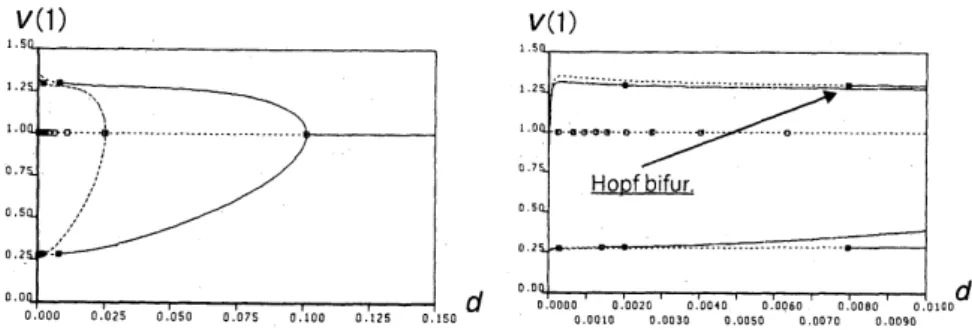
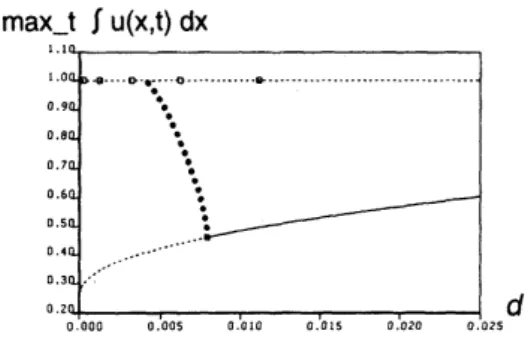
solution is obtained by the numerical simulation (see Figure 2). From Figure 2 implies the existence ofthe Hopfbifurcation from the nonconstant solution in the neighborhood at $d=0.008$. Moreover, these periodic solutions are stable from Figure 3. Therefore, we
suggestthat there is a Hopfbifurcation phenomenafor the shadowsystem (2). Therefore,
we guess the change of the number ofeigenvalues with a positive real part.
$y(1)$
Figure 2: Vertical and horizontal axises
mean
the maximal value of $v(x)(v(1))$ and $d.$$\max_{-}t$
;
$u(x,t)dx$Figure 3: Vertical and horizontal axises
mean a
maximal value of $\Vert u(\cdot, t)\Vert_{L^{1}}$ and $d.$$\mathcal{D}=100.,$ $\alpha=2.0,$ $a=0.25.$
5
Relaxation
oscillation
In Section 4,
we
show that the periodic solution of (1) exists due to the secondary bi-furcation phenomena from the monotone solutionas
large $\mathcal{D}$and is stable by numerical
computations (see Figures $2-3$). It is difficult to show the Hopf bifurcation from the
nonconstant solution for
our
limiting system (2). Butwe
suggest the appearance of theperiodic pattern from the lose of stability in Section 3. Therefore,
we
discuss about theappearance ofthis phenomena from the other viewpoint. To do so,
we
demonstrate theinfinite dimensional relaxation oscillation
as
the onset of these spatio-temporalpheno-mena
(see [3, 4 In order to explain that,we
introducea
new
parameter$\delta$which
mean
the rate ofthe growth. Then, we have the following system with respect to (2):
$\{\begin{array}{ll}(\int_{0}^{1}Ee^{\alpha v}dx)_{t}=\delta\int_{0}^{1}f(Ee^{\alpha v})dx, t>0v_{t}=dv_{xx}+g(v, E) , x\in(0,1) , t>0v_{x}(0, t)=v_{x}(1, t)=0, t>0\end{array}$ (15)
where $E(t)$, $v(x, t)$
are
unknown functions.Figure 4 implies the existence of periodic solution of (15) for small $\delta$
by a numerical
simulation.
Figure 4: Periodic pattern with respect to $v(x, t)$ of (15) for $d=0.04,$ $\alpha=2.0,$ $\delta=$
According
to the argument in [3, 4],we
show that the behavior of the solution is described by the fast and slow dynamics derived from (15) as $\delta$ is sufficientlysmall.
Fast dynamics
First, we consider the
case
of $\delta=0$as
follows:$\{\begin{array}{l}(\int_{0}^{1}Ee^{\alpha v}dx)_{t}=0, t>0v_{t}=dv_{xx}+g(v, E) , x\in(0,1) , t>0v_{x}(0, t)=v_{x}(1, t)=0, t>0.\end{array}$
(16)
It follows from the first equation of (16) that
$\int_{0}^{1}Ee^{\alpha v}dx=\mu$ (17)
for any positive constant $\mu.$
We already discuss the constant solution of (16) in Lemma 1.
On
the other hand, thestationary solution $v(x)$ satisfies
$\int_{0}^{1}Ee^{\alpha v}dx=\int_{0}^{1}vdx (=\mu)$ (18)
by integrating the first equation of(4) and using the boundary condition of$v$. Therefore,
a
constant solution $(E_{c}, v_{c})$ is represented by $E_{c}=\mu e^{-\alpha\mu},$$v_{c}=\mu$ for any $\mu>0.$
In order to have nonconstant solutions by using the bifurcation method, we consider
the linearized eigenvalue problem around $(E_{c}, v_{c})$. By setting $E=E_{c}+Mv=\mu+V$ and
substituting this into (16), the linearized eigenvalue problem is written by
$\{\begin{array}{ll}M_{t}=-E_{c}\alpha\{Me^{\alpha\mu}+(\alpha\mu-1)\int_{0}^{1}Vdx\}, t>0V_{t}=dV_{xx}+Me^{\alpha V}+(\alpha\mu-1)V, x\in(0,1) , t>0V_{x}(0, t)=V_{x}(1, t)=0, t>0.\end{array}$
(19)
Substituting $M=\phi e^{\lambda t},$ $V=\psi e^{\lambda t}\cos n\pi x$ into (19), we have $\phi(\lambda+\alpha\mu)=0,$ $\psi(\lambda+$
$d(n\pi)^{2}-\alpha\mu-1)=$ O. When $\lambda=0$, it holds that $\phi=0,$ $\alpha\mu=d(n\pi)^{2}-1$. Because
of $d>0$, we get the condition $\alpha\mu-1>$ O. There are two constant solutions of (4) in
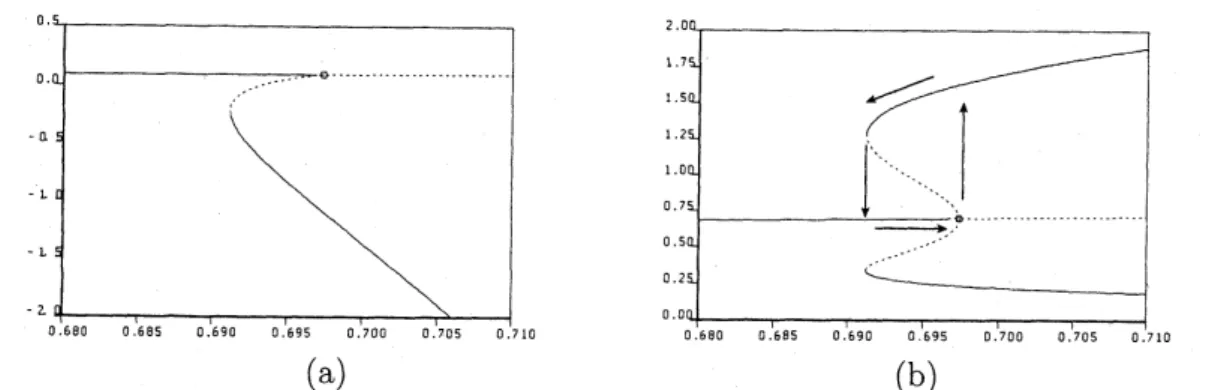
Lemma 1. Then, $v^{*}(E)$ satisfies this condition. The curve in Figure 5 (a) corresponds to
$\lambda=0$ in
$\mu-\alpha$ plane, which is the mode $n$ perturbations. On the other hand,
we
showthe nonconstant solution subcritically bifurcating from the constant solution $v^{*}(E)$ and
subsequentlyturnthe direction due to saddle-node bifurcation in Figure5 (b). Therefore,
there appears ahysteresis phenomena. That is, thebifurcating solutionfromthe constant
solution becomes unstableand
recovers
the stability after the saddle-node bifurcation. Weremark that the direction ofbifurcating branch is different depending on $\alpha.$
Therefore, anapproximation $(E_{c}(\mu), v_{c}(x, \mu, d))$ of stationarysolutions of(15) satisfies
(a) (b)
Figure 5:
$f(u)=u(1-u)(u-O.25)$
, $d=0.04$, (a) Vertical and horizontal axisesmean
$\alpha$ and $\mu$, (b) Vertical and horizontal axises
mean
$v(O)$ and $\mu,$ $\alpha=2.0$. There is a first
bifurcation at $\mu=0.697$ and
saddle-node
at $\mu=0.697.$Slow dynamics
Next,
we
assume
that the solution of(15) tends tosome
monotone stationary solutionon
the upper branch in Figure5
(b). Then, the solution is governed by the dynamicswith the slow time scale $T=\delta t$. Therefore, by using the
new
time variable $T$ andsetting$\delta=0$, (15) is rewritten
as
$\{\begin{array}{ll}(\int_{0}^{1}Ee^{\alpha v}dx)_{T}=\int_{0}^{1}f(Ee^{\alpha v})dx, T>00=dv_{xx}+g(v, E) , x\in(0,1) , T>0v_{x}(0, T)=v_{x}(1, T)=0, T>0.\end{array}$ (21)
Since the relation (17) from (16) is shown, $\mu(t)$ satisfies
$\frac{d\mu}{dT}=\int_{0}^{1}f(Ee^{\alpha v})dx$ (22)
for
a
solution $(E_{s}(\mu),$ $v^{s}(X, \{\iota, d))$ of (21). Therefore, the behavior of the solution isexpressed by (22).
Figure 6 (a) shows that $\int_{0}^{1}f(E(\mu)e^{\alpha v_{c}})dx=f(E(\mu)e^{\alpha v_{c}})$ is positive on the constant
solution brunch corresponding to the center line in Figure6 (b). Therefor, $v_{c}$ is increasing
with respect to $T$. But the solution is destabilized as it passes the bifurcation point and
eventually tends to the stable
nonconstant
solution.On
the other hand, the value ofintegration $\int_{0}^{1}f(E(\mu)e^{\alpha v_{s}^{+}})dx$ is negative
on
the upper branch in Figure 6 (b).There-fore, the solution $\mu(t)$ is decreasing with respect to $T$ and tends to the constant solution
through the saddle-node bifurcation point. Thereafter these process is periodically
repe-ated. Therefore the appearance of the relaxation oscillation phenomena is heuristically
(a) (b)
Figure 6:
$f(u)=u(1-u)(u-O.25)$
, $d=0.04,$$\alpha=2.0(a)$ Vertical and horizontal axisesmean
$v(O)$ and $\mu$, (b) Vertical and horizontal axisesmean
$\int_{0}^{1}f(Ee^{\alpha v})dx$ and$\mu.$
References
[1] M. Aida, T. Tsujikawa, M. Effendiev, A. yagi and M. Mimura, Lower estimate of
at-tractor dimension for chemotaxis growth system, Journal
of
the London Mathematical Society, 74 (2006),453-474.
[2] W. Alt and D. A. Lauffenburger, Transient behavior ofa chemotaxis system modeling
certain types oftissue inflammation, J. Math. Biol., 24 (1987), 691-722.
[3] S.-I. Ei, H. Izuhara and M. Mimura, Infinite dimensional relaxation in
aggregation-growth systems, Discrete
Contin.
Dyn. Syst. Ser. B,17
(2012),1859-1887.
[4] S.-I. Ei, H. Izuhara and M. Mimura, Spatio-temporal oscillations irl the Keller-Segel
system with logistic growth, Physica D,
277
(2014), 1-21.[5] C. Gai, Q. Wangand J. Yan, Qualitative analysis of stationaryKeller-Segel chemotaxis
models with logistic growth, preprint.
[6] H. Izuhara, K. Kuto and T. Tsujikawa, Bifurcation structure of stationary solutions
for a chemotaxissystem with bistable growth, preprint.
[7] K. Kuto, K. Osaki, T. Sakurai, T. Tsujikawa, Spatialpattern ina
chemotaxis-diffusion-growth model, Physica D, 241 (2012),
1629-1639.
[8] M.
Mimura
and T. Tsujikawa, Aggregating pattern dynamics ina
chemotaxis modelincluding growth, Physica A, 230 (1996),
499-543.
[9] E. Nakaguchi and K. Osaki, Globalsolutions andexponentialattractorsofa
parabolic-parabolic systemfor chemotaxis with subquadratic degradation, Discrete Contin. Dyn.
Syst. Ser. B, 18 (2013),
2627-2646.
[10] Y. Nishiura and H. Fujii, Stability of singularly perturbed solutions to systems of
[11] K. Osaki, T. Tsujikawa,
A.
Yagi and M. Mimura, Exponential attractor fora
chemotaxis-growth system of equations, Nonlinear Analysis $TMA.$ $51$ (2002),
119-144.[12] K. J. Painter and T. Hillen, Spatio-temporal chaos in
a
chemotaxis model, Physica D, 240 (2011),363-375.
[13] R., Schaaf,
Global
solution branches of two-point boundary value problems, LectureNotes in Mathematics, 1458, Springer-Verlag, Berlin,
1990.
[14] J. Shi, Semilinear Newmann boundary value problems
on
a rectangle,7rans.
AMS,354 (2002), 3117-3154.
[15]
J. Smaller
andA.
Wasserman,Global
bifurcation of steady-state solutions, J.Diffe-rential Equations,
39
(1981),269-290.
[16] I. Takagi, Point-condensation for.areaction-diffusion system, J.
Differential
Equati-ons, 61 (1986),
208-249.
[17] J.I. Tello and M. Winkler, A chemotaxis system with logistic source, Comm. Partial
Differential
Equations, 35 (2007),849-877.
[18] T. Tsujikawa, Stationary problem of
a
simple chemotaxis-growth model, RIMSKokyuroku, 1924 (2014),
55-63.
[19] T. Tsujikawa, K. Kuto, Y. Miyamoto and H. Izuhara, Stationary solutions for
some
shadow system of the Keller-Segel model with logistic source, to appear in DCDS-S,
2014.
[20] D. E. Woodward, R. Tyson, M. R. Myerscough, J. B. Murray, E.
O.
Budrene, B.O.
Berg, Spatio-temporal patterns generated by Salmonella typhimurium, Biophys., 68