Spreading, vanishing
and singularity
for
radially
symmetric
solutions of
a
Stefan-type
free boundary problem
早稲田大学大学院基幹理工学研究科 兼子裕大(Yuki Kaneko)’
Department ofPure and Applied Mathematics, Waseda University
早稲田大学理工学術院 山田義雄 (Yoshio Yamada)
Department
of
Pureand
Applied Mathematics, Waseda University1
Introduction
We
considera
free boundary problem fora
reaction-diffusion equation:(FBP) $\{\begin{array}{ll}u_{t}-d\triangle u=f(u) , t>0, g(t)<r<h(t) ,u(t, g(t))=0, u(t, h(t))=0, t>0,9’(t)=-\mu u_{f}(t,g(t\rangle) , t>0,h’(t)=-\mu u_{r}(t, h(t)) , l>0,g(0)=g_{0}, h(0)=h_{0}, u(0, r)=u_{0}(r) , g_{0}\leq r\leq h_{0},\end{array}$
where $d,$ $\mu,$ $g_{0}$ and $h_{0}(g_{0}<h_{0})$
are
positive constants, $r=|x|(x\in \mathbb{R}^{N})$,$\triangle=\partial_{r}^{2}+(N-1)\partial_{r}/r$ for $N\geq 2$, and the initial function $u_{0}$
satisfies
$u_{0}\in C^{2}(g_{0}, h_{0})\cap C([g_{0}, h_{0} u_{0}>0 in (g_{0}, h_{0})$, $u_{0}(90)=u_{0}(h_{0})=$ O.
Moreover the nonlinear function is assumed to satisfy
$f\in C^{1}(\mathbb{R})$, $f(0)=f(1)=0,$
$f(u)>0(0<u<1)$
, $f(u)<0(u>1)$,$f’(O)>0,$ $f(u)/u$ is decreasing with respect to $u\in[O$, 1$].$
Problem (FBP) may be used to model the spreading of
invasive
or new
species, where $u(t, r)$ represents the population density of the species that
occupy a radially symmetric region denoted by
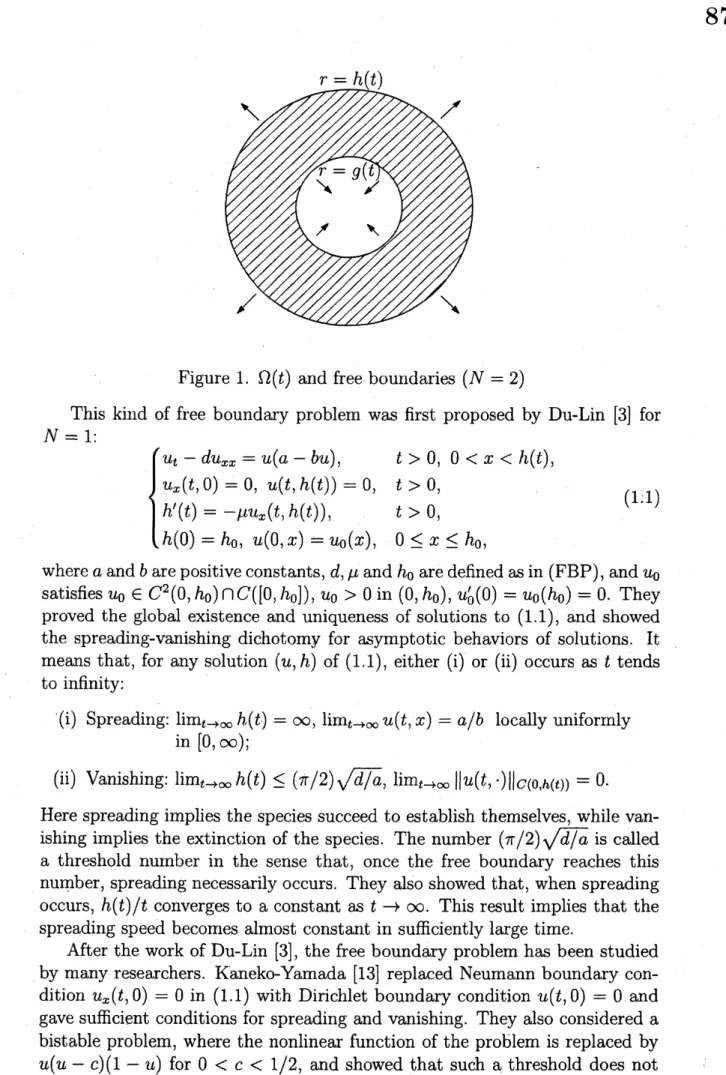
$\Omega(t)=\{x\in \mathbb{R}^{N};g(t)<|x|<h(t)\}.$
The
free
boundaries $r=g(t)$,$h(t)$ imply the spreading front of the species,whose behaviors are determined by Stefan conditions $g’(t)=-\mu u_{r}(t, g(t\rangle)$,
$h’(t)=-\mu u_{r}(t, h(t))$, respectively. It will be shown that $g(t)$ is decreasing and $h(t)$ is increasing with respect to $t>0$, and hence $\Omega(t)$ is expanding in $t>0.$
“JSPS ResearchFellow, supportedby Grant-in-Aid forJSPS Fellows $(26$
.
7046$)$.数理解析研究所講究録
Figure 1. $\Omega(t)$ and free boundaries $(N=2)$
This kind of free boundary problem
was
first proposed by Du-Lin [3] for$N=1$:
$\{\begin{array}{ll}u_{t}-du_{xx}=u(a-bu) , t>0, 0<x<h(t) ,u_{x}(t, O)=0, u(t, h(t)\rangle=0, t>0,h’(t)=-\mu u_{x}(t, h(t)) , t>0,h(O)=h_{0}, u(O, x)=u_{0}(x) , 0\leq x\leq h_{0},\end{array}$ (1.1)
where$a$and$b$
are
positive constants, $d,$$\mu$and $h_{0}$
are
definedas
in (FBP),and$u_{0}$ satisfies $u_{0}\in C^{2}(0, h_{0})\cap C([0, h_{0} u_{0}>0 in (0, h_{0}),$ $u_{0}’(0)=u_{\zeta)}(h_{()})=0$.
Theyproved the global existence and uniqueness of solutions to (1.1), and showed
the spreading-vanishing dichotomy for asymptotic behaviors of solutions. It
means
that, for any solution $(u, h)$ of $(1.1\rangle,$ either (i)or
(ii)occurs
as
$t$ tendsto infinity:
(i) Spreading: $\lim_{tarrow\infty}h(t)=\infty,$ $\lim_{tarrow\infty}u(t, x)=a/b$ locally uniformly
in $[0, \infty)$;
(ii) Vanishing: $\lim_{tarrow\infty}h(t)\leq(\pi/2)\sqrt{d}/a,$ $\lim_{tarrow\infty}\Vert u(t, \cdot)\Vert_{C(0,h\langle t))}=0.$
Here spreading implies the species succeed to establish themselves, while
van-ishing implies the extinction of the species. The number $(\pi/2)\sqrt{d}/a$ is called
a threshold number in the
sense
that,once
the free boundary reaches thisnumber, spreading necessarily
occurs.
They also showed that, when spreadingoccurs, $h(t)/t$ converges to
a
constantas
$tarrow\infty$.
This result implies that thespreading speed becomes almost constant in sufficiently large time.
After the work ofDu-Lin [3], the free boundary problem has been studied
by many researchers. Kaneko-Yamada [13] replaced Neumann boundary
con-dition $u_{x}(t, 0)=0$ in (1.1) with Dirichlet boundary condition $u(t, 0)=0$ and
gave
sufficient
conditions
for spreading and vanishing. They also considereda
bistable problem, where the nonlinear
function
of the problem is replaced by$u(u-c)(1-u)$ for $0<c<1/2$, and showed that such
a
threshold does notfree
boundary problem (cf.Du-Lou
[4],Du-Matsuzawa-Zhou
[6],Gu-Lin-Lou
[8], Guo-Wu [9],
Kaneko-Oeda-Yamada
[11],Kaneko-Matsuzawa
[12], Liu-Lou[15], Wang [16] etc However there
are
only a few papers which deal withmulti-dimensional free boundary problem (cf. Du-Guo [1], Du-Guo [2],
Du-Matano-Wang [5], Kaneko [10]).
The situation is completely
different
in multi-dimensional free boundaryproblems. When $N\geq 2$, the geometricprofile offree boundaryrelatesstrongly
tothe regularity ofsolutions. For example, when
some
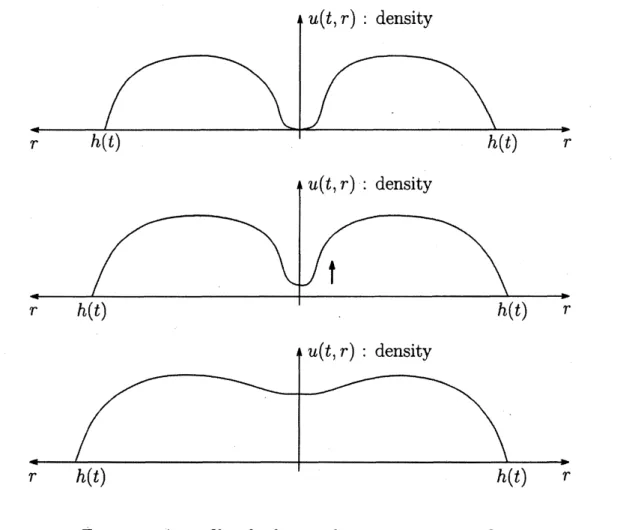
partsofthe freebound-ary connect each other, singularity
appears
for the density function. Then wecan
not deal with classical solution afterwards. However, introducing a weakform,
we can
consider the problem forall
time. In (FBP), sucha
phenomenonactually
occurs
according to initial data and parameters in the equations:The purpose of this paper is to introduce
some
results ofKaneko-Yamada
[14] where the following contents
are
discussed:(i) Existence and uniqueness of classical/weak solutions for (FBP);
(ii)
Generation
of singularityand
regularity of weak solutions;(iii) Spreading and vanishing in multi-dimensional problem (FBP).
Let $(u, g, h)$ besolutions of(FBP) and $\Omega(t)=\{x\in \mathbb{R}^{N}, g(t)<|x|<h(t)\}.$
Throughout this paper,
we
employ the notionof
spreading, vanishing andsingularity in the following
sense:
(i) Spreading is the
case
where $\bigcup_{t>0}\Omega(t)=\mathbb{R}^{N}$ and $\lim_{tarrow\infty}u(t, r)=1$uniformly in any compact set of $[0,$$\infty$
(ii) Vanishing is the
case
where $\bigcup_{t>0}\Omega(t)$ isa
bounded set in $\mathbb{R}^{N}$and $\lim_{tarrow\infty}\Vert u(t, \cdot)\Vert_{C(g(t),h(t\rangle)}=0$;
(iii) Singularityis the
case
where thereexistsa
number$\tau*\in(O, \infty$] such that$\lim_{tarrow T}\cdot g(t)=0.$
We
obtainthe existence and uniquenessof classical solutions
to (FBP)until
inner boundary $g(t)$ reaches the origin and singularity appears. We continue
to
consider
the problem afterwards by introducing a weak formulation, andmoreover
the weak solutionsrecovers
smoothness immediately aftersingular-ity appears. Hence we study spreading and vanishing for classical solutions.
Furthermore it will be shown that, if $\lim_{tarrow\infty}h(t)=\infty$, then singularity
ap-pears at a finite time. We
can
refer details ofproofs to [14].The paper is organized as follows: in Section 2
we
give main results for(FBP). This section is divided into two subsections; the former one relates to
the existence and uniqueness of solutions to (FBP) and the latter is concerned
with asymptotic behaviors of solutions.
2
Main Results
2.1
Existence and uniqueness
of
solutions
In this section
we
show the existence and uniqueness of solutions to (FBP).The assertions
are
summarizedas
follows:$\bullet$ Let $T\in(O, \infty]$ satisfy $\lim_{larrow T}g(t)>0$
.
Then there existsa
unique localdassical solution
for
$0<t<T,$ $g(i)<r<h(t)$.
In other words $u,$ $u_{r},$ $u_{rr}$ and $u_{t}$are
continuous for$0<t<T,$
$g(t)<r<h(t)$.
Moreoverthe classical solution is extended to
some
time $\tau*$ when $g\langle t$) reaches theorigin.
$\bullet$ There exists a unique weak solution in the sense of Definition 1 for all
time. This fact impliesthat
we
can solve the freeboundary problemafter
$g(t)$ arrives at the origin at $t=T_{\}}^{*}$ and that a weak solution is identical with a classical solution for $0<t<\tau*.$
$\bullet$ Every weak solution
recovers
smoothness for $T>\tau*$. Ihatmeans
$u,$ $u_{r},$ $u_{rr}$ and $u_{t}$are
continuousfor
$t>T_{\rangle}^{*}g(t)<r<h(t)$.We have the local existence ofa unique classical solution to (FBP).
Theorem 1. For anygiven $\alpha\in(0,1)$, there exists a number$T>0$ depending
on
$g_{\zeta j},$ $h_{0\}}\alpha$ and $\Vert u_{く)}\Vert_{C^{2}(g_{0},h_{0})}$ suchthat
(FBP) hasa
unique solution $(u, g, h)$satisfying
$(u,g, h)\in\{C^{\frac{(1+\alpha)}{2},\lambda+\alpha}(\overline{\Omega}_{T})\capC^{1+\frac{\alpha}{2},2+\alpha}(\Omega_{T})\}\cross C^{1+\frac{\alpha}{2}}[0, T]$ $\cross$
Cl
$+$量
$[0,T],$
where $\Omega_{T}=\{(t, r)\in \mathbb{R}^{2}|0<t\leq T, g\langle l)<r<h(t)\}.$
In the following theorem,
we
give the boundedness of solutionsand
mono-tonicity of thefree boundaries, and show the time interval such that the
clas-sical
solution exists.Theorem 2. Let$T$ be any positive constant such that$g(T)>0$. Then it holds
that
$0<u(t, r)\leq C_{X}in\Omega_{T}$ and $-\infty<g’(t)<0<h’(t)\leq\mu C_{2}$,
for
$0<l\leq T,$where constants $C_{1}$ and $C_{2}$
are
independentof
$T$, and $\Omega_{T}$ is thesame as
thatof
Theorem 1. Moreover the classical solution existsfor
$t\in(0, T_{\max})$, where$T_{\max}$ is
a
positive constant thatsatisfies
$T_{\max}=\infty$ and $\lim_{tarrow T_{\max}}g(t)>0$,or
$\tau_{\max}\grave{\in}(0, \infty] and \lim_{tarrow T_{\max}}g(t)=0.$
We will introduce weak solutions to (FBP), referring to Du-Guo [2] and
Definition 1. Let $G_{T}=(0,T)xG$ for some $T>0$ and bounded domain $G$
satisfying $[0, h_{0}]\subseteq G\subset[O, \infty$). A function $u(t, r)$ is called
a
weak solution to(FBP)
over
$G_{T}$ when it satisfies$\bullet$ $u\in H^{1}(G_{T})\cap L^{\infty}(G_{T})$, $u\geq 0inG_{T},$
$\bullet\iint_{G_{T}}d(r^{N-1}u_{r}\phi_{r})-r^{N-1}\alpha_{i}(u)\phi_{t}drdt-\int_{G}r^{N-1}\alpha(\tilde{u}_{0})\phi_{0}dr\backslash$
(2.1)
$= \int\int_{G_{T}}r^{N-1}f(u)\phi drdt$
for any $\phi\in C^{1}(G_{T})$ satisfying $\phi=0$ for $(\{T\}\cross G)\cup([0,T]\cross\partial G)$
and
$\phi_{0}(r)$ $:=\phi(0, r)$. In (2.1), $\alpha$ and $\tilde{u}_{0}$
are
given by$\alpha(u)=\{\begin{array}{ll}u, u>0,u-d/\mu, u\leq 0,\end{array}$ $\tilde{u}_{0}=\{\begin{array}{ll}u_{0}, r\in[g_{0}, h_{0}],0 r\in G\backslash [g_{0}, h_{0}].\end{array}$
We
can
apply a result in [2] to (2.1) to obtain the following resulton
theglobal existence of unique weak solutions.
Proposition 1. For any$T>0$, let $G\supset[O, h_{0}]$ be
a
suficiently large domain.Then there exists a unique weak solution
for
(FBP)over
$[0, T]\cross G.$Remark 1. By a comparison principle
for
thefree
boundary problem,one
can
choose a suitably large domain $G$ such that $G$ includes $[0, h(T)].$
We provide a relation between classical solutions and weak solutions.
Proposition 2. The following results hold true:
(i) Let $u=u(t, r)$ be a classical solution to (FBP). Then
a
function
$v(t, r)=\{\begin{array}{ll}u(t, r) , (t, r)\in\bigcup_{0<t<T}\{t\}\cross(9(t), h(t)) ,0, (t, r)\in\bigcup_{0<t<T}\{t\}\cross(G\backslash (g(t), h(t)))\end{array}$
is
a
weak $\mathcal{S}$olution to $(F^{i}BP)$ over $G_{T}=(0, T)\cross G.$(ii) Let $v$ be a weak solution to (FBP) over $G_{T}=(0, T)\cross G_{f}$ and let $h,$$g\in$
$C^{1}(0, T)(g(t)<h(t)$
for
$0\leq t\leq T)\mathcal{S}$atisfy$\{r\in G, g(t)<r<h(t)\}=\{r\in G, v(t, r)>0\},$
$\{r\in G, r\leq g(t), h(t)\leq r\}=\{r\in G, v(t,r)=0\}$
for
$0\leq t\leq T$.If
afunction
$u$satisfies
the following properties,$\bullet$
$u=v$
for
$(t, r) \in\bigcup_{0<t<T}\{t\}\cross[g(t), h(t)],$$\bullet$
$u,$ $u_{r}$ is continuous
for
$(t, r) \in\bigcup_{0\leq t<T}\{t\}\cross[g(t), h(t)],$$\bullet$
$u_{rr},$ $u_{t}$ is continuous
for
$(t, r) \in\bigcup_{0<t<T}\{t\}\cross(g(t), h(t))_{f}$then $(u, g, h)$ is a classical solution to (FBP),
The following theorem
assures
any weak solution must become smoothimmediately after singularity appears.
Theorem 3.
Assume
that there existsa
constant $\tau*$ $>$ $0$ satisfying$\lim_{tarrow T}*g(t)=0$. Then any weak solution must be in $C^{1,2}(D_{T^{*}})_{f}$ where $D_{T^{*}}=$
$\bigcup_{t>\tau*\{\ell\}\cross}(0, h(t))$.
2.2
Spreading, vanishing and singularity
In this section
we
study the asymptotic behaviors ofsolutions to (FBP). Withthe help of Theorem 3,
we
may consider the classical solutions in large time,which makes it easierto investigate spreading and vanishing. Themain results
of this section
are
summarizedas
follows:$\bullet$ If the outer boundary expands to infinity $( i.e. \lim_{tarrow\infty}h(t)=\infty)$, then
the inner boundary reaches the origin at a finite time (i.e. $\lim_{zarrow\tau}*g(t)=$
$0$ for $\tau*<\infty$).
$\bullet$ Spreading-vanishing dichotomyholds true for (FBP) in the
sense of
The-orem 5.
$\bullet$ There are
some
sufficient conditions for spreading and vanishing. Ifini-tial habitat is larger than the threshold value, or population density is
sufficiently large, then spreading
occurs.
On the other hand, if initialFigure 2. A profile of solution that generates singularity The following theorem shows the generation of singularity.
Theorem 4.
If
the solution $(u, g, h)$satisfies
$\lim_{tarrow\infty}h(t)=\infty$, then thereexists a
finite
value $\tau*\in(O, \infty)$ such that$\lim_{tarrow T}*g(t)=0.$We will prepare some threshold numbers that play important roles. Let $\Omega$
be
a
bounded domain in $\mathbb{R}^{N}$.
Denote
by $\lambda_{1}=\lambda_{1}(d;\Omega)$the
least
eigenvalue for$\{\begin{array}{ll}-d\Delta\phi=\lambda\phi, x\in\Omega,\phi=0, x\in\partial\Omega.\end{array}$
It is well known that $\lambda_{1}(d\cdot\Omega)$ is continuous with respect to $d$ and $\Omega$, and
$\lambda_{1}(d;\Omega_{1})>\lambda_{1}(d, \Omega_{2})$ if $\Omega_{1}\subset\Omega_{2}(\Omega_{1}\neq\Omega_{2})$. Let $\Omega$ be
a
ball with radius$l>0,$
that is, $\Omega=B_{l}$ $:=\{x\in \mathbb{R}^{N};|x|<l\}$. Then $\lambda_{1}(d;B_{l})$ is decreasing with
respect to $l$ and
satisfies
$\iotaarrow 0+hm\lambda_{1}(d;B_{l})=+\infty, \lim_{larrow+\infty}\lambda_{1}(d;B_{l})=0.$
Hence there exists
a
unique number $R_{\eta}^{*}$ such that$f’(0)=\lambda_{1}(d;B_{R_{0}^{*}})$, $f’(0)>\lambda_{1}(d;B_{l})f\circ rl>$ 瑞.
We
now
replace $\Omega$ to $B_{l}\backslash B_{g(t)}$. Similarlywe
find $B_{l_{1}}\backslash B_{g(t_{1})}\subseteq B_{i_{2}}\backslash B_{g(i_{2})}$ for $t_{1}\leq t_{2},$ $l_{1}\leq l_{2}$ (because $g(t)$ is decreasing) and determine a unique positivenumber $R^{*}=R^{*}(d,g(t))$ for each $t\geq 0$ which satisfies
$f’(O)=\lambda_{1}(d;B_{R^{*}}\backslash B_{g(t)})$, $f’(O)>\lambda_{1}(d, B_{l}\backslash B_{g(t)})$ for $l>R^{*}$
The following proposition shows the dependence of$R^{*}(d,g(t))$ on $d$ and $t.$
Proposition 3. Thefollowing results hold
for
$R^{*}(d, g\langle t)$).(i) $R^{*}(d, g(t))$ is monotone decreasing with respect to $t>0$ and monotone
increasing with respect to $d>0.$
(ii) $R^{*}(d, g(i))$ is continuous
for
$d$ and $\ell$. Moreoverif
there existsa
number$\tau*>0$ such that $\lim_{tarrow T}*g(t)=0_{f}$ then $\lim_{tarrow T}*R^{*}(d, g(t))=R_{0}^{*}.$
$T1)e$ fo lowing theorem provides spreading, vanishing and singularity for
the free boundary problem.
Theorem 5. Let $(u, g, h)$ be any solution to (FBP). Then either (i)
or
(ii)holds true:
(i) Spreading: $\bigcup_{t>0}\overline{\Omega}(t)=\mathbb{R}^{N},$ $1i\alpha 1_{tarrow\infty^{u(t,r)}}=1$ uniformly in any bounded subset
of
$[0, \infty$);Singularity: there exists finite value $\tau*<\infty$ such that $\lim_{tarrow T}*g(t)=0$;
(ii) Vanishing:
If
$g_{\infty}$ $:= \lim_{tarrow\infty}g(t)>0$ (resp. $g(T_{1})=0$for
some$T_{1}<\infty$),then $\bigcup_{t>0}\overline{\Omega}(t)CB_{R}.$ $\backslash B_{9\infty}\lim_{tarrow\infty}\Vert u(t, \cdot)\Vert_{C(g(t),h(t)\rangle}=0$
$($resp. $u_{t>0}\overline{\Omega}(t)C\overline{B}_{R_{\infty}^{*}},$ $\lim_{tarrow\infty}\Vert u(t, \cdot)\Vert_{C(g(t),h(t))}=0)$, where
$R_{\infty}^{*}$ $:= \lim_{tarrow\infty}R^{*}(d,g(t))$. $Moreover_{J}$
for
some
$\beta>0,$$\Vert u(t, \cdot)\Vert_{C(g(t),h(t)\rangle}=O(e^{-\beta t})$
as
t $arrow$ o 科.We provide asufficient condition for singularity.
Proposition 4.
If
$h_{0}\geq R^{*}(d, g_{0})$, then singularity appears ata
finite
time,and spreading
occurs as
$tarrow oo.$The following theorem gives sufficient conditions for spreading and
vanish-ing concernvanish-ing
on
initial data.Theorem 6. Assume $h_{0}<R^{*}(d,g_{0})$. Let a smooth
function
$\phi=\phi(r)$ satisfy$\phi(g_{0})=\phi(h_{0})=0$
.
Then there existsa
positive number$\sigma^{*}\in[0, \infty]$ such that$\bullet$
If
$u_{0}>\sigma^{*}\phi$, then singularity appears and spreading occurs;$\bullet$
If
$u_{0}\leq\sigma^{*}\phi$, then vanishingoccurs.
Acknowledgements
The authors would liketo thank Professor Katsuyuki Ishii for giving them
References
[1] Y. Du and Z. M. Guo, Spreading-vanishing dichotomy in the diffusive
logistic model with
a
free boundary, II, J.Differential
Equations, 250(2011), pp.
4336-4366.
[2] Y. Du and Z. M. Guo, The Stefan problem for the Fisher-KPP equation,
J. Differential Equations, 253 (2012), pp.
996-1035.
[3] Y. Du and Z.
G.
Lin, Spreading-vanishing dichotomy in thediffusive
10-gistic model with
a
free boundary,SIAM J. Math.
Anal., 42 (2010), pp.377-405.
[4] Y. Du and B. Lou, Spreading and vanishing in
nonlinear
diffusionprob-lems with free boundaries, J. Eur. Math. Soc., 17 (2015), pp. 2673-2724.
[5] Y. Du, H. Matano and K. Wang, Regularity and asymptotic
behavior
ofnonlinear Stefan problems, Arch. Rational. Mech. Anal., 212 (2014), pp.
957-1010.
[6] Y. Du, H. Matsuzawa and M. Zhou, Sharpestimateofthe spreading speed
determined by
nonlinear
free boundary problems,SIAM J. Math.
Anal.,46 (2014), pp.
375-396.
[7] A. Friedman, The Stefanproblem in several space variables, Trans. Amer.
Math. Soc. 132 (1968), pp.
51-87.
[8] H. Gu, Z. G. Lin and B. Lou, Different asymptotic spreading speeds
in-duced by advection in
a
diffusion problem with free boundaries, Proc.Amer. Math. Soc., 143 (2015), pp.
1109-1117.
[9] J. S. Guo and C. H. Wu, On a free boundary problem for
a
two-speciesweak competition system, J. Dyn. Diff. Equat., 22 (2012), pp.
873-895.
[10] Y. Kaneko, Spreading and vanishing behaviors for radially symmetric
so-lutions of free boundary problems for reaction-diffusion equations,
Non-linear Analysis: Real World Applications, 18 (2014), pp. 121-140.
[11] Y. Kaneko, K. Oedaand Y. Yamada, Remarks onspreading andvanishing
for free boundary problemsof some reaction-diffusion equations, Funkcial.
Ekvac., 57 (2014), pp.
449-465.
[12] Y. Kaneko and H. Matsuzawa, Spreading speed and sharp asymptotic
profiles of solutions in free boundary problems for nonlinear
advection-diffusion equations, J. Math. Anal. Appl., 428 (2015), pp.
43-76.
[13] Y. Kaneko and Y. Yamada, A free boundary problem for
a
reaction-diffusion equation appearing in ecology, Adv. Math. Sci. Appl., 21 (2011),
pp. 467-492.
[14] $y$. Kaneko and Y. Yamada,
Generation
of singularity fora
Stefan-typefree boundary problem of
a
reaction-diffusion equation withnon-convex
initial domain, preprint.
[15] X.
Liu
and B. Lou, Asymptotic behavior of solutions to diffusionproblemswith
robin and free boundary conditions, Math. Model. Nat. Phenom., 8(2013), pp. 18-32.
[16] M. Wang, On