INTRODUCTION TO NON-DEGENERATE MIXED FUNCTIONS
MUTSUO OKA
1. COMPLEX ANAYTIC HYPERSURFACE SINGULARITIES
Contents
Chaptcr 1. Complex analytic hypersurafcc singularities 1.1 Milnor fibration
1.2 Weighted homogeneous polynomial Chapter 2. Mixed function
2.1 Weighted homogeneous polynomlal
2.2 Mixed non-singularpoint
2.3
Transversality2.4 Two special
cases
2.5 General mixed functions 2.6 Milnor flbration
Chapter 3. Mixed projective
curves
3.1 Canonical orientation
3.2 Milnor fibration and Hopf fibration
3.3 Degreeof mixed projective hypersurfacc
3.4 Twistedjoin typepolynomial
1.1. Milnor fibration. We first recallthe theoryofMilnor fibrations for
holomor-phic functions.
Let $f(z)$ be
a
holomorphic function of n-variables $z_{1},$$\ldots,$$z_{n}$ suchthat $f(0)=0$.
As is well-known, J. Milnor proved that
Theorem 1. ([15])There exists a positive number$\epsilon_{0}$ such that the argument
map-ping
$\varphi:=f/|f|:S_{\epsilon}^{2r\iota-1}\backslash K_{\epsilon}arrow S^{1}$
is alocally trivial
fibration for
any positive$\epsilon$ with$\epsilon\leq\epsilon_{0}$ where$K_{\overline{c}}=f^{-1}(0)\cap S_{e}^{2n-1}$.
We call this the first description of Milnor fibration. Topologically $S_{\epsilon}\backslash$
$K_{\epsilon}\cong F\cross I/h$ : $Farrow F$
.
The characteristic polynomial is defined by $P_{n-1}(t)=$$\det(h$
.
$-t id)$, where $h_{*}$ : $H_{n-1}(F)arrow H_{l-1}(F)$. $h_{*}$ is called monodromyhomomor-phism.
Theorem 2. ([15]) Suppose that $\epsilon$ is $s\uparrow,fficientl\uparrow/small$
as
in the above theorem.Then $K$ is $(n-3)-$ connected. Suppose
further
that $O$ is an isolated singularity.Then $F$has the homotopy type
of
a bouquetof
spheresof
$S^{n-1}$Define
Euclidean inncr product and hermitian inner product:
$z=(z_{1}, \ldots, z_{n})=x+iy_{)}w=(w_{1}\ldots., w_{n})=u+iv$
$(z, w)=z_{1}\overline{w}_{1}+\cdots+z_{\iota}\overline{w}_{\iota}$, $(z, w)_{\mathbb{R}}=(x, u)+(y, v)=\Re(z, w)$
$\mathbb{C}^{n}\Leftrightarrow \mathbb{R}^{2n}$,
$z\Leftrightarrow(x, y)$
$f(z)=g(x, y)+ih(x, y)$
$gradg=(\frac{\partial g}{\partial x_{1}}, \ldots, \frac{\partial g}{\partial x_{n}}, \frac{\partial g}{\phi_{1}}, \ldots, \frac{\partial g}{\partial y_{n}})$
Tangent spaces:
$T_{Z}S_{\epsilon}=\{w\in \mathbb{C}^{r\iota}|\Re(z, w)=0\}$
$T_{Z}f^{-I}(t)=\{w\in \mathbb{C}^{n}|(w, gradf(z))=0\}$
$= \{w\in \mathbb{C}^{n}|w_{1}\frac{\partial f}{\partial z_{1}}+\cdots+\prime u)_{n}\frac{\partial f}{\partial z_{n}}=0\}$
$=\{w\in \mathbb{R}^{2n}| (w, gradg(z))_{\mathbb{R}}=(w, gradh(z))_{R}=0\}$
$T_{Z}F=\{w\in \mathbb{C}^{n}|\Re(w, z)=\Re(w, igrad\log(f(z))) =0\},$ $F=\varphi^{-1}(1)$
Note that
$\log f(z)=\log|f(z)|+i\arg(f(z))$, $f(z)/|f(z)|=\exp(i\arg(f(z))$.
Lemma 3. ([15]) $\varphi=f/|f|$ : $S_{\epsilon}arrow S^{1}$ is asubmersion
if
andonlyif
$\{z$, igrad$\log f(z)\}$are linearly independent overR.
1.1.1. Cone theorem and the second
fibmtion.
Suppose that $V=f^{-1}(0)$ hasan
isolated singularity at the origin. Then there exists a positive $\epsilon>0$ such that
$S_{r}rhV$ for any $0<r\leq\epsilon$. Note that $S_{r}rhV\Leftrightarrow T_{Z}S_{r}\supset T_{Z}V$
$\Leftrightarrow\forall z\in S_{r}\cap V,$
{
$z$, grad f(z)}: linearly independent over$\mathbb{C}$Theorem 4. ([15]) Assume $O$ is an isolated singularity
of
V. Then there existsa positive number $r_{0}>0$ so that
for
any $r,$ $0<r\leq r_{0},$ $S_{r}$rn
V. In particular,$(B_{r}, B_{r}\cap V)\cong$Cone$(S_{r}, K_{r})$
.
Wecall such $r_{0}$ a stable radius.
Proof.
Suppose there does not exists such $r_{0}$. By Curvc Selection lemma, one canfind
a
real analytic path$p$ : $[0, \epsilon]arrow V,$ $p(t)\in V\backslash \{O\},$ $t\neq 0$ such that $p(t)$ is tangent to $V$. Thus we canwrite
$p(t)=\lambda(t)gradf(p(t)),$$t>0$.
Then
we
havea
contradictionas
follows. Put $\varphi(z)=(z, z)=\Vert z\Vert^{2}$ and $\phi=\sqrt{\varphi}$.
$\frac{d}{dt}\varphi(p(t))=2\Re(\frac{dp(t)}{dt},p(t))$
For the proof of the second assertion,
we
construct a vector field $\chi$on
$B_{r}\backslash \{O\}$such that
For any $z\in V\backslash \{O\}$, there exists
an
open neighborhood $U(z)$ such that $\chi(z)\in$$T_{Z}f^{-1}(f(z))$ for any $z\in U(z)$
.
More precisely, for any $0<\epsilon_{1}<r_{0}$, there exists$\delta(\epsilon_{1})>0$ such that $f^{-1}(7T)rhS_{7}$. for any $|\eta|\leq\delta(\epsilon_{1}),$ $\epsilon_{1}\leq r\leq r_{0}$
.
Take $U(z)$so
that$U(z)\subset f^{-1}(D_{\delta(\epsilon_{1})})\cap B_{r_{0}}\backslash B_{\text{\’{e}}_{1}}^{o}$
$\Re(\chi(z), grad\phi(z))=-1$.
Then using the integration $\psi(z, t)(\psi(z, 0)=z)$ of $\chi$, we
see
that $\frac{d\psi(\psi(Z,t)}{dt}=$$-1$ and thus starting from $z\in S,.,$ $\lim_{tarrow\tau}\cdot|\psi(z, t)|=0$. Using this, we get a
homeomorphism:
$\Psi:(S_{r}, K_{r})\cross[0, r)arrow B_{r}\backslash \{O\},$ $\Psi(z.t)=\psi(z, t)$
which extends to the homeomorphism Cone$(S_{r}, K_{r})\cong(B_{r}, V)$
.
$\square$1.1.2. Second description
of
Milnorfibration.
Take $r0$as
before. Fix $0<r\leq r_{0}$.
Theorem 5. Fix $r,$$0<r\leq r_{0}$
.
Take $\delta>0sufficicntl\uparrow/small$ so thatfor
$anyr \int_{arrow}$ $|\eta|\leq\delta,$ $S_{r}rhf^{-1}(\eta)$. Put $E(r, \delta)^{*}=\{z\in B_{r}\backslash V||f(z)|\leq\delta\}$
.
Then $f$ : $E(r, \delta)^{*}$$\Delta_{\delta}^{*}\iota s$ a locally trivial fibration, where $\Delta_{\delta}^{*}=\{\eta\in \mathbb{C}|0<|\eta|\leq\delta\}$
.
Theorem 6. Two
fibrations
$\varphi:S_{r}\backslash K_{r}arrow S^{1}$ and$f$ : $\partial E(r, \delta)^{*}arrow S_{\delta}^{1}$are
equiva-lent.
1.2. Weighted homogeneous polynomials. Let $a_{1},$$\ldots$,$a_{n}$ and$c$ begiven
posi-tive integerswith$gcd(a_{1}, \ldots, a,,)=1$
.
An analyticfunction $f(z_{1}, \ldots , z_{f\iota})$ iscalled $a$weightedhomogeneous polynomial
of
type$(a_{1}\ldots..a_{n};c)$ or a weighted homogeneouspolynomial
of
degree $c$ with the weight vector$(a_{1}, \ldots, a_{n})$ if$f$ satisfiesthefunctionalequality
$f(t^{a\iota}z_{1}, \ldots, t^{a_{n}}z_{n})=t^{c}f(z_{1}, \ldots, z_{n}))$ $z\in \mathbb{C}^{\iota},$ $t\in \mathbb{C}^{*}$
Definition 7. The $\mathbb{C}$’-action associated with a weighted homogeneous polynomial:
C’ $\cross \mathbb{C}^{n}arrow \mathbb{C}^{n}$, $(t, z)\mapsto t\circ z:=(t^{a_{1}}z_{1}, \ldots, t^{a_{n}}z_{?t}))$
Then weighted homogeneous $\Leftrightarrow f$($t$oz) $=t^{c}f(z)$.
Note that $V=f^{-1}(0)$ is $\mathbb{C}$’ stable.
Example 8. 1. Let $f(z)$ be a homogeneous polynomial
of
degree $c$.
Then $f(z)$satisfies
the obvious equality: $f(tz_{1}, \cdots , tz_{\iota})=t^{c}f(z_{1}, \cdots, z_{\tau\iota})$. Thus $f(z)$ is a weightedhomogeneous polynomialof
type $(1, \cdots, 1;c)$ ,2. Let $f(z)=z_{1}^{a_{1}}+\cdots+z_{n}^{a_{n}}$ (Pham-Brrieskorn polynomial). Then it is weighted
homogeneouspolynomial
of
type $(p_{1}, \ldots,p_{n}, c)$ where $c=$ lcm$(a_{1}, \ldots, a_{n})$ and$p_{j}=$$c/a_{j}$
.
Theorem 9. Assume that $f$ is
a
generalized weighted homogeneous polynomialof
type $(a_{1}, \ldots, a_{n};c)$. Then(1) (Euler equality). We have the equality;
$cf( z)=\sum_{i=1}^{n}a_{i^{Z}i^{\frac{\partial f}{\partial z_{i}}}}$.
(2) Assume that $c\neq 0$
.
The only possible cnttical valueof
$f$ is $0$ and $f$ : $\mathbb{C}^{n}-f^{-1}(0)arrow$C’ is a locally trivialfibmtion.
(3) Assume that $a_{1},$$\ldots$ ,$a_{n},$$c>0$
.
Then theMilnorfibration
of
$f$ at the origin isdefincd
on
anysphere $S_{\Xi},$ $\epsilon>0$ andt he restrictionof
the abovefibration
over $S^{I}: \int:\int^{-1}(S^{1})arrow S^{1}$ is equivalent to the Milnor
fibration of
$f$ at theorigin; $f/|f|$ : $S_{\epsilon}^{2n-1}-K_{\epsilon}arrow S^{1}$
for
any $\epsilon>0$. In particular, the Milnorfiber
is diffeomorphic to theaffine
hypersurface $f^{-1}(1)$. The hypersurface $f^{-1}(0)$ is contractible to the origin.(4) ([Or-Mil]) Assumethat the$0$mgin$\iota s$anisolatedsingular pointand$a_{1},$
$\ldots,$$a_{n},$$c>$
$0$
.
(a) For any $e>0$ , the sphere $S_{\epsilon}$ and the hypersurface $f^{-1}(0)$ intersect
transversely.
(b) Putting $c/a_{i}=u_{\tau}/v_{i}$ with $u_{i},$$v_{i}\in N,$ $(u_{i}, v_{i})=1$
.
$i=1,$ ..
,$n$, thedivisor
of
thezeta-function
is given asfollows.
$( \zeta(t))=(\frac{1}{v_{1}}\Lambda_{1l_{1}}-1)\cdots(\frac{1}{v_{n}}\Lambda_{\uparrow\iota_{n}}-1)$
Inparticular,
$\mu=\prod_{i=1}^{n}\ell-1)=\prod_{i=1}^{n}(\frac{\tau\iota_{i}}{v_{i}}-1)$.
Proof.
(4-a): Euler equality is given by differentiating $t^{c}f(z)=f$($t$oz). Assumethat
$\lambda z_{i}=\overline{\frac{\partial f}{\partial z_{i}}},$$i=1,$
$\ldots,$$n$
Then by Euler equality, we have
$cf( z)=\sum_{i=1}^{n}a_{i}z_{i}\frac{\partial f}{\partial z_{i}}=\overline{\lambda}\sum_{i=1}^{n}a_{i}z_{j}\overline{z}_{i}\neq 0$.
$\square$
1.2.1. Equivalence
of
global and localfibmtions.
$E=f^{-1}(S^{1})$ and define$\psi:Earrow S_{r}\backslash V$, $\psi(z)=\tau oz,$ $\Vert\tau\circ z\Vert=r,$ $\tau>0$
or
$\xi=\psi^{-1}:S_{r}\backslash Varrow E$, $\xi(z)=s(z)\circ z,$ $s(z)=|1/|f(z)|^{1/c}$
Then we havc the commutative diagram:
$E$ $arrow^{\psi}$
$S_{r}\backslash K$
$\downarrow f$ $\downarrow f/|f|$
$S^{1}$ $arrow^{id}$
2. $MlXED$ FUNCTION
Now
we
considcr the situation ofrcal algebraic variety of codimension 2: $V=\{g(x, y)=h(x,y)=0|z=x+iy\in \mathbb{C}^{\tau\iota}\}$whcre $z_{j}=x_{j}+iy_{j}$ and $g,$ $h\in \mathbb{R}[x, y]$
.
We study when the link is fiberedover
the circle. It can be writteas
$V=\{z\in \mathbb{C}^{n}|f(z,\overline{z})=0\}$, $f( z,\overline{z})=g(\frac{z+\overline{z}}{2}, \frac{z-\overline{z}}{2i})+ih(\frac{z+\overline{z}}{2}, \frac{z-\overline{z}}{2i})$
Wc call $f$ a mixed polynomial.
2.1. Weighted homogeneous polynomials. A mixed polynomial$f( z,\overline{z})=\sum_{\nu,\mu}c_{\nu,\mu}z^{\nu}\overline{z}^{\mu}$
is called polar weighted homogeneous (respectively mdially weighted homogeneous)
if there exist integers positive integers$p_{1},$ $,$
.
.
$,p_{n}$ anda non-zero
integer $m_{p}$ (resp.positive integers $q_{1},$
$\ldots,$$q_{\iota}$ and
a
non-zero
integer $m_{r}$) such that$gcd(p_{1}\ldots., p_{n})=1,$ $\sum_{j=1}^{n}p_{j}(\nu_{j}-\mu_{j})=rr\iota_{p}$, if$c_{\nu.\mu}\neq 0$
$($resp. $gcd(q_{1},$
$\ldots,$$q_{n})=1,$ $\sum_{j=1}q_{j}(\nu_{j}+\mu_{j})=\gamma r\iota_{7}.)$
Wcsay$\int(z,\overline{z})$is a md-polar weighted homogeneous if$\int$is radially weighted
homo-gcneous oftype, say $(q_{1}, \ldots, q_{n};m_{r})$, and $f$ is also polar weightcd homogeneousof
type, say $(I)1,$ $\ldots$,$p_{\iota};rn_{\rho})([23])$
.
We definc vcctorsof rational numbers $(tl_{1)}\ldots , \prime n_{1})$and $(v_{1}, \ldots, v_{n})$ by $u_{i}=q_{i}/m_{r},$ $v_{i}=p_{i}/m_{\rho}$ and
we
call thcm the normalized mdial (respectively polar) weights.Example 10. Let $f=z_{1}^{3}\overline{z}_{1}+z_{2}^{4}\overline{z}_{2}$. Polar $weight:(3,2;6)$, Radial weight: (5,4;20)
Using
a
polar coordinate $(r, \eta)$ of$\mathbb{C}$’ where $7^{\cdot}>0$ and $\eta\in S^{1}$ with $S^{1}=\{\eta\in$$\mathbb{C}||\eta|=1\}$, we define a polar$\mathbb{R}^{+}\cross S^{1}$-action
on
$\mathbb{C}^{n}$ by$(r, \eta)\circ z=(r^{q_{1}}\eta^{\rho_{1}}z_{1}, \ldots, r^{q_{\mathfrak{n}}}\eta^{\rho_{n}}z_{n})$, $re^{i\eta}=(r, \eta)\in \mathbb{R}^{+}\cross S^{1}$
$(r, \eta)\circ\overline{z}=\overline{(r,\eta)oz}=(7^{q_{1}}\eta^{-\rho_{1}}\overline{z}_{1}, \ldots, r^{q_{n}}r|^{-\rho_{n}}\overline{Z}_{7l})$
.
Assume that $f(z,\overline{z})$ is rad-polar weightcd homogeneous polynomial. Then $f$
satis-fies the functional equality
(1) $f((r, \eta)\circ(z,\overline{z}))=r^{m_{r}}\eta^{m_{p}}f(z,\overline{z})$
.
This notion
was
introduced by Ruas-Seade-Verjovsky [27] implicitly and then byCisneros-Molina [5].
It is easy to see that such a polynomial defines aglobal fibration
$f:\mathbb{C}^{n}-f^{-1}(0)arrow \mathbb{C}^{*}$. For example, put $U_{r,\theta}=\{\rho e^{i\eta}|1/r\leq\rho\leq r, -\theta\leq\eta\leq\theta\}$
$\Psi:[1/r, r]\cross[-\theta, \theta]\cross f^{-1}(1)arrow f^{-1}(U_{r,\theta})$, $\Psi(\rho, \theta, z)=(’ C^{\backslash }/m_{p}))\circ z$
Theorem 11. $\varphi=f/|f|$ : $S_{r}^{2n-1}\backslash K_{r}arrow S^{1}$ is a locally trivial
fibmtion for
any$r>0$ and it is equivalent to $f$ : $f^{-1}(S^{1})arrow S^{1}$
.
Proof.
First,$\psi_{\theta}$ : $\varphi^{-1}(1)arrow\varphi(\exp(i\theta))$, $\psi_{\theta}(z)=(1, \exp(i\theta/m_{p}))$oz
givesthe trivialization. Define
$\Phi:S_{r}^{2n-1}\backslash K,$. $arrow f^{-1}(S^{1})$ $\Phi(z)=(1/|f(z)|^{1/m_{r}}, 0)\circ z$
2.2. Mixed non-singular point. Lct $f(z,\overline{z})$ bc a mixcd polynomial and we
con-sider a hypersurface $V=\{z\in \mathbb{C}^{r\iota};f(z_{\grave{l}}\overline{z})=0\}$
.
Put $z_{j}=x_{j}+iy_{j}$.
Then $f(z,\overline{z})$ is a real analytic function of$2n$ variables $(x, y)$ with $x=(x_{1}, \ldots, x_{n})$ and $y=(y_{1}, \ldots, y_{n})$.
Put $f(z,\overline{z})=g(x, y)+ih(x, y)$ where $g$. $h$arc
real analyticfunctions. Recall that
$\frac{\partial}{\partial z_{j}}=\frac{1}{2}(\frac{\partial}{\partial x_{j}}-i\frac{\partial}{\partial y_{J}})$
.
$\frac{\partial}{0’\overline{z}_{J}}=\frac{1}{2}(\frac{\partial}{\partial x_{J}}+i\frac{\partial}{0y_{J}})$Thus for
a
complexvalued function $f$,we
dcfine$\overline{\partial}z_{j}\partial\perp_{=}$
;di
$+i \frac{\partial h}{\partial z_{J}}$, $\lrcorner\partial\underline{\dot{(}})_{L}\partial\overline{z}_{j}\overline{\partial}\overline{z}_{jJ}=+i\frac{\partial}{\partial}\frac{g}{z}-$Wc
assume
that$g,$ $h$arenon-constantpolynomials. Then $V$isarealcodimensiontwo subvariety. Put
$d_{N}g( x, y)=(\frac{\text{\^{o}}}{\partial}x_{1}L , . .., \frac{\text{\^{o}}}{\partial}x_{n}4_{-\#_{y_{1}}^{\partial}}, ., , \#_{11n}^{\partial_{-}})\in \mathbb{R}^{2n}$
$d_{\mathbb{R}}h( x, y)=(\frac{\partial h}{\partial x_{1}}, \ldots, \frac{\partial h}{\partial x_{n}}, \frac{\partial h}{\partial y_{1}} , ..., \frac{\partial h}{\partial’y_{n}})\in \mathbb{R}^{2n}$
For acomplex valued mixed polynomial, we use the notation:
$df(z,\overline{z})=(_{\partial z_{1}\partial z_{n}}^{\lrcorner}\partial;,$$\ldots,\partial)\in \mathbb{C}^{n}$
.
$\overline{d}f(z,\overline{z})=(\frac{\partial\int}{\partial\overline{z}1}\cdots\cdot\cdot\overline{0}_{\overline{z}_{n}}^{\partial}\perp)\in \mathbb{C}^{n}$We say that a point $z\in V$ is
a
mixed-singular point of $V$ if and only if $df_{z}$ : $T_{Z}|BC^{n}arrow T_{f(Z)}\mathbb{C}$ is surjectivcor
equivalentlythe two vectors $dg_{N}(x, y),$ $dh_{N}(x, y)$are
linearly dependent over R.Proposition 12. [23] The following two conditions are equivalent.
(1) $z\in V$ is a mixed singular point.
(2) $d_{CjR},$$clh_{\mathbb{R}}$ are linearly dependent overR.
(3) There exists a complex number$\alpha$. $|cx|=1$ such that $\overline{df(z.\overline{z})}=\alpha\overline{d}f(z,\overline{z})$.
2.3. Transversality. We
assume
again $\int(z,\overline{z})$ is a rad-polar weightedhomoge-neous
polynomialas before. First wcobscrve that $f^{-1}(t)$ is mixcd non-singularforany $t\neq 0$
as
$df$ : $T_{Z}f^{-1}(t)arrow T_{t}\mathbb{C}$ is surjectivc.Proposition 13. [23] Let $V=f^{-1}(0)$
.
Assume that the mdial weight $q_{j}>0$for
any $j$. Then $V$ is contractible to the origin O.
If
further
$O$ is an isolated mixed singularityof
$V,$ $V\backslash \{O\}$ is smooth.Proposition 14. [23](Tmnsversality) Under the same assumption
as
in Proposi-tion 13, th$e$ sphere $S_{r}=\{z\in \mathbb{C}^{n};\Vert z\Vert=\tau\}$ intersects tmnsversely with $V$for
any$\tau>0$.
2.4. Two special
cases.
There are twocases
foc which we know more about thetopology of Milnor fiber.
2.4.1. Casel, Simplicial polynomial. Let $\int(z.\overline{z})=\sum_{j=1}^{9}c_{j}z^{n_{j}}\overline{z}^{m_{j}}$ be
a
mixedpolynomial. Herewe assume that $c_{1},$ $\ldots.c_{s}\neq 0$. Put
$\hat{f}(w):=\sum_{j=1}^{s}c_{j}w^{n_{j}-m_{j}}$ , $w=(w_{1}\ldots., w_{\tau\iota})\in \mathbb{C}^{n}$.
We call $f$ the the associated Laurent polynomial. This polynomial plays
an
important role for the determination of the topology of the hypersurface $F=$ $f^{-1}(1)$. Note thatProposition 15.
If
$f(z,\overline{z})$ is a polar weighted homogeneous polynomialof
polarweight type $(p_{1}, \ldots,p_{n};m_{p}),\hat{f}(w)$ is also a weighted homogeneous Laurent
polyno-mial
of
type $(p_{1}, \ldots,p_{?l};m_{\rho})$ in the complex variables $’|v_{1)}\ldots,$$w_{n}$.
A mixed polynomial $f(z,\overline{z})$ is called simplicial if thc exponent vectors $\{n_{j}\pm$
$m_{j}|j=1,$$\ldots,$$s\}$
are
linearly independent in$Z^{n}$ respectively. In particular,
simplic-ity impliesthat $s\leq n$
.
When $s=n$, wesay that $f$isfull. Put $n_{j}=(n_{j.1}, \ldots, n_{j,n})$,$m_{j}=(m_{j,1}, \ldots,m_{j,n})$ in $N^{n}$
.
Assume that $s\leq n$.
Consider two integral matrix$N=(n_{i,j})$ and $M=(m_{i,j})$ where the k-th
row
vectorsare
$n_{k},$ $m_{k}$ respectively. Lemma 16. Let $\int(z_{j}\overline{z})$ be a mixed polynomialas
above.If
$f(z,\overline{z})$ is simplicial,then $f(z,\overline{z})$ is apolar weighted homogeneouspolynomial. In the case $s=n,$ $f(z,\overline{z})$
is simplicial
if
and onlyif
dct$(N\pm M)\neq 0$.
2.4.2. Example. Let$B_{a,b}(z,\overline{z})=z_{1}^{a_{1}}\overline{z}_{1}^{b_{1}}+\cdots+z_{n}^{a_{n}}\overline{z}_{n}^{b_{n}},$$a_{i},$$b_{i}\geq 1,$ $\forall i$
$f_{a,b}(z,\overline{z})=z_{1}^{a_{1}}\overline{z}_{2}^{b_{1}}+\cdots+z_{n}^{a_{n}}\overline{z}_{1}^{b_{n}},$ $a_{i},$$b_{i}\geq 1,$ $\forall i$
$k(z,\overline{z})=z_{1}^{d}(\overline{z}_{1}+\overline{z}_{2})+\cdots+z_{n}^{d}(\overline{z}_{n}+\overline{z}_{1}),$ $d\geq 2$
.
The associated Laurent polynomials are
$\hat{f_{a.b1}}(w)=u)^{a_{1}}?v_{2}^{-b_{1}}+\cdots+’|l)_{n1}^{(x_{n\prime u)^{-b_{n}}}}$
$\hat{k}(w)=w_{1}^{d}(1/w_{1}+1/w2)+\cdots+w_{n}^{d}(1/w_{n}+1/w_{1})$
.
Corollary 17. For the polynomial $f_{a,b}$, the following conditions are equivalent.
(1) $f_{a,b}$ is simplicial.
(2) $f_{a,b}$ is a polar weighted homogeneous polynomial.
(3) (SC) $a_{1}\cdots a_{n}\neq b_{1}\cdots b_{\downarrow}$.
Let $f( z,\overline{z})=\sum_{j=1}^{s}c_{j}z^{n_{j}}\overline{z}^{m_{j}}$ be a polar wcighted homogeneous polynomial of radial weight typc $(q_{1}\ldots..q_{n};m_{r})$ and ofpolar weight typc
$(p_{1}\ldots. , p_{n};m_{p})$. Lct $F=f^{-1}(1)$ be the fiber.
2.4.3. Canonical
stmtification ofF
and thetopologyof
each stmtum. Foranysubset$I\subset\{1,2, \ldots, n\}$,
we
define$\mathbb{C}^{I}=\{z|z_{j}=0, j\not\in I\},$ $\mathbb{C}^{*I}=\{z|z_{i}\neq 0 iff i\in I\},$ $\mathbb{C}^{*n}=C^{*\{1,\ldots,n\}}$
and we define mixed polynomials $f^{f}$ by the restriction: $f^{I}=f|_{\mathbb{C}^{I}}$
.
For simplicity,we write a point of$\mathbb{C}^{I}$
as
$Z_{I}$
.
Put $F^{*I}=\mathbb{C}^{*I}\cap F$.
Note that $F^{*I}$ is a non-emptypropersubsetof$\mathbb{C}^{*I}$ ifandonly if$f^{I}(z_{I},\overline{z}_{I})$ is not constantlyzero. Nowwe observe
that the hypersurface $F=f^{-1}(1)$ has the canonical stratification
$F=\coprod_{J}F^{*I}$.
Thus it is essential to determine the topology of each stratum $F^{*1}$
.
Put $F^{*}$ $:=$ $F\cap \mathbb{C}^{*n}$, the open dense stratum and put $\hat{F}^{*};=f^{-1}(1)\cap \mathbb{C}^{*n}$ where $\hat{f}(w)$ is the associated Laurent weighted homogeneous polynomial.Theorem 18. [23] Assume that$f(z,\overline{z})$ is a simplicialpolar weighted homogeneous
polynomial and let $f(w)$ be the associated Laurent weighted homogeneous
polyno-mial. Then there exists
a
canonical diffeomorphism $\varphi$ :isomorphism
of
the two Milnorfibmtions
defined
by$f(z,\overline{z})$ and $\hat{f}(w)$;$\mathbb{C}^{*n}-f^{-1}(0)$ $arrow^{f}$ $\mathbb{C}^{*}$
$\mathbb{C}^{*\iota}-\hat{f}^{-1}(0)\downarrow\varphi$
$arrow^{f^{\dot}}$
$\mathbb{C}^{*}\downarrow id$
and it
satisfies
$\varphi(F^{*\iota})=\hat{F}^{*n}$ and$\varphi$ is compatible with the respective canonical monodromy maps.
Proof.
Assume first that $s=n$ for simplicity. Recall that$f( w)=\sum_{j=1}^{n}c_{j}w^{n_{j}-m_{j}}$.
Let $w=(?1)1\cdots\cdot$, $\})_{?L})$ be the complex coordinatcs of$\mathbb{C}^{\prime\iota}$ which is the ambient space
of$\hat{F}$
.
We construct $\varphi$ :
$\mathbb{C}^{*\prime\iota}arrow \mathbb{C}$“
$\iota$
so that $\varphi(z)=w$ satisfies
$w(\varphi(z))^{n_{j}-m_{j}}=z^{n_{j}}\overline{z}^{m_{J}}$, thus $\int(\varphi(z))=\int(z)\wedge$.
For the construction of $\varphi$, we
use
the pol\‘ar coordinates $(\rho_{j}, \theta_{j})$ for $z_{j}\in$ C’ andpolar coordinates $(\xi_{j}, 71j)$ for $w_{j}$
.
Thus $z_{j}=p_{j}$ cxp$(i\theta_{j})$ and $w_{j}=\xi_{j}\exp(i\eta_{j})$.First we take $\eta j=\theta_{j}$
.
Put $n_{j}=(n_{j,1}, \ldots.n_{j,n}),$ $m_{j}=(m_{j,1)}\ldots, m_{j,n})$ in$N^{n}$
.
Consider two integral matrix $N=(n_{i,j})$ and$M=(m_{i,j})$ where the k-th
row
vectorare
$n_{k},$ $m_{k}$ respectively. Now taking the logarithm of thc equality $z^{n_{j}}\overline{z}^{m_{j}}=w^{n_{j}-m_{j}}$,we
getan
equivalent equality:
$(n_{j1}+7\prime l_{j1})\log\rho_{1}+\cdots+(n_{jn}+7|\iota_{jn})\log p_{7l}$
$=(n_{j1}-m_{j1})\log\xi_{1}+\cdots+(n_{jn}-m_{jn})$Iog$\xi_{n}$
,
for$j=1,$$\ldots,$$n$
.
Thiscan
be writtenas
(2) $(N+M)(\begin{array}{ll}log \rho_{1}| log \rho_{n}\end{array})=(N-M)(\begin{array}{ll}log \xi_{l}| log \xi_{n}\end{array})$
Put $(N-M)^{-1}(N+M)=(\lambda_{ij})\in$ GL$(n, \mathbb{Q})$
.
Nowwe define $\varphi$ as follows.$\varphi:\mathbb{C}^{*n}arrow \mathbb{C}^{*n}$
.
$z=(\rho_{1}\exp(i\theta_{1}), \ldots, \rho_{\iota}\exp(i\theta_{?b}))\mapsto$$w=(\xi_{1}\exp(i\theta_{1}), \ldots, \xi_{n}\exp(i\theta_{n}))$
where$\xi_{j}$ is given by $\xi_{j}=\exp(\sum_{i=1}^{?l}\lambda_{ji}\log\rho_{i})$ for$j=1,$
$\ldots,$$n$. It is obvious that $\varphi$
isa real analyticisomorphism of$\mathbb{C}^{*n}$ to$\mathbb{C}^{*n}$
.
Let us consider theMilnor fibrationsof $f(z,\overline{z})$ and $\hat{f}(w)$ in the respective ambient tori $\mathbb{C}^{*n}$.
$f:\mathbb{C}^{*n}\backslash f^{-1}(0)arrow \mathbb{C}^{*}$, $\hat{f}:\mathbb{C}^{*n}\backslash f^{-1}(0)arrow \mathbb{C}^{*}$
Recall that the monodromymaps $h^{*},\hat{h}^{*}$
are
given as$h^{*}$ : $F^{*}arrow F^{*}$, $z\mapsto\exp(2\pi i/rr\iota_{p})$ oz
$\hat{h}^{*}$
: $\hat{F}^{*}arrow\hat{F}^{*}$,
Recallthatthe$\mathbb{C}$’-actionassociated with $f(w)$is thc polar action of$f(z,\overline{z})$
.
Namely$\exp i\theta$ow $=$ $(\exp(ip_{1}\theta)tl\prime_{1},$
$\ldots$,cxp$(ip_{\iota}\theta)\prime w,,)$
.
Thuswe
have the commutativcdia-gram:
$\hat{F}_{\alpha}^{*}F_{\alpha}^{*}\downarrow\varphiarrow^{arrow\hat h^{*}h^{*}}$ $\hat{F}_{\alpha}^{*}\Gamma_{\alpha}^{*}\downarrow\varphi$
where $F_{a}^{*}=f^{-1}(\alpha)\cap \mathbb{C}^{*n}$ and $\hat{F}_{a}^{*}=f^{-1}(\alpha)\cap \mathbb{C}^{*n}$ for $\alpha\in \mathbb{C}^{*}$. $\square$
2.4.4. Remark. The
case
$f(z.\overline{z})=z_{1}^{a_{1}}\overline{z}_{1}+\cdots+z_{n}^{a_{n}}\overline{z}$,. is studied in [27]. In thiscase, $g=z_{1}^{a_{1}-1}+\cdots+z_{n}^{a_{n}-1}$ and $\varphi$ : $f^{-1}(1)arrow g^{-1}(1)$ is givcn by
$w_{j}=z_{j}|z_{j}|^{\frac{2}{a_{j}-1}},$ $.)^{\prime=1,\ldots,n}$
We can see that this is ahomeomorphism.
2.4.5.
Zeta-functions.
Nowwe
know that by [19, 20], the inclusion map $\hat{F}^{*}arrow \mathbb{C}^{*n}$is $(n-1)$-equivalence and $\chi(\hat{F}^{*})=(-1)^{n-1}\det(N-M)$ for $s=n$ and $0$ otherwise.
In general, for
a
diffeomorphism $h:Farrow F$, the zetafunction of $h$ is defined by$\zeta_{h}(t)=\frac{\prod_{j=1}^{\infty}\det(th_{2j-1}-id)}{\prod_{j=0}^{\infty}dct(l_{\text{ノ}}h_{2j}-id)}$
where $h_{j}=h_{*}$ : $H_{j}(F)arrow H_{j}(F)$
.
Note also in
our casc
the monodromy map $\hat{h}$ : $\hat{F}^{*}arrow F^{*}$へ
has a period $m_{p}$
.
Thcfixed point locus of $(\hat{h})^{k}$ is $p*$ if$m_{p}|k$ and $\emptyset$
othcrwise. Thus using the formula of the zeta function (see, forexample [15]),
$\zeta_{\hat{h}}.(t)=\exp(\sum_{j=0}^{\infty}(-1)^{n-1}dt^{jm_{\rho}}/(jm_{p}))=(1-t^{m_{p}})^{(-1)^{n}d/m_{p}}$
where $d=\det(N-M)$ if $s=n$ and $d=0$ for $s<n$. Translating this in the
monodromy $h^{*}$ : $F^{*}arrow p*$,
we
obtainCorollary 19. $F^{*}$ has a homotopy type
of
CW-complexof
dimension $n-1$ andthe inclusion map $F^{*}arrow \mathbb{C}^{*n}$ is an $(s-1)$-equivalence. The zeta
function
$\zeta_{h}\cdot(t)$of
$h^{*}$ : $F^{*}arrow F^{*}$ is givenas
$(1-t^{m_{p}})^{(-1)^{n}d/m_{p}}$ with $d=\det(N-M)$if
$s=n$ and$\zeta_{h}\cdot(t)=1$
for
$s<n$.
2.4.6. Connectivity
of
$F$.
Now weare
ready to patch together the information ofthestrata $F^{*I}$ forthetopology of$F$
.
First wcintroducethe notionof k-conveniencewhichisintroduced for holomorphic functions ([20]). We say$f(z,\overline{z})$ is k-convenient
if$f^{I}\not\cong 0$ for any $I\subset\{1,2, \ldots, n\}$ with $|I|\geq n-k$
.
The following is obvious by thedefinition.
Proposition 20. [23] Assume that$f(z,\overline{z})$ is a simple polar weighted homogeneous
polynomialwith $s$ monomials and
assume
that $f$ is k-convenient. Then $k\leq s-1$.Now
we
have the following result about the connectivity of$F$.
Theorem 21. [23] Assume that $f(z,\overline{z})$ is a simple polar weighted homogeneous
polynomial with $s$ monomials and
assume
that $f$ is k-convenient. Then $F$ is2.4.7. Join type polynomials. Another special typc of mixed functions
are
mixed polynomials of join type. Consider the rad-polar wcighted homogcneouspoly-nomials $g(z,\overline{z}),$ $h(w,-w)$ with $z=(z_{1}, \ldots.z_{n})$ and $w=(w_{1)}\ldots, w_{m})_{0}$ Consider $f(z, w,\overline{z},-w)=g(z,\overline{z})+h(w,-w)$. Then
Theorem 22. (Cisneros-Molina [5]) The Milnor
fiber
of
$f$’
is homotopic to thejoin
of
$g^{-1}(1)*h^{-1}(1)$ and the monodromy is also the$\gamma oin$of
the respective monodromy.Proof.
Let $(p_{1}, \ldots, p_{n})$ and $(r_{1}, \ldots, r_{m})$ be the normalized polar weights. Then $f$ has the nomalized polar weight $(p_{1}, \ldots, p_{n}, r_{1}, \ldots, r_{m})$. The polar weight is givenbymultiplyingtheleast
common
multipleofthe denominator. The proofis dividedinto three steps. Let $F_{f}=f^{-1}(1)\subset \mathbb{C}^{n+m},$ $F_{9}=g^{-1}(g),$ $F_{h}=h^{-1}(1)$
.
Let $F_{1}=\{(z, w)|g(z,\overline{z})\in \mathbb{R}\}\dot{)}F_{2}=\{(z, w)\in F_{1}|0\leq g(z,\overline{z})\leq 1\}$.Step 1. $F_{1}\subset F$ is a defoemation retract which is compatiblc with thc
mon-odromy.Step 2. $F_{2}\subset F_{1}$ is also
a
deformation retract.Step 3. $F_{2}$ is homotopic to the join $F_{g}*F_{h}$ and thejoined monodromy.
$\square$
Corollary 23. Suppose that$F_{1}$ and$F_{2}$has the homotopy types
of
bouquesof
spheresof
dimension $n-1$ and $m-1$.
Then$F_{harrow}isn+m-2$ connected and
$H_{n+m-1}(F)$ $H_{n+m-1}(F)$
$\downarrow\cong$ $\downarrow\cong$
$H_{n-1}(F_{1})\otimes H_{m-1}(F_{2})$ $h_{1}\underline{\otimes}h_{2}\rangle$
$H_{n-1}(F_{1})\otimes H_{m-1}(F_{2})$
2.5. General mixed functions. This section is completely included in [24]. 2.5.1. Newton boundary
of
a
mixedfunction.
Suppose thatwe are
givena
mixedanalytic function $f( z,\overline{z})=\sum_{\nu,\mu}c_{\nu,\mu}z^{\nu}\overline{z}^{\mu}$
.
We alwaysassume
that $c_{0,0}=0$so
that$O\in f^{-1}(0)$. We call the variety $V=f^{-1}(0)$ the mixed hypersurface. The mdial
Newtonpolygon $\Gamma_{+}(f;z,\overline{z})$ (atthe origin) ofa mixed function $f(z,\overline{z})$ is defined by
the
convex
hull of$\bigcup_{c_{\nu,\mu}\neq 0}(\iota$
ノ $+\mu)+\mathbb{R}^{+n}$.
Hereafter we call $\Gamma_{+}(f;z,\overline{z})$ simply the Newton polygon of $f(z,\overline{z})$. The Newton
boundary $\Gamma(f;z,\overline{z})$ is defined by the union of compact faces of $\Gamma_{+}(f)$. Observe that $\Gamma(f)$ is nothing but the ordinary Newton boundary if$f$ is a complex analytic function. For a given positive integer vector $P=(p_{1}, \ldots,p_{n})$, we associate a
linear function $p_{P}$
on
$\Gamma(f)$ defined by $\ell_{P}(\nu)=\sum_{j=1}^{\tau\iota}p_{j}\nu_{j}$ for $\nu\in\Gamma(f)$ and let$\Delta(P, f)=\triangle(P)$ be the facc where $\ell_{P}$ takes its minimal value. In other words,
$P$ gives radial weights for variables
$z_{1},$$\ldots,$$z_{n}$ by rdeg$P^{Z}j=r\deg_{P}\overline{z}_{j}=p_{j}$ and
rdeg$P^{Z^{\nu}\overline{z}^{\mu}=\sum_{j=1}^{n}p_{j}(t\text{ノ_{}j}}+\mu j$). To distinguish the points
on
theNewton boundaryand weight vectors, we denote by $N$ the set of integer weightvectors and denote a
vector $P\in N$ by
a
column vectors. We denote by $N^{+},$ $N^{++}$ the subset ofpositiveor strictly positive weight vectors respectivcly. Thus $P={}^{t}(p_{1},$$\ldots,p_{n})\in N^{++}$
(respectively $P\in N^{+}$) if and only if$p_{i}>0$ (resp. $p_{i}\geq 0$) for any $i=1$, . .,$n$
.
Wedenote the minimal value of$p_{P}$ by $d(P;f)$ or simply $d(P)$
.
Note thatFor
a
positive weight $P$,we
define theface
function
$f_{P}(z,\overline{z})$ by $\int_{P}(z,\overline{z})=\sum_{\nu+\mu\in\Delta(P)}c_{\nu,\mu}z^{\nu}\overline{z}^{\mu}$.Example 24. Consider a mixed function $f$ $:=z_{1}^{3}\overline{z}_{1}^{2}+z_{1}^{2}z_{2}^{2}+z_{2}^{3}\overline{z}_{2}$. The Newton
boundary $\Gamma(f;z,\overline{z})$ has two faces $\Delta_{1},$$\triangle_{2}$ which have weight vectors $P$ $:={}^{t}(2,3)$
and $Q:={}^{t}(1,1)$ respectively. The corresponding invariants
are
$f_{P}(z,\overline{z})=z_{1}^{3}\overline{z}_{1}^{2}+z_{1}^{2}z_{2}^{2},$ $d(P;f)=10$ $f_{Q}(z,\overline{z})=z_{1}^{2}z_{2}^{2}+z_{2}^{3}\overline{z}_{2},$ $d(Q;f)=4$.
FIGURE 1. $\Gamma(f)$
2.5.2. Non-degenemte
functions.
Suppose that $f(z.,\overline{z})$ isa
given mixed function$f(z,\overline{z})$
.
For$P\in N^{++}$, thcfacc function$f_{P}(z,\overline{z})$ isa
radiallywcightcd homogeneouspolynomial oftype $(p_{1}, \ldots,p_{\iota};d)$ with $d=d(P;f)$.
Definition 25. Let $P$ be a strictly positivc weight vector. We say that $f(z,\overline{z})$ is
non-degenemte for $P$, if thc fiber $f_{P}^{-1}(0)\cap \mathbb{C}^{*n}$ contains
no
critical point of themapping $f_{P}$ : $\mathbb{C}^{*n}arrow \mathbb{C}$
.
In particular, $f_{P}^{-1}(0)\cap \mathbb{C}^{*n}$ is a smooth real codimension 2 manifold oran
empty set. We say that $f(z,\overline{z})$ is strongly non-degeneratefor $P$if the mapping $f_{P}$ : $\mathbb{C}^{*n}arrow \mathbb{C}$ has
no
critical points. If$\dim\triangle(P)\geq 1$,we
furtherassume
that $f_{P}:\mathbb{C}^{*n}arrow \mathbb{C}$ is surjective onto $\mathbb{C}$.
A mixed function $f(z,\overline{z})$ is called non-degenemte (respectively strongly
non-degenemte) if $f$ is non-degenerate (resp. strongly non-degenemte) for any strictly
positive weight vector $P$
.
Consider the function $f(z,\overline{z})=z_{1}\overline{z}_{1}+\cdots+z_{n}\overline{z}_{n}$. Then $V=f^{-1}(0)$ is a single
point $\{O\}$
.
By the above definition, $f$ is a non-degencrate mixed function. Toavoid such
an
unpleasant situation,we
say thata
mixed function $g(z,\overline{z})$ isa
truenon-degenemte
function
ifit satisfies further the non-emptiness condition:(NE) : For any $P\in N^{++}$ with $\dim\Delta(P, g)\geq 1$, the fiber $g_{P}^{-1}(0)\cap \mathbb{C}^{*n}$ is
non-empty.
Remark 26. Assume that $f(z)$ is a holomorphic
function.
Then $f_{P}(z)$ is aweighted homogeneouspolynomial and we have the Euler equality:
Thus $f_{P}$ : $\mathbb{C}^{*n}arrow \mathbb{C}$ has
no
critical pointover
$\mathbb{C}^{*}$.
Thus$f$ is non-degenerate
for
$P$ implies $f$ is strongly non-degeneratefor
P. This is also thecase
if
$f_{P}(z.\overline{z})$ is apolar weighted homogeneous polynomial.
2.5.3. Isolatedness
of
the singularities. Let $\int(z.\overline{z})=\sum_{1/,\mu}c_{\nu},z^{\nu}\overline{z}^{\mu}l^{A}$. As we aremainlyinterested in the topologyofagermof a mixcd hypcrsurface at the origin,
wealways
assumc
that $f$ does not have the constant term so that $O\in f^{-1}(0)$.
Put$V=f^{-1}(0)\subset \mathbb{C}^{n}$
.
2.5.4. Mixedsingular points. We say that$w\in V$ is amixed singularpoint if$w$ is a
critical point of the mapping $f$ : $\mathbb{C}^{n}arrow \mathbb{C}$
.
We say that $V$ is mixed non-singular ifit has nomixed singular points. If$V$ is mixcd non-singular, $V$ is smooth variety of
realcodimensiontwo. Notethat asingularpoint of$V$ (as apoint ofareal algebraic
variety) is amixed singular point of$V$ but the
conversc
is not necessarily true. Forexample, every point ofthe spherc $S=\{z_{1}\overline{z}_{1}+\cdots+z_{\tau\iota}\overline{z}_{11}=1\}$ is a mixed singular
point.
2.5.5. Non-vanishing coordinate subspaces. For a subset $J\subset\{1,2, \ldots.n\}$, we
con-sider the subspacc $\mathbb{C}^{J}$ and the restriction $f^{J};=f|_{\mathbb{C}^{J}}$
.
Consider thc set
$\mathcal{N}\mathcal{V}(f)=\{I\subset\{1\ldots., n\}|f^{I}\not\equiv 0\}$ .
We call$\mathcal{N}\mathcal{V}(f)$ the set
of
non-vanishing coordinate subspacesfor
$f$.
Put$V\#=U_{v}^{V\cap \mathbb{C}^{*I}}I\in N(f)$.
Theorem 27. [24] Assume that $\int(z,\overline{z})$ is a true non-degenerate mixed
function.
Then there exists a positive number $r_{0}$ such that thefollowing properties are
satis-fied.
(1) (Isolatedness ofthe singularity) The mixed hypersurface $V^{t}\cap B_{r_{O}}$ is mixed
non-singular. Inparticular, $co\dim_{R}v\#=2$
.
(2) $(bansvC^{1}rsality)$ The sphere $S_{r}$ with$0<r\leq r_{0}$ intersects $V\#$ transversely. We say that $f$ is k-convenient if $J\in \mathcal{N}\mathcal{V}(f)$ for any $t’\subset\{1\ldots., 7b\}$ with $|J|=$
$n-k$. Wesay that$f$ is convenientif$f$is $(n-1)$-convenient. Notcthat $V\#=V\backslash \{O\}$
if$f$is convenient. For a given$\ell$with$0<\ell\leq n$,
we
put$W(\ell)=\{z\in \mathbb{C}^{n}||I(z)|\leq\ell\}$
where$I(z)=\{i|z_{i}=0\}$
.
Thus $W(r\iota-1)=\mathbb{C}^{*r\iota}$. If$f$ is$\ell$-convenient, $V\cap W(\ell)\subset V\#$.
Corollary 28. Assume that $f(z,\overline{z})$ is a convenient true non-degenemte mixed
polynomial. Then $V=f^{-1}(0)$ has an isolated mixed singularity at the origin.
Remark 29. The assumption “true” is to make
sure
that $V^{*}=f^{-1}(0)\cap \mathbb{C}^{*n}$ isnon-empty.
2.6. Milnor fibration. In this section,
we
study the Milnor fibration, assumingthat $f(z,\overline{z})$ is
a
strongly non-degenerate convenient mixed function. Wehaveseen
inTheorem 27thatthere existsapositivenumber$r_{0}$ suchthat $V=f^{-1}(0)$ ismixed
non-singular except at the origin in the ball $B_{r_{0}}^{2n}$ and the sphere $S_{r}^{2n-1}$ intersects
transversely with $V$ for any $0<r\leq r_{0}$
.
The following isa
key assertion for whichweneed the strong non-degeneracy.
Lemma 30. [23] Assumethat$f(z,\overline{z})$ is
a
strongly non-degenerate convenient mixedfunction.
For anyfixed
positive number $r_{1}$ with $r_{1}\leq r_{0}$, there exists positive$V_{\eta}$ $:=f^{-1}(\eta)$ has
no
mixed singularity inside the ball $B_{r_{0}}^{2n}$ and (b) the intersection$V_{\eta}\cap S_{r}^{2n-1}$ is tmnsverse and smooth.
2.6.1. Milnor fibration, the second description. Put
$D(\delta_{0})^{*}=\{l\mathfrak{j}\in \mathbb{C}|0<|\eta|\leq\delta_{0}\},$ $S_{\delta_{0}}^{1}=\partial D(\delta_{0})^{*}=\{\eta\in \mathbb{C}||?\}|=\delta_{0}\}$
$E(r, \delta_{0})^{*}=f^{-1}(D(\delta_{0})^{*})\cap B_{r}^{2n}$
.
$\partial F_{\lrcorner}(r, \delta_{0})^{*}=f^{-1}(S_{\delta_{0}}^{1})\cap B_{r}^{2n}$.ByLemma 30and thctheorem ofEhresm\‘an ([31]),
we
obtain thc following descrip-tion of the Milnor fibradescrip-tion of the second type ([10]).Theorem 31. (ThcseconddescriptionoftheMilnor fibration) Assume that$f(z,\overline{z})$
is
a
convenient, strongly non-degenerate mixedfunction.
Take positive numbers$r_{0},$$r_{1}$ and $\delta_{0}$ such that $r\leq r_{0}$ and $\delta_{0}\ll r_{1}$ as in Lemma 30. Then $f$ : $E(r, \delta_{0})^{*}arrow$
$D(\delta_{0})^{*}$ and $f$ : $\partial E(r, \delta_{0})^{*}arrow S_{\delta_{0}}^{1}$
are
locally trivialfibmtions
and the topologicalisomorphism class does not depend
on
the choiceof
$\delta_{0}$ and $r$.
2.6.2. Milnor fibmtion, the
first
description. We considcr now thc original Milnorfibrationon the sphere, which is defined
as
follows:$\varphi:S^{2n-1}\backslash K_{r}arrow S^{1}$, $z\mapsto\varphi(z)=f(z,\overline{z})/|f(z,\overline{z})|$
where $K_{r}=V\cap S_{r}^{2n-1}$
.
The fibrations of this typcfor mixed functions and relatedtopics have been studied by many authors ([27, 28, 6, 29, 26, 3]). But most of the
works treat rather special classes of functions. The mapping $\varphi$ can be identified
with$\varphi(z)=-\Re(i\log f(z))$, taking the argument$\theta$as alocal coordinate of the circle
$S^{1}$
.
Weuse
the basis $\{\frac{\partial}{\partial z_{j}}, \frac{\partial}{\partial\overline{z}_{j}}|j=1, \ldots, n\}$ of the tangent space $T_{Z}\mathbb{C}^{n}\otimes \mathbb{C}$. Fora mixed function$g(z,\overline{z})$,
we use
two complex “gradientvectors” defined by$dg=( \frac{\partial g}{\partial z_{1}}, \ldots, \frac{\partial g}{\partial z_{n}})$, $\overline{d}g=(\frac{\partial g}{\partial\overline{z}_{1}}, \ldots, \frac{\partial g}{\partial\overline{z}_{n}})$
.
Takeasmooth path $z(t),$ $-1\leq t\leq 1$ with$z(O)=w\in \mathbb{C}^{n}\backslash V$ and put $v=\frac{dZ}{dt}(0)\in$
$T_{W}\mathbb{C}^{n}$
.
Then we have$-(\Re(i\log f(z(t),\overline{z}(t)))_{t=0}\underline{d}$ $(lt$
$=- \Re(\sum_{i=1}^{n}i\{\frac{\partial f}{\partial z_{j}}(w^{-}w)\frac{dz_{j}}{dt}(0)+\frac{\partial f}{\partial\overline{z}_{j}}(w^{-}w)\frac{d\overline{z}_{j}}{dt}(0)\}/f(w, w-))$
$=\Re(v, i\overline{d\log f}(w^{-}w))+\Re(\overline{v}, i\overline{\overline{d}\log f}(w, w-))$
$=\Re(v,$$i$dlog$f(w,\overline{w}))+\Re(v, -i,\overline{d}\log f(w,-w))$
$=\Re(v, i(\overline{d\log f}-\overline{d}\log f)(w,-w))$
.
Namely we have
(3) $- \frac{d}{dt}(\Re(i\log f(z(t),\overline{z}(t)))_{\iota=0}=\Re(v, i(\overline{d\log f}-\overline{d}\log f)(w,\overline{w}))$.
Thus by the
same
argumentas
in Milnor [15], we getLemma 32. [24] A point $z\in S_{r}^{2n-1}\backslash -K_{r}$ is a criticalpoint
of
$\varphi$if
and onlyif
the$\mathbb{R}two$ complex vectors
$i(\overline{d\log f}(z,\overline{z})-d\log f(z,\overline{z}))$ and$z$
are
linearly dependent overLemma 33. [24] Assume that $f(z,\overline{z})$ is a stmngly non-degenemte mixed
func-tion. Then $ther\underline{e}$ exists a positive number $\gamma_{0}$ such that the two complex vectors
$i$$($dlog$\int(z,\overline{z})-d\log f(z,\overline{z}))$ and $z\in S_{r}\backslash K_{r}$ are linearly independent over$\mathbb{R}$
for
any $r$ with $0<r\leq r_{0}$
.
Now we are ready to prove thc existence of thc Milnor fibration of the first
description.
Theorem 34. [24](Milnor fibration, the first description) Let$f(z,\overline{z})$ be a strongly
non-degenemte convenient mixed
function.
There exists apositive number$r_{0}$ suchthat
$\varphi=f/|f|:S_{r}^{2n-1}\backslash K_{\Gamma}arrow S^{1}$ is a locally trivial
fibmtion
for
any $r$ with $0<r\leq r_{0}$.2.6.3. Equivalence
of
two Milnorfibrations.
Take positivenumbers$r,$ $\delta_{0}$ with $\delta_{0}\ll$$7’$ as in Theorem 31. Wc comp\‘arethe two fibrations
$f:\partial E(r, \delta_{0})arrow S_{\delta_{0}}^{1}$, $\varphi:S_{r}^{2r\iota-1}\backslash K_{r}arrow S^{1}$
and
we
will show that theyare
isomorphic. However the proof is muchmore
complicated compared with the
case
of holomorphic functions. Thereason
is thatwe have to take
care
ofthe two vectors$i$ $($dlog$f-\overline{d}\log f),$ $\overline{d\log f}+\overline{d}\log f$
which
are
not perpendicular. (Inthe holomorphic casc, thc proof is casyas
the two vectors reduce to the perpendicular vectors $i\overline{d\log f},$ $\overline{d\log f}.$) Considera
smoothcurvc $z(t),$ $-1\leq t\leq 1$, with $z(O)=w\in B_{r}^{2\tau\iota}\backslash V$ and $v=\frac{dZ(t)}{dt}(0)$. Put $v=$
$(v_{1}, ., . , v_{n})$. First from (3), we observe that
$\frac{\log f(z(t),\overline{z}(t))}{dt}|_{t=0}=\sum_{j=1}^{2\iota}(v_{j}\frac{\partial\log f}{\partial z_{j}}(w^{-}w)+\overline{v}_{j}\frac{\partial\log f}{\partial\overline{z}_{j}}(w, w-))$
$= \Re(v, (og \int+\overline{d}\log f)(w^{-}w))+i\Re(v, i(\overline{d\log f}-\overline{d}\log f)(w, w))$.
Define two vectors on $\mathbb{C}^{n}-V$:
$v_{1}(z,\overline{z})=\overline{d\log f}(z,\overline{z})+\overline{d}\log f(z,\overline{z})$
$v_{2}(z,\overline{z})=i$$($dlog$\int(z,\overline{z})-\overline{d}\log f(z,\overline{z}))$
The above equality is translated
as
(4) $\frac{\log f(z(t),\overline{z}(t))}{dt,}|_{t=0}=\Re(v, v_{1}(w,-w))+i\Re(v, v_{2}(w, w-))$.
The following will play the key role for the equivalence of two fibrations:
Lemma 35. [24]labelkey lemma Under the
same
assumption as in Theorem 34,there exists a positive number$r_{0}$ so that
for
any $z$ with $\Vert z\Vert\leq r_{0}$ and $f(z,\overline{z})\neq 0$, the three vectors$z$, $v_{1}(z,\overline{z})$, $v_{2}(z,\overline{z})$
are
either (i) linearly independent over $\mathbb{R}$ or (ii) they are linearly dependentover
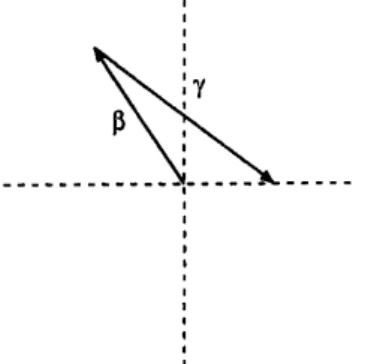
$\mathbb{R}$ and the relation can be written as(5) $z=av_{1}(z,\overline{z})+bv_{2}(z,\overline{z}),$ $a,$$b\in \mathbb{R}$.
$1|\mathfrak{l}$
’11
$\mathfrak{l}$ $1$ $1$ $1$111
FIGURE 2. If$\lambda_{0}\leq 0,$ $|\beta|<|\gamma|$
Now we areready to prove the isomorphism theorem:
Theorem 36. Under the same assumption
as
in Theorem 34, the twofibmtions
$f:\partial E(r, \delta_{0})arrow S_{\delta_{0}}^{1}$, $\varphi:S_{r}^{2n-1}\backslash K_{r}arrow S^{1}$
are topologically isomorphic.
3. MIXED PROJECTIVE CURVES
Let $f(z,\overline{z})$ bc a rad-polar weighted homogeneous mixed polynomial with $z=$
$(z_{1}, \ldots, z_{n})\in \mathbb{C}^{n}$. Namely there exist integers $(q_{1}, \ldots, q_{n})$ and $(p_{1}, \ldots, p_{n})$ and positive intcgers $d_{r},$ $d_{p}$ such that
$\int(t\circ z, t\circ\overline{z})=t^{d_{r}}f(z,\overline{z})$, toz $=(t^{q\iota}z_{1}, \ldots, t^{q_{\hslash}}z_{n})_{\dot{\prime}}t\in \mathbb{R}^{+}$
$f(\rho\circ z,\overline{\rho\circ z})=\rho^{d_{\rho}}f(z,\overline{z})$, $\rho\circ z=(\rho^{P1}z_{1,\ldots)}\rho^{\rho_{n}}z_{n}),$ $\rho\in \mathbb{C},$ $|\rho|=1$
.
This gives $\mathbb{R}^{+}\cross S^{1}$ action by
$(t, \rho)\circ z=(t^{q_{1}}\rho^{\rho_{1}}z_{1}, \ldots, t^{q_{n}}\rho^{p_{n}}z_{n})$, $t\rho\in \mathbb{R}^{+}\cross S^{1}$.
We say that $f(z,\overline{z})$ is strongly polar weighted homogeneous if$p_{j}=q_{j}$ for $j=$
$1_{:}\ldots,$ $n$
.
Then the associated $\mathbb{R}^{+}\cross S^{1}$ action on$\mathbb{C}^{n}$ is in fact thc $\mathbb{C}^{*}$ action whichis defined by
$(z, \tau)=((z_{1}, \ldots, n), \tau)\mapsto\tau oz=(z_{1}\tau^{\rho_{1}}, \ldots, z_{n}\tau^{p_{n}}),$ $\tau\in \mathbb{C}^{*}$.
We say $f(z,\overline{z})$ is strongly polar homogeneous if further the weights satisfies the
equalities$q_{j}=p_{j}=1$for any$j$
.
Astrongly polar weighted homogeneous polynomial$f(z,\overline{z})$ satisfies the equality:
(6) $f((t, \rho)\circ z, \overline{(t,\rho)\circ z})=t^{d_{r}}\rho^{d_{p}}\int(z.\overline{z})$, $(t, \rho)\in \mathbb{R}^{+}\cross S^{1}$.
Assume that $f(z,\overline{z})$ is a strongly polar weighted homogeneous polynomial of
radial degree$d_{r}$ and ofpolar degree$d_{p}$ respectivcly and let $P=(p_{1}, \ldots,p_{n})$ be the
weight vector. Let $\overline{V}$ be the mixed affine hypersurface
$\tilde{V}=f^{-1}(0)=\{z\in \mathbb{C}^{n}|f(z,\overline{z})=0\}$
.
Let $\varphi$ : $S^{2n-1}\backslash Karrow S^{1}$ be the Milnor fibration with
$K=\tilde{V}\cap S^{2n-1}$ and let $F$ be
the fiber. Recall that $\varphi(z)=\int(z,\overline{z})/|f(z,\overline{z})|$
.
Thus $F$ is defined byWe
can
equivalently consider the globalfibration$f$ : $\mathbb{C}^{n}-\tilde{V}arrow \mathbb{C}^{*}$.
Thcn the Milnorfiber is identified with the hypersurface $f^{-1}(1)$
.
The monodromy map $h$ : $Farrow F$(in either case) is defined by
$h( z)=(\exp(\frac{2p_{1}\pi i}{d_{p}})z_{1}, \ldots, \exp(\frac{2p_{n}\pi i}{d_{p}})z_{1})$ . We consider alsothe wighted projective hypersurface $V$ defined by
$V=\{(z_{1}:z_{2} :. . . :z_{n})\in \mathbb{C}\mathbb{P}(P)^{\iota-1}|f(z,\overline{z})=0\}$
whereCP$(P)^{n-1}$ is the weightedprojcctivespace defined by thcequivalenceinduced
by the above C’ action:
$z\sim w\Leftrightarrow\exists\tau\in \mathbb{C}^{*},$ $w=\tau\circ z$
.
It is well-known that $\mathbb{C}\mathbb{P}(P)^{n-1}$ is an orbifold with at most cyclic quotient
singu-larities.
By (6), $z\in f^{-1}(0)$ and $z’\sim z$, then $z’\in f^{-1}(0)$
.
Thus the hypersurface$V=\{[z]\in \mathbb{C}\mathbb{P}^{n-1}(P)|f(z)=0\}$ is well-defined. Consider the quotient map $\pi$ :
$S^{2n-1}arrow \mathbb{C}\mathbb{P}(P)^{n-1}$ or$\pi$ : $\mathbb{C}^{n}\backslash \{O\}arrow$ CIP$(P)^{n-1}$
.
Forthe brevity‘s sake,we denotethe restrictions $\pi|F:Farrow \mathbb{C}\mathbb{P}^{n-1}\backslash V$ and $\pi|K$ : $Karrow V$ by the same $\pi$
.
We areinterested in the topology of$V$ and the relation with the Milnor fibration.
3.1. Canonical orientation. It is well known that a complex analytic smooth
variety has
a
canonical orientation whichcomes
from the complex structure (seefor example p.18, [7]$)$
.
Let $\tilde{V}=f^{-1}(0)$ be a mixed hypersurface. Take a point$a\in\tilde{V}$. We say that a is a mixedsingularpoint of $\tilde{V}$
, ifa is acritical point of the
$mapp_{\sim}^{ing}f$ : $\mathbb{C}^{n}arrow$ C. Otherwise, a is a mixed regular point. Note that a point
a $\in V$ to be a regular point
as
a point of a real analytic variety is a necessarycondition but not a sufficient condition for the regularity as a point on a mixed variety. Recall that
a
isa
mixed singular point ifand only if$df_{a}:T_{a}\mathbb{C}^{\tau\iota}arrow T_{f(a)}\mathbb{C}$is surjective. This is equivalent tothe existencc of acomplex number $\alpha\in \mathbb{C}$ with
$|\mathfrak{a}|=1$ such that
$\overline{df}(a,\overline{a})=\alpha\overline{d}f(a,\overline{a})$ i.e., $\overline{\frac{\partial f}{\partial z_{j}}}(a,\overline{a})=(y\frac{\partial f}{\partial\overline{z}_{j}}(a,\overline{a}),$$.i=1,$
$\ldots,$
$\gamma\iota$
([23]). We assert that
Proposition 37. There is a canonical orientation on the smooth part
of
a mixedhypersurface.
Proof.
Takea
regular point a $\in\tilde{V}$.
The normal bundle $\mathcal{N}$ of $\tilde{V}\subset \mathbb{C}^{n}$ has acanonical orientation so that $df_{a}$ : $\mathcal{N}_{a}arrow T_{f(a,\overline{a})}\mathbb{C}$ is an orientation preserving
isomorphism. This gives acanonicalorientation on $\tilde{V}$
so
that the ordered union ofthe oriented frames $\{v_{1}, \ldots, v_{2n-2}, n_{1}, n_{2}\}$ of$T_{a}\mathbb{C}^{n}$ is the orientation of $\mathbb{C}^{b}$ ifand
only if $\{v_{1}, \ldots , v_{2,\iota-2}\}$ is
an
oriented frame of$T_{a}\tilde{V}$ where $\{n_{1}, n_{2}\}$ isan
orientedframe of normal vectors. $\square$
Consider amixed homogeneous hypersurface $\tilde{V}$
and let $V$ be the corresponding
mixed projective hypersurface.
Proposition 38. Let $a\in\tilde{V}\backslash \{O\}$
.
Then $a\in\tilde{V}$ is a mixed singular pointof
$\tilde{V}$if
and only
if
$\pi(a)\in V$ is a mixedsingular point.3.2. Milnor fiberation and Hopf fiberation. Consider the Hopf fibration $\pi$ : $S^{2\tau\iota-1}arrow \mathbb{C}\mathbb{P}^{\tau\iota-1}$ and its restriction to the Milnor fiber $F=\{z\in S^{2r\iota-1}|f(z,\overline{z})>$
$0\}$
.
Put $K=f^{-1}(0)\cap S^{2n-1}$ be the link. As $\int$ is polar weighted, it is easy tosee
that $\pi$ : $Farrow \mathbb{C}\mathbb{P}^{n-1}\backslash V$ isa
cyclic covering of order $d_{p}$ and the coveringtransformation is generated by the monodromy map
$h;Farrow F$, $z\mapsto\exp(\frac{2\pi i}{d_{p}})\cdot z$. Thus
we
haveProposition 39. (1) $\chi(F)=d_{p}\chi(\mathbb{C}\mathbb{P}^{n-1}\backslash V)$.
(2) $\chi(\mathbb{C}\mathbb{P}^{\iota-1}\backslash V)=n-\chi(V)$ and $\chi(V)=n-\chi(F)/d_{p}$
.
(3) We have thefollowing exact sequence.
$1arrow\pi_{1}(F)arrow^{\pi\#}\pi_{1}(\mathbb{C}\mathbb{P}^{n-1}\backslash V)arrow Z/d_{p}Zarrow 1$
.
The following specialcases are
uscd later.Corollary 40. (1) Suppose $n=2$
.
Then $K\subset S^{3}$ is a link. Put $7^{\cdot}$ be thenumber
of
the components. Then $V$ is $r$ points and $r$ and $\chi$ are related by$\frac{\chi(F)}{d_{p}}=2-r\cdot$.
(2) Suppose$n=3$
.
Then $V\subset \mathbb{P}^{2}$ isa
curve
of
genus
$g$ and $1+2g= \frac{\chi(,F)}{d_{\rho}}$.
Remark 41. Let $f$ be a mixed polar weighted polynomial
of
two variables and let $r$ be the numberof
link components $S^{3}$. Let $s$ be the numberof
irreduciblecomponents
of
$f$. Then $r\geq s$. For example, For example, let $f(z_{1)}z_{2},\overline{z}_{1},\overline{z}_{2})=$$-2z_{1}^{2}\overline{z}_{1}+z_{2}^{2}\overline{z}_{2}+tz_{1}^{2}\overline{z}_{2}$. Then
for
$t=0$, lkn$(f)=1=6$ andfor
$t=2,$ $s=1$ and$1kn(f)=3$
.
Corollary 42.
If
$d_{p}=1$, the projection $\pi$ : $Farrow \mathbb{C}\mathbb{P}^{n-1}\backslash V$ is a diffeomorphism.The monodromymap $h:Farrow F$ givcs free $Z/d_{p}Z$ action on $F$
.
Thus usingtheperiodic monodromy argumcnt in [15], wcget
Proposition 43. The zeta
function
of
$h:Farrow F$ is given by$\zeta(t)=(1-t^{d_{p}})^{-\chi(F)/d_{p}}$.
In particular,
if
$d_{\rho}=1,$ $h=id_{F}$ and$\zeta(t)=(1-t)^{-\chi(F)}$.
3.3. Degree of mixed projective hypersurfaces. Suppose that$f(z,\overline{z})\in\Lambda t(q+$
$2r,$$q;n)$ be a stronglypolar homogeneous polynomial and let
$V=\{z\in \mathbb{C}\mathbb{P}^{n-1}|f(z,\overline{z})=0\}$.
We
assume
that the singular locus $\Sigma V$ of$V$ is either emptyor $co\dim_{R}\Sigma V\geq 2$. Wehave observed that $V\backslash \Sigma V\subset \mathbb{C}\mathbb{P}^{n-1}$ is canonically oriented so that the union of
the oriented frame of$T_{P}V$, say $\{v_{1,\ldots,2(n-2)\}}?)$ and the frame of normal bundle
$\{w_{1}, w_{2}\}$ which is compatible with the local defining complex function $g_{j}$
on
theaffine chart$U_{j}=\{z_{j}\neq 0\}$ istheorientedframeof$\mathbb{C}\mathbb{P}^{n-1}$
.
(Recallthat$g_{j}$ isamixed
Thus ithasafundamentalclass $[V]\in H_{2n-4}(V;Z)$ byBorel-Haefliger [4], The
topo-logical degree of $V$ is the integer $d$so that $\iota_{*}[V]=d[\mathbb{C}\mathbb{P}^{7l-2}]$ where $l$, : $Varrow \mathbb{C}\mathbb{P}^{r\iota-1}$
$\mathbb{C}\mathbb{P}^{n-2}isthei.nclusion$ map and
$[\mathbb{C}\mathbb{P}^{n-2}]$ is the homology class ofa canonical hyperplane
Theorem 44. [22] The topological degree
of
$V$ is equalto the polar degree$q$.
Namely thefundamental
class [V] corresponds to $q[\mathbb{C}\mathbb{P}^{n-2}]\in H_{2(n-2)}(\mathbb{C}\mathbb{P}^{n-1})$ by the inclu-sion mappin9 $\iota_{*}$.
3.3.1. Residue
formula for
amonic mixed polynomial. Let$g(w, \overline{w})=\sum_{a.b}c_{a,b}w^{a}\overline{w}^{b}$be
a
mixed polynomial. Put $d= \max\{a+b|c_{a,b}\neq 0\}$ and we call $d$ the radial degree of $g$. We say that $g$ is a monic mixed polynomialof
degree $d$ if $g$ has aunique monomial of radial degrce $d$.
Lemma 45. Assume that$g(w,\overline{w})$ is a monic mixed polynomial
of
degree $d$ whichis written as
$g(w,\overline{w})=c_{0}(\overline{w})w^{q+r}+c_{1}(\overline{w})w^{q+r-1}+\cdots+c_{q+r}$
$c_{j}(\overline{w})\in \mathbb{C}[\uparrow\overline{v}],$ $rdcg_{\overline{w}^{C’}j}\leq\gamma\cdot,$$j=0,$
$\ldots,$$q+7^{\cdot}$ $c_{0}(\overline{w})=c_{0r}\overline{w}^{r}+\cdots+c_{00},$ $c_{0r}\neq 0$
with $d=q+2r$. Then
$\frac{1}{2\pi}l_{|w|=R}$Gauss$(g)d\theta=q$,
3.3.2. Mixedprojective
curves.
In this section, wc study basic examplesin the pro-jectivc surface $\mathbb{C}\mathbb{P}^{2}$.
Thus weassume
that $n=3$.
We considcr projectivecurves
ofdegree $q$:
$C=\{[z_{1}:z_{2}:z_{3}]\in \mathbb{C}\mathbb{P}^{2}|f(z_{1}, z_{2}, z_{3})=0\}$
where $f$ is a strongly polar homogeneous polynomial with pdeg$f=q$
.
We haveseen
that the topological degree of$C$is $q$ by Theorem 44. The genus $g$ of$C$ is notan
invariant of$q$.
Recall that fora
differentiable curve $C$ of genus $g$, embedded in$\mathbb{C}\mathbb{P}^{2}$
, with the topological degree $q$,
wc
have the following Thom’s inequality, whichwas conjectured by Thom and proved by for example Kronheimer-Mrowka [13]:
$g \geq\frac{(q-1)(q-2)}{2}$
wherethe right side number isthegcnus ofalgebraiccurvesof dcgree$q$, givenby the
Pl\"ucker formula. Recall that for a mixed strongly polar homogcneous polynomial, the genus and the Euler characteristic ofthe Milnor fiber arc related as follows (
Corollary 40):
$g= \frac{1}{2}(\frac{\chi(F)}{q}-1)$
where
$F=\{(z_{1}, z_{2}, z_{3})\in \mathbb{C}^{3}|f(z_{1}, z_{2}, z_{3_{j}}\overline{z}_{1},\overline{z}_{2},\overline{z}_{3})=1\}$.
I. Simplicial polynomials. Wc consider the following simplicial polar
homoge-neous polynomials ofpolar degree $q$
.
$f_{s_{1}}(z,\overline{z})=z_{1}^{q+r}\overline{z}_{1}^{r}+z_{2}^{q+r}\overline{z}_{2}^{r}+z_{3}^{\eta+r}\overline{z}_{3}^{r}$
$f_{s_{2}}(z,\overline{z})=z_{1}^{q+r-1}\overline{z}_{1}^{r}z_{2}+z_{2}^{q+r-1}\overline{z}_{2}^{r}z_{3}+z_{3}^{q+r}\overline{z}_{3}^{r}$
$f_{\hslash_{J}^{a}}(z,\overline{z})=z_{1}^{q+r-1}\overline{z}_{1}^{\tau}.z_{2}+z_{2}^{q+r-1}\overline{z}_{2}.z_{3}+z_{3}^{q+r-1_{\overline{Z}_{3}^{z}Z_{1}}}$.
$f_{s4}(z,\overline{z})=z_{1}^{q+r+1}\overline{z}_{1}^{r}\overline{z}_{2}+z_{2}^{q+r+1}\overline{z}_{2}^{r}\overline{z}_{3}+z_{3}^{q+r}\overline{z}_{3}^{r}$
$f_{s_{5}}(z,\overline{z})=z_{1}^{q+r+1}\overline{z}_{1}^{r}\overline{z}_{2}+z_{2}^{q+r+1}\overline{z}_{2}^{r}\overline{z}_{3}+z_{3}^{q+r+1}\overline{z}_{3}^{r}\overline{z}_{1}$
Let $F_{s:}$ betheMilnor fiber of$f_{s_{i}}$ andlet $C_{s_{i}}$ be the corresponding projective
curves
for $i=1,$ $\ldots,$
$5$
.
First, the Euler characteristic ofthe Milnor fibers and the generaarc
givenas
follows.$\chi(F_{s}.)=q^{3}-3q^{2}+3q$, $g(C_{s_{i}})= \frac{(q-1)(q-2)}{2},$ $i=1,2.3$
$\chi(F_{s_{4}})=q(q^{2}+q+1)$, $g(C_{S4})= \frac{q(q+1)}{2}$
$\chi(F_{s_{5}})=q(q^{2}+3q+3)$, $g(C_{s_{4}})= \frac{(q+2)(q+1)}{2}$
In [21],
we
have shown that $C_{s_{1}}$ and $C_{s_{2}}$arc
isomorphic to algebraic planecurves
defined by the associated homogeneous polynomialsof degree $q$: $q_{s_{1}}(z)=z_{1}^{q-1}z_{2}+z_{2}^{q-1}z_{3}+z_{3}^{q}$
$g_{S2}(z)=z_{1}^{q-1}z_{2}+z_{2}^{q-1}z_{3}+z_{3}^{q}$.
We also expect that $C_{s_{3}}$ is isotopic tothe algebraic
curve
$z_{1}^{q-1}z_{2}+z_{2}^{q-1}z_{3}+z_{3}^{q-1}z_{1}=0$,
as
the genus of $C_{s_{3}}$ suggests it (see also [21]).II. We consider the followingjoin type polar homogeneous polynomial. $h_{j}(z,\overline{z})=g_{j}(w^{-}w)+z_{3}^{q+r_{\overline{Z}_{3}^{r}}}$,
$g_{j}(w,-w)=(w_{1}^{q+.7}\overline{w}_{1}^{j}+w_{2}^{q+j}\overline{w}_{2}^{j})(\uparrow v_{1}^{r-j}-\alpha w_{2}^{r-j})(\overline{w}_{1}^{r-j}-\beta\overline{w}_{2}^{r-j})$, $0\leq j\leq r$.
($\alpha,$$\beta\in$ C’
are
generic.) The the Milnor fiber $F_{g_{g}}$ of $g_{j}$ is connected. The linkcomponentnumber of$g=0$islkn$(g)=q+2(,.-j)$. Thus$\chi(F_{g_{j}})=q(q-2+2(’\cdot-j))$
by Corollary 40 and $g= \frac{(q-1)(q-2+2(r-j))}{2}$
.
In particular, taking$q=2$, we obtain
$g=r-j$
and thusCorollary46. Forany smooth
surface
$S$of
genus$g$, thereis an embedding$S\subset \mathbb{C}\mathbb{P}^{2}$so that the degree
of
$S$ is 2.We observe that the
case
$q=1$ gives only the trivialcasc
$g=0$ in this family. 3.4. Twisted join type polynomial. In this section,we introducc anew
class of mixedpolarweighted polynomials which weuse
toconstructcurves
withembeddeddegree 1. For further detail,
see
[22]. Let $f(z,\overline{z})$ be apolar weighted homogeneouspolynomial ofn-variables $z=(z_{1}, \ldots, z_{n})$
.
Let $Q={}^{t}(q_{1},$$\ldots,$$q_{n}),$ $P=\downarrow(p_{1}, \ldots,p_{n})$ be the radial and polar weight respectively and let $d,$ $q$ be the radial and polar
${}^{t}(p_{1}/q,$ $\ldots,p_{n}/q)$ the normalized mdial weights and the normalized polar weights
respectively.
Consider
the mixed polynomial of (n$+$ l)-variables:$g(z,\overline{z}, w.\overline{w})=f(z,\overline{z})+\overline{z}_{n}w^{a}\overline{w}^{b}$, $a>b$
.
Consider thc rationalnumbers $\overline{q}_{n+1},\overline{p}_{n+1}$ satisfying
$\frac{q_{n}}{d}+(a+b)\overline{q}_{\iota+1}=1$, $- \frac{p_{n}}{q}+(a-b)\overline{p}_{\iota+1}=1$.
We
assume
that $q_{?t}<d$sothat $\overline{q}_{\iota+1},,\overline{p}_{r\iota+1}$are
positive rationalnumbers. Thepoly-nomial $g$ is a polar weighted homogeneous polynomial with the normalized radial
and polar weights $\overline{Q’}=L(q_{1}/d, \ldots , q_{n}/d,\overline{q}_{\tau+1})$ and $\overline{P’}={}^{t}(p_{1}/q,$
$\ldots,$$p_{n}/q,\overline{p}_{n+1})$
respectively. The radial and polar degrec of $g$ are given by lcm$(d. denom(\overline{q}_{n+1}))$
and lcm$(q, dcnorn,(\overline{p}_{n+1}))$ wherc$dr^{I},\gamma\iota om(x)$ is the dcnominator of$\prime f’\in \mathbb{Q}$. Wecall,$q$ $a$
twistedjoin
of
$\int(z,\overline{z})$ and$\overline{z}_{n}w^{a}\overline{w}^{b}$.
We saythat9 is apolar weighted homogeneous
polynomial of twistedjoin type. A twisted join type polynomial behavesdifferently than the simplejoin type, as
wc
willsee
below.We recall that $f(z,\overline{z})$ is callcd to bc l-convenient ifthe restriction of $f$ to each coordinate hyperplane $f_{i}$ $:=f|_{\{z_{i}=0\}}$ is non-trivial for $i=1,$
$\ldots,$$n$ ([23]) Lemma 47. Assume that $n\geq 2$ and $f$ is l-convenient. Then
$\phi_{\#}:\pi_{1}((\mathbb{C}^{*})^{n}\backslash F_{f}^{*})\cong Z^{n}\cross Z$
is an isomorphism where $\phi$ is the canonical mapping
$\phi:(\mathbb{C}^{*})^{n}\backslash F_{f}^{*}arrow(\mathbb{C}^{*})^{n}\cross(\mathbb{C}\backslash \{1\})$
defined
by $\phi(z)=(z, f(z,\overline{z}))$ and $F_{f}^{*}$ $:=f^{-1}(1)\cap(\mathbb{C}^{*})^{n}$.
Put $F_{f_{n}}:=f_{n}^{-1}(1)=F_{f}\cap\{z_{n}=0\}\subset \mathbb{C}^{n-1}$ with $f_{\mathcal{T}l}:=f|_{\mathbb{C}^{n}\cap\{z_{n}=0\}}$
.
Theorem 48. [22] Assume that $n\geq 2$ and $f$ is l-convenient and$g(z,\overline{z}, w,\overline{w})$ is
a
twistedjoin polynomial as above. Then
(1) the Milnor
fiber of
$g,$ $F_{g}=g^{-1}(1)$, is simply connected.(2) The Euler charactentstic
of
$F_{9}$ is given by the formula;$\chi(F_{g})=-(0-b-1)\chi(F_{f})+(c\prime_{l}-b)\chi(F_{f_{n}})$.
3.4.1. Construction
of
a familyof
mixed curves with polar degree $q$.
Now weare
ready to construct akey family ofmixed
curves
with embedding degree $q$. Recallthe polynomial:
$h_{q.r,j}(w,\overline{w}):=(z_{1}^{q+j}\overline{z}_{1}^{j}+z_{2}^{q+j}\overline{z}_{2}^{j})(z_{1}^{r-j}-\alpha z_{2}^{r-j})(\overline{z}_{1}^{r-j}-\beta\overline{z}_{2}^{r-j}))$ $w=(z_{1}, z_{2})$. $h_{q,r},.’(w, w-)$ is l-convenientstronglypolarhomogeneous polynomialwiththe radial
degrce $q+r$ and thc polar degree $q$ respectively. The constants $\alpha,$$\beta$ are generic,
For this, it suffices to
assume
that $|\alpha|,$$|\beta|\neq 0,1$ and $|\alpha|\neq|\beta|$. Consider the twisted join polynomial of3 variables $z_{1},$$z_{2},$$z_{3}$:$s_{q,r,j}(z,\overline{z})=h_{q,r,g}(w^{-}w)+\overline{z}_{2}z_{3}^{q+r}\overline{z}_{3}^{r-1}$ , $z=(z_{1}, z_{2}, z_{3})$.
Let $F_{q,r,j}=s_{q,r,j}^{-1}(1)\subset \mathbb{C}^{3}$ be the Milnor fiber and let $S_{q,r,j}\subset \mathbb{P}^{2}$ be the
corre-sponding mixed projective
curve:
$S_{q,r,j}=\{[z]\in \mathbb{P}^{2}|s_{q,r,j}(z,\overline{z})=0\}$.
Note that $S_{q,r,j}$ is a smooth mixed
curvc.
The following describes the topology of $F_{q,,.,j}$ and $S_{q.?\cdot,j}$.
Theorem 49. (1) The Euler chamcteristic
of
the Milnorfiber
$F_{q,r,j}$ is given$by$:
$\chi(F_{q,r,j})=q(q^{2}-q+1+2(r-j))$
.
(2) The genus
of
$S_{q,’\cdot,j}$ is given by:$g(S_{q.r,j})= \frac{q(q-1)}{2}+(r-j)$
Proof.
Let $H_{q,r,j}=h_{q,,.,j}^{-1}(1)$.
Then by Corollary 40,$\chi(H_{q,r,j})=-q(q-2+2(r-j))$
$\chi(H_{q,r,j}\cap\{z_{2}=0\})=q$
and thc assertion follows from Theorcm 48. 口
3.4.2. Mixed
curves
with polar degree 1. We considcr thccase
$q=1,$$j=0$:$\{\begin{array}{ll}f\iota(w, w-) :=(z_{1}+z_{2})(z_{1}^{r}-\alpha z_{2}^{r})(\overline{z}_{1}^{r}-\beta\overline{z}_{2}^{r})f_{r}(z,\overline{z}) :=h(w,\overline{w})+\overline{z}_{2}z_{3}^{r+1}\overline{z}_{3}^{r-1}S_{r} :=\{[z]\in \mathbb{P}^{2}|f_{r}(z,\overline{z})=0\}.\end{array}$
Corollary 50. Let $S_{r}$ be the mixed
curve
as
above. Then the embedding degreeof
$S_{r}$ is 1 and the genusof
$S_{r}$ is $r$.
Proof.
Let $F_{r}=f^{-1}(1)$ be theMilnorfiberof$f_{r}$.
ByTheorem 48,we
have$\chi(F_{r})=$$2r+1$
.
Thus by Corollary 40, the assertion follows immediately. 口Remark 51. $h,(w, w-)$ can be replaced by $(z_{1}^{r+1}-z_{2}^{r+1})(\overline{z}_{1}-\beta\overline{z}_{2}^{r})$ without changing
the topology.
REFERENCES
[1] N. A‘Campo. Lafonction zeta d‘urlemonodromie. Comm. Math. Helv., 50:539-580, 1975.
[2] R. Benedetti and J.-J. Risler. Real algebraic and semi-algebraic sets. Actualit\’es
Math\’ematiques. [Current MathematicalTopics]. Hermann, Paris, 1990.
[3] A. Bodin and A. Pichon. Meromorphic functions, bifurcation sets and fibred links. Math.
Res. Lett., 14(3):413-422, 2007.
[4] A. Borel and A. Haefliger. Laclasse d‘homologie fondamentale d‘un espaceanalytique. Bull.
Soc. Math. Phance, 89:461–513, 1961.
[5] J. L.Cisneros-Molina. Join theorem forpolarweighted homogeneoussingularities. In
Singu-larities II, volume475 of Contemp. Math., pages 43-59. Amer, Math. Soc., Providence, RI,
2008. [6]
[7] P. Griffiths and J. Harris. Principles of algebraic geometry. Wiley Classics Library. John
Wiley &Sons Inc., New York, 1994. Reprint of the 1978 original.
S. M. GuseYn-Zade, I. Luengo,andA.Melle-Hern\’andez. Zetafunctions of germsof
meromor-phic functions, and the Newton diagram. Funktsional. Anal. i Pnlozhen., $32(2):26-35,$ 95,
1998.
[8] S. M. GuseIn-Zade, I. Luengo, and A. Melle-Hern\’andez. On the topology of germsof
mero-morphicfunctions and its applications. Algebm i Analiz, $11(5):92-99$, 1999.
[9] H. Hamm. Lokale topologische Eigenschaften komplexerR\"aume. Math. Ann., 191:235-252,
1971.
[10] H. A. Hamm and D. T. L\^e. Unth\’eor\‘eme de Zariski du typede Lefschetz. Ann. Sci. \’Ecole
Norm. Sup. (4),6:317-355, 1973.
[11] M. Kato andY.Matsumoto.On theconnectivityoftheMilnorfiber ofaholomorphicfunction
at acritical point. In Manifolds–Tokyo 197S (Proc. Intemat. Conf., Tokyo, 197S), pages
[12] A. G. Kouchnirenko. Poly\‘edres de Newton et nombres de Milnor. Invent. Math., 32:1 31, 1976.
[13] P. B. Kronheimer and T.S. Mrowka. The genus of embedded surfacesin theprojective plane.
Math. Res. Lett., 1(6):797.808, 1994.
[14] F. Michel, A. Pichon, andC. Weber. The boundary of the Milnor fiber ofHirzebruchsurface
singularities. In Singularity theory, pages 745760. World Sci. Publ., Hackensack, NJ, 2007.
[15] J. Milnor. Singularpoints ofcomplexhypersurfaces. AnnalsofMathematicsStudies, No. 61.
Princeton University Press, Princeton, N.J., 1968.
[16] J. Milnorand P. Orlik. Isolatedsingularities definedby weighted homogeneous polynomials.
Topology, 9:385-393, 1970,
[17] M.Oka. On the resolution ofthe hypersurfacesingularities.In Complexanalyticsingulart,ties,
volume 8of Adv. Stud. Pure Math.,pages 405-436. North-Holland, Amsterdam, 1987.
[18] M. Oka. Principal zeta-function ofnondegenerate complete intersection singularity. J. Fac.
Sci. Univ. Tokyo Sect. IA Math., 37(1):11-32, 1990,
[19$|$ M. Oka. On the topologyoffull nondegenerate complete intersection variety. Nagoya Math.
J., 121:137..148, 1991,
[20] M. Oka. Non-degenerate complete intersectionsingulanty. Hermann, Paris, 1997. [21] M. Oka. Onmixed Brieskornvariety. Comtemporary Math., 538,389-399,20, 2011
[22] M. Oka. On rnixed planecurves ofpolardegree 1. Proceeding ofthe CentreforMath. and its
applications, Australian National Univ., 43, 67-74, 2010
[23] M. Oka. Topologyofpolarweighted homogeneous hypersurafces. Kodai Math. $J_{)}$31(2):163
182, 2008.
[24] M. Oka. Non-degenerate mixedfunctions. KodaiMath. J., 33(1):1 62, 2010.
[25] A. Pichon. Real analyticgerms $f\overline{g}$andopen-book decompositions of the 3-sphere. Intemat.
J. Math., 16(1): 1-12, 2005.
[26] A. Pichon and J. Seade. Real singularities and operi-book decompositions of the 3-sphere.
Ann. Fac. Sci. Toulouse Math. (6), 12(2):245265, 2003.
[27] M. A. S. Ruas, J. Seade, and A. Verjovsky. Onreal singularities with a Milnor fibration. In
Trends in singulanties, Trends Math., pages 191-213. Birkhauser, Basel, 2002.
[28] J. Seade. Open book decompositions associatedtoholomorphic vectorfields. Bol. Soc. Mat. Mexicana (3), $3(2):323$ 335, 1997.
[29] J. Seade. On the topology ofhypersurface singularities. In Real and complex singulamties,
volume 232 of Lecture Notes in Pure and Appl. Math., pages 201 205. Dekker, New York,
2003,
[30] A. N.Varchenko. Zeta-functionof monodrornyand Newtonsdiagram. Invent. Math.,
37:253-262, 1976.
[31] J. A. Wolf. Differentiable fibre spaces and mappings compatible with Riemannian metrics.
Michigan Math. J., 11:65-70, 1964.
DEPARTMENT oP MATHEMATICS
TOKYO UNIVERSITY OF SCIENCE
26 $w_{AKAM}$lYA-C110, $s_{HINJUKU-KU}$
TOKYO 162-8601