INTERPRETATION
OF RACK COLORING KNOTINVARIANTS
IN TERMS OF QUANDLESKOKORO TANAKA AND YUMA TANIGUCHI
1.
INTRODUCTION
This note is a survey of [15]. It is known that racks give us invariants of oriented framed knots [6] and quandles give us that of oriented knots [11, 13]. Considering an oriented knot with an integer as the oriented framed knot,
Nelson [14] constructed
an
invariant of (unframed) oriented knotsby using rackcoloring invariants. It is natural to consider whether there is
some
relationship between his invariant and an invariant of oriented knots derived from quandletheory. In this note, we give two interpretation of his invariant in terms of
quandles.
This note is organized
as
follows. We review basics of racks and quandles in Section 2. In Section 3, we introduce Nelson’s polynomial rack countinginvariant. In Section 4, we give a first interpretation of Nelson’s invariant in terms of quandle colorings with a kink map. In Section 5, we give a second interpretation of Nelson’s invariant in terms of quandle cocycle invariants. We give a byproduct of this study in Section 6.
2. PRELIMINARIES
2.1. Racks and quandles. For a non-empty set $X$ and a binary operation $*$
on $X$, we consider the following three conditions:
(Ql) For any $a\in X,$ $a*a=a.$
(Q2) For any $a\in X$, the $map*a:Xarrow X$, defined by $\bullet\mapsto\bullet*a$, is bijective.
(Q3) For any $a,$$b,$ $c\in X,$
$(a*b)*c=(a*c)*(b*c)$ .
These three conditions correspond to the Reidemeister
moves
of type I, II and III respectively.A pair $(X, *)$ is called
a
rack ifit satisfies conditions (Q2) and (Q3). Henceracks
are
useful for studying oriented framed knots. $A$ pair $(X, *)$ is calleda
quandle if it satisfies conditions (Ql), (Q2) and (Q3). Hence quandles areuseful for studying oriented knots. We remark that
a
quandle is a rack bydefinition. Racks and quandles have been studied in, for example, [6, 11, 13].
For racks $X$ and $Y$, a rack homomorphism $f$ : $Xarrow Y$ is a map such that
$f(a*b)=f(a)*f(b)$ for any $a,$ $b\in X$
.
If both $X$ and $Y$are
quandles,we
call2.2.
Rack colorings and quandle colorings. We definean
invariant of oriented framed knots by using racks. Let $R$ be a finite rack. Let $(D, w)$ bea diagram of an oriented knot $K$ whose writhe is an integer $w$. We
can
thinkof $(D, w)$
as
a diagram of $(K, w)$ by blackboard framing, where $(K, w)$ is anoriented framed knot whose underlying oriented knot is $K$ and whose framing
is $w$
.
Let $\mathcal{A}(D, w)$ be the set ofarcs
of$(D, w)$.
$A$map $c$ : $\mathcal{A}(D, w)arrow R$ isa
$mck$coloringifitsatisfies the followingrelation at everycrossing. Let$x_{j}$ be the
over-arc
ata
crossing, and $x_{i},$$x_{k}$ be under-arcs at the crossing such that the normaldirection of $x_{j}$ points from $x_{i}$ to $x_{k}$
.
Then it is required that $c(x_{k})=c(x_{i})*$$c(x_{j})$.
See
Figure 1. Let $Co1_{R}(D, w)$ be the set of rack colorings ofa
diagram$(D, w)$ with respect to $R$. Then the cardinality $|Co1_{R}(D, w)|$ is
an
invariantof the framed knot $(K, w)$
.
More precisely, it is invariant under Reidemeistermoves
of type II and III (and is invariant under framed Reidemeistermove
oftype I). Thus we denote the value $|Co1_{R}(D, w)|$ by $|Co1_{R}(K, w)|$
.
We note that $|Co1_{R}(K, w)|$ is finite, since $R$ is finite.Similarly,
we
definean
invariant of oriented knots by using quandles. Let $Q$be a finite quandle. Let $D$ be a diagram of an oriented knot $K$ and $\mathcal{A}(D)$ the
set of
arcs
of $D.$ $A$ map $c:\mathcal{A}(D)arrow Q$ is a quandle coloring if it satisfies thesame relation at every crossing
as
that in rack colorings. Let $Co1_{Q}(D)$ be the set ofquandle coloringsofa
diagram $D$ with respectto $Q$.
Thenthe cardinality$|Co1_{Q}(D)|$ is
a
invariant of the knot $K$.
More precisely, it is invariant underReidemeister
moves
oftype I, II and III. Thus we denote the value $|Co1_{Q}(D)|$ by $|Co1_{Q}(K)|$ We note that $|Co1_{Q}(K)|$ is finite, since $Q$ is finite.$x_{k}$
$C(X_{i})*C(X_{j})=C(X_{k})$
$x_{i}$
FIGURE 1. Coloring relation at a crossing
3. $NELSON’ S$ POLYNOMIAL RACK COUNTING INVARIANT
3.1. Rack rank. For
a
rack $R=(R, *)$, let $\iota_{R}:Rarrow R$ be the mapcharac-terized by $\iota_{R}(a)*a=a$ for any $a\in R$
.
The map $\iota_{R}$ is well-defined by thecondition (Q2). It is easy to
see
that $\iota_{R}$ is bijective. We remark that $\iota_{R}$cor-responds to a negative kink as in the left most dotted box of Figure 2, where
we
denote the map $\iota_{R}$ by $\iota$ for simplicity.The mckmnk of
a
rack $R$, denoted by $N_{R}$, is defined to be the minimumsuch , then is defined to be
.
The rack rank corresponds toa
diagramconsisting of $N_{R}$ copies of negative kinks
as
in Figure 2, wherewe
denote therack rank $N_{R}$ by $N$ for simplicity. For a finite rack $R$, we have $N_{R}\neq\infty$, since
$\iota_{R}$ is bijective. We remark that the rack rank of a quandle is 1, since the map $\iota_{Q}$ is the identity map for any quandle $Q.$
$=a$
FIGURE 2. Diagrammatic meaning of the rack rank
3.2. Polynomial rack counting invariant. Nelson [14] found
a
periodic-ity of rack coloring
invariants
of orientedframed
knots with respect to their framings.Proposition 3.1. Let $R$ be
a
finite
$mck$ with $mck$ rank N. Let $(K, w)$ bean
oriented
framed
knot whose underlying oriented knot is $K$ and whose framing is an integer $w$.
Then we have $|Co1_{R}(K, w)|=|Co1_{R}(K, w-N)|.$With the above proposition in hand, Nelson [14] constructed
an
invariant of (unframed) oriented knots by using rack coloring invariants.Definition 3.2. Let $R$ be a finite rack with rack rank $N,$ $K$ an oriented knot.
The polynomial rack counting invariant of $K$ with respect to $R$ is given by
$PR(K, R) := \sum_{w=0}^{N-1}|Co1_{R}(K, w)|t^{w}\in \mathbb{Z}[t, t^{-1}]/(t^{N}-1)$,
where $t$ is a formal variable.
4. FIRST INTERPRETATION
4.1. Kink map. For a rack $R=(R, *)$, a map $\varphi$ : $Rarrow R$ is said to be
a
kinkmap of $R$ if it satisfies the following three conditions:
(Kl) The map $\varphi$ is bijective.
(K2) For any $a,$ $b\in R,$ $\varphi(a)*b=\varphi(a*b)$.
(K3) For any $a,$$b\in R,$ $a*\varphi(b)=a*b.$
The conditions (K2) and (K3) correspond to Figure 3 and Figure 4 respectively.
It is easy to check that the map $\iota_{R}$ is a kink map of $R$
.
This is the mostimportant example among kink maps of$R$. We note that the notion of “a kink
$a$ $a$
FIGURE 3. Diagrammatic meaning of the condition (K2)
$\approx$
$a$
a
FIGURE 4. Diagrammatic meaning of the condition (K3)
4.2. Quandle coloring with
a
kink map. Using a kink map of a quandle,we
can
extend the notion of quandle coloring. Let $Q$ bea
finite quandle and$\varphi$
a
kink map of $Q$.
Let $D$ bea
diagram ofan
oriented knot $K$, and denoteD.
the diagram $D$ with a base point. At the base point,we
cut thearc
of $D.$into two
arcs
$x_{in}$ and $x_{out}$, where the orientation points from $x_{in}$ to $x_{out}$.
Let$\mathcal{A}(D.)$ be the set of
arcs
ofD..
$A$ map $c:\mathcal{A}(D.)arrow Q$ is a quandle coloringwith
a
kinkmap
if it satisfies thesame
relation at every crossingas
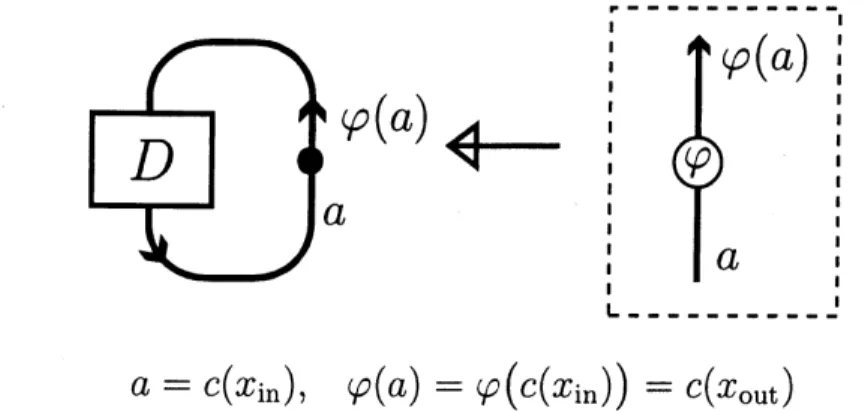
that in rack colorings and quandle colorings, and the relation at the base point suchthat $\varphi(c(x_{in}))=c(x_{out})$
.
See Figure 5. For a diagram D., let $Co1_{Q,\varphi}(D.)$ bethe set of quandle colorings with
a
kink map with respect to $Q$ and $\varphi$.
Thenthe cardinality $|Co1_{Q,\varphi}(D.)|$ is a invariant of the knot $K$. More precisely, it
is invariant under Reidemeister
moves
of type I, II and III, and it does not depend on the choice ofa
base point. Thuswe
denote the value $|Co1_{Q,\varphi}(D.)|$by $|Co1_{Q,\varphi}(K)|$
.
We note that $|Co1_{Q,\varphi}(K)|$ is finite, since $Q$ is finite.4.3. Associated quandle. For a rack $R=(R, *)$,
we
denote the map $\iota_{R}$by $\iota$ for simplicity, and define a new binary operation
$*^{\iota}$ on the set $R$ by
$a*^{\iota}b:=\iota(a)*b$
.
Thenwe
have the following.Proposition 4.1. The pair $(R, *^{\iota})$ is a quandle.
The quandle $(R, *^{\iota})$ is called the associated quandle of $R$ and is denoted by
$a=c(x_{in}) , \varphi(a)=\varphi(c(x_{in}))=c(x_{out})$
FIGURE 5. Coloring relation at the base point
4.4. First interpretation. Let $R=(R, *)$ be a finite rack with rack rank $N.$
We denote the map $\iota_{R}$ by $\iota$ for simplicity. Let $R_{Q}=(R, *^{\iota})$ be the associated
quandle of $R.$
Proposition 4.2. For any integer $n$, a map $\iota^{n}$ is a kink map
of
$R_{Q}.$Remark 4.3. In the above proposition, the finiteness of $R$ is not needed.
Theorem 4.4. Let $K$ be an oriented knot and $w$ be an integer. Let $(K, w)$
be the oriented
framed
knot whose underlying oriented knot is $K$ and whoseframing is $w$. Then
we
have the following.(1) For any integer $w,$ $|Co1_{R}(K, w)|=|Co1_{R_{Q},\iota^{-w}}(K)|.$
(2) $PR(K, R)= \sum_{w=0}^{N-1}|Co1_{R_{Q},\iota^{-w}}(K)|t^{w}$
5. SECOND INTERPRETATION
5.1. Rack 2-cocycles and quandle 2-cocycles. Let $R$ be
a
rack and $N$ anatural number. $A$ $mck2$-cocycle [7, 8, 9, 10] is a map $\theta$ : $R\cross Rarrow \mathbb{Z}/N\mathbb{Z}$
such that
$\theta(a, b)+\theta(a*b, c)=\theta(a, c)+\theta(a*c, b*c)$
for any $a,$$b,$ $c\in R.$
Let $Q$ be a quandle and $N$
a
natural number. $A$ rack 2-cocycle $\theta$ : $Q\cross Qarrow$ $\mathbb{Z}/N\mathbb{Z}$ is said to be a quandle 2-cocycle [2] if $\theta(a, a)=\overline{0}$ for any $a\in Q.$5.2. Quandle cocycle
invariant.
Let $Q$ bea
quandle, $N$ a natural number,and $\theta$ :
$Q\cross Qarrow \mathbb{Z}/N\mathbb{Z}$
a
quandle 2-cocycle. Let $D$ bea
diagram ofan
orientedknot $K.$
For each $c\in Co1_{Q}(D)$ and each crossing $\tau$,
we
assign an element $W_{\theta}(\tau, c)$ in $\mathbb{Z}/N\mathbb{Z}$ as follows. Let$x_{j}$ be the over-arc at the crossing $\tau$, and $x_{i},$$x_{k}$ be
under-arcs such that the normal direction of $x_{j}$ points from $x_{i}$ to $x_{k}$
.
Then wedefine $W_{\theta}(\tau, c)$ by
where $\epsilon(\tau)=1$
or
$-1$ if the $sign$ of the crossing $\tau$ is positive or negativerespectively. See Figure 6.
For each $c\in Co1_{Q}(D)$, the element $W_{\theta}(c)$ in $\mathbb{Z}/N\mathbb{Z}$ is then defined by
$W_{\theta}(c):= \sum_{\tau}W_{\theta}(\tau, c)\in \mathbb{Z}/N\mathbb{Z},$
where $\tau$
runs over
all crossings of $D.$$x_{k}$
$\pm\theta(c(x_{i}),$ $c(x_{j}))$
$x_{i}$
FIGURE 6. Weight at
a
crossingThe quandle cocycle invariant [2] of $D$ with respect to the 2-cocycle $\theta$,
de-noted by $\Phi_{\theta}(D)$, is defined by
$\Phi_{\theta}(D) := \sum t^{W_{\theta}(c)}\in \mathbb{Z}[t, t^{-1}]/(t^{N}-1)$
.
$c\in Co1_{Q}(D)$Then $\Phi_{\theta}(D)$ is invariant of $K$, that is, it is invariant under Reidemeister
moves
of type I, II and III. Thus
we
denote the value $\Phi_{\theta}(D)$ by $\Phi_{\theta}(K)$.
We remarkthat the quandle cocycle invariant $\Phi_{\theta}(K)$ is
a
refinement of the number ofquandle colorings $|Co1_{Q}(K)|$
.
More precisely, fora
map $\epsilon$ : $\mathbb{Z}[t, t^{-1}]/(t^{N}-1)arrow$ $\mathbb{Z}$ defined by $\epsilon(t)=1$, we have $\epsilon(\Phi_{\theta}(K))=|$Col$Q(K)|.$5.3. Quotient quandle. For a rack $R=(R, *)$, we denote the map $\iota_{R}$ by $\iota$
for simplicity, and define the relation $a\sim^{\iota}b$
on
$R$ if there existsan
integer $n$such that $b=\iota^{n}(a)$ for $a,$$b\in R$
.
It is easy to check that the relation$\sim^{\iota}$
is
an
equivalence relation
on
$R$.
Moreover,we
have the following.Proposition 5.1. The quotient set $R/\sim^{\iota}$ has a natuml binary opemtion, which
we
denote by thesame
symbol $*by$ abuseof
notation, inducedfrom
$R=(R, *)$.
And the pair $(R/\sim^{\iota}, *)$ is a quandle.
The quandle $(R/\sim^{\iota}, *)$ is called the quotient quandle of $R$ and is
denoted
by$Q$. For any $a\in R$, we denote its equivalence class by $[a]\in Q.$
5.4. Second interpretation. Let $R=(R, *)$ be a finite rack with rack rank
$N$, and $\pi$ : $Rarrow Q$ a natural projection from $R$ to its associated quandle
$Q=(R/\sim\iota, *)$
.
Using extension theory for racks and quandles developed inProposition 5.2.
If
the numberof
elements in isfor
anythen
(1) there exists a rack 2-cocycle $\theta_{R}:Q\cross Qarrow \mathbb{N}/N\mathbb{Z}$ such that
$\theta_{R}([a], [a])=-i$
for
any $[a]\in Q,$and
(2) the map $\theta$ :
$Q\cross Qarrow \mathbb{Z}/N\mathbb{Z}$,
defined
by$\theta([a], [b]):=\theta_{R}([a], [b])+i$
for
any $[a],$ $[b]\in Q,$ is a quandle 2-cocycle.Remark 5.3. In the above proposition, the finiteness of $R$ is not needed.
Theorem 5.4. Let $K$ be an oriented knot and $w$ be an integer. Let $(K, w)$ be
the
framed
knot whose underlying knot is $K$ and whose framing is $w$. Then wehave the following.
(1) $\sum_{w=0}^{N-1}|Co1_{R}(K, w)|=N\cdot|Co1_{Q}(K)|.$
(2)
If
the numberof
elements in $\pi^{-1}([a])$ is $N$for
any $[a]\in Q$, then$PR(K, R)=N\cdot\Phi_{\theta}(K)$
for
the quandle 2-cocycle $\theta$ as in Proposition 5.2(2).6. BYPRODUCT
As a byproduct of two interpretations of Nelson’s polynomial rack counting invariants, we can interpret quandle cocycle invariants in terms of quandle colorings with a kink map. Let $Q=(Q, *)$ be a finite quandle, $N$ a natural
integer, and $\theta$ : $Q\cross Qarrow \mathbb{Z}/N\mathbb{Z}$ a quandle 2-cocycle. Let $\tilde{Q}$ be a set given by
$Q\cross \mathbb{Z}/N\mathbb{Z}.$
Proposition 6.1.
Define
a binary opemtion $*\sim on$ $\tilde{Q}$ by$(a,-m)*\sim(b,\overline{n}) :=(a*b, m-+\theta(a, b))$
.
Then the pair $(\tilde{Q}, *\sim)$ is a quandle. Let $\varphi$ :
$\tilde{Q}arrow\tilde{Q}$ be a map definedby
$\varphi(a, m-)$ $:=(a,\overline{m}-\overline{1})$ for all $(a, m-)\in\tilde{Q}.$
Proposition 6.2. For any integer $n$, a map $\varphi^{n}$ is a kink map
of
$\tilde{Q}.$Theorem 6.3. Let $K$ be
an
oriented knot and $D$ a diagmmof
K. Then thefollowing hold.
(1) For any integer $w$, we have
(2) $\Phi_{\theta}(K)=\frac{1}{N}\sum_{w=0}^{N-1}|Co1_{\tilde{Q},\varphi^{w}}(K)|t^{w}$
REFERENCES
[1] N. Andruskiewitsch, M. Grana, From mcks to pointed Hopf algebras, Adv. Math. 178
(2003), no. 2, 177-243.
[2] J. S. Carter, D. Jelsovsky, S. Kamada, L. Langford, M. Saito, Quandle cohomology
and state-sum invariants ofknotted curves and surfaces, Trans. Amer. Math. Soc. 355
(2003), no. 10, 3947-3989,
[3] M. Eisermann, Homological chamcterization ofthe unknot, J. Pure Appl. Algebra 177
(2003), no. 2, 131-157.
[4] M. Eisermann, Knotcolouringpolynomials, PacificJ. Math. 231 (2007), no. 2, 305-336.
[5] M. Eisermann, Quandle coverings and their Galois correspondence, preprint
(math.$GT/0612459)$.
[6] R. Fenn, C. Rourke, Racks and links in codimensiontwo, J. Knot Theory Ramifications
1 (1992), no. 4, 343-406,
[7] R. Fenn, C. Rourke, B. Sanderson, An introduction to speciesand the mckspace, Topics in knot theory (Erzurum, 1992), 33-55, NATO Adv. Sci. Inst. Ser. C Math. Phys. Sci.,
399.
[8] R,. Fenn, C. Rourke, B. Sanderson, $\mathcal{I}kunks$ and classifying spaces, Appl. Categ.
Struc-tures 3 (1995), no. 4, 321-356.
[9] R. Fenn, C. Rourke, B. Sanderson, James bundles, Proc. London Math. Soc. (3) 89
(2004), no. 1, 217-240.
[10] R.Fenn, C.Rourke, B. Sanderson, The rackspace, Trans. Amer. Math. Soc. 359 (2007),
no. 2, 701-740.
[11] D. Joyce, A classifying invariant
of
knots, the knot quandle, J. Pure Appl. Algebra 23(1982), no. 1, 37-65.
[12] Y. Kimura, Characterization
of
framings via cohomologyof
the knot quandle, J. KnotTheory Ramifications 20 (2011), no. 12, 1695-1707.
[13] S. V. Matveev, Distribu tive groupoids in knot theory, (Russian) Mat. Sb. (N.S.)
119(161) (1982), no. 1, 78-88,
[14] S. Nelson, Link invariants
from finite
mcks, to appear in Fund. Math.(arXiv:0808.0029).
[15] K. Tanaka, Y. Taniguchi, Interpretation of mck coloring knot invariants in terms
of
quandles, in preparation.
DEPARTMENT OF MATHEMATICS, TOKYO GAKUGEI UNIVERSITY, NUKUIKITA 4-1-1,
KOGANEI, TOKYO 184-8501, JAPAN
$E$-mail address: [email protected]
DEPARTMENT OF MATHEMATICS, TOKYO GAKUGEI UNIVERSITY, NUKUIKITA 4-1-1,