On Solitons of
Standing
Wave Solutions
for the Cubic-Quartic
Nonlinear
Schr\"odinger equation
Katsuya Inui1, Ben T. Nohara2, Takuya
Yamano3
and AkioArimoto4
1’2’4 Musashi Institute of Technology
1-28-1 Tamazutsumi, Setagaya, Tokyo, 158-8557 Japan
3 Ochanomizu University
2-1-1 Ohtsuka, Bunkyo-ku, Tokyo, 112-8610 Japan
2Contact
person: [email protected]Abstract
We investigatethe standingwavesolutions oftheform$A(x, t)=\varphi(x)e^{-i\Omega t}$
for $\Omega>0$ for the one-dimensional Schrodinger equation with a quartic term
of the form $iA_{t}+PA_{xx}+Q|A|^{2}A+\epsilon|A|^{3}A=0$ where $i=\sqrt{-1}$, and $e>0$ is
a fixed coefficient. We show that there are both bright and dark solitons for
small $\epsilon>0$ in thecase that $P<0$ and $Q<0$ and in the case that $P>0$ and
$Q<0$ by using phase portrait analysis.
Keywords. Solitons, Standing Wave Solutions, the nonlinear Schr\"odinger equation
1
Introduction
In general, the Schrodinger equation govems the envelope of group waves, which propagate in the water and the plasma, etc. Moreover, the nonlinear Schr\"odinger
equation govems the non-linearity of the envelope. The fact that the solution
for the nonlinear Schr\"odinger equation can be
a
soliton is known and ofinter-est [Zakharov72]. Many studies ofgroup
waves
have been carried out in the waterwave area
andsome
otherarea as
well. For example, in the fiber-optic communica-tion system, the GVD (Group Velocity Dispersion), in which problem the launchedpulse may spread outside its timing window due to dispersion, limits the
transmis-sion data rate caused by the $pu_{1}^{1}se$ overlapping between adjacent timing windows.
Nonlinearrefraction ofSPM (Self-Phase Modulation)
can
also limit the systemper-formance by causingspectral broadening ofthe optical pulse. Those effects
are
alsodescribed by the linear or nonlinear Schr\"odinger equation and analyzed to achieve
the optimal system performance (see [Agrawa197]).
We study the following the cubic-quartic nonlinear Schr\"odinger equation
(CQNLS) $iA_{t}+PA_{xx}+Q|A|^{2}A+\epsilon|A|^{3}A=0$
.
There exist
some
studiesconcemed theCNLS
with higher-perturbed terms fromterms has beenformulatedin the vibration of elastic plateswith cubic characteristics ofspring $[Nohara05a]$. Moreover, a sufficient condition is suggested to have soliton
solutions for the Schr\"odinger equation with the perturbed term ofthe generaldegree
$(n+1)$ [Nohara07] and the approximation formula of the perturbed soliton solution
is shown [Nohara06].
The aim of this paper is to seek solitons of the standing
wave
solutions forthe CQNLS by using phase portrait analysis. The standing
wave
solutionsare
represented by
$A(x, t)=\varphi(x)e^{-i\Omega t}$.
By virtue of the above form of the solution, the CQNLS is reduced to the second
order ordinary differential equation. We investigate homoclinic orheteroclinic orbits ofthe ODE, that correspond to the envelopes ofsolitons.
This paper is organised
as
follows. InSection 2,we
formulateour
target equation,CQNLS, and state theorems on solitons (Theorem 2.1). In Sections 3-6,
we
analysethe standing
wave
solutions as the proof of Theorem 2.1 for $P<0$ and $Q<0$ (Sec.3$)$, for $P>0$ and $Q<0$ (Sec. 4), for $P<0$ and $Q>0$ (Sec. 5), and for $P>0$ and
$Q>0$ (Sec. 6).
2
Target
equation and
main
theorems
Our target equation is a one-dimensional Schr\"odinger equation with the quartic nonlinearity of the following form,
$\{\begin{array}{l}iA_{t}+PA_{xx}+Q|A|^{2}A+\epsilon|A|^{3}A=0 for x\in \mathbb{R}, t>0,A|_{t=0}=A_{0}(x).\end{array}$ (2.1)
where, $i=\sqrt{-1},$ $P$ and $Q$ are known real numbers, $\epsilon>0$ is a fixed coefficient, and
$A=A(x, t);\mathbb{R}\cross \mathbb{R}_{+}arrow \mathbb{C}$ is
an
unknown function.In this paper,
we
are
concemed with solitons of the standingwave
solutions$A=A(x, t)$ in the following form.
$A(x, t)=\varphi(x)e^{-i\Omega t}$, (2.2)
where, $\varphi(x)\in C^{2}(\mathbb{R};\mathbb{R})$ represents
an
envelope of solutions, and the angularfre-quency $\Omega\in \mathbb{R}$ is
a non-zero
fixed constant.Substituting thefunction $A$ofthe form (2.2) into theequation (2.1) anddividing
by $e^{-i\Omega t}$, we have the envelope equation
$\varphi’’=-\frac{\Omega}{P}\varphi[1+\frac{1}{\Omega}(Q|\varphi|^{2}+\epsilon|\varphi|^{3}))]$
.
(2.3)We call its solution $\varphi$,
an
envelope solution. The characteristics of solitoncan
bemainly stated by using
a
separatorix ofthe orbit and integrability of the envelope.Fact 1. (Classiflcation of Solitons) Solutions $A=A(x,t)$
of
the equation (2.1)$\varphi_{c}(x)=\varphi(x)-c$
for
a constant $c$.
(A) A bright and gray soliton have the following characteristics (1), (2) and (3). (1) The phase portrait $(\varphi, \varphi’)$
of
a bright and gray soliton constructs ahomo-clinic orbit.
(2)1 The envelope $\varphi=\varphi(x)$ is integrable modulo constants, that is, there exists
a
constant $c$ such that $\int_{-\infty}^{\infty}$I
$\varphi_{c}(x)|dx<\infty$.
A bright soliton
can
be distinguishedfrom
a gray soliton by (B) and (C). (B) A bright soliton has thefollowing characteristics (4) or (5).(4) $\varphi’’(x_{b+})<0$, where $x_{b+}$ is
defined
by the equality$\varphi_{c}(x_{b+})=\max_{x}\varphi_{c}(x)$,for
$\varphi_{c}(x)>0$
.
(5) $\varphi^{ll}(x_{b-})>0$, where $x_{b-}$ is
defined
by the equality $\varphi_{c}(x_{b-})=\min_{x}\varphi_{c}(x)_{f}$for
$\varphi_{c}(x)<0$
.
(C) A gray soliton has the following characteristics (6) or (7).
(6) $\varphi’’(x_{g-})>0$, where $x_{g-}$ is
defined
by the equality $\varphi_{c}(x_{g-})=\min_{x}\varphi_{c}(x)$,for
$\varphi(x)>0$
.
(7) $\varphi’’(x_{g+})<0$, where $x_{g+}$ is
defined
by the equality$\varphi_{c}(x_{g+})=\max_{x}\varphi_{c}(x)_{f}$for
$\varphi(x)<0$.
(D) A dark soliton has the following characteristics (8), (9) and (10).
(8) The phase portrait $(\varphi, \varphi^{f})$
of
a dark soliton constructs a heteroclinic orbit.(9) The envelope $\varphi=\varphi(x)$ is non-integrable in the
sense
that there does notexist any constant $c$ such that $\int_{-\infty}^{\infty}$
I
$\varphi_{c}(x)|dx<$oo.
(10) The envelope $\varphi=\varphi(x)$ is bounded.
On envelope solutions $\varphi$ for the CNLS without the quartic term $(i.e., \epsilon=0)$, it
is known that there
are
(i) bright solitons (sech solutions) for $P<0$ and $Q<0$
(ii) dark solitons ( $\tanh$ solutions) for $P>0$ and $Q<0$.
It is also known that the equation (2.1) has no soliton solution for $P$ and $Q$ except
for the above two
cases
(e.g. [Watanabe85]).Now we state the theorem in the following.
Theorem 2.1. (Solitons for the CQNLS) Assume that $\Omega>0$ and $\epsilon>0.$
Con-sider the equation (2.1). (1) Let $P<0$ and $Q<0$
.
i$)$
If
$\epsilon^{2}<\frac{25}{216}\frac{(-Q)^{3}}{\Omega}$, then there exist both bright and dark solitonssimultane-ously.
ii)
If
$\epsilon^{2}=\frac{25}{216}\frac{(-Q)^{3}}{\Omega}$, then there exist only dark solitons.iii)
If
$\frac{25}{216}\frac{(-Q)^{3}}{\Omega}<\epsilon^{2}<\frac{4}{27}\frac{(-Q)^{3}}{\Omega}$, then there exist only gray solitons.iv)
If
$\epsilon^{2}\geq\underline{4}\underline{(-Q)^{3}}$, then there exist
no
soliton.27 $\Omega$
(2) Let $P>0$ and $Q<0$
.
i$)$
If
$\epsilon^{2}<\frac{4}{27}\frac{(-Q)^{3}}{\Omega}$, then there enist both bright and dark solitonssimultane-ously.
ii)
If
$\epsilon^{2}\geq\underline{4}\underline{(-Q)^{3}}$, then there exist
no
soliton. 27 $\Omega$(3) Let $P<0$ and $Q>0$
.
There exist no solitonfor
all $\epsilon>0$.
(4) Let $P>0$ and $Q>0$. There $e$rist no soliton
for
all $\epsilon>0$.
3
The
case
$P<0,$ $Q<0$
Putting
$-a^{2}$ $:= \frac{Q}{\Omega},$ $b^{2}$ $:=- \frac{\Omega}{P},$ $c^{2}$
$:= \frac{\epsilon}{\Omega}$, (3.1)
we
can
express (2.3)as
$\varphi’’=b^{2}\varphi(1-a^{2}|\varphi|^{2}+c^{2}|\varphi|^{3})(=:f(|\varphi|))$, (3.2)
that is,
$(+)$ : $\varphi’’=b^{2}\varphi f_{+}(\varphi)(\varphi>0)$ and $(-)$ : $\varphi’’=b^{2}\varphi f_{-}(\varphi)(\varphi<0)$, (3.3)
where $f_{+}(x)(:=f(x))=1-a^{2}x^{2}+c^{2}x^{3}$ and $f_{-}(x)(:=f(-x))=1-a^{2}x^{2}-c^{2}x^{3}$.
Hereafter, we let $a$ represent the positive square root of $a^{2}=- \frac{Q}{\Omega}$ according to
(3.1), that is, $a:=\sqrt{-\frac{Q}{\Omega}}$. Similarly, we represent $b:=\sqrt{-\frac{\Omega}{P}}$ and $c:=\sqrt{\frac{\epsilon}{\Omega}}$
.
3.1
Phase portrait analysis for
$\varphi\geq 0$We rewrite the equation $(3.3)-(+)$ in the dynamical system
$\{\begin{array}{l}\varphi’=\eta,\eta’=b^{2}\varphi(1-a^{2}\varphi^{2}+c^{2}\varphi^{3})(=b^{2}\varphi f_{+}(\varphi)),\end{array}$ (3.4)
whose fixed points in the
area
$\varphi\geq 0$are
$(\varphi, \eta)=(0,0),$ $(\alpha, 0),$ $(\beta, 0)$ $(0<\alpha<\beta)$,
where, $\alpha$ and $\beta$
are
the positive solutions of $f_{+}(x)=0$ if$0<c^{4}< \frac{4}{27}a^{6}$, (3.5)
which is equivalent to $f_{+}( \frac{2}{3}a^{2}cv)<0$
.
Since the Jacobian matrix of the dynamical system (3.4) becomes
we
obtain the eigenvalues of $J$ and specify the fixed points in thearea
$\{(\varphi, \eta)$ ;$\varphi\geq$
$0\}$
as
(0,0) : saddle, $(\alpha, 0)$ : center, $(\beta, 0)$ : saddle. (3.6)
In fact, the fixed point (0,0) is a saddle point since the characteristic equation
$\lambda^{2}=K_{+}(0)=b^{2}(f_{+}(0)+0f_{+}’(0))=b^{2}$gives the real and opposite signed eigenvalues
$\lambda=\pm b=\pm\sqrt{-\frac{\Omega}{P}}$
.
For $(\alpha, 0)$we
canget $\lambda^{2}=K_{+}(\alpha)=b^{2}(f_{+}(\alpha)+\alpha f_{+}^{l}(\alpha))<0$
since $f_{+}(\alpha)=0,$ $f_{+}^{f}(\alpha)<0$ by observing the figure of $f+\cdot$ Hence, the eigenvalues
become imaginary $\lambda=\pm i\sqrt{-K_{+}(\alpha)}$, that implies a center. Similarly, for $(\beta, 0)$, it
follows that $\lambda^{2}=K_{+}(\beta)=b^{2}(f_{+}(\beta)+\beta f_{+}’(\beta))>0$ from $f_{+}(\beta)=0,$ $f_{+}’(\beta)>0$
.
Then, the eigenvalues become $\lambda=\pm\sqrt{K_{+}(\beta)}$, hence, the fixed point $(\beta, 0)$ is saddle.
3.2
Phase
portrait analysis
for
$\varphi<0$The equation $(3.3)-(-)$ is rewritten in the dynamical system
$\{\begin{array}{l}\varphi^{f}=\eta,\eta’=b^{2}\varphi(1-a^{2}\varphi^{2}-c^{2}\varphi^{3})(=b^{2}\varphi f_{-}(\varphi)).\end{array}$ (3.7)
Noting that $f_{-}(-\varphi)=f_{+}(\varphi)$, the fixed points in the
area
$\varphi<0$are
$(\varphi, \eta)=(-\beta, 0),$ $(-\alpha, 0)$ $(0<\alpha<\beta)$
.
The Jacobian matrix is given
as
$J=J_{(\varphi,\varphi’)}=(\begin{array}{ll}0 1K_{-}(\varphi) 0\end{array})$ , where $K_{-}(\varphi)=b^{2}(f_{-}(\varphi)+\varphi f_{-}’(\varphi))$,
hence, the fixed points in the area $\varphi<0$
are
$(-\beta, 0)$ : saddle and $(-\alpha, 0)$ : center. (3.8)
Infact, for $(-\beta, 0)$ thecharacteristicequation becomes $\lambda^{2}=K_{-}(-\beta)=b^{2}(f_{-}(-\beta)-$
$\beta f_{-}^{l}(-\beta))>0$ since $f_{-}(-\beta)=0,$ $f_{-}^{f}(-\beta)<0$ by observing the figure of
$f_{-}$.
Hence, the eigenvalues
are
$\lambda=\pm\sqrt{K_{-}(-\beta)}$.
Similarly, for $(-\alpha, 0)$,we see
$\lambda^{2}=$$K_{-}(-\alpha)=b^{2}(f_{-}(-\alpha)-\alpha f_{-}’(-\alpha))<0$ since $f_{-}(-\alpha)=0,$ $f_{-}^{f}(-\alpha)>0$
.
Hence,$\lambda=\pm i\sqrt{-K_{-}(-\alpha)}$. Thus we obtain the phase portraits for $\varphi\geq 0((3.3)-(+))$
and for $\varphi<0((3.3)-(-))$, respectively. In order to complete phase portrait for
the equation (3.2)
we
proceed to the following “unification”argument. In the “
uni-fication” argument, we calculate potential energy of the dynamical systems (3.4)
and (3.7) for deciding which saddle points
among
$(-\beta, 0),$ $(0,0)$, and $(\beta, 0)$ shouldbe connected each other in order to unify the phase portraits along the border
$\{(\varphi, \eta);\varphi=0\}$
.
Precisely,
one
has choice whether (a) to connect $(-\beta, 0)$ and $(\beta, 0)$as
twohet-eroclinic orbits, and make two looped homoclinic orbits that starts and terminates
two heteroclinic orbits,
or
(c) to make two looped homoclinic orbits that start andterminate at $(-\beta, 0)$ and $(\beta, 0)$, respectively. We will discuss the choice byobserving
potential energy in the next subsection. In the following table,
we
summarize thechoice of connection, where $arrow,$ $arrow$, and $\underline{\wedge}$ denote heteroclinic orbits, $rightarrow$ and $\mapsto$
represent homoclinic orbits.
Table 1: Choice of connection among the saddle points $(-\beta, 0),$ $(0,0)$, and $(\beta, 0)$
at the
case
$P<0,$ $Q<0;c\neq 0$.
3.3
Unification of
phase portraits
$\varphi\geq 0$and
$\varphi<0$In this subsection we consider the conditions for the parameter $c^{2}$ (or
$\epsilon$) for
cases
(a), (b), and (c), in the above subsection. To this end, integrating both sides of
$(3.3)-(+)$ with respect to $\varphi$ after multiplying $\varphi’$ implies that
$\frac{1}{2}(\varphi’)^{2}-\frac{b^{2}}{2}\varphi^{2}+\frac{a^{2}b^{2}}{4}\varphi^{4}-\frac{b^{2}c^{2}}{5}\varphi^{5}=E_{1}$ for
a
constant $E_{1}\in \mathbb{R}$, (3.9)or equivalently,
$\frac{1}{2}(\varphi^{f})^{2}+V_{+}(\varphi)=E_{1}$
.
(3.10)Here,
we
denote by $V_{+}(\varphi)$ the potential energy defined by $V_{+}(\varphi)$ $:=-b^{2}\varphi^{2}v_{+}(\varphi)$,where $v_{+}(\varphi)$ $:= \frac{1}{2}-\frac{a^{2}}{4}\varphi^{2}+\frac{c^{2}}{5}\varphi^{3}$.
First, for the
case
(a), i.e., the realization of two hetero-clinic orbits between$(-\beta, 0)$ and $(\beta, 0)$, the potential energy at their points, $V_{+}(-\beta)$ and $V_{+}(\beta)$ should
be the
same
value, and the value should be greater than $V_{+}(0)$, that is, $V_{+}(\beta)>$$0(=V_{+}(0))$
.
It is easy to see the condition is equivalent to $0< \epsilon^{2}<\frac{25}{216}\frac{(-Q)^{3}}{\Omega}$corresponds to the case (1) i) in Theorem 2.1. Note that there is also the potential
energy $V_{-}(\varphi)$ in the area $\varphi<0$, however, by the symmetry $V_{-}(\varphi)=V_{+}(-\varphi)$,
$V_{-}(-\beta)(=V_{+}(\beta))>0$ is fulfilled under the
same
condition.Secondly, for the
case
(b)we
impose the condition $\epsilon^{2}=\frac{25}{216}\frac{(-Q)^{3}}{\Omega}$, which isequivalent to $V_{+}(\beta)=0(=V_{+}(0))$, and corresponds to the
case
(1) ii) in Theorem2.1.
Thirdly, for the
case
(c) we impose the condition $\epsilon^{2}>\frac{25}{216}\frac{(-Q)^{3}}{\Omega}$ or $V_{+}(\beta)<$$0(=V_{+}(0))$
.
Combining with the condition (3.5) for the existence of the fixedpoints $(-\beta, 0)$ and $(\beta, 0)$, we have $\frac{25}{216}\frac{(-Q)^{3}}{\Omega}<\epsilon^{2}<\frac{4}{27}\frac{(-Q)^{3}}{\Omega}$, for the
case
(1) iii)in Theorem 2.1.
orbits from (to) $(-\beta, 0)$ to (from) $(\beta, 0)$
across
the $\varphi’$ axis in the phase portrait.Since the line ofthe heteroclinic orbit in the area $\varphi\geq 0$ ends at $(\beta, 0)$, we substitute
$\varphi(+\infty)=\beta$ and $\varphi’(+\infty)=0$ into (3.9) to have
$E_{1}=-b^{2}( \frac{1}{2}\beta^{2}-\frac{a^{2}}{4}\beta^{4}+\frac{c^{2}}{5}\beta^{6})$
.
(3.11)On the other hand, from $(3.3)-(-)$
we
obtain for $\varphi<0$ that$\frac{1}{2}(\varphi^{t})^{2}-\frac{b^{2}}{2}\varphi^{2}+\frac{a^{2}b^{2}}{4}\varphi^{4}+\frac{b^{2}c^{2}}{5}\varphi^{5}=E_{2}$
for a constant $E_{2}\in \mathbb{R}$. (3.12)
Then, substituting $\varphi(-\infty)=-\beta$ and $\varphi’(-\infty)=0$ into the above expression, (3.11)
becomes
$E_{1}=-b^{2}( \frac{1}{2}(\beta)^{2}-\frac{a^{2}}{4}(\beta)^{4}+\frac{c^{2}}{5}(\beta)^{5})=-b^{2}(\frac{1}{2}(-\beta)^{2}-\frac{a^{2}}{4}(-\beta)^{4}-\frac{c^{2}}{5}(-\beta)^{5})=E_{2}$.
Taking the limit $\varphiarrow 0$ in (3.9) and (3.12),
we
have $(\varphi^{f})^{2}arrow 2E_{1}$.
and $(\varphi^{l})^{2}arrow 2E_{2}$.Since $E_{1}=E_{2}$,
we
thus have$\lim_{\varphiarrow+0}$ $\varphi’=$ $\lim$
$\varphi^{l}$, (3.13)
along $(3.3)-(+)$ along$\varphi-0\vec{(3}.3$
)$-(-)$
which
ensures
the connectivity of the heteroclinic orbits from (to) the fixed point$(-\beta, 0)$ to (from) $(\beta, 0)$
.
Summarizing the above analysis,
we can
obtain the phase portrait and itspo-tential shown
as
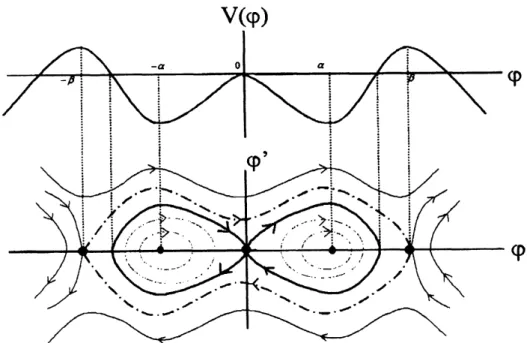
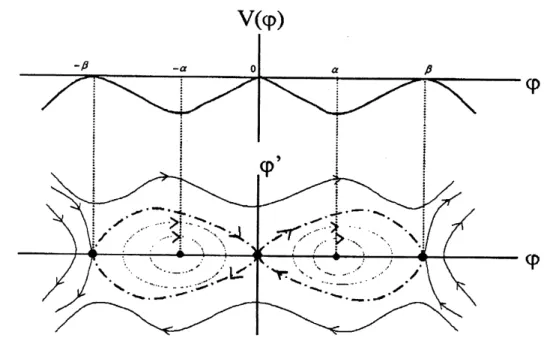
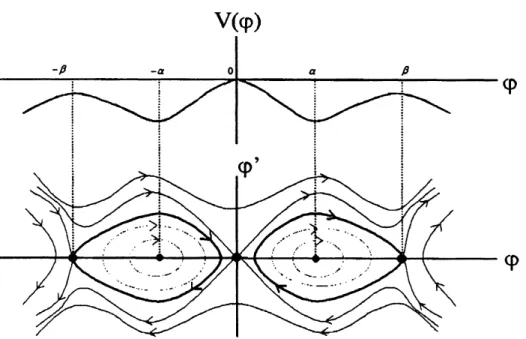
Figure 1, 2 and 3. Tha fact that bright, gray and dark solitons inTheorem 2.1(1) satisfy Fact 1 is easily found.
4
The
case
$P>0,$ $Q<0$
Putting $\hat{b}^{2}:=\frac{\Omega}{P}$, it follows from (2.3)
that
$\varphi’’=-\hat{b}^{2}\varphi(1-a^{2}|\varphi|^{2}+c^{2}|\varphi|^{3})$. (4.1)
Hereafter,
we
represent $\hat{b}$ $:=\sqrt{\frac{\Omega}{P}}>0$.
We consider the phase portrait for two
areas
$\varphi\geq 0$ and $\varphi<0$.
For $\varphi\geq 0$ weobtain
$\{\begin{array}{l}\varphi’=\eta,\eta’=-b^{2}\varphi(1-a^{2}\varphi^{2}+c^{2}\varphi^{3})(=b^{2}\varphi f_{+}(\varphi)),\end{array}$ (4.2)
whose fixed points
are
givenas
Figure 1: Phase portrait and Potential: the
case
of$P<0,$ $Q<0,$$V_{+}(\beta)>0$.a thick solid line:
a
homoclinic orbit,a
dotted line:a
periodic orbit,a
dash-dottedline: a heteroclinic orbit, a thin solid line:
a
blow-up orbitwhere, $\alpha$ and $\beta$
are
the positive solutions of$f_{+}(x)=0$ under the assumption$0<c^{4}< \frac{4}{27}a^{6}$
.
(4.3)The fixed points are classified
as
(0,0) : center, $(\alpha, 0)$ : saddle, $(\beta, 0)$ : center.
Similarly, for the
area
$\varphi<0$, the fixed points of the system$\{\begin{array}{l}\varphi’=\eta,(4.4)\eta’=-b^{2}\varphi(1-a^{2}\varphi^{2}-c^{2}\varphi^{3})(=b^{2}\varphi f_{-}(\varphi))\end{array}$
are
givenas
$(\varphi, \eta)=(-\beta, 0),$ $(-\alpha, 0)$ $(0<\alpha<\beta)$,
and the fixed points
are
classffiedas
$(-\beta, 0)$ : center, $(-\alpha, 0)$ : saddle.
Thus, the similar unification argument to the
one
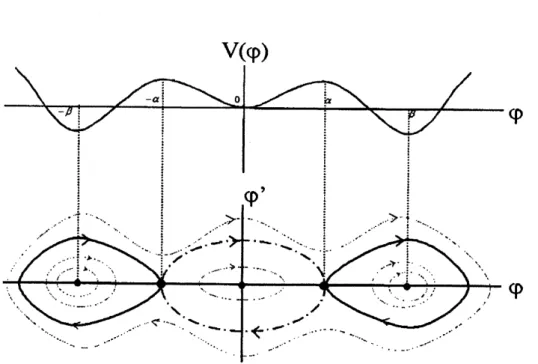
in the previous section realizesthe phase portrait in Figure 4 with its potential which shows the existence of both
bright and dark solitons. Tha fact that bright and dark solitons in Theorem 2.1(2) satisfy Fact 1 is easily found.
Figure 2: Phase portrait and Potential: the case of $P<0,$ $Q<0,$ $V_{+}(\beta)=0$
.
a dotted line:
a
periodic orbit,a
dash-dotted line:a
heteroclinic orbit,a
thin solidline:
a
blow-up orbitThe potential is derived from (4.2)
as
$V_{+}(\varphi):=b^{2}\varphi^{2}v_{+}(\varphi)$, where $v_{+}( \varphi)=\frac{1}{2}-\frac{a^{2}}{4}\varphi^{2}+\frac{c^{2}}{5}\varphi^{3}$
.
For realizingthe orbitsofthe bright solitons,
one
mustimpose the condition $V_{+}(\alpha)>$$V_{+}(\beta)$. However, this condition for the potential
energy
$V_{+}$ is automatically fulfilled
without imposing any smallness assumption on thecoefficient $\epsilon$ except the condition
(4.3). In fact, $V_{+}’(\varphi)=-b^{2}\varphi f_{+}(\varphi)>0$ for the interval $\alpha<\varphi<\beta$ implies
$V_{+}(\alpha)>$
$V_{+}(\beta)$.
5
The
case
$P<0,$ $Q>0$
In this case, there
are no
soliton for both $c=0$ and $c\neq 0$.
The equation (2.3)can
be given
as
$\varphi’’=b^{2}\varphi(1+\hat{a}^{2}|\varphi|^{2}+c^{2}|\varphi|^{3})$,
for $\hat{a}^{2}$ $:= \frac{Q}{\Omega}$, hence,
the second derivative is always positive for all $\varphi>0$, which
Figure 3: Phase portrait and Potential: the
case
of$P<0,$ $Q<0,$ $V_{+}(\beta)<0$.a thick solid line: a homoclinic orbit, a dotted line: a periodic orbit, a thin solid
line:
a
blow-up orbit6
The
case
$P>0,$ $Q>0$
The equation (2.3) for this
case
becomes$\varphi’’=-\hat{b}^{2}\varphi(1+\hat{a}^{2}|\varphi|^{2}+c^{2}|\varphi|^{3})$,
which implies that the second derivative is always negative for all $\varphi>0$. For $c=0$,
it
can
be easilyseen
that there is onlyone
fixed point $(0,0)$ for the above equation.Moreover, the fixed point (0,0) is not
a
saddle point, but a center point. Hence,there is no soliton for the
case
$c=0$.For $c\neq 0$, the phase portrait is exactly the
same as
thecase
$c=0$.
This isbecause the zero point of the polynomial $1+a^{2}\varphi^{2}+c^{2}\varphi^{3}$ locates in $\varphi<0$, while,
the zero point of the polynomial $1+a^{2}\varphi^{2}-c^{2}\varphi^{3}$ is in $\varphi>0$, hence, the formula
$1+a^{2}|\varphi|^{2}+c^{2}|\varphi|^{3}$ does not have
zero
points. Hence, there is the onlyone
fixed point $(0,0)$, i.e., a center. Thus, we can conclude that there is no soliton for bothcases
$c=0$ and $c\neq 0$.
7
Conclusion
We have considered the one-dimensional cubic-quartic nonlinear Schr\"odinger
equa-tion (CQNLS). Solitons of the standing
wave
solutions have been investigated by phase portrait analysis. For twocases
$(P<0$ and $Q<0)$ and $(P>0$ and $Q<0)$,it is observed that there
are
both bright and dark solitons simultaneously when theFigure 4: Phase portrait and Potential: the
case
of $P>0,$$Q<0$.
a thick solid line:
a
homoclinic orbit, a dotted line: a periodic orbit,a
dash-dottedline:
a
heteroclinic orbit,a
thin solid line: a blow-up orbitReferences
[Agrawa197] Agrawal, G. P., Fiber-Optic Communication System, 2nd ed.,
John Wiley&Son, Inc., New York, 1997.
[Nohara04] Nohara, B. T. ‘The stability ofthe governing equation of
enve-lope surface created by nearly bichromatic
waves
propagatingon an
elastic plate’, The Fourth World Congressof
NonlinearAnalysts Orlando, FL, USA, June 30-July 7, 2004.
[Nohara05a] Nohara, B. T., ‘Governing equations of envelope surface
cre-ated by nearly bichromatic
waves
propagatingon an
elasticplate and their stability’, Japan Joumal
of
Industrial andAp-plied Mathematics 22(1), 2005, 89-111.
[Nohara05b] Nohara, B. T. and Arimoto, A., ‘The stability of the
govem-ing equation ofenvelope surface created by nearly bichromatic
waves
propagatingon an elastic plate’, NonlinearAnalysispa-per number: NA4234, 2005.
[Nohara06] Nohara, B. T. and Arimoto, A., ‘On the Approximation
For-mula of Single Soliton Solution of Nonlinear Schr”odinger
Equation with High Order Perturbed Terms’ PDEs and
Nohara07] Nohara B. T. and Arimoto A., (2007), Analysis of the
sin-gle soliton solution for the nonlinear Schr\"odinger equations
with higher perturbed terms, RIMS Kokyuroku, 171-180, in Japanese.
[Watanabe85] S. Watanabe, Introduction to Soliton Physics, Baifukan (1985),in Japanese.
[Zakharov72] Zakharov, V.E. and Shabat, A. B., ‘Exact theory of
two-dimensional selffocusing and one-dimensional self modulation
of