Difference
Approximation to Aubry-Mather Sets
Kohei Soga
Waseda University
([email protected])
1
PDE Approach to the Aubry-Mather
Theory
This paper presents a rough description of the PDE approach to the Aubry-Mather
theory and the results of the preprint [9] by Takaaki Nishida and the author on difference
approximation to Aubry-Mather sets.
We consider the following
non-autonomous
Hamiltonian systems withone
degree offreedom
generated by $C^{2}$-functions
$H$:(1.1) $x’(s)=H_{u}(x(s), s, u(s))$, $u’(s)=-H_{x}(x(s), s, u(s))$,
$H(x, s, u):\mathbb{T}\cross \mathbb{T}\cross \mathbb{R}arrow \mathbb{R},$ $\mathbb{T}:=\mathbb{R}/\mathbb{Z}$
.
A physical example of (1.1) is
a
forced pendulum witha
time-periodic force. Underseveral conditions,
autonomous Hamiltonian
systems with two degrees of freedomcan
be
deduced
to (1.1)on
each energy level set.Since $H(x, s, u)$ is periodic with respect to $s$ with the period 1, the dynamics of (1.1)
can
be studied by the iteration of its time-l map$\mu=\phi_{H}^{0,1}$ : $\mathbb{T}\cross \mathbb{R}\ni(x(O), u(O))\mapsto(x(1), u(1))\in \mathbb{T}\cross \mathbb{R}$,
where $\phi_{H}^{0,s}$ is the flow of
(1.1).
Figure 1 shows
a
numerical example of the trajectories $(x^{k}, u^{k})=\mu^{k}(x^{0}, u^{0}),$ $k\in \mathbb{N}$.
X
In Figure 1
we
observe the several smoothcurves
diffeomorphic to $\mathbb{T}$ which trap thetrajectories. Such
curves are
called $\mu$-invariant tori. We also observe the region whereonly
one
trajectoryseems
tomove
around densely. Such a region is sometimes calleda
chaotic region.
We focusour attention
on
the searchfor $\mu$-invarianttori or,more
generally, $\mu$-invariantsets, where $\mathcal{I}\subset \mathbb{T}\cross \mathbb{R}$ is said to be
$\mu$-invariant, if $\mu(\mathcal{I})\subset \mathcal{I}$. This is
one
of thecentral issues in the theory of Hamiltonian dynamics and has been studied theoretically
and numerically for
a
long time. The celebrated resultson
the issueare
the KAM(Kolmogorove-Arnold-Moser) theory and Aubry-Mather theory for
area
preserving twistmaps
on an
annulus. Although these theoriescover
also the flow cases,we
will not referto this here.
The KAM theory applies in particular to slightly perturbed integrable twist maps.
Suppose that $\mu$ is smooth as needed and is of the form $\mu(x, u)=\mu_{0}(x, u)+\mu_{1}(x, u)$
with $\mu_{0}(x, u)=(x+\rho(u), u),$ $\rho’(u)\neq 0$ and $|\mu_{1}(x, u)|\ll 1$
on
$\mathbb{T}\cross[u_{1}, u_{2}]$. Then theKAM
theory providesa
familyof
$\mu$-invariant
toricalled KAM
toriwhich
occupiesa
largepart of $\mathbb{T}\cross[u_{1}, u_{2}]$
.
Each KAM torus carries quasi-periodic trajectories witha
common
asymptotic slope $\alpha=\lim_{|k|arrow\infty}\frac{\tilde{x}^{k}}{k}$ ($\tilde{x}^{k}\in \mathbb{R}$ is the lift of$x^{k}\in \mathbb{T}$) called
a
rotation number,which is
a
Diophantine number. The KAM theory isa
kind of perturbation theoryand requires
a severe
smallness condition for the perturbation anda
number theoreticalcondition. Numerical studies show that KAM tori disappear and chaotic regions spread
as
the magnitude of perturbation gets larger, in general. It isan
interesting problem tomake this process clear.
The Aubry-Mather theory is not based on
a
perturbation theory buton
calculus ofvariation and does not require the smallness condition
nor
the number theoreticalcon-dition. Suppose that $\mu$ satisfies the twist condition, namely, $\mu(x, u)=(f(x, u), g(x, u))$
with $f_{u}(x, u)\neq 0$
.
Then the Aubry-Mather theory providesa
family of $\mu$-invariant setscalledAubry-Mather sets. EachAubry-Mather set is either
a
smoothcurve
diffeomorphicto $\mathbb{T}$
or
a subset of a Lipschitz curve homeomorphic to $\mathbb{T}$ and carries conditionallyperi-odic trajectories with
a
common
rotation number $\alpha$, namely, if$\alpha$ is rational (irrational),the trajectories
are
periodic (quasi-periodic). The remarkable fact is that not only forDiophantine numbers but also for any number $\alpha$ there exists the Aubry-Mather set with
the rotation number $\alpha$. We refer to [7] for
an
interesting review of the Aubry-Mahtertheory.
J. Moser pointed out that each
area
preservingtwist map onan
annulus is representedas
thetime-l mapofa
certain Hamiltonian system ofthe form (1.1) with $H(x, s, u)$ whichis strictly
convex
in $u[7]$ (see also its reference [28]). Letus
remark that theconverse
isnot true.
A
new
approach to the Aubry-Mather theory is pioneered independently by A. Fathi[5] and W. $E[4]$
.in
combination with the analysis of Hamilton-Jacobi equations. Letus
call the new approach the “PDE approach”. Fathi deals with autonomous Hamiltonian
systems with general degrees offreedom; His setting is different from
ours.
We focusour
attention to the results of $E$, which deal with (1.1) for $H(x, s, u)$ which is strictly
convex
in $u$. $E$ shows that for each number $\alpha$ there exists a $\mu$-invariant set with the rotation
number $\alpha$ which is
a
subset of the graph ofa
solution toa
nonlinear PDE and hasa
structure quite similar to that of Aubry-Mather sets. This result is independent of the
The PDE approach
can
beseen as a
generalization ofa
consequence ofthe “method ofcharacteristics”
forfirst
order nonlinear PDEs. Letus
consider the initial value problemto the hyperbolic conservation law with $C^{1}$-initial data
(1.2) $\{\begin{array}{l}u_{t}(x, t)+H(x, t, u(x, t))_{x}=0 in \mathbb{R}^{2},u(x, 0)=u_{0}(x) on \mathbb{R}.\end{array}$
Let $(\tilde{x}(s;y), u(s;y))$ : $\mathbb{R}arrow \mathbb{R}^{2}$ be the solution of
$\tilde{x}’(s)=H_{u}(\tilde{x}(s), s, u(s)),$ $u’(s)=-H_{x}(\tilde{x}(s), s, u(s))$, $\tilde{x}(0)=y,$ $u(O)=u_{0}(y)$.
The
curve
$c(s;y)$ $:=(\tilde{x}(s;y), s, u(s;y))$ is calleda
characteristic curve of (1.2). The ideaof the method of characteristics is the following: If for each $x,$$t$ there exists the unique
value
$y=y(x, t)$for which
$\tilde{x}(t;y)=x$and the
familyof characteristic
curves
$\{c(s;y)\}_{y\in \mathbb{R}}$forms a
$C^{1}$-surfaceof
the $(x, t, u)$-space representedas
$u=u(x, t)$ $:=u(t;y(x, t))$, then$u(x, t)$ is the$C^{1}$-solution of(1.2). Conversely, ifthereexists
a
$C^{1}$-solution $u(x, t)$ of(1.2),then the surface defined
as
the graph of $u(x, t)$ consists of the family of characteristiccurves.
Asa
consequence,we
have the following statement:Proposition 1.1 Suppose that there exists
a
$\mathbb{Z}^{2}$-periodic $C^{1}$-solution $\overline{u}(x, t)$
of
(13) $u_{t}(x, t)+H(x, t, u(x, t))_{x}=0$.
Then $\mathcal{I}(\overline{u});=\{(x,\overline{u}(x, 0))|x\in \mathbb{T}\}$ is a $\mu$-invariant torus which carries trajectories with
a common
rotation number.The proof is simple. Let $(x^{0}, u^{0})$ be any point of$\mathcal{I}(\overline{u})$ and $\tilde{x}(s)$ be the solution of
$\tilde{x}’(s)=H_{u}(\tilde{x}(s), s,\overline{u}(\tilde{x}(s), s)),\tilde{x}(0)=x^{0}$.
Note that $u^{0}=\overline{u}(x^{0},0)$ and $\tilde{x}(s)$
can
be defined globallyon
$\mathbb{R}$.
Then using (1.3)we
have$\frac{d}{ds}\overline{u}(\tilde{x}(s), s)$ $=$ $\overline{u}_{t}(\tilde{x}(s), s)+\overline{u}_{x}(\tilde{x}(s), s)\tilde{x}’(s)$
$=$ $\overline{u}_{t}(\tilde{x}(s), s)+H_{u}(\tilde{x}(s), s,\overline{u}(\tilde{x}(s), s))\overline{u}_{x}(\tilde{x}(s), s)$
$=$ $-H_{x}(\tilde{x}(s), s,\overline{u}(\tilde{x}(s), s))$.
Therefore $(x(s), u(s))$ $:=(\tilde{x}(s)mod 1,\overline{u}(\tilde{x}(s), s))$ is
a
solution of (1.1). By the $\mathbb{Z}^{2}-$periodicity of $\overline{u}$
we
have $\mu^{k}(x^{0}, u^{0})=(x(k), u(k))=(x(k),\overline{u}(x(k), 0))\in \mathcal{I}(\overline{u})$ for any$k\in \mathbb{Z}$
.
Wesee
also that $X(s)$ $:=(x(s), smod 1)$ : $\mathbb{R}arrow \mathbb{T}^{2}$ is either periodicor
one-to-one. Thus
we
conclude that there exists $\lim_{|s|arrow\infty}\frac{\overline{x}(s)}{s}$ which is independent ofthe point $(x^{0}, u^{0})\in \mathcal{I}$, due to the classical result of Poincar\’e: Let $y(s)$ : $\mathbb{R}arrow \mathbb{R}$ be
continuous such that $Y(s)$
$:=(y(s)mod 1, smod 1)$
: $\mathbb{R}arrow \mathbb{T}^{2}$ is either periodicor
one-to-one. Then there exists the asymptotic slope $\lim_{|s|arrow\infty}\frac{y(s)}{s}$ which is
finite.
If,for
another$\tilde{y}(s)$ : $\mathbb{R}arrow \mathbb{R}$ satisfying the above condition, $\tilde{Y}(s)$ and$Y(s)$
never
intersect, thentheir asymptotic slopes
are
thesame.
Wecannot always expect theexistence of$\mathbb{Z}^{2}$
-periodic$C^{1}$-solutions$\overline{u}(x, t)$. The method
of characteristics is technically limited to construction
of
local in time $C^{1}$-solutions. Itcase
where characteristiccurves
are
always defined globally, because the surfaceformed
by the characteristic
curves
may be eventually folded and it cannot be representedas
the
graphof a
singlevalued function.
In other words, thecurves
$(\tilde{x}(s;y), s)$ : $\mathbb{R}arrow \mathbb{R}^{2}$,which
are
called the projected characteristic curves, may eventually have intersectionswith others in finite time. That is why the class of entropy solutions is introduced.
Entropy solutions
are
special weak solutions of (1.3) withan
additional condition calledthe entropy condition.
Now
we
consider $\mathbb{Z}^{2}$-periodicsolutions of (1.3) in the class of entropy solutions. A
function $\overline{u}(x, t)$ is
a
$\mathbb{Z}^{2}$-periodic entropy solution of (1.3) with $H(x, s, u)$ which is
convex
in $u$, if$\overline{u}$ belongs to $L_{loc}^{1}(\mathbb{R}^{2})$ and satisfies the following:
.
$\overline{u}(x+k, t+l)=\overline{u}(x, t)$ for any $x,$$t\in \mathbb{R}$ and $k,$ $l\in \mathbb{Z}$,.
$\iint_{\mathbb{R}^{2}}\overline{u}(x, t)\varphi_{t}(x, t)+H(x, t,\overline{u}(x, t))\varphi_{x}(x, t)dxdt=0$for any
$\varphi\in C_{0}^{\infty}(\mathbb{R}^{2})$,.
$\overline{u}(x+h, t)-\overline{u}(x, t)\leq e(t)h$for any
$h>0$ and $x,$ $t\in \mathbb{R}$,where $C_{0}^{\infty}(\mathbb{R}^{2})$ denotes the setof$C^{\infty}$-functions defined
on
$\mathbb{R}^{2}$ withcompact supports and
$e(t)$ is
a
positive valued function. The last condition is the so-called entropy conditionfor the
convex
case.
Countably many discontinuitiesare
allowed for $\overline{u}(\cdot, t)|_{x\in T}$ for eachfixed
$t$, but they must jump down! A set of points $x_{0}=x_{0}(t)$ of discontinuity of$\overline{u}(\cdot, t)$
form
a
continuouscurve for
$t\in(t_{0}, \infty)$, which is calleda
shock.The problems here
are
the following: How to find $\mathbb{Z}^{2}$-periodic entropy solutions of
(1.3)? Is there any result similar to Proposition 1.1 in the class of entropy solutions?
For simplicity
we
consider these problems takinga
simple example of$H(x, s, u)= \frac{1}{2}u^{2}-F(x, s)$
.
In this
case
(1.1) is of the form(1..4) $x’(s)=u(s)$, $u’(s)=F_{x}(x(s), s)$
and (1.3) is the
forced
Burgers equation with the $\mathbb{Z}^{2}$-periodic forcing term $F_{x}(x, t)$
(15) $u_{t}(x, t)+u(x, t)u_{x}(x, t)=F_{x}(x, t)$
.
The arguments below hold for general functions $H(x, s, u)$ which is strictly
convex
andsuperlinear with respect to $u$ (see e.g. [2], [1]).
H. R. Jauslin, H. O. Kreiss and J. Moser [6] prove that there exist $\mathbb{Z}^{2}$-periodic entropy
solutions of (1.5) throughthe vanishing viscositymethod and conjecture that $\mathcal{I}(\overline{u})$ would
contain
a
$\mu$-invariant set $\mathcal{M}(\overline{u})$for
each $\mathbb{Z}^{2}$-periodic entropy solution$\overline{u}$
of
(1.5).Jauslin-Kreiss-Moser
take the following steps to obtain $\mathbb{Z}^{2}$-periodic entropy
solutions: First
theyfind
$\mathbb{Z}$-periodic in $t$ solutions $\overline{u}^{\nu}$ of the parabolic equation with the periodicboundary condition
(16) $u_{t}^{\nu}(x, t)+u^{\nu}(x, t)u_{x}^{\nu}(x, t)=F_{x}(x, t)+\nu u_{xx}^{\nu}(x, t)$ in $\mathbb{T}\cross \mathbb{R}_{+}$,
where the term $\nu u_{xx}^{\nu},$ $\nu>0$is called
an
artificialviscosity, whichyieldsclassical solutionsto (1.6). And then theyfind
a
sequence $\nu_{j}arrow 0+$ for which$\overline{u}^{\nu_{j}}$ convergestoa
$\mathbb{Z}^{2}$-periodicentropy solution $\overline{u}$ of (1.5). Note that each classical solution of(1.6)
conserves
its
average
on
$\mathbb{T}:\int_{0}^{1}u^{\nu}(x, t)dx\equiv C$for $t>0$, andso
does each entropy solution of (1.5) in$\mathbb{T}\cross \mathbb{R}_{+}$
.
Theorem 1.2 ([6]) 1. Fix $\nu>0$ arbitmrily. Then
for
each $C\in \mathbb{R}_{f}$ there exists the$u\dot{n}ique$ time-periodic $C^{2}$-solution $\overline{u}^{\nu}$
of
(1.6) with the momentumC.
Any other solutions$u^{\nu}$
of
(1.6) with thesame
momentum $C$satisfy
1
$u^{\nu}(\cdot, t)-\overline{u}^{\nu}(\cdot, t)\Vert_{L^{1}(T)}arrow 0$as
$tarrow\infty$.2. For each $C\in \mathbb{R}$ there exists a sequence $\nu_{j}arrow 0+such$ that the sequence $\overline{u}^{\nu_{j}}$ with
the momentum $C$ converges to a $\mathbb{Z}^{2}$
-periodic entropy solution $\overline{u}$
of
(1.5) in the topologyof
$C^{0}(\mathbb{T};L^{1}(\mathbb{T}))$, which belongs to Lip$(\mathbb{T};L^{1}(\mathbb{T}))$ and has the momentum C. Furthermore$\overline{u}$ is uniformly bounded
and $\overline{u}(\cdot, t)|_{x\in T}$ is a
function of
bounded variationfor
each $t$.The conjecture ofJauslin-Kreiss-Moser above is proved to hold by $E[4]$: There exists a
$\mu$-invariant closed subset $\mathcal{M}(\overline{u})$
of
$\mathcal{I}(\overline{u})$ carwing the conditionally periodic trajectorieswith a
common
rotation number. $\mathcal{I}(\overline{u})$ is backward$\mu$-invariant. The remaining part
$\mathcal{I}(\overline{u})\backslash \mathcal{M}(\overline{u})$ is the unstable set
of
$\mathcal{M}(\overline{u})$, namely,any
backward trajectoriesof
$\mu$
on
the graph fall into $\mathcal{M}(\overline{u})$.
As
isdiscussed
below, the lastfact
is important also for thecomputation of $\mathcal{M}(\overline{u})$.
Before stating
more
detailswe
see
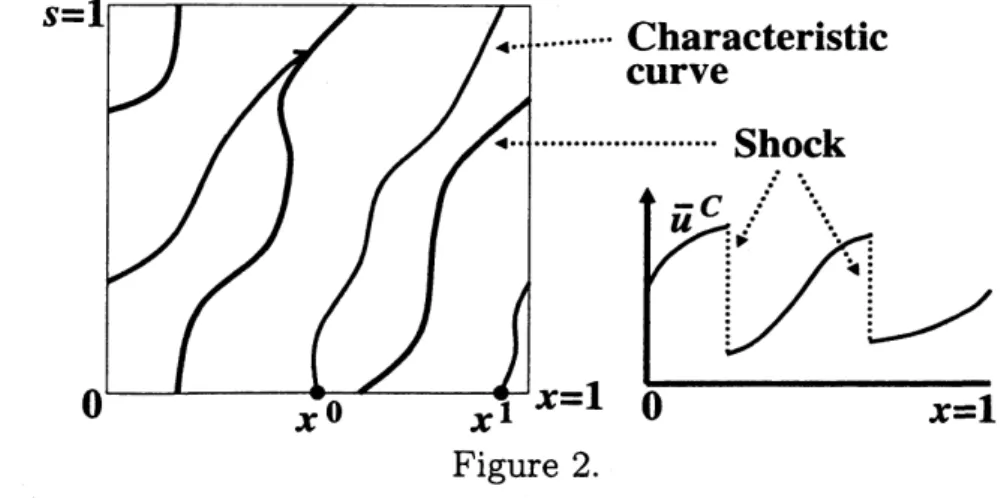
that the results are natural consequences ofprop-erties of entropy solutions. Let
us
consider the situation where $\overline{u}$ is piecewise $C^{1}$ and$\overline{u}(\cdot, t)|_{x\in T}$ has
a
certain finite number of points of discontinuity for each $t$. The smoothpart of graph$(\overline{u})$ $:=\{(x, t,\overline{u}(x, t))|x, t\in \mathbb{T},\overline{u}(x-0, t)=\overline{u}(x+0, t)\}$ consists of the
characteristic
curves.
The projected characteristiccurves
have the velocity $(\overline{u}(x(t), t), 1)$.For a point $x_{0}$ ofdiscontinuity of $\overline{u}(\cdot, t_{0})$, we have a positive number $d>0$ such that
$\overline{u}(x_{0}-h, t_{0})>\overline{u}(x_{0}+h, t_{0})+d$ for any small $h\geq 0$. Hence the twoprojected characteristic
curves
through $(x_{0}-h, t_{0})$ and $(x_{0}+h, t_{0})$ necessarily intersect at $s>t_{0}$on
a
shock andthese
characteristic
curves
go
away from graph$(\overline{u})$.
The situation is illustratedon
$\mathbb{T}^{2}$in
Figure 2.
For $s<t_{0}$, on the other hand, each characteristic
curve never
runs into any shocks.In other words, two projected characteristic curves never intersect for $s<t_{0}$, because
otherwise the entropy condition is violated at the intersection. Therefore any
character-istic
curve
$c(s)=(\tilde{x}(s), s, u(s))$ through a point of the smooth part of graph$(\overline{u})$ at $s=t_{0}$stay
on
the smooth part for $s<t_{0}$, namely, $u(s)=\overline{u}(\tilde{x}(s), s)$ for $s<t_{0}$.That is why $\mathcal{I}(\overline{u})$ is only backward
$\mu$-invariant in general. For each characteristic
curve
there exist accumulating points $x^{*}$ of $\{\tilde{x}(-k)mod 1\}_{k\in \mathbb{N}}$, whichare
the pointsof continuity of $\overline{u}(\cdot, 0)$
.
Therefore we conclude that the characteristiccurves
through$(x^{*}, 0,\overline{u}(x^{*}, 0))$
never
run
into any shocks in both directions. These special points$(x^{*}, 0,\overline{u}(x^{*}, 0))$ yield
a
$\mu$-invariant set $\mathcal{M}(\overline{u})$.The above speculation
can
be justified through the theory of viscosity solutions of theHamilton-Jacobi
equations of the form(1.7) $v_{t}(x, t)+H(x, t, v_{x}(x, t))=$ const.
We briefly refer to the notion of viscosity solutions. If
we
havea
$C^{1}$-solution $v(x, t)$of (1.7) defined
on
$\mathbb{R}\cross \mathbb{R}_{+}$, then multiplying the derivative $\varphi_{x}$ ofany
test function$\varphi\in C_{0}^{\infty}(\mathbb{R}\cross \mathbb{R}_{+})$ and integrating by parts
over
$\mathbb{R}\cross \mathbb{R}_{+}$we
havea
continuous weaksolution $u=v_{x}$ of (1.3). The regularity ofentropy solutions
on
$\mathbb{R}\cross \mathbb{R}_{+}$ isworse
than $C^{0}$in general. Therefore we cannot always expect such a solution of (1.7). Note that the
method ofcharacteristics also works for the construction of local in time $C^{2}$-solutions of
(1.7) with $C^{2}$-initial data.
Let
$u(x, t)\in L^{\infty}(\mathbb{R}\cross \mathbb{R}_{+};\mathbb{R})$ bea
weak solutionof
(1.3) which belongs also to$Lip_{loc}(\mathbb{R}_{+};L^{1}(K;\mathbb{R}))$ for each compact set $K\subset \mathbb{R}$
.
Thenwe
havea
locally Lipschitzfunction $v$ of the form $v(x, t)= \int_{0}^{x}u(y, t)dy+\int_{0}^{t}P(s)ds$ with
some
function $P(s)$ whichis defined
on
$\mathbb{R}\cross \mathbb{R}_{+}$ and satisfies (1.7) almost everywhere. Note thata
locally Lipschitzfunction is differentiable almost everywhere. If $u$ satisfies the entropy condition, then
$v(\cdot, t)$ for each fixed $t$ has
a
special property in its nondifferentiable part which is calledsemiconcavity. Satisfaction ofthe equation almost everywhere and semiconcavity
are
thecharacterizations of viscosity solution of (1.7), which
are
also realized by the vanishingviscosity method with the artificial viscosity $\nu v_{xx}$. We point out [3], [1] for
more
details.Now we see
some
details of the results by E. Let $\overline{u}(x, t)$ be a $\mathbb{Z}^{2}$-periodic entropy
solution of (1.5) with the momentum $C$. It follows from the above argument that there
exists
a
$\mathbb{Z}^{2}$-periodic Lipschitz function$\overline{v}(x, t)$ satisfying $C+\overline{v}_{x}=\overline{u}$
a.e.
such that$\overline{v}_{t}(x, t)+H(x, t, C+\overline{v}_{x}(x, t))=\overline{H}(C)$ in $\mathbb{R}^{2}$ (in the
sense
of viscosity solution),$\overline{H}(C)=\int\int_{T^{2}}H(x, t,\overline{u}(x, t))dxdt$
.
Let $L^{C}(x, t, \xi)$ be the Legendre transform of $H(x, t, C+p)$ with respect to $p$
.
Thewell-known representation formula for viscosity solutions yields
(1.8) $\overline{v}(x, t)=\inf_{\eta\in AC,\eta(t)=x}\{l^{t}L^{C}(\eta(s), s, \eta’(s))ds+\overline{v}(\eta(\tau), \tau)\}+\overline{H}(C)(t-\tau)$,
where $AC$ is the class of absolutely continuous
curves
$\eta$ :$\mathbb{R}arrow \mathbb{R}$ and $\tau$ is
an
arbitrarynumber less than $t$. This is
a
direct generalization of the representationformula
forlocal in time $C^{2}$-solutions via the method of characteristics. The variational problem
in (1.8) is denoted by $($CV$)_{\tau}^{x,t}$. There exists
a
$C^{2}$-minimizer$\gamma$ : $[\tau, t]arrow \mathbb{R}$ of $($CV$)_{\tau}^{x,t}$
satisfying the Euler-Lagrange equation with respect to $L^{C}$. Therefore $(x(s), u(s))$
$:=$ $(\gamma(s)mod 1, C+L_{\xi}^{c}(\gamma(s), s, \gamma’(s))):[\tau, t]arrow \mathbb{T}\cross \mathbb{R}$ satisfies (1.4).
Theorem 1.3 $([$4$])$ 1. Existence
of
“one-sided minimizers”: For each $(x,$ $t)\in \mathbb{R}^{2}$ thereexists
a
curve
$\gamma(s)$ : $(-\infty, t]arrow \mathbb{R}$ with $\gamma(t)=x$ such thatfor
any interval $[t_{1}, t_{0}]\subset$$(-\infty, t]$ the restnction $\gamma|_{[t_{1},t_{0}]}$ is
a
minimizerof
$(CV)_{t_{1}}^{\gamma(t_{0}),t_{0}}$ and $\overline{v}$ isdifferentiable
withrespect to $x$ at each point $(\gamma(s), s)$ with $s<t$ satisfying
If
there exists $v.(x, t)$, then (1.9) holdsfor
$s=t$ and such $\gamma$ is unique.2. Existence
of
$l$‘two-sided minimizers”: There exist
curves
$\gamma^{*}(s)$ : $\mathbb{R}arrow \mathbb{R}$ such thatfor
any interval $[t_{1}, t_{0}]\subset \mathbb{R}$ the restriction $\gamma^{*}|_{[t_{1},t_{0}]}$ is a minimizerof
$(CV)_{t_{1}}^{\gamma^{*}(t_{0}),t_{0}}$ and$\overline{v}$
is
differentiable
with respect to $x$ at each point $(\gamma^{*}(s), s)$ with $s\in \mathbb{R}$ satisfying$\overline{v}_{x}(\gamma^{*}(s), s)=L_{\xi}^{C}(\gamma^{*}(s), s, \gamma^{*}’(s))$.
3. $\overline{H}(C)$ depends only on $C$ and belongs to $C^{1}(\mathbb{R}).\overline{H}’(C)$ is monotone increasing.
Each
one
and two-sided minimizer$\gamma,$$\gamma^{*}$satisfies
$\lim_{sarrow-\infty}\frac{\gamma(s)}{s}=\overline{H}’(C)$, $\lim_{|s|arrow\infty}\frac{\gamma^{*}(s)}{s}=\overline{H}’(C)$ .
The following
are
characteristiccurves
of (1.5) in $\mathbb{T}^{2}$:$c(s)=(\gamma(s)mod 1, smod 1, C+\overline{v}_{x}(\gamma(s), s))$ : $(-\infty, t]\cdotarrow \mathbb{T}^{2}\cross \mathbb{R}$, $c^{*}(s)=(\gamma^{*}(s)mod 1, smod 1, C+\overline{v}_{x}(\gamma^{*}(s), s))$ : $\mathbb{R}arrow \mathbb{T}^{2}\cross \mathbb{R}$
.
They
are
trappedon
graph$(\overline{u})=${
$(x,$$t,$ $C+\overline{v}_{x}(x,$ $t))|x,$$t\in \mathbb{T}$, there exists $\overline{v}_{x}(x,$ $t)$}.
Inother words, if
a
characteristiccurve
$c(s)$ of (1.5) in $\mathbb{T}^{2}$ satisfies $c(t_{0})\in$ graph$(\overline{u})$ forsome
$t_{0}\in \mathbb{R}$, then $c(s)$ is trappedon
graph$(\overline{u})$ for $s\leq t_{0}$.
Let $\Omega(\gamma)$ be the set of allthe $\omega$-limit points of $\{\gamma(-k)mod 1|k\in \mathbb{N}, -k\leq t_{0}\}$, where $\gamma$ : $(-\infty, t_{0}]arrow \mathbb{R}$ is
a
one-sided minimizer of (1.8). Each one-sided minimizer through
a
point of $\Omega(\gamma)$can
beextended to a two-sided minimizer. We define
$\Gamma(\overline{u})$ $:=\{(\gamma^{*}(s)mod 1,$ $smod 1,$
$C+ \overline{v}_{x}(\gamma^{*}(s), s))|\gamma^{*}(0)\in\bigcup_{\gamma}\Omega(\gamma),$ $s\in \mathbb{R}\}$ ,
where $\gamma^{*}$
are
two-sided minimizers. $\Gamma(\overline{u})$ isa
subset of graph$(\overline{u})$. It is proved in [4] thatfor each one-sided minimizer $\gamma$ there exists
a
two-sided minimizer$\gamma^{*}$ such that
(1.10) $|\gamma(s)-\gamma^{*}(s)|arrow 0$
as
$sarrow-\infty$and therefore each$c(s)$ trapped
on
graph$(\overline{u})$ for $s\leq t_{0}$ falls into $\Gamma(\overline{u})$as
$sarrow-\infty$.
This isbased
on
thesimple factthat, fortwodifferent minimizers $\gamma,\tilde{\gamma}$associated
with$\overline{u},$ $(\gamma(s), s)$and $(\tilde{\gamma}(s), s)$
never
intersect. For $sarrow+\infty$, each $c(s)$ througha
point ofgraph$(\overline{u})\backslash \Gamma(\overline{u})$runs
intoa
shock and goes away from graph$(\overline{u})$ in general. $\mathcal{M}(\overline{u})$ $:=\Gamma(\overline{u})\cap(\mathbb{T}\cross\{0\}\cross \mathbb{R})$is a $\mu$-invariant set carrying the trajectories of $\mu$ with the rotation number
$\overline{H}’(C)$. For
any $\alpha\in \mathbb{R}$, there exists $C$ such that $\overline{H}’(C)=\alpha$. As is proved in [4], $\mathcal{M}(\overline{u})$ is
a
closedsubset of
a
Lipschitzcurve.
We call $\mathcal{M}(\overline{u})$ the Aubry-Mather set associated with theentropy solution $\overline{u}$. From
now
on, the term ”Aubry-Mather set”means
$\mathcal{M}(\overline{u})$.
2
Difference Approximation
to
Aubry-Mather
sets
Let
us
consider the computational aspectsof
the issue. The main interest is thecompu-tation of $\mathbb{Z}^{2}$
-periodic entropy
solutions
of (1.5) and Aubry-Mather sets. Asan
effectiveapproach to entropy solutions,
we
have not only the smooth approximation by theconvenient
alsofor
numericalsimulations.
The rigorous treatmentof
thedifference
ap-proximation to entropy solutions is found in lots of works (e.g. [8]). Many of them
are
on
entropy solutions of initial value problems.Concerning the difference approximation of periodic entropy solutions,
we
find in[6]
a
difference scheme to (1.6) for numerical tests of Theorem 1.2 (but there isno
theoretical argument for the scheme). We also point out [10], in which the existence of
$\mathbb{Z}^{2}$
-periodic entropy solutions of (1.5) is proved with the Lax-Friedrichs difference scheme
and Brouwer’s fixed point theorem. The idea is to regard $\mathbb{Z}^{2}$-periodic
difference solutions
as fixed points of the time-l map derived from the semigroup of the difference scheme.
Wepresent two methods which
are more
constructive and easily simulated [9]: Theone
is
based
on
the long timebehavior of
difference solutions derived from the Lax-Friedrichs
difference
scheme. The other is basedon
Newton’s method for thefixed
pointsof
thetime-l map. The
convergence
of these methodsare
established. Our resultscan
beextended to general types of the forced Burgers equation (1.3) with $H(x, s, u)$ which is
strictly
convex
in $u$, assuming additional conditions.We construct $\mathbb{Z}^{2}$-periodic
entropy solutions of the forced Burgers equation (1.5) with
a
$\mathbb{Z}^{2}$-periodic $C^{2}$-function $F$.
Our
basic tool is the two-stepLax-Riedrichs difference
scheme in $\mathbb{T}\cross \mathbb{R}_{t\geq 0}$. Let $N,$ $K$ be natural numbers. The mesh size is defined
as
$\Delta x:=$$N^{-1},$ $\triangle t$ $:=K^{-1}$
.
Set $\lambda$ $:=\Delta t/\triangle x,$$x_{n}$ $:=n\triangle x\in[0,1](n=0,1,2, \cdots, N),$ $t_{k}$ $:=k\Delta t\in$ $[0, +\infty)(k=0,1,2, \cdots)$. The solution to the initial value problem
$\{\begin{array}{l}u_{t}(x, t)+u(x, t)u_{x}(x, t)=F_{x}(x, t) in \mathbb{T}\cross \mathbb{R}_{+},u(x, 0)=g(x) on \mathbb{T}\end{array}$
is replaced with the family of vectors
$u^{k}=(u_{0}^{k}, u_{1}^{k}, \cdots, u_{N-1}^{k})\in \mathbb{R}^{N}(k=0,1,2, \cdots)$,
where $u^{0}=(g(x_{0}), \cdots, g(x_{N-1}))$
.
This is called thedifference
solution with the initialvalue $u^{0}$. Each
difference
solution $u^{k}$ with an initial value $u^{0}\in \mathbb{R}^{N}$ is given in thefollowing way: Let $\Delta y$ $:= \frac{1}{2}\Delta x,$ $\triangle\tau$ $:= \frac{1}{2}\Delta t,$
$y_{m}$ $:=m\triangle y\in[0,1](m=0,1,2, \cdots, 2N)$,
$\tau_{l}$ $:=l\Delta\tau\in[0, +\infty)(l=0,1,2, \cdots)$;Define
$u_{n}^{k}:=W_{2n}^{2k}.$,
where $W_{m}^{l}$
are
computed for each $l=0,1,2,$ $\cdots$ and each$m\in\{0,1,2, \cdots, 2N\}$ satisfying$l+m=$
even
through the difference equation with the periodic boundary condition$\{\begin{array}{l}\frac{W_{m+1}^{l+1}-\frac{(W_{m+2}^{l}+W_{m}^{l})}{\Delta\tau 2}}{}+\frac{1}{2}\frac{(W_{m+2}^{l})^{2}-(W_{m}^{l})^{2}}{2\Delta y}=\frac{F(y_{m+2},\tau_{l})-F(y_{m},\tau_{l})}{2\Delta y},W_{\pi\dot{\iota}\pm 2N}^{l}=W_{m}^{l}, W_{2n}^{0}=u_{n}^{0}.\end{array}$
Set
$u_{n\pm N}^{k}$ $:=u_{n}^{k}$.
The semigroups $u^{0}\mapsto u^{k},$ $W^{0}\mapsto W^{\iota}$are
denoted by $\psi^{k}$ : $\mathbb{R}^{N}arrow \mathbb{R}^{N}$,$\Psi^{l}$
:
$\mathbb{R}^{N}arrow \mathbb{R}^{N}$ respectively. $\psi^{k},$ $\Psi^{l}$are
$C^{2}$.Since
$F$ is $\mathbb{Z}^{2}$-periodic,
the
time-lmap
is
well-defined.
Note that $\psi^{KT+k}=\psi^{k}$. $\circ\phi^{T}$ for each $T\in \mathbb{N}$, where $\phi^{T}$ is the T-iterationof $\phi$. The following
function
is calledan
approximate solution of (1.5) in$\mathbb{T}\cross \mathbb{R}_{\geq 0}$:
$u_{\triangle}(x, t):= \frac{u_{n+1}^{k}-u_{n}^{k}}{\triangle x}(x-x_{n})+u_{n}^{k}$ for
$x\in[x_{n}, x_{n+1}],$ $t\in[t_{k}, t_{k+1}),$ $\triangle=(\triangle x, \triangle t)$
.
It follows from a simple calculation that the average in $x$ of each difference solution $u^{k}$
at each $k$ and therefore that of the approximatesolution
$u_{\Delta}(x, t)$ is conservative, namely
$C(u^{0}):= \sum_{n=0}^{N-1}u_{n}^{0}\triangle x\equiv\sum_{n=0}^{N-1}u_{n}^{k}\Delta x\equiv\int_{0}^{1}u_{\Delta}(x, t)dx$
.
The value $C=C(u^{0})$ is called the momentum of
a
solution. $u^{k}(C),$$u_{\Delta}^{C}(x, t)$ denote$u^{k},$$u_{\Delta}(x, t)$ with the momentum C. $u^{k}$ is said to be
a
periodic difference solution, if$u^{k+K}=u^{k}$ for all $k=0,1,2,$ $\cdots$
.
This is equivalent to the relation $\phi(u^{0})=u^{0}$.
For each $v=(v_{0}, \cdots, v_{N-1})\in \mathbb{R}^{N}$, the followingare
introduced:$\Vert v\Vert_{\infty}:=\max_{0\leq n\leq N-1}|v_{n}|$, $\Vert v\Vert_{1}:=\sum_{n=0}^{N-1}|v_{n}|$, $Var.[v]:= \sum_{n=0}^{N-1}|v_{n+1}-v_{n}|$ $(v_{N}=v_{0})$
.
Theorem
2.1
([9])Let
$M=\sqrt{\max_{(xt)\in T^{2}}2F_{xx}(x,t)}fr>0_{f}\tilde{r}>M,$ $0<\lambda_{0}<(r+$$\tilde{r})^{-1}$
.
Fix any natuml numbers $N,$ $K$so
that $\triangle x=N^{-1},$ $\triangle t=K^{-1}$ satisfy(2.1) $\lambda_{0}\leq\frac{\triangle t}{\triangle x}=\lambda<(r+\tilde{r})^{-1},\tilde{r}<2\triangle t^{-1},$ $\triangle t\leq\Delta x$.
Initial values
are
restricted to the set$B_{r,\overline{r}}:=\{v\in \mathbb{R}^{N}|$ $-r \leq\sum_{n=0}^{N-1}v_{n}\triangle x\leq r,$ $0 \leq n\leq N-1\max\frac{v_{n+1}-v_{n}}{\triangle x}\leq\tilde{r}$ $(v_{N}=v_{0})\}$ .
1. For each $u^{0}\in B_{r,\overline{r}}$, there exists the unique
difference
solution $u^{k}=\psi^{k}(u^{0})$, whichsatisfies for
any $k$$\max_{0\leq n\leq N-1}\frac{u_{n+1}^{k}-u_{n}^{k}}{\triangle x}\leq\tilde{r}$, $\Vert u^{k}\Vert_{\infty}\leq|C(u^{0})|+\tilde{r}$, $Var.[u^{k}]\leq 2\tilde{r}$
.
2. For each $C\in[-r, r]$, there exists the unique periodic
difference
solution $\overline{u}^{k}(C)$with the momentum $C$, which
satisfies for
any $k$$\max_{0\leq n\leq N-1}\frac{\overline{u}_{n+1}^{k}(C)-\overline{u}_{n}^{k}(C)}{\triangle x}\leq M$, $\Vert\overline{u}^{k}(C)\Vert_{\infty}\leq|C|+M$, $Var.[\overline{u}^{k}(C)]\leq 2M$. 3. $\overline{u}^{k}(C)$ is stable: Any other
difference
solutions $u^{k}(C)$ with thesame
momentum $C$ satisfyI
$u^{k}(C)-\overline{u}^{k}(C)\Vert_{1}arrow 0$as
$karrow\infty$.4.
Any twodifference
solutions $u^{k}(C),$$v^{k}(C)$ with thesame
momentum $C$ satisfy$||u^{k}(C)-v^{k}(C)\Vert_{1}arrow 0$
as
$karrow\infty$.
5. The decay rate is exponential: There exist
constants
$a>0$ and $\rho<1$ which maydepend
on
$\Delta x,$$\Delta t$ such that any twodifference
solutions $u^{k}(C),$$v^{k}(C)$ with thesame
6.
$\overline{u}_{n}^{k}(C)$ isa
strictly increasing $C^{1}$-function
with respect to $C$for
eachfixed
$n,$$k$.7. Newton’s method to the equation $\phi(u)=u$ is convergent.
8. There exists a sequence $\overline{u}_{\Delta_{t}}^{C}$
of
$\{\overline{u}_{\triangle}^{C}(x,$$t)|\triangle=(\triangle x,$ $\triangle t)$ satisfies (2.1)$\}$, where$\triangle_{i}arrow 0$, which converges to a $\mathbb{Z}^{2}$
-periodic entropy solution $\overline{u}^{c}$
of
(1.5) in $C^{0}(\mathbb{T};L^{1}(\mathbb{T}))$.9. $\overline{u}^{C}$ belongs to Lip
$(\mathbb{T};L^{1}(\mathbb{T}))$, has the momentum $C$ and
satisfies for
$a.e$. $x,$$y\in \mathbb{T}$, $x\neq y$ and all $t,$$\tau\in \mathbb{T}$$\frac{\overline{u}^{C}(y,t)-\overline{u}^{C}(x,t)}{y-x}\leq M$, $Var.[\overline{u}^{C}(\cdot, t)]\leq 2M$, $\Vert\overline{u}^{c}(\cdot, t)\Vert_{L(r)}\infty’\leq|C|+M$,
$\Vert\overline{u}^{c}(\cdot, t+\tau)-\overline{u}^{c}(\cdot, t)\Vert_{L^{1}(T)}\leq 2A|\tau|$, $A= \frac{2M}{\lambda_{0}}+\max_{(x,t)\in T^{2}}|F_{x}(x, t)|$.
Although
we
addno
viscosityterm, the above assertionsare
reminiscent of the resultson
(1.6) found in [6]. The $\Vert\cdot\Vert_{1}$-contraction property is because of the so-called numerical
viscosityof the difference scheme.
Our
prooffollowsOleinik [8], wherethe $\triangle$-independentone-sided estimate for $\frac{u_{n+1}^{k}-u_{n}^{k}}{\Delta x}$ is established and then the argument
on
the functions ofbounded variation is used. However
we
need further investigations, sincewe
deal withthe long time behavior ofthe difference scheme with a fixed mesh $\triangle$, namely, we consider
the limit $t_{k}arrow\infty$ with
a
fixed mesh $\Delta$ at first and then take the limit $\Deltaarrow 0$. Note thatthese
two limitprocesses
are
notcommutable
in general, since the decay exponent $\rho<1$in 5. may be arbitrarily close to 1
as
$\trianglearrow 0$.
Now
we
compute Aubry-Mather sets. A simulation ofa
KAM torus of$\mu$can
be easilymade through
a
computation ofan
initial value problem of (1.4), with the Runge-Kuttamethod for instance. Aubry-Mather sets may exist in the region with no KAM tori,
filled with chaotic trajectories. In such
a
region, it is quite difficult to directly computetrajectories
on
the Aubry-Mather sets, because it is not easy to find the initial values ofsuch trajectories and chaotic motions
are
very sensitive to initial values. Even ifwe findthe appropriate initial value with the “double” accuracy of C Language, the slight
error
is likely to soon
cause
a behavior totally different from the theoretically expectedone.
It follows from (1.9) that each one-sided minimizer $\gamma$ : $(-\infty, t_{0}]arrow \mathbb{R}$ satisfies
(2.2) $\gamma’(s)=\overline{u}(\gamma(s), s)$.
We are interested in the uniqueness of the initial value problems for (2.2) and the
simu-lations ofthe problems for $sarrow-$oo in order to obtain approximations of Aubry-Mather
sets. The uniqueness argument is rather difficult, since $\overline{u}$ may have countably many
shocks within $x,$$t,$ $\in \mathbb{T}$. We state
a
sufficient conditionon
the uniqueness, showinga
regularity property of $\mathbb{Z}^{2}$-periodic entropy
solutions.
Theorem 2.2 ([9]) Suppose that there exists
an
interval $[x_{1}, x_{2}]\subset[0,1)$on
which$\overline{u}(\cdot, t)$is continuous. Then $\overline{u}$ is continuous
on
the following stripe regionof
$\mathbb{R}^{2}$:$G(t):= \bigcup_{s\in(-\infty,t]}[\gamma_{1}(s), \gamma_{2}(s)]\cross\{s\}$,
where $\gamma_{1},$ $\gamma_{2}$
are
one-sided minimizers satisfying $\gamma_{1}(t)=x_{1},$ $\gamma_{2}(t)=x_{2}$. Furthermore$\overline{u}$ is
Lipschitz continuous with respect to $x$
on
$G(t-\epsilon)$for
$\epsilon>0$ with the Lipschitz constantThe proof is based
on
the simple fact that, for two different minimizers $\gamma,\tilde{\gamma}$ associatedwith $\overline{u},$ $(\gamma(s), s)$ and $(\tilde{\gamma}(s), s)$
never
intersect.We simulate the initial value problems to (2.2) through an approximation $\overline{u}_{\Delta}$ of$\overline{u}$ and
obtain approximations $c_{\triangle}(s)$ of $c(s)$.
Our
difference scheme for the task is the following:$\frac{\gamma^{-(k+1)}-\gamma^{-k}}{-\triangle t}=\overline{u}_{\triangle}(\gamma^{-\text{ん}}, t_{-k}),$ $k\geq 0$.
We define $c_{\Delta}(s)$ : $(-\infty, 0]arrow \mathbb{T}^{2}\cross \mathbb{R}$
as
$c_{\Delta}(s):=(\gamma^{-(k+1)} mod 1, t_{-(k+1)} mod 1,\overline{u}_{\Delta}(\gamma^{-(k+1)}, t_{-(k+1)}))$ for $s\in[t_{-(\text{ん}+1)}, t_{-k})$.
(1.10) implies that $c_{\Delta}(s)$
are
likely to be absorbedas
$sarrow-$oo
ina
subset $\Gamma(\overline{u}_{\Delta})$of graph$(\overline{u}_{\Delta})$. $\Gamma(\overline{u}_{\Delta})$ is considered
as an
approximation of $\Gamma(\overline{u})$.
Unfortunately thismethod is not mathematically justified at this stage. An
error
estimate between $\mathbb{Z}^{2}-$periodic difference solutions and genuine entropy solutions should also be established.
Now
we
show numerical results of $\overline{u}_{\triangle}(x, t),$ $c_{\Delta}(s),$ $\mathcal{M}(\overline{u})$ $:=\Gamma(\overline{u}_{\Delta})\cap(\mathbb{T}\cross\{0\}\cross \mathbb{R})$and the dynamics of the time-l map $\mu$ of (1.4), obtained by the
“double” accuracy of $C$
Language. $(X, Y, Z)$ denotes the
axes
of $\mathbb{T}^{2}\cross \mathbb{R}$, where $X$ corresponds to space and $Y$to time. We take
an
example$F(x, s)=- \frac{1}{10}\cos(4\pi x)\sin(2\pi s)$
.
Figure 3 shows the graphs of $\overline{u}_{\Delta}^{c}$ with $C=0.6,$ $-0.2,$ $-0.78$ on the section $Y=0$
together with the Aubry-Mather sets associated with them, which lie in the chaotic
region. Small scattered (green) dots
are
formed byone
chaotic trajectory of$\mu$ computedby the Runge-Kutta method. We observe the following: Each Aubry-Mather set consists
of periodic trajectories visualized with large (blue) dots. When $C$ increases, the position
of shocks of $C=0.6$
moves
right along with the upper boundary of the chaotic region.Similarly when $C$ decreases the position of shocks of $C=-0.78$
moves
left along withthe lower boundary of the chaotic region. And finally
we
have the continuous graphsof $\overline{u}_{\Delta}^{c}$ which coincide with the upper and lower
boundaries
of the chaotic region. Thenondifferentiable
parts of the boundariesare
the Aubry-Mather sets. The Aubry-Matherset associated with
$C=-0.2$
consists of two periodic trajectories with the rotationnumber $- \frac{1}{4}$. The Runge-Kutta method for (1.4) with
an
initial pointon
theAubry-Mather set provides a solution which behaves periodically only within a short span of
time. Even though the initial point is additionally re-adjusted with the “long-double”
accuracy, $|s|\cong 25$ is the longest time for which the solution keeps the periodic state!
Figure 4 indicates the graph of $\overline{u}_{\triangle}^{C}$ with $C=-0.17965244477$ on the section $Y=0$
together with the Aubry-Mather set associated with it. The Aubry-Mather set drawn
by (blue) dots consists of the only
one
periodic trajectory with the rotation number$- \frac{3193}{12774}=-0.249960857992798$. The value of $C=-O.17965244477$ would be close to the
critical value at which the rotation number changes from $- \frac{1}{4}$ to
an
irrational rotationnumber, since $C=-0.1796524448$ yields the Aubry-Mather set consists of two periodic
trajectorieswith the rotation number $- \frac{1}{4}$. If
$\overline{u}^{c}$
has
a
shock and $\mathcal{M}(\overline{u}^{c})$ hasan
irrationalrotation number, then $\overline{u}^{C}$
must have infinitely many shocks with the arbitrarily small
sizes within $(x, t)\in \mathbb{T}^{2}$. In such
a
case
the profile of $\overline{u}_{\Delta}^{c}$ may be rather different fromthat of $\overline{u}^{C}$, because
with fixed $\triangle x,$$\triangle t$. Here is a question: When $\triangle x,$$\triangle t$
are
fixed
and $C$ is varied, doesthere exist $\mathcal{M}(\overline{u}_{\Delta}^{c})$ having
an
arbitrarily given rotation number?X
Figure
3.
$N$
X
References
[1] P. Bernard, The asymptoticbehaviour ofsolutions ofthe forced Burgers equation
on
the circle, Nonlinearity 18 (2005), 101-124.
[2] U. Bessi, Aubry-Mather theory and Hamilton-Jacobi equations, Commun. Math.
Phys. 235 (2003),
495-511.
[3] P. Cannarsa,
C.
Sinestrari,Semiconcave
functions, Hamilton-Jacobi equations andoptimal control, Birkh\"auser (2004).
[4] W. $E$, Aubry-Mather theory and periodic solutions of the forced Burgers equation,
Comm.
Pure Appl. Math. 52 (1999), No. 7,811-828.
[5] A. Fathi, Th\’eor\‘eme KAM faible et th\’eorie de Mather
sur
les syst\‘emes lagrangiens,(Rench) [A weak KAM theorem and Mather’s theory of Lagrangian systems]C. R.
Acad. Sci. Paris
S\’er. I Math. 324 (1997), No. 9,1043-1046.
[6] H. R. Jauslin, H. O. Kreiss, J. Moser, On the forced Burgers equation with periodic
boundary conditions, Proc. Sympos. Pure Math. 65 (1999), 133-153.
[7] J. Moser, Recent developments in the theory of Hamiltonian systems,
SIAM
Rev. 28(1986),
No.
4,459-485.
[8]
O.
A. Oleinik, Discontinuous solutions of nonlinear differential equations, A. M.S.
’nansl. (ser. 2) 26 (1957), 95-172.
[9] T. Nishida, K. Soga, Difference approximation to Aubry-Mather sets of the forced
Burgers equation, preprint.
[10] S. Takeno, Time-periodic solutions for a scalar conservation law, Nonlinear Anal.