Are manufacturers’ efforts to improve their brands’
reputation
really
rewarded?
The
case
of
Japanese
yogurt market
Tomohito
KAMAI
and Yuichiro
KANAZAWA
Division
of Policy and Planning Sciences, University of Tsukuba
1
Introduction
Since yogurt
was
first introduced in Japan in $1950’ s$, the market became one of themaincategory for thegroceryretail channel with the second largest sales infoodcategory
according to the national retail survey conducted between September
2012
to February2013.1.
The recent market growth is said to be stimulated bya group ofproducts withnewlyfound lactic-acidbacilli, which
are
claimed to enhance immune strength andpreventconsumers
from virus-infection, allergies andso
forth. The traditional marketing theorywould predict that these manufacturers’ efforts
are
rewarded with high margins. Theaverage price ofyogurt, however, kept decreasing
over
the last decade and the temporalprice reduction ( $TPR$ henceforth) is prevalent practice in this category, with 66.7% of
supermarket engaged in TPR in
a
sampled week according to the retail surveyin2007.2
In order to
answer
if the manufacturersare
really rewarded for their innovations, weemploy a framework of [4] whereby retail prices are decomposed into manufacturers’
and retailers’ margins and marginal cost to
assess
the relative magnitude of them. Inaddition to strategic interaction among manufacturers and retailers and
consumer
statedependence, a model is able to accommodate forward-looking pricing policy of firms as
description offirms’ behavior and margins each firm obtains
as
aresult of theirbehaviorcould be drastically altered ifwe fail to model such behavior. In the research of [4], for
example, both manufacturers and retailers in U.S. cereal market
are
shown to set pricesaccounting for the effect of current prices
on
future profit. In this research,we
applythemodel to the yogurt data in Japanese market to correctly
answer
our inquiry with themost plausibleframework to describe the market.
$1Sour\infty:KSP-POS$Market $7\dagger endRepo72$, vol.48, Knowledgeon SalesPromotionServiceProviders.
2Comparedto 2003, the average retail price of boxed yogurtin storesin Tokyo area fell by7.5% in 2008, and it further fell by 149% in 2013 accordingto “Retail Survey”’ conductedby Statistics Bureau, Ministry of Internal Affairs and Communications, Japan. Data regarding TPRare obtainedfrom “National Survey of Prices” conductedbyStatistics Bureau, Ministry of Internal Affairs and Communications and calculated from dataof“Distribution of RegularPrices and Sale Prices by Sales Floor Space, Type of Outlets- Japan, City Groups,Prefectures
The rest of paper is organized
as
follows. The next section describes the model. Insection 3, we present our estimation procedure. We briefly explain our data insection 4.
Insection 5, wewill present anddiscuss results for empirical analysis. Section6concludes.
2
The Model
In this section, we specify bothdemand- and supply-side models. Aswe implied, there
are three major dimensions in the modeling framework, which are strategic interaction
among manufacturers andretailers, consumerstate dependence, and forward-looking
be-havior of firms. Out of them, consumer state dependence is specified in demand-side
behavior and the rest is specified in supply-side behavior. This approach of structural
market equilibrium model enables the analysis of supply-sidebehavior by observing only
the demand-side data, which is an advantage of the model
as
supply-side information israrely available to researchers.
The modeliswidely used in the literature asit offers rich insights tomarketingissues.
Themain
use
ofthe model includes theory testing, what-ifanalysis, and identification ofthe determinant ofmarketing power and profitability among channel members [10]. As
for theory testing,forexample, [7]justifyapolicyofuniform pricing where different items
under thesamebrandnamehave identical prices in spite of the difference insomeproduct
attribute such as flavors in yogurt category. By identifying the competitive structure of
the market and the source of the profitability of participants in the same distribution
channels, each participant can figure out how they can efficiently align their marketing
mix optionsto achievemaximumreturn given their competitive environment. In thisline,
[2] usethe modelto calibrate the monetaryvalue oftarget pricing and [9] investigate the
impact ofbrandpositioning andchangein price forcars under Bertrand competition. [8]
investigate the relationship between the retail environment and intensity ofmanufacturer
condition. [16] investigate the effect ofnew brand introduction to competitive
relation-ships between firms. Recently, the power balance between manufacturers and retailer
is often discussed when retailers are armed with their store brands which have multiple
effects such as increased bargaining power with respect to manufacturers, inducing store
traffic and building store loyalty in the context of among retailers competition and so
forth. Theexamples in this line include [5] and[13]. Theother examplesof papers in this
2.1 Demand-Side Specification
Because supply-side behavior is estimated conditional on the estimation results of
demand-sidemodel, we start with demand-side model.
2.1.1 The brand choice model
Let
us
suppose thereare
$j=1$,. ..
,$J$ brands in the market and each household $i=$$1$,
. .
.
,$I$ has $t_{i}=1$,.
. .
,$T_{i}$ purchasing occasions. We employ the multinomial logit modelfor household brand choice behavior with the latent class model to accommodate the
heterogeneity
across
households [11]. Specifically, the deterministic part of the utility ofhousehold $i$ choosingbrand $j$ at its $t_{i^{-}}th$ purchasingoccasionis defined
as
$v_{ijt}. =x_{jt_{:}}\cdot\beta_{s}+sim_{kj}\cdot SD_{s}+\xi_{jt_{i}}$ (1)
where the outside option is expressed
as
$v_{i0t_{*}}=0$ and where vector $x_{jt_{i}^{3}}$ includes branddummyvariables andprice of brand$j$ a household$i$ facesonpurchasingoccasion$t_{i},$ $sim_{kj}$
istheattribute similarityindexfor brand$j$with respect to the previously purchased brand
$k$, and $\xi_{jt_{i}}$ is the unobserved demand characteristics which
can
be observed byfirms andhouseholds but not by a researcher. The examplesofunobserved demand characteristics
are
national advertisement, coupon availability, shelf space allocations and so forth. Asprevalent in this study field, we
assume
it commonly affects all households [3, 18, 19].It is empirically well known that ignoring unobserved product characteristics leads to a
biased estimate ofpriceeffect
as
they could be correlated with prices [1, 18, 3, 2, 14, 19].To avoid this problem,
we
employ an idea oftwo-stage least squares. Parameters to beestimated
are
$\beta_{s}$ and $SD_{s}$, where asubscript $s=1$,. .
.
,$S$ corresponds to segment (i.e., $a$subset to which households belong to, where those in the same segment are assumed to
be the
same
in terms of responsiveness to marketing mix variables).2.1.2 The attribute similarity index
We use the attribute similarity index to express the state dependence in household
brand choice behavior, following $[$4$]^{}$ In their specification, each brand is allocated with
a set of attributes by aresearcher. Each attribute has different levels, and brands
are
3Theterm$\xi_{jt}$
.
isasubset of$\xi_{jt}$wherethelatter is defined forallcalendar dates and brands inthe panel,and the formerisretrieved fromthelatteraccording to$t.$. Onthe other hand, thevaluesof$x_{jt_{i}}$may be$d_{1}$fferentdependingon households
evenwhentwo households shop at thesametime astemporalpnce reduction suchascouponmay only be availabletoa speclfic household.
4Theidea of the attributesimilantyindexcanbefoundin previous papers (e.g., [12]),but thespecificationin prevous literature requires questionnairewhich explicitlyasks subjects for theperceived similarity between listed brands. The advantage of the specificationof [4] is that it does not $req_{U1}re$ such information and similarity between brandscanbe calibrated from thedata,although the level of attributes shared by brands must be set by researchers.
assumed to be similar iftheyshare the
same
level ofattributes. The degree ofsimilaritybetween brands increaseswith the number of attribute levels shared by thesebrands.
Employing the attribute similarity index enables a researcher to examine how each
brand attribute contributes to the perception of similarity between brands among
con-sumers. Apparently, this approach would yield richer insight on consumer brand choice
behavior and onbrand positioning compared to the prevalent approach such as
employ-ing the lagged brand indicator variable. Specifically, the similarity between the brand
purchased on the previous occasion (brand k) and the brand a household faces on the
current purchase occasion (brand j) isspecified as
$sim_{kj}=\frac{I_{kj}+\sum_{p--1}^{P}I_{kjp}\cdot r_{p}}{1+\sum_{p=1}^{P}r_{p}}$, (2)
where $I_{kj}$ is
an
indicator variable taking unity if $k=j,$ $I_{kjp}$ isan
indicator variabletaking unity iftwo brands share the same level of attribute $p=1,$$\cdots,$$P$, and $r_{p}>0$
is importance weight associated with attribute $p$ to be estimated. As (2) implies, the
similarityindex is designed to take value between $0$ (brands
are
totallydissimilar) and 1(brands are identical). The parameter of the attribute similarity index, $SD_{s}$, can either
be positive or negative which corresponds to inertia (i.e., a previous brand consumption
experience raises the probability of repurchasing a brand) and variety-seeking (i.e., $a$
previous brand consumption experience lowers the probability of repurchasing a brand)
respectively. Following [4], wespecify $SD_{s}$ to be the function of demographic variables
as
$SD_{s}=\gamma_{s0}+D_{i}\cdot\gamma_{s}$ (3)
where$D_{i}$ isvectorofdemographic characteristics of household$i,$ $\gamma_{s0}$ is
an
interceptterm,and $\gamma_{s}$ is vector of parameters for $D_{i}$
.
The available demographic information in ourpanel is gender andage.
2.2 Supply-Side Specification
Following the precedingresearch, weassumethatthe retailer is a local monopolist which
maximizes itsjoint category
profit.5
The assumptionof alocal monopolist isoftenjustifiedby empirical reports which find that there is httle evidence ofamong store competitions
[3, 17, 19, 4]. Wefurther assume that there are multiple manufacturers which sell their
brands through acommonretailer. Manufacturers areallowed to produce multiple brands.
Afterestimating demand side parameters,wewillestimate the margins ofmanufacturers
anda retailerunderfour different games,which arisefromthecombination of two gamesin
5Aretailer couldusetheother pricing rulessuchas brand profitmaximizationwhereitsets up aprofitfunction for eachbrand. However, [17]empirically shows thataretailerattainsa maximumprofitwhen it engages incategoryprofit
horizontal strategicinteraction among manufacturers and twogames in verticalstrategic
interaction between manufacturers and
a
retailer. Two games in horizontal strategicinteraction
are
Bertrand competition and tacit collusion, where Bertrand competitionrefersto own-brands profit maximizing behaviorofeachmanufacturer and tacit collusion
refers to the behavior of manufacturers which collectively maximize total profit from
all brands in the market. Two games in vertical strategic interaction
are
manufacturerStackelberg and vertical Nash. In the manufacturer Stackelberg game, manufacturers
act
as
Stackelberg leaders with respect to a retailer and choose their wholesale pricesanticipatinga reaction from a retailer and wholesale prices ofcompeting brands. In this
case, the retailer chooses retail prices to maximize its profit taking wholesale prices
as
given. In the vertical Nashgame, manufacturers andaretailer
move
simultaneously; theychoose pricesanticipating the profit maximizing behavior of the others [6, 17]. We
reserve
the derivation of margins in Appendix.
Our
derivation much follows [19] and [4].After calculating margins of manufacturers and
a
retailer,we
will estimate marginalcost ofeach brand using variables such
as
prices of ingredients. Finally, wewill calculatelikelihood for each model andgame, and compare the results by Vuongtest statistics.
3
Estimation
3.1 Demand-Side Estimation
3.1.1 Pricingequation
Aspricesmaybe correlated with unobserved demandcharacteristics,wefirst set up the
pricing equation
$p_{jt}=\kappa_{0}+z_{jt}\cdot\kappa_{1}+\eta_{jt}$ (4)
where $z_{jt}$ is an instrument which is correlated with $p_{jt}$ but not with $\xi_{jt},$ $\kappa_{0}$ and $\kappa_{1}$ are
parameters to be estimated, and $\eta_{jt}$ is a randomerror term. Note that this equation is
defined forcalendardate $t=1$,
.
. .
,$T$.
We estimate$\hat{p_{jt}}$ and $\hat{\eta_{jt}}$by ordinary least squares.Next, $\xi_{jt}$ is obtained
as
residual in the following equation:$\ln\tilde{S}_{jt}-\ln\tilde{S}_{0t}=x_{jt}\cdot\beta+sim_{kj}\cdot SD+\xi_{jt}$ (5)
where $\ln\tilde{S}_{jt}$ and$\ln\tilde{S}_{0t}$
are the$\log$ of observed market shares of brand$j$ and outsidegood
at time $t$respectively.
Ifprice endogeneity exists, the terms $\xi_{jt}$ and $\eta_{jt}$ will be
correlated.6
This correlationshould arise
as
$\eta_{jt}$can
represent both demand and cost shock (i.e., if the unobserveddemand characteristic is desirable, it is reasonable to
assume
it incurs cost). In orderto check the existence of price endogeneity, we
assume
that $\xi_{jt}$ and $\eta_{jt}$ jointly followthe bivariate normal distribution as correlation in that distribution equates dependence
between them. We also
assume
that their means are both zero, and theirmoments existup to the second order.
3.1.2 Likelihood function
Thelikelihood ofpurchase historyof household $i$ \‘iswritten as
$L_{i}= \prod_{t_{i}=1}^{T_{i}}\int\{\prod_{j=0}^{J}[Pr_{ijt_{i}}]^{y_{ijt_{i}}}\cross f(\xi_{jt_{i}}|\eta_{jt_{i}})\cross f(\eta_{jt_{i}})\}d\xi_{jt_{i}}$ (6)
where $y_{ijt_{i}}$ is
an
indicator function taking unity if household$i$ chooses brand$j$ at time
$t$ and $0$ otherwise, $f(\xi_{jt}|\eta_{jt})$ is the conditional density of $\xi_{jt}$, and $f(\eta_{jt})$ is the density
function of $\eta_{jt}$
.
Similarly to $\xi_{jt_{i}}$, the term$\eta_{jt_{i}}$ is a subset of $\eta_{jt}$, which is defined for all
calendar dates in the panel. In this paper, weemploy the latent class model under which
thelikelihood functionasin (6) for household$i$is replaced with $L_{i}(S_{i}=s)$, the likelihood
of household $i$ belonging to the segment $s$ or $S_{i}=s$
.
Then we have the likelihood forwhole panel data as
$L= \prod_{i=1}^{I}\{\prod_{s=1}^{S}L_{i}(S_{i}=s)\cross Pr_{i}(s)\}$ (7)
where $S$ is the number ofsegments and$Pr_{i}(s)$ is the membership probability to segment
$s$ of household $i$
.
Parameters $\beta_{s}$ and $SD_{s}$ are estimated by maximizing this likelihoodfunction.
3.2 Supply-Side Estimation
3.2.1 Marginalcost
Wespecify the marginal cost equation as
$mc_{jt}=w_{j0}+input_{jt}\cdot w_{r}$ (8)
where$w_{j0}$ is abrand-specific intercept term, $input_{jt}$ isvectorofobservable cost shifters,
and $w_{r}$ is corresponding vector ofparameters. For the notational convenience, let $w\equiv$
$(w_{j0}, w_{r})$
.
Nowto estimate $w$, we utilize the following equationwhere$\overline{CMM}_{jt}$ and$\overline{CMR}_{jt}$
are
computedmargin of manufacturers and a retailer for brand$j$at time$t$respectively, and
$\epsilon_{jt}$isa random
error
term. Assumingtheerrorterm$\epsilon_{jt}$followsanormal distribution with
mean
zero and finitevariance (which is to be estimated), theright-hand side of theequation
$\epsilon_{jt} =p_{jt}-\overline{CMM}_{jt}-\overline{CMR}_{jt}-w_{j0}-input_{jt}\cdot w_{r}$ (10)
also follows the normal distribution. Then
we
have thelikelihood functionofthesupply-side
as
$\prod_{t=1j}^{T}\prod_{=1}^{J}g(\epsilon_{jt})$ (11)
where $g$ is the marginal density of $\epsilon_{jt}$, to estimate $w$ and to calculate Vuong test
statistics.
4
Data
We
use
scanner-panel data of yogurt purchases from anonymous retail chain in thewestern Tokyoin January
2007
to December2008.
Between two type yogurts–box typeand snacktype –wechose the latter type for
our
empirical analysisas
the former typemay also be used for cooking. Out of brands remained on sale throughout the period,
wechose 7 brands which had enough purchasing records across stores, as wewould like
to use the average yogurt prices in these stores
as
instruments for prices of yogurt inparticular store
we
wouldanalyze.7
After choosing households who only purchased theselected
7
brands at least twice,183
households who made 15,194 shopping trips and2,550 yogurt purchases remained. In thedata, 76.5% ofpurchases
were
made byafemalemember of household. The average age of
consumers
in the panelis 59.4 with standarddeviations of19.6. The minimum and maximum ages of consumers in the panel
are
14and 94respectively.
The summary of brands is summarized in Table 1. The attributes we used for the
attribute similarity indexwere “Raw milk usage”’ (the proportionof
raw
milk in yogurt,3 levels), “Fat level” (the fat amount contained, 3 levels) and “Ager usage” (whether
yogurt contains ager or not, 2levels). Ager is used to produce so called “hard-type”
yogurt, which has texture likepudding unlike plain-type yogurt. Out ofthesebrands, we
are
especially interested in brand 3, 5, and 6; brand 3 is differentiated in terms oftaste(it isthe only brand using only
raw
milk), brand5
isthe yogurt with special lactic-acid$\overline{7The}$
other stores hadatleast20dates without asinglesale of any brands dunng two years. We chose to exclude them from our analysis, asbrandswitchcould havebeenattributedto thefact thatsomeof themwereoutof stock in these stores. Inthis paper, wearenotfocusingonths kind offorced brandswitchingbehavlor.Table 1: Summaryof brands.
$\overline{\overline{Aoerage}}$
pnoe Mmufaetmer Mgket Rawnulk Fatlenl Ager Fat$\infty$ntent $Sug\pi\omega$ntent$\frac{(yenpergrm)IDshweoeageoeage(g/100g)(g/100g)}{Brnd104591114\%NoMiddleYae2.477.77}$ Brand 2 0.486 2 2.95% Partial Middle Yes 205 14.6 Brand 3 0.488 3 0.86% An High Yes 410 14.9 Brand4 0.483 4 108% Partial Low No 176 152 Brand5 1.113 4 322% Partial Middle No 3.04 9.73 Brand6 1113 4 135% Partial Low No 143 920 Brand 7 0834 5 231% Partial Low No 188 134
bacilli, and brand
6
is a low fat version of brand5.
To compare the margins ofthesebrands withthose of the otherswould
answer
thequestionwe
addressed–whether
thesebrands guarantee high margins to manufacturers. Relatively small numbers in “Market
share” column in Table 1 are because of outside option as
consumers
did not buy any ofthese7brands 87.0% of theirshopping trips. Brand 7 is a brandcontaining a fruit, which
is thought to justify its higher retail price.
As for explanatory variables for marginal cost, we collected data of raw milk $price_{\rangle}$
laborwageinfour prefectures where 7brands of yogurt areproduced,international sugar
price,creampriceindex, and internationaloil
price.8
Because all datawereonlyavailablein monthly basis, we transformed them into weekly data by the linear filtering process
employedby [15]. As for international sugarprice, we multiplied it to the sugar amount
each brand contains. Also, since
cream
is mixed in yogurt to increase fat content,we
multiplied cream price index to the fat amount each brand contains. We used raw milk
price asthey were, andwe took$\log$ for labor wage and for international oil price because
theirscaleswereof different orders of magnitude. In addition,we employed manufacturer
dummyvariablesto incorporatefirm-specific coststructure.
5
Empirical
Results
5.1 Demand-Side Results
We estimate the latent class model by increasing the number of segments until there is
no improvement in AIC. We find that the model with six segments maximizes
AIC.9
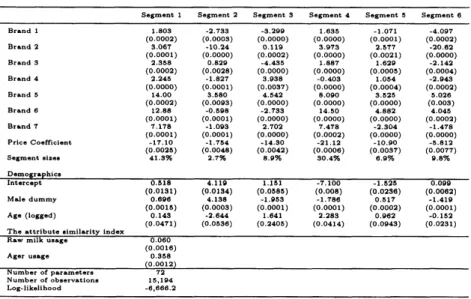
Theparameter estimates of the optimal model with standard errors are presented in Table 2.
All parameters are significant at 1% level.
$\overline{8The\inf ormat\mathring{i}n}$sources are as follows:Rawmilk price andcreampriceindexare obtainedfromthedatabaseof “Japan
DalryAssociation”; labor wage infourprefecturesareobtalned from statisticaldepartmentsofcorresponding prefectures;
international sugar pnce is obtained from the database of “Agriculture&Livestock Industries Corporation”;international
oilpriceisobtained from “U.S. EnergyInformationAdministration.”
9Additionally, we constructedand estimated two othermodels, which are a multinomial logit model without state dependence and themodel with lagged brand choicedummyvariable with thesamenumber of segments to compare the
Table 2: Parameterestimatesof theoptimalmodel.
Segment1 Segment2 Segment 3 SegmentSegment 44SegmentSSegmentSegment66 Brand1 1803 $-27S3$ $-S299$ 1635 $-1071$ $\fbox{Error::0x0000}4097$ $(00002)$ (0.0003) $(0$0000$)$ $(00000)$ ($0$OOOI) $(0$0002$)$ Brand2 3067 $-1024$ 01193$97S$ 2.$577$ $-2062$ $(0 0001 ) (0 0000 ) (0 0002 ) (0 0000 ) (0 0021 ) (0 0000 )$ Brand 3 2358 $0829$ $-44S5$ 1 887 $1629$ $-2.142$ $(0$0002$)$ ($O$.0028) $(0$0000$)$ $(00000)$ (0.0005) $(0$0004$)$ Brand4 2245 $-1827$ 3938 $0403$ 1064 $-2.943$ $(00000) (00OOI) (00OS7) (0 0000 ) (0 0004 ) (0 0002 )$ Brand 5 1400 3580 4.542 8090 3.525 5026 $(0$0002$)$ $(0$0093$)$ $(00000)$ (00000) $(00000)$ $(000S)$ Brand 6 1288 -O.698-2.733 14.50 4.882 4045
$(0$0001$)$ (O. OOOI) (00000) $(00000)$ $(00000)$ (O. 0002)
Br $nd7$ 7.$178$ $-1093$ 27027478-2.304 $\fbox{Error::0x0000}1478$
($O$.0001) (0.0001) (0.000$O$) $(0$0002$)$ $(O.0000)$ $(0$0000$)$
Price Coefficient $-1710$ $-1754$ $-14$SO $-2112$ $-1090$ $-8812$ $(0002b\rangle (0 0048 ) (0 0042 ) (0 0006 ) (0 0037 ) (0 0077 )$
Segmenteizes 41 S% 2.7% 89% $30$4% $6$9% 9.8%
$\frac{D\cdot\mathring{m}r\bullet hic\epsilon}{}$
Intercept 051841191161 $-7100$ $-1626$ 0099 $(0$0131$)$ ($0$OI34) (0.0585) (0.008) $(0$0236$)$ (0.0062) Male dummy 0.696 4 IS8 $arrow 196S$ $-1786$ $0617$ $-1419$$(0 0015 ) (0 0003 ) (0 0001 ) (0 0001 ) (0 0002 ) (0 0001 )$
Age(logged) O.$143$ $-2644$ 1641 $228S$ $0962$ -O.152
$(0$0471$)$ $(0$0536$)$ (0.2405) $(0$0414$)$ $(0$0943$)$ $(0$0231$)$
$\frac{Thoattr1but*s1mllarltylndex}{R\cdot wmi1ku\cdot\cdot\zeta e0060}$ $(0 0016 )$
Agerusage $0368$
$\frac{(OO012)}{Numberofparamoters72}$
Numberof observations 15,194 ${\rm Log}$-likelihood $-6,6662$In Table 2, ”Brand” entries represent brand-specific intercepts relative to outside $or\succ$
tions, presented below “Demographics” entry
are
parameters for calculating $SD_{s}$, whichisaparameterofthe attribute similarity index in (2), andpresentedbelow “The attribute
similarity index” entry
are
the estimatesof importance weights fortwo attributes tocal-culate the attribute similarity
index.10
Becausewe
find that using all three attributesresults in anomalies in estimation, we chooseto
remove
“Fat level”’ attribute. Thelargernumber of “Ager usage” relative to “Raw milk usage” suggests that perceived similarity
between brands largely depends onthe type of yogurt (i.e., whether yogurt is hard-type
or plain-type).
Wecalculated how statedependence tendency varies
across
segments by genders usingmean
age. Households in segment 4 and6
are
found to be variety-seekers and the restis almost all inertial. Only segment 2 had opposingsigns for state dependence tendency
dependingongender (malesin this segment exhibit strong inertial tendency whilefemales
exhibit modest variety-seeking tendency). Overall,
we
do notseethe consistentrelation-shipbetween state dependence tendencies and demographic variables. Beingmale affects
theutilityofthe similarbrand topreviously purchasedoneeither positivelyor negatively,
and thesameistrue for age.
$1\fbox{Error::0x0000}We$only present
estimates ofimportance weightsforsegment 1 in Table2. This is because weestimated them with the model without segment and usedthese estimatesfor the models with the greater number of segments. In other words, we assumedperceptions ofsimzlarity between brandswere commonacrosssegmentsasin [4]. This isbecauseestimating themodel without thisassumptionwouldhaveincreased the number ofparameters by 66, and this could have made the estimation unstable.
Table3: Margins (Unit: yen per gram)under eachmodel and game.
Brand1 Brand2 Brand 8 Brand 4 Brand5 Brand 6 Brand 7
$\underline{AveragePrices0451050405lS0480112711280S59}$
Retail margin O051 O.109 O.105 $0104$ 0313 O.187 O.103
$(0 0006 ) (0 0013 ) (0 0031 ) (0 0024 ) (0 0051 ) (00026\rangle (0 0019 )$
$\underline{manufacturerStackelberg}$
Bertrandcompetition $0039$ $0$IOO $0007$ $0125$ 0039 $0115$ $0085$ ($O$.0006) $(0$0028$)$ $(0$0044$)$ $(0$0015$)$ $(0$0033$)$ $(0$0014$)$ $(00010\rangle$
Tacit collusion $0048$ $0131$ $0018$ $0147$ $0045$ O119 $0$I07
$(000IO)$ $(0$0023$)$ $(0$0046$)$ $(0$0015$)$ ($O$.0036) $(0$0013$)$ $(0$0021$)$
verticalNash
Bertrand competition 0042 O.084 $0088$ $0084$ 0304 $0182$ $008S$ (O0006) $(0$0002)0002$)$ (O. 0026)0026) $(0$0016$)$ $(0$0050$)$ $(0$0027$)$ ($O$OOII)
5.2 Supply-Side Results
In this subsection, we will present the results of margins, marginal cost and model
comparison. Though the actual calculations proceed in this order,
we
first present theresult of model comparison as it helps the interpretation of the results of margins.
5.2.1 ${\rm Log}$-likelihood for supply-side and Vuongtest statistics
After calculating margins,
we
calculated the $\log$-likelihood for supply-side in (11) andVuong test statisticsto compare thefits ofthreemodels and games in thesemodels. We
find that the market is best described by the verticalNash-Bertrandcompetition game.
In addition to forward-looking model, where firms account for the impact of current
price on future profit, we also conducted analysis using static model and myopic model.
The static model is a standard multinomial logit model without state dependence and
the myopic model assumesthat firms account for state dependence in demand (i.e., firms
considerthe effect ofahousehold previousbrandchoice via the attribute similarity index)
but do not account for the future profit associated with current pricing decision. We
compare the Vuong test statistics across models to find that the best-fitting model (the
verticalNash-Bertrandcompetitiongamein forward-looking model) is statisticallybetter
than anyother models and games.
5.2.2 Margins
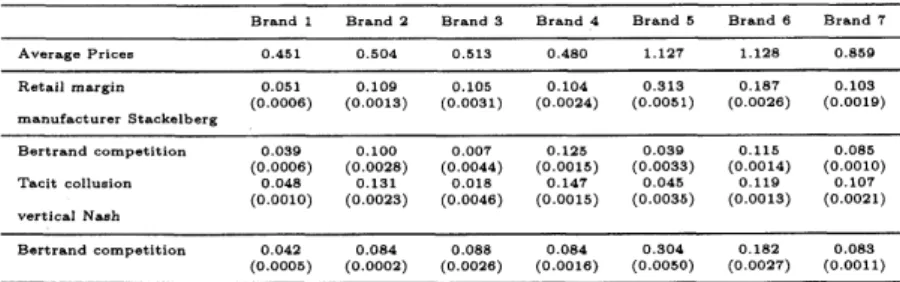
The margins (in yen per gram) of suggested model are presented in Table3. It should
be noted that margins in the vertical Nash-Bertrand competition game in Table 3 are
our best estimate within the employed framework, and those in the other entries are
counter-factual in thesense that, had these sorts ofgamesand perspectives werein play,
First of all, manufacturers’ margins under tacit collusion always exceed those under
Bertrand competition
as
expected. However, for brand 1, 3, 5 and 6, the margins undermanufacturer Stackelberg
are
lower than vertical Nash counterparts in both myopic andforward-looking models regardless of which game in horizontal interaction is assumed.
Thisisonepiece of evidence thatmanufacturer Stackelberggamebetween manufacturers
and aretailer cannot be justified with data.
Remember that brand3 has
a
distincttaste advantagedue tothe fact that ituses
onlyraw
milk, while brand5
and6
are
the yogurt with special lactic-acid bacilli. Thereforewe expect that these brands to command higher margins. As expected, brand 3, 5 and
6 command three largest margins under the vertical Nash-Bertrand competition game
(0.088, 0.304, and
0.182
respectively), whichwe estimate to reflect Japanese yogurtmar-ket. Meanwhile, brand 3 and 5 havethe least and the second least margins respectively
under the manufacturer Stackelberg-Bertrand competition counter-factual (0.007 and
0.039), whichis another evidence that manufacturer Stackelberg game cannot be justified
with
data.11
These facts and the market being characterized by the vertical Nash-Bertrand
com-petition game jointly imply that differentiating brands by improving its quality enables
manufacturers to charge higher margins relative to the others. However,
we
note thata retailer also charges the largest and the second largest margins for brand 5 and
6
andchargesthefourthlargest margin for brand3. In fact, theamount of retailer’smargins
are
higher than manufacturers’ margins for all brands in the vertical Nash-Bertrand
com-petition game
as
shown in Table 3. These facts lead usto the conclusion that a retailerhasmore power than manufacturers. The decreasing price ofyogurt over thelast decade
is at least partially due to decreasing power of manufacturers relative to the retailer in
addition to competition among manufacturers
as
indicated byour
result. The existenceof fierce competition among manufacturers makes sense,
as
157yogurt brands existed inthemarket in January
2007
to December 2008.5.2.3 Marginalcost
Theestimation result for marginal cost of the vertical Nash-Bertrand competition game
of the proposed model is presented in Table$4^{}$ Wefindthat after includingmanufacturer
dummyvariables, all variablesexcept for international oil price have negative coefficients
in the best-fitting game, thus we exclude
them.13
The high values for manufacturers$\overline{1lThemargim}$
ofBrmd1$md5$ under themanufacturerStackelberg-Bertrand competition gamein forward-lookingmodelappear to be thesamein Table 3, but this is because of rounding. The margin ofbrand1 is shghtly larger than that ofbrand5,even though the difference is minimal.
12Resultsforthe other modelscanbe provided upon the request to the author.
13Ifweuseonly labor wage, their coefficients are positive. The effect of labor wageseemsto beabsorbed bymanufacturer
Table4: Marginal cost estimation in forward-looking model.
manufacturerStackelberg Bertrand competition Tacit collusion
$\overline{t\fbox{Error::0x0000}valuop}$
Estimate Std.Err $p$-value Estimate Std Err $t$-value$\overline{Intercept07420233}3182 0002 \fbox{Error::0x0000}0816 0240 3408 0001$
Manufacturer 2 $0041$ $0026$ $-159S$ $0110$ $-0061$ $0027$ $-2319$ 0021 Manufacturer$3$ $-0026$ $0030$ $\fbox{Error::0x0000}0880$ $0379$ $0031$ $0031$ $-1004$ O316
Manufactur\’er4 0.287 O0221322 $0000$ $0287$ $0022$ 12870000 Manufacturer6 $0346$ $0027$ 13 $0000$ 0335 $0027$ 12 0000 Cream price index 0133O0324137O000O1390033 4192 $0000$
Internationaloilprice $0038$ $0024$ 1546 $0123$ $0037$ O025 1480 0.139 $\frac{Rawm1kprice00030002110402700003\mathring{0}00212780202}{vertica1NashBertrandcompetitionTac\mathfrak{i}tc11u\cdot ion}$ $\frac{Estimat\’{e} StdErrt-va1uep-va1ueEstimateStdErrtva1uep\fbox{Error::0x0000}va1ue}{Intercept0196008224010.01701870.08422250.026}$ Manufacturer$2$ $-0048$ $0021$ $-2280$ O. 023 $0063$ $0021$ 2918 0.004 Manufacturer 3 $0037$ $0021$ 1778 $0076$ $-0044$ $0021$ 2075 $003S$ Manufacturer 4 O.163 00179563 $0000$ 0161 $0018$ 9193 0000 Manufacturer5 0315 $0021$ 1511 $0000$ $0304$ $0021$ 1417 0000
International oil price $0037$ $0018$ 2015 $0044$ $0037$ $0019$ 1967 $0061$
4 and 5
are
consistent with the fact that manufacturer 4 produces brand 5 and 6 andmanufacturer 5 produces brand
7.
5.2.4 The price endogeneity
After estimating $\hat{\xi_{jt}}$
and $\hat{\eta_{jt}}$, wetested the correlation between them using one of
Pear-son’s product moment correlation coefficient test. The test reveals that they
are
signif-icantly correlated and thus prices
are
proven to be endogenously determined, which isconsistent with the general finding in literature.
6
Conclusion
In this paper, weempirically analyzed Japanese yogurt market incorporating consumer
heterogeneity,
consumer
state dependence, forward-looking behavior ofmanufacturersandaretailer, and priceendogeneity arises from the interaction between unobserved demand
characteristics and prices. Ourdemand-side findingsareconsistent with those of previous
literature; consumers areheterogeneous in their responsiveness tomarketingvariables and
degreesofstate dependence. Onsupply-side, wefindpricesareendogenouslydetermined,
manufacturers engage in Bertrand competition game, manufacturers and a retailer play
vertical Nash game, and they set prices considering their impact on future profit.
We find that brands with differentiating features (brand 3, 5 and 6) do command
higher margins, proving that manufacturers’ efforts are rewarded. However, a retailer
also charges higher margins for these brands and obtains larger split of the profit. We
alsofind that there arerigorous competitions among manufacturers in this marketwhich
competition
was
thecase
in theU.S.
cerealmarket with largenumberof brands. Finally,our work adds another evidence to the body of literature in this field of intersection be
tween marketing and neo empirical industrial organization,
as
lack of empirical study isgeneral
concern
in thisarea
[10].One major limitation of this research is the assumption of a monopolistic retailer
as
retailers
are
likely to compete in reality. In fact, “National Survey of Prices”’ conductedbyStatisticsBureau, Ministry ofInternalAffairsandCommunicationsin Japan indicates
that the average retail prices of yogurt are higher in stores withno competitors around.
Incorporating retail competition in the framework employed in this study would be an
interesting
source
of future research. The other possible direction of future research isinclusion the effect of store brand. This topic is common in the literature, and widely
investigated in the context such
as
its effect on power balance between manufacturers,store loyalty and so forth. As state dependence is often neglected in these analysis,
investigating the effect of store brand in the presented frameworkmayprovide
new
insightto the literature.
Appendix
In appendix$A$, we derivemargins in myopic model. In appendix$B$, we derive margins
in forward-looking model. Wenote that equations to derive margins in static model
are
identicalto those in myopic model.
A
Margins
in
Myopic Model
We start with margins of
a
retaileras
it will be used in calculating margins ofmanu-facturers.
A.1 Margins ofaRetailer
Theprofit function for the monopolisticretailer is defined
as
$\pi_{R}=\sum_{j=1}^{J}(p_{jt}-w_{jt})S_{jt}M$ (12)
where $w_{jt}$ is the wholesale price for brand$j$ at time $t,$ $S_{jt}$ is the market share, and $M$is
Now by partially differentiating (12) with respect to each retail price$p_{jt}$, setting them
zero, and algebraic manipulations, we have
$(\begin{array}{l}p_{1t}-w_{1t}\vdots p_{Jt}-w_{Jt}\end{array})=-\{\begin{array}{lll}\frac{\partial S}{\partial p}u1t \cdots \frac{\partial S}{\partial p}\Delta lt p_{Jt}{}_{\frac{\partial}{\partial}\lrcorner}S_{L} \cdots \frac{\partial}{\partial}s_{Jt}\ovalbox{\tt\small REJECT} p\end{array}\}(\begin{array}{l}S_{1t}\vdots S_{Jt}\end{array})$
.
(13)Using the notation of [4], we have
$(p_{t}-w_{t})=\Phi_{t}^{-1}S_{t}$ (14)
where $(p_{t}-w_{t})\equiv(p_{1t}-w_{1t}, \cdots,p_{Jt}-w_{Jt})^{T}$ is$J\cross 1$ vectorofretail margins, $\Phi_{t}$ is$J\cross J$
matrix with elements
$\Phi_{jkt}=-\frac{\partial S_{kt}}{\partial p_{jt}}$
for brand$j,$$k=1,$$\cdots,$$J$, and $S_{t}$ is $J\cross 1$ vector$S_{t}=(S_{1t}, \ldots, S_{Jt})^{T}.$
A.2 Margins ofManufacturers
Now wederive margins of manufacturersunder different games. Unlikein theretailer’s
case, the profit function of manufacturers differs depending on which game in horizontal
strategicinteractionis assumed. The profitfunction$\pi_{f}$ofmanufacturer$f$under Bertrand
competition isgiven by
$\pi_{f}=\sum_{j\in J_{j}}(w_{jt}-mc_{jt})S_{jt}M$, (15)
where $J_{f}$ isasubset of brands produced bymanufacturer $f$and$mc_{jt}$ is the marginal cost
of producing brand $j$ at time $t$
.
The manufacturer’s margin from brand $j$ is $w_{jt}-mc_{jt}.$On the otherhand, the totalprofit function $\pi_{\forall f}$ of collusive manufacturers is given by
$\pi_{\forall f}=\sum_{j=1}^{J}(w_{jt}-mc_{jt})S_{jt}M.$
The first order condition of the profit function in tacit collusion game is
$\frac{\partial\pi_{\forall f}}{\partial w_{lt}}=M[S_{lt}+\sum_{j=1}^{J}[(w_{jt}-mc_{jt})\sum_{k=1}^{J}\frac{\partial S_{jt}}{\partial p_{kt}}\cdot\frac{\partial p_{kt}}{\partial w_{lt}}\Vert=0$ (16)
for$l=1$, .
. .
,$J$.
By algebraic manipulation, we have$(\begin{array}{l}w_{1t}-mc_{1t}\vdots w_{Jt}-mc_{Jt}\end{array})=-[\{\begin{array}{ll}\frac{\partial p_{1t}}{\partial w_{1t}},\cdot Z\partial L^{t}\partial w_{1t}\frac{\partial p_{1t}}{\partial wJt},\cdot \dot{\partial}w\partial\ovalbox{\tt\small REJECT}_{\frac{t}{Jt}}\end{array}\}$ $\{\begin{array}{ll}\frac{\partial}{\partial}s_{lt}\lrcorner tp,\cdot {}_{\frac{\partial}{\partial}\lrcorner}S_{1}p_{1t}p_{Jt}{}_{\frac{\partial}{\partial}\lrcorner}S_{A}, \frac{\partial}{\partial p}S_{\ovalbox{\tt\small REJECT},Jt}\end{array}\}]^{-1}(\begin{array}{l}S_{1t}\vdots S_{Jt}\end{array}),$
where the
left
hand sideof
equation (17)is
$J\cross 1$ vectorof manufacturers’
margins. Thefirst order condition of profit function in Bertrand competition can be derived similarly.
In equation (17), the terms$S_{jt}$ and $\partial S_{jt}/\partial p_{kt}$canbe directlyobtained from the estimated
demand parameters but $\partial p_{kt}/\partial w_{lt}$ cannot be. Thuswe must infer these terms indirectly,
and the difference between manufacturer Stackelberg and vertical Nash stems from how
these terms
are
specified. We start with the manufacturer Stackelberg-Tacit collusiongame because margins under the other games
can
be derivedas
the specialcase
of thisgame.
A.2.1 Margins under the manufacturer Stackelberg-Tacit collusion game
To infer$\partial p_{kt}/\partial w_{lt}$,
we
exploitthe firstorder condition of the retail profit function definedin (12);
$\frac{\partial\pi_{R}}{\partial p_{gt}}=S_{9^{t}}+\sum_{k=1}^{J}[(p_{kt}-w_{kt})\frac{\partial S_{kt}}{\partial p_{gt}}]=0$ (18)
for$g=1$,
. . .
,$J$with themarket size$M$removed. Since aretailer is assumedtomaximizethe category profit, the change inwholesalepriceof one brand would affectall retail prices
in the category. Thuswetotallydifferentiate (18) with respecttoprices$p_{jt},$$j=1$,
. . .
,$J,$and wholesale price $w_{lt}$ for brand $l$, to obtain, for
some
$g,$$\sum_{j=1}^{J}[\frac{\partial S_{gt}}{\partial p_{jt}}+\frac{\partial S_{jt}}{\partial p_{gt}}+\sum_{k=1}^{J}(p_{kt}-w_{kt})\frac{\partial^{2}S_{kt}}{\partialp_{jt}\partial p_{gt}}]dp_{jt}-\frac{\partial S_{lt}}{\partial p_{gt}}\cdot dw_{lt}=0.$
(19)
Denoting the terms inside the bracket on the left hand side of equation (19) as $v(g,j)$,
we have theset of$J$equations for
some
$l$as
$\{\begin{array}{l}\nu(1,1)dp_{1t}+\nu(1,2)dp_{2t}+\cdots+\nu(1, J)dp_{Jt}=\frac{\partial S}{\partial p_{1}}Lt .dw_{lt},.:\nu(J, 1)dp_{1t}+\nu(J, 2)dp_{2t}+\cdots+\nu(J, J)d=_{Jt}\cdot dw_{lt}.\end{array}$ (20)
Defining$G_{g}\equiv(\nu(9,1),$
$\ldots,$$\nu(g, J we$ rewrite $the$expression $in (20)$ inmatrix form and
rearrangeit
as
assuming the inverse of the $J\cross J$matrix $(G_{1}, \ldots, G_{J})^{T}$ exists. Ransposingboth sides of
equation (21) and stacking them vertically for $l=1,$$\cdots,$$J$, we have
$[_{\frac{\partial p_{1t}}{\partial w_{Jt}}..A,IL} \frac{\partial p_{1t}}{\partial w\iota t},\cdot\cdot..,\partial\Delta IL\rangle.\cdot,\partial w_{Jt}\partial]=\{\begin{array}{lll}\frac{\partial}{\partial}s_{1t}\Delta p \cdots -\partial_{t}\partial\frac{S}{p_{J}}t \frac{\partial}{\partial}S\lrcorner tp_{1t} \cdots \frac{\partial}{\partial}S_{\ovalbox{\tt\small REJECT}}p_{Jt}\end{array}\} \cdot(G_{1}^{T}, \cdots, G_{J}^{T})^{-1}$ (22)
Substituting (22) into (17), we have the manufacturers’ margins under the manufacturer
Stackelberg-Tacit collusion game as
$(w_{t}-mc_{t}) = -(\Phi_{t}^{T}G^{-1}\Phi_{t})^{-1}S_{t}$ (23)
where $(w_{t}-mc_{t})=(w_{1t}-mc_{1t}, \cdots, w_{Jt}-mc_{Jt})^{T}$ and $G=(G_{1}^{T}, \cdots, G_{J}^{T})$
.
A.2.2 Margins under the manufacturer Stackelberg-Bertrand competition game
In Bertrand competition, each manufacturer maximizesthe profit from its ownbrands.
Thus in Bertrand competition, (17) applies only to the brands aparticularmanufacturer
produces. This requires replacement of the third term$\Phi_{t}$ in matrix$(\Phi_{t}^{T}G^{-1}\Phi_{t})^{-1}$ in (23)
with $\Phi_{t}\cdot*\Omega$, where $\cdot*$ denotes element-by-element multiplication, and
$\Omega$ is $J\cross J$matrix
whose $(j, k)$ elements are indicator functions taking unity if brands$j$ and $k$ are made by
the
same
manufacturer and zero otherwise. Then we have the manufacturers’ marginsunder the manufacturer Stackelberg-Bertrand competitiongame
as
$(w_{t}-mc_{t})=-(\Phi_{t}^{T}G^{-1}\Phi_{t}\cdot*\Omega)^{-1}S_{t}$
.
(24)A.2.3 Margins under theverticalNash-Tacit collusion game
In the vertical Nash game, manufacturers and a retailer move simultaneously. More
specifically, manufacturers set wholesale price expecting a certain level of retail margin
forthe brand;aretailersets its retail margin for each brand basedonits profit maximizing
behavior. Now by assumption, we have the relationship
$\frac{\partial(p_{jt}-w_{jt})}{\partial w_{jt}}=0$
orequivalently
$\frac{\partial p_{jt}}{\partial w_{jt}}=1$ (25)
for all $j=1$ ,
.
..
,$J$ since the retail margin of brand $j,$ $p_{jt}-w_{jt}$, is not affected bySimilarly,
since
the retail margin of brand,$p_{jt}-w_{jt}$,
is not affected by the wholesale priceof the other brands,
we
have$\frac{\partial(p_{jt}-w_{jt})}{\partial w_{kt}}=0$
orequivalently
$\frac{\partial p_{jt}}{\partial w_{kt}}=0$ (26)
for$j=1$,
. .
.
,$J,$$j\neq k^{14}$ Finally, from(25) and (26), the matrix with elements$\partial p_{jt}/\partial w_{kt}$on the right-hand side of equation (17) becomes
an
identity matrix and equation (17)becomes
$(\begin{array}{l}w_{1t}-mc_{1t}\vdots w_{Jt}-mc_{Jt}\end{array})=-\{\begin{array}{lll}\frac{\partial S}{\partial_{P1}}At \cdots \frac{\partial}{\partial}S_{\Delta}p_{1t} \frac{\partial}{\partial}S\lrcorner\iota p_{Jt} \cdots \frac{\partial S}{\partial p}\Delta Jt\end{array}\}(\begin{array}{l}S_{1t}\vdots S_{Jt}\end{array})$
Thus we have manufacturers’ margins under the vertical Nash-Tacit collusion game
as
$(w_{t}-mc_{t})=\Phi_{t}^{-1}S_{t}$ (27)
which is identical to margin of the retailer. This makes
sense
as
the vertical Nash gameassumes
approximately equal power between manufacturers and aretailer [6].A.2.4 Margins under the vertical Nash-Bertrand competition game
Since the retailer behaves the same independent of whether manufacturers compete
or tacitly collude, the conditions (25) and (26) still hold in the vertical Nash-Bertrand
competitiongame. And by thesamereasoning of themanufacturerStackelberg-Bertrand
competitiongame,
we
havethemanufacturers’ margins under the verticalNash-Bertrandcompetition game
as
$(w_{t}-mc_{t})=(\Phi_{t}\cdot*\Omega)^{-1}S_{t}$
.
(28)$\overline{14We}$
note thattbs behavioralpnncipleof retalerisconsistent with its profit mmmizing behavior,asthepredeterminedretailmargms arestill determined from the first order condition of its profit function
$\frac{\partial\pi R}{\partial p_{gt}}=S_{gt}+\sum_{k=1}^{J}[(p_{kt}-w_{kt})\frac{\partial S_{kt}}{\partial p_{gt}}]=0$
B
Margins
in
Forward-Looking
Model
Here we derive the margins in forward-looking model. We start with the margin of a
retailer.
B.1 Margins of
a
Retailer (Forward-Looking Model)The objectivefunction ofone-periodforward-lookingretaileris$V_{R}=\pi_{R1}+\delta\pi_{R2}$, where
$\pi_{Rt}$ is a profit function defined in (12) for period$t=1$, 2, and the term
$\delta$
is some
exoge-nously given discount rate. Then the first orderconditions are
$\{\begin{array}{l}\frac{\partial}{\partial}\pi_{k1}AL+\delta\sum^{J_{\frac{\partial}{\partial}n^{\pi}a}.\partial S_{2}}j=1S_{j2}\hat{\partial S_{j1k1}}\frac{\partial}{\partial}\frac{S}{p}L^{1}p.= 0\partial\pi\partial_{Pk2} = 0\end{array}$ (29)
for $k=1$,
.
.
.
,$J$.
In (29), the first equation corresponds to the first order condition ofthefirst periodprofitfunction and the secondequation correspondsto that of the second
periodprofit. As the first order condition inthe secondperiod is alreadyknown, weonly
concern
for the first equation in (29) in the following derivation. Furthermore, in thatequation, the unknownterms are $\partial\pi_{R2}/\partial S_{j2}$ and $\partial S_{j2}/\partial S_{j1}.$
Clearly, $\partial\pi_{R2}/\partial S_{j2}$ is $(p_{j2}-w_{j2})$
.
To calculate $\partial S_{j2}/\partial S_{j1}$,we
exploit the followingrelationship:
$S_{j2}= \theta_{j2|j1}\cross S_{j1}+\sum_{l=1,l\neq j}^{J}\theta_{j2|l1}\cross S_{l1}$ (30)
where $\theta_{j2|j1}$ is the probability of purchasing brand$j$ in period2given the purchase of the
brand in period 1, and$\theta_{j2|l1}$ isdefinedlikewise withbrand$l$
.
Sincethe market share sumsup to one, the term $S_{l1}$ isrewritten as $S_{l1}=(1-S_{11}-\cdots-S_{l-1,1}-S_{l+1,1}-\cdots-S_{J1})$
for all $l=1$,
.
..
,$J,$ $l\neq j$, which includes the term $-S_{j1}$.
Thus, the partial derivative ofthe second termonthe right-hand side of equation (30) with respect to $S_{j1}$ is
$\frac{\partial[\sum_{l=1,l\neq j}^{J}\theta_{j2|l1}\cross S_{l1}]}{\partial S_{j1}}=-\sum_{l=1,l\neq j}^{J}\theta_{j2|l1}$
as $\partial S_{l1}/\partial S_{j1}=-1$ for $l=1$,
. .
.,$J,$ $l\neq j$.
Thus taking partial derivative of both sides of(30) with respect to $S_{j1}$,
we
have$\frac{\partial S_{j2}}{\partial S_{j1}}=\theta_{j2|j1}-\sum_{l=1,l\neq j}^{J}\theta_{j2|l1}$
.
(31)In the
same
manner as
in the derivation of vector $(p_{t}-w_{t})$, the second term on theleft-hand side ofthe first equation in (29)
can
be expressed by matrix formas
$\delta\{\begin{array}{lll}\frac{\partial}{\partial}p_{11}S_{\lrcorner\perp} \cdots \frac{\partial S}{\partial p_{l}}\perp 1 \frac{\partial S}{\partial p}LJ1 \cdots \partial S_{1}\vec{\partial_{PJ1}}\end{array}\} \{\begin{array}{lll}\triangle_{1} \cdots 0 0 \cdots \triangle_{J}\end{array}\} (\begin{array}{l}p_{12}-w_{12}\vdots p_{J2}-w_{J2}\end{array})$
where the second matrix is diagonal matrix with diagonal elements $\Delta_{j}$, which
we
willexpress
as
$\Delta$.
Thuswe
havethe margin inthe first periodas
$(\begin{array}{l}p_{1l}-w_{11}\vdots p_{J1}-w_{J1}\end{array})=-\{\begin{array}{lll}\frac{\partial}{\partial}\frac{S}{P1}\perp 1 \cdots \partial S\perp\vec{\partial_{P1l}} -\frac{\partial S}{\partial_{PJ}}\iota 1 \cdots \partial S\perp\vec{\partial_{PJ1}}\end{array}\}$ $(\begin{array}{l}S_{11}\vdots S_{J1}\end{array})-\delta\{\begin{array}{lll}\Delta_{1} \cdots 0 0 \cdots \triangle_{J}\end{array}\}$ $(\begin{array}{l}p_{12}-w_{12}\vdots p_{J2}-w_{J2}\end{array})$
or $(p_{1}-w_{1})=\{\Phi^{T}\}^{-1}S_{1}-\delta\Delta(p_{2}-w_{2})$, assuming the inverse of $\Phi^{T}$ exists. To derive
margins in forward-looking model, wefirst calculate the margins in the myopic
case
fromweek 2, and use these margins in calculating margins in forward-looking model starting
from week 1.
B.2 Margins of Manufacturers (Forward-Looking Model)
Thederivationofmargins ofmanufacturersin one-period forward-looking model much
followsthe
case
of the retailer. Herewe
consider the margin in themanufacturerStackelberg-Tacitcollusion game as margins in the other games are special case of those under thisgame.
The objective functionis $V_{M}=\pi_{f1}+\delta\pi_{f2}$ and thefirst orderconditions
are
$\{\begin{array}{l}\frac{\partial\pi f1}{\partial wk1}+\delta\sum^{j}=1\frac{\partial\pi_{f2}}{\partial S_{j2}}.\frac{\partial S}{\partial S}\angle^{2_{-}}j1^{\cdot}\partialS_{1}k1 = 0\frac{\partial\pi_{f2}}{\partial w_{k2}} = 0.\end{array}$ (32)
As
was
the casein (29), the first equation of(32) correspondsto thefirst order conditionof the first period profit function and the second equation corresponds to that of the
secondperiod profit. Clearly, $\partial\pi_{f^{2}}/\partial S_{j2}=(w_{j2}-mc_{j2})$
.
Then the product ofthistermand $\partial S_{j1}/\partial w_{k1}$ turns out to be the second termof the first order condition of the profit
functionofmanufacturersin (16), exceptfor the subscript being2insteadof$t$in wholesale
price$w_{j2}$ and marginalcost $mc_{j2}$
.
Then thisproduct term can bewritten in matrixformas
or
simply $\Phi_{t}^{T}G^{-1}\Phi_{t}(w_{2}-mc_{2})$.
Thus the second termon the left-hand side of the firstequation of(32) becomes $\delta(\Phi_{t}^{T}G^{-1}\Phi_{t})\Delta(w_{2}-mc_{2})$
.
Then wehave $S_{1}+\Phi_{t}^{T}G^{-1}\Phi_{t}(w_{1}-$$mc_{1})+\delta(\Phi_{t}^{T}G^{-1}\Phi_{t})\Delta(w_{2}-mc_{2})=0$or$(w_{1}-mc_{1})=-(\Phi_{t}^{T}G^{-1}\Phi_{t})^{-1}S_{1}-\delta\cdot\Delta(w_{2}-mc_{2})$,
assuming the inverse of $\Phi_{t}^{T}G^{-1}\Phi_{t}$ exists. The margins in the other games are derived
similarly
as
we presented in the myopiccase.
References
[1] Steven T Berry. Estimating discrete-choice models of product differentiation. The
RAND Journal
of
Economics, pages 242-262, 1994.[2] David Besanko, Jean-PierreDub\’e, and Sachin Gupta. Competitive price
discrimina-tion strategies inaverticalchannel using aggregate retail data. Management Science,
$49(9):1121-1138$, 2003.
[3] DavidBesanko, SachinGupta, andDipak Jain. Logitdemand estimation under
com-petitive pricing behavior: An equilibrium framework. Management Science, $44(11-$
$part-1):1533-1547$, 1998.
[4] Hai Che, K Sudhir, and PBSeetharaman. Bounded rationality in pricing under
state-dependent demand: Do firms look ahead, and if so, how far? Journal
of
MarketingResearch, pages 434-449, 2007.
[5] Pradeep K Chintagunta. Investigating category pricing behavior at a retail chain.
Journal
of
Marketing Research, $39(2):141-154$, 2002.[6] S Chan Choi. Price competition in a channel structure with a common retailer.
Marketing Science, $10(4):271-296$, 1991.
[7] Michaela Draganska and DipakCJain. Consumerpreferences and product-line
pric-ing strategies: An empirical analysis. Marketpric-ing science, $25(2):164-174$,
2006.
[8] Michaela Draganska and Daniel Klapper. Retail environment andmanufacturer
com-petitive intensity. Journal
of
Retailing, $83(2):183-198$, 2007.[9] Dan Horsky and Paul Nelson. New brand positioning and pricing in anoligopolistic
market. Marketing Science, 11(2):133-153, 1992.
[10] Vrinda Kadiyali, K Sudhir, and Vithala R Rao. Structural analysis of competitive
behavior: Newempiricalindustrial organization methods in marketing. International
[11] Wagner A. Kamakura and Gary J. Russell. Aprobabilistic choice model for market
segmentationandelasticitystructure. Journal
of
Marketing Research,$26(4):379-390.,$1989.
[12] James M. Lattin. A model of balanced choice behavior. Marketing Science, $6(1):48-$
65., 1987.
[13] Sergio Meza and K Sudhir. Do private labels
increase
retailer bargaining power?Quantitative Marketing and Economics, $8(3):333-363$,
2010.
[14] Aviv Nevo. Measuringmarket power in the ready-to-eat cereal industry.
Economet-rica, $69(2):307-342$, 2001.
[15] Margaret E Slade. Product rivalry with multiple strategic weapons: An analysis of
price and advertising competition. Journal
of
Economics&
Management Strategy,$4(3):445-476$,
1995.
[16] S Sriramand VrindaKadiyali. Empirical investigation of channelreactionstobrand
introductions. InternationalJournal
of
Research in Marketing, $26(4):345-355$, 2009.[17] K Sudhir. Structural analysis ofmanufacturer pricing in the presence of
a
strategicretailer. Marketing Science, $20(3):244-264$,
2001.
[18] J Miguel Villas-Boas and Russell S Winer. Endogeneity in brand choice models.
Management Science, $45(10):1324-1338$, 1999.
[19] J Miguel Villas-Boas and Ying Zhao. Retailer, manufacturers, and individual
con-sumers:
Modelingthe supplyside in the ketchup marketplace. Journalof
MarketingResearch, pages 83-95,
2005.
[20] Sha Yang, Yuxin Chen, and Greg M Allenby. Bayesian analysis of simultaneous
demand and supply. Quantitative Marketing and Economics, $1(3):251-275$, 2003.
Graduate School of Systems and Information
DivisionofPolicy and Planning Sciences
University of Tsukuba
Tsukuba
305-8573
JAPAN
$E-$-mail address: [email protected]
$E-$-mail address: [email protected]
$\ovalbox{\tt\small REJECT}\grave{y}oe\star g\backslash y$ス$\overline{\tau}$ム