
内部波ビームの
3
次元的安定性
神戸大学 (Kobe University) 片岡 武 (Takeshi Kataoka)
Massachusetts Institute of Technology Triantaphyllos R. Akylas
要旨 一様な密度成層流体中を伝播する内部波ビームの 3 次元撹乱に対する線形安 定性を取り扱った。 具体的には,撹乱の波長がビームの幅に比べて十分長い場 合を仮定し,漸近理論を駆使して Euler方程式系を基に変調安定性を調べた。 その結果,一方向のみにエネルギーを伝える進行波ビームは,振幅がある値を 超えると変調不安定となり,両方向にエネルギーを伝える定在波ビームは,任 意の振幅において変調不安定となることが分かった。
1.
緒言
In
an
inviscid, incompressible, unifonnly stratified fluid ofconstant Brunt-V\"ais\"al\"afrequency $N_{0}$,a
plane intemal
wave
has thewave
frequency $\omega$ which isa
function only of the angle $\theta$ between thewavenumberdirection and thevertical[l]:
$\omega=N_{0}\sin\theta$
.
(1.1)Theinternalwavebeaminvolvesplanewaveswithvariouswavenumbers $l$ foracertain fixedangle $\theta,$
and thebeam is localized inthe wavenumber direction. Such localization is possible because intemal
waves
essentially propagate perpendicular tothewave
crest.Intemal
wave
beamscan
be readily produced froma
two-dimensional oscillatingsource
ofa
givenfrequency $\omega_{0}(<N_{0})$
.
The inducedsteadybeampattemconsists of fourstraightlinesstretchingfrom thesource
withthe angles $\pm\cos^{-1}(\omega_{0}/N_{0})$ tothevertical. Thiswell-knownpattemiscalled ‘StAndrew’sCross’, andwas first verified experimentally by Mowbray & Rarity[2] usingvibration ofa horizontal
cylinder
as
an
oscillatingsource.
Inthepresent study,
we
examinethe linearstabilityofthese internalwave
beamsto long-wavelengththree-dimensionalperturbations. The stabilityof the internal
wave
beamwas
treatedin thepast only byTabaei andAkylas[3], andtheyfoundthat thewavebeam istwo-dimensionally stable.Herewe examine
the stability to three-dimensional perturbations, and found that they are, in fact, three-dimensionally
unstable iftheir amplitude exceeds some threshold value for progressive beams and unstable for any
amplitudeforpurely standingbeams.Thisreportis based
on
Kataoka andAkylas[4].2.
基礎方程式
Consider three-dimensional internal
wave
disturbances inan
inviscid, incompressible, uniformlystratified Boussinesq fluid of constant Brunt-V\"ais\"al\"a frequency $N_{0}$
.
Forthe purpose ofstudying thestability of
an
intemalwave
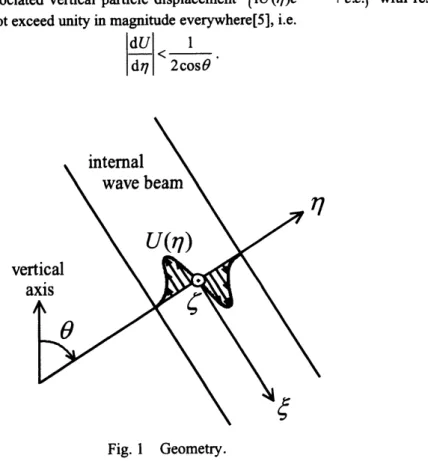
beam, it is convenientto work with the spatial coordinates $(\xi,\eta,\zeta)$, thealong-beam, across-beam and horizontal transverse directions, respectively (Fig. 1). We
use
dimensionless variables throughout, employing the
same
scalingsas
in Tabaei&
Akylas[3] (with thebeam width
as
characteristic length, $1/N_{0}$as
time scale, anda
typicalvalue ofthebackgrounddensity).$\nabla\cdot u=0$, (2.la)
$\rho_{l}+u\cdot\nabla\rho=-u\sin\theta+v\cos\theta$, (2.lb) $u_{t}+u\cdot\nabla\rho=-p_{\xi}+\rho\sin\theta$, (2.lc) $v_{t}+u\cdot\nabla v=-p_{\eta}-\rho\cos\theta$ , (2.ld) $w_{t}+u\cdot\nabla w=-p_{\zeta}$ , (2.le)
where $\theta$ is
an
angle between the$\eta$ axis and the vertical,
$t$ is the time, and $\rho$ and $p$
are
thedensityand
pressure
perturbations fromthe backgroundstate,respectively, andthe subscripts $t,$ $\xi,$ $\eta$and $\zeta$ denote partialdifferentiationwithrespect tothesevariables.
Equations(2.1)have the$fol[oWil$
$\{$
$ng$exact solution representing fmite-amplitude internal
wave
beam$u=u_{0}(t,\eta)\equiv\{U(\eta)e^{-i\sin\theta t}+c.c.\},$
$v=w=0,$
$\rho=\rho_{0}(t,\eta)\equiv\vdash iU(\eta)e^{-isi\theta l}+c.c.\}$, (2.2) $p=p_{0}(t,\eta)\equiv\{$
icos$\theta\int U(\eta’)d\eta’e^{-i\sin\theta t}+$
c.c.
$\},$
where $U(\eta)$ is
a
given arbitrary function of $\eta$ which decays rapidlyas
$\etaarrow\pm\infty$ andc.c.
denotescomplex conjugate. In the present study
we
exclude the limitingcases
of $\thetaarrow 0$ and $\pi/2$ for whichthe internal
wave
beam approachesa
horizontal steady shear flowor
becomes nearly vertical with frequency closetotheBnmt-V\"ais\"al\"afrequency.Thus,we
put$0< \theta<\frac{\pi}{2}$
.
(2.3)Moreover, in orderto avoid density inversions
so
that the internalwave
beam (2.6) is statically stable,the derivative of the associated vertical particle displacement $\{iU(\eta)e^{-i\sin\theta t}+C\mathcal{L}.\}$ with respect to the vertical directionmust notexceed unityinmagnitudeeverywhere[5],i.e.
$| \frac{dU}{d\eta}|<\frac{1}{2\cos\theta}$
.
(2.4)We examine the linear stability of the above statically stable intemal
wave
beam $(2.2)-(2.4)$ tothree-dimensionalperturbations. Tothisend,employingFloquettheory,
we
write
$\{\begin{array}{l}uvw\rho p\end{array}\}=\{\begin{array}{l}u_{0}(t,\eta)00\rho_{0}(t,\eta)p_{0}(t,\eta)\end{array}\}+\{\begin{array}{l}\hat{u}(t,\eta)\hat{v}(t,\eta)\hat{w}(t,\eta)\hat{\rho}(t,\eta)\hat{p}(t,\eta)\end{array}\}\exp[\sigma t+i$ ($k$
\’e
$+m\zeta$)$]$, (2.5)where $(\hat{u},\hat{v},\hat{w},\hat{\rho},\hat{p})$
are
unknown functions of $t$ and$\eta$ which
are
periodic in $t$ with thesame
period $2\pi/\sin\theta$
as
that of the internalwave
beam, $\sigma$ isan
unknown complex constant, and $k$ and $m$are
given real constants. Substituting(2.5)into(2.1)andlinearizing withrespecttotheperturbations,wehave the followingsetofequations for $(\hat{u},\hat{v},\hat{w},\hat{\rho},\hat{p})$:
$ik\hat{u}+\frac{\partial\hat{v}}{\partial\eta}+im\hat{w}=0$ , (2.6a)
$\frac{\partial\hat{\rho}}{\partial t}+\sin\theta\hat{u}+(\frac{\partial\rho_{0}}{\partial\eta}-\cos\theta)\hat{v}=-(\sigma+iku_{0})\hat{\rho}$, (2.6b)
$\frac{\partial\hat{u}}{\partial t}-\sin\theta\hat{\rho}+\frac{\partial u_{0}}{\partial\eta}\hat{v}=-[i\ovalbox{\tt\small REJECT}^{\wedge}+(\sigma+iku_{0})\hat{u}]$, (2.6c)
$\frac{\partial\hat{v}}{\partial t}+\cos\theta\hat{\rho}+\frac{\partial\hat{p}}{\partial\eta}=-(\sigma+iku_{0})\hat{v}$, (2.6d)
$\frac{b\hat{v}}{\partial t}+im\hat{p}=-(\sigma+iku_{0})\hat{w}$
.
(2.6e)Inadditiontobeing periodicin $t$ with period $2\pi/\sin\theta,$
$( \hat{u},\hat{v},\hat{w},\hat{\rho},\hat{p})(t)=(\hat{u},\hat{v},\hat{w},\hat{\rho},\hat{p})(t+\frac{2\pi}{\sin\theta})$, (2.7) the perturbationsmustalso decayin $\eta,$
$(\hat{u},\hat{v},\hat{w},\hat{\rho},\hat{p})arrow 0$
as
$\etaarrow\pm\infty$.
(2.8) The above set of equations $(2.6)-(2.8)$ constitutes an eigenvalue problem, $\sigma$ being the eigenvalueparameter. When there is
a
solution $(\hat{u},\hat{v},\hat{w},\hat{\rho},\hat{p})$ with $\sigma$ havinga
positive real part, thecorresponding internal
wave
beam is linearly unstable. Sincea solution for $k<0(m<0)$ is obtainedfromthatfor $k>0(m>0)$by $(\hat{u},\hat{v},\hat{\rho},u_{0},\rho_{0},\eta)arrow(-\hat{u},-\hat{v},-\hat{\rho},-u_{0},-\rho_{0},-\eta)(\hat{w}arrow-\hat{w})$,
we
set$k>0,$ $m\succ 0$
.
(2.9)3.
漸近解析
$(k\sim m^{3/2}<<1)$Assuming
now
that theperturbation islong inthe $\xi$ and $\zeta$ directions,thatis, $k$ and $m$ in (2.9)are
small,$k=\epsilon^{3}\kappa,$ $m=\epsilon^{2}$, (3.1) where $\epsilon$ is
a
smallPositive
Parameter and $\kappa$ isa Positive
$O(1)$ constant,we
seekan
asymptoticsolution of$(2.6)-(2.8)$for small $0<\epsilon<<1.$
3.1.
Inner solutionPutting aside the decaying boundaly condition (2.8),
we
seeka
solution of (2.6) which satisfies theperiodicitycondition(2.7)in $t$ andvariesby $O(1)$ in
$\{\begin{array}{l}\hat{u}=\hat{u}^{(0)}+\epsilon\hat{u}^{(1)}+\cdots,\hat{v}=\epsilon^{3}\hat{v}^{(3)}+\epsilon^{4}\hat{v}^{(4)}+\cdots,\hat{w}=\epsilon^{2}\hat{w}^{(2)}+\epsilon^{3}\hat{w}^{(3)}+\cdots,\hat{\rho}=\hat{\rho}^{(0)}+\epsilon\hat{\rho}^{(1)}+\cdots,\hat{p}=\hat{p}^{(0)}+\epsilon\hat{p}^{(1)}+\cdots,\sigma=\epsilon^{3}\sigma^{(3)} +\epsilon^{s}\sigma^{(5)}+\cdots,\end{array}$ (3.2)
Substituting (3.1) and (3.2) into (2.6) and collecting the same-order terms in $\epsilon$,
we
obtaina
series ofequations for $(\hat{u}^{(n)},\hat{v}^{(n+3)},\hat{w}^{(n+2)},\hat{\rho}^{(n)},\hat{p}^{(n)})(n=0,1,2,\cdots)$
:
$i\kappa\hat{u}^{(n)}+\frac{\partial\hat{v}^{(n+3)}}{\partial\eta}=F^{(n)}$, (3.3a) $\underline{\partial\hat{\rho}^{(n)_{+\sin\theta\hat{u}^{(n)}}}}=G^{(n)}$ , (3.3b) $\partial t$ $\partial\hat{u}^{(n)}$ $\overline{\partial t}-\sin\theta\hat{\rho}^{(n)}=H^{(n)}$, (3.3c) $\underline{\partial\hat{p}^{(\hslash)_{+\cos\theta\hat{\rho}^{(n)}}}}=I^{(n)}$ , (3.3d) $\partial\eta$ $\partial\hat{w}^{(n+2)}$ $-+i\hat{p}^{(n)}=J^{(n)}$, (3.3e) $\partial t$
wherethe terms
on
theright-hand sidesare
inhomogeneous terms andgivenby$F^{(0)}=G^{(0)}=H^{(0)}=I^{(0)}=J^{(0)}=0(n=0)$ (3.4a)
$\{\begin{array}{l}F^{(n)}=-i\hat{w}^{(n+1)}G^{(n)}=\hat{v}^{(n)}-(\sigma^{(3)}+in\ell_{0})\hat{\rho}^{(n-3)}H^{(n)}=\frac{\partial u_{0}}{\partial\eta}\hat{v}^{(n)}-i\hat{\varphi}^{(n- 3)}-(\sigma^{(3)}+in\ell_{0})\hat{u}^{(n-3)}(n=3,4)I^{(n)}=\frac{\partial\hat{v}^{(n)}}{\partial t}J^{(n)}=\triangleleft\sigma^{(3)}+ixu_{0})\hat{w}^{(n- 1)}\end{array}F^{(n)}=-i\hat{w}^{(n+1)}, G^{(n)}=H^{(n)}=I^{(n)}=J^{(n)}=0(n=1,2) ,(3.4c)(3.4b)$
For $n=0$, equations (3.3)
are
homogeneous and have the following nontrivial solution that satisfiesthe periodicity condition(2.7)
$\{\begin{array}{l}\hat{u}^{(0)}\hat{v}^{(3)}\hat{w}^{(2)}\hat{\rho}^{(0)}\hat{p}^{(0)}\end{array}\}=\{\begin{array}{l}\frac{0}{V}(3)\overline{W}^{(2)}00\end{array}\}+\{\begin{array}{l}\hat{U}_{-}^{(0)}\int\hat{U}_{-}^{(0)}d\eta’\hat{V}^{(3)}-i\hat{U}_{-}^{(0)}icot\theta\int\hat{U}_{-}^{(0)}dicos\theta\eta’\end{array}\}e^{-i\sin\theta t}+\{\begin{array}{l}\hat{U}_{+}^{(0)}\hat{V}_{+}^{(3)}icot\thetai\hat{U}_{+}^{(0)}\int-icos\theta\hat{U}_{+}^{(0)}d\eta’\int\hat{U}_{+}^{(0)}d\eta’\end{array}\}e^{is\dot{m}\theta t}$, (3.5)
where $\overline{V}^{(3)}$ isconstant
and
Here $\hat{U}_{\pm}^{(0)}(\eta)$ and $\overline{W}^{(2)}(\eta)$
are
as yetundetermined functions of$\eta$: Capital-letter variables withthe
hat and subscript $\pm$
are
the complexamplitudes of components proportionalto $\sim e^{\pm i\sin\theta t}$ that have thesame
frequencyas
the underlying beam, and variables with the overbar denotemean-flow components(which
are
independent of $t$); $\overline{V}^{(3)}$ and $\overline{W}^{(2)}$, in particular, represent $O(\epsilon^{3})$ and $O(\epsilon^{2})$
mean
flows in the across-beam $(\eta)$ and the transverse $(\zeta)$ directions, respectively. The higher hamonic
components$(\sim e^{f2i\sin\theta/}, e^{\pm 3is\dot{m}\theta t},\cdots)$ do notappearatthis level.
For $n\geq 1$, the equations (3.3)
are
inhomogeneous, and the inhomogeneous terms $G^{(n)},$ $H^{(n)},$ $I^{(n)}$and $J^{(n)}$ on the right-hand sides of(3.3) must satisfy the following solvability conditions to have a solution
$J^{2\pi/\sin\theta}e^{\pm i\sin\theta t}(\pm iG^{(n)}+H^{(n)})dt=0$, (3.7a)
$J^{2\pi/s\dot{m}\theta}[i(\cot\theta H^{(n)}+I^{(n)})-\frac{\partial J^{(n)}}{\partial\eta}]1t=0$
.
(3.7b)For $n=1$ and 2, the solvability conditions (3.6)
are
identically satisfied, anda
solution of (3.3)satisfying(2.7)becomes the
same
formas
(3.5) with the numbers intheparentheses, atany superscriptsbeing added by $n$ and
$\overline{V}^{(n+3)}=-i\int\overline{W}^{(n+1)}d\eta’$ , (3.8a) $\hat{V}_{\pm}^{(n+3)}=-i\kappa\int\hat{U}_{\pm}^{(n)}d\eta’+\cot\theta\int\int’\hat{U}_{\pm}^{(n-1)}d\eta^{n}d\eta’$, (3.8b)
$(n=1,2)$
.
For $n=3$ and 4, the solvability conditions (3.7) become the following six equations for
$(\hat{U}_{-}^{(0)},\hat{U}_{+}^{(0)},\overline{W}^{(2)},\hat{U}_{-}^{(1)},\hat{U}_{+}^{(1)},\overline{W}^{(3)})$
:
$\sigma^{(3)}\hat{U}_{-}^{(0)}=\kappa\cos\theta\int\hat{U}_{-}^{(0)}d\eta’-\frac{dU}{d\eta}\overline{V}^{(3)}$ , (3.9a)
$\sigma^{(3)}\hat{U}_{+}^{(0)}=-\kappa\cos\theta\int\hat{U}_{+}^{(0)}d\eta’-\frac{dU^{*}}{d\eta}\overline{V}^{(3)}$, (3.9b)
$\sigma^{(3)}\frac{d\overline{W}^{(2)}}{d\eta}=2\kappa\cot\theta(\frac{dU}{d\eta}\int\hat{U}_{-}^{(0)}d\eta’+\frac{dU}{d\eta}\int\hat{U}_{+}^{(0)}d\eta’)$ , (3.9c)
$\sigma^{(3)}\hat{U}_{-}^{(1)}=\cos\theta(\kappa\int\hat{U}_{-}^{(1)}d\eta’+\frac{i}{2}$
cote
$\int\int’\hat{U}_{-}^{(0)}d\eta^{n}d\eta’)+i\frac{dU}{d\eta}\int\overline{W}^{(2)}d\eta’$, (3.9d) $\sigma^{(3)}\hat{U}_{+}^{(1)}=-\cos\theta(\kappa\int\hat{U}_{+}^{(1)}d\eta’+\frac{i}{2}\cot\theta\int\int’\hat{U}_{+}^{(0)}d\eta^{n}d\eta’)+i\frac{dU^{*}}{d\eta}\int\overline{W}^{(2)}d\eta’$, (3.9e)$\sigma^{(3)}\frac{d\overline{W}^{(3)}}{d\eta}=2\cot\theta[\frac{dU^{r}}{d\eta}(\kappa\int\hat{U}_{-}^{(1)}d\eta’+\frac{i}{2}\cot\theta\int\int’\hat{U}_{-}^{(0)}d\eta^{n}d\eta’)$
(3.9f)
$+ \frac{dU}{d\eta}(\kappa\int\hat{U}_{+}^{(1)}d\eta’+\frac{i}{2}\cot\theta\int\int’\hat{U}_{+}^{(0)}d\eta^{n}d\eta’)]$
where the asterisk denotes complex conjugate. These equations for the amplitudes, $\hat{U}_{\pm}^{(0)}(\eta)$ and
$\hat{U}_{\pm}^{(1)}(\eta)$, ofthe primary hannonic perturbation and the induced transverse
mean
flow, $\overline{W}^{(2)}(\eta)$ and $\overline{W}^{(3)}(\eta)$,mustbesupplemented withsuitableboundaryconditions. Specifically,$\int\int^{l}\hat{U}_{-}^{(0)}d\eta^{n}d\eta’arrow 0, \int\int’\hat{U}_{+}^{(0)}d\eta^{\hslash}d\eta’arrow 0, \int\hat{U}_{-}^{(1)}d\eta’arrow 0, \int\hat{U}_{+}^{(1)}d\eta’arrow 0$ , (3.10)
where matchingwith theouter
solution
(3.13)obtainedin Section 3.2 is
alreadytakeninto
account.The conditions(3.9)
ensure
that the flow field associated withtheprimary-hannonic perturbation,as
well
as
the $0(\epsilon^{2})$ transversemean
flow component vanishes far away from the beam. The inducedmean
flowat $O(\epsilon^{3})$, however,does notremainlocallyconfined in thevicinityof the beam:$( \hat{u},\hat{v},\hat{w})arrow\epsilon^{3}\overline{V}^{(3)}(\cot\theta, 1, \frac{\mp i}{\sin\theta}) (\etaarrow\pm\infty)$, (3.11) where $\overline{V}^{(3)}$ is constant. In order to construct
an
overall solution of $(2.6)-(2.7)$ that satisfies thedecaying condition(2.8) in $\eta$ ,
we
must seekan
outer solution which decays slowly in $\eta$ atinfinityandisconnectedto(3.11)intheinnerlimit.
3.2.
Outer solution
Introducing
a
reducedcoordinate$Y=\epsilon^{2}\eta$, (3.12)
we
look fora
solution which varies by $O(1)$ in $Y$ and is independent of $t$ (mean flow) of thefollowingorders
$\hat{u}=\epsilon^{3}\hat{u}_{0}(Y) , \hat{v}=\epsilon^{3}\hat{v}_{0}(Y) , \hat{w}=\epsilon^{3}\hat{w}_{o}(Y) , \hat{\rho}=\epsilon^{6}\hat{\rho}_{0}(Y) , \hat{p}=\epsilon^{4}p_{0}(Y)$
.
(3.13) The orders of (3.13)are
determined by (3.11) and balance of terms in (2.6) noting that $u_{0},\rho_{0}arrow 0$ $(|\eta|arrow\infty)$.
Substituting (3.1), $(3.12)-(3.13)$ and $\sigma=\epsilon^{3}\sigma^{(3)}$into
(2.6) and collecting the same-ordertermsin $\epsilon$ ofeach equation,
we
obtain$\epsilon^{2}x$
Fig. 2 Streamlines of the
mean
flow described by theouter solution (3.15) (with (2.5)). The abscissa $\epsilon^{2}x[=\epsilon^{2}(\xi\cos\theta+\eta\sin e)]$ is the horizontal direction perpendicular to the other horizontal transverse $\epsilon^{2}\zeta$ direction (the ordinate) along the beam positioned at $x=0$.
Streamlines for$\{\frac{d\hat{v}_{o}}{\sin\theta dY}+i\hat{w}_{O}=0(3)n^{\hat{u}_{0}-\cos\theta\hat{v}_{O}=0\prime},$
,
(3.14)
Theseequations have
a
solutionwhich decaysas
$|Y|arrow\infty$ andisconnected to(3.11)at $Y=0$$\{\begin{array}{l}\hat{u}_{O}\hat{v}_{o}\hat{w}_{O}\hat{\rho}_{O}\hat{p}_{0}\end{array}\}=\{\begin{array}{l}cot\thetal-i/sin\theta\sigma^{(3)}cos\theta/sin^{2}\theta\sigma^{(3)}/s\dot{m}\theta\end{array}\}\overline{V}^{(3)}\exp(-\frac{Y}{\sin\theta})$ for $Y>0$, (3.15a)
$\{\begin{array}{l}\hat{u}_{0}\hat{v}_{O}\hat{w}_{O}\hat{\rho}_{O}\hat{p}_{o}\end{array}\}=\{\begin{array}{l}cot\thetali/sin\theta\sigma^{(3)}cos\theta/sin^{2}\theta-\sigma^{(3)}/sin\theta\end{array}\}\overline{V}^{(3)}\exp(\frac{Y}{\sin\theta})$ for $Y<0$, (3.15b)
where $\overline{V}^{(3)}$
isconstant. The flowdescribed by (3.15)ispurelyhorizontalbecause $\hat{u}_{O}/\hat{v}_{o}=\cot\theta$,and it formsasingle circulating flow which traverses the beam because $\overline{V}^{(3)}$ is
constant(figure2).
Thus, wehave constructed
an
overall solution of$(2.6)-(2.7)$ whichsatisfies the decaying condition(2.8) under the supposition that there is
a
solution $(\hat{U}_{-}^{(0)},\hat{U}_{+}^{(0)},\overline{W}^{(2)},\hat{U}_{-}^{(1)},\hat{U}_{+}^{(1)},\overline{W}^{(3)})$ of the eigenvalueproblem $(3.9)-(3.10)$
.
If the eigenvalue problem $(3.9)-(3.10)$ hasa
solution whose eigenvalue $\sigma^{(3)}$has
a
positivereal part, the underlyingbeamisunstable. Itspossibility isexplored numericallyin Section4.
4.
$($3.
$9)-(3.10)$の数値解
4.1. Renormalization
Welet
$\psi_{\pm}=\int\int’\hat{U}_{\pm}^{(0)}d\eta^{\nu}d\eta’, \psi_{S\pm}=\int\hat{U}_{\pm}^{(1)}d\eta’, \varphi=arrow\tan\theta\int\overline{W}^{(2)}d\eta’, \varphi_{S}=-i\tan\theta\overline{W}^{(3)},$
(4.1)
$V= \tan\theta\overline{V}^{(3)}, \tilde{\kappa}=2\tan\theta\kappa, \tilde{\sigma}=\frac{2\sin\theta}{\cos^{2}\theta}\sigma^{(3)}, \tilde{U}=\frac{2}{\cos\theta}U,$
andobtain
a
renormalizedversionof theeigenvalue problem$(3.9)-(3.10)$:
$\tilde{\sigma}\frac{d^{2}\psi_{-}}{d\eta^{2}}=\tilde{\kappa}\frac{d\psi_{-}}{d\eta}-\frac{d\tilde{U}}{d\eta}V$,
(4.2a)
$\tilde{\sigma}\frac{d^{2}\psi_{+}}{d\eta^{2}}=-\tilde{\kappa}\frac{d\psi_{+}}{d\eta}-\frac{d\tilde{U}^{*}}{d\eta}V$, (4.2b)
$\tilde{\sigma}\frac{d\psi_{S-}}{d\eta}=\tilde{\kappa}\psi_{S-}+i\psi_{-}-\frac{d\tilde{U}}{d\eta}\varphi$ , (4.2d)
$\tilde{\sigma}\frac{d\psi_{s+}}{d\eta}=-(\tilde{\kappa}\psi_{S+}+i\psi_{+})-\frac{d\tilde{U}}{d\eta}\varphi$ , (4.2e)
$\tilde{\sigma}\frac{d\varphi_{S}}{d\eta}=-i[\frac{d\tilde{U}}{d\eta}(\tilde{\kappa}\psi_{S-}+i_{\psi_{-}})+\frac{d\tilde{U}}{d\eta}(\tilde{\kappa}\psi_{S+}+i_{\psi_{+}})]$, (4.2f)
with
$\psi_{-}arrow 0, \psi_{+}arrow 0, \frac{d\varphi}{d\eta}arrow 0, \psi_{S-}arrow 0, \psi_{S+}arrow 0, \varphi_{S}arrow\frac{\mp V}{\sin\theta}(\etaarrow\pm\infty)$
.
(4.3)Equations $(4.2)-(4.3)$ constitute the eigenvalue problem for $(\psi_{-},\psi_{+},\varphi, \psi_{S-},\psi_{s+},\varphi_{S})$, with $\tilde{\sigma}$
being
theeigenvalueparameter.Wesolvethis problem numerically.
The underlying beam profile $\tilde{U}(\eta)$ is chosen to be the
same
Gaussian streamfimction profilesas
Tabaeietal.[5],
$\tilde{U}(\eta)=\{\begin{array}{ll}U_{0}\zeta A(l)e^{il\eta}dl (proyessive beams), (4.4a)\frac{U_{0}}{2}[A(l)e^{il\eta}dl=-2U_{0}\eta e^{-2\eta^{2}} (standing beams), (4.4b)\end{array}$
where $U_{0}$ is
a
positive parameterand $A(l)=ile^{-l^{l}/8}/\sqrt{8\pi}$.
Progressive beams describeuni-directionalbeams which involveplane
waves
with wavenumbers $l$ ofthesame
$sign$only, whereas standingbeamsincludethose of both signs. The profile $\tilde{U}(\eta)/U_{0}$
is
shownin
figure3.
Statically stablecondition(2.4)becomes
$U_{0}< \frac{1}{2\cos^{2}\theta}$
.
(4.5)The intemal wave beams (4.4)
are
statically stable for any $\theta$ if $U_{0}<0.5$.
Even for the greateramplitudes, they
are
statically stable dependingon
the value of $\theta$.
In what follows,we
present thestability results for progressive beamsin Section 4.2 and standing beams in Section 4.3. Fornumerical
methodto solve $(4.2)-(4.3)$,
we
use
the finite-difference method for discretization anda
standard$QZ$algorithm for the eigenvaluesolver[6].The parameters of$(4.2)-(4.3)$
are
$\theta,\tilde{\kappa}$ and $U_{0}.$ 1 0.5 $\frac{\tilde{U}(\eta)}{U_{0}}0$ $-0.5$ $-1_{-6}$ $-4 -2$ $0$ 2 4 6 $\eta$Fig.3 Profiles $\tilde{U}(\eta)/U_{0}$ of theprogressive beam(4.4a) (solidline: real part, dashedline: imaginary
4.2. Progressive beams
Computed eigenvalues $\tilde{\sigma}$
with
a
positive real partversus
$\tilde{\kappa}$are
plottedinfigure4for $\theta=\pi/6$ and$\pi/3$
.
Amplitudes of the underlyingbeamsare
chosentobe $U_{0}=0.35,0.5$ and0.65 (thesebeams
are
allstatically stable according to (4.5)$)$
.
Figure $4(a)$ shows that progressive beamsare
unstable for
$U_{0}\geq 0.35$, and according to
our
numerical results, the critical amplitude of the instability is about$U_{0}=0.3.$
Figure4 also shows that the growth rate ${\rm Re}[\tilde{\sigma}]$,which is
an
increasing functionof $\tilde{\kappa}$for small $\tilde{\kappa},$
reaches
a
peak atsome
finite $\tilde{\kappa}$and fmally falls to
zero
at the higher $\tilde{\kappa}$.
Thus, the instability is
three-dimensional(or oblique).The stability of theinternal
wave
beamwas
first examined byTabaeiandAkylas[3] to longitudinal (two-dimensional)perturbation which corresponds to $\tilde{\kappa}arrow\infty$ inthe
present
notation,andfound
no
instability. Theirresultisconsistent withour
result.The
imaginary
part ${\rm Im}[\tilde{\sigma}]$ ofthe above complex eigenvalues isplottedin figure$4(b)$
.
It is alwaysone-signed (negative) and the magnitude
grows
linearly in $\tilde{\kappa}$with almost the
same
gradient for allcases.
$\tilde{\kappa} \tilde{\kappa}$
Fig. 4 Computed eigenvalues $\tilde{\sigma}$
with
a
positivereal partversus
$\tilde{\kappa}$fortheprogressive beams (4.4a)
with $\theta=\pi/6[U_{0}=0.35(O),$$0.5(\triangle)$ and0.65 $(\square )]$and $\pi/3[u_{0}=0.35(+),$$0.5(\nabla)$and 0.65 $(\Diamond)]:(a){\rm Re}[\tilde{\sigma}]$
versus
$\tilde{\kappa};(b){\rm Im}[\tilde{\sigma}]$versus
$\tilde{\kappa}$.
The dotted lines represent the corresponding
gradients $\tilde{\sigma}/\tilde{\kappa}$ as $\tilde{\kappa}arrow\infty$ for
the solution ofthe smaller order $k=O(\epsilon^{4})$ (see [4]).
4.3.
Standing beams
Eigenvalues $\tilde{\sigma}$
with apositive realpart
versus
$\tilde{\kappa}$areplottedinfigure5for thestatically stable beams
with $U_{0}=0.1,0.4$ and0.65 when $\theta=\pi/6$ and $\pi/3$ (these beams
are
all statically stable accordingto(4.5)$)$
.
In contrast to thecase
ofprogressive beams inwhich only complex eigenvalues appear, purerealeigenvalues solelyappear inthe standing-beam
case.
Figure 5 showsthat
a
standing beam isunstable for the small amplitude $U_{0}=0.1$.
Indeedwe
havea
surprising result thatit is unstable
even
forvery
small amplitude $U_{0}<<1$, thatis, the eigenvalues $\tilde{\sigma}$remainto be positive
as
$U_{0}arrow 0$.
So the standing beam is unstable for any amplitude. Moreover theeigenvalues $\tilde{\sigma}$
godown to
zero
atfinite $\tilde{\kappa}$,
so
thattheinstabilityis three-dimensional as inthecase
of progressive beams.$\tilde{\kappa}$
Fig.
5
Computed eigenvalues $\tilde{\sigma}$versus
$\tilde{\kappa}$for the standing beams (4.4b) with $\theta=\pi/6[U_{0}=0.1$
$(\bullet$ $)$, 0.4 (A) and 0.65 $(\blacksquare)]$ and $\pi/3[U_{0}=0.1(+),$ $0.4(v)$ and 0.65 (2)$]$
.
The dotted linesrepresent the corresponding gradients $\tilde{\sigma}/\tilde{\kappa}$
as
$\tilde{\kappa}arrow\infty$ for the solution of the smaller order$k=O(\epsilon^{4})$ (see[4]).
5.
結言
The linear stability to three-dimensional disturbances ofa uniform, plane intemal wave beam in
a
stratified fluid with constant buoyancy frequency isconsidered. The associated eigenvalue problemis
solved asymptotically, assuming perturbations oflong wavelength relative to the beam width. In this
limit, instability
occurs
solely due tooblique perturbations andso
it is three-dimensional. Propagatingbeams that transport
energy in
one
direction, in particular,are
found to be unstable to such obliqueperturbationswhenthebeamsteepnessexceeds
a
certainthresholdvalue,whereaspurely standingbeamsare
unstableirrespectiveof theirsteepness.参考文献
[1]Lighthill, M.J. 1978 WavesinFluids.Cambridge University Press.
[2] Mowbray, D. E. & Rarity, B. S. H. 1967 $A$ theoretical and experimental investigation of the phase
configurationofintemalwavesofsmallamplitudeinadensitystratifiedliquid.$J$ Fluid Mech 28, 1-16.
[3]Tabaei,A. &Akylas, T. R.2003Nonlinear internalwavebeams.$J$FluidMech. 482, 141-161.
[4] Kataoka, T. & Akylas, T. R. 2013 Stability of intemal gravity
wave
beams to three-dimensional modulations.$J$ FluidMech.736,67-90.[5]Thorpe, S. A. 1987 Onthereflection ofatrain offinite-amplitude intemal
waves
fromauniformslope$J$FluidMech. 178,279-302.


![Figure 4 also shows that the growth rate ${\rm Re}[\tilde{\sigma}]$ , which is an increasing function of $\tilde{\kappa}$](https://thumb-ap.123doks.com/thumbv2/123deta/5960495.1056469/9.892.103.762.424.716/figure-shows-growth-tilde-sigma-increasing-function-tilde.webp)

