EQUIANGULAR LINES AND SEIDEL MATRICES WITH THREE EIGENVALUES II
FERENC SZ\"OLL\H{O}SI
ABSTRACT. We discusssome preliminary results on equiangular lines in $\mathbb{R}^{d}$ whose Seidel matrixhas three different eigenvalues.
2010 Mathematics Subject Classification. Primary $05B20$, secondary $05B40.$ Keywords and phrases. Equiangular lines, Seidel matrix, Switching, Two-graph
1. INTRODUCTION AND MAIN RESULTS
This paperis based
on a
talkgiven at RIMS, and describessome
preliminaryresultsfroma
forthcoming paper jointly with Gary Greaves and Akihiro Munemasa [3]. A set of$n\geq 1$ lines, represented bythe unit vectors $v_{1},$$\ldots,$
$v_{n}\in \mathbb{R}^{d}$, is called equiangular
if there exists a constant $\alpha>0$ for which $|\langle v_{i},$$v_{j}\rangle|=\pm\alpha$ holds for every $1\leq i<j\leq n.$
Such lines arise in many applications [5]. The fundamental problem in this
area
is thedetermination of the maximum number
of
equiangular lines $N(d)$ in $\mathbb{R}^{d}$.
In the following
table, which is essentially the
same as
in [6], we display lower and upper bounds on $N(d)$ for the first few values of$d.$$d$ 2 $N(d)3$ $1/\alpha 2$ 34567-13 14 15 16 17 18 19 20 212223 661016 28
$28-303640-4248-5148-6172-7690-96126176276$
$\sqrt{5}\sqrt{5},33$ 3 3 3,$5$ 5 5 5 5 5 5 5 5 5TABLE 1. The maximum number of equiangular lines for $d\leq 23.$
We remark that there exist several incorrectly revised tables in the current literature (e.g.
the one in [1, p. 884]$)$ which might suggest to the uninitiated that $N(d)$ is known for small
$d$. This is, however, not the
case as
$d=14$is already undecided. Table 1 shows that despiteofconsiderable amount of research in the past 40 years, determining $N(d)$ even for relatively
small values of $d$ is still out of reach. Methods, obtaining configurations with the above
indicated number of lines
are
fairly standard andare
discussed in details throughout the scattered literature [1], [6], [11], [12] and [13].Remark 1.1. Seidel seems to claim in [1, p. 884] that the lower bounds indicated above cannot beimproved unless $d=19$ or 20. We tend to believe that this is not the case, but it is unclear whether or not his statement follows implicitly from the cited literature.
The Gram matrix of the equiangular line system $[G]_{i,j}$ $:=\langle v_{i},$$v_{j}\rangle,$ $1\leq i,j\leq n$, is of
funda-mental interest, since it contains $aJ1$ the relevant information and thus study ofequiangular
Date: October 8,2013.
Contribution tothe2nd RIMS JointResearch: Designs, Codes, Graphs and RelatedAreas, RIMS, Kyoto.
数理解析研究所講究録
FERENCSZ\"OLL SI
lines via matrixtheoretical and linear algebraic tools is possible. It is, however, more conve-nientto considerthe Seidel matrix $S:=(G-I)/\alpha$instead, which is a symmetric matrixwith zero diagonal and $\pm 1$ entries otherwise. The algebraic multiplicity of the smallest eigenvalue
$\lambda_{0}$of$S$describes thesmallest possible dimension$d$wherethe line system fitsinwithcommon
angle $\alpha=-1/\lambda_{0}$. Seidel matrices are the central objects of this work. We remark here that
there is an ambient graph $\Gamma(S)$ associated with each Seidel matrix, whose adjacency matrix
$A$ can be obtained from the formula
$A:=(J-S-I)/2.$
In the following we review equiangular line systems with common angle 1/3 and 1/5 in
$\mathbb{R}^{d}$
, or, equivalently, Seidel matrices with smallest eigenvalue $-3$ and $-5$. The goal is to
get
some
insight into the size of maximal equiangular line systems with prescribed commonangle $\alpha$ in $\mathbb{R}^{d}$
, which we denote by $N_{1/\alpha}(d)$. The case $N_{3}(d)$ is completely understood and
was determined by Lemmens and Seidel in [6].
Theorem 1.2 (See [4], [6], [7]). The maximum number
of
equiangular lines in $\mathbb{R}^{d}$ withcommon
angle $\alpha=1/3$ is described in Table 2 below.$N_{3}(d)d|_{2}^{2} 43 64 105 166 7-1528 2(d-1)16-$
TABLE 2. The maximum number of equiangular lines with $\alpha=1/3.$
It is easy toseethat the Seidel matrix of any maximal set of equiangular lines with
common
angle 1/3 must contain an $I_{4}-J_{4}$ principal submatrix. This leads to the concept of pillars,which is a nontrivial geometric interpretation of equiangular line systems [6]. If the same
principle, that is, the existence of a $I_{6}-J_{6}$ principal submatrix, would hold for $\alpha=1/5$
as well, then the following result would describe the size of such maximal equiangular line systems.
Theorem 1.3 (See [6]). Any set
of
unit vectors withcommon
angle 1/5 in $\mathbb{R}^{d}$, which
con-tains a $I_{6}-J_{6}$ principal submatrix, has maximum cardinality 276
for
$23\leq d\leq 185$, and$\lfloor 3(d-1)/2\rfloor$
for
$d\geq 186.$We remark here that theSeidel matrix with spectrum$\{[-5]^{3}, [-1]^{2}, [1]^{3}, [3]^{3}, [5]^{1}\}$ describing
one of the four maximal equiangular line systems in $\mathbb{R}^{9}$ with
common
angle 1/5 does notcontain (up to switching) any $I_{6}-J_{6}$ principal submatrices.
Theorem 1.3
was
subsequently improved by Neumaier, who determined the maximumnum-ber of equiangular lines with
common
angle 1/5 in $\mathbb{R}^{d}$for large $d$. It turns out that the
Seidel matrix of all such line systems is switching equivalent to one whose ambient graph
has largest eigenvalue at most 2. Such graphs are called Dynkin graphs.
Theorem 1.4 (Neumaier, [8]). Assume that $S$ is a Seidel matrix
of
order $n\geq 45374$ withsmallest eigenvalue $-5$. Then $S$ is switching equivalent to some Seidel matrix $S’$ such that
the ambient graph $\Gamma’=(J-S’-I)/2$ is a Dynkin graph.
Corollary 1.5. Assume that $d\geq 30251$. Then $N_{5}(d)=\lfloor(3d-1)/2\rfloor.$
Proof.
See [3]. $\square$The main contribution of this manuscript is the description of the analogue of Table 2 corresponding to
common
angle $\alpha=1/5$. Thiscase
is still far from being completelyunderstood.
EQUIANGULARLINES AND SEIDEL MATRICES WITH THREE EIGENVALUES II
Proposition 1.6. Bounds
on
$N_{5}(d)$:$N_{5}(d)d|_{d}^{2-4}6567971081291610181120-2212261328-3014361540-421648-511748-611872-7619$
$N_{5}(d)d|_{90-96}^{20}126211762227623276-d(d+1)/224-185\lfloor 3(d-1)/2\rfloor-d(d+1)/2186-30250\lfloor 3(d-1)/2\rfloor 30251-$
TABLE 3. The maximum number ofequiangularlines with $\alpha=1/5.$
Proof.
The lower boundscome
from direct constructions, while the upper boundsare
avail-ablefrom the literature. The
case
$d>30250$follows from Neumaier’s result. See [3] for moredetails. $\square$
Some of the lower bounds in Table 3 above correspond to Seidel matrices with three
eigen-values. The known maximal set of equiangular lines in dimensions
19-23
allcome
from theWitt-design. The examples in dimension 21,22 and 23
are
regular two-graphs; Taylor’s ex-ample in dimension 20 has four distinct eigenvalues [12]; while the following construction, discovered by Asche, leads to a Seidel matrix with three distinct eigenvalues in dimension 19.Example 1.7 (See [12, p. 124]). Let $\mathcal{B}$ be the set
of
759 blocksof
the Witt-design, the“octads“,
defined
on the ground set $X=\{1,2, \ldots, 24\}$, let $e_{i}$ denote the standard basis in $\mathbb{R}^{24}$for
$1\leq i\leq 24$ andfor
a subset$T\subseteq X$ let us denote$e_{T}:= \sum_{i\in T}e_{i}$. Let$B_{1},$$B_{2}\in \mathcal{B}$ suchthat $1\not\in B_{1},$$B_{2}$ and $B_{1}\cap B_{2}=\{2,3\}$. The vectors $v_{B}$ $:=(4e_{B}-4e_{1}-e_{X})/\sqrt{80}$
for
which$1\in B\in \mathcal{B}$ are all orthogonal to$4e_{1}+e_{X}$
.
Those, which in addition are orthogonal to allof
$e_{1}-e_{2},$ $e_{1}-e_{3},$ $v_{B_{1}}$ and $v_{B_{2}}$
form
an equiangularline systemof
72 lines in$\mathbb{R}^{19}$. Moreover,
the corresponding Seidel matrix has spectrum $\{[-5]^{53}, [13]^{16}, [19]^{3}\}.$
Consult
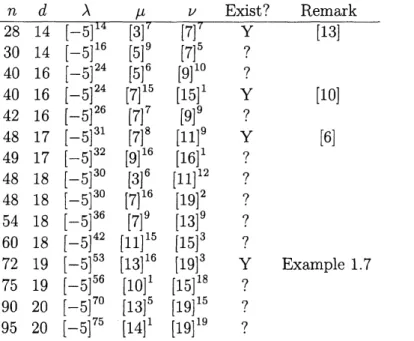
AppendixA for
the parameter sets ofsome
additional
hypotheticalSeidel
matricesof small orders. We remark here that for large $d$ maximal equiangular line systems can be
obtained in the
cases
$\alpha=1/3$ and $\alpha=1/5$ bythe following easy construction.Lemma 1.8. There exists$mn$ equiangular lines in$\mathbb{R}^{mn-m+1}$ with
common
angle$\alpha=1/(2n-$1$)$
for
every $m,$$n\geq 2$. Moreover we can assume that the corresponding Seidel matrix hasspectrum $\{[1-2n]^{m-1}, [1]^{m(n-1)}, [n(m-2)+1]^{1}\}.$
Proof.
It is easy to see, by using properties of the Kronecker product, that the $mn\cross mn$matrix $S:=J_{n}\otimes(J_{m}-2I_{m})+I_{mn}$ has the desired spectrum. Under the assumptions on$m$
and $n$ its smallest eigenvalue is $1-2n$, hence the result follows. $\square$
It would be nice to see a combinatorial interpretation ofSeidel matrices with three distinct eigenvalues. Suchnewperspective might shed
some
lightonthe existence of the hypothetical Seidel matrices highlighted in the appendix. This will hopefully lead to improvements uponthe best known lower bounds on the number of equiangular lines in small dimensions.
ACKNOWLEDGMENTS
Thiswork
was
supported bythe Hungarian National Resear$ch$Fund OTKA K-77748 andbythe JSPS KAKENHI Grant Number 24 $\cdot$02807.
FERENC SZ\"OLL SI
REFERENCES
[1] F. BUEKENHOUT: Handbook of incidence geometry (ed.), Elsevier Science, Amsterdam, The Nether-lands (1995).
[2] F. C. BUSSEMAKER, J. J. SEIDEL: Symmetric Hadamard matrices of order 36, Annals of the New
York Academy of Sciences, 175, 66-79 (1970).
[3] G. GREAVES, A. MUNEMASAAND F. Sz$\"{o}_{LL}\’{o} SI$; Equiangular linesinreal Euclidean spaces, in
prepa-ration (2013).
[4] J. HAANTJES: Equilateral point-sets in elliptic two- and three-dimensional spaces, Nieuw Arch. Wisk.,
22, 355-362 (1948).
[5] R. B. HOLMES, V. I. PAULSEN: Optimalframes for erasures, Linear AlgebraAppl., 377,31-51 (2004). [6] P. W. H. LEMMENS, J. J. SEIDEL: Equiangularlines, J. Algebra, 24, 494-512 (1973).
[7] J. H. VAN LINT, J. J. SEIDEL: Equilateral point sets in elliptic geometry, Indag. Math., 28, 335-348
(1966).
[8] A. NEUMAIER: Graph Representations, Two-Distance Sets, and Equiangular Lines, Linear Algebra Appl., 114-115, 141-156 (1989).
[9] E. SPENCE: Homepage. http:$//www$
.
maths.gla.ac.$uk/\sim$es/.[10] E. SPENCE; The strongly regular (40,12, 2,4) graphs, Electron. J. Combin., 7, #22, 4 pp. (electronic)
(2000),
[11] D. E. TAYLOR: Regular 2-graphs, Proc. London Math. Soc. 35, 257-274 (1977).
[12] D. E. TAYLOR: Sometopics inthe theoryof finite groups, PhD thesis, UniversityofOxford (1972).
[13] J. C. TREMAIN: Concreteconstructions of equiangular line sets, arXiv:0811.2779 [math.MGI, (2008).
APPENDIX A. A SUPPLEMENTARY TABLE
Here
we
display a list of feasible spectrum of Seidel matrices whose existence might reach,or improve upon the maximum number of equiangular lines in dimensions 14, 16-20.
$\frac{nd\lambda\mu\nu Exist?Remark}{2814[-5]^{14}[3]^{7}[7]^{7}Y[13]}$ 30 14 $[$-5$]^{}$
[5]9[7]5
$?$ 40 16 $[$-5$]^{}$[5]6
$[$9$]^{1}$ $?$ 40 16 $[-5]^{24}$[7]15[15]1
$Y$ [10] 42 16 $[-5]^{26}$[7]7[9]9
$?$ 48 17 $[-5]^{31}$[7]8[11]9
$Y$ [6] $49 17 [-5]^{32} [9 ]^{ 16} [16 ]^{ 1}$ $?$ 48 18 $[-5]^{30}$[3]6[11]12
$?$ 48 18 $[-5]^{30}$[7]16[19]2
$?$ 54 $18$ $[$-5$]^{}$ $[$7$]^{}$ $[13]^{9}$ $?$ 60 18 $[-5]^{42}$ $[$11$]^{}$[15]3
$?$ 72 19 $[-5]^{53}$[13]16[19]3Y
Example 1.7 $75 19 [-5]^{56} [10 ]^{ 1} [15 ]^{ 18}$ $?$ 90 20 $[$-5$]^{}$[13]5[19]15
$?$ $95 20 [-5]^{75} [14 ]^{ 1} [19 ]^{ 19}$ $?$TABLE 4. Feasible parameter sets of Seidel matrices with 3 distinct eigenvalues. F. $Sz.$: RESEARCH CENTERFOR PURE AND APPLIED MATHEMATICS, GRADUATE SCHOOL OF
INFORMA-TION SCIENCES, TOHOKU UNIVERSITY, SENDAI 980-8579, JAPAN
$E$-mail address: [email protected]