REFEREED ARTICLE
An Investigation of the Circumstances
of Flood Response in Thailand
─Case Study of the Flooding Situation in 2011─
I-soon RAUNGRATANAAMPORN
1)Contents
Ⅰ.Introduction
Ⅱ.Disaster Management Framework in Thailand Ⅱ.1 National level
Ⅱ.2 Regional level Ⅱ.3 Municipality level (1) Municipality
(2) Bangkok Metropolitan Administration (BMA) Ⅲ.Flood situation in Thailand in 2011
Ⅲ.1 Overview of flood situation in 2011 Ⅲ.2 Casualties and Economic damages (1) Casualties
(2) Economic damages
Ⅲ.3 Emergency response toward flood situation in 2011 Ⅲ.4 Feedback and criticism toward flood management Ⅳ.Conflict resolution in flood situation
Ⅳ.1 Pak Kret Municipality, Nonthaburi Province, Thailand Ⅳ.2 Samut Sakorn Municipality, Samut Sakorn Province, Thailand Ⅴ.Conclusion and discussion
Keywords: Community-Based Disaster Risk Management (CBDRM), flood response, conflict resolution.
Ⅰ.Introduction
Disaster management has become a hot-button issue in urban development and human security since threats from hazards and vulnerability are increasing, and cause the damage from natural disasters more severe, and it has become crucial to lower the socio-economic loss. “Disaster,” defined as a serious disruption of the functioning of a community or a society involving widespread human, material, economic or environmental losses and having an impact which exceeds the ability of the affected community or society to cope using its own resources (UNISDR, 2009), and consequential “hazards,” defined as a dangerous phenomenon, substance, human activity or condition that may cause loss of life, injury or other health impacts, property damage, loss of livelihood and services, social and economic disruption, or environmental damage (UNISDR, 2009). In 2005, the United Nations Office for Disaster Risk Reduction (UNISDR) established a model for disaster management called Hyogo Framework for Action (HFA), according to this framework, were determined to be the baseline of disaster management, and community involvement towards disaster management thus became a crucial aspect of tackling threats from disasters and hazards in the peaceful time of the non-disaster phase. The Hyogo Framework for Action stated that approaches
such as increasing capacities of community members in disaster preparedness, adaptive behaviors to reducing risks, knowledge transfer from disaster stakeholders, and concern from the next generations are primary tasks to apply on the community level as Community-Based Disaster Risk Management (CBDRM). To achieve successful disaster management on the local level, external organizations such as the government, non-profit organizations (NPOs), the academic sector and the private sector are encouraged to cooperate with the community and municipality in order to increase the capability of the community to reduce the risk and handle the damages and losses caused by disaster. Thailand adopted the Hyogo Framework of Action to be implemented in the case of disaster management as a
Strategic National Action Plan (SNAP)2) for the period from 2010-2019.
The flood of 2011 in Thailand could be considered to contain unusual circumstances compared to other flooding cases: it caused a large amount of economic loss and the duration of flood inundation was long and affected a wide-scale area. It also did not seem to be a flash flood, but rather developed over time from the beginning of March in the northern region of Thailand, becoming more severe from August until November, representing a period of approximately eight months of flood inundation. Due to the slow response by government and subordinate organizations such as municipality, divisions and departments to distribute relief aid to afflicted people, there was some conflict during the flood response on a community level. Moreover, the response according to the plan did not operate properly, with problems such as double-standard of response, communication, information management and intergovernmental relations occurring. Thus, the ineffectiveness of integration of flood management should be addressed as a core problem of flood management and flood response in that situation. There are two objectives in this study: (1) to summarize the current disaster management framework in Thailand; and (2) to figure out how local communities could respond to flood situations after the ineffectiveness of response activities operated by the government. There are six chapters in this paper: the first is an introduction; the second is the current disaster management framework in Thailand; the third is reviewing the flood situation in 2011 in Thailand; the fourth is feedback and criticism towards flood management; the fifth is conflict resolution; and the sixth is a conclusion.
Ⅱ.Disaster Management Framework in Thailand
Ⅱ.1 National level
The Disaster Relief Act (2007) established the Department of Disaster Protection and Management (DDPM) as a basic strategy to respond to any and all circumstances of a disaster situation. The DDPM’s tasks and duties comprise a system of responding to disaster management in a comprehensive way (mitigation, preparedness, response and recovery) by coordinating with governmental sectors, divisions and departments, local authorities, private organizations, and civic society within an integrative approach. The disaster policy in Thailand gained greater importance following the tsunami which devastated the southern region of Thailand in 2004. It drew the attention of the Thai government in tackling these issues, and various kinds of approaches and projects were enacted to enhance
a sense of safety culture3) on the local level. According to the disaster management policy established by the
Department of Disaster Management and Prevention in the year 2013, there are 7 aspects and four strategies, which are described in table 1:
The Strategic Committee for Water Resources Management (SCWRM) was established in order to manage flood response and management in Thailand after the flood situation in 2011. The Prime Minister became the chief of SCWRM and those with expertise in water-related issues became members of this committee. The responsibility for this committee was stated in the Prime Ministry’s regulation. The six main tasks which are the responsibility of
Table 1 Content of Disaster Department and Mitigation Plan
Core Strategy Approaches
(1) To apply the Incident Command System (ICS) as an operational framework
(2) To minimize the number of traffic accidents under the governmental policy as national policy
(3) To prepare the suitable operation plan of disaster management in accordance to the ASEAN Economic Community (AEC) policy in 2015
(4) Increasing the idea of safety culture to young generation
(5) To increase the preparation in local level by applying Community-Based Disaster Risk Management (CBDRM) (6) To increase capabilities and accuracy in disaster-related information and data
(7) To increase the capabilities of volunteer activities ready to be dispatched for disaster response
(1) Increase capacities of organizations with relevance to disaster management activities toward disaster prevention and relief
(2) To increase the effective integration among disaster response units on national level
(3) To encourage the collaboration through networking of disaster response units for increasing the effectiveness of disaster management on local level (4) To improve the system of victim relief to become more standardized
Source: Department of Disaster Protection and Management, 2013
Fig.1 Classification of Duty in National Headquarter of Disaster Management in Thailand
Fig.2 Command system in disaster response of Thailand
Source: A. Mokkawej, 2009
Fig.3 Classification of proposal of flood management classified by basin
SCWRM are: (1) revision of flood management policies and relevant operation plans on the national level as a framework in accordance with national development policy; (2) reporting the situation and the status of project implementation to the Thai cabinet annually; (3) coordinating with other divisions or departments to operate policies; (4) approving flood-management projects initiated by consultants and providing expertise to operate and implement SCWRM tasks; (5) approving or delegating power to committees to implement flood-management projects; and (6) proposing proper mitigation measurements and preparedness which are suitable to the characteristics of area.
Ⅱ.2 Regional level
According to the Strategic National Action Plan (SNAP), the contents of each strategy regarding disaster management activities are stated as an operation plan in terms of a year plan. Although the success of most of the non-structural mitigation measures such as community-based disaster risk management, establishing a risk map, implementing disaster drills, sharing information relevant to the disaster situation, are evaluated annually; all are applied as a baseline of this plan and operation. Moreover, the specifications of the disaster emergency response operation plan vary according to the characteristic of the hazards.
The provincial and district level (Amphoe) are taking responsibility for the Strategic National Action Plan (SNAP) by supervising, monitoring, and evaluating municipal activities of disaster management on the local level and ensuring that those subordinate organs (municipalities) are establishing proper methods of disaster management. The provincial and district level (Amphoe) will supervise municipalities to see their capacity for handling disaster situations and when their limits have been reached and also for those disaster situations which afflict multi-jurisdictions of municipalities.
Ⅱ.3 Municipality level (1) Municipality
According to the Thai Constitution which established in 2007, Public Administration Organizations (PAO) were authorized as the main organizations to support, provide, monitor and implement necessary services on its jurisdiction (Article 16 of Thailand Decentralization Law, 1999) and have to respond to disaster or emergency situations as a first-hand respondent, and support Provincial governor as a deputation (Article 20 of Disaster Relief Law, 2007). As they are closely related to communities, municipalities are considered a local government in Thailand (Section 1 Article 4 and Section 3 Article 69-71 in accordance with the Public Administration Act, 1991). Bangkok Metropolitan Administration and Pattaya City are special local governments. The reasons are that both of these two local governments have their own legal identity, their mayors serve as city managers, and these two local governments are established in order to serve the rapid growth of urban development, Bangkok as a capital city, and Pattaya due to its rapid development as a tourist destination. To serve the local demand in their jurisdictions, those two areas are considered as special local governments, with the legal right to enact and implement services and regulations in accordance with the provision of basic services, specific demands and other tasks in its jurisdiction. Moreover, as stated in the single-command approach in the framework of disaster response, Local Administrative Organizations (municipalities, Pattaya City and Bangkok Metropolitan Administration) are enabled to become first-hand respondents towards disaster management issues. However, the changing of decision-makers or emergency managers is dependent on the severity of the disaster and the size of the afflicted area.
with each other and took responsibility in the event of a disaster. The Division of Disaster Prevention in municipalities implemented the regulation that the two major responders diagnose the damage caused by the disaster and provide basic relief. Fundamentally, on a legal basis, municipalities are concerned with the relief and mitigation of disaster threats, but in the case of the flood in 2011, the disaster proved larger than the municipalities’ capacity to handle it and respond to it. Thus, municipality response and relief methods were focused on flood budget relief in accordance with the Thai Cabinet in two ways: one was the ordinary flood relief budget, which provided for households that were afflicted by flooding for more than seven days; the second was a subsidy budget based on flood damage which was not to exceed 30,000 THB per household. Providing budget relief became the main strategy to give relief to victims to recover their conditions after the flood had subsided. However, the reason that budget relief seems to be such a big problem in municipality response is a misunderstanding from local communities, namely that the expectations for relief per household are larger than the limitation offered per household. This conflict of interest stems from the difference in cost estimation between that arrived at in self-evaluation by afflicted household and that determined by the evaluation of municipal officers.
(2) Bangkok Metropolitan Administration (BMA)
The Bangkok Metropolitan Administration is considered a special local government system, which can be divided
Fig.4 Executive organization in Bangkok Metropolitan Administration
into three parts, as follows: (1) Executive organs, generally coming from elections; (2) Department and divisions, which are classified as sixteen departments governed by the Permanent Secretariat of the Bangkok Metropolitan Administration; and (3) Sub-district office, which derived command and policy initiated by superior organs and was implemented as an actor. Primary objectives of the Bangkok Metropolitan Administration such as maintaining public safety, disaster mitigation and relief, city planning, traffic management, provision of infrastructures, social welfare, and environmental policies are stated as tasks of the Bangkok Metropolitan Administration (Bangkok Metropolitan Administration act, 1985)
The primary flood response in the Bangkok Metropolitan Administration is under the purview of the Department of Drainage. The two threats which relate to flood risk in the BMA are, (1) Flood Prevention Plan for the BMA due to intensive rainfall, and (2) Flood Prevention Plan for the BMA under tidal flood risk. There are two types of flood measurement in the Bangkok Metropolitan Area: structural measurement and non-structural measurement. The implementations under these two approaches depend on the area of density. A structural measurement such as the polder system and embankment projects is applied in urban areas with high density of population. Non-structural measurement such as urban planning or canal cleaning is applied in urban areas with medium or low density of population. As an autonomous organization, the Bangkok Metropolitan Area had to respond to flood protection by itself under its legal basis and the BMA governor became an emergency manager in the case of flood situation as an executive organ. There are two kinds of subordinate organs which are considered operational organs: in-charge organs and supportive organs. The authority which is in charge of flood management in the Bangkok Metropolitan Area is the Department of Drainage.
According to the current situation of disaster management framework in Thailand, the inter-governmental relationship towards disaster management is top-down approach, and structure-oriented approach. Tasks of local government towards disaster management are to implement disaster mitigation and preparation projects in their jurisdiction. In case of disaster situation, municipalities could take response towards disaster situation based on its resources and capacities. Since the situation become more severe and cover larger than one jurisdiction, superior organs such as provincial office and central government, have to command and become the emergency manager towards that situation
Fig.5 Incident Command System (ICS) and on-site single command
Ⅲ.Flood situation in Thailand in 2011
Ⅲ.1 Overview of flood situation in 2011
Thailand has experienced flooding since ancient times due primarily to the annual monsoon. Such was the case in
the flooding of 2011. According to climate data4), five tropical monsoons struck during the period from July 25, 2011
to January 16, 2012, and caused flooding throughout the central region of Thailand (Fig.6). The flooding originally began in the northern region of Thailand in August of 2011 and become severe in September in the northern part of the Chao Phraya Basin, then expanded to impact a wide swath of the central region in October. The afflicted area of flooding covered 65 provinces with an estimated area of 90,652.43 square kilometers and claimed the lives of 815 people to that point in time. The flood inundation from the northern region caused flooding in the central region from the end of July to the end of August, 2011, but the situation became more severe from September 1 to November 27. There are two reasons for the severity of the flooding in 2011: natural causes and man-made factors. A natural characteristic of the afflicted regions and the effects from global warming caused the unexpected intensity of rainfall, which in turn caused flood inundation in the regions. The other cause was man-made, namely self defense in flood-prone areas, which caused isolation in flood protection, and the existing flood-management measures could handle only the average annual flooding (Kongchan, 2012).
According to the National Statistic Office (NSO), which collected data from February 10 to March 21, 2012, concerning the flood situation in 2011, the result of the survey showed that 16.9 million households were afflicted by flooding (80.4% of total households in 2010) and most of the afflicted households were impacted by the flood both inside and outside buildings. There were 17.6 million people affected by flooding (82.2% of the total population in 2010).
Fig.6 Track of Tropical storm affecting Thailand in 2011
198.61 1,963.22 22,925.70 122.62 739.07 1,415.72 9,100.50 24,604.89 29,591.11 5,000.00 10,000.00 15,000.00 20,000.00 25,000.00 30,000.00 35,000.00
Month
A
pp
ro
xi
m
at
e
flo
od
ar
ea
(S
q.
Km
)
Jan-11 Feb-11 Mar-11 Apr-11 May-11 Jun-11 Jul-11 Aug-11 Sep-11 Oct-11Fig.7 Approximate flooded area in Thailand 2011
Source: GISTDA, 2011
Fig.8 Flood afflicted area due to situation of flooding in 2011
Source: (a) Thailand Integrated Water Resource Management, 2012 (b) TEAM Consultant, 2011
In conclusion, there are 684 districts level (Amphoe) and 4,920 sub-district levels (Tambon) in 61 Provinces affected by flooding.
Ⅲ.2 Casualties and Economic damages (1) Casualties
Although there were not many people killed in the flooding, this situation caused a large amount of economic damage, especially in the industrial sector, in the supply chain, and on the household level. According to the survey conducted by the National Statistic Office (NSO) in 2012 entitled Flood-Afflicted Household Survey during July– December 2011 concerning flood-afflicted households during the period from July to December of 2011, approximately 8.1 percent of total afflicted households experienced injuries or casualties due to the floods. Most of the health-related issues in the flood disaster this time related to the stress on household members, flux, conjunctivitis and rash (Table 2).
(2) Economic damages5)
According to the National Statistic Office report entitled “Flood-Afflicted Household Survey during July–December 2011” Data showed that during the flood of 2011, the average income in flood-afflicted households decreased in the post-flood period when compared to the pre-flood period (table 3). Households in Bangkok and the central region were more seriously effected than households in other regions, and the people in afflicted areas had to adapt from full-time jobs to part-time jobs. However, this data also shows that overall unemployment increased approximately one percent overall. In the case of damage costs, people who lived in households in Bangkok and the central region saw higher damage costs to assets than in other regions.
Table 2 Percentage of flood afflicted household categorized by illness and Casualties
Illness and Casualties Region
Total Bangkok Central Northern Northeast Southern
Total 100.00 100.00 100.00 100.00 100.00 100.00
Nothing 91.9 93.4 88.6 93.0 93.2 94.1
Afflicted and cause illness or Casualties 8.1 6.6 11.4 7.0 6.8 5.9
Stressfulness, conjunctivitis, flux,
Hong Kong foot and rash 7.5 4.9 10.8 6.5 6.6 5.7
Injuries 0.6 1.5 0.8 0.4 0.1 0.2 Casualties 0.3 0.3 0.2 0.3 0.2 0.2 Electric shock 0.1 0.1 0.1 0.2 0.1 0.1 Drown 0.0 0.0 0.0 0.0 0.0 0.0 Chronic diseases 0.1 0.0 0.1 0.1 0.0 0.0 Other cause 0.1 0.2 0.0 0.0 0.1 0.1
Ⅲ.3 Emergency response toward flood situation in 2011
The government had applied the Incident Command System (ICS) to respond to unusual situations, especially in the case of disasters. The person in the role of emergency manager would change depending on the severity of
Table 3 Percentage of household members classified by type of job (before and after flood inundation)
Aspects Region
Total Bangkok Central Northern Northeast Southern
Before flood inundation 100.00 100.00 100.00 100.00 100.00 100.00
Full-time job 53.0 53.3 53.5 52.8 52.4 53.0
Part-time job 7.7 4.0 5.2 10.2 10.1 6.7
Unemployed 15.0 18.6 17.4 15.2 11.0 12.7
Students 24.3 24.1 23.9 21.8 26.5 27.6
After flood inundation 100.00 100.00 100.00 100.00 100.00 100.00
Full-time job 47.2 48.9 47.1 49.0 45.4 45.0
Part-time job 11.8 6.6 9.3 13.5 15.3 13.1
Unemployed 16.7 20.4 19.7 15.8 12.8 14.3
Students 24.3 24.1 23.9 21.7 26.5 27.6
Average household income
Before flood inundation 15,782 30,466 18,210 10,932 10,517 15,833
After flood inundation 14,095 27,188 15,801 9,818 9,646 14,994
Housing 100.00 100.00 100.00 100.00 100.00 100.00
Undamaged 52.1 50.1 50.6 56.3 45.3 69.8
Damaged 47.9 49.9 49.4 43.7 54.7 30.2
Average Damage cost (THB) 12,574 24,626 11,513 10,079 9,898 8,475
Vehicles (Cars and motorcycles) 100.00 100.00 100.00 100.00 100.00 100.00
No asset in this type 13.5 27.8 11.4 8.8 13.5 9.1
Have this type of asset 86.5 72.2 88.6 91.2 86.5 90.9
Undamaged 62.3 55.6 68.4 63.3 56.4 68.4
Damaged 24.2 16.6 20.2 27.9 30.1 22.5
Average Damage cost (THB) 8,268 23,769 10,426 5,310 5,112 4,714
Furniture and household equipments 100.00 100.00 100.00 100.00 100.00 100.00
No asset in this type 5.1 5.8 3.2 4.1 7.8 5.1
Have this type of asset 94.9 94.2 96.8 95.9 92.2 94.9
Undamaged 55.7 50.7 60.8 54.0 53.5 59.2
Damaged 39.2 43.5 36.0 41.9 38.7 35.5
Average Damage cost (HB) 5,281 12,172 5,702 3,645 2,716 2,853
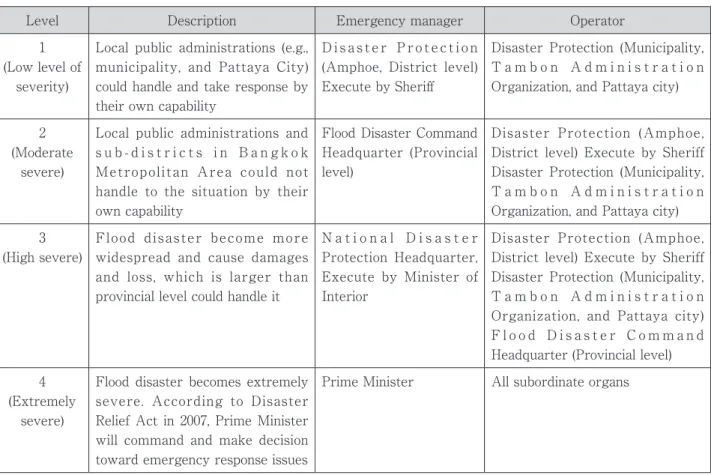
situation. Generally, municipalities, the Bangkok Metropolitan Administration, and Pattya City will take responsibility as primary organs towards disaster situation and use their own resources and capability. (Article 50 of Municipality Act 2000; Section 5 Article 89 of Bangkok Administration Act, 1985; and Section 4 Article 62 of Pattaya City Administration Act, 1999). In cases where the situation becomes more severe and municipalities are unable to handle them, the supervisory organization (e.g., on the provincial and central government levels) will supervise and command the response to that situation. In the case of wide-scale disaster situations, the Prime Minister will become the emergency manager. The structure of single command is shown in table 4 and figure 9.
According to the Disaster Relief Act of 2007, the Prime Minister has to respond as a decision maker in disaster situations. In order to tackle the flood disaster and give relief support to victims, the Thai government established the Flood Relief Operation Center (FROC) for giving basic relief to flood victims and flood-afflicted communities. There are 14 tasks which are relevant to flood response efforts. They are: (1) Giving relief to victims and offering additional response to flood relief as a one-stop service; (2) Rapidly responding and providing relief and ensuring the security and assets of victims; (3) Monitoring relief aid and ensuring it operates properly; (4) Providing vehicle support; (5) Coordinating with other divisions and departments in disaster prevention and announcing to people in a timely manner; (6) Establishing evacuation planning and providing temporary shelters as basic relief; (7) Monitoring and overseeing water discharge; (8) Having the right to establish donation centers; (9) Tracing the demands and attitudes of victims through various kinds of information avenues, such as hotlines, news and notifications; (10) Monitoring and overseeing the relief effort for victims; (11) Assigning relevant organizations to provide to FROC information and data which is necessary for support assessment; (12) FROC becomes the information center for predicting the flood situation and making announcements; (13) Giving a daily report to the Prime Minister; and (14)
Table 4 Actors in Incident Command System
Level Description Emergency manager Operator
1 (Low level of
severity)
Local public administrations (e.g., municipality, and Pattaya City) could handle and take response by their own capability
D i s a s t e r P r o t e c t i o n (Amphoe, District level) Execute by Sheriff
Disaster Protection (Municipality, T a m b o n A d m i n i s t r a t i o n Organization, and Pattaya city) 2
(Moderate severe)
Local public administrations and s u b - d i s t r i c t s i n B a n g k o k Metropolitan Area could not handle to the situation by their own capability
Flood Disaster Command Headquarter (Provincial level)
Disaster Protection (Amphoe, District level) Execute by Sheriff Disaster Protection (Municipality, T a m b o n A d m i n i s t r a t i o n Organization, and Pattaya city) 3
(High severe)
Flood disaster become more widespread and cause damages and loss, which is larger than provincial level could handle it
N a t i o n a l D i s a s t e r Protection Headquarter, Execute by Minister of Interior
Disaster Protection (Amphoe, District level) Execute by Sheriff Disaster Protection (Municipality, T a m b o n A d m i n i s t r a t i o n Organization, and Pattaya city) F l o o d D i s a s t e r C o m m a n d Headquarter (Provincial level) 4
(Extremely severe)
Flood disaster becomes extremely severe. According to Disaster Relief Act in 2007, Prime Minister will command and make decision toward emergency response issues
Prime Minister All subordinate organs
Having the right to establish or approve working groups for supporting its operation as necessary.
Ⅲ.4 Feedback and criticism toward flood management
Since the situation became severe in October of 2011, the government established the Flood Relief Operation Center (FROC) prior to the flooding of Bangkok in the middle of October. A failure of communication and inaccuracy of information occurred, which influenced people to protect themselves using their own resources rather than rely on the information provided by FROC. Moreover, difference aspects of political issues among afflicted communities were spotted in the transparency of flood relief. The poor response and management from the government effected its credibility, especially in the Prime Minister and the government’s ability to provide good governance of flood response both in that situation and moving forward.
As a result of the failure in management in the case of the flood of 2011, the perceptions of people towards the
government sector were at a low level. According to results of the Suan Dusit poll6), 46.90 percent of respondents
mentioned that the government could not handle the severe flood problems because of the poorly prepared management, and 24.39 percent mentioned that the government was still giving out unclear information. On the aspect of relief, 60.0 percent of evacuees needed compensation from the government, with 21.24 requiring unemployment compensation and 18.71 needing debt reliefs. In the case of non-evacuees, 24.75 percent needed the
Fig.9 Executive units under the single command system
government to control the price of goods and 17.57 percent needed transportation fare exception. Moreover,
according to a survey by the Academic Network for Community Happiness Observation and Research (ANCHOR)7)
conducted by Assumption University, which surveyed the attitude of people towards disaster response organs, the majority of samples show that satisfaction in the service from army forces were ranked first, advocacy groups were second, and media groups were third. With regard to satisfaction in the service sector, satisfaction in the medical hotline ranked first, followed by the railway hotline in second and emergency calls in third.
There are several things to consider as reasons for the difficulties of traditional Thai communities with relevance to disaster management. Factors such as unexpected occurrences, false alarms, common norms in disaster management, unwanted evacuations, and political perspective all caused difficulties in disaster management. However, there are also some advantages in the country with regard to disaster management. Social networking, an overall
Fig.10 Summarize towards satisfaction of public in flood situation in 2011
Source: Suan Dusit Poll, 2011
Fig.11 Summarize towards satisfaction of public in flood situation in 2011
sense of charity, the effort towards capacity buildings in communities, and collaboration among public administration organizations are necessities in response and relief efforts in a disaster-management context. According to Tawida
Kamolvej8), who in 2011 described current disaster management in terms of organizations, there are three
components of disaster management. These are: (1) Organizational flexibility in legislation and regulation, operation manual, command and control, collaboration, information sharing, and training; (2) Technical infrastructure, including risk assessments, operation plans, building analysis, provision of facilities and infrastructure, technical support, and
provision of equipment; and (3) Cultural openness9), with common norms of disaster management, willingness to get
involved in disaster management activities, risk acceptance, and revision of plans and operations plans.
The problem of intergovernmental relations between the central government and local government occurred in the flood response of 2011. The flood emergency response which was established by the central government deputized local government to tackle the situation as a first-hand respondent; however, the supportive instruments such as authority, budgets, proper communication, information management, coordination, and necessary equipment were not adequately provided, leading to the ineffectiveness of emergency response. As a result of brainstorming among Public Administration Officers, executive organs summarized the ineffectiveness of flood response. The two issues are: (1) The decision maker in the case of flood response is decided on the provincial level, that is to say the local level; and (2) Although canals became crucial players in the discharge of flood waters, their management is excluded from the tasks of Public Administration Organization because the Royal Irrigation Department has authority on water discharge. The below statements reveals some parts of the findings:
"One problem that we found towards flood response is the limit of the first-hand respondent in flood discharge, which is some operation, might be intrusive to other divisions, departments or other organization. Although central government delegate its authorities to public administrative organization to operate, but it not practical since the limitation stated in legal basis and might intervene to other organizations' tasks. Public Administration Organization in flood vulnerability provinces are not authorized to discharge flood or water because this operation belongs to Royal Irrigation Department (RID) or Marine Department (MD) Thus, Public Administration Organization could not intervene to this issue. Moreover, Public Administration Organization has no authorize to establish temporary shelter or taking budget for preparation for flood response. The reason is according to Disaster Relief Act (2007) which delegate power to Provincial governor for managing disaster management activities in Provincial administrative boundary, if Provincial governor do not declared a state of emergency, public administration organizations or municipalities could not spend,
or ask for the budget to apply for flood response or preparation in local level." 10)
Orathai Kokphol 11)
Director of Local Government King Prajadhipok’s Institute According to the results of a seminar entitled"Public Administration Organization towards disaster management strategy handled by King Prajadhipok's Institute during 13th–14th March 2012, regarding to the experiences of emergency management in flood situation in the year of 2011”, there were seven lessons learned, which could be stated as follows: (1) The flood in the Bangkok Metropolitan Region was unexpected, which reveals the ineffectiveness of communication and a lack of information; (2) There was a lack of supportive systems such as database, equipment, and alternatives to apply in Incident Command System and Single Command during the response period; (3) There is not any strategy for protecting the transportation network, which became more crucial for providing relief in terms
of logistics; (4) Flood barriers such as sandbags might not be appropriate for flood protection; since the flood barriers leaked, the water volume inflowed rapidly and caused severe damage out of proportion to the effectiveness of reducing the inflow of water volume; (5) Community involvement and individual participation became a potential aspect of flood management; (6) Designated evacuation shelters were afflicted by the flood, which reveals the failure of risk assessment; and (7) Risk communication is important, as there are five factors (the rainfall intensity on the upstream level, the effect of tidal flooding in coastal or riverside areas, land subsidence, the ineffectiveness of land-use regulation, and the ineffectiveness of flood-management systems) which stimulated the severity of flooding in the case of the 2011 Thai flood.
Ⅳ.Conflict resolution in flood situation
The consequences of the flood of 2011 reveal the ineffectiveness of flood management, information sharing, inaccuracy of information, and the difference of flood perceptions among different people and different communities, which leads to conflict in flood-afflicted areas. However, there are some efforts being made to resolve those conflicts
in emergency response. According to the result of a study by the Thailand Research Fund12) involving conflict
resolution in flood response, although some conflicts occurred, they did not go further and become violent, and communities and municipalities tried to collaborate with each other to minimize their deficiencies in responding to the flood. According to Prof. Dr. Chaiwat Sataanan, Faculty of Political Science, Thammasat University, and Assoc. Prof. Dr. Anuchat Puangsamlee, Faculty of Environment and Resource Studies, Mahidol University, most of the cases of conflict in flood response come from afflicted communities that tried to claim their rights in flood-relief activities, and those kinds of situations influenced them to be involved in flood-response activity. The below statements reveals some parts of that study:
"According to the 126 cases of conflicts which proceed to riot in local level, there are approximately five percent which politicians had involved, other cases are communities' involvement, which show the good sign of collaboration, and riots did not become violence but the debating towards various kinds of flood
management among local government, government officers and communities members had founded." 13)
Chaiwat Sataanan 14)
Faculty of Political Science, Thammasat University "Interestingly, only eight cases of 126 cases of conflict were proceeding to violence, and communities try to resolve their conflicts by their own, by 74% of 126 cases. This output may reveal sense of robustness among community members in conflict resolution, especially in flood management; or there is no any other suitable system or structure in flood conflict resolution.
“According to the study finding, those affected people were deciding to gather or mob on the road for reveal their demand or claims, rather to apply as a political process such as parliament or governmental offices. Although the problems or demands of afflicted people are relating to local level, but they shown their attitudes
towards flood management in national level as strategy of their declaration.” 15)
Anuchat Poungsomlee 16)
According to this study, these four types of conflict in flood-management issues are: (1) Vulnerability aspects which relate to ineffectiveness of flood preparation and flood discharge or drainage; (2) Conflict during emergency response, such as illegally opening water gates or breaking flood barricades; (3) Conflict during the recovery process, such as demand of temporary shelters, demand for electricity, and demand for food; and (4) Inequality of response and relief provision offered by the government, causing dissatisfaction due to double standards. Precisely, 46.9 percent of the total cases occurred in the emergency response period, singing their names to involve themselves as groups and announcing via media to communicate and demand to claim their request. Moreover, the main groups which were blamed were first FROC, then the provincial offices, but people did not blame the municipalities. One possible reason is that people realize the limits of competency of municipalities, but it is possible that communities are familiar with municipalities themselves.
Regardless of the method of declaration, more than 58.7 percent of cases were resolved in negotiation through a self-help approach and did not proceed further to conflict. Confrontation can easily come about to cause further conflict. The residential districts which are located in Bangkok and Pathumtani Provinces were potential sites of conflict from flood management, and the protective measures (flood barriers, sandbags, or water gate control) especially were potential causes for further conflict and riot. These conflicts and claims also reveal the gaps among governmental sectors, especially the intergovernmental relationship between the central government and the local government, and between executive organs and operational organs. Thus, the effort which was initiated by the government should operate with equity and unity, and the flood management mechanisms are necessities, strengthening the inter-governmental relations in order to reduce gaps between the central government and the local government. Negotiation among stakeholders is also necessary in flood management in the future.
The collaboration among flood disaster stakeholders during the flooding of 2011 found, not only communities and municipalities as first-hand respondents, but also academic and research institutions taking part in conflict resolution by trying to figure out how to minimize conflicts in flood response. However, this study applied two case studies of the flood situation: Pak Kret Municipality, Nonthaburi Province, and Samut Sakorn Municipality. Online information such as media, newspapers, information provided by municipalities, and discussion from experts are applied as secondary data sources in this paper.
Ⅳ.1 Pak Kret Municipality, Nonthaburi Province, Thailand
Pak Kret Municipality is located in Amphoe Mueng Park Kret, Nonthaburi Province. Pak Kret Municipality is bordered on the west by the Chao Phraya River. The jurisdiction of Pak Kret Municipality is about 36.04 square kilometers, which covers five districts and 34 villages (fig.12). This area is in the flatlands of the Chao Phraya River Basin and has the potential for planned cultivation, but nowadays Pak Kret Municipality has become a residential area for commuters who are working in the Bangkok Metropolitan Area.
Pak Kret Municipality was considered to have a high level of flood risk and it was estimated that the area might see flooding of at least 1.50 meters in height due to flood in 2011, but it was not flooded in that time. Vichai Bandasak, Mayor of Pak Kret Municipality, explained that in terms of flood protection in Pak Kret Municipality in 2011, basic protective measures such as building soil dykes and stacking sandbags were implemented as a baseline of protection to guard against threats from river flooding alongside the Chao Phraya River. Additional measures, such as around-the-clock maintenance of those barricades, are necessary, especially with the danger of leakage in the flood barriers. Moreover, with regard to flood barricade systems, Pak Kret Municipality built two lines of barricades to protect against the leakage of water. Communities also made efforts to collaborate with the municipality in flood protection.
Since Pak Kret Municipality was flooded in 1995, various kinds of structural measurements such as dyke systems and pumping stations were constructed to mitigate and prepare for potential unusual situations. In cases of conflict between stakeholders, the municipalities had to ask monks to negotiate with communities to minimize conflicts. However, in the case of communities which were afflicted by the flood, there were various kinds of relief provided by municipalities such as relief bags or bridges built for access to flood-afflicted areas.
Phra Padungsak Kositthammo, abbatial abbot of Wat Salak Nua temple, explained the protection effort during the flooding of 2011. When this temple was informed of the flooding situation, they asked for soil and sand to make flood barricades. Monks, community members, and laborers from Myanmar and Cambodia were called on to help make sandbags and set up flood barricades to block water. At the time of high tides, monks helped municipal officers to monitor the pumping machine in daytime, while community members monitored the machines during the night, and schools cooked foods to provide sustenance to volunteers. The statement below shows the important of monks in conflict resolution in the case of flooding:
"I asked communities member like 'If flood barricade are leak and might cause a flood in this area, what should we do?' the resolution comes up with the temple and community will dedicate to become flood to protect business and commercial area, and ask municipality to apply Tiwanon Road as a third-line flood barricade. This circumstance is impossible if communities try to resolve by themselves, but monk can do,
because of the traditional and respects from people." 17)
Fig.12 Location of Pak Kret Municipality, Nonthaburi Province
Phra Padungsak Kositthammo, Abbatial abbot of Wat Salak Nua temple
Ⅳ.2 Samut Sakorn Municipality, Samut Sakorn Province, Thailand
Amphoe Mueng, Samut Sakorn is located in Samut Sakorn Province, which is bordered on the south by the Thai Gulf. Like Pak Kret Municipality, Samut Sakorn Municipality is connected to a major river, the Tha Chin River. The area of Samut Sakorn Municipality, Amphoe Mueng, Samut Sakorn is about 10.33 square kilometers (fig.13) and it is located in the flatlands of the Chao Phraya River Basin with potential for planned cultivation. In the case of the flood situation of 2011, this area was proposed as the last area of flood drainage in the Chao Phraya and Tha Chin River Basins. Samut Sakorn is dependent on geographic attributes in order to discharge water volume to the Thai Gulf. Moreover, the discharge approaches in Samut Sakorn have applied the potential of tidal waves to flow the water to the sea. However, the coordination of Samut Sakorn communities to clear the debris or barricades to water flow is just one aspect contributing to the flow of water volume. The drainage system of Samut Sakorn is dependent on the canal system, which in turn depends on geographic attributes, rather than coordination.
In the case of flood management in Samut Sakorn Municipality, municipal officers and the provincial sector tried to monitor and evaluate the situation. Samut Sakorn was expected to become flooded in the flood of 2011 due to its geographical attributes; thus, the first priority of the municipality in flood response in Samut Sakorn Municipality is to discharge the water to the Gulf of Thailand as fast as possible. The response efforts provide by Samut Sakorn
Fig.13 Location of Samut Sakorn Municipality, Samut Sakorn Province
Municipality and the Samut Sakorn Provincial office are based on machinery. The National Municipality League of Thailand also gives support to municipality as a third party by contacting flood-unaffected municipalities to gives some flood protection equipment, relief materials and manpower.
Due to the large amount of flooding widespread throughout many provinces, water flowed through Khlong Mahasawwad Canal, Khlong Pasi Charoen Canal, Borommarachonnanee Road, Petch Kasem Road, Jom Thong Road, and Akechai Road. These path leads to Phara Rama II Road and approach Samut Sakorn Province. Historically, Samut Sakorn had a numbers of canals, which could drain the amount of water practically; when the water approaches, as it does annually, this canal system could handle the large amount of water discharge, so the effect from flooding in the upper streams did not affect Samut Sakorn severely, unlike other flood-afflicted provinces. In 2011, Samut Sakorn had to respond to the flood discharge caused by the changing of land use and disappearance of the canal system, especially the urban development of Amphoe Mueng and Amphoe Kratum Ban, Samut Sakorn Province. Moreover, the Tha Chin River, which is considered a major river to discharge water from upper stream to the Gulf of Thailand, was chosen to flow the water in order to alleviate the large amount of water from the Chao Phraya River. Although the local authorities had well-prepared flood protection such as flood protection gates and canals, the inaccurate information provided by the government, such as when and how the water would approach the municipality, led to improper flood management. Especially in the west part of Bangkok, even though it has canals, there are no vertical lines of canals which could distribute the amount of water to another section of horizontally-laid canals. Consequently, the discharge of water was likely to create conflicts between communities, especially in the case of communities which did not want to become flooded, but were needed in order to discharge the large amount of water more rapidly and lower the duration of flood in the region. Samut Sakorn residents were delegated to discharge a large amount of water from the upper stream into the Gulf of Thailand through their own efforts such as surveying and destroying some flood barricades such as garbage and water plants. This effort shows an effective collaboration in flood mitigation and response; however, municipal officers have to contact people and communities which have different attitudes to flood management and have not received proper support from the government. Otherwise, Samut Sakorn might be afflicted by flooding in the future. Although Samut Sakorn was not declared a model of flood management, the past attitude of people who live individually changed to an attitude of
collaboration18). This situation points out the importance of community leaders, administrative organizations, the
business sector, the industrial sectors, and individual people. The effort of flood discharge was initiated and enacted by the people of Samut Sakorn, without support from the government. As usual, even though there was collaboration within the municipality, coordination with nearby jurisdictions proved very difficult to maintain or even initiate; thus, third parties and organizations are required to negotiate and resolve the conflicts.
Ⅴ.Conclusion and discussion
Thailand experiences annual flooding regardless of its geographic conditions, since the urban area expanded to suburbs and rural areas through unplanned urban expansion, and because of deforestation which leads to severe flooding, especially in the downstream area of the Bangkok Metropolitan Region. Crucially, there are four major reasons for the unusual circumstances of this flood situation. They are: (1) Natural causes (e.g., tropical storms); (2) Failure of dam management; (3) Ill-prepared flood mitigation, such as unplanned urban expansion, deforestation, and canal settlements; and (4) Political issues, which become more sensitive due to the discontinuity of management governed by different governments. However, the topic of flood occurrence is still not answered clearly.
private sector have tried to protect their land and assets by collaborating with each other in order to survive together. Precisely, the collaboration between communities and municipalities in the flood situation reveal the sense of Community-Based Disaster Risk Management (CBDRM) which is an important factor in reducing their vulnerability and enhancing their capacities (ADPC 2003). There are nine elements of the bottom-up approach towards the concept of CBDRM, which are: (1) The capability of local people in initiating and sustaining their own community development; (2) Local leadership; (3) Broad-based local participation in comprehensive planning; (4) Education opportunities; (5) The improved utilization of local resources; (6) Responsible utilization of outside financial support; (7) Local initiative continuity; (8) The realization that responsibility for change rests with community members; and (9) Variation of perceptions of risks among community members and groups in community (ADPC, 2006). This flood case motivated communities to take concern for flood response and made them realize that they should do something to tackle an unsecure situation, rather than wait for relief by the government. These circumstances showed the possibility of local self relief in a flood situation. Moreover, the approach of Incident Command System also encourages the importance of local administration towards flood management, which is related to the concept of the bottom-up approach. However, it really depends on the local resources and the severity of the disaster. If the severity of the disaster could be considered as an uncontrollable, then the effectiveness of Incident Command System on the local level, in this case the municipalities and the Bangkok Metropolitan Administration, depends on local resources such as equipment, budgets, and teamwork among municipal offices and community members.
Municipalities also changed their strategy of response towards flood disasters, instead collaborating with community members and community organizations as co-workers. Even though those areas were afflicted by flooding, the municipalities were not seen as the main subject being blamed due to unsuccessful flood protection. The central government was the subject being blamed by local people, especially those who live in flood-afflicted areas. Moreover, since the questions relate to transparency of relief distribution, double-standards, and slowness in response from the central government, these responsibilities are laid at the doorstep of the central government.
Conflicts on the local level between community members and municipalities with regard to flood management also occurred, even though there was collaboration among various stakeholders. To reduce these conflicts, political-free actors are necessary to fill the role of negotiator. Though they can come from any kinds of groups or have any particular interests, mostly they belong to Buddhism, and monks are individuals who people respect; as a result, monks become suitable negotiators in conflict resolution. Monk could involve in flood conflict resolution as negotiator because most of Thai people are respect in Buddhism, any violation to monk or any violent action in temple are considered as a sinful in Thai Society. These circumstances showed the necessity of third parties in flood management, especially in the case of conflict resolution. During the flood situation of 2011, conflict resolution towards flood response was resolved by confrontation, and sometimes through intervention by authorities (Thailand Research Fund, 2012). Because this flood situation afflicted a wide-scale area, relevant authority groups were the police and municipal officers. However, other groups such as academic and institutional groups, as well as non-profit organizations, participated in conflict resolution by providing a public hearing, which created a sense of negotiation and found suitable solutions in long-term approach and comprehensive flood management. Thus, the measures to resolve conflict in flood management depends on the situation: negotiation and finding common agreement is suitable in a non-disaster period, unlike a disaster period, when confrontation and intervention might be useful. This research reveal the important of third-parties towards flood conflict management, for each role of third-parties towards flood response and flood conflict resolution are depends on their function, legislation, manpower, resources and roles in society.
Although the potential for collaboration has been underlined as an important factor in disaster management activities, in disaster response it seems that it is the common goal of all kinds of respondents and stakeholders to pull in the same direction. This study focuses on the collaboration during disaster response, but in order to improve the stability of collaboration between municipalities and communities, long-term collaboration is necessary for the success of community-based disaster management. This flood situation revealed the importance of flood conflict management among stakeholders in flood response, to minimize those conflicts, various approaches such as risk communication, public involvement in the planning process, capacity buildings, and increasing social cohesion become crucial aspects in an urban resilience approach and achieve sustainable development.
Notes
1 )Doctoral student of Graduate school of Policy Science, Ritsumeikan University, E-mail: [email protected]
2 )Strategic National Action Plan (SNAP) is the operation plan which adopts the concept of Hyogo Framework for Action (HFA). The SNAP operation plan was implemented at the beginning of 2010 and proposed to end in the year of 2019.
3 )Definition of Safety culture had stated in 1988 after the Chernobyl disaster. As the product of individual and group values, attitudes, perceptions, competencies, and patterns of behavior that determine the commitment to, and the style and proficiency of, an organization’s health and safety management (Advisory Committee on the Safety of Nuclear Installation, 1993:23, Antonsen, 2009:16) Safety culture also being as a way of ensuring high levels of safety performance in organizations, which in contrast to the systematic engineered management of hazards and effects (Hudson, 1999)
4 )Thaiwater.net, 2013, The documentary of Thailand flooding in 2011 [In Thai] available at http://www.thaiwater.net/current/ menu.html
5 )Economic damage could described into two aspects, economic ‘damage’ is refers to direct impacts on physical assets, products, raw materials, machinery and properties; economic ‘loss’ is refers to reduced or loss of production opportunities (GFDRR; Global Facility for Disaster Reduction and Recovery)
6 )Suan Dusit Poll, 2011, Perception towards Flooding in Thailand and Politics in 2011, by Sukhum Chaloeisap
7 )Academic Network for Community Happiness Observation and Research, ANCHOR, 2011, Feedback from afflicted people towards relief organs in 2011, by Noppadol Kannika
8 )Assistance Professor Dr., Faculty of Political Science, Thammasat University
9 )Cultural openness refers to individual perspectives and institutional perspectives. There are main aspects of cultural openness are (1) Transparency; value and process. (2) Awareness; identification of relevant cultural aspects and reflectivity. And (3) Reliability; trust and responsibility (Leichsenring et. Al., p.7)
10)King Prajadhipok’ Institute, 2012, Roles and Responsibility of Public Administrative Organization towards Strategic Disaster Management Issues, Seminar, 13th–14th March, 2012.
11)Assistant Professor Dr., Faculty of Political Science, Thammasat University, and Director of Local Government King Prajadhipok’s Institute
12)Thailand Research Fund (TRF), 2012, The Voice and Vulnerability: Political Debate in Flood Situation in 2011 13)Ibid., 2012
14)Prof. Dr., Division of Faculty of Political Science, Thammasat University 15)Ibid., 2012
16)Associate Professor Dr., Faculty of Environment and Resource Studies, Mahidol University
17)Kom Chut Luk News, 2011, Pak Kret Model, the collaboration between Municipality, Temple and household, News [In Thai] 18)OK Nation Blog, 15th November 2011, Samut Sakorn dedicate in flood discharge, The prototype of the last province in flood
management [In Thai]
References
A. Mokkawej, 2009, Disaster Management in Local Level [in Thai]. Available at http://www.slideshare.net/taem/taem11-1723307 Assumption University’s Academic Network for Community Happiness Observation and Research (ANCHOR), 2011, Feedback from
afflicted people towards relief organs, by N. Kannika, 2011, Assumption University, Available at http://www.ryt9.com/s/ abcp/1274661
Asian Disaster Preparedness Center (ADPC), 2006, Community-Based Disaster Risk Management: Rationale and Process, Community-Based Disaster Risk Management for Local Authorities, Participant’s Workbook, pp. 17-18 http://www.adpc.net/ pdrsea/pubs/curriculum-cbdrm.pdf
Dailynews, 2012, Public Administrative Organizations are Important toward Sustainable Flood Management: Scholars and Citizens’ Point of View, news, available at http://www.dailynews.co.th/article/728/9754
Department of Drainage and Sewerage, Flood Protection and Management Plan in Bangkok Metropolitan Area in FY 2011, Bangkok Metropolitan Administration, pp. 1- 28
Health Information System Development Office: 2012, Annual Report, pp.35
H. Leichsenring, S. Noe, U. Brandenburg, Towards a Culture of Openness: Cultural Change of the Institution and the Impact of Widening Access Measures. Available at http://expandingopportunities.eu/sites/default/files/Towards%20a%20culture%20of%20 openness.pdf
King Prajadhipok’ Institute, 2012, Roles and Responsibility of Public Administrative Organization towards Strategic Disaster Management Issues, Seminar, 13th–14th March, 2012.
Kom Chut Luk News, 2011, Pak Kret Model, the collaboration between Municipality, Temple and household, News
National Statistic Office, 2012, Flood-Afflicted Household Survey during July – December 2011, available at http://service.nso.go.th/ nso/nsopublish/themes/files/repFlood54.pdf
OK Nation Blog, 15th November 2011, Samut Sakorn dedicate in flood discharge, The prototype of the last province in flood
management
Available at: http://www.oknation.net/blog/chalee2/2011/11/15/entry-1
O. Nabangchang et. Al., 2012, Household Economic Losses: A Case Study of Thailand’s 2011 Flood. International Conference on Climate Change Impacts and Adaptation for Food and Environmental Security, 2012. Available at http://icciafes.searcabackup. org/downloads/presentation/Parallel%20Session%203B/Household-Economic-Losses-A-Case-Study-of-Thailand-2011-Flood---Orapan-Nabangchang-Srisawalak.pdf
O. Patterson, F. Weil, and K. Patel, 2009, The Role of Community in Disaster Response: Conceptual Models, Popul Res Policy Review (2010) Vol. 29, pp. 127-141
http://www.lsu.edu/fweil/CommunityInDisasterResponseConceptualModels.pdf
P. Hudson, 1999, Safety Culture – Theory and Practice, RTO HFM Workshop on “The human Factor in System Reliability–Is Human Performance Predictable”, Siena, Italy. Available at http://ftp.rta.nato.int/public/PubFulltext/RTO/MP/RTO-MP-032/MP-032-08. pdf
S. Antonsen, 2009, Safety Culture: Theory, Method and Improvement, Ashgate Publishing ISBN: 978-0-7546-7695-9 S. Kultanakulwong et.al. Flood Annual Report, 2012. Available at
http://project-wre.eng.chula.ac.th/watercu_eng/sites/default/files/Report_flood2554%20_281154_.pdf
Suan Dusit Poll, 2011, Perception towards Flooding in Thailand and Politics, by Sukhum Chaloeisap, 2011, Suan Dusit Rajabhat University, Available at http://dusitpoll.dusit.ac.th/polldata/2554/25541322362158.pdf
T. Kamolvej, 2011. Lesson Learnt towards Flood Management in 2011: Thailand. Available at http://www.ocsc.go.th/ocsc/th/files/ SES/AsstProfDr_Tawida.pdf
T. Kamolvej, 2011, Roles and Responsibilities of Public Administrative Organization in terms of Regulation, Ordinances and Law, Disaster Management in Local Level, King Prajadhipok’ Institute. ISBN 978-974-449610-2. pp. 57-70
Thailand Political Base, Strategic Committee for Water Resources Management (SCWRM), 2011.Available at http://politicalbase.in.th/ index.php/%E0%B8%84%E0%B8%93%E0%B8%B0%E0%B8%81%E0%B8%A3%E0%B8%A3%E0%B8%A1%E0%B8%81%E0%B8%B2 %E0%B8%A3%E0%B8%A2%E0%B8%B8%E0%B8%97%E0%B8%98%E0%B8%A8%E0%B8%B2%E0%B8%AA%E0%B8%95%E0%B8 %A3%E0%B9%8C%E0%B9%80%E0%B8%9E%E0%B8%B7%E0%B9%88%E0%B8%AD%E0%B8%A7%E0%B8%B2%E0%B8%87%E0 %B8%A3%E0%B8%B0%E0%B8%9A%E0%B8%9A%E0%B8%9A%E0%B8%A3%E0%B8%B4%E0%B8%AB%E0%B8%B2%E0%B8%A 3%E0%B8%88%E0%B8%B1%E0%B8%94%E0%B8%81%E0%B8%B2%E0%B8%A3%E0%B8%97%E0%B8%A3%E0%B8%B1%E0%B8 %9E%E0%B8%A2%E0%B8%B2%E0%B8%81%E0%B8%A3%E0%B8%99%E0%B9%89%E0%B8%B3_(%E0%B8%81%E0%B8%A2% E0%B8%99.)
Thairath, 2012, Public Administrative Organizations blame to Governments’ flood delegation approach, news, available at http:// www.thairath.co.th/content/pol/245471
Thailand Research Fund (TRF), 2012, The Voice and Vulnerability: Political Debate in Flood Situation in 2011 Available at. http:// pr.trf.or.th/index.php?option=com_content&view=article&id=1366:54-3--126-&catid=43:2010-06-10-02-38-55&Itemid=61
Thai Universities for Healthy Public Policy, The Suggestion towards Flood management in Thailand. Available at www.tuhpp.net The Prime Minister’s Officer, 2011, The Establishment of Flood Relief Operation Center (FROC), Available at http://flood.mnre.
go.th/download/direction193-2554.pdf
T. Mala, Walaiporn Chinasri and Wilailuk Ruangsom, 2013, The Role of Local Government in Disaster Management: A Preliminary Investigation of The Flood Case in Pathum Thani Province, Valailonkkorn Paritat Journal. Year 3, Vol.1, (Jan-Jun 2013), pp. 167-181. Access: http://acad.vru.ac.th/Journal/journal%203-1/3_1_13.pdf
T. Kongchann, 2012, What have we learn towards Thailand flood in 2011?, Available at http://www.eric.chula.ac.th Thaiwater.net, 2012: Data of Thailand Flooding in 2011, Available at http://www.thaiwater.net/current/flood54.html
The United Nations Office for Disaster Risk Reduction, (UNISDR), 2013, Terminology. Available at http://www.unisdr.org/we/ inform/terminology