Multiple Regression Analysis of Compassion
Fatigue/Satisfaction Questionnaires, and
Correlation between these Questionnaires and
Care Providers’ Behavior (FR behavior)in
Japanese Child Welfare Facilities
journal or
publication title
Journal of social policy and social work
volume
18
page range
39-57
year
2011-03
Multiple Regression Analysis of Compassion Fatigue/
Satisfaction Questionnaires, and Correlation between these
Questionnaires and Care Providers’ Behavior (FR behavior)
in Japanese Child Welfare Facilities
Takashi Fujioka
【Abstract】
The purpose of this study was to examine multiple regression analysis of Compassion Fatigue/ Satisfaction Questionnaires and Correlation between these questionnaires and care providers’ behavior in Japanese child welfare facilities.
Through the hierarchical OLS regression analysis , experience as a care provider is very important for examining Compassion Satisfaction. It was predicted that Compassion Fatigue and Satisfaction will impact the burn out separately. The author constructed the linear multiple regression equation on Burnout risk, Compassion Fatigue and Compassion Satisfaction. The second purpose of this study is to ascertain the relationship of Compassion Fatigue /Satisfaction with FR(Frightened/ Frightening) behavior.
The hierarchical regression analysis was conducted to assess the relationship between Compassion Fatigue, Compassion Satisfaction, and FR behavior. As a result, only one factor , PTSD significantly effects Total FR behavior. From the results of Correlation between four factors of Compassion Fatigue and the three factors of FR behavior among care givers in child welfare facility, Frightened behavior in FR behavior have the significant correlation with Dissociation behavior, Secondary Traumatic Stress, PTSD, Denial tendency, and Trauma experience. Frightening behavior in FR behavior has a significant correlation with PTSD only in Compassion Fatigue. Depersonalized behavior in FR behavior check lists have a significant correlation with Dissociation behavior, and PTSD. Dissociation behavior has a significant correlation with all four factors in Compassion Fatigue.
【Keywords】
Compassion Fatigue , Compassion Satisfaction, Dissociation, FR behavior, Burnout risk, Secondary Traumatic Stress(STS), Third Traumatic Stress (TTS)
Recently there are some researchers who think that burnout seems to be connected with the concept of Secondary Traumatic Stress or Compassion fatigue, especially among workers who contact with injured, disordered or traumatized persons. A caregiver or a supporter who listens to the story by injured people is hurt by the story at the same time. A clinical social worker or a therapist who works as a helper, a caregiver, and a supporter with injured, disordered or traumatized persons experiences the drawing out of earlier memories in which he or she has been hurt. In Japan there are many researches on Secondary Traumatic Stress and Compassion Fatigue/Satisfaction, but it is necessary to investigate these concepts from the standpoints of Japanese situation and culture in Japanese clinical field and facility(FujiokaT,, 2004,2005,2006,2007,2008,2010; Fukushima,M.2009; Kon,Y.&Kikuchi,A. 2007; Shinozaki,T.2007;Nishi ,M.&Nojima,K.2002).
When burnout risk/ compassion fatigue were prevented for care workers or care providers , for example through consultation of support measures, training, and collaboration, maltreated children would be supported from the viewpoint of attachment to developmental disability, and a state of the staff as "a container of attachment" would be kept in good condition. I have challenged that many care givers would be good container through the clinical attachment approach, for example the use of ‘Life Script of Attachment’, and self-monitoring by Compassion Fatigue Self Check Test. The purpose of this study is to examine the effect of self-monitoring by Compassion Fatigue/Satisfaction Self Check Test to Burn out risk, and to investigate the relationship of these questionnaires with inadequate approach, FR behavior by care providers to children in Japanese Child Welfare Facility.
Meaning of Compassion Fatigue
A Care giver has “Compassion Fatigue" by being an care giver, and by balance with “Compassion satisfaction " which is joy of being a care giver , which is assumed to protect from risk of burnout (Figley,1995). Originally, in the English word of “Compassion”, there are meanings such as "intense feelings, eagerness, passions such as anger, intense love" in Passion. We use the word of Compassion, it means that Com – means “with”. So when we say “Compassion with” , we always feel “passion with together”. In addition to this meaning, I find that Passion means martyrdom. I think that “ Compassion” means “become a martyr with hurt persons/especially maltreated abused children” in the clinical child welfare field. It means profoundly to be with abused children and neglected children.
Dissociation and Compassion fatigue
social workers themselves have to confront their own trauma. Moreover, the specialty of the helpers, the building of sympathy and relationship with clients, increasingly means placing them in the process of extending to the situation of burnout. In this case, the dissociation which is a peculiar reaction to the trauma, happens to the side of the helper. The helper sometimes cuts off his/her character, personality and feelings in the process to the burnout. Fujioka(2005) pointed out the importance of the process of burnout and reexamined the process in through the concept of dissociation. As a result, the author suggested the possibility that the helper confronts the situation of the similar phenomenon-dissociation- as clients. To prevent such a high risk situation, the necessity of the self check list about the burnout and compassion fatigue was suggested. Dissociation is the key concept of Pierre Janet, especially this concept connects trauma and the attitude of protecting hurt mind.
Secondary Traumatic Stress or Compassion fatigue and the idea of Pierre Janet
Fujioka (2006) discussed secondary traumatic stress or compassion fatigue though some concepts of Pierre Janet. He pointed out that treatment for Trauma follows two ways, to be confronted or to confront with traumatic experiences. One is to confront trauma directly, and the other is to confront trauma indirectly. The relationship between fatigue and traumatic memory was indicated in P. Janet’s idea.
When human being continues to confront trauma for long time, he/she avoids feeling pain, bitterness, tightness and suffering and creates a condition of dissociation. In case of Compassion Fatigue, the same situation or dissociation will be created in the mind for long time. But as Janet pointed out, keeping trauma means continuing to feel serious fatigue. I think that compassion fatigue has two meanings, one is fatigue by traumatized children and the other is fatigue by care givers’ own trauma. Perhaps the treatment to traumatized children means severe situation for care givers with severe trauma through the relationship with children who have some problems, some disorders or severe trauma.
I think that discussion about Treatment for traumatized children means the profound examination on preventing Compassion Fatigue.
I discussed that it is necessary to investigate the relationship of compassion fatigue and personal dissociation tendency. Perhaps many Japanese people have high dissociation tendency, so there will be strong connection between compassion fatigue and personal dissociation tendency. If the expert in child welfare facility has some traumatic experiences in his or her life, the relationship with traumatized children would draw out pain or specific memories in the past time. He or she may be always exposed to the traumatic memory or the traumatic emotion. If the supportive atmosphere would be prepared for him or her, he or she might not be exposed to a risk of dissociation, and not feel Compassion Fatigue so severely.
Compassion Fatigue in two facilities in Japan
(40%) risk of burnout, while for 60%, there was low risk of burnout (together, 0;A,B provides equipment for level 3,4 of a high domain). However, 36% occupied the classified level 4,5 and nearly 40% was in a state of high compassion fatigue. The possibility is suggested that compassion fatigue becomes high before actual burnout. A social worker may sense the degree of this compassion fatigue early, and it is an important precaution to plan some countermeasures before it becomes severe burnout, and forces the social worker to take leave of absence from duty or to resign.
The discussion in Fujioka(2008) is conducted from 4 standpoints. 1.Third Traumatic Stress ; Traumatic stress in a family who has a caregiver, care worker, and/or social worker. 2. Defense against "Family Burnout" of a helper. 3. The construction of relations between place of work and everyday life. 4.The treatment for dissociation and the construction of integration of daily life as a worker in the people-supporting field and as a member of family and community. It was necessary to investigate Compassion Fatigue about other people in Japanese Child Welfare facility through the standard of Compassion Fatigue/Satisfaction in Japanese.
Factor Analysis on Compassion Fatigue and Satisfaction in 110 persons in Japanese child welfare facilities.
Based on investigation by Japanese edition of questionnaires developed by Figley,C. et al., Fujioka(2007) studied the basics toward standardization of these questionnaires to relate to compassion satisfaction and compassion fatigue. Furthermore, he suggested coping methods for burnout and compassion fatigue based on them.
As a result of data analysis, four factors of "satisfaction in relations with fellow workers", "satisfaction in relations with users", "satisfaction as nature of care workers or social workers " and "feeling of satisfaction in life" were extracted on compassion satisfaction.
On compassion fatigue, four factors of "compassion fatigue accumulated as substitution-related trauma", "denial feelings", "PTSD-like compassion fatigue" and "a trauma experience of care worker or social worker oneself" were extracted.
From these results, it was suggested that there were 2 types of compassion fatigue; one is
"Trauma-dominance Compassion Fatigue" that has a certain trauma recurred, and another is "Stress-"Trauma-dominance Compassion Fatigue" that has the possibility to become a new trauma.
About burnout standards by Figley,C. et al., correlation with the burnout standards that Maslach,C. et al made was high and the result was provided that factor structures were approximately similar.
It was suggested that the general scores of compassion satisfaction, compassion fatigue and burnout affects burnout prevention, coping with compassion fatigue and awareness of compassion satisfaction.
Especially "considerably high danger " group occupies 35%, and "high danger " group occupies 17%, while " high- risk compassion fatigue" groups occupy 52% together. This suggests the necessity of support for care workers or social workers in all child care or child welfare facilities.
and tightness are supported by peers, friends, and families may prevent from high depersonalization tendency. 3, A person who feels enough compassion satisfaction does not give Third Traumatic
Stress(TTS) (for example, negative behavior and negative verbal expression to family. 4, A feeling of
emotional exhaustion is related to third traumatic stress. 5, Disagreement of a nurturing policy between an administrator and a care worker or social worker lead the whole risk of burnout to a higher degree. 15 items were suggested as anti-burnout coping skills for compassion fatigue such as "inflection of a self-check list".
Factor Analysis on Compassion Fatigue and Satisfaction in 212 persons in Japanese child welfare facilities.
From the standpoint of many research on Compassion Fatigue/Satisfaction, Fujioka(2010) examined some support programs in relation with burnout measures and compassion fatigue and satisfaction. As a result of data analysis of 212 persons, he was able to get a result similar to Fujioka (2007). About Compassion Satisfaction, four factors were extracted. Four factors were named as follows; "satisfaction in relations with fellow workers", " satisfaction in relations with a child or children", " satisfaction in the nature of care workers or social workers", and "feeling of satisfaction in life"
About compassion fatigue, four factors of "compassion fatigue accumulated as a substitution-related trauma", "denial feelings", "PTSD-like compassion fatigue" and "a trauma experience of care worker or social worker oneself" were extracted.
Correlation of these factors with Burnout Standard made by Maslach, C. and Jackson proved to be statistically significance. On this basis, the following points were suggested. 1 Compassion satisfaction showed significant negative correlation with "the emotional consumption feeling" that was a lower factor and "de-personification" of standardized burnout measures, and equilateral correlation with "sense of accomplishment of each individual" was suggested. 2 With a feeling of consumption and de-personification, equilateral correlation with Compassion Fatigue was suggested. But Compassion Fatigue was not related with personal sense of accomplishment. 3 A meaningful difference is seen in the number of years in Compassion Satisfaction. It was suggested that for ten years, it was necessary to regard care givers to be a professional care provider. 4 Compassion Fatigue accumulated as a substitution-related
trauma (Secondary Traumatic Stress) was related to Third Traumatic Stress by care givers’ families.
5 There was an association between Compassion Fatigue or Satisfaction and Burn out. Third Traumatic Stress(TTS) is key concept for supporting a care giver’s family.
Third Traumatic Stress of Care givers’ and Social Workers’ Families
Compassion Fatigue and the methods/attitudes of Child Care Support
The author thinks that Child Care Support is support for Parents and Care- Workers. It is important for child care workers to investigate the relation of the main point of attachment parenting with Compassion fatigue or Satisfaction. For child care, it is necessary to construct pro-support, pro- help to Parents and Care givers. "The problem" that children have, "a problem" and "a feeling of maladjustment" are "the points of contact of a relation with care givers and children". Problems in attachment become the point of contact with children. A look at such " problems“ is very important. The author thinks that Compassion Fatigue /Satisfaction affects occupational commitment just like FR(Frightened/ Frightening) behavior. But nobody has investigated this standpoint on Compassion fatigue/Satisfaction and Burnout. Especially, FR action (including an expression / a gesture etc.) “Frightened or Frightening” (FR) is very important in the area of Child welfare facility. An inappropriate action for parenting is a point to "let a child feel fear" with an abused child. A care giver who has various "unsolved models" was hurt (a trauma), and cannot arrange experiences.
When burnout risk/ compassion fatigue were prevented for care workers, for example; consultation of measures supports, the training, collaboration, maltreated children would be supported from a viewpoint of attachment to developmental disability, and a state of the staff as "a container of attachment" would be kept in good conditions. The author have challenged that many care givers would be good container through clinical interview and insight to own self by ‘Life Script of Attachment’, and self-monitoring and self-awareness by Compassion Fatigue Self Check Test.
When relations with the staff and children become complicated, feelings of satisfaction with children are reduced, and that compassion fatigue increase mainly on substitute trauma. In this way it is thought that further examination of compassion fatigue and compassion satisfaction as support programs to abused children effectively.
Purpose of the study.
The purpose of this study is to conduct a multiple regression analysis of Compassion Fatigue/ Satisfaction Questionnaires and examine the correlation between those Questionnaires and Care Providers’ Behavior in Japanese Child Welfare Facilities.
To that purpose, we had three primary research questions: (1) Is there an association between Burn out and Compassion Fatigue/Satisfaction ?; (2)Is there an association between three control variables and Compassion Fatigue/Satisfaction ? : and (3) Does Compassion Fatigue /Satisfaction effect care provider’s professional commitment as FR(Frightened/ Frightening) behavior on the standpoint of clinical attachment approach ?
Methods
Sample and Procedures
purpose of the questionnaire, the observance of obligation of keeping secrecy, management of personal information, a way of entry were explained to all care providers in each facility. I had each staff fill out the questionnaire and collected them later. These were unsigned. Study questionnaires were coded in a manner that prevented duplicate responses while maintaining anonymity of respondents. Completed questionnaires were received from 212 respondents.
For purpose (3) data was obtained from some child welfare facilities in Japan. The same procedure was used as purpose (1)(2). Study questionnaires were coded in a manner that prevented duplicate responses while maintaining anonymity of respondents. Completed questionnaires were received from 61 respondents.
Measures
Compassion Fatigue/Satisfaction Scale -Original Version- (66 items)
We used Care giver Compassion Fatigue/Satisfaction was measured with the Compassion Fatigue/ Satisfaction Scale (Original version, Figley and Stamm,2002; Japanese Translated version , Fujioka 2007). The Compassion Fatigue/Satisfaction Short Version is a 66-item self- report instrument that instructs respondents to indicate how frequently they experienced each of 66 symptoms during the previous week using a 6-choice, Likert-type response format ranging from never (0) to very often (5). The 66 items of the Compassion Fatigue/Satisfaction and burn out are designed to be congruent with the 26 symptom criteria of Compassion Satisfaction, the 23 symptom criteria of Compassion Fatigue and the 17 symptom criteria of Burn out (Figley and Stamm, 2002).
FR behaviors.
The author constructed new check lists about FR behavior with reference to Main, M., & E. Hesse (1996) and Abrams,K.Y., Rifkin,A.& Hesse,F. (2006) .
For example, parts of FR behavior Check lists are as follows; I change how to put out and intonation of a voice suddenly . I change an expression suddenly. I suddenly access a child. I take no notice of crying. I leave a crying child and go to other places. I stare with a look letting a child be afraid. I will not dare to look at a child. I contact in a voice letting a child be afraid. I scowl at a child. I contact a child with no expression. I take an incomprehensible action for even myself . I contact a child stickily. I contact not to harm a mood of a child. I contact a child with a frightening face. I hurl negative words at a child. I am irritated and put up a hand to a child. I catch a child and strongly shake it.
FR behavior Check lists is a 25-item self- report instrument that instructs respondents to indicate how frequently they experienced each of 25 symptoms during the previous week using a 5-choice, Likert-type response format ranging from never (1) to very often (5). These FR behavior Check lists have three factors, Frightened behavior, Frightening behavior and De-personalized behavior by Factor Analysis.
Dissociation behaviors.
experienced each of 5 symptoms during the previous week using a 5-choice, Likert-type response format ranging from never (1) to very often (5).
Compassion Fatigue/Satisfaction Scale -Short Version -(34 items)
Care giver Compassion Fatigue/Satisfaction was measured with the Compassion Fatigue/Satisfaction Scale (based on Figley and Stamm,2002; Fujioka 2007,2010). The Compassion Fatigue/Satisfaction Short Version is a 34-item self report instrument that instructs respondents to indicate how frequently they experienced each of 34 symptoms during the previous week using a 5-choice, Likert-type response format ranging from never (1) to very often (5). The 34 items of the Compassion Fatigue/Satisfaction are designed to be congruent with the 17 symptom criteria of Compassion Satisfaction and 17 symptom criteria of Compassion Fatigue by factor analysis of 66 original items of Compassion Fatigue/ Satisfaction self check lists (Figley and Stamm,2002). These Compassion Fatigue/Satisfaction Scale -Short Version - have 8 factors; 4 factors on Compassion Fatigue,(1,Secondary Traumatic Stress or
compassion fatigue accumulated as a substitution-related trauma, 2,PTSD-like compassion fatigue, 3,Denial Feelings , 4,Trauma Experience of care worker or social worker oneself ) and 4 factors on Compassion Satisfaction (1,satisfaction in relations with fellow workers, 2 satisfaction in relations with a child or children, 3, satisfaction as nature of care workers or social workers, and 4,feeling of satisfaction in life) by Factor Analysis(based on Figley and Stamm,2002; Fujioka 2007, 2010).
Control variables.
Based upon previous research linking them to independent and dependent variables, the following three control variables were included in the study questionnaire: care giver age, gender, experience. Experience was operationalized as the number of years working in a child welfare facility.
Data analysis
Data were analyzed with the Statistical Package named SPSS. First, a hierarchical ordinary least squares regression analysis was conducted to assess the relationship between Compassion Fatigue and Compassion Satisfaction and the relationship between these questionnaires with FR behavior . Next multiple regression analysis was conducted to assess the relationship between Compassion Fatigue, Compassion Satisfaction and Burn out. In addition to these analyses the correlation between four factors of Compassion Fatigue/Satisfaction and the three factors of FR behavior among care givers in child welfare facility were determined.
Results
Sample Characteristics
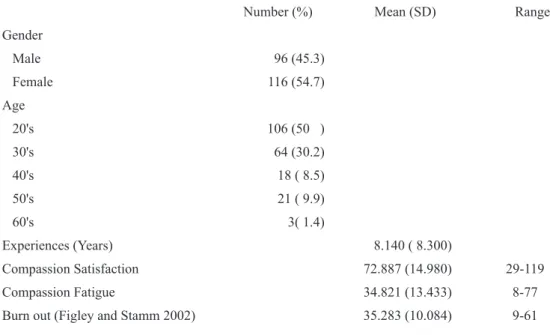
= 8.30) of experience. Scores on the Compassion Satisfaction Scale ranged from 29-119 with a mean of 72.887 (SD =14.980). Scores on the Compassion Fatigue Scale ranged from 8-77 with a mean of 34.821 (SD =13.433 ). Scores on the Burn out Scale (Figley and Stamm, 2002) ranged from 9-61 with a mean of 35.283 (SD =10.084).
Table 1. Descriptive statistics for key variables (n = 212).
Number (%) Mean (SD) Range
Gender Male 96 (45.3) Female 116 (54.7) Age 20's 106 (50 ) 30's 64 (30.2) 40's 18 ( 8.5) 50's 21 ( 9.9) 60's 3( 1.4) Experiences (Years) 8.140 ( 8.300) Compassion Satisfaction 72.887 (14.980) 29-119 Compassion Fatigue 34.821 (13.433) 8-77
Burn out (Figley and Stamm 2002) 35.283 (10.084) 9-61
For investigating purposes (3) new study participants attended this study. 61 study participants had five ranges of age; 20's(67.2%), 30's(27.9%), 40's(0%), 50's(3.3%), 60's(1.6%). Gender ; male(24;39.34%),fem ale(37;60.66%). The sample had an average of 5.32 years (SD = 5.82) of experience.
Multiple regression analysis
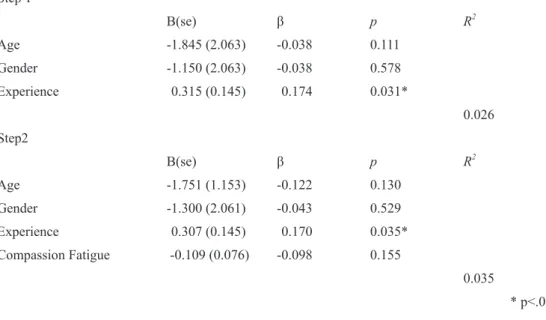
Table 2. Hierarchical regression analysis predicting Compassion Satisfaction among care givers in child welfare facility.
Step 1 B(se) β p R2 Age -1.845 (2.063) -0.038 0.111 Gender -1.150 (2.063) -0.038 0.578 Experience 0.315 (0.145) 0.174 0.031* 0.026 Step2 B(se) β p R2 Age -1.751 (1.153) -0.122 0.130 Gender -1.300 (2.061) -0.043 0.529 Experience 0.307 (0.145) 0.170 0.035* Compassion Fatigue -0.109 (0.076) -0.098 0.155 0.035 * p<.05
Table 3 displays the results of the Multiple regression analysis for predicting Burnout among care givers in child welfare facility. In MRA Compassion Fatigue and Compassion Satisfaction significantly predicted Burn out.
Linear multiple regression equation ;
Burnout risk = 0.490×Compassion Fatigue + (-0.163×Compassion Satisfaction) + 30.123
………. (a) Table 3. Multiple regression analysis predicting Burnout among care givers in
child welfare facility.
B(se) β p R2
Compassion Fatigue 0.490(0.036) 0.652 .0001** Compassion Satisfaction -0.163(0.033) -0.242 .0001** Constant Term 30.123(2.841)
0.516
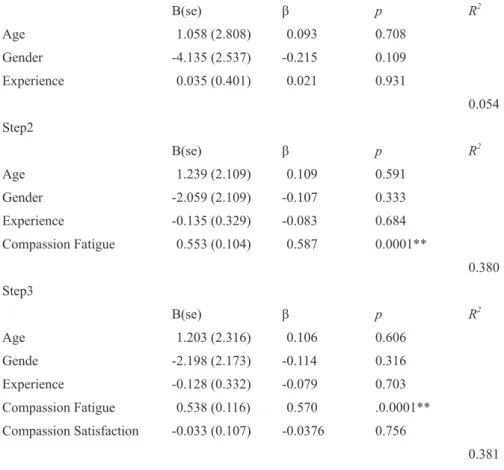
Table 4. Hierarchical regression analysis predicting FR Behavior among care givers in child welfare facility.
Step 1 B(se) β p R2 Age 1.058 (2.808) 0.093 0.708 Gender -4.135 (2.537) -0.215 0.109 Experience 0.035 (0.401) 0.021 0.931 0.054 Step2 B(se) β p R2 Age 1.239 (2.109) 0.109 0.591 Gender -2.059 (2.109) -0.107 0.333 Experience -0.135 (0.329) -0.083 0.684 Compassion Fatigue 0.553 (0.104) 0.587 0.0001** 0.380 Step3 B(se) β p R2 Age 1.203 (2.316) 0.106 0.606 Gende -2.198 (2.173) -0.114 0.316 Experience -0.128 (0.332) -0.079 0.703 Compassion Fatigue 0.538 (0.116) 0.570 .0.0001** Compassion Satisfaction -0.033 (0.107) -0.0376 0.756 0.381
Table 5 displays the results of the Multiple regression analysis for predicting FR behavior. The Multiple regression analysis was conducted to assess the relationship between Compassion Fatigue, Compassion Satisfaction, and FR behavior.
Linear multiple regression equation ;
FR behavior = 0.550×Compassion Fatigue + (-0.007×Compassion Satisfaction) +32.8756
………. (b) Table 5. Multiple regression analysis predicting FR behavior among care givers
in child welfare facility.
B(se) β p R2
Compassion Fatigue 0.550 (0.106) 0.594 .0001 ** Compassion Satisfaction -0.007 (0.099) -0.008 0.945 Constant Term 32.876(6.995)
0.357
Linear multiple regression equation ;
FR behavior = 0.381 × Secondary Traumatic Stress + 1.167 × PTSD + (-0.039×Denial Feeling) + 0.157×Trauma Experience + 31.356 ………. (c)
Table 6. Multiple regression analysis predicting FR behavior among care givers in child welfare facility.
B(se) β p R2
Secondary Traumatic Stress 0.381 (0.324) 0.151 0.244
PTSD 1.167 (0.211) 0.5916 .0001 **
Denial Feeling -0.039 (0.457) -0.0096 0.932 Trauma Experience 0.157 (0.387) 0.0488 0.687
Constant Term 31.356 2.286
0.466
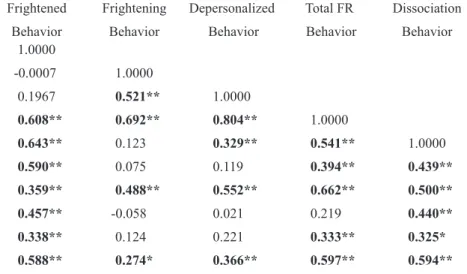
Table 7 displays the results of Correlation between four factors of Compassion Fatigue and the three factors of FR behavior among care givers in child welfare facility.
4 factors of Compassion Fatigue contained Secondary Traumatic Stress, PTSD, denial tendency, trauma experience . 3 factors of FR behavior contained Frightened behavior, Frightening behavior, Depersonalized behavior.
Frightened behavior in FR behavior have the significant correlation with Secondary Traumatic Stress, PTSD, denial feeling, trauma experience in Compassion Fatigue and Total FR Behavior , Dissociation behavior . Frightening behavior in FR behavior has significant correlation only with PTSD in Compassion Fatigue. Total FR Behavior have the significant correlation with Dissociation
Behavior. Depersonalized behavior in FR behavior check lists has significant correlation with
Dissociation behavior, PTSD in Compassion fatigue. Dissociation behavior has significant correlation
with all four factors in Compassion Fatigue (Secondary Traumatic Stress, PTSD, Denial feeling, Trauma experience).
Table 7. Correlation between four factors of Compassion Fatigue and the three factors of FR behavior among care givers in child welfare facility.
Behavior Frightened Behavior Frightening Behavior Depersonalized Behavior Total FR Behavior Dissociation Behavior Frightened Behavior 1.0000 Frightening Behavior -0.0007 1.0000 Depersonalized Behavior 0.1967 0.521** 1.0000 Total FR Behavior 0.608** 0.692** 0.804** 1.0000 Dissociation Behavior 0.643** 0.123 0.329** 0.541** 1.0000
Secondary Traumatic Stress 0.590** 0.075 0.119 0.394** 0.439**
PTSD 0.359** 0.488** 0.552** 0.662** 0.500**
Denial Feeling 0.457** -0.058 0.021 0.219 0.440**
Trauma Experience 0.338** 0.124 0.221 0.333** 0.325*
Total Compassion Fatigue 0.588** 0.274* 0.366** 0.597** 0.594**
4 factors of Compassion Fatigue (Secondary Traumatic Stress, PTSD, Denial Feeling, Trauma Experience ) 3 factors of FR behavior (Frightened Behavior, Frightening Behavior, Depersonalized Behavior)
Table 8 displays the results of Correlation between four factors of Compassion Satisfaction and the three factors of FR behavior among care givers in child
welfare facility. Frightened behavior in FR behavior has significant negative(-) correlation with satisfaction as nature of care workers . Frightening behavior and Depersonalized behavior in FR behavior have no significant correlation with four factors in Compassion Satisfaction. Total FR Behavior has significant negative(-) correlation with satisfaction in relations with a child or children. Dissociation Behavior has significant correlation with Total Compassion Satisfaction, especially satisfaction in relations with a child or children and satisfaction as nature of care workers.
Table 8. Correlation between four factors of Compassion Satisfaction and the three factors of FR behavior among care givers in child welfare facility.
Behavior Frightened Behavior Frightening Behavior Depersonalized Behavior Total FR Behavior Dissociation Behavior Frightened Behavior 1.000 Frightening Behavior -0.001 1.000 Depersonalized Behavior 0.197 0.521** 1.000 Total FR Behavior 0.608** 0.692** 0.804** 1.000 Dissociation Behavior 0.643** 0.123 0.329** 0.541** 1.000 Satisfaction in relations
with fellow workers -0.104 -0.054 -0.211 -0.176 -0.207
Satisfaction in relations
with a child or children -0.202 -0.144 -0.206 -0.265* -0.265*
Satisfaction as nature
of care workers -0.351** 0.086 -0.207 -0.240 -0.468**
Feeling of satisfaction in life 0.006 0.071 -0.119 -0.021 -0.115 Total Compassion Satisfaction -0.222 -0.031 -0.250 -0.246 -0.351**
* p<.05 **p<.01 4 factors of Compassion Satisfaction (Satisfaction in relations with fellow workers, Satisfaction in relations with a child or children, Satisfaction as nature of care workers, Feeling of satisfaction in life)
Table 9. Multiple regression analysis predicting Three factors of FR behavior among care givers in child welfare facility.
Criterion Variable; Frightened Behavior
B(se) β p R2
Secondary Traumatic Stress 0.590 ( 0.176) 0.453 0.001**
PTSD 0.159 (0.115) 0.156 0.172
Denial Feeling 0.461 (0.248) 0.221 0.068 Trauma Experience -0.082 (0.210) -0.049 0.698 Constant Term 10.841 (1.241)
0.408 Criterion Variable; Frightening Behavior
B(se) β p R2
Secondary Traumatic Stress -0.075 (0.169) -0.066 0.660
PTSD 0.476 (0.111) 0.538 0.0001 **
Denial Feeling -0.300 (0.239) -0.165 0.214 Trauma Experience 0.052 (0.202) 0.036 0.798 Constant Term 11.137 (1.195)
0.272 Criterion Variable; Depersonalized Behavior
B(se) β p R2
Secondary Traumatic Stress -0.133 (0.1700) -0.113 0.435
PTSD 0.533 (0.111) 0.576 0.0001 ** Denial Feeling -0.200 (0.240) -0.105 0.408 Trauma Experience 0.187 (0.203) .124 0.362 Constant Term 9.378 (1.201) 0.330 †p<.10 * p<.05 **p<.01 Discussion
The purpose of this study was to examine multiple regression analysis of Compassion Fatigue/ Satisfaction Questionnaires and determine the correlation between those Questionnaires and Care Providers’ Behavior in Japanese Child Welfare Facilities.
An association between Burn out and Compassion Fatigue / Satisfaction
Through the hierarchical OLS regression analysis , when Compassion Fatigue was added in Step 2, only experience was significant. Experience is very important in thinking about Compassion Satisfaction. The author described the relationship between experience and Compassion Satisfaction in Fujioka(2007) . Fujioka(2007) indicated that Compassion satisfaction changes up and down every year after beginning to work, and numerical value of Compassion satisfaction is stabilized from 7 years to 10 years.
multiple regression equation (a) as follows;
Burnout risk = 0.490 × Compassion Fatigue + (-0.163 × Compassion Satisfaction) + 30.123
We have to investigate the reason of the influence to Burn out. This was first challenge to construct the numerical formula, Burnout risk and Compassion Fatigue / Satisfaction.
The relationship of Compassion Fatigue /Satisfaction with the interaction between care providers and children, just like FR(Frightened/ Frightening) behavior
The hierarchical regression analysis was conducted to assess the relationship between Compassion Fatigue, Compassion Satisfaction, and FR behavior. Step 1 FR behavior regressed on the three control variables. But we had no significant effect of three variables to FR behavior. Next it was indicated that the Compassion Fatigue predicts the FR behavior significantly. Step 3, we added the third factor, Compassion Satisfaction. We did not find significant effect in this research. So the author constructed the linear multiple regression equation (b) as follows;
FR behavior = 0.550 × Compassion Fatigue + (-0.007 × Compassion Satisfaction) + 32.8756 ………. (b)
The hierarchical regression analysis was conducted to assess the relationship between four factors of Compassion Fatigue and FR behavior as follows;
FR behavior =0.381 × Secondary Traumatic Stress + 1.167×PTSD
+ (-0.039×Denial Feeling) + 0.157 × Trauma Experience + 31.356
………. (c)
These were first challenge to construct the numerical formula, FR behavior and Compassion Fatigue / Satisfaction.
A hierarchical regression analysis was conducted to assess the relationship between four factors of Compassion Fatigue and FR behavior. PTSD significantly affected FR behavior. PTSD is an important
factor in four factors of Compassion Fatigue.
Fujioka(2005) described that compassion fatigue has two kinds, one is stress-based compassion fatigue and the other is trauma-based compassion fatigue. It is thought that FR behavior is connected with stress-based compassion fatigue.
Table 7 displays the results of Correlation between four factors of Compassion Fatigue and the three factors of FR behavior among care givers in child welfare facility. Frightened behavior in FR behavior has significant correlation with Secondary Traumatic Stress, PTSD, denial feeling, trauma experience. Frightened behavior in FR behavior seems to be connected to a care provider’s trauma or scar in childhood. It is necessary for a care provider to confront his or her own trauma experience with a supervisor .
before it leads to severe FR behavior, if care givers can notice beforehand. Depersonalized behavior in FR behavior check lists have significant correlation with Dissociation behavior, PTSD. Depersonalized behavior in FR behavior
Depersonalized behavior can be dealt with before it leads to severe FR behavior. Dissociation behavior has significant correlation with all four factors in Compassion Fatigue (Secondary Traumatic Stress, PTSD, Denial feeling, Trauma experience). In this study we confirmed the relation between Dissociation and Compassion Fatigue. It could be determined that Fatigue and Dissociation were related closely, just as Pierre Janet already described in 19 century.
In addition, we found that three parts of concepts of FR behavior connect with each part of Compassion Fatigue. Especially Frightened behavior in FR behavior connect with all aspects of Compassion Fatigue. And Frightening Behavior has significant correlation only with PTSD in Compassion Fatigue. It could be ascertained that FR behavior and Compassion Fatigue are closely related.
Table 8 displays the results of Correlation between four factors of Compassion Satisfaction and the three factors of FR behavior among care givers in child
welfare facility. Frightened behavior in FR behavior has significant negative(-) correlation with satisfaction as nature of care workers . Satisfaction as nature of care workers will be developed by training, workshop and supervision. For Protecting FR behavior by care workers we have to construct career development system in Child welfare facility. Monitoring the nature of care workers is very important for support to care workers.
Frightening behavior and Depersonalized behavior in FR behavior have no significant correlation with four factors in Compassion Satisfaction. Total FR Behavior have the significant negative(-) correlation with satisfaction in relations with a child or children. Satisfaction in relations with a child or children is main part of compassion Satisfaction with children. Dissociation Behavior has significant negative(-) correlation with Total Compassion Satisfaction, especially satisfaction in relations with a child or children and satisfaction as nature of care workers. Awareness and talking about satisfaction in relations with a child or children and satisfaction as nature of care workers have the role of protection from consequences of dissociation in the field of facility.
Compassion Fatigue of Trauma Dominance and Compassion Fatigue of Stress Dominance
Fujioka(2005) described that compassion fatigue has two types of, Trauma-dominance Compassion
Fatigue(TDCF) and Stress- dominance Compassion Fatigue(SDCF). In Stress- dominant Compassion
Fatigue, the trauma may be deeply and profoundly hidden in the mind, and stress would be felt in a situation of work. I think Trauma-dominance Compassion Fatigue would be easy to cause a stronger dissociation tendency, and the degree of the burnout tendency would differ by the state of a child, how to live in family and community and how to live in the past, especially in childhood. Deep sadness (grief, sorrow, lament) and profound trauma will draw out compassion fatigue for a care giver or a care provider who continues to be exposed to Trauma-dominance Compassion Fatigue and experiences dissociation unconsciously under those situations. Children who had a severe trauma will draw compassion fatigue of trauma dominance of a care provider easily. I think that under these helping situations with abused or traumatized or neglected clients(children or elderly people or handicapped people), compassion fatigue would be easy to connect to severe burnout situation. In this study we found dissociation tendency is connected with all four factors in Compassion Fatigue (Secondary Traumatic Stress, PTSD, Denial tendency, Trauma experience). I have to emphasize that dissociation tendency is a key concept of Compassion Fatigue. P. Janet already pointed out the relationship between traumatic memory and psychological fatigue in the latter part of 19 century or early 20 century. The author discussed this point through compassion fatigue and dissociation in child welfare facilities. In other words, when care providers are exposed to compassion fatigue, particularly secondary wound-related stress, their own trauma experience may be drawn out. And care providers must be exposed to trauma experiences of children doubly more while they are exposed to their own trauma experience. This is Trauma- dominance Compassion Fatigue.
Further tasks in these area
Fujioka(2010) described four tasks of support programs as follows. 1, Necessity of enhancing investigations in other child welfare facilities. 2, Continuity of investigations. 3, Necessity of construction of individually-related examination about Compassion fatigue/Satisfaction and FR behavior or Clinical Attachment Approach. 4, Necessity of construction of the Academic Domain on Support for Care
Giver or other professionals for users and clients.
The author emphasized in this study that it is necessary to investigate the relationship of professional approach to clients with Compassion Fatigue and satisfaction. Perhaps it is very important for the protection of burnout or inadequate behavior in care providers and social workers to examine these subjects on Compassion fatigue/Satisfaction.
References
Abrams,K.Y., Rifkin,A.& Hesse,F. 2006. Examining the role of parental frightened/frightening subtypes in predicting disorganized attachment within a brief observational procedure. Development and Psychopathology, 18,345-361. Boscarles, J.A., R.Figley and Richard E. Adams 2004. Compassion Fatigue following the September 11 Terrorist Attacks:
A study of Secondary trauma among New York
Cherniss, C. 1980. Professional Burnout in Human Service Organization. Praeger, New York.
Figley, C. R. 1982. Traumatization and comfort : Close relationships may be hazardous to your health. Keynote address for Families and Close Relationships : Individuals in Social Interaction, Conference at Texas Tech University, Lubbock, TX.
Figley, C. R. 1985. Trauma and its wake: Study and treatment of PTSD. Newyork:Brunner /Mazel. Figley, C. R. 1989. Helping traumatized families. San Francisco : Jossey-Bass
Figley, C. R. (Ed.) 1995. Compassion fatigue : Coping with secondary traumatic stress disorder in those who treat traumatized. Brunner/Mazel : New York
Figley, C. R. (Ed.) 1998. Burnout in Families : The Systemic Costs of Caring. CRC Press : New York.
Figley, C. R. 1999. Compassion Fatigue : Toward a New Understanding of the Costs of Caring. In B. H. Stamm (Ed.) Secondary Traumatic Stress. Lutherville, MD : Sidran Press.
Figley, C. R. (Ed.) 2002. Treating Compassion Fatigue . Brunner-Routledge : New York. p107-119.
Figley, C. R. 2006. Lectures on Compassion Fatigue at the Seminar for Social Workers, Medical Doctors and Marriage, Couple Counselors in Florida.
Figley, C. R. 2007. Private discussion at Florida State University (2007/02/24)
Figley, C. R. & Stamm, B. H/ 1996. Review of the Compassion Fatigue Self-Test. In B. H. Stamm (Ed.), Measurement of stress, trauma, and adaptation. Lutherville, MD : Sidran Press.
Freudenberger, H. J. 1974. Staff burnout. Journal of Social Issues, 30, 159-165.
Freudenberger, H. J. 1975. Staff burnout syndrome in alternative institutions. Psychotherapy, 12 (1), 73-82. Freudenberger, H. J. 1977. Burn-out: Occupation hazard of the child care worker. Child Care Quarterly, 6(2), 90-99. Freudenberger, H. J. 1986. The issues of staff burnout in therapeutic communities. Journal of Psychoactive Drugs, 18(2),
247-251.
Fujioka, T. 2004. Burnout and Secondary Traumatic Stress in Care Workers and Case Managers Working in Welfare Facilities. Annual Report of Japan College of Social Work, Vol.40. 13-29. (In Japanese with English summary) Fujioka, T. 2005. Secondary Traumatic Stress and Dissociation in Care Workers, Case Managers and Social Workers
Working in Welfare Facilities and Agents.
Study Report of Japan College of Social Work, Vol.52, 149-163. (In Japanese with English summary)
Fujioka, T. 2006a. Compassion Fatigue and Dissociation -Through The Clinical Approaches by Pierre Janet- Journal of Social Policy and Social Work Vol.10. 23-33. (in English)
Fujioka, T. 2006b. Secondary Traumatic Stress (Compassion Fatigue), Burnout and Compassion Satisfaction in Care Workers, Case Managers and Social Workers Working in Welfare Facilities and Agents. Study Report of Japan College of Social Work, Vol.53. 27-52. (In Japanese with English summary)
Fujioka, T. 2007. On the Structure of Compassion Satisfaction and Compassion fatigue in Child welfare facilities. Study Report of Japan College of Social Work, Vol.54, 5-116. (In Japanese with English summary)
Fujioka, T. 2008. Compassion Fatigue in Japan. Journal of Social Policy and Social Work Vol.12 5-13. (in English) Fujioka, T. 2010. On the Construction of Support Program for Care Givers in Child Welfare Facilities on the Standpoint of
Compassion Fatigue. Study Report of Japan College of Social Work . Vol.57, (in Japanese with English abstract ) (in print)
Fukushima, M. 2010. Compassion Fatigue and Empathy among Victim Support Workers- With Use of Questionnaire Study-. Study Report of Japan Women’s University. Vol. 16, 85-100. (in Japanese with English abstract )
Hochschild, A, R. 1983. The managed heart. Berkeley : University of California Press. Janet, P. 1889. L'automatisme psychologique. Paris: Felix Alcan.
Reprint: Societe Pierre Janet, Paris, 1973.
(1898a), Névroses et idées fixes, Vol. 1 (pp. 423-484). Paris: Félix Alcan. (Reprint: Société Pierre Janet, Paris, 1990.) Janet, P. 1923. La médecine psychologique. Paris, Flammarion.
Janet, P. 1925. Psychological Healing, vols 1,2. New York, Macmillan.
(original publication: Les medications psychologiques,vols 1-3. Paris, Felix Alcan, 1919). Joinson, C. 1992 .Coping with compassion fatigue. Nursing, 22(4), 116-218.
Kon,Y.& Kikuchi,A 2007. An Attempt to Construct a Scale of Compassion Fatigue and Its Related Affects. Study Report of Department of Social Work, Iwate Prefectural University. Vol.9, 23-29. (in Japanese with English abstract ) Kubo M. 2004. The Psychology of Burnout. Science Publishing Co. (In Japanese)
Main, M., & E. Hesse 1996. Disorganized and disorientation in infancy Strange Situation behavior. Phenotypic resembalance to dissociative states. In l.Michelson and W. Ray (Eds.) Handbook of dissociation: theoretical, empirical, and clinical perspectives. New York, Plenum Press, 107-138.
Masuda,R. 2006. Discriminant validity and item context of Normal Dissociation Scale-short form- Correlation with splitting-projection and depersonalization/derealisation- Kyushu University Psychological Research. Vol.7 117-123. Maslach, C. 1976. Burn-out. Human behavior, 5(9), 16-22.
Maslach, C. and Jackson, S.E. 1981 The Measurement of Experienced Burnout. Journal of Occupational Behavior, 2: 99-113.
Nishi, M. & Nojima,K. 2002. STS in the shelter staff. Kyushu University Psychological Reseach. Vol.3,157-165.( in Japanese with English abstract)
Orlans, M. & Levy, T. M. 2006. Healing Parents-Helping Wounded Children Learn to Trust & Love. Child Welfare League of America, Inc. ; Washington.
Pearlman, L. A. 1999. Self-Care for Trauma Therapists : Ameliorating Vicarious Traumatized. In B. H. Stamm(Ed.) Secondary Traumatic Stress. Lutherville, MD : Sidran Press.
Pearlman, B.& Hartman,E.A. 1982. Burnout:Summary and future research. Human Relations,35,283-305 Pines, A. M., Aronson,E. 1988. Career Burnout:Cause and Cures(2nd ed). Free Press,New York.
Pines, A. M., Aronson, E. & Kafry, D. 1981. Burnout: From tedium to personal growth. New York: Free Press.
Pines, A. & Maslach,C. 1980. Combating staff burnout in child care centers: A case study. Child care quarterly ,9,5-16. Shimizu T., Tanabe T., and Nishio Y. (Eds), 2002. Burnout in Social Worker- the actual state and the treatment. Chuouhouki
Publishing Co. (In Japanese)
Shinozaki, T. 2007. Factors related to compassion fatigue among Children’s Home staff members. Child Abuse and Neglect. Vol.9, No.2 . 246-255. (in Japanese with English abstract)
Stamm, B. H. (Ed.) 1999. Secondary Traumatic Stress : Self-Care Issues for Clinicians, Researchers, &Educators. Lutherville, MD : Sidran Press.
Stamm, B. H. 2002. Measuring compassion satisfaction as well as fatigue: Developmental
history of the Compassion Satisfaction and Fatigue Test. In C. R. Figley (Ed.), Treating compassion fatigue (pp. 107–119). New York: Brunner-Routledge.
Stamm, B. H. 2003. Professional Quality of Life: Compassion Fatigue and Satisfaction Subscales, R-(Pro-QOL) http://www.isu.edu/~bhstamm (2005/2/25)