Phonological awareness through English picture books for elementary school English activities
Michiaki Matsumoto
小学校外国語活動における絵本を使った音韻認識を高める活動
1. Introduction
In 2020, the elementary school English in Japan will face a drastic change. According to Ministry of Education, Culture, Sports, Science, and Technology (MEXT), elementary school English activities will start from the third grade, and the current English activities will be transformed to the subject of English for fifth and six grades. More specifically, elementary school English for fifth and six grades will involve reading, writing, and learning basic English word order, as well as speaking and listening, which have been taught in current English activities for elementary schools. There are both positive and negative arguments for fifth and six graders to study reading and writing in English. The negative side argues that teaching reading, writing, and basic English grammar to elementary school students would increase the number of junior high school students who do not like English, if they started studying these English skills in elementary school.
According to the survey on junior high school students’ attitude for English study conducted by Benesse Education Research & Development Institute (2009), 78.6% of junior high school students answered English grammar was difficult, and 72% of students thought writing sentences in English was also difficult. On the other hand, the survey by MEXT (2014) reported that more than 75% of the first and second grades of junior high schools answered they had wanted to study reading and writing English in their elementary school English activities. The results would be interpreted that they would not have felt difficulties in reading and writing English, if they had started studying English reading and writing earlier in their elementary school English activities.
In the same survey by MEXT (2014), 88.8% of the first and second graders of junior high schools answered reading English alphabets in their elementary school English activities was useful, and 83.9% of the students also felt writing English alphabets in their elementary school English activities was useful. These results might reflect elementary school students’ desire to study reading and writing in English in their
elementary school. Taking those current issues into consideration, MEXT announced the next government curriculum guidelines for English in elementary schools in which elementary school English activities will start from the third grade, and elementary school English for fifth and six grades will include reading and writing basic English letters. However, little has been examined how we could teach reading and writing basic English letters to Japanese elementary school students who have had a limited exposure to alphabetic words in English before they start studying English in their fifth and six grades in elementary schools. The present study introduces an idea and an activity to enhance phonological awareness by using English picture books that were published for Australian children.
2. Phonological Awareness
Various researches have investigated the roles of phonological awareness or phonemic awareness in children’s ability to read English. Regarding phonological awareness, Cisero and Royer (1995) defined the development of phonological awareness in alphabetic languages into three forms: “syllable awareness,” “onset-rhyme awareness,” and “phonemic awareness.” Syllable awareness relates to the knowledge that words consist of syllables, and the skill to break down a word into syllables. Onset-rhyme awareness is the knowledge that syllables can be basically divided into smaller units of onset and rhyme.
Phonemic awareness is the knowledge to recognize that the smallest unit of sounds is phoneme, and the phoneme plays an important role in discriminating minimal pair words, such as “pat” and “bat.” Cisero and Royer (1995) conducted an experiment to confirm Treiman and Zukowski (1990)’s hypothesis that detecting rhyme is easier than detecting word initial (i.e., onset) and word final phonemes. The result revealed that Spanish and English speaking first grade students answered more accurately and faster in the rhyme detection task than in the onset detection task and final phoneme detection task.
The result was consistent with the previous Treiman and Zukowski (1990)’s finding that rhyme detection was easier than detecting onset consonants. Cisero and Royer (1995) discussed that children learning alphabetic languages, such as English and Spanish, might grow up in the environment where they would be exposed to a lot of activities emphasizing rhyme detection, such as listening to nursery rhymes, reading picture books, and so on. Thus, the ability to detect rhyme sounds develops faster in the early stage of English learning. Cisero and Royer (1995) also discussed the reason why rhyme awareness would develop faster and it is easier than onset and final phoneme awareness.
Cisero and Royer (1995) argued that detecting rhyme is more holistic than detecting smaller onset and final phoneme. So, onset and final phoneme detection would require more analytical knowledge, and be cognitively more difficult. The hypothesis that detection rhyme is easier and cognitively develops faster than onset and word final
detection implies that activities emphasizing rhyme would be effective in enhancing phonological awareness in English.
Regarding the relationship between phonological awareness and the development of reading ability, various studies have revealed that language learners with strong phonological awareness in a native language would show the better literacy knowledge in a foreign language. Cisero and Royer (1995) examined if cross-language transfer of the aforementioned relationship would occur between Spanish-speaking and English-speaking pupils. The result revealed that cross-language transfer was observed between the young speakers of the two languages. With respect to cross-language transfer, Cisero and Royer (1995) concluded that the languages should be alphabetic languages with similar phonological systems in order for the transfer to occur. Furthermore, it should be noted that the research was conducted for the English learners who study English in English as a second language (ESL) context.
However, recent studies have revealed that cross-language transfer of phonological awareness in a native language could occur, even if native languages are not alphabetic languages. For example, Wei and Zhou (2013) investigated if the transfer of phonological awareness would occur in the condition that the native language was Thai and the foreign language was English. Moreover, the subjects in the experiment of Wei and Zhou (2013) studied English in the English as a foreign language (EFL) context.
The subjects in the experiment of Wei and Zhou’s (2013) were third-grade elementary school students living in northern provinces in Thailand. They performed two kinds of tests, phonological awareness-related and reading-related tests in English and Thai separately. The results showed that those who had high scores in the phonological awareness tests in Thai could also perform better in reading-related tests in English.
Regarding the phonological awareness of Japanese children, quite a few studies have investigated the issue. For example, Allen-Tamai (2004, 2006) investigated the relationship between knowledge of English alphabets and phonological awareness of Japanese children. Allen-Tamai (2004) examined if there would be any correlation between phonological awareness in Japanese and that in English. In order to investigate the phonological awareness in Japanese, three tests, counting the number of morae, detecting the same initial morae, and detecting the same final morae, were carried out for five and six-year-old children. In addition, alliteration test, rhyme test, and phoneme blending test were used to examine the phonological awareness in English. The results revealed that those who had showed higher ability in the phonological awareness in Japanese could also perform better in phonological awareness in English, regardless of experience of English education. Allen-Tamai (2006) further examined how Japanese children decode the syllabic structures of English words. The study revealed that Japanese children analyzed English syllabic structures based on their knowledge of morae in Japanese. The result clearly showed that Japanese children in the early stage of English learning would be influenced by the phonological knowledge of their native
language, Japanese. That is, they would first decode the phonological structure of English sound not by a syllable but by a mora. Take the results together, Allen-Tamai (2010) emphasized the importance of enhancing the phonological awareness in English before introducing literacy education.
These studies on children’s’ phonological awareness revealed enhancing phonological awareness would contribute to the development of English reading skill. In other words, this implies the importance of enhancing phonological awareness in the process of English alphabet learning not only for children whose native languages are alphabetical, but also for children whose native languages are non-alphabetic, such as Thai or Japanese.
The next section will discuss an activity to enhance phonological awareness in English which makes use of English picture books for beginners.
3. Phonological awareness through English picture books
Regarding literacy education for beginning English learners, Leeper (2008) pointed out that much attention was payed to the importance of phonological awareness in the mid- 1980’s in the U.S. In order to improve auditory system in English, picture books, nursery rhymes, and games that contained lots of English alliterations and rhyming have been frequently used in early childhood education in the U.S. Moreover, Leeper (2008) introduced activities that used picture books to enhance children’s phonological awareness. For example, Leeper (2008, 72) proposed an activity which used a famous picture book, “Brown Bear, Brown Bear, What Do You See” by Bill Martin. In the activity, the instructor repeats expressions in the picture book, and poses questions, then, children think of words that rhyme with the initial words and answer the questions using rhyming words with the initial words, as in (1)
(1) a. “Fish, Fish, what do you see?”
“I see a dish.”
b. “Lark, Lark, what do you see?”
“I see a park.”
c. “Bug, Bug, what do you see?”
“I see a rug.”
In (1a), an instructor talks to children using an animal name “Fish,” and askes children to answer the word that rhymes with “Fish,” such as “dish,” and “shellfish.” In (1b) children will answer the question using words like “park,” “shark.” In (1c), the answers could be “rug,” “mug” and “drug.” The activity in (1) would be effective for English speaking children to notice that English has many rhyming sounds. The activity also develops phonological awareness in English.
Leeper (2008) also emphasized the importance of understanding the difference between phonological awareness and phonics. Phonological awareness is a theory of sound that makes learners notice that English speech sounds consist of various phonemes. On the other hand, the primary aim of using phonics is to teach English learners the relationship between graphemes and pronunciation in English. Thus, Leeper (2008) pointed out that it is important to use teaching materials that contain a lot of alliterations and rhyming in English first. Then, phonics should be introduced for preschoolers and elementary school students. The next section will introduce an English activity for Japanese elementary school students which mainly focus on phonological awareness through English picture books.
4. English Activities through Picture Books
4.1. Springboard Connect
As is discussed in the previous section, it has been emphasized that in early stages of English education that enhancing phonological awareness would help English learning children to develop their auditory system in English. There are many kinds of English picture books which have been published in the U.S., the UK, and Canada (cf. Leeper, 2008, P69). However, the level of these picture books varies book to book, and seems difficult for Japanese elementary school students, who have just started studying English. Thus, I would like to introduce an English activity that uses much easier picture books published by Macmillan Australia: Springboard Connect Series. Springboard Connect is a series of Australian picture books that consist of 30 levels, and each level has 5 titles of picture books. Each picture book has about 20 pages and is written in plain English. According to Macmillan Education Japan, Level 1 to Level 8 are suitable for first and second grades of elementary school students. Levels 9 to 12 are for third and fourth grades and Level 13 to Level 18 are suitable for fifth and sixth grades of Japanese elementary school students.
For the English activity in this study, level 2 and Level 3 are selected for the English activity for elementary school students. The following are the titles and content noun words that were mainly used in Springboard Connect level 2 and 3:
(2) Springboard Connect level 2
a. At the Park: ball, bee, dog, duck, man, park, rug, tree, van
b. Up the Tree: ball, bird, butterfly, cat, dog, ladder, lizard, man, tree c. My Brother: bed, chair, computer, cupboard, desk, room, toys
d. Fruit: banana, cherry, coconut, fruit, mango, peach, plum, star fruit e. It was So Hot: cold, hot
(3) Springboard Connect level 3
a. What Can You Do?: crawl, hop, leap, slide, swim, swing, trot
b. My Pop's Garden: pop, apples, bananas, figs, garden, lemons, mangoes, oranges, pick, plums
c. The Soup: beans, bowls, carrots, garlic, noodles, onions, sauce, soup, spinach, d. We Go to Town: bikes, bus, car, foot, go, taxis, top, town, train
e. Baby Animals: baby, chick, cub, kid, kit, kitten, lamb, pup.
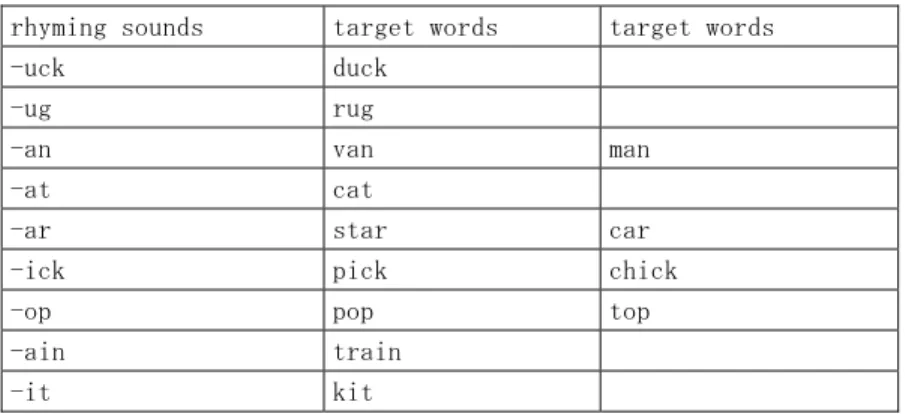
As shown in (2) and (3), the words used in the picture books are not so difficult for elementary school students in Japan. However, since the main words used in (2e) and (3a) were adjectives and verbs, the words in (2e) and (3a) were excluded from the word bank. Next, thirteen words in these picture books were selected which were used as the target words for the rhyming games. Table 1 is the list of the target words.
Table 1. Rhyming game target words rhyming sounds target words target words
-uck duck
-ug rug
-an van man
-at cat
-ar star car
-ick pick chick
-op pop top
-ain train
-it kit
In addition to the 13 words in Table 1, thirty new words were also chosen, which rhymed with the words in Table 1. These words together with the target words consist the word bank for the English rhyming game activity. Table 2 illustrates the words of English rhyming games.
Table 2. Rhyming game words
rhyming sounds target words new words non-rhyming word
-uck duck buck, luck, truck, luck corn
-ug rug bug, drug, tug job
-an van, man fan, pan kiss
-at cat, bat, fat, rat, hat neck
-ar star, car far, bar, guitar room
-ick pick, chick brick, sick, kick dress
-op pop, top, hop, stop gate
-ain train brain, main, rain, pain king
-it kit bit, hit, lit, fit, sit road
The next section introduces an English rhyming game activity, which aims at enhancing phonological awareness.
4.2. English Rhyming Game Activity
English rhyming games were implemented as a part of English activity in Nagomi town, Kumamoto. This activity was not a regular English activity at elementary schools, but a voluntary participation program for children. Therefore, any teaching materials and activities in English could be used. The participants were divided into the three groups according to their grades: lower, middle, and upper grades. Fifth and sixth grade elementary school students in Nagomi town consisted the upper grade group.
Students from Kyushu Lutheran College participated in the activity as instructors. The instructors showed elementary school students each picture book from Springboard Connect levels 2 and 3. Instead of using printed picture books, digital picture books of Springboard Connect were shown on a screen one by one. Then, the audio CDs that narrated the stories of the picture books were played. Since it took about two or three minutes for each story, the picture books were shown twice. After each story finished, the instructors showed the picture books again, and read aloud the content words in Table 1, and/or asked elementary school students to repeat the English words again. The two English rhyming games which were introduced in Allen-Tamai, M (2010, pp 197-198) were used. One of the games is a group game, in which elementary school students and college students made a group of five to six people. They made a circle, and each of them made a soft fist with his/her hand, and inserted his/her right index finger on the right side. An instructor, who did not take part in the game, read aloud English rhyming words from table 2. In addition to the rhyming words, a non-rhyming word was also added. The children were instructed not to move while the same rhyming words, such as
duck, buck, luck, truck, luck
, were heard, but were asked to pull out the index finger when a non-rhyming word, e.g.,corn
was heard. They had to try to hold the index finger on their right. The instructor read the rhyming words and non- rhyming words in table 2.The other game used in the activity was a pair game that was easier than the previous one. The elementary school students and college students made a pair, and sat face to face. An eraser was put between them. An instructor read aloud the English words in table 2. They were instructed to take the eraser as soon as they heard a non- rhyming word, such as
corn
. Those who could take the eraser were the winners. The rhyming game mentioned above seemed an easy activity, however, elementary school students concentrated on finding rhyming sounds and discriminating non-rhyming words. Most of them could find the rhyming words and discriminate non-rhyming words, even though they learned the words for the first time. This might be because they learned the English words in the picture book, in which they could encounter the new words in stories and with pictures. Thus, it might be beneficial for Japanese elementary school studentsto learn new English words through picture books. So, English rhyming games would enhance the sensitivity to English rhyming words.
5. Conclusion
The present study examines how important enhancing phonological awareness is before teaching English reading and writing. Especially, it would be noteworthy to point out the important role of phonological awareness in elementary school English activity in Japan. As discussed in the introduction, the elementary school English will be changed from becoming familiar with English sounds to reading and writing English words and alphabets in fifth and six grades. According to the survey, more than 80% of Japanese junior high school students who had experienced English activity in their elementary school days had a positive attitude toward studying English alphabets in elementary school English activity. However, another survey revealed that more than 70% of the junior high school students thought writing in English was difficult. Taking these reports into consideration, we should be careful in teaching English reading and writing in elementary school English activity. This paper reviews the previous studies on phonological awareness in English learning in ESL and EFL contexts. The studies reveal that enhancing phonological awareness could enhance the development of auditory system in English. This implies that phonological awareness would also contribute to the development of English auditory system for Japanese elementary school students before they study English reading and writing. Thus, an activity was introduced that made use of the Australian picture books and games which focus on enhancing phonological awareness in English. However, further studies will be necessary in evaluating the effectiveness of the activity.
References
Allen-Tamai, M. (2004). Cross-linguistic transfer of phonological awareness from Japanese to English.
ALAK, Proceedings, 138-142.
Allen-Tamai, M. (2006). Development of phonological awareness in a foreign language among young Japanese learners. A report of National Research Fund, No 16520348.
Allen-Tamai, M. (2010). Shougakkou Eigo no Kyouikuhou, Taishukanshoten
Benesse Education Research & Development Institute, (2009). Dai ikkai Chuugakkou eigo ni kansuru kihon chousa. http://berd.benesse.jp/global/research/detail1.php?id=3302.
Cisero, C. & Royer, J. (1995). The Development and Cross-Language Transfer of Phonological Awareness.
Contemporary Education Psychology 20, 275-303.
Leeper, S. (2015). Amerika-no Shougakkou dewa Kouyatte Eigo-o Osiete-iru, Michishobou Martin, B. & Carle, E. (2010).Brown Bear, Brown Bear, What Do You See? MPI.
Monbu Kagaku Shou, (2014). Heisei 26 nendo shougakkou gaikokugo katudo jissi jyoukyou chousa-no kekka
ni tuite. http://www.mext.go.jp/a_menu/kokusai/gaikokugo/1362148.htm.
Oxford children’s Rhyming Dictionary (2004). Oxford University Press.
Springboard Connect Level 2 & Level 3, (2013), Macmillan Language House
Treiman, R. & Zukowski, A. (1991). Levels of phonological awareness. In S. Brady & D. Shankweler (Eds.), Phonological process in literacy, 67-83. Hillsdale.
Wei, M. & Zhou, Y., (2013). Transfer of Phonological Awareness from Thai to English among Grade-Three Students in Thailand. Reading Matrix, 13(1), 1-13.