Fukushima Medical University
福島県立医科大学 学術機関リポジトリ
This document is downloaded at: 2021-11-08T00:18:32Z
Title Prevalence of Social Isolation in Community-Dwelling Elderly by Differences in Household Composition and Related Factors : From a Social Network Perspective in Urban Japan( 本文 ) Author(s) 島田, 今日子
Citation
Issue Date 2014-03-25
URL http://ir.fmu.ac.jp/dspace/handle/123456789/609
Rights
This is the original submission of the following article:
Shimada K et al. Prevalence of Social Isolation in Community- Dwelling Elderly by Differences in Household Composition and Related Factors: From a Social Network Perspective in Urban Japan. J Aging Health. 2014 Aug;26(5):807-823. © 2014 SAGE Publications. doi: 10.1177/0898264314531616 DOI
Text Version ETD
Prevalence of Social Isolation in Community-Dwelling Elderly by Differences in Household Composition and Related Factors: From a Social Network Perspective in Urban Japan
Abstract
Objectives: To measure the prevalence of social isolation in community-dwelling elderly and related factors based on household composition differences. Methods: We used the six-item Lubben Social Network Scale to measure social isolation in 2000 individuals. Multiple logistic regression analysis was performed to examine factors related to social isolation with household composition after adjusting for gender and age. Results: The prevalence of social isolation was 31.0% for elderly living alone and 24.1% for those living with family. For both, poor mental health and lack of social support from non-family members were associated with social isolation risk. For elderly living with family, low intellectual activities and poor health practice were associated with social isolation risk. Discussion: This study showed high prevalence of social isolation. For prevention, promoting mental health and encourage them to make friends may be important. For elderly living with family, promoting intellectual activities and good health practice is recommended.
Key words
social isolation, living alone, living with family, community-dwelling elderly, social network
Introduction
In Japan, with changes in household composition, increase in the number of elderly households, shift toward a nuclear family, and reduction in community interactions, various problems have arisen due to social isolation, including dying alone. When elderly people go through
experiences such as worsening health, retirement, children leaving the nest, and the death of friends or life partners, they may fall into social isolation. It is therefore desirable to establish a support strategy to address this issue. Previous studies have highlighted social isolation as being related to suicide (Cornwell& Waite, 2009) and reduced well-being (Chappell& Badger,1989) while In addition impacting on death rates (LaVeist, Sellers, Brown, & Nickerson, 1997), and the World Health Organization (WHO) has called for its prevention (WHO, 2002).
Social Isolation
Social isolation is an objective measure related to lack of social contacts with family and community, whereas loneliness is a subjective feeling pertaining to lack or loss of social contacts (De Jong Gierveld, Van Tilburg, & Dykstra, 2006; Townsend, 1963). Furthermore, there are many other operational definitions for measuring social isolation, such as defining
“persons living by themselves with no visitors for the past week, and having absolutely no interaction with humans the previous day” (Townsend, 1968) or combining “living alone” and
“absence of interactions with friends or neighbors”, among others (Kawai, 2002; LaVeist TA, Sellers, Brown, & Nickerson, 1997; Chappell & Badger, 1989). However, there are no set criteria or conditions, and they vary as much as the researchers.
As Japan has an aging population, an increase in the number of elderly living alone was observed, which contributes to problems related to isolation. Recently in Japan, several reports focused on the social isolation associated with living alone (Kawai, 2002; Saito, Shimizu, &
Takei, 2010b; Saito, Shimizu, Yamaguchi, & Takei, 2009). Social isolation is operationally
defined as people living alone who have poor social networks (Kawai, 2002), or the state of
having poor face-to-face interactions with others, as well as few non-face-to-face interactions;
in other words, low frequency of contact with people other than their cohabitating family (Kobayashi et al., 2011; Saito et al., 2010a; Saito, Shimizu, & Takei, 2010b; Saito, Shimizu, Yamaguchi, & Takei, 2009). Then, Kobayashi et al.( 2011) and Saito et al.( 2010a) studies have included the social isolation of people who are cohabiting with others.
Household Composition
In Japan, 75.7% of persons aged 65 years or older lived with others (Graphical Review of Japanese Household, 2010). In Okayama Prefecture, Japan, among the elderly who died from unknown cause and underwent autopsy, about half were living with their family (Matsuzawa et al., 2009). This shows that even when elderly living with family, elderly people reach a state of dying without being cared for by anyone, meaning that any consideration of social isolation must not be limited to just people living alone but must In addition include people living with family. Recently in Japan, several reports focused on the social isolation associated with living alone. It is likely that the particular factors regarding the social isolation arising out of living alone compared with living with family might be different. Therefore, we think that it is important to separately analyze the social isolation associated with living alone and living with family.
In previous community-based studies on elderly people living with others in relation to social isolation, “the frequency of interaction with people other than cohabiting family members, such as family members living separately, friends, and neighbors” was looked at and studied in Japan. (Saito et al., 2010a; Kobayashi et al., 2011). However, this type of measurement does not consider the relationship with cohabitants, meaning that we do not have a complete
understanding of social isolation. Previous studies have reported social isolation of people living
alone, with very few covering people living with family. Based on the above, it is important to
include and consider people living with family members when studying social isolation.
Social Network Perspective
The six-item Lubben Social Network Scale (LSNS-6) (Lubben et al., 2006) can be used to measure social isolation even in people living with others. The LSNS-6 was developed with a focus on social networks in close relationships. The LSNS-6 has three subscales that relate to
“family and relatives” and “friends.” A low total score of less than 12 indicates that a person has limited social network and is at a high risk for social isolation (Lubben et al., 2006; Kurimoto et al., 2011). The prevalence of social isolation measured using the LSNS-6 in elderly people living within a community was 20% in Hamburg (Germany), 11% in Solothurn (Switzerland), 15% in London (England) (Lubben et al., 2006), and 17% in British Columbia (Canada) (Kobayashi, Cloutier-Fisher, & Roth, 2009). In Western countries, several community-based studies were undertaken to investigate the risk factors for social isolation using the LSNS-6 in British Columbia (Kobayashi, Cloutier-Fisher, & Roth, 2009) and London (Iliffe et al., 2007).
Social isolation was associated with men, poor health, and social factors such as low income (Iliffe et al., 2007; Kobayashi, Cloutier-Fisher, & Roth, 2009). These reports were cross- sectional and did not report the causal relationship between social isolation and risk factors.
In Japan, the LSNS-6 has been used on subjects aged 55 years or older (Kurimoto et al., 2011) but not on those aged 65 years or older , and to the best of our knowledge. There have been no studies on people aged 65 years or older living in the community to investigate the prevalence of and factors related to social isolation.
The aim of this community-based study was to measure prevalence of social isolation in elderly people using the LSNS-6 and examine related factors for two types of household composition; living alone and living with family. Knowledge from this study will help to delineate preventive measures against social isolation among high-risk individuals.
Methods
Subjects and procedure
In this study, 2,000 individuals between 65–84 years of age living in K Ward of Tokyo as of October 2011 were randomly selected from all seven areas in the ward making the ratios of gender and early- and latter-stage elderly the same as those of K ward. The investigation was conducted from December 1 through December 14, 2011. Subjects were surveyed using a self-administered questionnaire sent by mail. Overall, we received responses from 1,199 participants (response rate: 60.0%). After excluding those who were
hospitalized/institutionalized or who required long-term care or assistance (as certified by the Ministry of Health, Labor and Welfare), as well as those lacking data among the variables of interest (LSNS-6 and household composition), 1,013 individuals were available for analysis.
The Ethics Committee of Fukushima Medical University approved this study.
Investigation Items
The LSNS-6 total scale score is an equally weighted sum of the six items, with scores ranging from 0 to 30, where a total score of less than 12 is defined as being at risk of social isolation (Lubben et al., 2006; Kurimoto et al., 2011). As the LSNS-6 comprises only six questions with regard to the number and nature of an individual’s social network, these are easy to answer for the elderly individuals. The scale items that deal with kinship include the following:
1. How many relatives do you see or hear from at least once a month?
2. How many relatives do you feel at ease with that you can talk about private matters?
3. How many relatives do you feel close to such that you could call on them for help?
These three scale items were repeated with respect to nonkin ties by replacing the word
“relatives” with the word “friends”:
4. How many of your friends do you see or hear from at least once a month?
5. How many friends do you feel at ease with that you can talk about private matters?
6. How many friends do you feel close to such that you could call on them for help?
Each LSNS-6 question is scored on a 0 to 5 scale (0 = none, 1 = one, 2 = two, 3 = three or four, 4 = five to eight, 5 = nine or more). The total score is an equally weighted sum of these six questions with scores ranging from 0 to 30.
The items investigated were; gender, age, family composition, primary nursing care
requirement authorization, the Japanese version of the WHO-Five Well-Being Index (WHO-5-J) (Awata et al., 2007), self-rated health, height, weight, Motor Fitness Scale (MFS) (Kinugasa &
Nagasaki, 1998), Tokyo Metropolitan Institute of Gerontology (TMIG) Index of Competence:
(instrumental activities of daily living: IADL, intellectual activities, social roles) (Koyano, Shibata, Nakazato, Haga, & Suyama, 1991), three cognitive function items of the basic checklist of the Ministry of Health, Labor and Welfare, seven health practices(Belloc & Breslow, 1972), absence/presence of ailments, social support from cohabiting family members or others (Noguchi, 1991), and frequency of going out (Yasumura, 2006).
The WHO-5-J is a simple mental health index made up of five items scored from 0–25 points, with a higher score indicating a higher state of mental health. A score of below 13 or scoring 0 or 1 to any of the five items indicates low mental health state and warrants further assessment to confirm depression using the ICD-10 criteria. Regarding subjective health, participants were asked to rate their health on a 4-point scale, and we categorized the first two points as “healthy” and the last two as “not healthy”. The MFS asks yes/no questions of six items related to mobility, four items related to strength, and four items related to balance, with possible scores ranging from 0–14 points. Based on the Lawton’s model of competence, the TMIG Index of Competence was developed by reflecting the actual living conditions of community-dwelling elderly in Japan, to measure the degree of independence in life functions.
Its subscales are the five items of Instrumental Activities of Daily Living (IADL), four items of
intellectual activities, and four items of social role. Possible scores range from 0–13 points and
subjects were asked to respond “yes” or “no” to questions. Regarding cognitive function, elderly
subjects were asked to respond simply “yes” or “no” to three questions for a possible score of 0–3 points. For social support, we used modified version scale for elderly developed by Noguchi comprising 8 items. Subjects were asked to answer yes/no to whether there was a person who supported them, either a cohabiting family member, or someone else . For frequency of going out the home, subjects were asked whether or not they went outside one or more times per week.
Analysis Method
The “social role of TMIG index of Competence” was excluded from the analysis because of conceptual similarity with the LSNS-6. Furthermore, because “living with family members” on the social support index does not apply to elderly living alone, it was excluded from the
analysis. Regarding analysis methods, for a bivariate analysis of social isolation and other variables separately for elderly living alone and those living with family , a Chi- squared test, t test, and Mann Whitney U-test were performed. For multivariate analysis, multiple logistic regression analysis was performed adjusting for gender and age for elderly living alone and those living with family. Significant variables from the univariate analysis were used as explanatory variables, and social isolation as the outcome. All statistical analysis was carried out with SPSS17.0J for Windows (SPSS Japan Inc., Tokyo). A level of p<0.05 was considered significant.
Results
Figure 1 displays the LSNS-6 scores distribution by household composition among elderly living
alone and those living with family. The prevalence of social isolation was 31.0% for elderly living
alone and 24.1% for those living with family (Table 1). Of the elderly living alone, 32.8% were
males and the average age was 73.0(±4.7) years old whereas among those living with family,
49.7% were males and the average age was 72.4(±4.9) years old. For both groups, median scores
for the WHO-5-J, IADL, and the seven health practice were 17.5, and 5, respectively. Nearly 80%
were healthy, based on the subjective health evaluation questionnaire (Table 1).
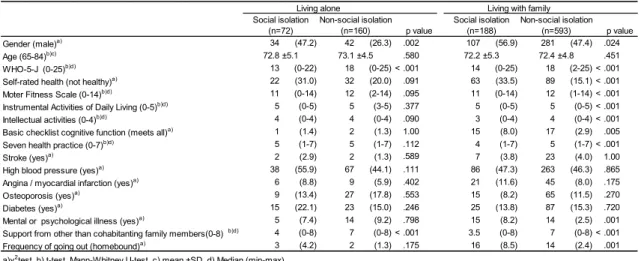
Using bivariate analysis, gender (p<.024), WHO-5-J (p<.001), self-rated health (p<.001), MFS (p<.001), IADL (p<.001), intellectual activities (p<.001), cognitive function items from the basic checklist (p<.005), seven health practice (p<.001), absence/presence of mental or psychological illness (p<.001), social support from persons other than cohabiting family
(p<.001) and going out the home (p<.001) were significantly associated with social isolation for living with family status. Regarding living alone status, gender (p<.002), WHO-5-J (p<.001), and social support from persons other than cohabiting family (p<.001) showed significant association with social isolation (Table 2).
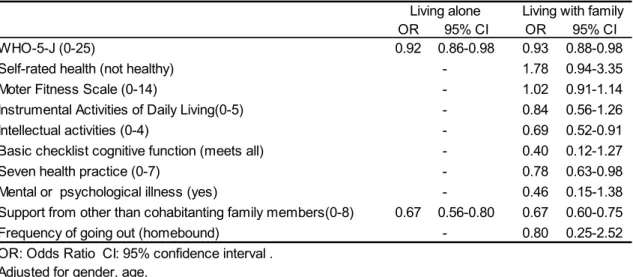
Results of the multivariate analysis are presented in table 3. For people living with family, WHO-5 (OR = 0.93, 95% CI 0.88–0.98), social support from persons other than the cohabiting family (OR = 0.67, 95% CI 0.60–0.75), intellectual activities (OR = 0.69, 95% CI 0.52–0.91), and the seven health practices (OR = 0.78, 95% CI 0.63–0.98) were associated with being socially isolated. On the other hand, for people living alone, WHO-5 (OR = 0.92, 95% CI 0.86–
0.98) and social support from persons other than the cohabiting family (OR = 0.67, 95% CI 0.56–0.80) were associated with being socially isolated.
Discussion
Prevalence of isolation
The overall prevalence of social isolation in this study was 25.7%, including 31.0% for living
alone status and 24.1% for living with family status. Previous studies from Japan and other
countries reported various overall prevalence of social isolation. Kurimoto et al. (2011) used
LSNS-6 and reported a prevalence of 19.4% among 55 years and older in a community in
Tohoku region, Japan. Age differences and stratification by household composition might
explain the difference. In our study, elderly were stratified based on the household composition
whereas in the study by Kurimoto et al., they were not. While the subjects in our study ranged from 65 to 84 years of age, Kurimoto et al.’s (2011) study included individuals who were late middle-aged and employed with broader social networks. In addition, compared to other studies conducted elsewhere using the LSNS-6 (Hamburg 20%, Solothurn 11%, London 15%; Lubben et al., 2006), our study revealed a higher prevalence of social isolation for both living alone and living with family status. Indeed, according to a survey by the Organization for Economic Cooperation and Development (OECD) called Society at a Glance 2005 OECD Social Indicators, with 34 member countries, Japan ranked last out of 20 countries for having
absolutely no relationships with friends/colleagues or people in religious/sports/cultural groups, with 15.3% of the responses. Although the ages of the respondents in the OECD survey were not limited to elderly, this highlights the lack of personal interaction of Japanese people.
Furthermore, some studies have shown that elderly people in Japan tend to have close relationships limited to spouses and children whereas in the United States, such a close
relationships commonly extend to relatives (Fujisaki, 1998). Thus, it is likely that elderly people in Japan are satisfied with interactions with family living together. Consequently, there are fewer interactions with others and a narrower social network among elderly in Japan than those of the same age group in the United States.
Our study found a higher prevalence of social isolation in elderly individuals living alone
compared with those living with family. In contrast, the prevalence of social isolation measured
by Saito et al. assessing the frequency of interaction with people other than cohabiting family
members (2010a) in Japan was 24.1% for living alone status and 28.7% for living with family
status, showing no marked difference in the prevalence between the two. The difference might
be due to the differences in social isolation measurement indicators. It measured frequency of
contact without person living with family and the more consistently stable social networks that
elderly living with family have because of close interaction on a daily basis with other people.
Factors related to Social isolation by household composition
A one- point drop in the scores for mental health and for social support from persons other than cohabiting family increased the risk of social isolation by 1.09 and 1.50 for elderly living alone, and 1.08 and 1.50(reciprocal number) for elderly living with family, respectively. For only those living with family, each one point drop in the scores for intellectual activities and for the seven health practice increased the social isolation risk by 1.46 and, 1.28 ( reciprocal number),
respectively. Taken together, there are shared factors related to social isolation for elderly living alone and those living with family and these factors highlight the necessity to take steps to prevent social isolation in community-dwelling elderly, regardless of household composition.
A previous study using the LSNS-6 (Iliffe et al., 2007) reported a relationship between social isolation and depression tendency, and this is in agreement with our findings. Furthermore, Harlow et al. (1991) reported that having more friends was consistently associated with lower levels of depressive symptomatology, which is in accordance with our findings. In addition, using their own isolation scale, Roberts et al. (1997) reported that social isolation could predict depression. The scale differed from the LSNS-6 as there was no family and friend subscale, and the measurement asked for the number of close family and friends unitarily. Even when living with other family members, persons who have few conversations and interactions with other people may have fewer opportunities to alleviate their stress and anxiety by expressing them, and this could cause a poor mental health. The elderly who have few friends or family members with whom they feel close to may fall in that state. Furthermore, people with a poor mental health may have difficulty maintaining good relationships with family and friends, resulting in reduced interactions. Therefore, steps should be taken to prevent social isolation, which, in turn, will help promote mental health.
Our study showed that social isolation was associated with low social support from people
other than family members. Similar results were obtained in a longitudinal study with women
with breast cancer, which reported a high risk of death among socially isolated individuals, who
did not have support other than cohabiting family members. The study used the Berkman-Syme Social Networks Index for measuring social isolation. The discussion of study highlighted the lack of care or nursing by close relatives, friends, or children living together (Kroenke,
Kubzansky, Schernhammer, Holmes, & Kawachi, 2006). Using the LSNS-6, a report showed a relationship between social isolation and lack of emotional and instrumental support (Blozik et al., 2009). For elderly living with family, it is likely that limiting interaction to only family members might have reduced interactions with friends and relatives, thus preventing them to receive social support from other than cohabiting family members.
Furthermore, while this study reported a median score of 12 out of a possible 14 points on the MFS, another study reported an average score of 10 points for subjects desiring to participate in exercise group activities for community-dwelling elderly people from 70–84 years of age in Japan (Gotou, Niu, & Nagatomi, 2010). The higher score obtained in our study might be indicative of independence and an overall good physical strength. Therefore, family members and other people with whom elderly people interact in their daily lives might be just monitoring instead of actually providing care, which such socially isolated people may be regarded as being unable to obtain social support. In addition, a previous study using the LSNS-6 in British Columbia on social isolation and social support from persons other than family members through home visit care, etc., found no relationship between the two (Kobayashi, Cloutier- Fisher, & Roth, 2009). However, their subjects were elderly persons who likely had home visit care and their level of independence was different from that of our subjects, which may have led to a different result.
In this study, low intellectual activities and poor health practices were identified as factors
related to social isolation of elderly living with family. To the best of our knowledge, this is the
first study to report such an association. Intellectual activity comprises four items, including
being able to complete pension paperwork or other paperwork, reading newspapers, reading
books or magazines, and showing interest in articles or magazines about health. Although clear
explanation for this relationship has yet to be established, possible pathways could be suggested.
Indeed, it has been reported in Japan that individuals with high intellectual activities tend to consume more meat and animal products including milk (Kumagaya et al., 1995). In addition, Iwasa et al. (2010) reported th at openness might be related to intellectual activity. Thus, it is possible to make a connection linking social isolation, a protein-rich diet (meat, dairy), and openness. A negative or passive attitude toward health-related behavior and lack of openness could result in social isolation, even when cohabiting with someone. Despite these speculations, we believe that our findings deserve attention and need to be explored by other studies.
Earlier studies have demonstrated a relationship between the LSNS-10 and health practice (Lubben, 1988), and this was shown in this study as well. In addition, we found a relationship between the abbreviated LSNS-6 and seven health practices. The lifestyle differences between elderly people and cohabiting family members may lead to a disconnect with each other, decrease interactions, and cause social isolation of elderly people.
In this study, several differences in factors related to social isolation between elderly living alone and those living with family were considered to be due to differences in their background.
Such differences in related factors may have been stemmed from mutual interactions, good or bad relationships between the elderly persons and their cohabitants, or conditions of shared households. In addition, it may have been difficult to obtain clear results because a few were elderly living alone or in social isolation. Larger scale data may help reveal factors behind social isolation.
As for cognitive function and self-rated health, we found a relationship in this study by bivariate analysis for social isolation of elderly living with family but not in multivariate analysis. Previous studies demonstrated associations between social isolation and cognitive function (Iliffe et al., 2007) and self-rated health (Iliffe et al., 2007; Kobayashi, Cloutier-Fisher,
& Roth, 2007) in the multivariate analysis using the LSNS-6. The differences in results of
cognitive function between the previous studies and ours were probably due to a difference in
accuracy in the scale as we used a 3-item scale. While self-rated health was not discussed in this paper, a slight positive correlation was observed between mental health state and self-rated health. It is thought that the results of previous studies were different due to the strong relationship between social isolation and mental health state.
To provide support for preventing social isolation in community-dwelling elderly people regardless of household composition, it is important to maintain and promote mental health, to deepen relationships with old friends, and to provide support through social or cultural
activities. For elderly people who live with others, and for their family as well, maintaining and promoting intellectual activities and In addition providing support for desirable health practice while providing health-related information are needed.
Limitations
The scope of this study was limited because findings were restricted to one district of an urban area in Japan. This study was based on cross-sectional data, therefore we could not establish the causal relationship between social isolation and those factors. Because there were few elderly living alone in social isolation, caution is advised when generalizing these findings.
Regarding individuals living with elderly, there was a mix of married couples, parents, and children or some elderly lived in multigenerational households, suggesting a variety of relationships with living partners and a diversity of social isolation in individuals living with others. Therefore, further study needed because socially isolated individuals have narrow social networks and this study did not measure how satisfied these individuals were with limited interactions with family or friends.
Significance of this study and Future Research
In Japan, this was the first study to use the LSNS-6 to determine the prevalence of social
isolation by household composition and to investigate related factors. This study revealed poor
mental health and lack of social support from other than cohabitating family members as factors related to social isolation in elderly living alone and those living with family. In addition, low intellectual activities and poor health practice were associated with social isolation in elderly living with family.
It is hoped that large-scale and longitudinal studies will be conducted to investigate social isolation in detail and to examine cause–effect relationships behind social isolation.
Declaration of Conflicting Interests
The authors declared no potential conflicts of interest with respect to the research, authorship, and /or publication of this article.
Funding
Authors disclose that they received following supports for their research and/or authorship of this article: Grant-in-Aid for Scientific Research(C), Grant-in-Aid for Young Scientists (B) from Grant-in-Aid for Scientific Research (KAKENHI), and Research Grant for The Universe Foundation.
References
Awata, S., Bech, P., Koizumi, Y., Seki, T., Kuriyama, S., Hozawa, A., Ohmori, K., Nakaya, N., Matsuoka, H., & Tsuji, I. (2007).Validity and utility of the Japanese version of the WHO- Five Well-Being Index in the context of detecting suicidal ideation in elderly community residents. International psychogeriatrics, 19(1), 77-88.
Belloc, N.B., & Breslow, L. (1972). Relationship of physical health status and health practices.
Preventive Medicine. 1 (3), 409-421.
Blozik, E., Wagner, J. T., Gillmann, G., Iliffe, S., von, Renteln-Kruse. W., Lubben, J., Beck, J.
C., Stuck, A. E., & Clough-Gorr, K.M. (2009). Social network assessment in community-
dwelling older persons: results from a study of three European populations. Aging clinical and experimental research, 21 (2), 150-157.
Chappell, N.L., & Badger, M. (1989). Social isolation and well-being. Journal of gerontology.
44 (5), 169-176.
Cornwell, E. Y., & Waite, L. J. (2009).Measuring social isolation among older adults using multiple indicators from the NSHAP study. The journals of gerontology. Series B, Psychological sciences and social sciences. 64, 38-46.
De Jong Gierveld, J., Van Tilburg, T., & Dykstra, P. A. (2006). Loneliness and Social isolation.
In A. Vangelisti, A., & Perlman, D. (Eds), Cambridge Handbook of Personal Relationships (pp. 485-499). Cambridge: Cambridge University Press.
Fujisaki, H. (1998).Elderly, family and social network (Modern family issues series: 4) (pp. 22- 35). Tokyo: Baifukan. (In Japanese)
Gotou, T., Niu, K., & Nagatomi, R. (2010). Prevention of decline in subjective physical functioning of older people by regular participation in a community based exercise group.
Japanese Journal of Geriatrics, 47(6), 601-610. (In Japanese)
Graphical Review of Japanese Household. From Comprehensive Survey of Living Conditions.
Ministry of Health, Labour and Welfare’s secretariat information. (2010). Retrieved from http://www.mhlw.go.jp/toukei/list/dl/20-21-01.pdf
Harlow, S. D., Goldberg, E.L., & Comstock, G. W. (1991). A longitudinal study of risk factors for depressive symptomatology in elderly widowed and married women. American journal of epidemiology, 134(5), 526-538.
Iliffe, S., Kharicha, K., Harari, D., Swift, C., Gillmann, G., & Stuck, A. E. (2007). Health risk
appraisal in older people 2: the implications for clinicians and commissioners of social
isolation risk in older people. The British journal of general practice, 57(537), 277-282.
Iwasa, H., Masui, Y., Gondo, Y., Kawai, C., & Inagaki, H. (2010). The five-factor model of the personality and higher-level competence decline among Japanese community-dwelling older adults. Japanese Journal of Gerontology, 31(4), 449-457. (In Japanese)
Kinugasa, T., & Nagasaki, H. (1998). Reliability and validity of the Motor Fitness Scale for older adults in the community. Aging: clinical and experimental research, 10(4), 295-302.
Kurimoto, A., Awata, S., Ohkubo, T., Tsubota-Utsugi, M., Asayama, K., Takahashi, K., Suenaga, K., Satoh, H., & Imai, Y. (2011). Reliability and validity of the Japanese version of the abbreviated Lubben Social Network Scale. Japanese Journal of Geriatrics, 48 (2), 149- 157. (In Japanese)
Kawai, K. (2002).Social Isolation, security and welfare problems among the elderly in urban areas, focusing on the living conditions of the single-living elderly in Minato Ward, Tokyo. Shakai seisakugaku, 7, 118-131. (In Japanese)
Kobayashi, E., Fujiwara, Y., Fukaya, T., Nishi, M., Saito, M., & Shinkai, S. (2011). Social support availability and psychological well-being among the socially isolated elderly differences by living arrangement and gender, Japanese Journal of Public Health. 58(6), 446-456. (In Japanese)
Kobayashi, K.M., Cloutier-Fisher, D., & Roth, M. (2009). Making meaningful connections: a profile of social isolation and health among older adults in small town and small city, British Columbia. Journal of Aging and Health, 21(2), 374-397.
Koyano, W., Shibata, H., Nakazato, K., Haga, H., &Suyama, Y. (1991). Measurement of competence: reliability and validity of the TMIG Index of Competence. Archives of Gerontology and Geriatrics, 13(2), 103-116.
Kroenke, C.H., Kubzansky, L. D., Schernhammer, E. S., Holmes, M.D., &Kawachi, I.
(2006).Social networks, social support, and survival after breast cancer diagnosis.
Journal of clinical oncology. 24(7):1105-1111.
Kumagai, O., Shibata, H., Watanabe, S., Amano, H., Suzuki, T., Nagai, H., Haga, H.,
&Yasumura, S. (1995). Relationship of dietary patterns to change in functional capacity (intellectual activities) in the community dwelling elderly. Japanese Journal of
Gerontology, 3, 146-155. (In Japanese)
LaVeist, T. A., Sellers, R. M., Brown, K. A., & Nickerson, K. J. (1997). Extreme social
isolation, use of community-based senior support services, and mortality among African American elderly women. American journal of community psychology, 25(5), 721-732.
Lubben, J. E. (1988). Assessing social networks among elderly populations. Family &
Community Health, 11(3), 42-52.
Lubben, J. E., Blozik, E., Gillmann, G., Iliffe, S., von Renteln Kruse, W., Beck, J. C., & Stuck, A. E. (2006). Performance of an abbreviated version of the Lubben Social Network Scale among three European community-dwelling older adult populations. The Gerontologist.
6(4), 503-513.
Matsuzawa, A., Tamiya, N., Yamamoto, H., Yamazaki, K., Motozawa, M., & Miyaishi, S.
(2009). The background factors of the deaths of elderly people using forensic autopsy cases in Japan: The prevention of solitary deaths. Journal of Health and Welfare Statistics. 56(2), 1-7. (In Japanese)
Noguchi, Y. (1991).The concept and measurement of social support for the elderly. Shakai Rounengaku, 34, 37-48. (In Japanese)
Organization for Economic Cooperation and Development (OECD). (2005).Social Cohesion Indicators. Society at a Glance 2005 OECD Social Indicators. Retrieved from
http://www.oecd-ilibrary.org/social-issues-migration-health/society-at-a-glance- 2005/social-cohesion-indicators_soc_glance-2005-8-en
Roberts, R. E., Kaplan, G. A., Shema, S. J., & Strawbridge, W. J. (1997). Does growing old
increase the risk for depression?. The American Journal of Psychiatry, 154(10), 1384-
1390.
Saito, M., Fujiwara, Y., Kobayashi, E., Fukaya, T., Nishi, M., & Shinkai, S. (2010a).Prevalence and characteristics of social isolation in the elderly in a dormitory suburb according to household composition. Japanese Journal of Public Health, 57(9), 785-795. (In Japanese)
Saito, M., Shimizu, Y., & Takei, S. (2010b). Relationship between the trajectory of living alone and social isolation of the elderly in an urban area. Japanese Journal of Gerontology, 31(4), 470-480. (In Japanese)
Saito, M., Shimizu, Y., Yamaguchi, M., & Takei, S. (2009). Prevalence and Characteristics of the Socially Isolated Elderly in a Large Urban Area. Japanese journal of social services, 50(1), 110-122. (In Japanese)
Townsend, P. (Eds.). (1963). Isolation, Loneliness, and the Hold on Life. The Family life of old people; An inquiry in East London, 188-205. Penguin Books.
Townsend, P., (1968). Isolation, desolation, and loneliness. In Shanas, E., Townsend, P. &
Wedderburn, D. (eds.), Old People in Three Industrial Societies, 258-287. Routledge, London.
World Health Organization. (2002). Active ageing: A policy framework. Geneva, Switzerland.
Yasumura, S. (2006). Prevention and support of homebound elderly in the new long-term care
insurance system. Japanese Journal of Gerontology, 27(4), 453-459. (In Japanese)
Social isolation
Figure 1. LSNS-6 score distribution by household composition
Living alone Living with family
n
Poi nts Poi nts
0 10 20 30 40 50 60 70
0 1 3 4 5 6 7 8 9 10 11 12 13 14 15 16 17 18 19 20 21 22 23 24 25 26 27 29 30 n
0 10 20 30 40 50 60 70
0 1 2 3 4 5 6 7 8 9 101112131415161718192021222324252627282930 n
Table 1. Characteristics and comparison by household composition
n
%n
%p value
Social isolation (0-11) 72 (31.0) 188 (24.1) .040
Gender (male) 76 (32.8) 388 (49.7) < .001
Age (65-84)
a)73.0 ± 4.7 72.4 ± 4.9 .044
WHO-5-J (0-25)
b)17 (0-25) 17 (0-25) .093
Self-rated health (not healthy) 54 (23.4) 152 (19.6) .227
Moter Fitness Scale (0-14)
b)11 (0-14) 12 (0-14) .028
Instrumental Activities of Daily Living (0-5)
b)5 (0-5) 5 (0-5) < .001
Intellectual activities (0-4)
b)4 (0-4) 4 (0-4) .985
Basic checklist cognitive function (meets all) 3 (1.3) 32 (4.1) .040
Seven health practice (0-7)
b)5 (1-7) 5 (1-7) .297
Stroke (yes) 4 (1.8) 30 (4.0) .146
High blood pressure (yes) 105 (47.7) 349 (46.5) .759
Angina / myocardial infarction (yes) 15 (6.8) 66 (8.9) .407
Osteoporosis (yes) 36 (16.4) 80 (10.7) .025
Diabetes (yes) 38 (17.2) 112 (15.0) .459
Mental or psychological illness (yes) 19 (8.6) 29 (3.9) .007
Support from other than cohabitanting family members (0-8)
b)7 (0-8) 6 (0-8) .533
Frequency of going out (homebound) 5 (2.2) 30 (3.9) .305
a)
Mean ± SD,
b)Median(min-max) Note. N varies due to somemissing values.
Living alone (n=232) Living with family (n=781)
Table 2. Social isolation and Non-social isolation comparison by household composition
p value p value
Gender (male)a) 34 (47.2) 42 (26.3) .002 107 (56.9) 281 (47.4) .024
Age (65-84)b)c) 72.8 ±5.1 73.1 ±4.5 .580 72.2 ±5.3 72.4 ±4.8 .451
WHO-5-J (0-25)b)d) 13 (0-22) 18 (0-25) < .001 14 (0-25) 18 (2-25) < .001
Self-rated health (not healthy)a) 22 (31.0) 32 (20.0) .091 63 (33.5) 89 (15.1) < .001
Moter Fitness Scale (0-14)b)d) 11 (0-14) 12 (2-14) .095 11 (0-14) 12 (1-14) < .001
Instrumental Activities of Daily Living (0-5)b)d) 5 (0-5) 5 (3-5) .377 5 (0-5) 5 (0-5) < .001
Intellectual activities (0-4)b)d) 4 (0-4) 4 (0-4) .090 3 (0-4) 4 (0-4) < .001
Basic checklist cognitive function (meets all)a) 1 (1.4) 2 (1.3) 1.00 15 (8.0) 17 (2.9) .005
Seven health practice (0-7)b)d) 5 (1-7) 5 (1-7) .112 4 (1-7) 5 (1-7) < .001
Stroke (yes)a) 2 (2.9) 2 (1.3) .589 7 (3.8) 23 (4.0) 1.00
High blood pressure (yes)a) 38 (55.9) 67 (44.1) .111 86 (47.3) 263 (46.3) .865
Angina / myocardial infarction (yes)a) 6 (8.8) 9 (5.9) .402 21 (11.6) 45 (8.0) .175
Osteoporosis (yes)a) 9 (13.4) 27 (17.8) .553 15 (8.2) 65 (11.5) .270
Diabetes (yes)a) 15 (22.1) 23 (15.0) .246 25 (13.8) 87 (15.3) .720
Mental or psychological illness (yes)a) 5 (7.4) 14 (9.2) .798 15 (8.2) 14 (2.5) .001
Support from other than cohabitanting family members(0-8) b)d) 4 (0-8) 7 (0-8) < .001 3.5 (0-8) 7 (0-8) < .001
Frequency of going out (homebound)a) 3 (4.2) 2 (1.3) .175 16 (8.5) 14 (2.4) .001
Note. N varies due to somemissing values
(n=72) (n=160) (n=188) (n=593)
a)χ2test, b) t-test, Mann-Whitney U-test, c) mean ±SD, d) Median (min-max)
Living alone Living with family
Social isolation Non-social isolation Social isolation Non-social isolation