The investigation of pellicle peelability on Japanese chestnut cultivar of Yakko
(Castanea crenata Sieb. et Zucc.)
journal or
publication title
Scientia Horticulturae
volume 234
page range 146‑151
year 2018‑04‑14
URL http://id.nii.ac.jp/1578/00002455/
doi: 10.1016/j.scienta.2018.02.029
Title: The investigation of pellicle peelability on Japanese chestnut cultivar of ‘Yakko’
1
(Castanea crenata Sieb. et Zucc.)
2 3
Author(s): Norio Takadaa,*, Masahiko Yamadab, Sogo Nishioa, Hidenori Katoa, Yutaka
4
Sawamuraa, Akihiko Satoc, Noriyuki Onouec, and Toshihiro Saitoa
5 6
Author affiliation:
7
a Institute of Fruit Tree and Tea Science, NARO 2-1 Fujimoto, Tsukuba, Ibaraki 305-
8
8605, Japan
9
b College of Bioresource Sciences, Nihon University, 1866 Kameino, Fujisawa,
10
Kanagawa 252-0880, Japan
11
c Division of Grape and Persimmon Research, Institute of Fruit Tree and Tea Science
12
NARO, Akitsu, Higashihiroshima, Hiroshima 729-2494, Japan
13 14
*Corresponding author.
15
E-mail address: [email protected] (N. Takada).
16
*Manuscript
Click here to view linked References
Abstract
17
Japanese chestnuts (Castanea crenata Sieb. et Zucc.) generally have difficult-
18
peeling pellicles even after heating, making easy-peeling pellicle (EPP) an important
19
breeding target. Recently, EPP cultivars ‘Porotan’ and ‘Porosuke’ were released by a
20
government-funded breeding program. However, very few genotypes carry the major
21
recessive gene responsible for the EPP trait, resulting in inbreeding within a narrow
22
gene pool. To discover other genetic materials having the potential for EPP breeding,
23
we evaluated the pellicle peelability of 59 accessions (51 Japanese local cultivars and 8
24
wild individuals) by using the high-temperature oil peeling method. We discovered that
25
‘Yakko’ had an exceptionally high pellicle peelability score (87%), close to that of
26
‘Porotan’ (94%). The results of segregation ratio analysis of pellicle peelability and
27
genotype prediction by simple sequence repeat (SSR) markers among F1 seedlings
28
suggested that the EPP alleles of ‘Porotan’ and ‘Yakko’ are at the same locus. However,
29
a haplotype structure analysis of the EPP genome region with SSR markers revealed
30
that both haplotypes of ‘Yakko’ differed from those of ‘Porotan’, suggesting that the
31
EPP gene of ‘Yakko’ had a different origin from that of ‘Porotan’ or was inherited from
32
a common ancestor many generations ago.
33 34
Keywords: Japanese chestnut, Breeding, Haplotype, Inbreeding, Pellicle peelability
35 36
Highlights
37
● Pellicle peelability was evaluated in 59 Japanese chestnut accessions.
38
● The goal was to detect accessions with easily peeled pellicles.
39
● The pellicle peelability of ‘Yakko’ was exceptionally high.
40
● Peelability of ‘Yakko’ and ‘Porotan’ appears to be controlled by the same locus.
41 42
Abbreviations
43
APR, average peeling rate; DPP, difficult-peeling pellicle; EPP, easy-peeling pellicle;
44
HOP, high-temperature oil peeling; MAS, marker-assisted selection; NARO, National
45
Agriculture and Food Research Organization; NIFTS, Institute of Fruit Tree and Tea
46
Science, NARO; QTLs, quantitative trait loci; SSR, simple sequence repeats
47 48
1. Introduction
49
There are four major chestnut species: Japanese chestnut (Castanea crenata Sieb.
50
et Zucc.), Chinese chestnut (C. mollissima Bl.), European chestnut (C. sativa Mill.), and
51
American chestnut (C. dentata Borkh.). Japanese chestnut is naturally distributed and is
52
grown in Japan and the Korean Peninsula, and many local cultivars have been
53
developed in Japan (Pereira-Lorenzo et al., 2012). Chinese chestnut is grown mainly in
54
China. European chestnut is commercially grown in Europe, Asia Minor, and North
55
Africa. American chestnut was a common species in eastern North America until the
56
early 20th century, when it was decimated by the accidental introduction of chestnut
57
blight (Woodroof, 1979). Japanese chestnut cultivars are believed to have been selected
58
from wild chestnuts of Japanese origin (Kotobuki, 1994). This hypothesis is supported
59
by the considerable genetic distance between local Japanese chestnut cultivars and
60
Chinese chestnut accessions, as determined using amplified fragment length
61
polymorphism markers (Yamamoto et al., 1998).
62
Many cultivars of Chinese chestnut and European chestnut have a pellicle that is
63
easy to peel (hereafter, an easy-peeling pellicle: EPP). In contrast, Japanese chestnut
64
cultivars generally have a pellicle that is difficult to peel (hereafter, a difficult-peeling
65
pellicle: DPP), even after heating (Kikuchi, 1948; Miller et al., 1996; Pereira-Lorenzo et
66
al., 2012; Tanaka et al., 1981). The pellicle of Japanese chestnut can be scraped away by
67
hand using a knife, but this is laborious and costly. Thus, releasing new Japanese
68
chestnut cultivars with EPP has been an important target for Japanese chestnut breeding,
69
in addition to large nut size, high eating quality, and high productivity. This program
70
started in 1947 at a national level and is currently managed by the Institute of Fruit Tree
71
Recently, the breeding program released two Japanese chestnut cultivars with the EPP
73
trait: ‘Porotan’ in 2006 (Saito et al., 2009) and ‘Porosuke’ in 2016 (Saito et al., 2017).
74
The area planted to ‘Porotan’ has been increasing rapidly, reaching 212 ha in 2014. The
75
EPP trait of ‘Porotan’ is controlled by a single major recessive gene: the pellicle
76
peelability locus has been designated P/p (Takada et al., 2012), and a molecular marker
77
linked to this locus was developed (Nishio et al., 2013). Today, marker-assisted
78
selection (MAS) is available for the EPP trait in cross-derived populations, allowing
79
selection using large seedling populations and eliminating the need to raise the plants
80
until they are old enough to produce nuts, which is laborious and time-consuming.
81
So far, very few genotypes (offspring, selections, or cultivars) have been found to
82
carry the EPP gene. This is a concern because repeated crossing among specific genetic
83
resources within a narrow gene pool results in inbreeding depression, such as decreased
84
tree vigor and productivity, in woody fruit crops, including Japanese pear (Sato et al.,
85
2008) and persimmon (Yamada et al., 1994). This depression has not yet been observed
86
in Japanese chestnut, but based on the results for other tree species, seems likely to
87
develop as breeding progresses. Outcrossing can mitigate or eliminate inbreeding
88
depression by incorporating genes from accessions that are genetically distant from the
89
current cross parents in breeding, thus increasing genetic diversity.
90
Both ‘Porotan’ and ‘Porosuke’ are early-maturing cultivars, which results in early
91
cessation of EPP nut production in areas of cultivation and a concentration of harvest
92
dates within a brief period. Therefore, the development of a mid- or late-maturing
93
cultivar with EPP, which would extend the season when fresh nuts are available and
94
give farmers more time to harvest their crops, is a current chestnut breeding target at
95
NIFTS. Kotobuki et al. (1984) suggested that nut harvest time is controlled by
96
quantitative trait loci (QTLs), and Nishio et al. (2017) detected QTLs for nut harvesting
97
date. Thus, we wish to identify later-ripening Japanese chestnut accessions with some
98
level of EPP as cross parents for the breeding of mid- or late-maturing cultivars.
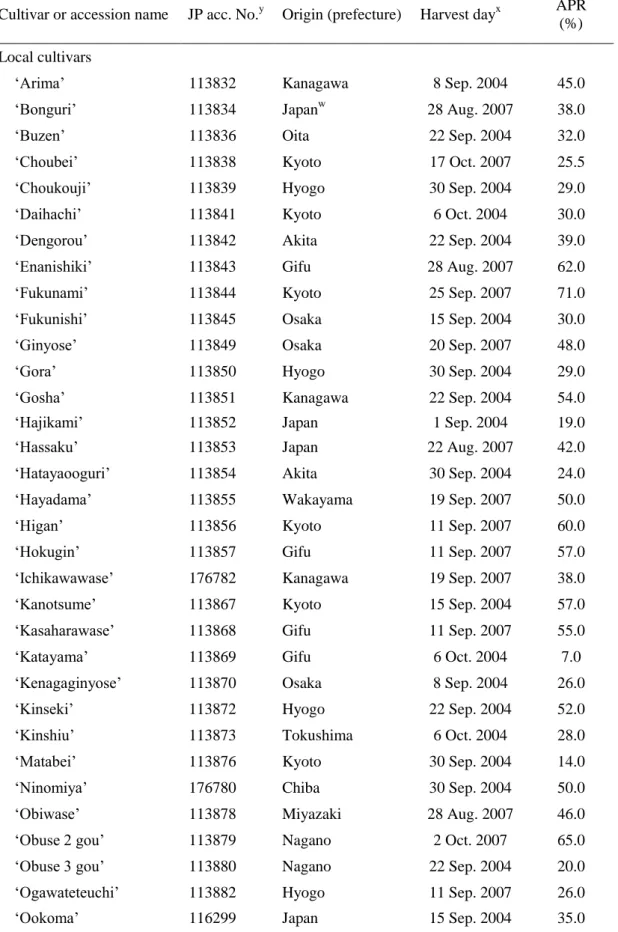
99
In books published about a century ago, Nakaoka (1913), Yagioka (1915), and
100
Tanaka (1933) described local Japanese chestnut cultivars having EPP on the basis of
101
their observations, but they did not report any test results. This suggests that some
102
unidentified EPP genotypes might exist among Japanese chestnut genetic resources,
103
including the local cultivars mentioned in those books. Our previous study suggested
104
the possibility of breeding novel EPP cultivars by crossing among DPP accessions with
105
relatively easily peeled pellicles (Takada et al., 2017). Thus, it is necessary to identify
106
accessions with relatively high pellicle peelability for breeding novel EPP cultivars. The
107
objective of this study was to discover Japanese chestnut accessions with the EPP trait
108
or with relatively high pellicle peelability by surveying 59 Japanese chestnut accessions
109
that were not included our previous study (Takada et al., 2017).
110 111
2. Materials and methods
112
2.1. Pellicle peelability of 51 local cultivars and 8 wild individuals
113
We tested a total of 59 Japanese chestnut accessions, consisting of 51 local
114
cultivars and 8 wild individuals, and used ‘Porotan’ as the standard for the EPP trait
115
(Table 1). We grew one tree per accession at NIFTS, in Tsukuba, Ibaraki (36°02ʹ56ʺN,
116
140°05ʹ56ʺE), Japan. The pellicle peelability of each accession was evaluated in either
117
2004 or 2007 (Table 1). All trees were grown following standard cultural techniques
118
used in commercial production in Japan.
119
The harvest day for each accession was the first day that ≥10 nuts could be
120
harvested. In 2004, it ranged from 25 August for ‘Yamaguchiwase’ to 6 October for
121
‘Daihachi’, ‘Katayama’, and ‘Kinshiu’. In 2007, it ranged from 22 August for
122
‘Hassaku’, ‘Tanabata’, and ‘Toyotamawase’ to 17 October for ‘Choubei’ and
123
‘Shimokatsugi’. Among the 33 accessions harvested in 2004, 24 were harvested again
124
in 2007. The average harvest day of these 24 accessions was 18 September in 2004 and
125
27 September in 2007.Although there was a difference of about 10 days in mean
126
harvest day between the two years, the relative maturities of the accessions were similar
127
in each of the two years. Nuts were harvested after the bur opened and were then stored
128
at 5 °C for 1 month.
129
Ten nuts per accession were randomly used to evaluate pellicle peelability. For
130
accessions harvested in both 2004 and 2007, peelability was assessed only in 2004.
131
After the shells were removed, the nuts were fried in canola oil at 190 °C for 2 min (the
132
high-temperature oil peeling [HOP] method; Shoda et al., 2006). The pellicle peelability
133
of each nut was then determined by means of hand-peeling with a paring knife and was
134
scored by visual estimation of the percentage of the surface area that peeled away
135
without scraping (“peeling rate”), on a scale graded in 10% increments, where “0%”
136
represents 0%, “5%” represents 0%< and ≤10%, “15%” represents 10%< and ≤20%, …
137
“85%” represents 80%< and ≤90%, and “95%” represents 90%< and ≤100% (Takada et
138
al., 2017). Pellicle peelability was quantified as the average peeling rate of 10 nuts per
139
genotype evaluated (APR; %). The accessions with APR values ≥75% were classified
140
as EPP; those with APR <75% were considered DPP.
141 142
2.2. Inheritance of pellicle peelability of ‘Yakko’
143
As described in Results, ‘Yakko’ had an exceptionally high APR value relative to
144
the other accessions, suggesting that it has a major EPP gene. To test whether the mode
145
of inheritance of pellicle peelability of ‘Yakko’ was the same as that of ‘Porotan’, we
146
examined the segregation ratio of pellicle peelability among F1 seedlings of crosses
147
made using ‘Yakko’ as a parent. We crossed ‘Porotan’ (p/p) × ‘Yakko’ in 2006 and
148
2010, and ‘Tanzawa’ (P/p) × ‘Yakko’ in 2005 and 2006. ‘Tanzawa’ was previously
149
shown to be heterozygous for the p allele found in ‘Porotan’ (Takada et al., 2012;
150
Nishio et al., 2013). Two-year-old offspring were planted in a space of 2 m × 5 m in the
151
NIFTS orchard. Nuts were harvested from each seedling of ‘Tanzawa’ × ‘Yakko’ in
152
2011 and of ‘Porotan’ × ‘Yakko’ in 2013 after the bur opened and stored at 5 °C for 1
153
month. Ten nuts from each seedling were randomly evaluated for pellicle peelability by
154
the HOP method as described in section 2.1. As above, seedlings having average APR
155
values of ≥75% were regarded as EPP. The segregation ratio of pellicle peelability for
156
the seedlings of ‘Tanzawa’ × ‘Yakko’ was tested by the chi-square goodness-of-fit test
157
for the hypotheses of a 1:1 segregation ratio.
158 159
2.3.Association between pellicle peelability and genotype estimated by simple sequence
160
repeat markers
161
Because ‘Yakko’ had an exceptionally high APR value, similar to that of
162
‘Porotan’, we hypothesized that both cultivars had the same p/p genotype. Thus, we
163
estimated the pellicle peelability genotypes of F1 seedlings derived from ‘Tanzawa’
164
(P/p) × ‘Yakko’ (described in section 2.2) by determining which allele from ‘Tanzawa’
165
was present in each seedling. Two simple sequence repeat (SSR) markers closely linked
166
to the P/p locus of ‘Tanzawa’ (PRB28 and PEB62; Nishio et al., 2013) were used to
167
genotype each seedling.
168
Genomic DNA was extracted from young leaves or young buds using a DNeasy
169
Plant Mini Kit (Qiagen, Hilden, Germany) according to the manufacturer’s instructions.
170
Polymerase chain reaction products were separated and detected with a 3130xl Genetic
171
Analyzer (Life Technologies, Carlsbad, CA, USA). The size of each amplified band was
172
determined by comparison with a set of internal standard DNA fragments (400HD-ROX,
173
Life Technologies) in GeneMapper v. 5.0 software (Life Technologies).
174 175
2.4 Haplotype structure around the P/p locus of ‘Yakko’ and ‘Porotan’
176
To determine the haplotype structure around the P/p locus of ‘Yakko’ and
177
‘Porotan’, we investigated an F1 population derived from ‘Porotan’ × ‘Yakko’
178
(described in section 2.2). Genomic DNA was extracted as in section 2.3. The seedlings
179
were genotyped using 10 SSR markers associated with the P gene locus (PEA18,
180
PEA41, PEB62, PEB102, PRA51, PRB25, PRB28, PRD2, PRD52, PRD58; Nishio et
181
al., 2013). The size of each amplified band was determined as described in section 2.3.
182
The order and spacing of the markers were obtained from Nishio et al. (2013).
183
The fragment sizes of SSR markers PRA51 and PRB25 were 19 bp and 20 bp
184
larger, respectively, than those reported previously (Nishio et al., 2013). These size
185
differences are explained by a change in the forward primers from M13-tailed primers
186
(Schuelke, 2000) to fluorescently labeled primers. In addition, since the DNA sequencer
187
was changed from a PRISM 3100 DNA sequencer (Applied Biosystems, Carlsbad, CA,
188
USA) to a 3130xl Genetic Analyzer, a difference of 1 bp was found in some markers
189
(PRD2, PRB28, PEB62, PRD58) relative to the results of Nishio et al. (2013).
190
191
3. Results
192
3.1. Pellicle peelability of 51 local cultivars and 8 wild individuals
193
The APR of the 59 accessions and ‘Porotan’ ranged from 7.0% in ‘Katayama’ to
194
94.0% in ‘Porotan’ (Table 1). The frequency distribution of the APR values was
195
continuous in the 58 accessions with APR < 75% (Fig. 1). ‘Porotan’ and ‘Yakko’ had
196
exceptionally high APR values, which were discontinuous with those of the other
197
accessions (Fig. 1). The APR value of ‘Yakko’ was 87.0% and close to that of ‘Porotan’,
198
and only these two cultivars were classified as EPP. The mean APR value of the 58
199
DPP accessions was 43.3%. Among the DPP accessions, only ‘Otomune’ (72.0%),
200
‘Fukunami’ (71.0%), and Shibaguri-166 (71.0%) had APR values of ≥ 70% (Table 1).
201 202
3.2. Inheritance of pellicle peelability of ‘Yakko’
203
In a population of 16 F1 offspring of the cross of ‘Porotan’ (p/p) × ‘Yakko’,
204
pellicle peelability segregated in a ratio of 14 EPP to 2 DPP (Fig. 2). The two DPP
205
offspring had APR values of 59.0% and 61.0%. This segregation ratio was close to the
206
expected ratio of 1:0 for the progeny of parents homozygous for recessive alleles at the
207
same locus. In a population of 17 F1 offspring from ‘Tanzawa’ (P/p) × ‘Yakko’, pellicle
208
peelability segregated in a ratio of 6 EPP to 11 DPP (Fig. 2). The hypothesis of 1:1
209
segregation, as expected from a cross of a heterozygous parent by a homozygous
210
recessive parent, was not rejected at P < 0.05.
211 212
3.3.Association between pellicle peelability and genotype estimated by SSR markers
213
On the assumption that ‘Yakko’ has the same p/p genotype as ‘Porotan’, we
214
estimated the genotypes of 17 F1 offspring from Tanzawa’ × ‘Yakko’ by using SSR
215
markers PRB28 and PEB62 and then compared the estimated genotypes with the APR
216
scores. The segregation was estimated as 7 offspring with the p/p genotype and 10 with
217
the P/p genotype, including one recombinant genotype that was judged to be P/p owing
218
to its very low APR value (3%). When these data were compared to the phenotypes, 6
219
of the 7 seedlings estimated as having the p/p genotype had APR ≥ 75% and were
220
classified as EPP (Fig. 3). The remaining seedling estimated as having the p/p genotype
221
had APR = 60.0% and was classified as DPP. All 10 seedlings estimated as having the
222
P/p genotype had APR < 29% and were classified as DPP (Fig. 3). The mean APR
223
values were 17.4% for the estimated P/p genotypes versus 83.7% for the estimated p/p
224
genotypes, indicating that the pellicle peelability of seedlings with the p/p genotype (as
225
estimated by SSR) was much higher than that of seedlings with the P/p genotype.
226 227
3.4. Haplotype structure around the P/p gene locus of ‘Yakko’ and ‘Porotan’
228
Overall, the two haplotypes of SSR markers around the P/p locus of ‘Yakko’
229
showed different structures from those of ‘Porotan’ (Fig. 4). In the region between
230
markers PEB62 and PEA41, all of which lie on the same side of the P/p locus, one
231
haplotype of ‘Yakko’ showed the same structure as both haplotypes of ‘Porotan’.
232
However, on the other side of the P/p locus, between markers PRD2 and PRD52, the
233
SSR marker haplotypes differed between ‘Porotan’ and ‘Yakko’, as well as within each
234
of the accessions.
235 236
4. Discussion
237
Japanese chestnut cultivars generally have DPP traits,but nearly a century ago,
238
pellicle peelability was described in some local cultivars as EPP or relatively EPP.
239
Cultivars ‘Shimokatsugi’ (Nakaoka, 1913), ‘Akaguri’, ‘Choubei’, ‘Imakita’, ‘Kenaga’,
240
‘Mikado’, ‘Shimokatsugi’, ‘Shougatsu’, ‘Wasa’ (Yagioka, 1915), ‘Akaguri’, ‘Gora’,
241
‘Gosha’, ‘Ideno’, ‘Terai’, ‘Teteuchi’, ‘Yakko’, and ‘Wasa’ (Tanaka, 1933) were
242
described as EPP or relatively EPP, but these descriptions provided no supporting data.
243
These cultivars were not grown widely, probably owing to low productivity, small nuts,
244
or other undesirable characteristics. Ten of these cultivars (all except ‘Akaguri’, ‘Ideno’,
245
‘Mikado’, and ‘Wasa’) are conserved at NIFTS. At the time of the present study,
246
‘Imakita’ and ‘Shougatsu’ had already been classified as DPP (APR = 41.0% and 35.0%,
247
respectively; Takada et al., 2017), so they were not retested here.
248
We evaluated the pellicle peelability of 7 local cultivars (‘Choubei’, ‘Gora’,
249
‘Gosha’, ‘Kenaga’, ‘Shimokatsugi’, ‘Teteuchi’, and ‘Yakko’) from among the 14
250
cultivars previously described as EPP or relatively EPP. In two cases, cultivars
251
considered to be synonymous were used. In the first case, ‘Kenaga’, introduced by
252
Yagioka (1915), is considered synonymous with ‘Kenagaginyose’, which is conserved
253
at NIFTS. Similarly, ‘Teteuchi’, introduced by Tanaka (1933), seems to be synonymous
254
with cultivar ‘Ogawateteuchi’, which is conserved at NIFTS, because both cultivars
255
originated in Ogawa village in Hyogo prefecture. Among these cultivars, the APR
256
values were all less than 55% except for ‘Yakko’, which was 87.0% (Table 1). Thus,
257
only ‘Yakko’ was selected as having the EPP trait among this group of old cultivars.
258
According to the database of NARO Genebank, this cultivar has intermediate tree vigor,
259
intermediate nut size, and high eating quality. Since these 14 cultivars cited about a
260
were not evaluated in this study or by Takada et al. (2017). One of these, ‘Terai’, is
262
included in the NIFTS collection and should be evaluated for pellicle peelability. The
263
four cultivars that are not conserved at NIFTS will have to be acquired by exploration.
264
In our previous study (Takada et al., 2017), the high and continuous variation of
265
the APR values among the DPP accessions suggested the existence of quantitative gene
266
effects on pellicle peelability. This indicates the possibility of developing novel EPP
267
cultivars by accumulating QTLs for more easily peeled pellicle among the DPP
268
accessions with relatively high APR values. In a previous study, 70.0% (Shibaguri-37)
269
was the highest APR value among the DPP accessions (Takada et al., 2017). In the
270
present study, ‘Fukunami’, ‘Otomune’, and Shibaguri-166 had APR ≥ 70%, like
271
Shibaguri-37. These accessions can be considered as cross parents for attempts to breed
272
novel EPP cultivars. To develop such cultivars efficiently, it will be necessary to clarify
273
the mode of inheritance and to perform QTL analysis on the pellicle peelability of these
274
accessions.
275
The segregation of the APR values in the F1 seedlings of ‘Porotan’ × ‘Yakko’,
276
most of which were EPP, suggested that both ‘Porotan’ and ‘Yakko’ were homozygous
277
for recessive alleles at the same locus (i.e., both p/p). As noted, however, there were two
278
exceptional DPP offspring (Fig. 2). APR values have considerable environmental and
279
non-genetic variability (Takada et al., 2017); thus, the small sample size (10 nuts) may
280
explain the two-exceptional offspring. The distribution of the APR values in offspring
281
from ‘Tanzawa’ × ‘Yakko’ suggests a bimodal distribution with peaks corresponding to
282
EPP and DPP but also showing environmental and non-genetic variability. ‘Tanzawa’
283
has genotype P/p (Takada et al., 2012), and the approximately 1:1 segregation in the F1
284
progeny of ‘Tanzawa’ × ‘Yakko’ supports the hypothesis that ‘Yakko’ has a p/p
285
genotype at the same EPP locus as in ‘Porotan’ and ‘Tanzawa’ (Fig. 2).
286
Consistent with the assumption that the genotype of pellicle peelability in ‘Yakko’
287
is p/p, the seedlings from ‘Tanzawa’ × ‘Yakko’ that inherited the p allele of ‘Tanzawa’
288
were EPP, with one exception, and all of those that inherited the P allele of ‘Tanzawa’
289
were DPP (Fig. 3). The result also shows that EPP in ‘Yakko’ is controlled by the same
290
locus as in ‘Porotan’ (which is the same as that in ‘Tanzawa’). The SSR markers closely
291
linked to the p gene of ‘Porotan’ (Nishio et al., 2013) should also able to predict the p
292
gene of ‘Yakko’ (Fig. 4), although the specific marker alleles would sometimes differ.
293
In practical use, these SSR markers would be highly effective in MAS of the pellicle
294
peelability trait in ‘Yakko’ in addition to that of ‘Porotan’ and its relatives. The APR
295
values were also influenced by quantitative minor effects responsible for genetic
296
variation in DPP cultivars. The low APR values in the F1 seedlings of ‘Tanzawa’ ×
297
‘Yakko’ with the P/p genotype (Fig. 3) may be partly due to quantitative gene effects
298
specific to ‘Tanzawa’ and ‘Yakko’.
299
The crossing data indicate that it is highly possible that ‘Yakko’ has the same p
300
allele at the P/p locus as ‘Porotan’. However, the two SSR marker haplotypes around
301
the P/p locus of ‘Yakko’ showed somewhat different structure from those of ‘Porotan’
302
(Fig. 4). A previous study indicated that the recessive p allele in ‘Porotan’ was derived
303
from ‘Higan’, a local cultivar in Kyoto Prefecture, in central Japan (Nishio et al., 2014).
304
‘Yakko’ is a local cultivar from the northern part of Osaka Prefecture, which is adjacent
305
to Kyoto Prefecture. Thus, some genetic relationship possibly exists between ‘Yakko’
306
and ‘Higan’, although no parent–offspring relationship was detected between them
307
generations ago, and the haplotypes may have changed owing to recombination over
309
time. Another possibility is that the p allele of ‘Yakko’ arose by mutation independently
310
from that of ‘Higan’ and ‘Porotan’. These questions may be answered by future DNA
311
sequencing of the EPP gene. So, it is suggested that the EPP alleles of ‘Porotan’ and
312
‘Yakko’ are at the same locus but the EPP gene of ‘Yakko’ had a different origin from
313
that of ‘Porotan’ or was inherited from a common ancestor many generations ago.
314
Nishio et al. (2014) identified ‘Yakko’ and ‘Kanotsume’ as a parent–offspring
315
pair. The APR value of ‘Kanotsume’ was 57.0% in this study, which suggests that it has
316
the P/p genotype (assuming that ‘Yakko’ has the p/p genotype at this locus). In addition,
317
‘Kanotsume’ and ‘Dengorou’ are a parent–offspring pair. ‘Dengorou’ had APR = 39.0%,
318
suggesting that it might have the P/p genotype. Thus, additional Japanese accessions
319
may carry the p allele as heterozygotes, and it would be impossible to identify these
320
genotypes only from the evaluation of pellicle peelability.Thus, it is important to
321
discover accessions with p alleles by genotyping linked SSR markers among a wider
322
range of genetic resources. For this purpose, developing markers tightly linked to the
323
P/p locus and identifying p alleles of different origins will be necessary.
324
Since the development of ‘Porotan’, only ‘Higan’ and its relatives have been used
325
at NIFTS for breeding of Japanese chestnut with the EPP trait. Repeated crossing
326
among these genetic resources will cause inbreeding, leading to depression of tree vigor
327
and productivity. Our haplotype structure analysis revealed that both EPP haplotypes
328
from ‘Yakko’ differ from those of ‘Porotan’, so their EPP alleles may have different
329
origins or an old common ancestor. Additionally, no parent–offspring relationships
330
were detected between ‘Yakko’ and either ‘Porotan’ or its ancestral cultivar ‘Higan’
331
(Nishio et al., 2014). Thus, ‘Yakko’ and its relatives will be effective as cross parents
332
for avoiding inbreeding depression risks arising from repeated use of ‘Higan’ and its
333
relatives in the Japanese chestnut breeding program at NIFTS.
334
Most of the accessions with the p gene derived from ‘Higan’ have early maturity
335
(e.g., usually around early September). For broadening the nut harvest period of the EPP
336
cultivars, making use of breeding materials that combine the EPP trait with later nut
337
harvest times would be desirable. The harvest day of ‘Yakko’ was 22 September 2004
338
and that of its offspring ‘Kanotsume’ was 15 September 2004, both later than those of
339
‘Higan’ (11 September 2007) and ‘Porotan’ (4 September 2007). Also, the EPP gene
340
region of ‘Yakko’ can be predicted by the same SSR markers as those used to detect the
341
p gene of ‘Porotan’, which would enable efficient MAS of pellicle peelability in the
342
offspring of ‘Yakko’ and its relatives. In the breeding of the EPP cultivars, ‘Yakko’ and
343
‘Kanotsume’ would therefore be useful as cross parents to lengthen the harvesting
344
period while also lowering the risk of inbreeding depression.
345 346
Acknowledgements
347
This research did not receive any specific grant from funding agencies in the
348
public, commercial, or not-for-profit sectors. This research owes a debt to the many
349
persons involved in Japanese chestnut breeding at NIFTS. We are sincerely grateful for
350
their efforts.
351 352
Declaration of Interest
353
The authors declare no conflict of interest.
354 355
Kikuchi, A. 1948. Chestnut. In: Pomology 1 (In Japanese). Yokendo, Tokyo. pp. 231–
357
245.
358
Kotobuki, K. 1994. Chestnut. In: Jpn. Soc. Hort. Sci. (ed.). Horticulture in Japan.
359
Asakura Publishing Co. Ltd., Tokyo. pp 53–55.
360
Kotobuki, K., Y. Machida, Y. Sato, I. Kajiura, and T. Kozono. 1984. Genetics of the
361
resistance to the chestnut gall wasp (Dryocosmus kuriphilus Yasumatsu), harvest
362
date, mean nut weight, and the characteristics of selected clones of chestnut: results
363
of the fourth chestnut breeding program. Bull. Fruit Tree Res. Stn. A 11: 43–53 (In
364
Japanese).
365
Miller, G., D. D. Miller, and R. A. Jaynes. 1996. Chestnuts. In: J. Janick and J. N.
366
Moore (eds.). Fruit breeding. Vol. III. Nuts. Wiley, Inc., New York. pp. 99–123
367
Nakaoka, A. 1913. Experiment, Cultivation of Tanba chestnut. Yurindou, Tokyo (In
368
Japanese).
369
Nishio, S., H. Iketani, H. Fujii, T. Yamamoto, S. Terakami, N. Takada, and T. Saito.
370
2014. Use of population structure and parentage analyses to elucidate the spread of
371
native cultivars of Japanese chestnut. Tree Genet. Genomes 10: 1171–1180. DOI
372
10.1007/s11295-014-0751-z.
373
Nishio, S., N. Takada, T. Yamamoto, S. Terakami, T. Hayashi, Y. Sawamura, and T.
374
Saito. 2013. Mapping and pedigree analysis of the gene that controls the easy peel
375
pellicle trait in Japanese chestnut (Castanea crenata Sieb. et Zucc). Tree Genet.
376
Genomes 9: 723–730. DOI 10.1007/s11295-012-0587-3.
377
Nishio, S., S. Terakami, T. Matsumoto, T. Yamamoto, N. Takada, H. Kato, Y. Katayose,
378
and T. Saito. 2017. Identification of QTLs for agronomic traits in the Japanese
379
chestnut (Castanea crenata Sieb. et Zucc) breeding. Hort. J. (in press). DOI:
380
10.2503/hortj.OKD-093.
381
Pereira-Lorenzo, S., A. Ballester, E. Corredoira, G. Bounous, R. Botta, G. L. Beccaro, T.
382
L. Kubisiak, M. Conedera, P. Krebs, T. Yamamoto, Y. Sawamura, N. Takada, J.
383
Gomes-Laranjo, and A. M. Ramos-Cabrer. 2012. Chestnut. In: M. L. Badenes and
384
D. H. Byrne (eds.). Fruit Breeding. Springer Science + Business Media, New York.
385
pp. 729–769.
386
Saito, T., K. Kotobuki, Y. Sawamura, K. Abe, O. Terai, M. Shoda, N. Takada, Y. Sato,
387
T. Hirabayashi, A. Sato, T. Nishibata, Y. Kashimura, T. Kozono, H. Fukuda, K.
388
Kihara, K. Suzuki and M. Uchida. 2009. New Japanese chestnut cultivar ‘Porotan’.
389
Bull. Natl. Inst. Fruit Tree Sci. 9: 1–9 (In Japanese with English abstract).
390
Saito, T., N. Takada, Y. Sawamura, S. Nishio, T. Hirabayashi, A. Sato, H. Kato, N.
391
Onoue, and M. Uchida. ‘Porosuke’, a new Japanese chestnut cultivar. 2017. Hort.
392
Res. (Japan) 16 (Suppl. 1): 282 (In Japanese).
393
Sato, A., Y. Sawamura, N. Takada, and T. Hirabayashi. 2008. Relationship between
394
inbreeding coefficients and plant height of 1-year-old seedlings in crosses among
395
Japanese pear (Pyrus pyrifolia Nakai) cultivars/selections. Sci. Hort. 117: 85–88.
396
DOI: 10.1016/j.scienta.2008.03.005.
397
Schuelke, M. (2000) An economic method for the fluorescent labeling of PCR
398
fragments. Nature Biotechnol. 18: 233–234.
399
Shoda, M., N. Takada, T. Saito, Y. Sawamura and K. Kotobuki. 2006. A method for
400
quickly removing pellicles from chestnuts by deep frying cooking oil. Bull. Natl.
401
Inst. Fruit Tree Sci. 5: 21–27 (In Japanese with English abstract).
402
Takada, N., S. Nishio, M. Yamada, Y. Sawamura, A. Sato, T. Hirabayashi, and T. Saito.
403
2012. Inheritance of easy-peeling pellicle trait of Japanese chestnut cultivar Porotan.
404
HortScience. 47: 1–3.
405
Takada, N., M. Yamada, S. Nishio, Y. Sawamura, A. Sato, N. Onoue, and T. Saito.
406
2017. Existence of genetic differences in pellicle peelability in Japanese Chestnut
407
(Castanea crenata Sieb. et Zucc.) cultivars and selections with difficult-peeling
408
pellicles. Hort. J. 86: 456-462. DOI: 10.2503/hortj.OKD-030.
409
Tanaka, K., K. Kotobuki, and N. Kakiuchi. 1981. Numerization of peeling easiness and
410
role of phenolic compounds of the pellicle in the adhesion between the pellicle and
411
embryo in comparison of Japanese (Castanea crenata Sieb. et Zucc.) and Chinese
412
(Castanea mollissima Blume) chestnuts. J. Japan. Soc. Hort. Sci. 50: 363-371.
413
Tanaka, Y. 1933. Cultivation of chestnut. Meibundou, Tokyo (In Japanese).
414
Woodroof, J. G. 1979. Tree Nuts: Production Processing Products (Second Ed.). AVI
415
Publishing Company, ING, Connecticut.
416
Yagioka, S. 1915. Cultivation of chestnut. Dainihon nougyo syoreikai, Tokyo (In
417
Japanese).
418
Yamada, M., H. Yamane, and Y. Ukai. 1994. Genetic analysis of Japanese persimmon
419
fruit weight. J. Amer. Soc. Hort. Sci. 119:1298–1302.
420
Yamamoto, T., T. Shimada, K. Kotobuki, Y Morimoto, and M. Yoshida. 1998. Genetic
421
characterization of Asian chestnut varieties assessed by AFLP. Breed. Sci. 48: 359–
422
363.
423 424
Fig. 1. Frequency distribution of the average peeling rate (APR; %) of 10 nuts per
425
accession evaluated by the high-temperature oil peeling method among 59 accessions
426
and ‘Porotan’. Values falling at the edges of two adjacent bins were classified into the
427
lower bin (e.g., an APR of 15% would be classified into the “10–15” bin).
428 429
Fig. 2. Frequency distribution of the average peeling rate (APR; %) of 10 nuts per
430
offspring evaluated by the high-temperature oil peeling method among offspring of F1
431
crosses of ‘Porotan’ (p/p) × ‘Yakko’ (left) and ‘Tanzawa’ (P/p) × ‘Yakko’ (right). EPP,
432
easy-peeling pellicle; DPP, difficult-peeling pellicle.
433 434
Fig. 3. Scatterplot of average peeling rate (APR; %) of the two genotypes estimated by
435
SSR analysis among 17 F1 offspring of ‘Tanzawa’ (P/p) × ‘Yakko’. Estimation was
436
based on the assumption that ‘Yakko’ has the same p/p genotype as ‘Porotan’. APR was
437
assessed in 10 nuts per offspring by the high-temperature oil peeling method.
438 439
Fig. 4. Haplotype structure around the EPP genes in ‘Yakko’. That of ‘Porotan’ was
440
determined by Nishio et al. (2013). Numbers indicate allele size (bp). Genetic distances
441
from PRD2 were inferred from an integrated map of the 550-40 × ‘Tanzawa’ F1
442
population (Nishio et al., 2013).
443
Table 1. Harvest day and average peeling rate (APR)z of the 60 Japanese chestnut genotypes used in 1
these experiments.
2
Cultivar or accession name JP acc. No.y Origin (prefecture) Harvest dayx APR (%) Local cultivars
‘Arima’ 113832 Kanagawa 8 Sep. 2004 45.0
‘Bonguri’ 113834 Japanw 28 Aug. 2007 38.0
‘Buzen’ 113836 Oita 22 Sep. 2004 32.0
‘Choubei’ 113838 Kyoto 17 Oct. 2007 25.5
‘Choukouji’ 113839 Hyogo 30 Sep. 2004 29.0
‘Daihachi’ 113841 Kyoto 6 Oct. 2004 30.0
‘Dengorou’ 113842 Akita 22 Sep. 2004 39.0
‘Enanishiki’ 113843 Gifu 28 Aug. 2007 62.0
‘Fukunami’ 113844 Kyoto 25 Sep. 2007 71.0
‘Fukunishi’ 113845 Osaka 15 Sep. 2004 30.0
‘Ginyose’ 113849 Osaka 20 Sep. 2007 48.0
‘Gora’ 113850 Hyogo 30 Sep. 2004 29.0
‘Gosha’ 113851 Kanagawa 22 Sep. 2004 54.0
‘Hajikami’ 113852 Japan 1 Sep. 2004 19.0
‘Hassaku’ 113853 Japan 22 Aug. 2007 42.0
‘Hatayaooguri’ 113854 Akita 30 Sep. 2004 24.0
‘Hayadama’ 113855 Wakayama 19 Sep. 2007 50.0
‘Higan’ 113856 Kyoto 11 Sep. 2007 60.0
‘Hokugin’ 113857 Gifu 11 Sep. 2007 57.0
‘Ichikawawase’ 176782 Kanagawa 19 Sep. 2007 38.0
‘Kanotsume’ 113867 Kyoto 15 Sep. 2004 57.0
‘Kasaharawase’ 113868 Gifu 11 Sep. 2007 55.0
‘Katayama’ 113869 Gifu 6 Oct. 2004 7.0
‘Kenagaginyose’ 113870 Osaka 8 Sep. 2004 26.0
‘Kinseki’ 113872 Hyogo 22 Sep. 2004 52.0
‘Kinshiu’ 113873 Tokushima 6 Oct. 2004 28.0
‘Matabei’ 113876 Kyoto 30 Sep. 2004 14.0
‘Ninomiya’ 176780 Chiba 30 Sep. 2004 50.0
‘Obiwase’ 113878 Miyazaki 28 Aug. 2007 46.0
‘Obuse 2 gou’ 113879 Nagano 2 Oct. 2007 65.0
‘Obuse 3 gou’ 113880 Nagano 22 Sep. 2004 20.0
‘Ogawateteuchi’ 113882 Hyogo 11 Sep. 2007 26.0
‘Ookoma’ 116299 Japan 15 Sep. 2004 35.0
Table 1
Cultivar or accession name JP acc. No.y Origin (prefecture) Harvest dayx APR (%)
‘Osaya’ 113884 Kanagawa 28 Aug. 2007 64.0
‘Otomune’ 113885 Hyogo 19 Sep. 2007 72.0
‘Saimyouji 1 gou’ 176786 Akita 2 Oct. 2007 24.5
‘Saimyouji 2 gou’ 176787 Akita 19 Sep. 2007 18.0
‘Shimokatsugi’ 113894 Osaka 17 Oct. 2007 54.0
‘Shuuhouwase’ 113895 Yamaguchi 11 Sep. 2007 66.0
‘Taishouwase’ 113897 Kanagawa 28 Aug. 2007 55.0
‘Tajiriginyose’ 113898 Osaka 15 Sep. 2004 30.0
‘Tamanishiki’ 113900 Japan 11 Sep. 2007 51.0
‘Tanabata’ 113901 Shizuoka 22 Aug. 2007 58.0
‘Toyotamawase’ 113907 Tokyo 22 Aug. 2007 30.0
‘Tsuchidawase’ 113908 Gifu 25 Sep. 2007 35.0
‘Tsunehisa’ 113910 Kanagawa 4 Sep. 2007 67.0
‘Waseginzen’ 113919 Japan 1 Sep. 2004 56.0
‘Yakko’ 113913 Osaka 22 Sep. 2004 87.0
‘Yamaguchiwase’ 113914 Hyogo 25 Aug. 2004 41.0
‘Yamaguchiwase 2 gou’ 113915 Tokushima 1 Sep. 2004 16.5
‘Yourou’ 113917 Gifu 9 Oct. 2007 33.0
Wild individuals
Sandoguri Kouchi 2 113971 Kouchi 30 Sep. 2004 63.0
Shibaguri-67 113888 Hyogo 22 Sep. 2004 39.0
Shibaguri-82 176797 Hyogo 22 Sep. 2004 56.0
Shibaguri-91 113889 Hyogo 22 Sep. 2004 57.0
Shibaguri-166 113890 Hyogo 15 Sep. 2004 71.0
Shidareguri-Gifu 113892 Gifu 15 Sep. 2004 51.0
Shidareguri-Tatsuno 2 234092 Nagano 15 Sep. 2004 42.0 Shidareguri-Tochigi 113937 Tochigi 8 Sep. 2004 56.0 Cultivar
‘Porotan’ 230435 F1 of 550-40 ×
‘Tanzawa’ 4 Sep. 2007 94.0
z Average peeling rate (APR; %) of 10 nuts evaluated by the high-temperature-oil peeling method.
3
y Accession numbers in the National Agriculture and Food Research Organization (NARO) 4
Genebank (http://www.gene.affrc.go.jp/index_en.php).
5
x For accessions harvested in both 2004 and 2007, the 2004 harvest day is shown. For each accession 6
listed, APR was measured in the year indicated.
7
w Prefecture is unknown.
8
Figure 1
Click here to download high resolution image
Figure 2
Click here to download high resolution image
Figure 3
Click here to download high resolution image
Figure 4
Click here to download high resolution image