Abstract
The purpose of this study was to identify factors, using the Health Belief Model (HBM) associated with Parkinson’s disease (PD) medication stockpiling for disaster preparedness among PD patients receiving home care services.
The survey was conducted through an anonymous, self-administered postal questionnaire between March and September 2013, targeting all 1,398 members of Japan Parkinson’s Disease Association in nine prefectures in East Japan including the Hokuriku region. The analysis included 571 valid responses (40.8%). The results of a binary logistic regression analysis indicated that three of the modifying factors in the HBM, “possession of a disability certificate,” “bringing a medicine notebook or information sheet when going out,”
and “awareness of the possibility of a future disaster” were significantly associated with stockpiling behavior. The “Cues to Action” factor (“encouragement from others or information promoting the stockpiling of medication”) was
also significantly associated. However, the other constructs in the HBM, “Susceptibility,”
“Severity,” “Perceived Threat,” “Barriers,” and
“Benefits,” did not show significant association.
We concluded that encouragement of stockpiling behavior from healthcare professionals and the PD Association, making a habit of always bringing a medicine notebook when going out, and raising awareness of the possibility of a disaster are useful in promoting medication stockpiling among PD patients.
Introduction
In March 2011, the Great East Japan Earthquake resulted in the death of 15,812 people.
Among the 15,681 victims whose age could be determined, 10,360 were over 60 years of age, accounting for 66.1% [1]. The number of disaster- related deaths accumulated by the end of March 2013 and reached 2688, and those were people aged 66 and above, accounting for 89.1%. The disaster caused great damage to vulnerable people; in particular, many elderly people and
How to promote the stockpiling of medication for disaster preparedness among Parkinson’s disease patients receiving home care services
Yuko Uda
1, Toshiko Ishizuka
1, Sumi Misawa
2, Nobuko Murayama
3, Toru Takiguchi
41
Department of Nursing Faculty of Health Sciences Niigata University of Health and Welfare, Niigata, Japan
2
Department of Nursing Faculty of Health Sciences Tohoku Fukushi University, Miyagi, Japan
3
Department of Health and Nutrition Faculty of Human Life Studies University of Niigata Prefecture, Niigata, Japan
4
Department of Health Informatics Faculty of Healthcare Management Niigata University of Health and Welfare, Niigata, Japan Key words: home care, patients with Parkinson’s disease, stockpiling of medication for disaster preparedness,
Health Belief Model
Received: 30 April 2015/Accepted: 24 September 2015
Corresponding author:Yuko Uda
Department of Nursing Faculty of Health Sciences, Niigata University of Health and Welfare, 1398 Shimami-cho, Kita-ku, Niigata 950-3198, Japan
TEL/FAX: + 81-25-257-4415, E-mail: [email protected]
people with diseases lost their lives.
For people with diseases receiving medical care at home, a disaster is an emergency situation which directly causes a life crisis. Through the experiences of large earthquakes such as the Great Hanshin-Awaji Earthquake of 1995 and the Chūetsu (Niigata) Earthquake of 2004, it has been recognized that patients with intractable diseases who are highly dependent on medical care require attention specific to the characteristics of their disease when such disasters occur. A number of publications have been developed, such as the Manual on supporting patients with intractable diseases at the time of disaster [2], Guidelines on establishment of a support plan for patients with intractable diseases in time of disaster (the Guidelines) [3], and Ministry of Health, Labour and Welfare Emergency Action Plan [4], and patients with intractable diseases have been introduced to healthcare professionals as people requiring assistance during a disaster.
Parkinson’s disease (PD) is a progressive intractable neurological disease with a prevalence rate of 100 to 150 per 100,000 people in Japan.
Most cases begin between the ages of 50 and 65, but the incidence rate increases with age, so the number of patients has been increasing in recent years [5]. The main symptoms of PD are tremor, muscle rigidity, bradykinesia, and postural instability. Drug treatment is the main method to control the symptoms of PD.
The Guidelines [3] identify anti-Parkinson’s disease medication (PD medication) as a “special therapeutic drug” in the section explaining the individual support systems required for specific intractable diseases when disasters occur. It states,
“If a patient suddenly stops taking the dopamine replacement drugs used for treatment of Parkinson’s disease symptoms, rarely it may worsen the symptoms and cause neuroleptic malignant syndrome, which is characterized by high fever, increased sweating, and muscle stiffness; therefore, caution is required. If a
patient is undergoing dopamine replacement therapy, the patient always needs to keep several weeks’ worth of medication on hand and must not stop taking the medication even if when it is impossible to seek medical attention.”
At the time of the Great East Japan Earthquake, patients with chronic diseases such as PD experienced an interruption of their treatment that resulted from losing the drugs, leaving them behind when evacuating, or lack of access to medical supplies caused by distruption of transportation systems. The interruption of treatment resulted in a worsening of their condition [6,7].
A survey of the effects of the disaster on patients with intractable diseases such as PD who suffered from the Great East Japan Earthquake, 212 out of 1,457 respondents (14.5%) indicated
“lack of medication” as one of the problems they experienced during the disaster [8].
To what extent are PD patients actually stockpiling their medication in preparation for a disaster? According to Imafuku et al. (2007) [9], among PD patients living in Shizuoka City, where the Tonankai Earthquake is expected in the near future, 17.4% had “no stockpile of medication,”
and 71.8% had “over three days’ worth of medication.” A study of patients with intractable diseases, including PD, revealed that 21.9% had
“no stockpile” [10] and 45.0% indicated
“medication” as a thing they would worry about in case of a disaster [11]. However, nursing research on people requiring assistance during a disaster, including PD patients, has been limited to small scale general surveys [9,12,13] and has focused only on methods of post-disaster support for home care patients on mechanical ventilation [14,15]. For patients in need of medication, only a few studies on the situation and education of diabetes patients have been reported [16,17].
There have been no studies reporting on the use
of a psychological and behavioral model for
supporting and promoting disaster preparedness
behavior.
This study aimed to identify the factors associated with PD medication stockpiling behavior using the Health Belief Model in order to develop methods for supporting and promoting disaster preparedness behavior among PD patients receiving home care services.
Materials and Methods 1. Research Framework
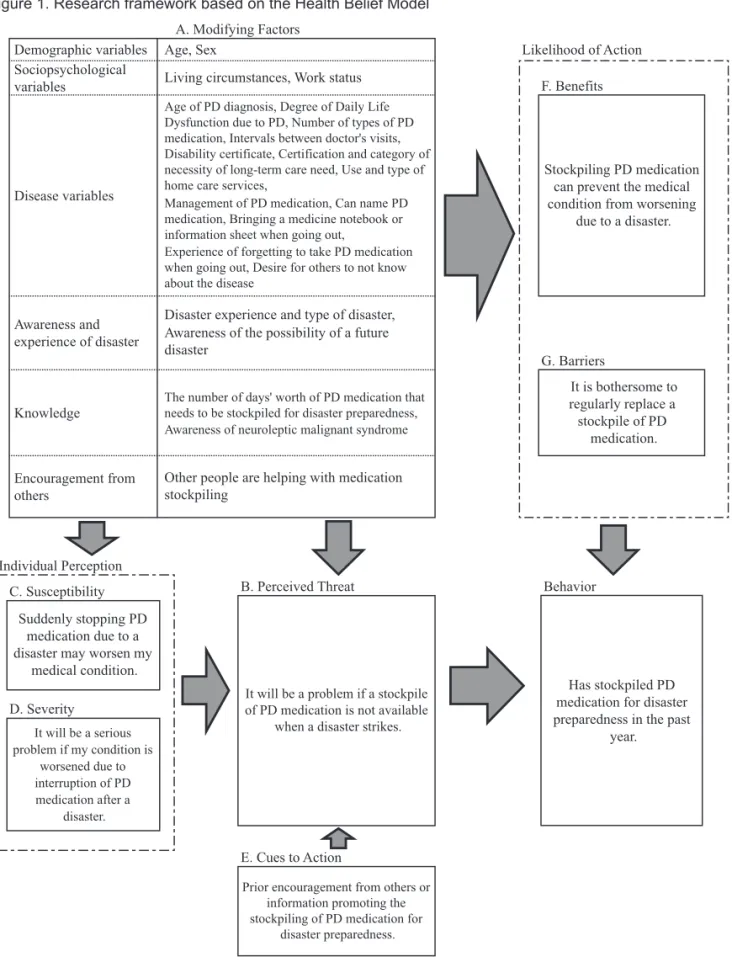
The Health Belief Model (HBM) is used to promote preventive health behavior (Figure 1) [18,19,20]. This relatively accessible model is based on behavioral science theory and has been applied in research on cancer screening behavior [21]. The HBM was used in this study because the stockpiling of PD medication is a type of preventive health behavior and because it provides a useful set of factors that are likely to affect stockpiling behavior.
The framework used in this study examines the association of “Modifying Factors,” “Perceived Threat,” “Susceptibility,” “Severity” “Cues to Action,” “Benefits,” and “Barriers” with the likelihood of change in a PD patient’s behavior of stockpiling medication for disaster preparedness in the past year.
2. Participants
Questionnaires were sent to all 1,398 members of Japan Parkinson’s Disease Association who lived in nine prefectures in East Japan including the Hokuriku region (Hokkaido, Aomori, Akita, Yamagata, Ishikawa, Toyama, Yamanashi, Gunma, and Niigata prefectures). These prefectures were selected because they each had less than five deaths due to the Great East Japan Earthquake of 2011 [22] and because it was possible to administer the questionnaires through local branches of Japan Parkinson’s Disease Association. We took into consideration the possibility that members of the association who lived in prefectures with five or more deaths
caused by the Great East Japan Earthquake may have become more aware of the importance of disaster preparedness and thus be more likely to stockpile PD medication. Therefore, members in prefectures with less than five deaths from the Great East Japan Earthquake were selected as the research participants for this study.
3. Data Collection
1) Preliminary study and questionnaire development
In order to develop the questionnaire to be used in this study, semi-structured interviews were conducted using an interview guide with four members of the Niigata Prefecture branch of the Japan Parkinson’s Disease Association who had experienced the Chūetsu (Niigata) Earthquake of 2004. The interview guide was developed based on previous studies [9,23] and was designed to investigate the following three points: (1) details of the disaster experience and challenges in receiving medical treatment after the disaster, (2) the status and awareness of disaster preparedness at the time of the interview, and (3) encouragement from others regarding disaster preparedness.
The interviews were conducted between May 2011 and October 2012 and took an average of 107 minutes. The four interview participants were all women; two of them were in their 60s and two were in their 70s, with an average age of 71.0 at the time of the interview. All of them lived with their family, were at the second stage of Daily Life Dysfunction, required some assistance with activities of daily living and doctor’s visits (corresponding to Stage III and IV of Hoehn and Yahr scale which is commonly used a system for describing how the symptoms of Parkinson’s disease progress.), and maintained a stockpile of more than three days’ worth of PD medication.
The duration of PD was over ten years for three
participants and two years for one participant at
the time of the disaster in 2004.
Figure 1. Research framework based on the Health Belief Model
1)
This framework was developed by the researcher, based on the Health Belief Model.
2)
The statements in the boxes are the questionnaire items.
Has stockpiled PD medication for disaster preparedness in the past
year.
Encouragement from others
Knowledge Awareness and experience of disaster Disease variables Sociopsychological variables
Demographic variables
Other people are helping with medication stockpiling
Awareness of neuroleptic malignant syndrome The number of days' worth of PD medication that needs to be stockpiled for disaster preparedness, Awareness of the possibility of a future disaster
Disaster experience and type of disaster, Experience of forgetting to take PD medication when going out, Desire for others to not know about the disease
Management of PD medication, Can name PD medication, Bringing a medicine notebook or information sheet when going out,
Age of PD diagnosis, Degree of Daily Life Dysfunction due to PD, Number of types of PD medication, Intervals between doctor's visits, Disability certificate, Certification and category of necessity of long-term care need, Use and type of home care services,
Living circumstances, Work status Age, Sex
A. Modifying Factors
Individual Perception
B. Perceived Threat
It will be a problem if a stockpile of PD medication is not available
when a disaster strikes.
E. Cues to Action
Prior encouragement from others or information promoting the stockpiling of PD medication for
disaster preparedness.
C. Susceptibility
It will be a serious problem if my condition is
worsened due to interruption of PD medication after a
disaster.
Suddenly stopping PD medication due to a disaster may worsen my
medical condition.
D. Severity
Likelihood of Action F. Benefits
Stockpiling PD medication can prevent the medical condition from worsening
due to a disaster.
G. Barriers
It is bothersome to regularly replace a stockpile of PD
medication.
Behavior
A verbatim transcription of the audio recorded interview data was created and analyzed to identify items relating to the status and awareness of disaster preparedness. To ensure validity, three researchers discussed the interpretation of the content until consensus was reached.
Questionnaire items relevant to each construct of the HBM framework (Figure 1) were developed based on the results of the preliminary study. For “Perceived Threat,” “Susceptibility,”
“Severity,” “Benefits,” and “Barriers,”
respondents indicated their level of agreement on a four-point scale with the following options:
“strongly agree,” “agree,” “somewhat disagree,”
and “disagree.” Separate four-point scales were used for “Cues to Action” (options: “many,”
“some,” “very few,” and “none”) as well as
“Behavior” (options: “never” “sometimes” “most of the time” and “always”).
2) Survey Method
A postal survey was used to collect data. An anonymous self-administered questionnaire was sent with a Parkinson’s Disease Association newsletter and returned by mail. Patients were asked to complete the questionnaire by themselves, or with someone’s assistance if needed. The survey was conducted from March to September 2013.
4. Data Analysis
To determine the association between the relevant factors and whether or not participants had stockpiled PD medication for disaster preparedness in the past year (April 2012 to March 2013), a chi-squared test was used to compare the difference in the proportions between those who had stockpiled and those who had not, for each factor. Respondents who answered that they “sometimes,” “most of the time,” or
“always” had a stockpile of medication for disaster preparedness in the past year were included in the stockpiling group, and those who
answered “never” were treated as the non- stockpiling group.
A binary logistic regression analysis (BLRA) (forward selection method, variable selection criteria p = 0.05) was performed with medication stockpiling as the dependent variable (stockpiling
= 0, non-stockpiling = 1) and the 27 items covering the various factors in the HBM framework (Table 2) as the independent variables.
IBM SPSS Statistics version 22.0 for Windows was used for the statistical analysis. The four- point scale was consolidated into a binary rating scale: “strongly agree” and “agree” versus
“somewhat disagree” and “strongly disagree”;
“know very well” and “know” versus “know little” and “don’t know at all.”
5. Definitions
In this study, ten natural disasters were defined based on the Disaster Countermeasures Basic Act [24]. In keeping with a previous study [25], a
“natural disaster experience” was defined as a situation where “property such as housing or cars as well as physical safety were threatened or injured, or serious problems were caused in daily life.” A home care PD patient was defined as a person who was either currently receiving home care treatment, or they were currently hospitalized or in a nursing facility but were planning to return home and receive home care treatment.
Stockpiling PD medication for disaster preparedness was defined as having over three days’ worth of medication prescribed for PD treatment, excluding medicines for constipation, digestive health, blood pressure, etc.
6. Ethical considerations
This study was approved by the ethics
committee of Niigata University of Health and
Welfare (17231-110307). The preliminary study
was conducted after explaining the purpose,
confidentiality measures, the planned publication
of results, the voluntary nature of the requested
cooperation, the fact that non-participation would not result in any disadvantage, and the opportunity to withdraw consent orally or in writing, and after obtaining a signed informed consent document.
A self-administered questionnaire was mailed to the participants in the main study with a request form describing the study objectives, the voluntary nature of the requested cooperation, assurance of anonymity, and the planned publication of results. The postal questionnaire was anonymous and return of the questionnaire was taken as consent to participate.
Results
1. Characteristics of participants
The questionnaire was mailed to 1,398 members, and 685 were returned (collection rate of 49.0%). Among the 685 respondents, 67 who were hospitalized or in a nursing home and eight respondents who were not taking PD medication were excluded from the data analysis. Also, 29 respondents who did not answer the basic characteristic questions regarding the respondent, age group, gender, and whether they had stockpiled PD medication in the past year were excluded. An additional ten respondents who had five or more missing data cells other than the previously mentioned items were also excluded.
Data from the remaining 571 respondents were analyzed, and items with missing values other than multiple choice were handled using the mode imputation method. The basic characteristics of the subjects are shown in Table 1.
2. Participants’ knowledge and behavior relating to PD medication (Table 2)
Two hundred ninety-seven respondents (52.0%) reported that they had a stockpile of PD medication, while 274 (48.0%) did not. Three hundred thirty-four respondents (58.5%) reported seeing a doctor more than once a month. Four hundred twenty (73.6%) respondents said they
self-manage their PD medication. Three hundred eighty-nine (68.1%) stated that they can name their PD medications. Two hundred seventy-six (48.3%) reported that they bring their medicine notebook with them when going out (in the past year). Ninety-eight (17.2%) reported that they have had trouble remembering to take their medication when going out or staying overnight away from their home in the past. Five hundred twenty-four (91.8%) indicated awareness that a stockpile of three days’ to two weeks’ worth of PD medication is necessary for disaster preparedness. One hundred seventeen (20.5%) indicated awareness of neuroleptic malignant syndrome.
3. Differences between participants with and without a PD medication stockpile in the past year (Tables 2 and 3)
The percentage of respondents with a stockpile of PD medication was significantly higher for those diagnosed with PD by age 59 than for those diagnosed at age 60 or above (p = 0.004), for those taking at least five types of PD medication than for those taking up to four types (p = 0.033), for those with a disability certificate (p = 0.002), for those receiving home care services (p = 0.010), for those that say they can name their PD medications (p = 0.023), for those who bring a medicine notebook or information sheet when going out (p < 0.001), for those with disaster experience (p = 0.010), for those who are aware of the possibility of a future disaster (p = 0.005), and for those aware of the necessity of stockpiling over three days’ to two weeks’ worth of PD medication for disaster preparedness (p = 0.049).
A significantly higher percentage of stockpiling
was also found among respondents who agreed or
strongly agreed that suddenly stopping PD
medication due to a disaster may worsen their
medical condition (“Susceptibility” factor) (p =
0.038), and those who reported receiving
encouragement from others or information
Table 1. Participant characteristics n = 571
n %
Respondent
Patient 517 90.5
Family member 53 9.3
Other 1 0.2
Living circumstances
Living alone 45 7.9
Living with family 526 92.1
Age 30s 1 0.2
40s 3 0.5
50s 28 4.9
60s 189 33.1
70s 280 49.0
Over 80 70 12.3
Sex
Male 257 45.0
Female 314 55.0
Work status
Employed 18 3.2
Housework or working at home 182 31.9
None 340 59.5
Others 31 5.4
Age of Parkinson’s disease diagnosis
Under 30 10 1.8
30s 10 1.8
40s 57 10.0
50s 163 28.5
60s 217 38.0
70s 107 18.7
Over 80 7 1.2
Degree of Daily Life Dysfunction
Does not need assistance with activities of daily living and doctor’s visits 173 30.3 Needs some assistance with activities of daily living and doctor’s visits 330 57.8 Needs full assistance with activities of daily living 68 11.9 Natural disaster experience
No 442 77.4
Yes 129 22.6
Among respondents answering “Yes,” 128 indicated the type of disaster
1)Earthquake 78 60.9
Heavy snow 33 25.8
Storm/Typhoon 32 25.0
Flooding 25 19.5
Heavy rain 14 10.9
Others 18 14.1
n % Disability certificate
No 309 54.1
Yes 262 45.9
Among respondents answering “Yes,” 261 indicated the degree of disability.
Grade 1 20 3.5
Grade 2 115 20.1
Grade 3 83 14.5
Grade 4 or above 43 7.5
Certification of long-term care need
No 222 38.9
Yes 349 61.1
Among resondents answering
“Yes,” 347 indicated the degree. Support Required 1 39 6.8
Support Required 2 64 11.2
Long-term Care Required 1 33 5.8
Long-term Care Required 2 100 17.5
Long-term Care Required 3 59 10.3
Long-term Care Required 4 32 5.6
Long-term Care Required 5 20 3.5
Use of home care sevices
No 310 54.3
Yes 261 45.7
Among respondents answering “Yes,” 259 indicated the type of home care services
2)Outpatient Day Long-Term Care 150 57.9
Home-Visit Long-Term Care 92 35.5
Home-Visit Rehabilitation 85 32.8
Home-Visit Nursing 59 22.8
Short-Term Admission for Daily Life Long-Term Care 51 19.7
Others 28 10.8
Prefecture of residence
Hokkaido 124 21.7
Aomori 63 11.0
Akita 51 8.9
Yamagata 42 7.4
Yamanashi 41 7.2
Toyama 58 10.2
Ishikawa 36 6.3
Niigata 102 17.9
Gunma 54 9.5
1) 2)
Answers total over 100% due to multiple responses.
Table 2. Differences between participants with and without a PD
1)medication stockpile in the past year n = 571 Stockpile of PD medication in the past year
p value
2)Total With
stockpile
n =297 % Without stockpile
n=274 %
A. Modifying factors Demographic variables
Age Less than 70 221 126 57.0 95 43.0
0.057
70 and over 350 171 48.9 179 51.1
Sex Male 257 132 51.4 125 48.6
0.778
Female 314 165 52.5 149 47.5
Sociopsychological variables
Living circumstances Live alone 45 21 46.7 24 53.3
0.469
Live with family 526 275 52.3 251 47.7
Work status Yes 200 109 54.5 91 45.5
0.383
No 371 188 50.7 183 49.3
Disease variables
Age of PD diagnosis up to 59 240 142 59.2 98 40.8
0.004
60 and over 331 155 46.8 176 53.2
Degree of Daily Life Dysfunction
Does not need assistance with activities of daily living and
doctor’s visits 173 87 50.3 86 49.7
0.586 Needs partial or full assistance
with activities of daily living 398 210 52.8 188 47.2
Number of types of PD medication 1 to 4 362 176 48.6 186 51.4
0.033
5 or more 209 121 57.9 88 42.1
Intervals between doctor’s visits More than once a month 334 172 51.5 162 48.5
0.769 Less than once a month 237 125 52.7 112 47.3
Disability certificate Yes 262 155 59.2 107 40.8
0.002
No 309 142 46.0 167 54.0
Certification of long-term care need Yes 349 189 54.2 160 45.8
0.199
No 222 108 48.6 114 114.0
Use of home care sevices Yes 261 151 57.9 110 42.1
0.010
No 310 146 47.1 164 52.9
Management of PD medication Patient 420 221 52.6 199 47.4
0.629
Someone else 151 76 50.3 75 49.7
Can name PD medication Can, Mostly can 389 215 55.3 174 44.7
0.023
Mostly cannot, Cannot 182 82 45.1 100 54.9
Bringing a medicine notebook or
information sheet when going out Always, Most of the time 276 166 60.1 110 39.9
p<0.001
Sometimes, Never 295 131 44.4 164 55.6
Experience of forgetting to take PD medication when going out
Often, Sometimes 98 52 53.1 46 46.9
0.820
Seldom, Never 473 245 51.8 228 48.2
Desire for others to not know about the disease
Yes 151 76 50.3 75 49.7
0.629
No 420 221 52.6 199 47.4
Stockpile of PD medication in the past year
p value
2)Total With
stockpile
n =297 % Without stockpile
n=274 %
Awareness and experience of a disaster
Experience of a disaster Yes 129 80 62.0 49 38.0
0.010
No 442 217 49.1 225 50.9
Awareness of the possibility of a
future disaster Strongly agree, Agree 328 187 57.0 141 43.0
0.005 Somewhat disagree, Disagree 243 110 45.3 133 54.7
Knowledge 0
The number of days’ worth of PD medication that needs to be stockpiled for disaster preparedness
Over three days to two weeks 524 279 53.2 245 46.8
0.049 Not necessary, Less than three
days 47 18 38.3 29 61.7
Awareness of neuroleptic malignant syndrome
Know very well, Know 117 54 46.2 63 53.8
0.155 Know a little, Don’t know at all 454 243 53.5 211 46.5
Encourgement from others
Other people are helping with medication stockpiling
Yes 382 197 51.6 185 48.4
0.763
No 189 100 52.9 89 47.1
B. Perceived Threat
It will be a problem if PD medication is not stockpiled when a disaster strikes.
Strongly agree, Agree 542 284 52.4 258 47.6
0.427 Somewhat disagree, Disagree 29 13 44.8 16 55.2
C. Susceptibility
Suddenly stopping PD medication due to a disaster may worsen my medical condition.
Strongly agree, Agree 521 278 53.4 243 46.6
0.038 Somewhat disagree, Disagree 50 19 38.0 31 62.0
D. Severity
It will be a serious problem if my condition is worsened because of stopping PD medication due to a disaster.
Strongly agree, Agree 534 282 52.8 252 47.2
0.149 Somewhat disagree, Disagree 37 15 40.5 22 59.5
E. Cues to Action
Received encouragement from others or information promoting the stockpiling of PD medication for disaster prepardness
Many, Some 138 116 84.1 22 15.9
p<0.001
Very few, None 433 181 41.8 252 58.2
F. Benefits
Stockpiling PD medication can prevent my medical condition from worsening due to a disaster.
Strongly agree, Agree 534 281 52.6 253 47.4
0.269 Somewhat disagree, Disagree 37 16 43.2 21 56.8
G. Barriers
It is bothersome to regulary replace my stockpile of PD medication.
Strongly agree, Agree 227 117 51.5 110 48.5
0.854 Somewhat disagree, Disagree 344 180 52.3 164 47.7
1)
Parkinson’s disease
2)
from chi-squared test
promoting the stockpiling of PD medication for disaster preparedness (“Cues to Action” factor) (p
< 0.001).
The results of the BLRA indicated that among the items measuring “Modifying variables,”
having a disability certificate (odds ratio [OR] = 1.5), bringing a medicine notebook or information sheet when going out (OR = 1.8), and being aware of the possibility of a future disaster (OR = 1.5) were significantly associated with the stockpiling of PD medication for disaster preparedness. Encouragement from others or information promoting the stockpiling of PD medication for disaster preparedness (“Cues to Action”) (OR = 7.0) had the most significant
effect on medication stockpiling for disaster preparedness (Table 3).
On the other hand, there was no association between “Perceived threat,” “Susceptibility,”
“Severity,” “Benefits,” or “Barriers” and stockpiling behavior.
4. Motivations for starting or not starting a stockpile of PD medication for disaster preparedness (Tables 4 and 5)
For the 279 respondents who reported that they maintain a stockpile of PD medication, many of them started stockpiling due to media information (36.6%), healthcare professionals (26.5%), and PD Association newsletters (25.4%), whereas Table 3. Binary logistic regression analysis results, with PD
1)medication stockpiling for disaster
preparedness in the past year as the dependent variable n=571
Item Category Odds ratio
3)95% Confidence
Interval p value A. Modifying Factors
Disease variables
Disability certificate
3)Yes 1.5 1.018-2.100 0.039
No 1.0
Bringing a medicine notebook or information sheet when going out
Always, Most of the time 1.8 1.236-2.541 0.002
Sometimes, Never 1.0
Awareness and experience of disaster
The possibility of a future disaster
Strongly agree, Agree 1.5 1.037-2.144 0.031 Somewhat disagree,
Disagree 1.0
E. Cues to Action
Encouragement from others or
information on promoting the stockpiling of PD medication for disaster preparedness
Many, Some 7.0 4.222-11.505 p<0.001
Very few, None 1.0
1)
Parkinson’s disease
2)
Analytical Method: Binary logistic regression analysis (forward selection method), variable selection criteria: p=0.05 with SPSS Statistics Ver. 22.0 for Windows
3)
Odds ratios are relative to the reference category, which is the lower item.
4)
Independent variables: 27 items in Table 2
5)
Nagelkerke R
2=0.218, Omnibus tests of model coefficients, Step 4, Model p<0.001
6)
Collinearity was considered to be non-problematic with standard error <2.0
7)
Odds ratios for “Perceived Threat,” “Susceptibility,” “Severity,” “Benefits,” and “Barriers” were not
significant and thus not included in this table.
disaster experience played less of a role in their motivation.
The 263 respondents who said they do not stockpile PD medication gave reasons such as,
“did not know the shelf life of the medication”
(28.9%), “never thought about it” (22.1%), “was reluctant to ask a doctor” (19.8%), and/or “was refused by a healthcare facility” (9.1%).
Discussion
This is the first study to use the Health Belief Model to identify factors relating to stockpiling behavior with a focus on the stockpiling of PD medication for disaster preparedness. The results show that “Cues to Action,” one of the HBM
constructs, was significantly associated with PD patients’ medication stockpiling behavior.
However, “Perceived threat,” “Susceptibility,”
“Severity,” “Benefits,” and “Barriers” did not show any association. Instead, “Modifying factors” such as bringing a medicine notebook or information sheet when going out, having a disability certificate, and awareness of the possibility of a future disaster were shown to be important factors.
1. Characteristics of the target population
According to the study by Taniguchi et al. on the status of PD patients [26], the average age of PD patients is 71.3 years, with the mean age of Table 4. Reasons for starting a stockpile of PD medication in the past year n=279
1)Reason n %
Media information 102 36.6
Health professional 74 26.5
Parkinson’s Disease Association newsletter 71 25.4
Encouragement from family and friends 57 20.4
Social worker 31 11.1
Experience of a disaster 24 8.6
Others 56 20.1
1)
Respondents with a stockpile of PD medication in the past year
2)
Answers total over 100% due to multiple responses.
Table 5. Reasons for not stockpiling PD medication in the past year n=263
1)Reasons n %
Lack of knowledge of the medication’s shelf life 76 28.9
Never thought about it 58 22.1
Reluctant to ask a doctor 52 19.8
Refused by a medical facility 24 9.1
Can’t imagine being in a disaster situation 14 5.3
Plan to get medication from a patient with the same disease 4 1.5
Others 59 20.6
1)
Among 274 respondents without a stockpile of PD medication in the past year, 263 gave their reasons.
2)