1. Introduction
Archaeological records from the time farming culture initially prospered in the Middle and Near East around 8000 to 6000 BC show the beginning of cultivation of grapes and wheat, among others
1–5 ). McGovern and colleagues reported finding chemical evidence of wine (Neolithic wine) made in ancient times (5400–5000BC).
Instrumental analysis (HPLC, IR, UV, etc.) of residues in pottery jars used to store wine identified the presence of components naturally contained in grapes, such as calcium tartrate
6–8 ).
In Japan, grapes today are most widely cultivated in Yamanashi and Nagano Prefectures. Common cultivars include Kyoho, Delaware, and Muscat, among others.
Our group has focused on Steuben, a specialty cultivar grown in Aomori Prefecture, in the Tohoku area of northern Honshu. Steuben was developed by crossing of the ‘Wayne’ and ‘Sheridan’ cultivars at the National Agricultural Experimental Station of New York, and was introduced into Japan in 1952
9). The Tohoku district and New York share a similar climate and latitude, and Steuben plantings in this area are large, particularly in Aomori Prefecture, which accounts for about 70% of total Steuben production
10). Thus, Steuben grapes have
been grown in Japan for use in wine production and elsewhere for many years.
These grapes and the wine made from them contain many polyphenols, including resveratrol and anthocyanin, which are known to have many health advantages, such as delaying aging
11–16). Other reports have described the presence of polyunsaturated fatty acids and their value as a good source of lipids
17), and that the pomace of some grapes has strong antioxidant and anti-tumor activity
18, 19). Phenols contained in grape pomace possess strong antibacterial activity, and are also reported to prevent food poisoning and infectious diseases
20). Interestingly, the vine and stem of grapes also contain terpenes, such as geraniol and citronellol
21).
In March 2015, we reported our findings on components of the leaves of the ‘Fuji’ apple tree. Here, we report our findings on components of the leaves of the grape variety Steuben
22, 23).
2. Experimental 2.1. Plant material
We used the leaves (1953 g) of Vitis labrusca
‘Steuben’ obtained in Goshogawara City in Aomori
〔
Original
〕3K\WRFKHPLFDO3URÀOHDQG%DFWHULFLGDO(IIHFWRI WKH/HDIRIWKH*UDSHVitis labruscaYDU¶6WHXEHQ·
Masahiko Nagaki
1), Takashi Narita
2)and Yoshifumi Goto
2)Abstract
The volatile oil of the grape Vitis labrusca var. ‘Steuben’ could not be obtained by steam distillation of the leaves. However, components contained in floral-water were obtained by extraction with hexane.
Principal components of the floral water of Steuben were -cadinol, at 8.1%, followed by -terpineol at 7.4% and linallol at 6.9%. Analysis of the aroma components of the leaves using the headspace (HS) method revealed that the two components (E)-2-hexenal (49.2%) and hexanal (27.9%) characteristically accounted for more than 77% of total aroma ingredients.
Regarding antimicrobial effects, the combination of Steuben floral-water with one of the isoprenoids, such as geraniol and farnesol, showed higher antibacterial activity than the isoprenoid alone.
Key words : floral-water; Vitis labrusca ‘Steuben’; steam distillation; headspace method; antibacterial activity
弘前医療福祉大学紀要 7(1), 17 − 23, 2016 J Hirosaki Univ Health Welfare 7(1), 17‑23, 2016
1 ) Department of Nursing, School of Health Sciences, Hirosaki University of Health and Welfare, 3-18-1 Sanpinai, Hirosaki, Aomori 036-8102, Japan
2 ) Graduate School of Science and Technology, Hirosaki University, 3 Bunkyo-cho, Hirosaki, Aomori 036-8561, Japan
Prefecture. Extraction was carried out by steam distillation, followed by component analysis. Further, we also analysed the aroma component of the leaves (0.31g) of Steuben using the headspace method.
2.2. ([WUDFWLRQRIÁRUDOZDWHUGLVWLOOHGZDWHU
Floral-water extracts were extracted 4 times with hexane (300 ml hexane/L distilled water).
2.3. Analysis
Floral-water extracts were analysed by flame ionization detector-gas chromatography (GC-FID).
GC-FID analysis was performed using a Hitachi Gas Chromatograph G-5000A (Hitachi, Tokyo, Japan).
Nitrogen was passed through a poly (alkylene glycol) column (30 m × 0.25 mm i.d.) at a carrier flow rate of 60 mL/min using a 10 °C/min gradient, initiated with a 5-min hold at 40 °C and ended on reaching 200 °C.
Injector and detector temperatures were 150 °C and 250 °C, respectively. Mass spectrometer-gas chromatography (GC-MS) analysis was performed on a JEOL Q1000GC-Mk II Mass Spectrometer (Japan Electron Optics Laboratory Co. Ltd., Tokyo, Japan) consisting of an HP-5 column (30 m × 0.32 mm × 0.25 μm film thickness: coated with 5%-phenyl-poly [methylsiloxane]) with a 1 mL/min helium carrier flow rate. Temperature was programmed to deliver a 15 °C/
min gradient initiated with a 4.7-min hold at 50 °C and terminated with a 2-min hold at 280 °C. Injector and GC- transfer line temperatures were both set at 200 °C.
Separated components were measured under non- isothermal conditions and identified by comparison with the RIs calculated from the Van den Dool-Kratz equation and the MS coincidence rate
24, 25). Component ratios were computed from the peak area ratio of GC- MS. Oil-drilling rate and extractability were calculated from the sample weight and extraction yield.
+HDGVSDFHPHWKRG
GC-MS measurement of the leaves was done using the headspace method. The aroma component of the leaves was analysed by GC-FID under the same conditions as the volatile oils analysis. GC-MS analysis was performed on a JEOL Q1000GC-Mk II equipped with a JEOL 12031 headspace auto sampler, consisting of an AQUATIC capillary column (Agilent, 60 m × 0.32
mm, 0.25 μm film thickness) with a 1 mL/min helium carrier flow rate (15 psi). Temperature was programmed to deliver a 10 °C/min gradient initiated with a 3.0-min hold at 40 °C, then to increase to 170 °C at 10 °C/min and then to 200 °C (12.5 min) at 20 °C/min. The increase was terminated with a 2-min hold at 280 °C. Injector and GC-transfer line temperatures were both set at 200 °C.
Separated components were identified by comparing retention times and mass spectra with laboratory data and the NIST library. The accordance of retention times in the GC-MS was confirmed by co-injecting the reagent with an n-alkane (C
7-C
40) retention index. The relative amounts of components were calculated from their respective GC-MS peak areas.
2.5. Assay of antimicrobial activity
Antibacterial assays were performed in accordance with the agar plate dilution method recommended by the Japanese Society of Chemotherapy
26–28). Antibacterial assay was then performed according to our previous method
29, 30). Bacteria were inoculated into 10 ml of Müeller-Hinton Broth medium (MHB, Difco
TM, Becton Dickinson (BD), USA) and cultured at 37 °C for 24 h without shaking. Each isoprenoid was dissolved in DMSO. Then, 120 ƫL of the dissolved isoprenoid solution was added to 12 ml Müller-Hinton Ager (MHA; Difco laboratories, USA) culture medium. For combination assays, floral-water obtained from the leaves by steam distillation was used instead of regular distilled water for the MHA culture medium.
2.6. Bacterial strains
Gram-positive bacteria used were 6WDSK\ORFRFFXV aureus 209P and S. aureus 834 (methicillin resistant - MRSA). Gram-negative bacteria used were (VFKHULFKLD coli IFO-3806 and 6KLJHOOD sonnei.
3. Results
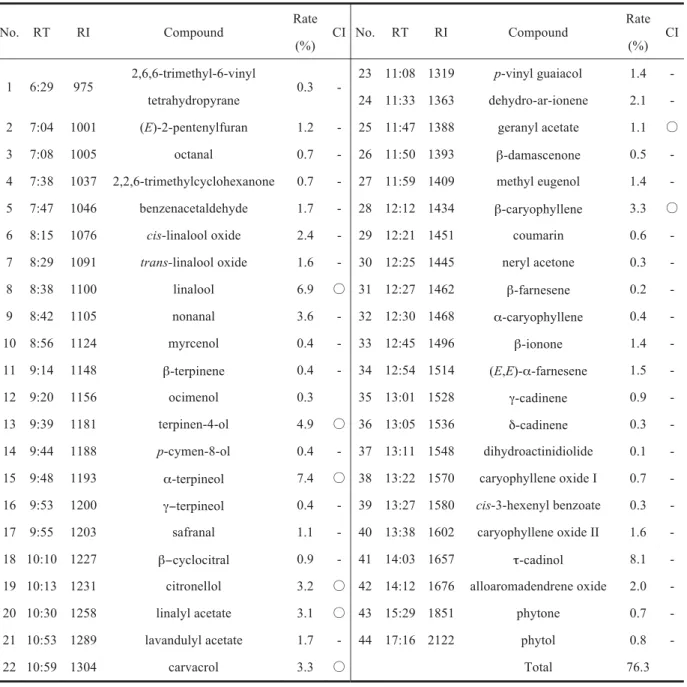
&RPSRQHQWVRIÁRUDOZDWHUH[WUDFWV
Results of the analysis of floral-water extract is
shown in Table 1. Among components extracted from the
leaves of Steuben,
-cadinol was contained at the highest
concentration, accounting for 8.1% of extracts. -Cadinol
has been reported to have a calcium antagonistic action
and is attracting interest in such fields as cardiology as a
treatment for cardiovascular disease. Other components
included linalool (6.9%) and -terpineol (7.4%), as well as myrcenol (0.4%) and -terpineol (0.4%) as minor constituents.
6FHQWFRPSRQHQWRI6WHXEHQOHDYHV
Aroma component analysis of the leaves of the Steuben identified 19 compounds (Table 2). Among scent components, (E)-2-hexenal accounted for 49.2%
followed by hexanal at 27.9%, together accounting for more than 75%. The leaves did not yield any sweet scent component reminiscent of grapes, such as 2-phenylethanol and citronellol.
3.3. Antibacterial activities
To create an MHA culture medium, geraniol was added to the MHA culture medium (Steuben floral-water MHA culture medium), which uses Steuben floral-water instead of distilled water. The results of combination studies of Steuben and geraniol are shown in Table 3, and Steuben and farnesol in Table 4. Geraniol alone showed an MIC of 534 g/mL against the Gram-positive bacteria S. aureus and MRSA. However, in combination studies of Steuben distilled water and geraniol, MIC for both was decreased to 311 g/mL, indicating increased antibacterial activity.
In addition, for the Gram-negative bacteria E. coli and
& &$'&+% *
& &$'&+% *
*(!$* /#,!%/#
**( /(&'/(%
,!%/#+!&#/(&(!&%%
'%*%/#+(% (%/#**
&*%#
$)%&%*(!$* /#/#& .%&% $* /#+%&#
%0%*# /
(/&' /##%#!%#&&#&.!
&+$(!%
#!%#&&#&.!
%(/#*&%
#!%#&&#
(%)%%&%%#
(/&' /##%$/(%&#
!&%&%*('!%%
(%)%
&!$%&#
!%%*('!%%&#
!%%/$%&#
! /(&*!%!!&#!
*('!%&#
(/&' /##%&.!
*('!%&#
.%/#%0&*
)(%# (/&' /##%&.!
/#&!*(#
!%&#
!*(&%##&# ##&(&$%(%&.!
#!%#/#**
' /*&%
#,%+#/#** ' /*&#
(,(&# &*#
Table 1.
Components contained in the floral-water of Steuben leaves.
RT: Retention Time RI: Retention Index CI: Co-injection with authentic sample
S. sonnei, geraniol alone showed an MIC of 445 g/mL, whereas combined use of Steuben floral-water and geraniol or Steuben floral-water and farnesol showed a decrease to 267 g/mL and 334 g/mL, respectively. In other words, combined use showed stronger antibacterial activity.
Against the Gram-positive bacteria S. aureus and MRSA, the MIC of farnesol alone was 184 g/mL for both.
In combination studies of Steuben floral-water and farnesol, in contrast, MIC for both decreased to 111 g/mL (Table 4), again indicating that combination use enhances antimicrobial activity.
In contrast, farnesol showed no antibacterial activity against Gram-negative bacteria.
4. Discussion
In this phytochemical study, steam distillation of the leaves of Steuben failed to yield volatile oil.
However, floral-water was extracted with hexane, and 39 components were identified. Among the extracted components, -cadinol content was highest, accounting for 8.1% of extracts. -Cadinol has been reported to show an antagonistic action against calcium, and its use in the treatment of cardiovascular conditions is anticipated
31).
We also analysed the aroma components of the leaf using the headspace method (HS method). Two components, (E)-2-hexenal (49.2%) and hexanal (27.9%), characteristically accounted for more than 77% of the total aroma ingredients. These components are known to produce a grassy smell and were previously identified as the main aroma components in the leaves of the Fuji apple tree, with (E)-2-hexenal again the major component
23). No sweet scent component reminiscent of grapes, such as the 2-phenylethanol, citronellol or similar compounds contained as flavour components in the fruit of the grape were obtained from the leaves of Steuben
32).
Table 2.
Aroma components of the leaf of Steuben
No. RT Compound Rate (%) MS agreement No. RT Compound Rate (%) MS agreement 1 9:23 3-methyl butanal 1.1 96% 11 14:23 isobutyl cyclopentane 5.3 89%
2 9:37 2-methyl butanal 1.9 99% 12 14:36 ()-2-hexenal 49.2 94%
3 9:55 1-penten-3-ol 2.3 98% 13 16:17 (,)-2,4-hexadienal 1.8 95%
4 10:21 2-ethyl furan 2.7 86% 14 16:47 ()-2-heptentenal 0.1 90%
5 10:24 1-penten-3-one 4.4 99% 15 17:00 2-penthyl furan 0.1 85%
6 11:18 4-methyl-1-hexene 0.3 85% 16 17:21 ()-2-pentehyl furan 0.2 87%
7 12:03 5-methyl-1-heptene 0.3 93% 17 17:52 benzaldehyde 0.2 96%
8 12:19 -2-penten-1-ol 0.7 99% 18 18:09 (,)-2,4-heptadienal 0.2 91%
9 12:24 ()-2-pentenal 1.0 97% 19 19:29 benzenacetaldehyde 0.5 96%
10 13:00 hexanal 27.9 93%
RT: Retention Time
Table 3.
Antibacterial activity of geraniol using MHA culture medium adjusted with Steuben floral-water.
Table 4.
Antibacterial test of farnesol using MHA culture medium adjusted with Steuben floral-water.
5. Conclusion
Although steam distillation of the leaves of Steuben did not yield essential oil, the floral-water was extracted with hexane and 39 components were identified. In addition to common contents such as terpineol and linalool, one noteworthy component of the floral-water extracts was -cadinol, which accounted for 8.1% of the extract.
Furthermore, analysis of the aroma components of leaves by the headspace method identified 19 components. Interestingly, (E)-2-hexenal and hexanal were found to account for 75% of the total ingredients.
The combination of Steuben floral-water with one of the isoprenoids such as geraniol and farnesol showed higher antibacterial activity than the isoprenoid alone. We previously obtained synergies between such isoprenoids and floral-water of the 5RVHUXJRVDflower [12], and their use in various aspects of antimicrobial agent development is expected.
We consider that the ongoing accumulation of basic research as represented by the present study will contribute to the development of pharmaceutical products.
Acknowledgment
This research was supported in part by the Cosmetology Research Foundation at the Graduate School of Science and Technology, Hirosaki University.
($FFHSWHG : November 25, 2015)
References
1. McGovern PE (2003) Ancient Wine: The Search for
the Origins of Viniculture (Princeton Univ Press, Princeton).
2. McGovern PE (1999) ”Georgia as Homeland of Winemaking and Viticulture. pp. 58–59” in National Treasures of Georgia, ed. O. Z. Soltes. London: P.
Wilson and Foundation for International Arts and Education.
3. Suga Y., Tanaka Y.: A study of grapes (I): the origin of grapes. J. of Chugoku Junior College, 24: 29–40, 1993. Suga Y., Tanaka Y.: A study of grapes (II): the origin of grapes.,ibid., 27: 75–88, 1996.
4. Shimizu K., “Food etymological dictionary” (in Japanese), Tokyodo, 1982 pp235.
5. S. Myles, A.R. Boyko, C.L. Owens, P.J. Brown, F.
Grassi, M.K. Aradhya, B. Prins, A. Reynold, J-M.
Chia, D. ware, C.D.Bustamante, E.S. Buckler.
Genetic structure and domestication history of the grape, 3URF 1DWO $FDG 6FL (USA), 108 3530–
3535 (2011).
6 . McGovern P. E., Voigt M. M., Glusker D. L. , Exner L. J., Neolithic Resinated Wine. Nature, 381, 480–81 (1996).
7. Hartung H., Badler V. R., Glusker D. L., Exner L.
J.: The begining of winemaking and viniculture in the ancient near east and egypt. Expdition 30 (1), 3–21 (1997).
8. Michel R. H., McGovern, P. E., Badier, V. R., The first wine and beer (chemical detection of ancient fermented beverages). Anal. Chem., 65 (8), 406A-413A (1993).
9. Aomori Prefecture functional food material database http://foodslink.jp/syokuzaihyakka/syun/
fruit/budou-Steuben.htm
10. Ministry of Agriculture, Forestry and Fisheries
specialty fruit production dynamics such as
research than (2012 fiscal year for raw grapes)
11. Latruffe, N., Rifler, J., Bioactive polyphenols from grapes and wine emphasized with resveratrol. Curr.
3KDUP'HV 19 (34), 6053–6063 (2013).
12. Uysal, U., Seremet, S., Lamping, J. W., Adams, J. M., Liu, D. Y., Swerdlow, R. H., Aires, D. J., Consumption of polyphenol plants may slow aging and associated diseases.&XUU3KDUP'HV 19 (34), 6094–6111 (2013).
13. Doshi, P., Adsule, P., Banerjee, K., Phenolic composition and antioxidant activity in grapevine parts and berries (vitis vinifera L.) cv. kishmish chornyi (shared seedless) during maturation. Int. J.
)RRG6FL7HFK 41(SUPPL. 1), 1–9 (2006).
14. Minegishi, Y., Haramizu, S., Hase, T., Murase, T., Red grape leaf extract improves endurance capacity by facilitating fatty acid utilization in skeletal muscle in mice.(XU -$SSO 3K\VLRO 111(9), 1983–
1989 (2011).
15. Pojer, E., Mattivi, F., Johnson, D., Stockley, C. S., The case for anthocyanin consumption to promote human health: A review.&RPSU 5HY )RRG 6FL ) 12 (5), 483–508 (2013).
16. Zhou, Q., Du, Y., Cheng, S., Li, R., Zhang, J., Wang, Y., Resveratrol derivatives in four tissues of six wild chinese grapevine species.1HZ=HDO-
&URS+RUW 43(3), 204–213 (2015).
17. Uysal, S., Zengin, G., Aktumsek, A., Karatas, S., Fatty acid composition, total sugar content and anti-diabetic activity of methanol and water extracts of nine different fruit tree leaves collected from mediterranean region of turkey.,QW - )RRG
3URS 18 (10), 2268–2276 (2015).
18. Licciardello, F., Wittenauer, J., Saengerlaub, S., Reinelt, M., Stramm, C., Rapid assessment of the effectiveness of antioxidant active packaging-study with grape pomace and olive leaf extracts.)RRG 3DFNDJLQJDQG6KHOI/LIH 6, 1–6 (2015).
19. Velliquette, R. A., Grann, K., Missler, S. R., Patterson, J., Hu, C., Gellenbeck, K. W., Scolten, J.D., Randolph, R. K., Identification of a botanical inhibitor of intestinal diacylglyceride acyltransferase 1 activity via in vitro screening and a parallel, randomized, blinded, placebo-controlled clinical trial.1XWU0HWDE 12 (1) , 1–13 (2015).
20. Friedman, M., Antibacterial, antiviral, and antifun- gal properties of wines and winery byproducts in
relation to their flavonoid content.- $JULF )RRG
&KHP 62 (26), 6025–6042 (2014).
21. Gunata, Y. Z., Bayonove, C. L., Baumes, R. L., Cordonnier, R. E., Changes in free and bound fractions of aromatic components in vine leaves during development of muscat grapes.3K\WRFKHP LVWU\ 25 (4), 943–946 (1986).
22. http://www.21aomori.or.jp/kinou/sozai/post-48.
html
23. M. Nagaki, M. Kasai, Y. Goto: Phytochemical analysis of the leaf fuji apple tree. J Hirosaki Univ +HDOWK:HOIDUH, 6 (1), 19–26 (2015).
24. Ronald L Prior, Xianli Wu, Karen Schaich:
Standardized Methods for the Determination of Antioxidant Capacity and Phenolics in Foods and Dietary Supplements. - $JULF )RRG &KHP 53, 4290–4302 (2005).
25. Adams R. P., (2012) “Identification of Essential Oil Components by Gas Chromatography/Mass Spectrometry” Allured Pub Corp. 1–804pp.
26. A. Nagayama, K. Yamaguchi, K. Watanabe, M.
Tanaka, I. Kobayashi, and Z. Nagasawa, J. Infect.
&KHPRWKHU14, 383–392 (2008).
27. S. Arakawa, T. Matsui, S. Kamidono, Y. Kawada, H. Kumon, K.Hirai, T. Hirose, T.Matsumoto, K.
Yamaguchi, T. Yoshida, K. Watanabe, K. Ueno, A. Saito, and T. Teranishi, - ,QIHFW &KHPRWKHU, 4, 97–106 (1998).
28. A.Saito, -,QIHFW&KHPRWKHU, 1, 83–88 (1995).
29. M. Nagaki, Y. Goto, T. Narita, J. Kawakami, R.
Miyamoto: Composition and antimicrobial activity of the essential oil and water extract from Japanese wild 5RVDUXJRVD., 7UDQV0DWHU5HV6RF-SQ, 36 (3), 517–521 (2011).
30. M. Nagaki, T. Narita, H. Ichikawa, J. Kawakami, A. Nakane: Antibacterial and antifungal activities of isoprenoids. 7UDQV 0DWHU 5HV 6RF -SQ 36 (1), 55–58 (2011).
31. Zygmunt PM., Larsson B, Sterner O, et al., Calcium antagonistic properties of the sesquiterpene T-cadinol and related substances: structure-activity studies, 3KDUPDFRO7R[LFRO., 73 (1), 3–9 (1993) 32. K. Hirano, M. Yasuhara, G. Okamoto: Aromatic
Components of Several Table Grapes Produced in
Japan. 6FL5HS)DFRI$JUL2ND\DPD8QLY, 83,
1–7 (1994).
ブドウのスチューベン(Vitis labrusca var. ‘Steuben’)の 葉の植物化学的プロファイルと殺菌効果について
長岐 正彦
1)、成田 孝司
2)、後藤 嘉文
2)1)弘前医療福祉大学 保健学部 看護学科 〒 306-8102 弘前市小比内 3-18-1 2)弘前大学大学院 理工学研究科 〒 036-8561 弘前市文京町 3
要 旨
ブドウのスチューベン(Vitis labrusca var. ʻSteubenʼ)の葉を用いて植物化学的分析を行った。水蒸気 蒸留を行ったが精油は得られなかった。しかし、フローラル・ウォーター(蒸留湯)に含まれる成分を ヘキサンにより抽出した。主要成分として ‑ カディノールが 8.1%、 ‑ テルピネオールが 7.4%、そして リナロールが6.9% と続いた。
また、ヘッドスペース法[GC-MS 測定]により、葉の香気成分の分析を行った。E‑2‑ ヘキセナール が48.4% と最も多く、続いて 1 ‑ テルペン ‑ 3 ‑ オール(12.4%)、3 ‑ ペンテノン(7.4%)等が多くみられた。
抗菌活性について調べるためにチューベンのフローラル・ウォーターを用いて作成した寒天培地を 用いて、ゲラニオールやファルネソール等のイソプレノイド類の抗菌活性を測定したところシナジー 効果によりイソプレノイド単独よりも抗菌活性が増加することが分かった。