論文要約
Introduction and Background
The aim of this study was to explore adaptive challenges JTEs have in the process of adopting the EIP policy and to investigate how they change in its process within the theoretical framework of adaptive leadership. This study emerged from my personal experiences as a teacher of English in secondary school education and my personal recognition that leadership is the concept overlooked in the implementation of a policy such as the EIP policy at a local public high school. Japanese teachers of English in secondary school education are constantly challenged to meet the needs of society and implement new educational policies from the MEXT. In order to meet these challenges, for example, a local board of education organizes teacher development programs to help JTEs improve their English skills. However, they traditionally just provide technical means to adaptive challenges JTEs are faced with in their teaching in class. Heifetz, Grashow, and Linsky (2009) argue that adaptive challenges need to be addressed by changing people’s beliefs and values. Thus, specific adaptive means are needed to meet adaptive challenges when JTEs find themselves experiencing adaptive challenges in educational changes.
In order to meet these adaptive challenges in the process of adopting the EIP policy, a teacher development program that would allow the JTEs involved in this study to teach English in English was created for this study.
The program was conducted in a public high school in Kyushu and
investigated how three JTEs involved in the program adopted the policy
within the framework of adaptive leadership. More specifically, the
researcher took advantage of his position as a Shunin (in charge of the
English department) at the school site where the study took place by
partaking in a participatory role of adaptive leadership, which provided rare
opportunities of examining the JTEs adaptive challenges and investigate how
they changed in its process. Because the research is embedded in a real time
situation involving teachers at their worksite, including the participating
researcher, the analysis and interpretations of the data collected from the
interviews with the three JTEs were conducted by using a grounded theory methodology.
Methodology
The study specifically adopted constructivist grounded theory suggested by Charmaz (2014) from among different versions of grounded theory (refer to Table 1).
Constructivist grounded theory provides a fuller participatory role for a researcher.
Table 1
Different Versions of Coding Processes
The chart above demonstrates the various approaches to grounded
theory. In particular note is the variation of the role of the researcher. As the
reader goes down the list, it can be observed that the role of the researcher
changes to a more participatory, constructive role in data collection and
analysis.
When conducting grounded theory, the latter part of its nomenclature needs to be addressed. This study never attempted to construct a formal or grand theory, in the sense of traditional science that has explanatory power over a broad area. More specifically, the study focuses on substantive theory, which has been referred to as a mid-ranged theory (Merton, 1979), with a more refined or limited reach, that explains the phenomena of a particular setting, as opposed to constructing a more encompassing or abstract theory having explanatory power of a phenomena at a broader societal level. Therefore, in this study focusing on teachers at their work site constructing a mid-range or substantive theory could be applicable to real practical situations (such as teaching), and this point was emphasized by Glaser and Strauss’s (1967) argument that grounded theory provides a method of developing a theory that is credible and applicable in a specific situation (e.g. within the context of a school environment).
As a result, the use of grounded theory enabled me to eventually construct a substantive theory grounded in data from these teacher participants as a way of theoretically interpreting and explaining social action and phenomena embedded in a specific situation.
After it became clear that grounded theory was an appropriate method, I found a suitable version of it that fit the situational design of my study taking place at a school site, including my role as the researcher. The constructivist variation of grounded theory I chose for my study was consistent to what I wanted to investigate in the research conducted. With regard to this point, Nunan (1991) posits,
I take the view that in carrying out research, the issue or question one wants to address should form the point of departure, and the research method or methods one chooses should be consonant with what it is that one wishes to discover. (p. 250)
His argument is that it is necessary for researchers to select an appropriate
method according to research questions or problems they want to address in
their studies. This holds for selecting an appropriate version of grounded
theory as well.
Data Analysis
This study found that challenges the JTEs needed to address were adaptive ones, and it was necessary to investigate the JTEs’ thinking process to help them adopt the EIP policy. This study also found that the theoretical framework of adaptive leadership played an important role in investigating their adaptive challenges JTEs are faced with, and teacher leaders need to know how to shape their fellow teachers’ professional identity. The analysis of the data from the interviews generated three categories of competing commitments, shaping teacher identity, and re-conceptualizing leadership and they were integrated into one thematic category of kindling for change . Competing commitments
Kegan and Lahey (2001) argue that competing commitments compose
“the process of dynamic equilibrium that works with breathtaking power and effectiveness to keep things pretty much as they are” (p. 59). This “dynamic equilibrium” is originally a chemistry terminology that means the state of equal continuing processes. In other words, it is a balance between forward and reverse processes occurring at the same rate. This is the kind of force that tries to keep things as they are, causing no overall changes. While conflicting ideas seem to stand still, and they seem to have characteristics of stasis and lack of motion, they have a system of counteracting motions that maintains a balance. This balancing process is more likely to produce immunity to change (Kegan & Lahey, 2001). As long as hidden competing commitments are embedded in the change process, it is not likely to have a lasting effect on what people want to change. The data under this category show how the teacher participants in this study confronted competing commitments.
Shaping teacher identity
Shaping teacher identity is one of the categories that emerged in data
analysis, and teacher identity is a very important area as explained. For the
teacher participants in this study, teacher identity was in a constant state of
flux, and the teachers constantly change and developed their teacher
identities through social interactions within the context of this study.
However, shaping teacher identity to the degree to which JTEs fully adopt the EIP policy is challenging. Especially, it is very challenging for in-service teachers who have been in the field of education for a long time. Despite this difficulty, the lack of attention given to the development of teacher identity in professional development is very problematic.
Shaping identity is very crucial in enhancing the possibilities of teacher growth and changes in knowledge and practice (Loughran &
Hamilton, 2016). Palmer (2007) emphasizes the importance of teacher identity by arguing that teacher identity should be placed in the quest for educational reform, stating “reform will never be achieved by renewing appropriations, restructuring schools, rewriting curricula, and revising texts if we continue to demean and dishearten the human resource called the teacher on whom so much depends” (p. 4). The data regarding the JTEs in this study will substantiate the important role of teacher identity as it emerged during the process of conducting leadership.
Re-conceptualizing leadership
There are many definitions of leadership, and this is true of the case for teacher leadership. There is no single definition of teacher leadership (Kelly, 2001). The concept of teacher leadership does not have a consensus in literature, and it is associated with activities, roles, and behaviors (Lee- Pegott, 2014), so teacher leader has become an umbrella phrase for different things in different contexts (Harris, 2005).
In the book entitled Educating the Reflective Practitioner , Schon
(1987) argues that people cannot be simply told what they need to know, but
they must learn to see for themselves. Thus, recognizing and reflecting on the
importance of leadership by actually seeing for themselves provided the JTEs
an opportunity to see why they were effectively adopting the EIP policy in
their classrooms and what was happening in their classrooms. The JTEs
involved in this study looked at the researcher from diverse perspectives of
leadership, and as the data from the interviews indicate, they re-
conceptualized their own views of leadership at different points of time by
acknowledging their growth and changes in knowledge and practice.
Kindling for change
After each category was developed according to its properties and dimensions in focused coding, these categories are integrated around a core category described in a few words in theoretical coding. This core category was identified as “the major theme of the study” (Corbin and Strauss, 2015, p. 8). According to Corbin and Strauss (2015), a core theme is an abstract concept with explanatory power. I use a metaphor for a core theme I identified in this study. Metaphors are very effective in describing abstract concepts because “human conceptual system is metaphorically structured and defined”
(Lakoff & Johnson, 2003, p7), and metaphors play a very crucial role in defining our realities (Lakoff & Johnson, 2003).
Based on the properties and dimensions of these three categories
mentioned above, I identified the thematic metaphor that encompassed the
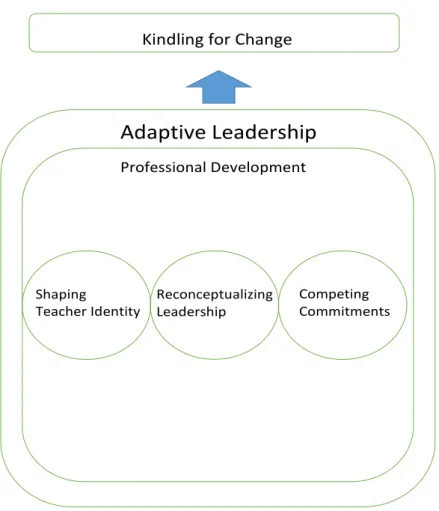
categories, which is “kindling for change.” (refer to figure 1). These three
categories are kindling for the process of change. Kindling is a small piece of
wood used to trigger a fire and this core theme as a metaphor has an
explanatory power. Kindling is metaphorically used in the field of
neuroscience as a phenomenon that triggers neurons to generate epilepsy
(Perlin, Gerwin, Panchision, Vick, Jakoi & Delorenzo, 1993). Thus, this also
can be used as a metaphor that ignites a change in education. More
specifically, this metaphor can be used in order to cause an instructional
change or reform change. If teacher leaders want to ignite a change in
instruction and reforms in the field of education, these three categories or
areas could shed light on what they may need to closely examine. The method
of grounded theory aims to create a thematic core theme, and “kindling for
change” is a theme or theory I constructed for this study. Different from a
formal theory in traditional science, this is a mid-range or substantive theory
(Charmaz, 2006; 2014; 2015) that seeks to explain a phenomenon in
particular settings. Hopefully, therefore, this theory could be transferable to
other similar situations at schools, and this will enable those people who want
to ignite a change at their schools to achieve any change they want to make their school better.
Competing commitments, shaping teacher identity, and re- conceptualizing leadership mentioned above are the areas that offer salient contextual considerations to inform those who want to promote adaptive leadership into a teacher development program created for JTEs who experience educational reform changes.
Figure 1. Three categories merging into a core theme. Three categories that emerged from the data in the professional development program, organized by the researcher as an adaptive leader merge into the core theme of kindling for change.
Outcomes
!
!
!
!
Adaptive!Leadership!
!
Professional!Development!Shaping!!
Teacher!Identity! Competing!
Commitments!
Reconceptualizing!!
Leadership!
Kindling!for!Change!
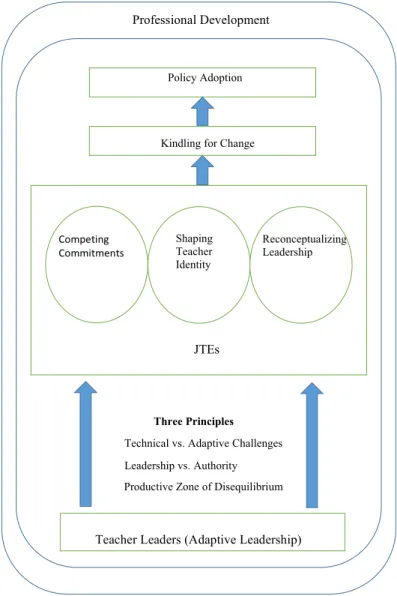
Shedding light on JTEs from the perspectives of these three areas will provide teacher leaders an insight into what it takes to change JTEs from within. A proposed model is shown in Figure 2.
Proposed Model for Teacher Development
Figure 2. Teacher development model within a theoretical framework of adaptive leadership. Teacher leaders utilize three principles to challenge JTEs to explore the three areas of their adaptive challenges to instigate kindle for change, leading to the adoption of a policy.
Figure 2 offers a proposed model for teacher leaders to implement adaptive
!
Professional Development
!
JTEs
Teacher Leaders (Adaptive Leadership) Technical vs. Adaptive Challenges Leadership vs. Authority Productive Zone of Disequilibrium Competing!
Commitments!
Shaping Teacher Identity
!
Reconceptualizing Leadership
! Kindling for Change
Policy Adoption
Three Principles
leadership at their school. The research understands the caveat that making broad generalizations about the outcomes of this study and applying them to other school sites. However, because this study was conducted in a public high school in Japan, it may be possible that the outcomes would resonate with other schools as they are also under the control of the MEXT guided by a national standardized curriculum. Therefore, it is quite plausible that teacher and teacher leaders may be up against similar realities as those in this study.
Under this premise, the outcomes of this study could be useful to inform teacher leaders at other schools who are interested in carrying out adaptive leadership as a means to effect change at their schools. The data from this study that inform the model above indicate that if teacher leaders intend to utilize three principles of adaptive leadership to implement the EIP policy, it is very possible that the three categories would be useful in their similar teaching environments. If this is the case, the teacher leaders could be better prepared to meet the realities that JTEs face during the implementation of the adaptive leadership process.
In addition, in this teacher development model, teacher leaders need
to empower JTEs to do something more than incorporating new technical skill
sets into their current mindset. They need to differentiate technical
challenges from adaptive ones, and address these adaptive challenges by
transforming their mindset. JTEs have to know their own beliefs and values
they stand for and how these beliefs and values play out in their actual
teaching. Teacher leaders also need to tell JTEs what they need to hear rather
than what they want to hear by doing more than what they expect authorities
to do. Their task is to instigate tolerable distress in JTEs or their groups,
making sure that they are kept in the productive zone of disequilibrium to
have them continue to address adaptive challenges. These principles
incorporated in teacher development allow JTEs to examine the three areas
of their adaptive challenges, which leads them to getting to know themselves
at a profound level. This phase translates into kindling for change and it
eventually leads to the policy adoption of JTEs.
This study extends the view of teacher leaders in secondary school education in Japan. More specifically, this study introduced the concept of adaptive leadership to secondary school education. There has not been much research conducted investigating teacher leaders due to cultural differences between Japan and the West. Leadership is a concept conceived in Western culture, and adaptive leadership is also a leadership theory constructed in that culture. Several comments from the JTEs gave an indication of how leadership may be perceived differently in Japan from the West. For example, Teacher A as a teacher participant in this study, stated that age was one of the most crucial elements that was likely to determine a leader in a group.
His comments reflect on a Japanese high school context being in a Confucian hierarchical society.
This study examined the potential adaptive leadership in the process of adopting the EIP policy and investigated possibilities of adaptive leadership within the Japanese educational context. It is very helpful to mobilize the JTEs to tackle their adaptive challenges by examining the three principals of adaptive leadership: technical and adaptive challenges, leadership and authority, and the productive zone of disequilibrium.
Conclusions and Limitations
A significant limitation of this study is that it focused on three JTEs at one grade level at a local public school in Japan during a specific time of data collection. However, given the nature of this study, this is a longitudinal qualitative study, so the sample size is appropriate. The teachers were selected because they were placed at the same grade level with the researcher.
Thus, the findings of this study cannot be generalizable to other contexts.
However, these findings might be transferrable to contexts similar to the
context this study was conducted in, so they might resonate with other JTEs,
helping them address issues associated with the adoption of the EIP policy in
similar contexts in public schools under the umbrella of a standardized
curriculum. Glaser and Strauss (1967) write about the possibilities of going
from a substantive to formal theory in the following:
Since substantive theory is grounded in research on one particular substantive area…., it might be taken to apply only to that specific area. A theory at such a conceptual level, however may have important general implications and relevance, and become almost automatically a springboard or stepping stone to the development of a grounded formal theory. (p. 79)
This means that more data obtained from many kinds of substantive areas leads to the generation of a formal theory. In other words, a formal theory could be generated from multiple substantive theories created by separate studies on JTEs adopting an educational policy such as the EIP policy in their classrooms within a framework of adaptive leadership. However, as far as this study is concerned, the objective was to create a substantive theory that could be transferrable to similar substantive areas. Thus, the results of this study may have a limited applicability but the objective of this study was met.
Future research on adaptive leadership should make attempts at
refining the concept further so that it is appropriate for the EFL in secondary
school education in Japan. Additionally, applying an adaptive leadership lens
to JTEs’ adoption of an educational policy such as the EIP policy has powerful
implications for teacher development. This lens enables teacher leaders to
identify the particular demands of change that may not be effectively
addressed simply through technical means such as increased knowledge
acquisition or behavioral modification. In order to achieve this goal, more
teacher development programs that provide avenues for reflecting on and
altering JTEs beliefs and values need to be considered within their own
schools, infusing their own learning into their teaching. This was the
intention of this study to use adaptive leadership grounded in getting
teachers to explore their teaching, having them take ownership in the
suggested changes, and getting them to apply them in their own particular
situations.
論文要約