Emerging embedded nonvolatile memory solution for ultra low power microcontroller systems
著者 林越 正紀
著者別表示 Hayashikoshi Masanori journal or
publication title
博士論文要旨Abstract 学位授与番号 13301甲第4810号
学位名 博士(工学)
学位授与年月日 2018‑09‑26
URL http://hdl.handle.net/2297/00053017
Creative Commons : 表示 ‑ 非営利 ‑ 改変禁止 http://creativecommons.org/licenses/by‑nc‑nd/3.0/deed.ja
博 ⼠ 論 ⽂ (要旨)
Emerging embedded nonvolatile memory solution for ultra low power
microcontroller systems
超低消費電⼒マイクロコントローラシステムを実現する 次世代不揮発性メモリ応⽤の研究
⾦沢⼤学⼤学院⾃然科学研究科 電⼦情報科学専攻
学籍番号︓1223112005
⽒名︓林越 正紀
主任指導教員名︓新居 浩⼆
2018 年 9 ⽉
3
Abstract
This thesis reports emerging embedded nonvolatile memory solution for ultra low power microcontroller systems.
Many semiconductor devices are used nowadays. In case of microcontrollers, that with embedded flash memory have become the mainstream and that volume is 70% of all market of microcontroller and the average growth rate of the market is about 16%, compared to the growth rate of all microcontroller market. Thus, the non-volatile memory devices typified by Flash memory are core technologies of all industries. Currently, Flash-MCU has become the mainstream of the microcontrollers. In the future, in which the semiconductor miniaturization, and the greening of society advance, the conventional embedded memory (SRAM, Flash memory) has the technology limitation such as the leakage current problem with the miniaturization of process technology, the next-generation nonvolatile memory (NVRAM) is expected. This study is intended to overcome the challenge of embedded the nonvolatile memory and investigate that solution for ultra-low power microcontroller systems.
For microcontroller systems, critical issues related to embedded nonvolatile memory are pointed out in Chapter 2. The main issues of an embedded nonvolatile memory design are summarized as five limitations: low voltage operation, high endurance characteristic, high speed access, high density, and low leakage current design of system for low power dissipation. An explanation for each limitation is provided to enhance understanding of the study objective.
For the next three parts of this paper, practical nonvolatile memory design techniques against each limitation are demonstrated. In Chapter 3, Capacitor-coupled EEPROM design with capacitor-coupled EEPROM cell and dual-mode sensing scheme for low voltage, high endurance, and high speed access is discussed.
In Chapter 4, practical high density 1T-4MTJ MRAM (Magnetic Random Access Memory) design with 1T-4MTJ cell and voltage-offset self-reference sensing scheme for high endurance, high density, and high speed access is discussed.
In Chapter 5, the zero standby microcontroller system technology with normally-off system architecture and its power management scheme for low voltage operation and low leakage current in point view of hardware and software technologies is discussed.
The overall conclusion of this contribution is presented as a summary in Chapter 6.
4
1. Background of research area
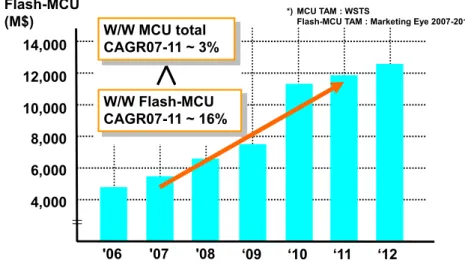
Many semiconductor devices are used nowadays. In case of microcontrollers, that with embedded flash memory have become the mainstream and that volume is 70% of all market of microcontrollers. The market overview of microcontrollers is shown in Figure 1. The average growth rate of the market is about 16%, compared to the growth rate of all microcontroller market, it has remained at a high rate. Thus, the non-volatile memory devices typified by Flash memory are core technologies of all industries. Microcontroller applications and market volume is shown in Figure 2. Thus, nonvolatile memory is embedded to almost of microcontroller devices.
*) MCU TAM : WSTS
Flash-MCU TAM : Marketing Eye 2007-2011
Flash-MCU (M$)
10,000 12,000 14,000
'06 '07 '08 ‘09 ‘10 4,000
6,000 8,000
‘11 ‘12 W/W Flash-MCU
CAGR07-11 ~ 16%
W/W MCU total CAGR07-11 ~ 3%
Figure 1: Market overview of microcontrollers
32b
(Auto, Industry)
> 80~100MHz
20~100MHz
< 20MHz 32b/16b
(PC, Industry, Auto, Consumer)
8b/4b
(Consumer etc.)
Integrated scale
Technology node (nm)
130 150 200 >250
Frequency
(as of 2011) (Smart card,
Medical)
40 90
Flash memory is embedded to almost of microcontroller devices.
Figure 2: MCU applications and market volume
5
2. Objective of this study
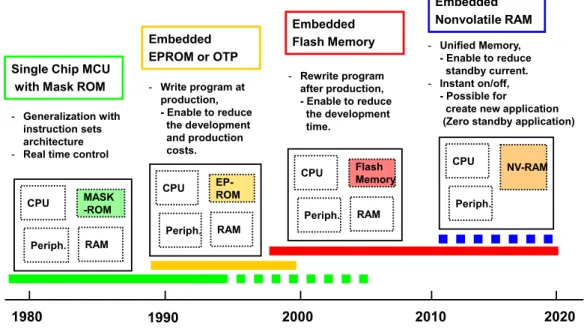
As mentioned in previous chapter, nonvolatile memory is a key device for recent microcontroller systems. The trend of microcontroller with embedded nonvolatile memory is shown in Figure 3.
Through ’80 years from the end of the ’70s, it appeared single-chip microcontroller with embedded mask ROM, and it becomes possible to make the generalization with instruction sets architecture and real time control. Thereby, it has made a big evolution in terms of performance and ease of use. In the late of ’80s, it appeared the microcontroller with EPROM (Erasable Programmable Read Only Memory) or OTP (One Time Programmable read only memory), and it becomes possible to write the program data at production stage by user. Thereby, the development and production cost has been greatly improved. After then, in the half of ’90s, it appeared the microcontroller with embedded Flash memory (Flash-MCU), and it becomes possible to rewrite the program data after production. Thereby, a mass production setup has become possible at program development completion and the development period has become enabled to be shorten. In addition, a big change has been happened on production and distribution cost side because of commonization of microcontrollers. Currently, Flash-MCU has become the mainstream of the microcontrollers. In the future, in which the semiconductor miniaturization, and the greening of society advance, the conventional embedded memory (SRAM, Flash memory) has the technology limitation such as the leakage current problem with the miniaturization of process technology, the next-generation nonvolatile memory (NVRAM) is expected. This study is intended to overcome the challenge of embedded the nonvolatile memory and investigate that solution for ultra-low power microcontroller systems.
1980 1990 2000 2010
MASK CPU -ROM
Periph. RAM
EP- CPU ROM
Periph. RAM
Flash Memory CPU
RAM Periph.
NV-RAM CPU
Periph.
Single Chip MCU with Mask ROM
Embedded EPROM or OTP
Embedded Flash Memory
Embedded Nonvolatile RAM
2020
- Write program at production, - Enable to reduce
the development and production costs.
- Generalization with instruction sets architecture - Real time control
- Rewrite program after production, - Enable to reduce
the development time.
- Unified Memory, - Enable to reduce
standby current.
- Instant on/off, - Possible for
create new application (Zero standby application)
Figure 3: Trend of microcontroller with embedded nonvolatile memory
6
3. Overview of this thesis
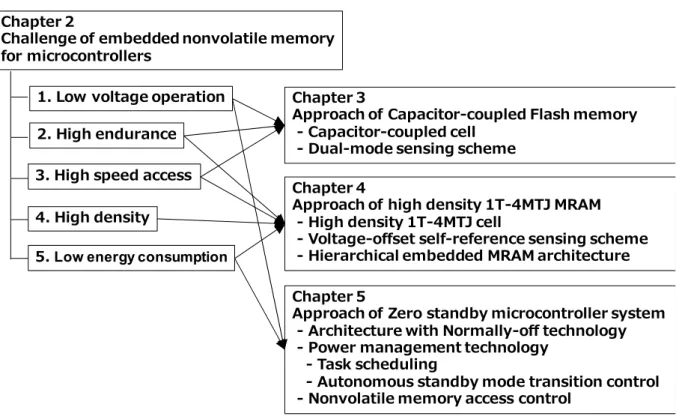
Figure 4 presents the outline of this thesis, as visualized very simply. First, the background and objective of this study are described. For microcontroller systems, critical issues related to embedded nonvolatile memory are pointed out in Chapter 2. The main issues of an embedded nonvolatile memory design are summarized as five limitations: low voltage operation, high endurance characteristic, high speed access, high density, and low power consumption energy design of system for low power dissipation. An explanation for each limitation is provided to enhance understanding of the study objective.
Chapter 2
Challenge of embedded nonvolatile memory for microcontrollers
2. High endurance 3. High speed access 4. High density
Chapter 3
Approach of Capacitor-coupled Flash memory - Capacitor-coupled cell
- Dual-mode sensing scheme Chapter 4
Approach of high density 1T-4MTJ MRAM - High density 1T-4MTJ cell
- Voltage-offset self-reference sensing scheme - Hierarchical embedded MRAM architecture Chapter 5
Approach of Zero standby microcontroller system - Architecture with Normally-off technology - Power management technology
- Task scheduling
- Autonomous standby mode transition control - Nonvolatile memory access control
5. Low energy consumption 1. Low voltage operation
Figure 4: Outline of this thesis
For the next three parts of this paper, practical nonvolatile memory design techniques against each limitation are demonstrated. In Chapter 3, Capacitor-coupled EEPROM design with capacitor-coupled EEPROM cell and dual-mode sensing scheme for low voltage, high endurance, and high speed access is discussed.
In Chapter 4, practical high density 1T-4MTJ MRAM (Magnetic Random Access Memory)
design with 1T-4MTJ cell and voltage-offset self-reference sensing scheme for high endurance,
7
high density, and high speed access is discussed.
In Chapter 5, the zero standby microcontroller system technology with normally-off system architecture and its power management scheme for low voltage operation and low leakage current in point view of hardware and software technologies is discussed.
The overall conclusion of this contribution is presented as a summary in Chapter 6.
4. Essentials of this thesis
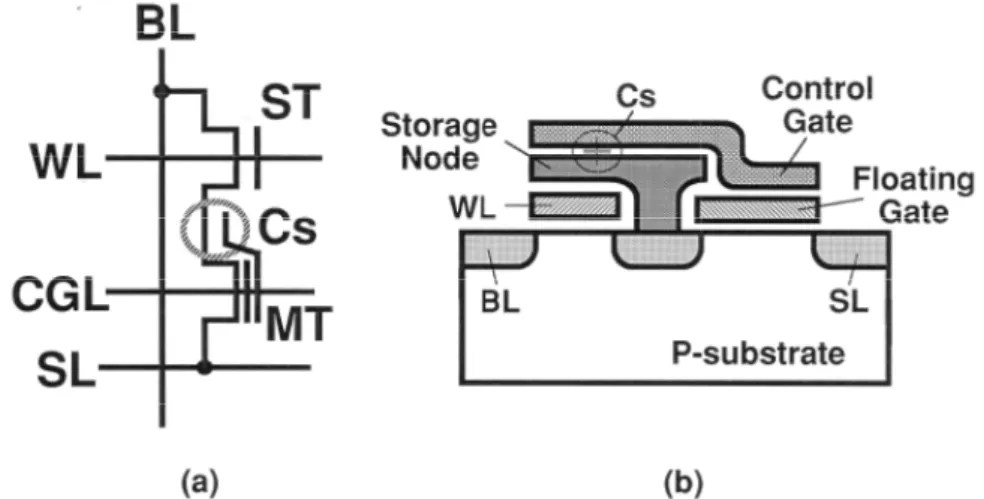
In Chapter 3, a dual-mode sensing (DMS) schenie of a capacitor-coupled EEPROM cell has been discussed. A new memory cell structure shown in Figure 5 and a new sensing scheme are proposed and estimated. The new memory cell combines an EEPROM cell with a DRAM cell.
The DMS scheme utilizes the charge-mode sensing of the DRAM cell in addition to the current-mode sensing of the EEPROM cell. Using this DMS technique, the sensing speed can be enhanced by 36% at a cell current of 15 FA by virtue of the additional charge-mode sensing.
Furthermore, the stress applied to the tunnel oxide of the memory transistor can be relieved by decreasing the programming voltage and shortening the programming time. Therefore, with this memory cell structure and sensing scheme, it is possible to realize high-speed sensing in low-voltage operation and high endurance.
Figure 5: A newly proposed capacitor-coupled EEPROM cell.
(a) A memory cell circuit. (b) A cross sectional view.
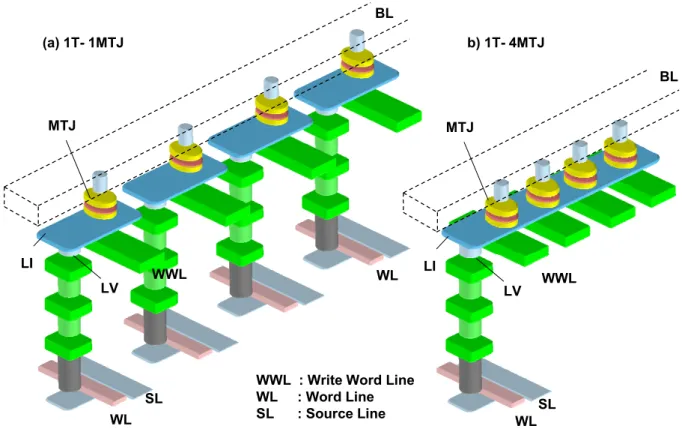
In Chapter 4, a high-density memory cell named 1-Transistor 4-Magnetic Tunnel Junction
(1T-4MTJ) has been proposed for Magnetic Random Access Memory (MRAM) shown in Figure
6. The new 1T-4MTJ cell has been successfully demonstrated by a 1-Mb MRAM test chip using
130-nm CMOS process. A 1-Mb 1T-4MTJ MRAM with 50MHz@4cycle operation
8
(tAC=56nsec) is demonstrated. Furthermore, the effective array size of 1T-4MTJ cell is estimated to be reduced of -35.7%. By using 1T-1MTJ and 1T-4MTJ cells, on-chip hierarchical memory scheme composed of fast 1T-1MTJ cell for cache memory and small 1T-4MTJ cell for large-capacity memory is feasible. Thus, microcontroller design indicates chip size reduction with keeping a microcontroller performance.
BL
WL LV
WWL : Write Word Line WL : Word Line SL : Source Line
b) 1T- 4MTJ
LI
SL SL WWL WWL (a) 1T- 1MTJ
WL BL
WL LV LI
MTJ MTJ
Figure 6: 1T-4MTJ MRAM cell structures
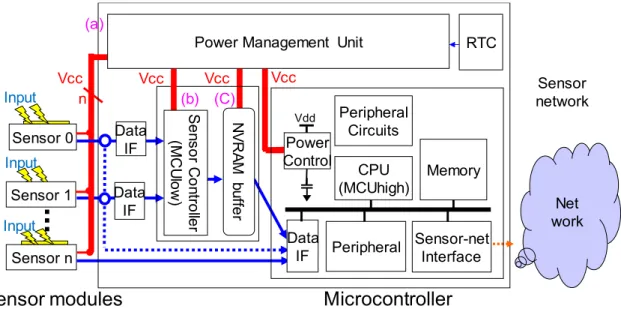
In Chapter 5, the low-power multi-sensor system with power management and nonvolatile memory access control for IoT applications, which achieves almost zero standby power at the no-operation modes has been proposed. System diagram of proposed normally-off multi-sensor node is shown in Figure 7. In here, power management scheme with activity localization can reduce the number of transitions between power-on and power-off modes with rescheduling and bundling task procedures. In addition, autonomously standby mode transition control selects the optimum standby mode of microcontrollers, reducing total power consumption. We demonstrate with evaluation board as a use case of IoT applications, observing 91 percent power reductions by adopting task scheduling and autonomously standby mode transition control combination.
Furthermore, we propose a new nonvolatile memory access control technology, and estimate the
possibility for future low-power effect.
9
Microcontroller
Input Sensor 0
Sensor n Sensor 1 Input
Sensor modules
n
RTC
NVRAM buffer
Input
Net work Sensor network Data
IF Data
IF
(b) (a)
(C)
Vcc Vcc Vcc
Sensor Controller(MCUlow) CPU
(MCUhigh)
Sensor-net Interface Data
IF Power Control
Vdd
Peripheral Peripheral
Circuits
Memory Vcc
Power Management Unit