中央大学博士論文
Synthetic Applications of Silicon-Based Cross-Coupling Reaction
Kenta Shimizu
清水 健太
博士(工学)
中 央 大 学 大 学 院 理 工 学 研 究 科 応 用 化 学 専 攻
平 成 2 5 年 度
2014年3月
Contents
Chapter 1 General Introduction 1
1.1 Cross-coupling Reactions 2
1.2 Intermolecular Activation of Organosilicon Reagents 4
1.2.1 Oraganohalosilanes 4
1.2.2 Organoalkoxysilanes 5
1.2.3 Oraganosilanoles and Organosilanorates 6
1.2.4 Organotrimethylsilanes 7
1.2.5 Masked silanols 7
1.3 Organo[2-Hydroxymethyl(phenyl)]dimethylsilanes (HOMSi Reagents) 8
1.4 Additional Carbon-Carbon Bond-Forming Reactions with HOMSi Reagents 18
1.5 Carbon-Heteroatom Bond-Forming Reactions with Heteroatom-Silcon Reagents 21
1.6 Cross-Coupling Polycondensation 23
1.7 Outline of the Thesis 24
References 26
Chapter 2 Novel Synthetic Method of HOMSi Reagents 29
2.1 Introduction 30
2.2 Results and Discussion 30
2.3 Experimental 36
References 50
Chapter 3 Polyarylene Synthesis by Cross-Coupling Reaction 53
with HOMSi Reagents 3.1 Introduction 54
3.2 Results and Discussion 54
3.3 Experimental 62
References 69
Chapter 4 Silicon-Based C-N Coupling Reaction 71
4.1 Introduction 72
4.2 Results and Discussion 72
4.3 Experimental 81
References 88
Chapter 5 Conclusion 91
Publication List 93
Acknowledgments 95
List of Abbreviations
Ac acetyl
Ar aryl
BINAP 2,2’-Bis(diphenylphosphino)binathtyl
Bn benzyl
Bz benzoyl
(R,R)-Bn-bod* (1R,4R)-2,5-dibenzylbicyclo[2.2.2]octa-2,5-diene Boc tert-butylcarbonyl
Bu butyl
t-Bu tert-butyl
cod 1,4-cycoctadiene
Cp η
5-cyclopentadienyl
Cy cyclohexyl
CyPF-t-Bu (R)-1-[(S
p)-2-(dicyclohexylphosphino)ferrocenyl]ethyl- di-tert-butylphosphine
Davephos 2-dicyclohexyl-2’-dimethylaminobiphenyl
dba dibenzylydeneacetone
DIBAL-H diisobutylaluminium hydride
dpca [N-(2-diphenylphosphino)benzylidene]cyclohexylamine
DME 1,2-dimethylethane
DMF dimethylformamide
DMI 1,3-dimethyl-2-pyroridinone DMPU N,N’-dimethylpropyleneurea DMSO dimethylsulfoxide
dppf 1,1’-bis(diphenylphosphino)ferrocene dpppz 1,2-bis(diphenylphosphino)benzene dvds 1,3-divinyl-1,1,3,3-tetramethyldisiloxane
E electrophile
ee enantiomer excess
Et ethyl
FET field-effect transistors
FG functional group
Hex hexyl
hfacac hexafluoroacethylacetone
HMDS 1,1,1,3,3,3-hexamethyldisilazane
HMPA hexamethylphosphoric triamide Jonphos (2-biphenyl)di-tert-butylphosphine
Me methyl
M
nnumber average molecular weight M
wweight average molecular weight NMP N-mehtyl-pyrroridone
Ns 2-nitorobenzenesulfonyl
Oct octyl
Pent pentyl
c-Pent cyclopentyl
PDI polydispersity index
PG protecting group
Ph phenyl
(R,R)-Ph-bod* (1R,4R)-2,5-diphenylbicyclo[2.2.2]octa-2,5-diene (S,S)-Ph-bnd* (1S,5S)-2,6-diphenylbicyclo[3.3.1]nona-2,6-diene PPTS pyridinium p-toluenesulfonate
Pr Propyl
i-Pr isopropyl
PTSA p-toluenesulfonic acid PVC photovoltaic cell
Py pyridyl
Ruphos 2-dicyclohexylphosphino-2’,6’-di-iso-propoxybiphenyl scCO
2supercritical carbon dioxide
TASF tris (dimethylamino)sulfonium difluorotrimethylsilicate TBAF tetrabutylammonium fluoride
TBDPS tert -butyldiphenylsilyl TBS tert -buthyldimethylsilyl TIPS tri- iso -propylsilyl
THF tetrahydrofuran
THP tetrahydropyran-2-yl
TMEDA N,N,N’,N’-tetramethylethylenediamine
TMS trimethylsilyl
X halogen
Xphos 2-dicyclohexylphosphino-2’,4’,6’-tri-iso-propylbiphenyl
Chapter 1
General Introduction
Organic synthesis has definitely influenced on modern science and technology par- ticularly pharmaceutical and material industry and brought various innovations. It should be noted that current organic synthesis made it possible to transform straghtfor- wardly by a variety of metal-catalyzed reactions. High selectivity and efficiency are at- tained by the well-designed catalytic reactions using specific organometallic complexes with appropriate ligands. Typical examples are asymmetric synthesis, metathesis, and cross-coupling reactions, to which the Nobel Prize in Chemistry was given in 2001, 2005, and 2010, respectively. However, along with economic and industrial develop- ments, we are faced with environmental problems such as global warming and energy resource issues. Chemists are requested to solve these problems. With the background mentioned above, the author has struggled with these problems through studied on more efficient and environmentally benign cross-coupling reaction.
1. 1 Cross-Coupling Reaction
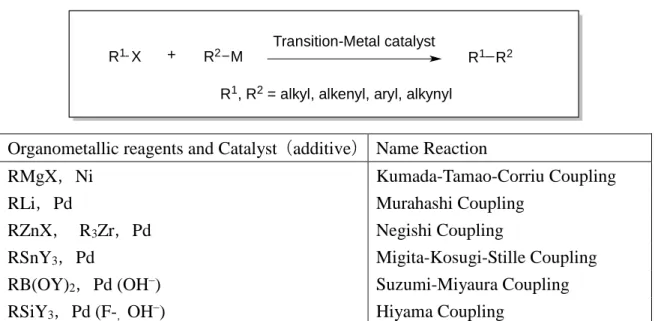
Cross-coupling reaction is the one that combines nucleophilic organometallic rea- gents with electrophiles like organic halides in the presence of transition metal catalysts such as palladium, nickel, cobalt, or iron. The reaction usually takes place at the original position stereospecifically with retention of configuration. Thus, this reaction is consid- ered now the most reliable and straightforward carbon–carbon bond forming transfor- mation and is widely applied to synthesis of a wide variety of π -electron conjugated or- ganic materials and pharmaceuticals. It should be noted that many Japanese chemists have contributed to the advances in the cross-coupling reaction as summarized in Figure 1.
R1 X + R2 M
Transition-Metal catalyst
R1 R2 R1, R2 = alkyl, alkenyl, aryl, alkynyl
Organometallic reagents and Catalyst ( additive ) Name Reaction
RMgX , Ni Kumada-Tamao-Corriu Coupling
RLi , Pd Murahashi Coupling
RZnX , R
3Zr , Pd Negishi Coupling
RSnY
3, Pd Migita-Kosugi-Stille Coupling
RB(OY)
2, Pd (OH
–) Suzumi-Miyaura Coupling
RSiY
3, Pd (F-
,OH
–) Hiyama Coupling
Figure 1. Cross-coupling reactions
Historically, the first protocol was disclosed in 1972 by the group of Kumada and Tamao and by Corriu independently, using Grignard reagents (RMgX) and nickel cata- lysts. Shortly thereafter, Murahashi used organolithium reagents and palladium catalysts.
Negishi screend combination of various transition and main group metals to find in 1976 organozinc reagents and palladium catalysts were the best. Next year the group of Migita and Kosugi and two years later Stille reported that organotin reagents were supe- rior in stability along with enough reactivity. Suzuki and Miyaura joined the game in 1979 to show that organoboron compounds are the best in handling and reactivity when they are activated by a base. Silicon reagents remained inapplicable for long time due to lack of general reactivity, though they are considered to be ideal in view of availability, stability and nontoxicity. Hiyama and Hatanaka reported in 1988 that tetragonal organo- silicon reagents participate in the palladium-catalyzed cross-coupling reaction in the presence of a fluoride activator.
1)The reactivity of organometallics falls roughly in the order of R
2Li > R
2MgX > R
2ZnX > R
2SnR
33> R
2B(OR
3)
2≃ R
2SiR
33. Namely, the less nucleophilic reagents show the more chemoselectivity that are preferable in view of storage and selective use. From the viewpoint of manufacturing, ready accessibility of elements, stability of reagents, nontoxicity, and easy waste recovery and storage are the essentials of choice. In this respect, organosilicon reagents have advantages: rich natural abundance, non- or low toxicity, and high chemoselectivity. Thus, the cross-coupling reaction with organosilicon reagents have attracted much interest recently
2).
Silicon is an element at the 14th group, right below carbon, in the Periodic Table.
Thus, saturated organosilicon compounds have a tetrahedral structure which is ex- tremely stable and inert under various conditions. However, once a nucleophile like flu- oride ion is present, some portion of the silicon compound is converted to a pentacoor- dinate silicate, to undergo transmetalation to transition metals as disclosed by Hiyama and Hatanaka. Scheme 1 summarizes the well-accepted mechanism of the silicon-based cross-coupling reaction: oxidative addition of Pd(0) complex to electrophile R
1–X to
Pd(0)
Pd R1 X
Pd R1 R2 R1X
R1R2
R2SiY3
R2Si Y Y F Y
X Si Y Y F Y
R2 Si Y
Y F Y Pd X R1
+ F
Scheme 1. Catalytic cycle for silicon-based cross-coupling reaction
give R
1-Pd(II)-X, (2) transmetalation with a pentacoordinate silicate, transferring or- ganic group R from Si possibly via a 4-membered transition state
3)to give R
1-Pd-R
2, (3) reductive elimination to give a coupled product and reproduce the starting Pd(0) com- plex . In order to undergo the transmetalation smoothly, it is essential to make penta- coordinate silicate more electrophilic. To this end, one to three heteroatom substituents like halogen or alkoxy are better present on silicon. In the following sections, reactivity of the organosilicon reagents is reviewed, depending on the kind of organic group to react with.
1. 2 Intermolecular Activation of Organosilicon Reagents 1. 2. 1 Organohalosilanes
Electronegative halogens on silicon make the silicon center more electrophilic.
Accordingly, the reaction in Eq 1
4)reported by Kumada and Tamao is not surprising:
alkenylpentafluorosilicate couples with allyl chloride with the aid of palladium(II) ace- tate at room temperature. The hexacoordinate silicate was considered to be nucleophilic enough to undergo transmetalation. This is the first to show highly coordinated silicate can transmetalate to palladium to effect cross-coupling reaction. However, a radical mechanism via single electron-transfer may be an alternative.
SiF5
K2 Bu +
Pd(OAc)2 cat.
Cl
THF, rt
Bu 71%
(1)
The same silicate cross-couples with phenyl iodide at 135 °C to give trans-stilbene and a cine-coupled product in a small amount
4)(Eq 2). High reaction temperature was necessary possibly for the porpose of the removing one fluoride from the hexacoordi- nate species. This reaction was not well-appreciated, because synthesis of pentacoordi- nate silicates is tedious and thus lacks the general potential.
Trimethylvinylsilane was first employed for the cross-coupling reaction, using
tris(dimethylamino)sulfonium difluorotrimethylsilicate ((Et
2N)
3S·F
2SiMe
3, TASF) acti-
vator in HMPA. To extend the scope of the reaction, one to three fluorines were intro-
duced on silicon; tetrabutylammonium fluoride (Bu
4N·F, TBAF) or potassium fluoride was later used as a fluoride ion source; simple THF as the solvent was found satisfacto- ry, all for the formation of pentacoordinate silicates in-situ through the reaction of te- tragonal silanes with a fluorine activator.
5)An example is the coupling of (E)-1-iodo-1-octene with (E)-1-dimethylfluorosilyl-1-octene to give a coupled 1,3-diene in a high yield (Eq 3). The fluorine on the silicon is definitely making the silicon center be more reactive for transmetalation than trimethylsilyl as is shown in Eq 4.
SiMe2F
Hex I
+ Hex
[Pd(allyl)Cl]2 cat.
(Me2N)3S·F3SiMe2 THF, 50 °C
Hex Hex
83%
SiMe2F
Me3Si I
+ Hex
[Pd(allyl)Cl]2 cat.
(Me2N)3S·F3SiMe2 THF, 50 °C
Me3Si
Hex 70%
(3)
(4)
Fluorine atoms on the silicon can be replaced by chlorine atoms, and a fluoride acti- vator may be replaced by a hydroxide ion as illustrated by Eq 5.
6)This particular exam- ple suggests a high potential of the silicon-based cross-coupling reaction for industrial applications.
Ph SiEtCl2 + Br
Ac
Pd(OAc)2 cat.
PPh3 cat.
NaOH
benzene, 80 °C Ph
Ac 89%
(5)
Alkyl cross-coupling using alkylsilanes is achieved using trifluorosilyl reagents.
The next example demonstrates high chemoselectivity of the coupling reaction.
NC SiF3
3 +
Br
Ac
Pd(PPh3)4 cat.
TBAF
THF, 100 °C Ac
88%
NC 3 (6)
1. 2. 2 Organoalkoxysilanes
Organoalkoxysilanes are more stable than halosilanes but equally applicable to the
cross-coupling reaction due to the enhanced Lewis acidity at the silicon center by oxy-
gen. Using inexpensive trialkoxyphenylsilanes and aryl chlorides,
7a)tosylate
7b)or me- sylate,
7c)biaryls have become readily accessible (Eq 7).
Ph Si(OMe)3 + Cl
OMe
Pd2(dba)3/
PCy2(2-biphenyl) cat.
TBAF, DMF, 85 °C
Ph
OMe 71%
(7)
Fu disclosed that a Ni/chiral diamine-catalyzed enantioselective cross-coupling re- action of α -bromobutyrates with phenyl(trimethoxy)silane to obtain α -phenylbutyrates with high enantioselectivity (Eq 8).
8)1. 2. 3 Organosilanols and silanolates
Orgonosilanols are shown by Hiyama and Mori to be equally effective for the cross-coupling reaction. The reaction of aryl halides with arylsilanols in the presence of a palladium catalyst and a silver oxide activator.
9)Alkneylsilanols also are applicable to the corresponding cross-coupling reaction (Eqs 9, 10).
Meanwhile Denmark achieved the cross-coupling reaction using organosilanols,
10)which react with organic halides in the presence of a palladium catalyst and KOSiMe
3(KOTMS) as a base in place of a fluorine activator (Eq 11). It is worth to note that TBS
silyl ethers are tolerated under the conditions.
SiMe2OH
Pent I
+ Pd(dba)2 cat.
KOTMS DME, rt,
Hex
80%
TBSO TBSO (11)
The reaction is considered to involve silanolates which substitute X in R
2-Pd-X to give R
1-Pd-OSiMe
2CH = CHR
1. This Pd(II) complex is attacked by another silanolate to complete transmetalation (Scheme 2).
R1 Si OH Me
Me base
R1 Si O Me Me
M
X Pd R2
R1 Si O Me Me
Pd R2 -MX
R1 Si O Me Me
M
Si R1 Si
O Me Me
O Me R1 MePd R2
R1 Pd R2 R1 R2
-Pd(0)
Scheme 2. Plausible mechanism of the cross-coupling of alkenylsilanolates
Denmark later employed organolsilanolates directly as the coupling reagent and in fact demonstrated that the cross-coupling reaction smoothly proceeded with potassium organosilanolates without an additional base.
11)1. 2. 4 Organo(trimethyl)silanes
As described in 1.2.1, tetraorganosilanes were initially employed for the sili- con-based cross-coupling reaction.
2)For instance, the reaction of 2-iodonaphthalene with vinyl(trimethyl)silane in the presence of a palladium(II)/triethylphosphite catalyst and TASF produced 1-vinylnaphthalene in a quantitative yield (Eq 12).
[Pd(allyl)Cl]2 PO(OEt)3 TASF THF, 50 °C
98%
SiMe3
I
(12)
1. 2. 5 Masked silanols
More than 10 years later Denmark reported that the cross-coupling reaction of aryl
iodides with 1-alkenyl-1-methylsilacyclobutanes proceeded smoothly to give sty-
renes.
13a)However, the silacyclobutane reagents were shown to decompose by a con- taminant water in TBAF • THF solution to give silanols or siloxanes, which turned out to be real active species for the cross-coupling reaction (Eq 13).
13b)Hex SiMe
+ I
OMe
Pd2(dba)3 cat.
TBAF, THF, rt Ac
94%
(13) Hex
Si OX
Hex Me
Me X = H or SiR3
Tetraorganosilanes with such substituent as 2-pyridyl,
14)2-thienyl,
15)allyl,
16)3,5-bis(trifluoromethyl)phenyl,
17)and benzyl
18)are used for the Pd-catalyzed TBAF-mediated cross-coupling: hereby these organic groups are converted to fluorosilanes or silanols before transmetalation for the cross-coupling.
1. 3 Organo[2-(hydroxymethyl)phenyl]dimethylsilanes (HOMSi reagents)
As described above, the cross-coupling reactions with organosilicon reagents such as halosilanes and silanols proceed successfully as these heteroatoms assist pentacoor- dinate silicate formation. Because tetraorgonosilicon reagents are desirable in terms of stability, easy handling and storage, the cross-coupling reaction with tetraorganosilanes has remained challenging for some time.
Scheme 3. Transition-metal catalyzed C-C bond formation with HOMSi reagent
In 2005, Hiyama and Nakao achieved the cross-coupling reaction with or- gano[2-(hydroxymethyl)phenyl]dimethylsilanes, so called HOMSi reagent (1~5).
HOMSi reagents react in the presence of a weak base and readily form cyclic penta- coordinate silicates by intramolecular nucleophilic attack of a hydroxyl group.
Co-generated silicon residue is cyclic silyl ether 6, which can be used for synthesis of the same or other HOMSi reagents as summarized in Scheme 3.
In the following sections, synthetic methods of HOMSi reagents and details of the cross-coupling reaction with HOMSi reagents are discussed.
Aryl substituted HOMSi reagents (Ar-HOMSi) can be easily prepared by the reac- tion of such organometallic reagents as arylmagnesium halides or aryllithiums with the cyclic silyl ether (Eq 14).
19-20)Alkenyl-HOMSi reagents are prepared by plati- num-catalyzed hydrosilylation of alkynes with protected hydrosilanes derived from the cyclic silyl ether or alternatively by the reaction of the cyclic silyl ether with alkenyl- magnesium halides (Eq 15).
19,21)Ru-Catalyzed hydrosilylation is recently shown to give (Z)-alkenyl-HOMSi selectively (Eq 16).
21)PGO SiMe2
H
Pt(dvds)/
P(tBu)3cat.
hexane, 0 °C to rt 2) deprotection R1
R2 Si R3 R1
HO
Me2
R2 +
1) R2
R3 R1 MgBr
OSi Me2
Et2O or THF 0 °C to rt
THPO SiMe2
H
Ph RuHCl(CO)[P(iPr)3] cat.
CH2Cl2, rt 1)
2) deprotection
+ Si
Ph HO
Me2
OSi Me2
ArMgXor ArLi Et2O or THF
HO SiMe2
Ar (14)
(15)
(16)
Kondo demonstrated a Pd-catalyzed dehydrohalogenative silylation of elec- tron-deficient aryl iodides using protected H-HOMSi reagents (Eq 17).
22)Deprotection provides the coupling active form of aryl-HOMSi reagents.
With the limited number of synthetic methods for HOMSi reagents, it is desirable to
exploit novel straightforward preparation of HOMSi reagents starting with disilanes or hydrosilanes. This is the target of the present Disseration and will be discussed in Chapter 2.
In the presence of a palladium catalyst and a weak base, the cross-coupling reaction of aryl iodides with HOMSi reagents proceeds smoothly to give coupled products in good yields.
19-21)For example, m-TBSoxymethylphenyl iodide react with a 1-octenyl-HOMSi reagent to give an octenylated benzyl silyl ether and the cyclic silyl ether in an excellent yield using PdCl
2, P(2-furyl)
3and K
2CO
3(Eq 18). The silyl pro- tecting group is tolerated under the conditions.
SiMe2
HO +
PdCl2cat.
P(2-furyl)3cat.
K2CO3, DMSO 35 °C
OSi Me2
+ I
TBSO TBSO
Hex 98%
Hex (18)
For the reaction of 1-iodo-1-octene, a dcpa ligand is effective for the reaction and the coupled 1,3-diene is obtained regio- and stereoselectively (Eq 19).
Aryl-HOMSi reagents also react with iodoarenes to give biaryls. Sterically hindered
2,6-dimethyliodobenzene gives 2,6-dimethylbiaryl in 94% yield (Eq 20).
Cross-coupling with HOMSi has recently been applied to the synthesis of vitamin A by López (Scheme 4).
23)An alkenyl-HOMSi reagent was prepared by the Pt-catalyzed hydrosilylation of 1,3-eneyne with a protected H-HOMSi reagent followed by deprotec- tion. The tetraene skeleton of vitamin A was constructed by the Pd-catalyzed cross-coupling of 1-iodo-1,3-diene with the alkenyl-HOMSi reagent. The coupling yield is 70% and is compared favorably with the Suzuki-Miyaura coupling or Mig- ita-Kosugi-Stille coupling. The reaction conditions are the mildest among these, and thus the silicon-based coupling is evaluated to be the best.
Scheme 4. Vitamin A synthesis via cross-coupling reaction with HOMSi reagent
Because regioselectivity in hydrosilylation of internal alkynes is hardly controlled,
synthesis of alkenyl-HOMSis by hydrosilylation remained restricted to terminal and
symmetrical internal alkynes. Recently, however, regioselective hydrosilylation of un-
symmetrical alkynes is attained to facilitate the synthesis of alkenyl-HOMSi reagents.
24)Hydrosilylation of 2-alkanoates with hydrosilanes is demonstrated to proceed high re-
gioselectively to give α -silylalkanoates. The resulting functionalized HOMSi reagent
can be converted into α -arylalkanoates by the cross-coupling with aryl iodides. An ex-
ample is shown in Eq 21.
24)The HOMSi-based cross-coupling reaction is applicable also to aryl bromides.
25)For example, 3-bromotoluene is cross-coupled with Ph-HOMSi with the aid of a Pd/Cu cat- alyst mixture to give the corresponding biaryl and the cyclic silyl ether (Eq 22).
Whereas HOMSis are excellent coupling reagent, protection of the hydroxyl group as a silyl ether, acetate ester, or THP or MOM ether makes the silicon moiety totally in- active; deprotection under different conditions produces specifically activated HOMSi reagent being ready for cross-coupling (Scheme 5) .
Scheme 5. Orthogonal protection and deprotection of HOMSi reagents
Using various protected halo-aryl-HOMSi reagents, a variety of oligo-arenes can readily be prepared according to a blue print of total synthesis by repeating cross-coupling and deprotection.
26-27An example is illustrated in Scheme 6.
Repeating the procedure of protection/cross-coupling and protection/halogenation,
oligothiophenes are readily prepared. Scheme 7 demonstrates a convergent synthesis of
a quinquethiophene with silyl groups on the both ends. The material has an excellent
character for three-dimensional holographic recording.
26-27)Scheme 6. Iterative cross-coupling–deprotection sequence
S Si(THP) S
S Si S
S Si(THP) Br S
S Si(THP) S
S S
S Si(THP) S
S
Br S S Si(THP)
S S S (t-Bu)Me2Si S
(t-Bu)Me2Si S Si 89%
90%
82%
90% 80%
a
b
c d
c
(a) PPTS (20 mol%), MeOH, 40 °C, 2 h; (b) n-BuLi, TMEDA, THF, -40 °C to rt, 1 h, then BrCF2CF2Br, -40 °C, 1 h;
(c) PdCl2(dppf)·CH2Cl2 (3 or 5 mol%), CuI (9 or 5 mol%), K2CO3 (2.5 eq), THF-DMF; (d) n-BuLi, TMEDA, THF, -78 °C, 5 min, then BrCF2CF2Br, -40 °C, 1 h.
75 °C
50 °C
Scheme 7. Convergent synthesis of disilylated quinquethiophene
Orthogonally protected HOMSi reagents are used to connect any desired π -electron systems as demonstrated in Scheme 8 .
Scheme 8. Stepwise synthesis of trisilylated Oligoarene
A modification of the HOMSi coupling is recorded by Williams who used aryl sul- famate as an electrophile. The electrophile allows to run the HOMSi coupling without a copper co-catalyst (Eq 23).
28)SiMe2 HO
+
PdCl2(dppf) cat.
K2CO3, H2O (0.1 eq) DMSO, 65 °C
O SiMe2 MeO
O S N OO
N
OMe
+
99% (23)
Cross-coupling of Ar-HOMSi reagents with benzyl carbonates proceeds in the ab-
sence of a base, as a methoxide ion is produced by oxidative addition of the benzyl–O
bond to palladium catalyst followed by decarboxylation, giving rise to diarylmethanes
(Eq 24)
29).
SiMe2 HO
Ph MeO O
O
Ar +
Cp(allyl)Pd cat.
dppf cat.
CuOAc cat.
THF, 50 °C Ph Ar O
SiMe2 +
Ar = 4-MeOC6H4, 92%
2,4,6-Me3C6H2, 87%
3-Pyridyl, 78%
2-Furyl, 75%
2-Thienyl, 71%
(24)
Alkyl-aryl coupling using alkylsilanes was attained initially by means of alkyltri- fluorosilanes.
6b)In contrast, modification of HOMSi reagents by introducing a dime- thylmethylene in place of the benzylic methylene and diisopropyl in lieu of the dimethyl on silicon, made it more facile.
30)For example, bromobenzonitrile is alkylated using various functionalized primary alkyl-HOMSi reagents (Eq 25).
Secondary alkyl coupling is achieved with the similarly modified HOMSi reagents.
Use of t-butyl alcohol as the solvent allowed alkylation of aryl halides with triisopropyl- ,
tricyclopentyl-, and tricyclohexyl-HOMSi reagents (Eq 26).
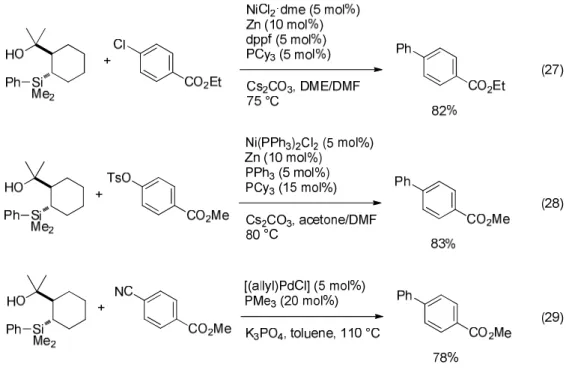
Robust HOMSi reagents are prepared based on the molecular design based on a cy- clohexane ring in place of the benzene moiety. The new HOMSi reagents allow the use of nickel catalyst and aryl chlorides (Eq 27) or sulfonates (Eq 28).
32)This sort of HOMSi reagents can undergo cross-coupling with aryl cyanides in the presence of a palladium-trimethylphosphine catalyst (Eq 29).
33)As discussed above, the silicon residue is recovered as a cyclic silyl ether after the cross-coupling reaction. Smith, III, took advantage of the characteristic features and ap- plied to a silicon-mediated cross-coupling of organolithium reagents with aryl halides using various cyclic silyl ethers listed in Fig 2.
34a)OSi Et2
Bu
OSi Et2
Ph
OSi Et2
N
OSi Et2
Me2N
Recoverable via
flash chromatography Recoverable via acid-base extraction siloxane 8 siloxane 9 siloxane 10 siloxane 11
Figure 2. Recoverable siloxanes
One of these cyclic silyl ethers is allowed to react first with aryllithium reagents to
generate pentacoordinate form of a HOMSi reagent, which readily couples with aryl iodides to give biaryls.
34b)The cyclic silyl ether is easily separated from the coupled product by acid/alkaline extraction and/or chromatography (Scheme 9).
Scheme 9. Cross-coupling reaction using recoverable siloxanes
Recovery of the cyclic silyl ether is facilitayed by supporting on polystyrene.
34c)The cross-coupling reaction is repeated three times without loss of the high efficiency (Scheme 10).
OSi Me2
Ph n
(2.5 eq)PhLi
(3.0 eq)
I OMe
PdCl2cat.
dcpa cat.
CuI cat.
OMe
+ recovered polymer
cycle coupling product recovered polymer 0
1 2 3
98%
91%
81%
(Mn = 63500, PDI = 1.2) 98% (Mn = 73000, PDI =1.6) 99% (Mn = 104400, PDI = 2.3) 99% (mn = 94600, PDI = 2.6) THF, -78 °C to rt, 3h THF, rt
Scheme 10. Recyclability of polymer-supported HOMSi reagents
As discussed above, the carbon–carbon bond formation with organosilicon reagents is almost established. However, its application to polymer synthesis or manufacturing is still rare due possibly to inefficiency of the reaction. Thus, it is essential to truly es- tablish the best conditions for stoichiometric reaction by the organosilicon reagents.
This problem as well as some solutions will be discussed will be discussed in Chapter 3.
1. 4 Additional Carbon–Carbon Bond-Forming Reactions with HOMSi Reagents HOMSi reagents undergo transmetalation to transition metals other than palladium catalysts to effect synthetic transformations characteristic of the metal. For example, a (hydroxo)rhodium(I) complex catalyzes alkenylrhodation of internal alkynes by alkenyl-HOMSi to give 1,3-dienes stereoselectively (Eq 30).
Under similar conditions, 1,6-diynes react with Ph-HOMSi to induce cyclization to give 1,2-bismethylenecyclopentanes (Eq 31). The mechanism of the cyclization is considered in a following way: after transmetalation, phenylrhodium is produced, which undergoes phenylrhodation at one of the alkyne moieties. The resulting alkenylrho- dium attacks another alkyne intramolecularly, namely alkenylrhodation proceeds. Fi- nally, the resulting dienylrhodium is protonated by the HOMSi reagent to provide with the final product.
These reactions are considered to proceed through transmetalation of HOMSi to the Rh catalyst to give an alkenyl- or aryl-Rh which undergo carbometalation of alkynes.
The resulting alkenylrhodium intermediates are then protonated by another molecule of
HOMSi to generate the Rh(I) catalyst (Scheme 11).
35)Si Me2 O LnRh
RhLn O
SiMe2
R R
R RhLn R
H
R H R
RhLn SiMe2
HO
R R
Scheme 11. Plausible reaction mechanism
Rhodium(I) complexes catalyze the Michael addition of HOMSi reagents to α , β -unsaturated substrates. In particular, using a chiral diene ligand, asymmetric 1,4-addition of extremely high enantioselectivity is attained and applied to the synthesis of pharmaceutical intermediates (Eqs 32 and 33).
36)NH O SiMe2
HO F +
NH O
F [Rh(OH)(C2H4)2]2 cat.
(R,R)-Ph-bod* cat.
1 M KOH (15 mol%) THF, 50 °C
Ph
Ph (R,R)-Ph-bnd*
92%, 96% ee
NCO2Bn O SiMe2
HO
F + N
CO2Bn O
F [Rh(OH)(C2H4)2]2 cat.
(R,R)-Bn-bod* cat.
1 M KOH (15 mol%) THF, 50 °C
(R,R)-Bn-bnd*
94%, 91% ee Me
ME
Ph
Ph
(32)
(33)
α -Substituted vinyl-HOMSis achieve a high level of enantioselective conjugate ad-
dition in sharp contrast to the corresponding vinylboronic acids which fail to give the
corresponding adduct. When applied to a β -silyl enone in Eq 34, a highly enan-
tio-enriched allylic silane is produced.
37)PhMe2Si
O
SiMe2 HO Me
+
[RhCl(C2H4)2]2 cat.
(S,S)-Ph-bod* cat.
1 M KOH (15 mol%) THF, 50 °C
PhMe2Si MeO
95%, 97% ee
(34)
The rhodium catalysis also enables 1,2-addition of HOMSi reagents to imines also.
Alkenyl-HOMSi reagents provide allylamines in high yields and high enantioselectivity (Eq 35).
38)H Ph NHNs SiMe2
HO
+
[Rh(OH)((S,S)-Ph-bnd*)]2 cat.
THF, 60 °C
Ph NHNs
Me 68%, 91% ee Ph
(S,S)-Ph-bnd*Ph
Me (35)
HOMSi reagents can be applicable to copper-catalyzed carbon-nitrogen bond form- ing reactions. Miura has used aryl-HOMSi for transmetalation to copper to give aryl- copper intermediates which react with BzO-NBu
2to give arylamines. As aryltrime- thylsilanes and -trimethoxysilanes fail to react, transmetalation with HOMSi reagents through intramolecular activation is definitely effective (Eq 36).
39)In a similar manner, a copper(II) salt catalyzes the reaction of HOMSi reagents with
DMF and ammonia in an aerobic atmosphere to give arenecarbonitriles (Eq 37).
40)Cyanide ion, derived from DMF, ammonia, and oxygen, is considered to couple with aryl-HOMSi reagents with the aid of the copper catalyst.
As discussed above, the organic groups in HOMSi reagents can be readily transferred to transition metals to effect synthetic reactions such as cross-coupling and conjugate addi- tion depending on the catalyst metal. This design concept of reaction will lead to inven- tion of novel synthetic methods characteristic of the metal in the future. Since the HOMSi reagent has a character appropriate to Green Chemistry, the chemistry with HOMSis will play important role in organic synthesis. It should be noted that the con- cept of intramolecular activation of C–Si bonds is discussed also by Takeda,
41)Shin- do,
42)Tamao,
43)and Brown.
44)1. 5 Carbon–Heteroatom Bond-Forming Reaction with Heteroatom–Silicon Re- agents
Silicon-based cross-coupling reaction is applicable not only to carbon-carbon bond formation but also carbon-heteroatom bond formation.
Hartwig attained the cross-coupling of TIPS thioether of benzenethiol, derived from
bromobenzene and triisopropylsilylmercaptan by the Buchwald-Hartwig reaction, with
p-bromotoluene in the presence of Pd(II)/CyPF-t-Bu catalyst, and cesium fluoride to
give unsymmetrical diaryl sulfides (Eq 38).
45)Barluenga et al. found N-TMS-aldimines to undergo coupling with aryl halides in the presence of a Pd/BINAP catalyst and NaOt-Bu to give N-arylaldimines, which upon hydrolysis were transformed to primary amines, demonstrating that N-TMS-aldimines are a synthetic equivalent of ammonia (Eq 39).
46)MeO Br
N
TMS OMe
+
Pd2(dba)3cat.
BINAP cat.
PhMe, 90 °C
N OMe
MeO
97%
NaOt-Bu (39)
The C–N coupling using N-TMS-imines followed by the Catallani reaction is ap- plied to synthesis of phenanthridines (Eq 40).
47)Scheme 12. C-N coupling via Catallani type reaction
Simple C – N coupling is achieved with N-TMS secondary amines with aryl bro-
mides using a palladium(II) catalyst/Johnphos, cesium carbonate in supercritical carbon
dioxides (scCO
2). The same coupling carried out in a common solvent fails to give the
C–N coupled products (Eq 40).
48)In view that the study on the carbon-heteroatom coupling using silyl-heteroatom re- agents is relatively rare and this approach is of great significance, the author has con- sidered more precise examination will lead to invention of a highly efficient and straightforward strategy.
1. 6 Cross-Coupling Polycondensation
Cross-coupling polycondensation has been an important tool for the synthesis of
various polymer materials, and thus, much attention has been focused on preparation of
π -conjugated polymer materials for light-emitting diodes, photovoltaics. Various types
of cross-coupling reaction have been employed for condensation reaction. Notably, the
reaction which involves boron, stannane, and magnesium reagents are often employed
for these polymer synthesis. However, these organometallic reagents have disad-
vantages in stability, toxicity, and waste problems of the co-produced metallic salt. Thus,
innovation in the cross-coupling reaction with other organometallic reagents is request-
ed for cross-coupling polymerization. In this regard, the silicon-based cross-coupling
reaction is ideal. However, only a few examples have been employed for the polymeri-
zation. Ozawa reported that palladium-catalyzed cross-coupling polycondensation of
diiodobenzene with bifunctional (E)- or (Z)-alkenylsilane to give corresponding
poly(arylene-vinylene)s (Eq 41).
49)
The cross-coupling polymerization of bifunctionalized trimethylsilylalkynes with arylene iodides in the presence of palladium-catalyst and silver(I) oxide as an activator is demonstrated by Mori (Eq 42).
50)Although ary-aryl bond-forming cross-coupling polycondensation with bifuntional organometallic reagent is essential for synthesis of polyarylenes for organic functional- ized materials, silicon-based cross-coupling polymerization has remained to be studied.
Cross-coupling polymerization is employied not only carbon-carbon bond-forming reaction but also carbon-heteroatom bond-forming reaction. For example, Kanbara demonstrated that palladium-catalyzed C-N-coupling polymerization. Cross-coupling reaction of m-dibromobenzene with piperazine in the presence of PdCl
2[P(o-tolyl)
3]
2and NaOt-Bu gave poly(aryleneamine) with M
w1800 (Eq 43).
51)In a manner similar to amines, primary and secondary phosphines are also employed for the polymerization with arylene dihalide.
52)Whereas carbon-carbon bond-forming cross-coupling polymerizations with various organometallic reagents are extensively studied, carbon-heteroatom coupling reaction is limited to that which uses H-heteroatom reagent. To enhance the efficiency of car- bon-heteroatom cross-coupling polymerization, novel heteroatom nucleophiles likes si- lylamines should be employed for polymerization.
1. 7 Outline of this Dissertation
In this Chapter the author has so far reviewed the reactions of carbon–carbon
cross-coupling and carbon-heteroatom coupling reactions with organosilicon reagents. It
is obvious that among many types of organosilicon compounds, the HOMSi reagent has an advantage in environmentally benign characters, which will allow HOMSi reagents find much more applications in manufacturing materials and pharmaceuticals. Also he has focused on the future possibility of carbon-heteroatom bond formation by means of N-TMS-heteroatom reagents.
In Chapter 2 is described novel synthesis of HOMSi reagents by the transition metal catalysis, starting with disilane analogs of HOMSi reagents. Highly functionalized HOMSi reagents are readily accessible by this method.
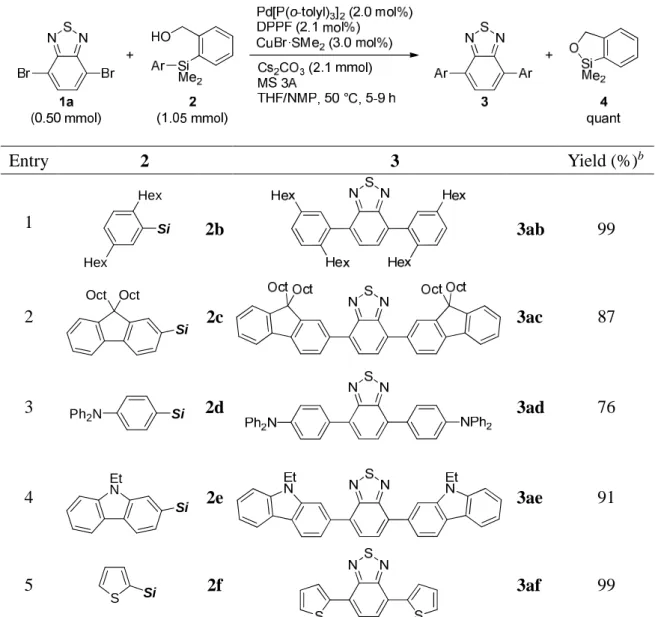
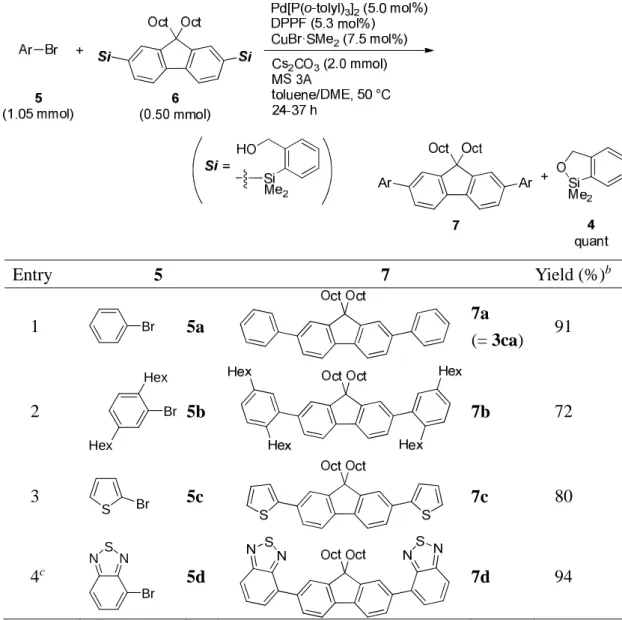
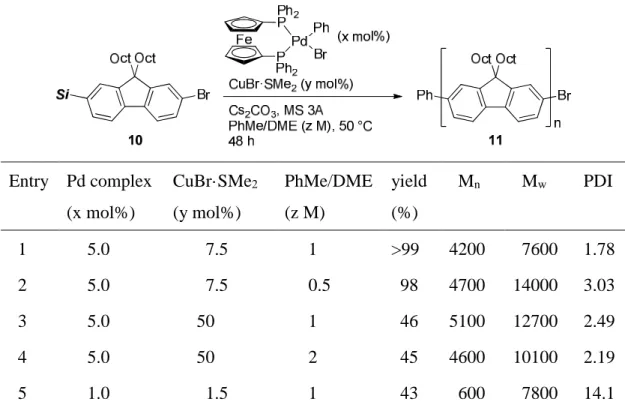
Chapter 3 is attributed to the study directed to double and multiple carbon–carbon bond formation with HOMSi reagents and subsequently polyarylene synthesis is demonstrated to be accessible using double functionalized HOMSi reagents.
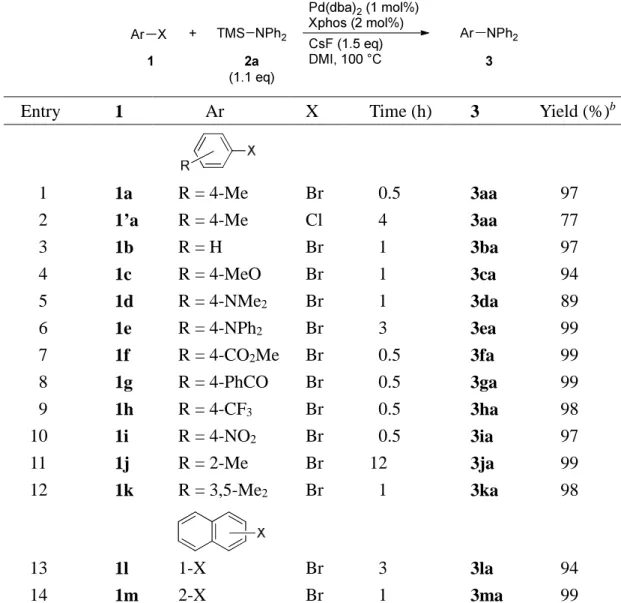
Chapter 4 describes the C–N coupling using N-TMS-diarylamines and -carbazoles using palladium or nickel catalysts and a nucleophilic activator in common solvents.
The findings are further applied to polyarylamine synthesis.
The final Chapter summarizes the chemistry discussed in the Dissertation.
References
(1) a) T. Hiyama, in Metal-Catalyzed Cross-Coupling Reactions, ed. by F. Diederich and P. J. Stang, Wiley-VCH, Weinheim, 1998, 421-453 b) T. Hiyama and E. Shirakawa, Top. Curr. Chem. 2002, 219, 61-85 c) S. E. Denmark and R. F. Sweis, in Metal-Catalysed Cross-Coupling Reactions, ed.
by A. de Meijere and F. Diederich,Wiley-VCH, Weinheim, 2nd ed. 2004, 163-216. d) J. Tsuji, Palladium Reagents and Catalysts, John Wiley & Sons, Chichester, 2004, 338-351. e) W. T.
Chang, R C. Smith, C. S. Regens, A. D. Bailey, N. S. Werner, S. E. Denmark, Organic Reactions, ed. by S. E. Denmark, 2011, 75, 213-745.
(2) a) S. E. Denmark, R. F. Sweis, Acc. Chem. Rev. 2002, 35, 835. b) S. E. Denmark, R. F. Sweis, Chem. Pharm. Bull. 2002, 50, 1531. c) S. E. Denmark, C. S. Regens, Acc. Chem. Rev. 2008, 41, 1486. d) Y. Nakao, T. Hiyama, J. Synth. Org. Chem., Jpn, 2011, 69, 1221. e) Y. Nakao, T. Hiyama, Chem. Soc. Rev. 2011, 40, 4893. f) H. F. Sore, W. R. J. D. Galloway, D. R. Spring, Chem. Soc.
Rev. 2012, 41, 1845.
(3) A. Sugiyama, Y. Ohnishi, M. Nakaoka, Y. Nakao, H. Sato, S. Sakaki, Y. Nakao, T. Hiyama, J. Am.
Chem. Soc. 2008, 130, 12957.
(4) a) J. Yoshida, K. Tamao, M. Takahashi, M. Kumada, Tetrahedron Lett. 1978, 19, 2161. b) J. Yo- shida, K. Tamao, H. Yamamoto, T. Kakui, T. Uchida, M. Kumada, Organometallics, 1982, 1, 542.
(5) a) Y. Hatanaka, T. Hiyama, J. Org. Chem. 1989, 54, 270. b) Y. Hatanaka, S. Fukushima, T.
Hiyama, Chem. Lett. 1989, 18, 1711.
(6) a) E. Hagiwara, K. Gouda, Y. Hatanaka, T. Hiyama, Tetrahedron Lett. 1997, 38, 439. b) H. Mat- suhashi, M. Kuroboshi, Y. Hatanaka, T. Hiyama, Tetrahedron Lett. 1994, 35, 6507.
(7) a) M. E. Mowery, P Deshong, Org. Lett. 1999, 1, 2137. b)L. Zhang, J. Wu, J. Am. Chem. Soc.
2008, 130, 12250. c) L. Zhang, J. Qing, P. Yang, J. Wu, Org. Lett. 2008, 10, 4971.
(8) X. Dai, N. A. Strotman, G. C. Fu, J. Am. Chem. Soc. 2008, 130, 3302.
(9) (a) K. Hirabayashi, A. Mori, J. Kawashima, M, Suguro, Y. Nishihara, T. Hiyama, J. Org. Chem.
2000, 65, 5342.
(10) S. E. Denmark, R. F. Sweis, J. Am. Chem. Soc. 2001, 123, 6439.
(11) S. E. Denmark, J. M. Kallemeyn, J. Am. Chem. Soc. 2006, 128, 15958.
(12) Y. Hatanaka, T. Hiyama, J. Org. Chem. 1988, 53, 920.
(13) a) S. E. Denmark, Y. Choi, J. Am. Chem. Soc. 1999, 121, 5821. b) S. E. Denmark, D. Wehrli, Y.
Choi, Org. Lett. 2000, 2, 2491.
(14) K. Itami, T. Nokami, Y. Ishimura, K. Mitsudo, T. Kamei, J. Yoshida, J. Am. Chem. Soc. 2001, 123, 11577.
(15) K. Hosoi, K. Nozaki, T. Hiyama, Chem. Lett. 2002, 31, 138.
(16) A. K. Sahoo, T. Oda, Y. Nakao, T. Hiyama, Adv. Synth. Cat. 2004, 346, 1715.
(17) H. Katayama, M. Nagao, R. Moriguchi, F. Ozawa, J. Organomet. Chem. 2003, 676, 49.
(18) B. M. Trost, M. R. Machacek, Z. T. Ball, Org. Lett. 2003, 5, 1895.
(19) Y. Nakao, H. Imanaka, A. K. Sahoo, A. Yada, T. Hiyama, J. Am. Chem. Soc. 2005, 127, 6952.
(20) Y. Nakao, A. K. Sahoo, A. Yada, J. Chen, T. Hiyama, Sci. Technol. Adv. Matar. 2006, 7, 536.
(21) Y. Nakao, H. Imanaka, J. Chen, A. Yada, T. Hiyama, J. Organomet. Chem. 2007, 692, 585.
(22) M. Iizuka, Y. Kondo, Eur. J. Org. Chem. 2008, 1161.
(23) J. Bergueiro, J. Montenegro, F. Cambeiro, C. Saá, S. López, Chem.
―Eur. J. 2012, 18, 4401.
(24) D. A. Rooke, E. M. Ferreira, Org. Lett. 2012, 14, 3328.
(25) J. Chen, M. Tanaka, A. K. Sahoo, M. Takeda, A. Yada, Y. Nakao, T. Hiyama, Bull. Chem. Soc.
Jpn. 2010, 83, 554.
(26) Y. Nakao, J. Chen, M. Tanaka, T. Hiyama, J. Am. Chem. Soc. 2007, 129, 11694.
(27) S. J. Shirbin, B. A. Boughton, A. C. Zammit, S. D. Zanatta, S. M. Marcuccio, A. A. Hutton, S. J.
Williams, Tetrahedron Lett. 2010, 51, 2971.
(28) S. J. Shirbin, B. A. Boughton, S. C. Zammit, S. D. Zanatta, S. M. Marcuccio, C. A. Hutton, S. J.
Williams, Tetrahedron Lett. 2010, 51, 2971.
(29) Y. Nakao, S. Ebata, J. Chen, H. Imanaka, T. Hiyama, Chem. Lett. 2007, 36, 606.
(30) Y. Nakao, M. Takeda, T. Matsumoto, T. Hiyama, Angew. Chem. Int. Ed. 2010, 49, 4447.
(31) a) S. E. Denmark, N. S. Werner, J. Am. Chem. Soc. 2008, 130, 16382. b) Y. Hatanaka, Y. Ebina, T. Hiyama, J. Am. Chem. Soc. 1991, 113, 7075.
(32) a) S. Tang, M. Takeda, Y. Nakao, T. Hiyama, Chem. Commun. 2011, 47, 307. b) S. Tang, S. H.
Li, Y. Nakao, T. Hiyama, Asian J. Org. Chem. 2013, 2, 416.
(33) S. Tang, S. H. Li, W. B. Yan, Tetrahedron Lett. 2012, 53, 6743.
(34) a) D. Martinez-Solorio, A. T. Hoye, M. H. Nguyen, A. B. Smith, III, Org. Lett. 2013, 15, 2454.
b) A. B. Smith, III, A. T. Hoye, D. Martinez-Solorio, W. S. Kim, R. Tong, J. Am. Chem. Soc.
2012, 134, 4533. c) M. H. Nguyen, A. B. Smith, III, Org. Lett. 2013, 15, 4258.
(35) Y. Nakao, M. Takeda, J. Chen, T. Hiyama, Synlett 2008, 774.
(36) Y. Nakao, J. Chen, H. Imanaka, T. Hiyama, Y. Ichikawa, W. L. Duan, R. Shintani, T. Hayashi, J.
Am. Chem. Soc. 2007, 129, 9137.
(37) R. Shintani, Y. Ichikawa, T. Hayashi, J. Chen, Y. Nakao, T. Hiyama, Org. Lett. 2007, 9, 4643.
(38) Y. Nakao, M. Takeda, J. Chen, T. Hiyama, Y. Ichikawa, R. Shintani, T. Hayashi, Chem. Lett.
2008, 37, 290.
(39) Y. Miki, K. Hirano, T. Satoh, M. Miura, Org. Lett. 2013, 15, 172.
(40) Z. Wang, S. Chang, Org. Lett. 2013, 15, 1990.
(41) a)H. Taguchi, K. Ghrouku, M. Tadaki, A. Tsubouchi, T. Takeda, J. Org. Chem. 2002, 67, 8450.
b) H. Taguchi, K. Takami, A. Tsubouchi, T. Takeda, Tetrahedron Lett. 2004, 45, 429.
(42) M. Shindo, K. Matsumoto, K. Shishido, Synlett 2005, 176.
(43) E. C. Son, H. Tsuji, T. Saeki, K. Tamao, Bull. Chem. Soc. Jpn. 2006, 79, 492.
(44) W. Rauf, J. M. Brown, Angew. Chem. Int. Ed. 2008, 47, 4228.
(45) M. A. Fernández-Rodigurz, Q. Shen, J. F. Hartwig, J. Am. Chem. Soc. 2006, 128, 2180.
(46) J. Barluenga, F. Aznar, C. Valdés, Angew. Chem., Int. Ed. 2004, 43, 343.
(47) a)D. A. Candito, M. Lautens, Angew. Chem., Int. Ed. 2009, 48, 6713. b) M. Blanchot, D. A.
Candito, F. Laraud, M. Lautens, Org. Lett. 2011, 13, 1486.
(48) a) C. J. Smith, T. R. Early, A. B. Holms, R. E. Shute, Chem. Commun. 2004, 1976. b) C. J.
Smith, M. W. S. Tsang, A. B. Holms, R. L. Danheiser, J. W. Tester, Org. Biomol. Chem. 2005, 3, 3767
(49) H. Katayama, M. Nagao, R. Moriuchi, F. Ozawa, J. Organomet. Chem. 2003, 676, 49.
(50) A. Mori, T. Kondo, T. Kato, Y. Nishiyama, Chem. Lett. 2001, 30, 286.
(51) T. Kanbara, A. Honma, K. Hasegawa, Chem. Lett. 1996, 25, 1135.
(52) T. Kanbara, S. Takase, K. Izumi, S. Kagaya, K. Hasegawa, Maclomolecular 2000, 33, 657.
Chapter 2
Novel Synthetic Method of HOMSi Reagents
Silylation of aryl bromides with disilanes of type [{2-(PGOCH
2)C
6H
4}Me
2Si]
2(PG:
protecting group) is successfully found to take place in the presence of a Pd/Ruphos or
Davephos/CuI catalytic system to give HOMSi reagents containing various functional
groups in good yields. BisHOMSi reagents also are prepared directly from the corre-
sponding arylene dibromides.
2.1 Introduction
Silicon-based cross-couplilng reaction is useful and environmentally bengine meth- od for new carbon-carbon bond formation as discussed in Chapter 1.
1)Particularly, or- gano [(2-hydroxymethyl)phenyl]dimethylsilanes (HOMSi reagents) are superior to other silicon reagents in nature regarding to handling, recovery and reuse of the Si resi- due.
2,3)In addition, HOMSi reagents are now commercially available worldwide.
Ar-HOMSi reagents have a great potential for the synthesis of various biaryls and func- tionalized oligoarenes. A general synthetic method of Ar-HOMSi reagents is the reac- tion of organometallic reagents such as aryl-Grignard reagents and aryllithiums with the cyclic silyl ether (cf. Eq 14, Chapter 1). Therefore, it is not easy to synthesize the func- tionalized arylHOMSi reagents without problem. To overcome this disadvantage, transi- tion metal-catalyzed silylation of organic halides with disilanes
4-6)or hydrosilanes
7)has an advantage for the synthesis of complex organosilicon compounds. Thus, Kondo re- ported a preparative method of aryl HOMSi reagents by the cross-coupling of bro- moarenes with a hydrosilane. However, yields remain only moderate and the scope is limited to two examples.
7k)In view that disilanes are also applicable to such silylation, in this chapter, the authour has focused on the use of disilanes for the silylation of aryl halides and describes a new synthesis of Ar-HOMSi reagents by the palladi- um/copper-catalyzed silylation of organic halides.
2.2 Results and discussions
Bisarylated tetramethyl disilane protected by THP group 1
THPwas prepared by the reaction of 1,2-dichlorotetramethyldisilane with the 2-Li-C
6H
4CH
2O-THP prepared by the lithiation of THP-protected 2-bromobenzylalcohol with butyllithium in 83% yield (Scheme 1). In a similar way, MOM-protected disilane (1
MOM) was prepared in 90%
yield. Other protected disilanes having acetyl (1
Ac), and TBDPS (1
TBDPS) were synthe- sized in high yields by the deprotection of 1
THPmediated by p-toluenesulfonic acid, followed by acetylation and silylation, of 1
Hwith corresponding electrophiles.
Scheme 1. Preparation of Disilanes 1
First, the author applied the reported conditions
4f,4g,4h,4jto the silylation of p-bromotoluene 2a using 1
THPin the presence of a base and was disappointed to find that no trace or small amounts of the desired product, 4-silyltoluene (3a) was formed.
Thus, he searched other activation methods to use of 1 as the silylation reagent. To this end, silylcopper reagents were formed under the reaction of disilanes with Cu(OTf) re- ported by Hosomi.
8He considered a HOMSi copper reagent is proceeded by the treat- ment of disilyl reagents 2 with Cu(I) for the silylation of organo halides.
9Of many cat- alysts and additives examined, he found that reaction conditions consisting of [Pd(allyl)Cl]
2, Ruphos (2-Dicyclohexylphosphino-2 ′ ,6’-diisopropoxybiphenyl), CuI, K
2CO
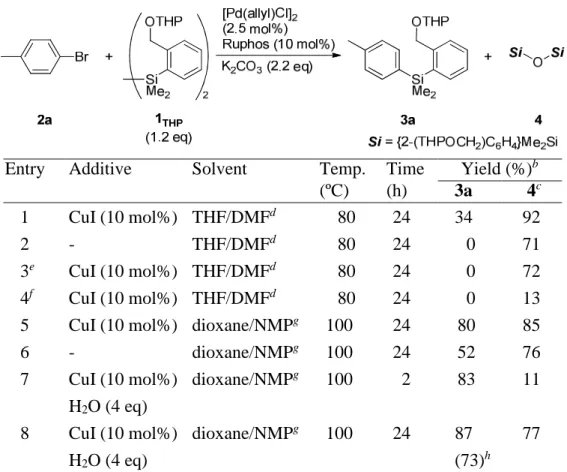
3and THP/DMF (3:1) as a solvent are patented to show the catalytic activity to give 3a in 34% NMR yield together with the generation of siloxane 4 in 92% yield (Ta- ble 1,entry 1). Other copper reagents such as CuBr, CuBr·SMe
2and CuCl were less ef- fective. In the absece of CuI, palladium or
Table 1. Reaction of 2a with 1
THPaEntry Additive Solvent Temp. Time Yield (%)
b(ºC) (h) 3a 4
c1 2 3
e4
f5 6 7
8
CuI (10 mol%) -
CuI (10 mol%) CuI (10 mol%) CuI (10 mol%) -
CuI (10 mol%) H
2O (4 eq) CuI (10 mol%) H
2O (4 eq)
THF/DMF
dTHF/DMF
dTHF/DMF
dTHF/DMF
ddioxane/NMP
gdioxane/NMP
gdioxane/NMP
gdioxane/NMP
g80 80 80 80 100 100 100
100
24 24 24 24 24 24 2
24
34 0 0 0 80 52 83
87 (73)
h92 71 72 13 85 76 11
77
a Unless otherwise noted, a mixture of 2a, 1THP (1.2 eq), [Pd(allyl)Cl]2 (2.5 mol%), ligand (10 mol%), CuI (10 mol%), K2CO3 (2.2 eq) and solvent (0.36 M) was heated at 80-100 °C. b NMR yield. c Yields based on 1THP. d 3:1. e without [Pd(allyl)Cl]2. f without K2CO3. g 4:1. h Isolated yield.
K
2CO
3, 3a was not produced, wheres 4 was generated (entries 1, 3 and 4). These results indicate that the silyl copper reagent is formed as an active silyl nucleophile via the re- action of 2(THP) with CuI maybe in the presence of K
2CO
3. To enhance yield of 3a, he examined various solvents and found dioxane/NMP (4:1) at 100 ºC, 3a was obtained in 80% yield (entry 5). In the absence of CuI, yield of 3a was in 52% yield (entry 6).
These results suggest that highly polar solvents enhances the silylation efficiency: as is evidenced by the additive of H
2O increased the yield in a shorter reaction time (entry 7).
Finally, under the reaction in the presence H
2O at 24 h the yield was improved upto 87% (entry 8).
Of note, deprotection of 3a mediated by para-toluenesulfonic acid in methanol gave active HOMSi reagent 5, 4-tolyl-2-(hydroxymethyl)phenyl}dimethylsilane, in high yield (Eq 1).
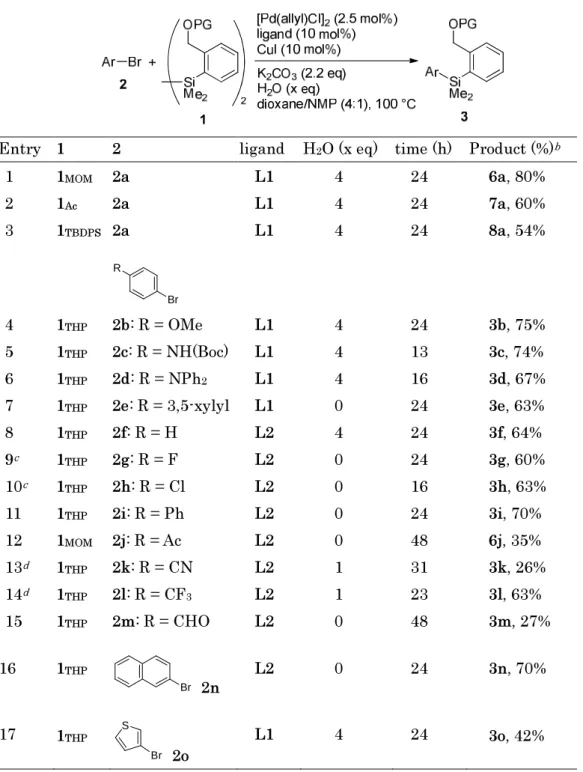
Scope and limitations of the reaction under the optimized conditions are summa- rized in Table 2. Protected disilanes 1
MOM, 1
Acand 1
TBDPSreacted with 2a smoothly to give the corresponding products 6a, 7a and 8a in moderate to high yields (entries 1-3).
Using 1
THPas a silylation reagent, the reaction of various organic bromides was exam- ined. Electron-donating groups such as p-MeO, p-NHBoc and p-Ph
2N did not hamper the reaction in the presence of Ruphos, and the corresponding HOMSi reagents 3b-3d were isolated in moderate to good yields (entries 4-6). In the case of 3,5-xylyl bromide 2e, H
2O did not show any advantage: 3e was isolated in 63% yield in the absence of H
2O (entries 7). On the contrary, when electron-neutral and electron-deficient aryl bro- mides were used under the conditions with Ruphos, the corresponding silylarenes were obtained but in very low yields. The author further screened ligands for the silylation
using these bromides and found that Davephos,
2-dicyclohexylphosphino-2 ′ -(N,N-dimethylamino)biphenyl, led to improvement in the
catalytic activity. Bromobenzene 2g upon this reaction using Davephos gave Ph-HOMSi
reagent 3g in 64% yield (entry 8). Electron-deficient aryl bromides preferred the reac-
tion in the absence or in the presence of 1 equiv amount of H
2O (entries 9-15). The re-
action of 1-bromo-4-fluorobenzene 2g gave 4-F-C
6H
4-HOMSi reagent 3g in 60% yield
(entry 9). Other electron-deficient groups such as chloro, phenyl, acetyl, cyano, trifluo- romethyl and formyl tolerated well the
Table 2. Silylation of organobromides 2 using disilane 1
aEntry 1 2 ligand H2O (x eq) time (h) Product (%)b 1
2 3
1MOM 1Ac 1TBDPS
2a 2a 2a
L1 L1 L1
4 4 4
24 24 24
6a, 80%
7a, 60%
8a, 54%
R
Br
4 5 6 7 8 9c 10c 11 12 13d 14d 15
1THP 1THP 1THP 1THP 1THP 1THP 1THP 1THP 1MOM 1THP 1THP 1THP
2b: R = OMe 2c: R = NH(Boc) 2d: R = NPh2 2e: R = 3,5-xylyl 2f: R = H
2g: R = F 2h: R = Cl 2i: R = Ph 2j: R = Ac 2k: R = CN 2l: R = CF3 2m: R = CHO
L1 L1 L1 L1 L2 L2 L2 L2 L2 L2 L2 L2
4 4 4 0 4 0 0 0 0 1 1 0
24 13 16 24 24 24 16 24 48 31 23 48
3b, 75%
3c, 74%
3d, 67%
3e, 63%
3f, 64%
3g, 60%
3h, 63%
3i, 70%
6j, 35%
3k, 26%
3l, 63%
3m, 27%
16 1THP
Br 2n L2 0 24 3n, 70%
17 1THP S
Br 2o L1 4 24 3o, 42%
a Unless otherwise noted, 2 (0.5 mmol), 1 (0.6 mmol), [Pd(allyl)Cl]2 (0.0125 mmol), ligand (0.05 mmol),CuI (0.05 mmol), K2CO3 (1.1 mmol), and 1,4-dioxane/NMP (4:1, 1.4 mL) were heated at 100 ºC.
b Isolated yield. c 120 ºC. d 80 ºC. L1 = Ruphos. L2 = Davephos.
silylation with 1
THPand 1
MOMto give the corresponding HOMSi reagents 3h-3i, 6j and 3k-3m in 26-70% yields (entries 10-15). The reaction of 2-bromonapthalene (2n) gave 3n in 70% yield (entry 16). 3-Bromothiophene (2o) was silylated with 1
THPin the pres- ence of Ruphos and 4 equiv. of H
2O to afford 3-thienyl-HOMSi reagent 3o in 42% yield (entry 17).
This silylation can be applied to the synthesis of bis-HOMSi reagents 10 by the reac- tion of dibromoarenes 9. For example, 4,4’-dibromobiphenyl (9a) reacted with 2.2 equiv.
of 1
THPunder the optimized conditions using Ruphos to give bissilylated biphenyl 10a in 64% yield (Eq 2). Similarly, 2,7-dibromo-9,9-dioctyl-9H-fluorene (9b) was double silylated to form the corresponding product 10b in 65% yield.
Ar Si
Cu X
Si Si
K2CO3 Cu Si
Si OY Ar Br
Si = Si{2-(PGOCH2)C6H4}Me2 X = Br, I Y = K, CO2K Pd(0)L
2
3
1
4 LPd
Ar Br
LPd Ar Si
Si O Si

![Table 1. Cross-coupling reaction of dihaloarenes 1 with 2a. a Pd[P(o-tolyl) 3 ] 2 (2.0 mol%) DPPF (2.1 mol%) CuBr·SMe 2 (3.0 mol%) Cs 2 CO 3 (2.1 mmol) MS 3A THF/NMP, 50 °C, 5 hHOSiMe2BrAr BrPh Ph Ar Ph O Si Me 2 1 (0.50 mmol) 2a (1.05 mmol) 3 4 quant+](https://thumb-ap.123doks.com/thumbv2/123deta/6357066.2129244/62.892.115.778.191.823/table-cross-coupling-reaction-dihaloarenes-tolyl-dppf-hhosime.webp)