長崎大学風土病紀要 第7巻 第3号:221‑229茸1965年9月 221
Susceptibility of Culex pipiens fatigans to Wuchereria
bancrofti in the Ryukyus, in comparison with that of C.
p. pallens in Japan*
Nanzaburo OMORI, Osamu SUENAGA, Shoei UEMURA, Ryo ISHIMINE
Department of Medical Zoology, Nagasaki University School of Medicine and Department of Medical Zoology, Research Institute of Endemics, Nagasaki
University (Director: Prof. N. OMORI)
Kunio NAKACHI and Naozo UEHARA
Ryukyu Health Laboratory
ABSTRACT : The intake of microfilariae, and experimental and natural infection of the mosquito in relation to the susceptibility of Culex pipiens fatigans to Wuchereria bancrofti was investigated on Miyako Island, in the Ryukyus. The results of obser‑
vations were compared with those of C. p. pallens in Japan.
Introduction
The senior author has investigated for long yea『s on the susceptibility of C. p.
pallens to W. bancroj'it in Japan concerning the microfilariae uptake by the female (Omori 1958a) and the nature of experimen‑
tal and natural infections under various conditions and in different locales (Omori
1958b, c, 1962, 1963). Studies on these sub績
jects were done with C. p. fatigans on Miya‑
ko Island in the Ryukyus in October 1961 and May 1962. The results of these mvestr gations with 0. p. fatigans on Miyako Island
are reported here and compared with C. p実
pollens in Nagasaki.
Pl乱ce乱nd朋[ethod
Miyako Island (24‑471N, 125‑171E) is in the southern part of the Ryukyus, subtropical. in climate, and highest in bancroftian micro‑
filarml incidence in the archipelago. Inves‑
tigations were conducted ln the village of
Hisamatsu. The topography and mean air temperatures of Miyako Island and the deta‑
iled account of microfilarial incidence in Hisamatsu were reported in a previous paper (Omori et al. 1962). The methods of
* contribution No. 47了from the Research Institute of Endemics, Nagasaki IJniversity
and No. 144 from the Department of Medical Zoology, Nagasaki University School of Medicine.
222 Nanzaburo OMORI, Osamu SUENAGA, Shoei UEMURA,
Ryo ISHIMINE, Kunio NAKAGHI and Naozo UEHARA
investigation were similar to those employed saki. Further particulars will be explained mthe experimentswith0. p.pMens in Naga- under the headings below.
Number of microfilariae taken up by a female fatigans
Females of C.p. fatigans emerged from wild caught larvae and pupae in a farm village on Miyako Island were fed on two donors on 26October, 1961 from9:40 to 10:40p.
m. Mean microfilarial count of donor A
before and after feeding of mosquitoes was 202per 20mm3 blood taken fromhisear lobe, or 50.5per5mm3blood (the quantity isnearly equal to a full blood meal of the mosquito).
The mean microfilarial count of donor
Bwas 147per20mm3, or36.8per5mm3 blood.
A number of engorged females were smea- red, eachona slide, justafterfeedingto exa- mine microfilaria intake, while others were reared to examine the states of larval devel-
Fig. 1. Percentage frequency
16.9
20
18.3
15-1
10-
50
16.9
40440.6
35-1
30
25
20
0'
i
<VH
en I
-p fi 0>
o f-s .ii>
ll.3
7.0
4.2
15-
10
s
0.1
5.8
O H-r-T
opment.
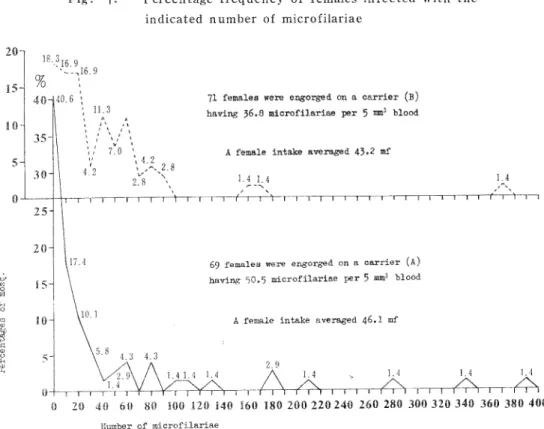
The percentages of female C. p. fatigans infected with different numbers of microfi- lariae are illustrated in Fig. 1. In the case of A, 69 females were infected with a total of 3179 microfilariae or an average of 46.1;
while in B, 71 females were infected with 3066 or 43.2 microfilariae per female. Thus
in A, the mean microfilaria intake was
slightly less; while in B, the mean was
slightly greater than the expected number.
As seen in Fig. 1, the frequency distrib- ution differed in A and B, and individual females also took up widely varying numb- ers^ In A, two females picked up no micro*
of females infected with the indicated number of microfilariae
\4.2
2^8
4.3 4.3 2.8
à"s,
71 females were engorged on a carrier (B) having 56*8 microfilarlae per 5 nm3 blood
A female intake averaged 45»2 "»f
1.4 1.4 1.4
~T-i-i-T-T-fr~ -i-i-r-i-r~
69 females were engorged on a carrier (A) having ^0*5 microfilariae per 5 n«a3 "blood
A female Intake averaged 46à"! mf
2.9
1.4_1.4 1.4 A 1.4 -, 1-4
"i-ir-V~r^i-i-r~T~~r\-TT T-i-i-r-f-ir~r^\ r~
1.4 1.4
0 20 40 60 80 100120140160180200220240260280300320340360380400 ITumber of microfilariae
Susceptibility of Culex, pipiens jatigans to Wuchereria bancrofti in the Ryukyus, in comparison with that of C. p. pallens in Japan filaria, whereas one had as many as 394; in
B, two females had none and one had 379.
This great variation seemed to be caused by the distribution pattern of microfilariae being of a Polya-Eggenberger type in the peripheral blood stream of the carrier. The same trend was observed by Omori (1958a) with C. p. pallens, and by Nakamura (1964)
223
with Aedes logoi,
Generally speaking, however, the average number of microfilariae found in a large sampling of engorged female mosquitoes might approach the number of microfilariae found in the same quantity of blood taken from an ear lobe of the carrier rupturing perhaps several blood vessels.
R esults of experimental infection of C. p. fatigans
Females of C. p. fatigans reared from wild
caught larvae and pupae in a village on
Miyako Island were fed on donors A and B
at night on 26 October, 1961. They were reared under natural air temperatures of 23
-26°C for 8 days onMiyako Island, 21-~25°C for 4 days at Naha City, and 20-23°C for 3 days from Naha through Kagoshima to Naga- saki. Upon arrival at Nagasaki (15 days after the infective meal), the females were
Table 1 Results of experimental
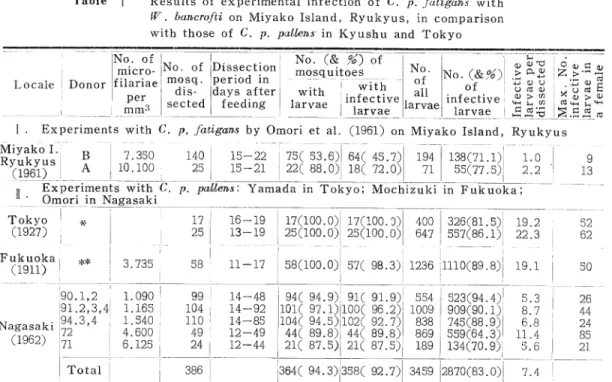
found to have mature larvae. On and after that day, they were kept at 25°C. The fema- les were dissected 15-20 days after the feeding with the results shown in I of Table 1. Results of experiments carried out at
Tokyo by Yamada (1927), at Fukuoka by
Mochizuki (1911), and at Nagasaki by Omori (1962) are presented in II of Table 1 for comparison with C. p. pallens.
Table 1 shows that the percentages of
infection of C. p. fatigans with
W . bancrofti on Miyako Island, Ryukyus, in comparison with those of C. p. pallens'in Kyushu and Tokyo
Locale Donor
Nmicro-o. of filariae
mm3per
N o. of
mosq.
secteddis-
Dissection period in days after feeding
No..(& #) of
mosquitoes larvaewith
infectivewith larvae
No.
of all larvae
of #) infective
larvae
QJ <U^
>^^
4-» 0) O
U ni cu
<u t> tn
<4H ^ Cfi
fl ^ '-d
* >'S-3
SSI<u >.<u X
à"-C3MH
:Sad,PH I-H (Xi
Experiments with C. p. fatigans by Omori et al. (1961) on Miyako Island, Ryukyus
MiyakoI. Classes\ACn oRn
Ryukyus! £ ^f^
(1961) j A i10-100
O mori in Nagasaki
140 15-22 j 75(53.6) 64( 45.7)1 194
25! 15-21 22(88.0)j18(72.0)1 71
138(71.1) 1.0 55(77.5) 2.2
Classes\ACExperiments with C. p. pallens: Yamada in Tokyo; Mochizuki in
II à" r\ ' à"__ AT . i à"
T okyo ''
(1927) ; i Fukuoka,
(1911) !
N agasaki (1962)
3 .735
90.1,2 | 1.090 91.2,3,41 1.165 94.3,4 ; 1.540
4.600 6.125
T otal
16-19
13-19 17(100.0) 17(100.0) 25(100.0) 25(100.0) ll-17
14-48 14-92 14-85 12-49 12-44
400 647
F ukuoka
326(81.5) 557(86.1)
19.2 22.3
58(100.0)! 57( 98.3)| 1236 11110(89.8)1 19.1 94( 94.9)] 91( 91.9)! 554
101( 97.1)|100( 96.2) 1009 104( 94.5)jl02( 92.7) 838
44( 89.8)1 44( 89.8) 869
21( 87.5)| 21( 87.5)( 189 1364( 94.3)358( 92.7) 3459 2870(83.0)
* The number of microfilariae of the donor is not given in the report.
** The number of microfilariae is uncertain because the author only examined the blood 48 days before the feeding experiment.
9
13
52 62 50
5 .3 8.7 6.8 ll.4
3.6
7 .4
224 N anzaburo OMORI, Osamu SUENAGA, Shoei UEMURA,
Ryo ISHIMINE, Kunio NAKACHI and Naozo UEHARA
females of jutigans having filaria larvae and of those having infective larvae are lower, and that the number of infective larvae per female dissected and the maximum number of infective larvae found in a female are much smaller than in oallens. This appeared to be caused partly by the discharge of some of microfilariae by the female fatigans and partly by the death of younger stage larvae in the mosquito, considering that the female Jatigans were found tohave taken up as manymicro-
filariae as pollens.
Contrarily, pallens was highly susceptible to the iparasite and was much greater in number of infective larvae per female disse-
cted, and also in the maximum number of
mature larvae in a female. However, it is to be remembered that by the author (1958c) the higher mortality of female pallens was found to be caused by the heavier parasi-
tism of the parasite on those days of
reaching maturity of filariae in them.
Results of natural Infection of C.p, fatigans
Table 2° Use of mosquito-nets and natural infection of C. p. fatigans
with W, bancrqfti in Hisamatsu Village, Ryukyus Beginning of dry season, October 21 to 26, 1961
Use of mosquito-
nets
yes
Mosquitoes found (+) or not found (-)
(-) in houses (+) in houses (-) in houses (-) in mosq.
(+) (-) C-) (+)
in houses in mosq.
in houses in rnosq.
(+) in houses (+) in mosq.
N o. ofi No. of mosquitoes houses collected dissected | infected
5
44
nets nets nets.
40
nets Total
Average per house
56
0
306 306
21
41
% infection to dissected mosquitoes
141 46.1#
21 ll 52.4#
41 30 73.2#
368
6.6 6.6
182 49.5#
3.3 !
B eginning of wet season, 28 May to 1 June, 1962
Use of mosquito-|
nets
yes
Mosquitoes found (+) or not found(-)
(-) in houses (+) In houses (-à") In houses (-) in mosq.
(+) in houses (-) in mosq.
(-) In houses (+) in mosq.
(+) in houses (+) In mosq.
nets.
nets.
nets.
nets , Total
Average per house
xro> of No. of mosquitoes
houses: collected i
2 i 0
9 i 75
2
15 I 13|
0
124 104
15 190
! to dissected infected j mosquitoes
16 23.5#
124 104 171
infection dissected
23 I 18.5#
i 21.2^
27.5,^
56 493 467 108 23.1#
1.9
Susceptibility of Cule% pipiens fatigans to Wuchereria bancrofii in the Ryukyus, in comparison with that of C. p. pattens in Japan
Surveys of natural infection of C. p.
jatigans were carried out at Hisamatsu
Village on Miyako Island from 21 to 26
October, 1961 and from 28 May to 1 June, 1962. The topography, number of houses, population, and microfilarial incidence in this village were presented in a previous
225
report (Omori et al., 1962).
In Hisamatsu there were no rivers, wells, or public water supply and, therefore, water for domestic use came exclusively from rain water. Consequently, the villag- ers had to economize extremely in water
usage, and only small amounts of foul
Table 3. Results of field survey of natural infection of C. p. fatigans with W. bancrofti on Miyako Island, Ryukyus, in comparison
with those of C. p. pollens in Nagasaki Name
of
village D ate
Mf incid- ence
No. of mosq. !~~No."of Farvae per female having
dif^^nt_st_age_la_rvae _
dissected infected Total 1 stage I II stage ffl stage
I . Studies on Miyako Island where C. p. fatigans is the vector Oct.
Hisamatsu
'61 37.9 368 182
May '62| 37.9 467 108
1737 182 342 T08
=9.5^= 9.^-|-= 3.7-g-= 3.8
=3-2lr= 2-9l-= 2-7!-17"= 1-6
Studies in Nagasaki Prefecture where C. p, pollens is the vector
Yaburoki !Aug. '58
Setobatake Jun.
Jul. '60
20.6 249 59 270
59 = 4.
20.6 97
// 92
Hyugashi Jun.
//
'60
Jul. '60
19
16
250
57' 16_53|4_13_b.d- . .._ i.j
70
19"-Hie-
55_ = 16"
47
14 - 3.4
21
4.21
7=7.0|-J-= i.o
28
63
Ota Jun. 21.7 52
I Jul. '60 i // 62
N ao-a^ Mayto ' i/Ln
Magate |Noy> /6]_ 14.0
7
39
7 - 5.6
?s n r\
= 7.0- à"=2.0
181^I18 6.6
237 16
81
15 = 5.4;
38
5- 7.6
14.8|^=18.9!-^8-=I 10 i 8 6.0
55_ I34
16~ '4!"14 16
16
43 555
Abumize '61 445
'62 268
176 43
2.4
17
~3~
= 5.7
4.1155
38= 4.1J-h 4-2
- 4.0
//
51 342= 6.7j-f4= 6.7-?-= 1.0 \~= 1.0
S-L SU | 1 , 1
13 -|L= 7.5J-g-= 4.8-^-=17.5 -
Total 1911 258 1460_p7
258á"
1236
232 =5.3214
35' i 10
à"---=1.7 D
ffl. Studies in Okubo, Nagasaki Prefecture where C. p. pollens is the vector
Okubo Jun. to
Aug. '64 26.4 655 279 |3937 4 ^3857 |65
.279 M'I271~ !12 = 5.4!15
10= 1.5
226 Nanzaburo OMORJ, Osamu SUENAGA, Shoei UEMURA,
Ryo ISHIMINE, Kunio NAKAGHI and Naozo UEHARA
water collected in the small sinks in each house. This created a favorable breeding
place for 0. p. fatigans. The number of
mosquitoes breeding in these sinks was not so numerous, and most villagerspassed the nights without mosquito-nets. The results of examinations for natural infection of C.
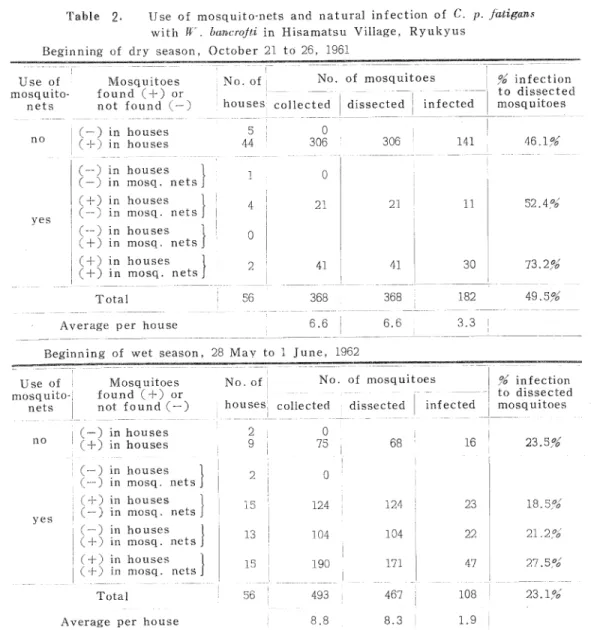
p. fatigans carried out in houses and mosq- uito-nets early in the morning or at night, are tabulated in Table 2.
At the beginning of the dry^season, about 46# of farigans collected were found infected in houses without mosquito-nets; about52^
were positive in houses where only parents and young children slept in mosquito-nets (older boys and youths were doing without them); about 73# were positive in houses
where mosquitoes were rather numerous
but the usage of mosquito-nets was as
above.
At the beginning of wet season, although
mosquitoes were not yet so numerous, in
many houses mosquito-nets were used but the older children were sleeping without them as usual. The infection rate in this season (23.1#) was markedly lower than in
the dry season. The reason for this could
not be clearly determined but may have
been partly caused by the changing of hou- ses in which some collections were made, and partly to the increase in use of mosq-
uito-nets because of some increase in num- ber of newly emerged females.
The number of mosquitoes (collected and)
dissected, that of those infected, and thenumber of filaria larvae per femaleJatiganshaving all stages, first, second, and thirdor infective stage larvae in nature are tabul-ated in I of Table 3, and those with C.p.pallens in Nagasaki Prefecture are in II andIII of the same table. As seen in thetable,the number of filaria larvae per femalevaried greatly. Generally speaking, howe-ver, the first stage larvae per female waslarger in number than the second and espe-cially infective stage larvae. Also, thenumber of infective larvae per female Jatigansappeared a little larger than that of p liens.In the survey carried out with f'atigans inOctober 1961, 12 females had 45 infectivelarvae:3 females had 1 each; 4 had 2 each;and the remaining 5had 3, 4, 5,7, and 15respectively. In the survey of May 1962, 7females had ll infective larvae : 4had 1 each;2 had 2 each; 1 had3. The above suggestedthat at the beginning of dry (and cooler)season some females had larger number ofmature larvae than at the beginning of wet(and warmer) season. In Nagasaki, however, from the end ofJune through early September, or from wetand warm to dry andwarmmonths, 16femieshad 25 infective larvae: ll females had 1each; 3 had2each; 2 had 4each. The above facts indicated thatfaiigans onMiyako Island, might have had, in somecases, a larger number of mature larvae perfemale than did pallens in Nagasaki,
C omparison of results of experimental and natural
infection in fatigans and pallens
In order to compare the susceptibility of the two species to W. bancrofti, chief points of the results of experiments in the labora- tory (Table 1) and in nature (Table 3) are given in Table 4.
Under experimental conditions, the perce-
ntage of female forigans having mature larvae to the infected was lower (that of those to the dissected was much lower as 49,7^ in fatigans against 92.7# in paliens), and the
number of mature larvae per female was
much smaller than in pallens, suggesting that
Susceptibility of Culex pipiens fatigans to Wuchereria bancrofti in the Ryukyus, in comparison with that of C. p. pollens in Japan Table 4- Comparison of the susceptibility of C, p. fatigans
and C. p. pallens to W. bancrofti
227
Species L
ocale
% of ? having1,1,and1
stage larvae to the infected
i n n
Experimental Infection (cf. Table 1)
No. of eachlarvae per stage9
fat igans pollens
Miyako Nagasaki
Natural infection (cf. Table 3)
fatigans pollen s
Miyako Nagasaki
85.4^
98.4^
87.6^
93.7^
2.4 8.0
2,9 1.6 17.£
f aiigans is less susceptible, while, pollens is highly susceptible to the parasite.
In nature, on the contrary, the percentage of female fatigans having mature larvae was
significantly higher and the number of
mature larvae per female appeared even
larger than in pollens. It is to be noted, however, that the percentage of the female pattens having the first stage larvae is higher, and that the numbers of the first and second stage larvae per female are also higher in pattens, showing that pattens is naturally high in susceptibility as observed in
the laboratory experiments. The marked
decrease in the percentages of female pattens having the second and infective stage larvae,
and in the number of mature larvae per
female, is probably due to the reduction in
6.6^
3.0^
7 .3 10.1
3.1 5.9
number of female pollens infected heavily with late second and infective stage larvae.
This, again, seems to be due to the high mortality of females infected heavily with premature and mature larvae on those days of reaching maturity of filariae in mosqui- toes.
In short, it seems that fatigans is less susceptible to the parasite and permits the development of smaller number of filariae but less affected by premature and mature larvae, while, pollens is highly susceptible
and permits the development of larger
number of filariae but much affected mecha- nically by developed filariae with a high mortality on those days of reaching maturity of filariae in mosquitoes.
S ummary
Engorged females of C. p. fatigans which were fed nearly simultaneously on the same carrier took up greatly varying number of microfilariae in their full blood meals
(about 5mm3). The average number, howe-
ver, may roughly approximate the number
to be found in 5mm3 blood taken from an
ear lobe of the carrier. The situation is similar in the case of C. p.pallens in Japan.
In experiments, the infection rate of
female fatigans having mature larvae was much lower and the number of mature larvae per female was much smaller than in pallens.
On the contrary, in nature, the rate was
significantly higher and the number of
mature larvae per female appeared even
larger in fatigans. The reason seems to be that fatigans is less susceptible to the para- site and permits the development of smaller
number of filariae but less affected by
228 Nanzaburo OMORI, Osamu SUENAGA, Shoei UEMURA,
Ryo ISHIMINE, Kunio NAKACHI and Naozo UEHARA
premature and mature larvae, while, pallens is highly susceptible and permits the develo- pment of larger number of filarlae but much affeeted by developed filariae with a high
mortality of heavily infected mosquitoes on those days of reaching maturity of filariae in them.
References
1) MOGHIZUKI, D. : On the relation betw-
een various species of mosquitoes and ban-
croftian filaria larvae. Fukuoka Ikadaigaku Zassi, 4 (3) : 384-444, 1911. (in Japanese).
2) NAKAMURA,Y. : Experimental studies
on the role of Aedes togoi in the transmission
of bancroftian filariasis. 1. Number of
microfilariae taken up by the female and
their movement in her body. Endem. Dis.
Bull. Nagasaki, 6 (1) : 25-33, 1964- (in
Japanese with English summary).
3) OMORI, N. à" Experimental studies on the role of the house mosquito, Cule% pipiens pattens in the transmission of bancroftian filariasis, 2. On the pattern of spatial distri- bution of microfilaria in the peripheral blood stream of the carrier. Nagasaki Med. J., 33 (8) : 1045-1053, 1958&. (in Japanese with English summary).
4) OMORI, N, : Experimental studies on the role of the house mosquito, Culex pipiens pollens in the transmission of bancroftian filariasis. 4. Development and longevity in days of filariae in mosquitoes kept at a series of constant temperatures. Nagasaki Med. J.f 33 (ll), Suppl. : 61-70, 1958b.
5) OMORI, N. : Experimental studies on the role of the house mosquito, Culex, pipiens
pattens in the transmission of bancroftian filariasis. 5. On the distribution of infective larvae in mosquito and the effect of para- sitism of filariae upon the host insect.
Nagasaki Med, J., 33 (ll) ; Suppl. : 143-
155, 1958c.
6) OMORI, N. : Areview of the role of
mosquitoes in the transmission of malayan and bancroftian filariasis in Japan. Bull.
Wld Hlth Orgi, 27 : 585-594, 1962.
7) OMORI, N. : A role of mosquitoes in
the transmission of filariasis in Japan. The 16th General Assembly of the Japan Medical
Congress. April 1-5, 1963, Osaka, Vol. fl :
759-776, 1963. (in Japanese).
8) OMORI, N., SUENAGA, O. and NAKAGHI,
K. : Epidemiology of bancroftian filariasis
in Hisamatsu Village, Miyako Island, the
Ryukyus, 1. Results of a survey made in
October, 1961. Endem. Dis. Bull. Nagasaki, 4 (3) : 194-205, 1962.
9) YAMADA, S. : An experimental study
on twenty four species of Japanese mosqui- toes regarding their suitability as interme- diate hosts for Filaria bancrofti Cobbold. Sci.
Rep. Gov. Inst. Inf. Dis.P 6 : 559-622,
1927.
琉球に於けるネッタイイエカのバンクロフト糸状虫に対する感受性と日本に於けるアカイエカのそれ との比較.大森南三郎・末永斂.上村昭栄・伊志嶺亮,長崎大学医学部医動物学教室, 長崎大学風土病 研究所衛生動物部(主任:大森南三郎教授)仲地国夫・上原直三,琉球衛生研究所.
総 括
ネッタイイ‑カの♀成虫を,同一仔虫保有者から晴間時的に吸血させ,満腹蚊の吸血直後に於ける摂
取付出数をみると,個体によってその数が著しく共なる蕃から人末梢血流中oj仔虫oj分和が‑一様ではな
Susceptibility of Cul閃pipiens fatigans to Wuchereria bancrofti in the Ryukyus, in comparison with that of C. p. pollens in Japan