An Integrated-Skills Approach to Vocabulary Learning
William Collins
Research and Development Center for Higher Research
英語単語を学びながら聞く、話す能力を育てる学習
ウィリアム・コリンズ
‐長崎大学 大学教育機能開発センター‐
Abstract
長崎大学の英語コミュニケーション授業の主要な目的は学生のスピーキングとリスニング能力を育 てることです。その大事な一部は単語力です。本論文は2年間大学教育機能開発センターの英語コミュ ニケーションIにおいて、学生が学期中に学習用ペーパーや音声やビデオの教材から習得した単語を単 語帳に書くことでどれだけその単語を記憶出来たかを研究したものです。最初に得た結果は、多様な学 習用ペーパーの教材の中で、ことわざから学んだ新出単語が記憶度が高く、次いで音声よりビデオ教材 から学習した方がその記憶度は良いという傾向が見られました。
Key Words: vocabulary notebook, e-learning, storytelling, internet search activities
1. Introduction
English courses offered in the humanities program for first and second year students at Nagasaki University’s Research and Development Center for Higher Education fall into two main categories: Comprehensive English and English Communication. Although the primary focus of the former classes is building reading and writing skills while the latter classes concentrate on listening and speaking skills, both classes address to some degree each of the four language skills of reading, writing, listening and speaking.
Given the role played by vocabulary-building in improving both the productive skills of writing and speaking as well as the receptive skills of listening and reading, an important goal of the English classes should be finding ways to connect speaking, listening, reading and writing skill-building activities with exercises that help students notice and retain a range of vocabulary expressions.
One way the author has sought to achieve this goal is by combining e-learning activities with a vocabulary notebook requirement. Through the
author’s English Communication homepage, a variety of self-access listening and reading materials were made available to the students. Through a gradually expanded e-learning component, students were required to complete listening activities, research topics to prepare learning exercises for their classmates, and record their speaking practice. In carrying out each of these activities, students were required to identify new vocabulary, use online resources to check meaning, synonyms, collocations and example sentences, and write these in their vocabulary notebooks. The goal of this integrated skills approach to vocabulary-learning was to improve students’ vocabulary while helping build habits of autonomous learning that are an essential part of the first and second year humanities program’s mission at Nagasaki University (See endnote). This paper reports the results of a pilot study conducted over two years in the first year English Communication I classes at Nagasaki University concerning the impact of keeping a notebook of vocabulary accessed through written, audio and video materials on improving students’ recall of new vocabulary.
Literature Review
Nation (1990) discusses what is involved in knowing a word. He argues that knowing a word involves being able to recognize it when it is heard and when it is seen. He also stresses the importance of associations, and suggests vocabulary learners should have a sense of what other words could be used instead of the word in question. Nation (2001: 52) adds that “the most pervasive and important relationship between words in organizing a lexicon is synonymy.” Another important component of vocabulary knowledge cited by Nation (1990) is collocations, which are the types of words typically co-occurring before and after the word in question.
Finally, Nation (1990: 112) argues that students should be encouraged to use a monolingual dictionary, which “helps learners master the use of general class words, and makes them familiar with the possibility of defining and paraphrasing words.”
Conklin & Schmitt (2008) explore the role of multi-word expressions and formulaic sequences in processing written texts. They note that at least one-third to one-half of language is composed of so-called “formulaic sequences,” i.e., prefabricated, memorized multi-word expressions. They find that because these sequences of words are processed as single units, rather than as individual component words, they are read more quickly than non-formulaic phrases. They also stress that spoken discourse, which occurs under time-constraints, relies heavily on these expressions.
Kikuchi (1995) discusses the advantages of English-captions in improving student listening-comprehension and motivation. His study focuses on short movie clips and finds that students viewing English dialogues with Japanese subtitles are less likely to listen to the English dialogue, while those with English subtitles are motivated to try and understand the dialogue.
The Study
The study was carried out over two years in the
first year English Communication I classes at Nagasaki University. The participants in the study were from a range of departments including Medical, Pharmacy, Education, Fisheries, Engineering, and Economics. A total of 400 students were surveyed over the two years of the study.
Data-Collection
The aim of the study was to ascertain the extent to which students could remember the English expressions newly acquired in a range of contexts.
These included audio-visual contexts such as conversation video-listening and conversation audio-listening, and written texts such as poems, quotes, and encyclopedia articles. At the end of each semester, students were given two surveys. The first concerned general attitudes about how well they felt they could remember expressions accessed in each format. In the second survey, administered in week fourteen of the fifteen week semester, two weeks after the students had submitted their vocabulary notebooks, each student was shown a random samplings of vocabulary listed in their notebooks and asked to rate how well they could remember each word.
Survey and Sampling Procedures
Likert-scale questions, the most widely used scale in survey research (Brown, 2001), were used. In the surveys, respondents were asked to specify the extent of their agreement to a series of statements concerning each of the four key areas. Convenience sampling procedures were adopted (see Dörnyei, 2003). As this was an exploratory, hypothesis-
generating study, statistical analysis was not performed on the resulting data.
First Year: Conversation Audio Listening and Internet Search Activities
In the first year of the study, students kept a vocabulary notebook of expressions learned in the following four contexts: while listening to audio conversations and while searching the internet to
prepare three types of “mini-lesson” activities to share with a partner in class including quote activities, poem activities and topic search activities.
Conversation Audio-Listening
An English homepage was introduced to students with e-listening activities. Students were given a choice of twenty-five story topics with links to audio recordings of teacher sample stories. To build vocabulary, topics were included that featured formulaic expressions, formed by combining core verbs like “have,” “make,” “put,” etc. with noun phrases.
Listening Requirement
The sample stories were in the form of audio recordings of conversations between two speakers, the author and another native English teacher. In these conversations, the speaker talked about a memory or experience related to the given topic, while the listener responded with questions, comments and basic rejoinders like “Oh really?” “Oh that’s good,”
“Oh no!” and so on.
Students were encouraged to spend time each week outside of class listening to the story conversations, reading the accompanying transcript as they listened. After listening to the audio recordings of the teacher conversations, they were to write their own stories on the same topic and record them in English.
Vocabulary Notebooks
Students were required to keep a vocabulary notebook to be handed and graded at the end of the semester. Each time students listened to an audio conversation, or completed each of three internet search activities, they were required to write new vocabulary in their notebooks, use online dictionaries to check the Japanese meaning, and write that next to the English expression.
Conversation Vocabulary
Each conversation recording on the homepage was linked to a transcript of the conversation and a list of useful vocabulary used in the conversation. A portion of a sample vocabulary list is shown in Table 1:
Table 1: Story Vocabulary List
1. Are you one of those people who---- あなたは---- のような性格ですか?
2. can’t stand ---が嫌い
3. do everything I can to--- なるべく---します。
4. get used to 慣れる 5. disrupt
6. shock to the system 精神的なショックを受ける 7. go through (changes / a tough time / a---experience) 通過[経験]する
8. peaceful
9. get into だんだん興味を持つ
10. have a lot of experience (doing---) ---をよくや っているから詳しい
11. responsive
12. hesitant (to do---) ---するのをためらう 13. flat
14. slopes 15. cheapskate
Because the multi-word expressions were often not listed in dictionaries, the Japanese meaning was provided, while students were required to check the meaning of the single-word expressions.
Internet Search Activities
Another opportunity students had to access new vocabulary was through the internet search activities they were periodically required to prepare for a partner. The students were given three options: a poem activity, a quote activity, and a topic search activity.
Quote Activities
In the quote activities, students used a search-engine to search for a particular type of quote, for example quotes about “friendship,” “peace,” or
“Japan”. The students then prepared a fill-in-the-blank or matching activities based on their quotes to share with a partner like the one shown in Table 2. The aim of this activity was to stimulate student interest in
other cultures and help build vocabulary.
Table 2: Student-Prepared Quote Activity Quotes Activity
1. Anyone who has never made a
has never tried anything new.
-Albert Einstein
2. A coward gets scared and quits. A hero gets scared, but still on.
-Anonymous
3. Love is blind; friendship its eyes.
-Anonymous
4. Most people would sooner die than ; in fact, they do so.
-Anonymous
5. If you don’t like something, change it; if you can’t change it, change the you
think about it.
-Mary Engelbreit
6. Great spirits have always violent opposition from mediocre minds.
-Albert Einstein
7. do what you are afraid to do.
-Anonymous
8. We get to make a living; we to make a life.
-Winston Churchill
9. The only job where you start at the top is a hole.
-Anonymous
10. If we can conquer space, we can conquer childhood .
-Buzz Aldrin
hunger give always encountered way goes
mistake think digging closes
Poem Activities
In the poem activities, students searched the internet to find a funny poem, a world classic poem, or a Japanese poem. On the homepage, there were links to websites featuring each type of poem. The students then prepared a fill-in-the-blank or matching activities based on their poem to share with a partner.
Topic Search Activities
In this option, students searched online
encyclopedias for articles about a topic of interest (for example, famous athletes, natural wonders of the world, Asian cooking, and so on). The original text was introduced to their partner with difficult words underlined and a vocabulary glossary at the bottom.
The student then made five questions in English for their partner to answer after reading the text.
First Year Outcomes
The aims of these requirements were to (1) build students’ vocabulary, (2) develop an outside of class study regimen to fulfill the University accreditation requirement and (3) increase students’ listening outside of class. In order to ascertain how well students recalled vocabulary accessed in the different study formats, students were given two surveys.
General Opinion Survey
In the first survey, they were asked rate the statement “I believe I will remember the vocabulary I learned in the audio conversation listening” as either 4 for “strongly agree,” 3 for “moderately agree,” 2 for
“moderately disagree,” or 1 for “strongly disagree.”
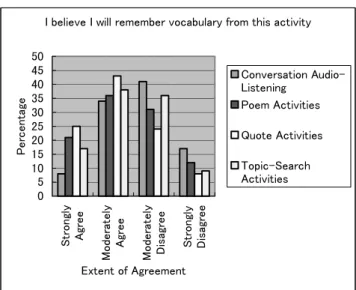
The results are shown in Figure 1:
I believe I will remember vocabulary from this activity
05 1015 2025 3035 4045 50
Strongly Agree Moderately Agree
Moderately Disagree Strongly Disagree
Extent of Agreement
Percentage
Conversation Audio- Listening
Poem Activities Quote Activities Topic-Search Activities
Figure 1: First Year General Opinion Survey
The results for how well students believed they would remember the conversation audio vocabulary were
disappointing, with 8% strongly agreeing they would remember, and 34% moderately agreeing, while 41%
moderately disagreed and 17% strongly disagreed.
The results were better for remembering the vocabulary from the poem activities, with 21%
strongly agreeing and 36% moderately agreeing they would remember, while 31% moderately disagreed and 12% strongly disagreed. The best results were from the quote activities, with 25% strongly and 43%
moderately agreeing that they would remember the quote vocabulary, while 24% moderately and 8%
strongly disagreed. For the topic search activities, 17% strongly and 38% moderately agreed that they would remember, with 36% and 9% strongly disagreeing.
Vocabulary-Specific Survey
Because of time-constraints and the large amount of data to be analyzed, the second survey was administered only in two classes rather than in all ten included in the first year of the study. These classes, chosen randomly, were from the pharmacy department in the first semester and the fisheries department in the second. To prepare for this survey, students in these classes were asked when writing expressions in their vocabulary notebooks to mark each expression that was “totally new”. This meant that, prior to encountering that word in the text or audio recording, they had never heard or seen the word before. This precaution was taken to prevent the inclusion of words students were already familiar with in the study. An individualized recall list was then created for each student in the target classes with expressions taken from each student’s vocabulary notebook. A group of forty of these expressions – ten from each of the four sections of the student’s notebook, conversation audio vocabulary, poem vocabulary, quote vocabulary, and topic search vocabulary – were listed in random order without identifying which section they were taken from and given to students two weeks after they handed in their vocabulary notebooks. The students were then asked
to rate each word from 1 to 4 with 4 indicating “I remember the meaning and could use it in a sentence,” 3 for “I remember the meaning but couldn’t use it in a sentence,” 2 for “I recognize the word, but I’m not sure what it means,” and 1 for “I don’t recognize this word.” The results for each of the four contexts are shown in Figure 2:
Vocabulary Specific Recall Ratings
0 10 20 30 40 50 60
Can Use in Sentence Remember Meaning
Recogn ize Word Don't Recogn
ize Word
Degree of Recall
Percentage
Conversation Audio Vocabulary Poem Vocabulary Quote Vocabulary Topic-Search Vocabulary
Figure 2: First Year Vocabulary Specific Survey
The results of these word-specific ratings aligned pretty closely with the results shown in Figure 1.
Again, the group of words students rated highest in terms of how well they recalled them was the quote activity vocabulary. 15% of these expressions were rated as “I remember the meaning and could use it in a sentence,” while 34% were rated as “I remember the meaning but couldn’t use it in a sentence.” 45% of the quote expressions were rated “I recognized the word, but I’m not sure what it means,” and only 6% were rated, “I don’t recognize this word.” The second highest recall was in the topic-search vocabulary with 10% of these expressions rated as “I could use this in a sentence,” 28% rated as “I remember the meaning,”
54% as “I recognize this word” and 8% as “I don’t recognize this word.” For the poem vocabulary, 7%
were rated as “I could use in a sentence,” 30% as “I remember the meaning,” 49% as “I recognize the word,” and 14% as “I don’t recognize this word.”
Finally, of the conversation audio vocabulary, 8% was rated as “I could use in a sentence,” 27% as “I remember the meaning,” 52% as “I recognize the word,” and 13% as “I don’t recognize this word.”
Second Year: Conversation Videos and Expanded Vocabulary Options
In the second year of the study, the options for students’ listening practice and vocabulary were expanded. The listening options were expanded to include conversation videos. The information students were required to write in the vocabulary notebooks was expanded to include synonyms, collocations, and L2 definitions. Finally, the author added extensive new example sentences taken from online concordances.
Conversation Videos
Video recordings were made of five of the original story conversations with the author recounting the same experiences with a second native English teacher from New Zealand. An additional seven new stories were recorded from the New Zealand teacher’s experience. Finally, a group of shorter conversations on non-idiom topics was video recorded. The original five stories were scripted, with a special focus given to vocabulary. The seven new stories were unscripted, to give them an authenticity.
The three native speakers featured in the conversation videos were from the United States, Canada, and New Zealand, giving students exposure to three different English accents.
Vocabulary Requirement
Nation (1990) suggested additional ways the story conversations could be exploited to improve the students’ vocabulary. Knowing a word involves more than knowing its L2 meaning. It also means knowing the following four elements:
(1) Synonyms: knowing a word also means knowing associations with related words whose meaning is
similar, but whose connotation is slightly different. When a word is learned, if it is linked to a set of related words with similar meaning, both the original word and the set of related words can be learned and retained. Knowing synonyms allows the students to see what other words could have been used instead of this word and thereby increases the students ability to express shades of meaning in L2.
(2) Collocations: knowing a word also involves knowing what other words will be “co-located”
or located in a text before or after that word.
Table 4 shows collocations for the word “car”:
Table 3: Collocations for the word “car”
Verbs (before)
back up--, break into--, crash--, drive--, hire--, park--, push--, register--, rent--, repair--, reverse--, road-test--, run--, service--, smash up--, start--, steal--, stop--, tow--, wreck--
Verbs (after) --break down, go off the road, run into something, screech to a halt, skid, swerve
Adjectives economical, flashy, luxury, powerful, second-hand, used
(3) L2 Definition: While most students are used to referring to bilingual dictionaries in which the English expression is given followed by the Japanese meaning, using a monolingual (English-English) dictionary helps students think in the second language, and develop skill in paraphrasing, an important strategy for communicating an idea in L2 even when they are unable to recall the specific word.
(4) English Example Sentences: The author explained the difference between single-word expression and formulaic sequences. For the former, students were required in the second year of the study to use online vocabulary resources to check
synonyms and collocations. For the multi-word expressions, the author consulted two online language concordances, the British National Corpus and Webcorpus. Conklin & Schmitt (2008) suggest that at least one-third to one-half of language is composed of so-called “formulaic sequences,” prefabricated, memorized multi-word expressions. Spoken discourse, particularly, which occurs under time-constraints, relies heavily on these expressions. These expressions are often in the form of frames with empty slots into which different expressions can be substituted. Consulting the two concordances, the author found authentic example sentences for the multi-word expressions in the story and music video vocabulary lists. Students were encouraged to write these example sentences in their notebooks and then translate them into Japanese.
Second Year Outcomes
At the end of the second year spring and fall semesters, students’ vocabulary notebooks were collected and analyzed. To determine the impact of the shift from conversation audio to conversation video listening on students’ vocabulary recall, the general opinion survey and vocabulary specific survey were again conducted. Analysis of this data produced the following findings:
General Opinion Survey
The results of the general opinion are shown in Figure 3:
Figure 3: Second Year General Opinion Survey
The students’ confidence in being able to remember the vocabulary from the conversation videos was significantly higher than for the conversation audio.
24% strongly agreed and 57% moderately agreed that they would remember the vocabulary they encountered in the conversation videos, while 17%
moderately disagreed and only 2% strongly disagreed.
Vocabulary Specific Survey
Again due to the time constraints and volume of data, the vocabulary specific survey was administered in only one class each semester. The first semester class was an engineering class, and the second was an education class. The same preparations and analysis were conducted as in the first year surveys. Again, a random sampling of ten expressions each from the three types of internet search activities (poem, quote, and topic search) were listed along with ten expressions taken from the conversation videos that each student viewed. The results are shown in Figure 4:
Vocabulary Specific Recall Survey
0 10 20 30 40 50 60
Can Use in Sentence Remember Meaning
Recognize Word Don't Recognize Word Degree of Recall
Percentage
Conversation Video Vocabulary Poem Vocabulary Quote Vocabulary Topic-Search Vocabulary
Figure 4: Second Year Vocabulary Specific Survey
Again, the extent of recall students indicated in their ratings for the conversation video vocabulary was markedly higher than for the conversation audio vocabulary, with 19% of those expressions rated “I remember the meaning and could use it in a sentence,” 46% rated “I remember the meaning.” 31%
I believe I will remember the conversation video vocabulary
100 2030 4050 60
Strongly Agree
Moderately Agree
Moderately Disagree
Strongly Disagree Extent of Agreement
Percentage
Percentage
of the conversation video expressions were rated, “I recognize the word but don’t remember the meaning,”
and only 4% were rated, “I don’t recognize this word.” The results for the poem, quote, and topic search vocabulary were largely unchanged in the second year survey.
Vocabulary Notebook Analysis
Evaluating the students’ vocabulary notebooks, it was possible to assess how well the students understood and met the expanded vocabulary requirements. The results are shown in Table 4:
Table 4: Students’ Vocabulary Notebooks
Average number of Expressions 214 Ratio of Single-Word to Multi-Word Expressions
44:56
Percentage of expressions with English Example Sentences
87%
Percentage of expressions with Example Sentences Translations
61%
Percentage of expressions with Japanese meanings
96%
Percentage of expressions with Synonyms 66%
Percentage of expressions with Collocations
34%
The results show that the average number of words students wrote in their vocabulary notebooks was 214.
Of these, 44% were single-word expressions and 56%
were multi-word expressions. 87% of these had English example sentences and of those 61% had Japanese translations. The percentage of single-word expressions with Japanese translations was 96%, that with synonyms was 66% and that with collocations was 34%. As a measurement of how well students understood these various aspects of vocabulary learning and were able to use the resources from the homepage to carry out independent research, this finding suggests the expanded vocabulary resources and requirements contributed to increased student
autonomy.
Discussion
The results from the two years of the study suggest that the context in which students access new vocabulary does have an impact on how well they remember it. Of the three types of written input explored in the study, poems, quotes and encyclopedia articles, the quotes were rated highest by the students as to how well they remembered the vocabulary they learned from them. The poem and topic search texts were rated roughly the same. One possible explanation for this is that quotes are much shorter, usually one sentence in length and express a highly memorable idea or opinion with an economy of words. Another finding from the study was the significantly higher ratings students gave the vocabulary accessed through conversation video compared with the vocabulary from the conversation audio. One possible factor in this was suggested by a comment found repeatedly in students’ written feedback that watching the speakers conversing while reading the subtitles made it easier and more enjoyable for them to follow the conversation than listening to the audio recording and reading the transcript.
Conclusion
The aim of this article was to explore how well students were able to recall vocabulary encountered in different media of language input. The paper reported the results of a two-year pilot study conducted at Nagasaki University in the first-year English Communication I classes concerning the impact on vocabulary retention of requiring students to keep a notebook of vocabulary encountered in written texts, audio and video-listening.
In the first year of the study students were required to keep a notebook of vocabulary they learned from conversation audio listening and from written texts taken from the Internet. These internet-search activities included the poem activity,
in which students found a poem of interest on the internet and made a learning activity based on the poem to share with a partner; the quotes activity, in which they chose ten quotes on a variety of topics, and the topic-search activity, in which they found an article on a topic of interest and made five English questions for a partner.
At the end of the first semester, two surveys were conducted concerning vocabulary students learned from these activities. In the general-opinion survey, students were asked generally how well the thought they would remember vocabulary taken from these four categories, while in the vocabulary-specific survey, they were asked to rate how well they recalled a random sample of specific vocabulary expressions taken from each of the four categories. The results in both surveys were similar. Students' perceptions of which activity-type's vocabulary they were most likely to remember and their ratings of how well they recalled specific vocabulary from each activity type produced the same results, with quote vocabulary the most memorable and that from the remaining three categories less so.
In the second year of the study, the information students were required to research for each vocabulary expression was expanded to include English definition, synonyms, collocations, English example sentences and Japanese sentence translations.
Also, a set of conversation videos with English subtitles was added to the homepage. Again the general opinion surveys and vocabulary-specific surveys were conducted. The results for the three written contexts were largely unchanged, but the students were markedly more confident about remembering the vocabulary learned from the conversation video than they were about the conversation audio vocabulary. The word-specific ratings for the conversation video vocabulary were also higher than for the audio. Finally, evaluation of the students’ vocabulary notebooks revealed that students had understood and successfully met the expanded vocabulary requirements.
There are several topics for further research suggested by these findings. Because being able to recognize a word as familiar is an important first step in acquisition, the students’ own ratings do provide evidence as to which words met this first test. In addition, the higher recall rates for the words accessed in the quote and conversation video activities suggest that for the students in the study, language learned in these activities was more memorable. However, to bolster the students’ claims of meaning recognition and ability to make sentences, it is necessary to independently verify whether students’ understanding of the word meanings is indeed accurate. In the next study, expanding the vocabulary-specific survey to require students to explain or otherwise identify the meaning of the expressions they rated as “I remember the meaning and can use it in a sentence,” and “I remember the meaning” will generate further empirical support of the data already gathered about students’ perceptions. In addition, adding other kinds of video-listening activities, such as news broadcasts, music videos, and movie scenes would allow the students’ recall of vocabulary encountered therein to be compared with their recall of the conversation video vocabulary.
Endnote:
The Mid-Range Objectives for Nagasaki University’s Humanities Program (中期目標)
“Courses should develop students’ ability to express themselves, and should foster habits of research and autonomous learning.”
自己表現能力の涵養を重視し,自主的な学習・研 究態度を身につけさせる。
References
Conklin, K. and N. Schmitt. 2008. “Formulaic sequences: Are they processed more quickly than nonformulaic language by native and nonnative speakers?” Applied Linguistics 29/1: 72-89. Oxford University Press
Dörnyei, Z. (2003). Questionnaires in second
language research. London: Lawrence Erlbaum Associates.
Kikuchi, T. 1995. “The potential of English-captioned films in English education.”
Numazu College of Technology Research Annual, 30, p.169-182
Nation, I. S. P. 1990. Teaching & learning vocabulary. New York: Newbury House/Harper Row Nation, I. S. P. 2001. Learning vocabulary in another language. Cambridge University Press.