A new class of carbonaceous chondrite (CY): Towards a reassessment of carbonaceous chondrite classification
Sara S. Russell and Ashley J. King
Department of Earth Sciences, The Natural History Museum, Cromwell Road, London SW7 5BD, UK
Introduction
The “CI-like chondrites”, including Y-86029, Y-82162, Y-86789, Y-86720 and B-7904, are phyllosilicate-rich meteorites found in Antarctica with chemical and mineralogical similarities to the CI meteorite falls but also some differences [e.g. 1‒3].
Since they contain less water than CI meteorites it has been suggested that they may formed by dehydration of a phyllosilicate- rich precursor. Analysis by X-ray diffraction (XRD) [4] underlined the mineralogical differences of these meteorites to CIs.
For example, Y-82162 contains 19 vol% sulphides compared to typical CI values of 4-7 vol%. CI-like chondrites contain significantly more anhydrous olivine and pyroxene than CI chondrites, and less magnetite and carbonate. . The oxygen isotope composition of CI-like chondrites is distinct from CI chondrites and are the highest 18O/16O ratios observed in any bulk carbonaceous chondrites [5]. This could be the result of mass fractionation caused by oxygen loss during dehydration. In this study we have investigated the mineralogy and petrology of a CI-like meteorite, Y-82162 to compare to CI and other type 1 chondrite meteorites, to place our XRD observations in petrographic context.
Results
As a start to our investigation we studied a thin section of Y-82162; we plan to study further meteorites. An element map was produced using the FEI Quanta 650 FEG SEM, and regions of interest were then selected for high resolution mapping. The section of Y-82162 we studied is approximately 56mm2. Like CI chondrites such as Orgueil and Ivuna, it is a micro-breccia composed of fine grained clasts dominated by a fine-grained phyllosilicate, Ca-bearing saponite and Fe,Mg serpentine. The meteorite differs to CI chondrites in that sulphides are highly abundant and clasts of phosphates and periclase are common.
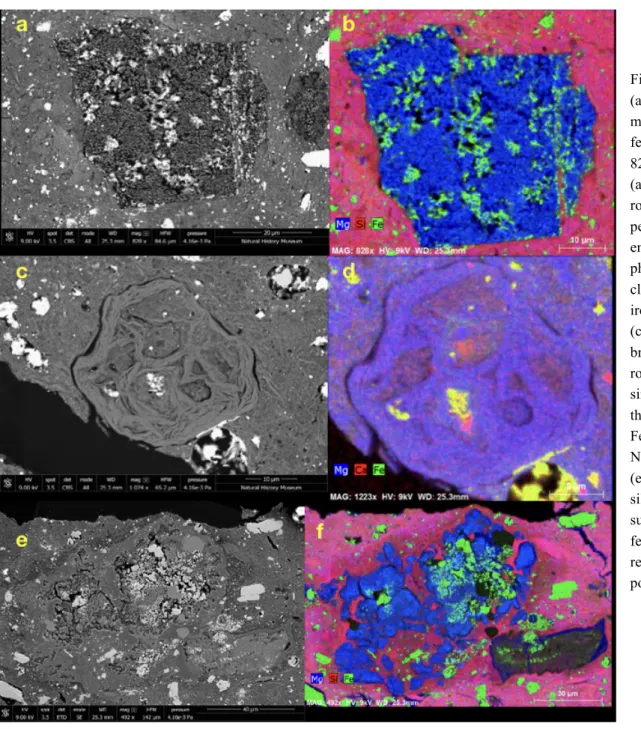
Unlike CI chondrites, Y-82162 contains a significant number of rounded or sub-rounded features, some examples of which are shown in Fig. 1. These are often more Mg-rich than the surrounding matrix and may be “ghost” chondrules. Such features are not typically observed in CI chondrites.
Discussion
CI-like meteorites: A new class - CY meteorites
Recent work on metamorphosed CM chondrites [6, 7] has led to a better understanding of how carbonaceous chondrites change when heated. Phyllosilicates dehydrate to poorly crystalline silicates that can be distinguished from primary olivine and pyroxene using XRD. Oxygen isotopes can change in complex ways to heating, but heated CMs usually have indistinguishable oxygen isotope compositions to unheated CMs [5].
The differing oxygen isotope composition, clear differences in modal mineralogy and obvious petrographic distinctions between “CI-like” chondrites and CI chondrites are remarkable. The “CI-like” meteorites cannot form by simple heating of a CI-like precursor as this does not explain the high sulphide abundance or petrographic features observed. There is a difference in oxygen isotopes between CI and “CI-like” chondrites and it is not at all clear that this is caused by dehydration. Because the samples come from clearly chemically different asteroid parent bodies, we suggest it should follow that they should not be in the same class, and that these meteorites should be considered a new class of water-rich carbonaceous chondrites.
Carbonaceous chondrite classes are typically named after the initial letter of the most representative fall. In this case there are no recorded falls and so we propose they are called the CY class, since most of the class were found in the Yamato mountains of Antarctica.
A re-look at the classification of carbonaceous chondrites.
We now have 9 classes of carbonaceous chondrites: CI, CM, CO, CV, CK, CR, CH, CB and CY and there are four categories of essentially chondrule-free petrological type 1 chondrites (CI1, CM1, CR1, CY1). The type 1 chondrites are water rich, perhaps from the outer solar system, and important to consider as a source of water to planets. However a broader question is what is the utility of carbonaceous chondrite classification? The original classes have often been implied to link one class to one asteroid parent body (see e.g. [8] for discussion of chondrite classification). We now know that there are over 700,000 asteroids in the asteroid belt (of which around 70% are C type and may be related to carbonaceous chondrites) and they can be
broadly grouped into families with similar spectral features [e.g. 9]. It is highly unlikely that all the meteorites from a single class come from a single asteroidal parent. In addition, our increased understanding of asteroidal processes means that many of the observed features in carbonaceous chondrites are due to processing on their parent body. For example the CMs and CO meteorites may come from a common family [e.g. 10], as may CV and CK meteorites [11]. CVs encompass a very broad range of mineralogical and petrographic features [12] whereas the CO3s define a group with a more narrow range of chemical compositions. In light of the two in-flight asteroid return missions Hayabusa2 and OSIRIS-REx, it is useful to attempt to understand how our meteorite collection compares to known asteroids. In the talk we will examine the relationships between carbonaceous chondrites in an attempt to make useful links to possible parent asteroid families.
Figure 1. BSE images (a, c, e) and element maps (b, d, f) of features observed in Y- 82162.
(a,b): clast consisting of rounded micron-sized periclase clasts embedded in phyllosilicates. The clast is decorated with iron-rich sulphides (c,d): phyllosilicate braids form a rounded feature with similar composition to the matrix for Mg and Fe, but richer in Al and Na;
(e,f): magnesium rich silicates and iron sulphides form a feature texturally reminiscent of a porphyritic chondrule.
References:
[1] Ikeda Y. (1991) Proc. NIPR Symp. Antarct. Meteorites 4 187-225. [2] Kojima H. and Yanai K. (1987) Symp. Antarct. Meteorites 12th, Natl. Inst. Polar Res., Tokyo. [3] Tomeoka et al., (1988) 13th Symp. Antarct. Meteorites 126-127. [4] King et al., (2015a) Geochim.
Cosmochim. Acta. 165 148-160. [5] Clayton and Mayeda (1999) Geochim. Cosmochim. Acta 63: 2089–2104. [6] Tonui E. K. et al. (2014) Geochimica et Cosmochimica Acta 126:284‒306 [7] King et al., (2015b) Meteoritics and Planetary Sciences abstract #5212 [8] Weisberg et al., (2006) Systematics and Evaluation of Meteorite Classification (pp. 19–52) In: Meteorites and the Early Solar System II, Eds D. Lauretta and H. Y. McSween, UA Press. [9] DeMeo, F.E., et al. (2009) Icarus 202, pp. 160-180. [10] Greenwood et al., 2014 45th LPSC abstract # 2610 [11] Greenwood et al., (2010) Geochimica et Cosmochimica Acta 74, 1684-1705. [12] McSween (1977) GCA 41 1777-1790.