Strategies
for
an
Optimized simulation of granular
particles
in
a
Newtonian
Fluid,
Part 2:
Numerical
algorithms
Ivaylo Petrov Tabakov\ddagger\dagger,
Institute of Mathematics and Informatics, Bulgaria
Hans-Georg Matuttis, Takafumi Suzuki\dagger,
\daggerUniversity of Electro-Comm unications, Department of Mechanical Engineeringand
Intelligent Systems, Chofu, Chofugaoka 1-5-1, Tokyo 482-8585, Japan
Abstract
Wedescribe
our
experienceswith sparse solvers for the stationaryincompress-ible Navier-Stokesequation on a Friedrichs Keller grid with various boundary
conditions. We simulate polygonal granular particles in a surrounding
in-compressible fluid in
a
$\mathrm{P}2\mathrm{P}1$ Galerkin finite element discretization, wherebyNewton-Raphson iteration turns out to be surprisingly robust. For the
inver-sionof the Jacobian, itturns out that from thevarious sparse algebraic solvers
in
use
in the numerical community, even GMRES does not reach the necessaryaccuracy, and only BiCGSTAB(l) gives satisfying results.
4
Introduction
The simulation of the interaction between fluids and granular material involves many
preliminary stepswhich simplifiesordecrease thedegreeof freedornofthe initial problem.
The findingsin research introduced in the article are preliminary for the $\mathrm{i}\mathrm{m}\mathrm{p}\mathrm{l}\mathrm{e}\mathrm{m}\mathrm{e}\mathrm{I}\grave{[perp]}\mathrm{t}\mathrm{a}\mathrm{t}\mathrm{i}\mathrm{o}\mathrm{n}$
of a full simulation containing polygonal granular particles modeled with the discrete
element method and the fluid modeled with the Galerkin finite element discretization of
the incompressible Navier Stokes equation.
For an efficient implem entation, the use of unstructured grids is necessary, as well as
the solution of the nonlinear system of equations resulting from the discretization, with
sparsematrix algorithm$\mathrm{n}\mathrm{s}$. Inthiswork, we investigate which of the considerablevarietyof
Krylov-space iterative solvers gives satisfying results for structured grids and is therefore
a candidate for the use with unstructured grids.
We
are
dealing exclusively here with solutionofthestationaryNavier-Stokesequation.though our final aim is an implementation of the time-dependent equations, because the
solution of the stationary problem is necessary to obtain consistent starting values for
the time-dependent Navier-Stokes equation in the DAE-form ulation (see the first part of
this article on the previous pages). From the structure of the problem , it is clear that
the non-stationary
case
is numerically more benign, because the mass-term dominates,where the non-linearities and the stiffness-matrix arerescaled with thetime-stepandtheir
contribution is much smaller than in the stationary problem.
5
Discretization
and Band
structure
As the work-horse for this investigation, we choose the Flow5-code by John $\mathrm{B}\mathrm{u}\mathrm{r}\mathrm{k}_{\epsilon}\mathrm{a}\mathrm{r}\mathrm{d}\mathrm{t}[5])$
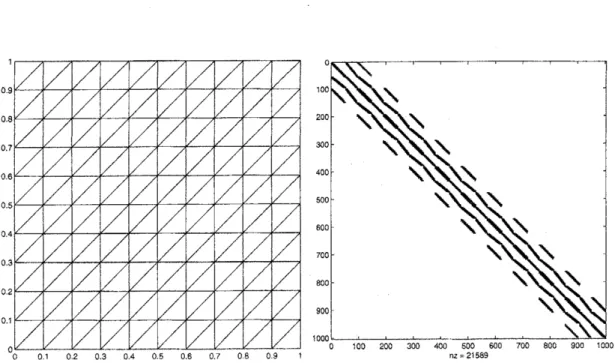
Figure 8: Thestructure of the Jacobian for the Friedrichs Keller grid (left, herefor cavity
flow) is a band matrix (right)
Navier-Stokes equation
$u \frac{\partial u}{\partial x}+v\frac{\partial u}{\partial y}+\frac{1}{\rho}\frac{\partial p}{\partial x}-\iota/\ovalbox{\tt\small REJECT}\frac{\partial^{2}u}{\partial x^{2}}+\frac{\partial^{2}u}{\partial y^{2}}\ovalbox{\tt\small REJECT}=0$, (S)
$u \frac{\partial v}{\partial x}\dashv- v\frac{\partial v}{\partial y}+\frac{1}{\rho}\frac{\partial p}{\partial y}-\iota/\ovalbox{\tt\small REJECT}_{\frac{\partial u}{\partial x}\frac{\partial vv2\ovalbox{\tt\small REJECT}}{\partial y}}^{\frac{\partial^{2}\mathrm{s})}{\partial x^{2}}+\frac{\partial^{2}}{+\partial y}}==00$
,
$(10)(9)$
for the $\mathrm{v}\mathrm{e}\mathrm{l}\mathrm{o}\mathrm{c}\mathrm{i}\mathrm{t}\mathrm{y}- \mathrm{f}\mathrm{i}\mathrm{e}\mathrm{l}\mathrm{d}\epsilon$; $?\iota.v$ in $x$,$y$-direction and the pressure field with dynamic viscosity
$lJ$ in a Galerkin Finite Elem ent Method with $\mathrm{P}2\mathrm{P}1$ elements. The discretized problem
is a system of nonlinear equations with velocities $u_{i}$ and $v_{i}$ x- and $\mathrm{y}$-direction
on
all $\mathrm{i}$integration points,
as
wellas on the pressures$\hat{p}_{k}$ on all integrationpoints $k$ (whichfor the$\mathrm{P}2\mathrm{P}1$-elements is only
a
subset of the $\mathrm{i}$ mesh-pointsof the velocities),so
that the vectorof all variables
$X=$ $(u_{12,\ldots i^{l}1}, uu\mathrm{L}’, v_{2}, \ldots v_{i},p_{1}j’ p_{2}, \ldots p_{k})$.
ThestationaryNavier-Stokes equations eqns. (8-10) consist formally
a
field problem$\mathcal{F}(u, v, p)=$$0$, and the corresponding discretized problem
$\overline{F}(X)=0$,
is a conventional root-finding problem for non-linear equations. The iterative solution by
the Newton-Raphson method
$\vec{X}_{n+1}=\vec{X}_{n}-(\nabla\vec{F}(\vec{X}_{n}))^{-1}\vec{F}(X_{n})\neg$ (10)
proved to be stable enough during the whole of the investigations;
no
additional$X_{0}$. The kernel of the iteration is the solution of the linear system
$\triangle\vec{X}=\check{x}(\nabla\vec{F}(\overline{X}_{n}))\ovalbox{\tt\small REJECT}_{A}\vec{F}(\vec{X})-1\mathrm{m}_{b}^{7b}$
’ (12)
where $A$is matrixofthe Jacobian and $\triangle x$ is the residual of the solution. We have started
the Newton-Raphson iteration with constant non-zero initial guesses, the initialization
with
zero
initial guessis bothunphysical and gave spurious convergence forsome
iterativesolvers. For most boundary conditions investigated, three iteration steps
were
enough,afterthat the solution changed only marginally.
Figure 9: Friedrichs-Keller gridsused for the simulation ofpipe flow and pipe How below
a protruding step (inflowon the left, outflowontheright, i.e. open boundaries
on
the leftandright end with
a nonzero
velocity gradient and fixed boundarieson
top andbottom).The grid points around the step in the grid on the right were chosen to minimize the
dislocation oftheothergrid points, not to minimize theerror in thespacialdiscretization.
For afinite-element discretization with$\mathrm{I}^{)}2\mathrm{P}1$-elem ents,one element has approximately
$n=15$ degrees offreedom, 6pointsfor $u$, 6points for$v$and 3 points for$p$, though apoint
belongson averageto $m=3$ elements. The dimensions of$\nabla F$for a $\mathrm{F}\mathrm{r}\mathrm{i}\mathrm{e}\mathrm{d}\mathrm{r}\mathrm{i}\mathrm{c}\mathrm{h}\iota \mathrm{i}\sigma- \mathrm{K}\mathrm{e}\mathrm{l}\mathrm{l}\mathrm{e},\mathrm{r}$ grid
(the usual Finite-Element grid,
see
Fig. 8, left) with $b$ $=(2\cross l_{x}\mathrm{x} ly)$ elements has thelinear dimension$l=$ $(2\cross l_{x}\cross l_{y})\mathrm{x}$$n/m$. Because thereareonlyentries foradjacent degrees
offreedom, the matrix is sparse and banded with bandwidth $(l_{x}\mathrm{x} ly)$ (see Fig. 8, right).
Forthe reference runs, wehave used the $\mathrm{L}\mathrm{U}$-decomposition (for theformulation ofVF as
full matrix) and the incomplete $\mathrm{L}\mathrm{U}$-decomposition (threshold $10^{-10}$, for the formulation
of$\nabla\vec{F}$as sparse matrix). For general problems with $l$ variables, thenumber of operations
necessary for a solution with the $\mathrm{L}\mathrm{U}$-decornposition is of the order of $l^{3}$, which would
be prohibitive for a general matrix which occurs for unstructured grids. For the banded
matrix of the Friedrichs-Keller-Grid, the number ofoperations is one order ofmagnitude
less, only $lb^{2}$.
6
Eigenvalue
Analysis
For finite difference discretizations, the discretized solution of the flow-lines corresponds
directlyto the continuumsolution. and the properties can be compareddirectly For the
Gaierkin Finite Elementmethod, which introduces basis functions and additionaldegrees
of freedom via integration, such acomparison is
more
problematic. One possible strategyis to analyze the problem[26] in terms of the eigenvalue spectrum of the Jacobian. The
solution of the linearsystem in eq. (12) with the Jacobian $\nabla\vec{F}(\vec{X}_{n})$. Because the choice
of Krylov-space solvers depends
on
the eigenvalue spectrum of the matrix of the linearsystem, it is worthwile to investigate the eigenvalue spectrum of the Jacobian to develop
an insight about the convergence of the algorithms depending on the physical problem.
It turns out that the eigenvalues ofthe Jacobian depend crucially
on
the vorticity in theproblem and the eigenvalueschange with each Newton-Raphson iteration eq. (11). In the
following, we have performed the Newton-Raphson iteration with $\mathrm{L}\mathrm{U}$-based inversion of
the Jacobian with constant initial vector.
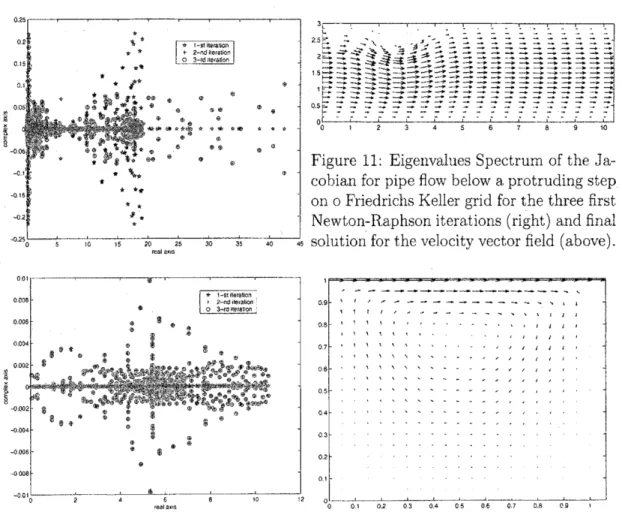
Forthe pipe flow (Fig.9 left), the eigenvalues forthe first Newton-Raphson iteration
are
along the cor plex axis, along the real axis, anda
third group is spread out fan-likesymmetrically around the real axis (Fig. 10). With proceeding iterations, the eigenvalues
of the fan-like group are drawn towards the real axis. The Newton-Raphson iteration
eq. (12) converged basically within three steps to ten digits accuracy
.
as
can
beseen
bythe fact that in the plot of thle eigenvalues, (Fig. 10, left), the symbols for the second
iteration $(’\backslash +’.)$
are
basically in the center of the symbols for the third iteration $(^{\rangle\backslash }’ 0")$.Convergence within three steps was also observed for the geometries below. Forthe flow
below a step (Fig.9 right), the eigenvalue distribution is about thesame as for the pipe
flow, (Fig. 11, note the different scale of the real axis in comparison to Fig. 10.) Afterthle
third iteration, some butterfly-like clouds remain relatively far from the real axis. For
the pipe-flow below
a
step, the Jacobian has larger eigenvalues (Fig. 11, left) than theJacobian for unperturbed pipe-flow (Fig.10, left), whereas the streamlines for the flow
around the obstacle show smaller velocities at the boundary
near
the obstacle (Fig. 11,right) than for the unperturbed flow (Fig.10 right). As the Jacobian enters the
Newton-Raphson iteration eq. 12 in the denominator,
so
that its large eigenvalues cause sm allcontributions, plausible to conclude that the small structures in the flow correspond to
large eigenvalues in the Jacobean, and viceversa.
In
case
ofcavity flow, at the first Newton-Raphson iteration the eigenvaluesare
near theaxis, andduring theiterationsspreadout into similar butterfly-like structures(Fig. 12, left) as inthecase
of the flow below astep (Fig. 11). As the similaritybetween thecavity-fiow and the flow below the step, one
can
conclude that the butterfly-like structures inthe eigenvalue spectrum
are
associated with the vorticity in the system.Figure 12: Eigenvalues Spectrum of the Jacobian Matrix for cavity flow using Friedrichs
Keller grid and the final solution for the velocity vector field. The upper boundary has
a
constant flow in $\mathrm{x}$-direction and zero velocity in $\mathrm{y}$-directionimposed, at all other wallsfixed boundary conditions are set. The right boundary is at $x=1.\mathrm{O}$, only the vector for
thle velocity of the upper right boundary point extends beyond.
stacles), the eigenvalue spectrum is “almost purely reai”. The eigenvalue analysis of the
Jacobean initialized with the correct final solution (Hagen-Poiseulle flow) might give the
$\mathrm{i}$mpression that purely real solvers are suitable for the problem. In case of cavity flow,
with the approachto thestationary numeric solution the eigenvalues runs away fromthe
real axis, and the necessity for solvers for problems with complex eigenvalue spectrum
becomes clear. Because the im aginarypart of the eigenvalues
can
become arbitrary largein the presence ofvortices, linear solvers are needed which are explicitly constructed for
problems where the corresponding matrix
can
contain complex eigenvalues.6.1
Choice
of
solvers
There
are
twoclasses of iterative solvers whichcanbe used onunstructuredgrids:Station-$\mathrm{a}\mathrm{r}\mathrm{y}/\mathrm{R}\mathrm{e}\mathrm{l}\mathrm{a}\mathrm{x}\mathrm{a}\mathrm{t}\mathrm{i}\mathrm{o}\mathrm{n}$ methods, which are basically improved versions of the Jacobi-Iteration,
Conjugate Gradient method. The drawback of the original relaxation methods (Jacobi,
Gauss-Seidel, Successive Overrelaxation) was the slow convergence due to the small
cur-$\mathrm{v}\mathrm{a}\mathrm{t}\mathrm{u}\mathrm{r}\mathrm{e}/$ largelength-scale introduced bythe “smoothing” inherent in the relaxation. This
problem can be
overcome
in the Multigrid methods, which solve the equationssimuita-neously also on
coarser
grids, so that the information is transferred between the lengthscales. The appealing feature oftransferring length scales ofthe solutiondirectly in
geo-metrical terms becomes lost when unstructured meshesareused, where so-calledalgebraic
multi grid method have to be
use
to compensate for the loss of geometrical informationin the corresponding matrix. The manuals of such algebraic multi grid packages (e.g.
$\mathrm{U}\mathrm{G}[2])$ are usually already much thicker than
some
bookson
linear algebra, and learningthehandling
even
as black boxes takes considerable time. Aswe
want to put our effortinthe solution of the Navier-Stokesequations, not in the underlying algebraic methods, we
choose instead Krylov-space solvers for sparse matrix methods, which are based more on
algebraic than
on
geometric considerations. Apart from the fact that the replacement ofthe$\mathrm{L}\mathrm{U}$-decomposition in the original code is straightforward, afurther advantage isthat
there
are
criteria irr terms of eigenvalues, although there is no guarantee of convergence(in the
case
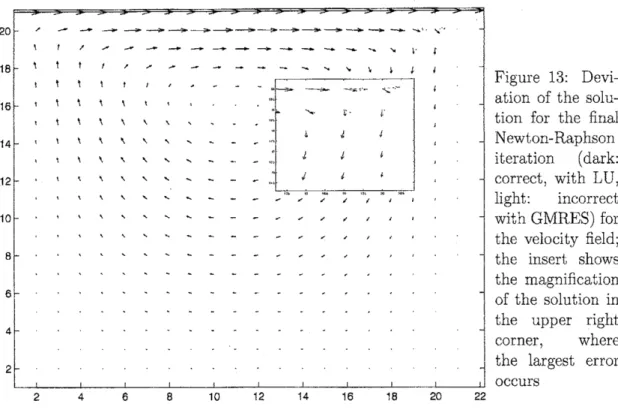
of Relaxation method, thereisn’t, either.)Figure 13:
Devi-than of the
solu-tion for the final
Newton-Raphson
iteration (dark:
correct, with $\mathrm{L}\mathrm{U}$,
light: incorrect
withGMR ES) for
the velocity field; the insert shows
the magnification
of the solution in
the upper right
corner, where
thle largest error
occurs
6.2
Nonstationary Iterative
Methods(Krylov
Space
Methods)
The ancestor of Krylov-Space methods (see Ref. [1] for
an
overview), which try to solvea linear system $Ax=b$ by minimizing the residuum vector $r=Ax-b$, is the Conjugate
Gradient method (GC), which works only for positive definite $A$. Newer methods have
been developed for more general
cases.
We did notuse
preconditioners, because forisunclear whata good” preconditioner might be. All standard methods like Bi-conjugate
Gradient, Conjugate Gradient Squared and Bi-conjugate Gradient Stabilized failed for the solution, both in the MATLAB-implementation
as
wellas
in the Implementation ofRef. [1]. Only with GMRES and BiCGSTAB(l)[lS], solutions for the Newton-Iteration
could be obtained at all
6.3
GMRES
-a surprising
failure
The Generalized Minimal Residual Method (GMRES) is widely used in fluid mechanics
in the so-calledNewton-GM RES-method for the Navier-Stokes equation forcompressible
flows. For our incompressible problem, it
never
converged to theexact(LU) solution withmore than three digits accuracy. This would not so bad for the velocity in Fig. 13, but it
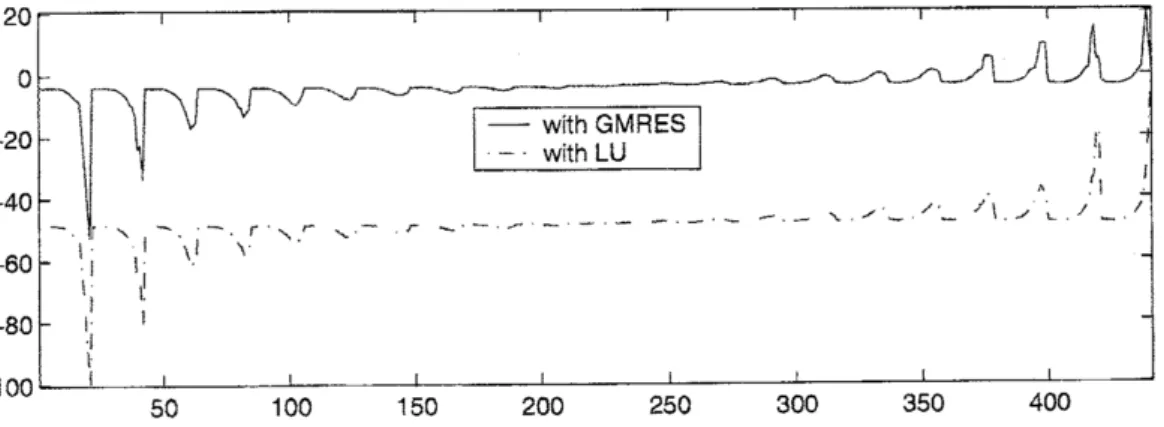
is unacceptable for the pressure in Fig. 14, as the violation of the continuum equation in
a DAE-formulation will lead to a degeneration of the solution away from the constraint
manifold. Wetriedout different initialsolutions, but this did notimprovethe convergence
in any way. The badconvergence oftheNewton-Raphson iteration with GMRES is
even
more surprising asthe Newton-Raphson iterationis asecond ordermethod, i.e. itdoubles
the accuracy of the solution in each iteration. This has the downright magic effect that
with a preliminary solution $x_{n}$ and a Jacobian or its approximant which are correct to
$\mathrm{k}$ digits in the n-th step, the next solution
$x_{n+1}$ will exhibit $2k$correct number of digits.
Not
even
this formidablepropertyseems
to further the accuracy of the solutions obtainedwith GMRES so we have to conclude that forour incompressibility problem, GMRES is
inherently inapplicable.
Figure 14: Comparison between pressure vectors obtained via GMRES and LU
respec-tively, for the 3rd iteration of the system in Fig. 8; the GM RES-pressure deviates from
the “numerically exact” $\mathrm{L}\mathrm{U}$pressure constantly
over
the whole grid.6.4
BiCGSTAB(1)-
the
successful
solver
BiCGSTAB(l) - Bi-Conjugate Gradient Stabilized(l)[18], is
newer
than other methods,so it has not yet found its way in standard references like Ref. [1]. It
was
explicitlybuilt for problems with complex eigenvalues spectra to
overcome
the problems inherent inBiCGSTAB
and GMRES and itwas
the only iterative linear solver which convergedwithin the desired tolerance. In contrast to other Krylov-Space methods. BiCGSTAB(l)
does not only
use
the residual $r.–Ax$ $-b$, but also the ”shadow residual” $r\sim=\tilde{x}^{T}A-\tilde{b}^{T}$.Using
a
zero-vector for the initialization lead to spuriousconvergence,
so
instead wechoose aconstant
non-zero
vector. Weuse
BiCGSTAB(4) as well as BiCGSTAB(8) and,apart from manually adjustment of the tolerance and the maximum number ofiterations,
there
were
no problem $\mathrm{s}$withthe convergence. BiCGSTAB(l)seems
to thebest choice forthe time-dependent solution of the Navier-Stoke Equation for incom pressible flow with
vortices orfurther
more
solver for the granular-particle - fluid system sil ulation.Figure 15: Convergence diagram ofBiCGSTAB(4) for the system in Fig, 8
Fig. 15 shows the convergence of the
no
rm of the residual $|r|=|b-Ax^{(\mathrm{i})}|$ withBiCGSTAB(4) to a given accuracy of $10^{-\mathrm{S}}$
.
The solver converges to toleranceapproxi-mately 10 after about 8000 BiCGSTAB(l)-iterations . For each Newton-Raphson
iter-ation, e.g. three, these 8000 BiCGSTAB(l)-iterations must be repeated, so that a total
of 24.000 BiCGSTAB(l)-iterations is necessary. This looks like a relatively costly
perfor-mance, but for a simulation of the time-dependent Navier Stokes equation, only for the
initial timestep the solution has to becomputed from scratch, using this many iterations
in the linearsolver; for the subsequent time-steps, the previous flow patterns
can
be usedas an initial guess which reduces the number of BiCGSTAB(l)-iterations, and usually,
only a single Newton-Raphson iteration is necessary.
7
Summary
and
Conclusions
We have investigated the solution of the stationary Navier-Stokes equations for the
in-com
npressible case with Newton-Raphson solution of the equations resultingGalerkin-Finite element discretization for various geometries and have compared the perform ance
of different linear solvers for the inversion of the Jacobian in the Newton-Raphson
pro-cedure. Convergence was reached within three to five iterations. Except GMRES and
BiCGSTAB(l), all other solvers among the large variety of Krylov-Space solvers failed to
converge
or
crashed already intheinitial problem. Though GMRESisapopular solverforthecompressible Navier-Stokesequations, asdocumented by the existence of the
cient for all problems we investigated. Only BiCGSTAB(l), with $l\geq 4$ gave satisfying
solutions for all test cases in comparison with the ”numerical exact” solution for
LU-decomposition. The next step in the investigation will be the solution of time-dependent
problem for the
same
boundaryconditions, using thestationarysolutions obtainedin thiswork
as
initial guess.References
[1] R. Barrett, M. Berry, T. F Chan,J.
Dem-mel, J. Donato. J. Dongarra, V. Eijkhout,
R.Pozo, C.Romine,andH. Van derVorst.
Templates
for
the Solutionof
LinearSys-tems: Building Blocks
for
IterativeMeth-ods, 2nd Edition. SIAM, Philadelphia, $\mathrm{P}\mathrm{A}_{\mathrm{t}}$ 1994.
[2| P. Bastian, K. Birken, K. Johannsen,
S. Lang, N. Neuss, H. Rentz-Reichert, and
C. Wieners. Ug- a flexible software
tool-box for solving partial differential
equa-tions. Computing and Visualization in
Science Volume 1, $pp$. 27-40, 1997.
[$3_{\rfloor}^{\rceil}$ J. Bey. Tetrahedral gridrefinem $\mathrm{e}\mathrm{n}\mathrm{t}$.
Corn-puting Volume 55, pP. 355-378, 1995.
[4] J. Bey. A$GM\mathit{3}D$ Manual, Repor$rtNr$. 50,
$SFB\mathit{3}\mathit{8}\mathit{2}$. Math. II st Univ.Tiibingen,
1996.
[$5|$ John Burkardt. http:$//\mathrm{w}\mathrm{w}\mathrm{w}$
.
csit.
$\mathrm{f}\mathrm{s}\mathrm{u}$. $\mathrm{e}\mathrm{d}\mathrm{u}/\sim$burkardt/.[$6|$ Sydney Chapman and T. $\mathrm{G}$ Cowling.
The Mathernatical Theory
of Non-uniform
Gases, Cambridge Unersity Press, Cam
-btidge, 1970.
[7] P. A. Cundall and 0. D. L. Strack. A
dis-crete numerical model for granular
assem-blies. Geotechnique, 29(1):47-65, 1970.
[8] E.Hairer and G.Wanner. Solving
Or-dinar.y
Differential
Equations $II$,Stiff
and Differential-Algebraic Problems,
vol-ume II of Springer Series in Computa-tionalMathematics. Springer. Berlin,
Hei-delberg, New York, 2 edition, 1996.
[9] U Frisch, B. Hasslacher, and Y. Pom eau.
Lattice-gasautomata for the navier-stokes
equation. Phys. Rev. Lett. Volume 56, $pp$.
1505-1508, 1986.
[10] $\mathrm{R}.\mathrm{A}$
. Gingold and $\mathrm{J}.\mathrm{J}$
.
Monaghan.Smoothed particle hydrodynamics:
the-oryandapplicationto non-spherical stars.
Mon Nat. R. Astron Soc, 181375-389,
1977.
[11] E. Hairer, S. P. Norsett, and G.
Wan-ner. Solving Ordinary
Differential
Equa-tions $I$,
Nonstiff
Problems, volume I ofSpringer Series in Computational
Mathe-matics. Springer, Berlin, Heidelberg, New
York, 2.nd edition, 1993.
[$12_{\rfloor}^{\rceil}$ F.H. Harlow and $\mathrm{J}.\mathrm{E}$
.
Welch. Numericalcalculation of time-dependent viscous
in-com pressibleflow, Phys. Fluids Volume 8,
pp. 2182-2189 1965
[$13_{\rfloor}^{\rceil}$ Kai Hdfler, Matthias M\"uller. Stefan Schwarzer, and Bernd$\mathrm{n}\mathrm{d}$ Wachm ann.
Inter-acting particle-liquid systems. High
Per-formance
Computing inScience andEngi-neering E. Krause W. Jdger$eds$.Springer,
1998.
[14] Takeo Kajishima. Num ericalinvestigation
of multiscale interaction between
turbu-lent flow and solid particles. In The
54
thNat. Cong
of
Theoreticales
AppliedMe-chanics, Tokyo, Japan, 2005.
$\downarrow\dagger 15]$ S. KoshizukaandY. Oka. Moving-particle
semi-implicit method forfragmentationof
incompressible fluid lust. Sci. $Eng$
.
Vol-$ume\mathit{1}\mathit{2}\mathit{3}_{y}pp$. 421-434, 1996.
[16] S. Koshizuka, H. Tarnako, and Y. Oka. A
particlemethod forincompressibleviscous
flow with fluid fragmentation. Comput.
Fluid Dynamics J. Volume 4, $pp$.
29-4
$\theta$,$|’ 17|$ A. J. C. Ladd and R. Verberg.
Lattice-boltzmann sixnulatiolls of particle fiuid
suspensions. J. Stat. Phys. Volume 104,
pp. 1191 - 1251, 2001.
$\llcorner\ulcorner 1\mathit{8}]$ Gerard
$\mathrm{L}$ G.Sleijpen and Diederik
R.Fokkema Bicgstab(1) for linear
equa-tions involving unsymmetric matrices
with complex spectrum Electron. Trans.
$N\uparrow lm\mathrm{r}7$. Anal. Volume 1. $pp$ 11-32, 1993
[$19|\mathrm{B}$ $\mathrm{D}$ Lubachevsky and F. H. Stillinger
Geometric properties of random$\mathrm{n}$disk pack-$\mathrm{i}_{\mathrm{I}1}\mathrm{g}\mathrm{s}$
.
J. Stat. Phys. $60(^{r}|\lrcorner/6):561- 583$,1990.
[$20_{\rfloor}^{\rceil}$ S. Luding, $\mathrm{E}$ Clement, A. Blumen, J.
Ra-jchenbach, and $\mathrm{J}$ Duran. Studies of
columns of beads under external
vibta-tions. $P/?7S$ Rev. $E$, 49(2):\perp 634, 1994.
$\lfloor|.21|$ H.-G. Matuttis, $\grave{[perp]}o\mathrm{b}\forall \mathrm{u}\mathrm{y}\mathrm{a}\mathrm{s}\mathrm{u}$ Ito, and
Alexander Schinner. Effect ot particle
shape on bulk-stress-strain relations of
granular materials. In Proceedin$\iota gs$
of
$Rlf\mathfrak{t}^{\prime Ig}$ Symposium on Mathematical $A_{\mathrm{b}-}$
pects
of
Complex Fluids $III$, voiurne 1305of RIM $S$ Kokyoroku series, pages 89-99,
Kyoto, 2003 RIMS.
[$22^{1}\mathrm{j}$ J. J. Monaghan. Smoothed particle$1_{1_{\iota}}\mathrm{v}\mathrm{d}\mathrm{r}\mathrm{o}-$
dvnaznics Annual Review
of
Astronomyand $A_{6}trophys\mathrm{i}c^{\backslash }s$, 30543-574, 1992
[$23_{\mathrm{J}}^{1}|$ J. ’1. Moveau Unilateral contact and dry
friction
infinitefreedom
dynamics, pages1 82. Number 302. $\rfloor 988$
[21] J. J. Moreau. An expression of $\mathrm{c}\mathrm{l}\mathrm{a}\mathrm{s}\mathrm{b}\mathrm{i}\mathrm{c}\dot{\mathrm{c}}11$
dynamics, Ann.Inst. H.Poincare’Anal aVon
$L\mathrm{i}n$’eaire, XXX(6):1-48, 1989.
[25] Shiro Okeda. Experiments on the
sound-velocity of granular beads (in Japanese).
Master’sthesis.The University of
Elcctro-Com munications. 2006.
[26] P.$\mathrm{A}\backslash \mathrm{I}$.Greshoand R.$\mathrm{I}_{\lrcorner}$.Sani. Incompressible
Flow and the Finite Element Method ,
Vol-$ume\mathit{1}$:
Advection-Diffusion.
John Wileyand SonsXTD, NewYork, $\mathrm{N}\mathrm{Y}$, $2\mathrm{t}$)Ot). $\int.27|$ P.M.Gresho and$\mathrm{R}.\mathrm{L}$.Sani. Incompressible
Flowand theFiniteElementMethod
.
Vol-$l\mathit{7}r\iota e$ $\mathit{2}$:Isoth$errr\iota al$ Laminar Flow. John
Wiley and SonsXTD, New York, $\mathrm{N}\mathrm{Y}_{1}$
2000
[28] $\mathrm{W}$ E.Schiesser. The NumericalMethod
of
Lines: Integration
of
PartialDifferential
Equations. Academic Press, San Diego,
1991
[$29|\mathrm{S}$ Schwarzer, K. H\"ofler. C. Manwart,
B. Wachmarm, and H. Herrm anll.
Non-browniansuspensions: Simulationand
lin-ear response physica a 1999. In Proc..
Conf
on Percolation and Disordered $6’ys-$tems. $\mathrm{R}\mathrm{a}1\iota \mathrm{s}\mathrm{c}1_{1}:_{1\mathrm{O}}1\mathrm{z}11\mathrm{a}\mathrm{u}\mathrm{s}\mathrm{e}\mathrm{I}1$, Germany, July
1998
$\lceil 30_{\mathrm{J}}^{1}|$ Bernd $\mathrm{l}\mathrm{V}\mathrm{a}\mathrm{c}‘ 1\mathrm{l}\mathrm{n}\mathrm{t}\mathrm{a}\mathrm{n}\mathrm{n}$and Stefan Schwarzer.
Three-di mensional rnassively parallel
com-putingofsuspensions. Int J. Mod Phys. $C$
Volume $\mathit{9}(^{r}v)pp$ 759-775. 1998
[31] Toru Watanabe,Hiroshi Watanabe.
Torni-ichi Hasegawa, and Takatsune Narumi
Flow analysis ofcomplex fluids through a
sm all orifice. In The
54
th Nat. Congof
$Theor\epsilon t\mathrm{i}cal$ $\mathrm{f}.\mathit{4}$ Applied Mechanics, Tokyo,
Japan, 2005.
[32] John $\mathrm{W}$Perram, John Rassm ussen, Eigil
Praestgaard, and Joel L.Lebowitz.
Ellip-soid contact potential: Theory and
reia-tion to overlap potentials. Phys. Rev. $E$,