Cytosolic glutamine synthetase isozymes play
redundant roles in ammonium assimilation under
low-ammonium conditions in roots of
Arabidopsis thaliana
著者
Konishi Noriyuki, Saito Masahide, Imagawa
Fumi, Kanno Keiich, Yamaya Tomoyuki, Kojima
Soichi
journal or
publication title
Plant and Cell Physiology
volume
59
number
3
page range
1-27
year
2018-01-24
URL
http://hdl.handle.net/10097/00125673
doi: 10.1093/pcp/pcy014This is the peer reviewed version of the following article: Noriyuki Konishi et al. (2018) Cytosolic glutamine synthetase isozymes play redundant roles in ammonium assimilation under low-ammonium conditions in roots of Arabidopsis thaliana. Plant and Cell Physiology 59:601-613, which has been published in final form at http://dx.10.1093/pcp/pcy014. This arti-cle may be used for non-commercial purposes in accordance with Oxford University Press for Self-Archiving
Cytosolic glutamine synthetase isozymes play redundant
roles in ammonium assimilation under low-ammonium
conditions in roots of Arabidopsis thaliana
Noriyuki Konishi1,2, Masahide Saito1, Fumi Imagawa1, Keiich Kanno1, Tomoyuki Yamaya1, and
Soichi Kojima1*
Keywords
Arabidopsis, ammonium, metab-olism, root, glutamine synthetase
Correspondence Dr. Soichi Kojima E-mail, [email protected] Received: 11 July 2017 Accepted: 17 January 2018 Published: 24 January 2018 DOI: 10.1093/pcp/pcy014
TOUR:
Tohoku University Repository1Graduate School of Agricultural Science, Tohoku University, 468-1 Aoba, Aramaki, Sendai 980-0845,
Japan
2Division for Interdisciplinary Advanced Research and Education, Tohoku University, 6-3 Aoba,
Arama-ki, Sendai 980-8578, Japan
Ammonium is a major nitrogen source for plants; it is assimilated into glutamine via a reaction catalyzed by glutamine synthetase (GLN). Arabidopsis expresses four cytosolic GLN genes, GLN1;1, GLN1;2, GLN1;3, and GLN1;4, in roots. However, the function and organization of these GLN1 isozymes in ammonium assimilation in roots remain unclear. In this study, we aimed to characterize the four GLN1 isozymes. The levels of growth of wild type and gln1 single- and multiple-knockout lines were compared in a hydroponic culture at ammonium concentrations of 0.1 and 3 mM. Under the low-ammonium con-centration, in single mutants for each GLN1 gene, there was little effect on growth, whereas the triple mutant for GLN1;1, GLN1;2, and GLN1;3 grew slowly and accumu-lated ammonium. Under the high-ammonium concentration, the single mutant for GLN1;2 showed 50% decreases in fresh weight and glutamine, whereas the other gln1 single mutants did not show notable changes in the phenotype. The double mutant for GLN1;1 and GLN1;2 showed less growth and a lower glutamine concentration than the single mutant for GLN1;2. Promoter analysis indicated an overlapping expression of GLN1;1 with GLN1;2 in the surface layers of the roots. We thus concluded that: 1) at a low con-centration, ammonium was assimilated by GLN1;1, GLN1;2, and GLN1;3, and they were redundant; 2) low-affinity GLN1;2 could contribute to ammonium assimilation at con-centrations ranging from 0.1 to 3 mM; and 3) GLN1;1 supported GLN1;2 within the outer cell layers of the root.
Introduction
The analysis of ammonium assim-ilation in roots at various concen-trations is vital for three important reasons: 1) ammonium and nitrate are the predominant nitrogen sources for plants in most soils (von Wirén et al. 2000); 2) ammonium inhibits plant growth at high con-centration (Britto and Kronzucker 2002, Hachiya et al. 2012, Li et al. 2014); and 3) soil ammonium concentration fluctuates due to nitrogen fertilization, nitrification, and ammonia emission (Riley et al. 2001, Martins et al. 2015, dos Santos et al. 2016) in agricultural fields.
Most ammonium is assimilated in the roots and then translocated to the shoots through the xylem, mainly in amide forms such as glutamine and asparagine (Kiyomi-ya et al. 2001, Andrews et al. 2013, Yamaya and Kusano, 2014). Am-monium is first incorporated into glutamine in an ATP-dependent reaction catalyzed by glutamine synthetase (GS or GLN) (Tobin and Yamaya 2001, Lea and Azeve-do 2007, CharAzeve-don et al. 2012, Thomsen et al. 2014). Cytosolic GLN1 is the major form in roots, while both GLN1 and plastidic GLN2 are expressed in shoots (Sakakibara et al. 1996, Ishiyama et al. 2004a and 2004b, Orsel et al. 2014). There are 3–16 GLN1 genes in the genome of higher plants (Orsel et al. 2014), and several
GLN1 genes are expressed in roots (Sakakibara et al. 1996, Ishiyama et al. 2004a and 2004b, Tabuchi et al. 2007, Goodall et al. 2013, Or-sel et al. 2014).
A major current focus in studies on ammonium assimilation is to understand the physiological func-tions of individual GLN1 isozymes. The Arabidopsis genome encodes five GLN1 genes (Thomsen et al. 2014). In previous reports, the importance of GLN1;2 in shoots was indicated (Lothier et al. 2011; Guan et al. 2016; Guan and Schjør-ring 2016). For example, in a GLN1;2 knockout line, there was a decrease in rosette fresh weight upon supplying 10 mM nitrate, although there was no obvious growth difference upon supplying 2 mM nitrate (Lothier et al. 2011). The expression of GLN1;2 was also increased by the supply of 20 mM ammonium in shoots, and gln1;2 mutants grew slowly upon the supply of 2–20 mM ammonium (Guan et al. 2016).
Arabidopsis expresses four GLN1 (GLN1;1, GLN1;2, GLN1;3, and GLN1;4) genes in roots (Ishiyama et al. 2004b). A study revealed that the recombinant GLN1 isozymes exhibit different enzymatic charac-teristics (Ishiyama et al. 2004b); specifically, GLN1;1 and GLN1;4 exhibit high-affinity for ammonium while GLN1;2 and GLN1;3 exhib-it low affinexhib-ity for exhib-it (Ishiyama et al. 2004b). Our recent report focused on the roots; it described the
con-tribution of two low-affinity GLN1 isozymes (GLN1;2 and GLN1;3) to ammonium assimilation in roots (Konishi et al. 2017). A hydropon-ic culture containing ammonium as a major nitrogen source revealed that gln1;2 grew more slowly and accumulated more ammonium in the hydroponic nutrient solution containing ammonium at a con-centration above 1 mM, whereas gln1;3 did not exhibit obvious changes (Konishi et al. 2017). The double knockout of GLN1;2 and GLN1;3 led to decreases in fresh weight and also glutamine concen-tration in the xylem sap (Konishi et al. 2017). Promoter activity of GLN1;2 was localized in epidermis and cortex in the root, whereas that of GLN1;3 was localized in the pericycle upon the supply of a high level of ammonium (Konishi et al. 2017). These results suggest the essential contribution of GLN1;2 to ammonium assimilation in the surface cell layers of roots and the non-essential contribution of GLN1;3 in the root pericycle (Konishi et al. 2017).
Nevertheless, the GLN1 isozyme responsible for the assimilation of lower concentrations of ammonium has not been identified because gln1;2 and gln1;3 single mutants do not show any notable phenotypes under lower-ammonium conditions (Konishi et al. 2017). Since the expression levels of GLN1;1 and GLN1;4 are high in low-nitrogen conditions (Lothier et al. 2011,
Konishi et al. 2017), high-affinity GLN1 isozymes (GLN1;1 and GLN1;4) are expected to be the major isozymes for the utilization of low concentrations of ammoni-um in roots.
To date, little information has been reported on the function of GLN1;4, while the functions of GLN1;1 have been reported by using reverse genetic approaches; however, the functions of GLN1;1 are still unknown under limited ammonium conditions (Guan et al. 2015, Guan et al. 2016).
The purpose of this study is to describe and examine the contri-bution and organization of GLN1 isozymes in ammonium assimilation in roots under a low ammonium concentration. Specifically, the present study analyzes the functions of four cytosolic GLN1 isozymes (GLN1;1, GLN1;2, GLN1;3, and GLN1;4) under low and high am-monium concentrations in Arabi-dopsis roots by using gln1 single-, double-, and triple-knockout lines and promoter-GFP lines. Compar-ison between gln1 single mutants and gln1 multiple mutants revealed the following findings: 1) at low ammonium concentrations, GLN1;1, GLN1;2, and GLN1;3 have over-lapping functions; 2) the high-af-finity GLN1;1 can be compensat-ed for by the low-affinity GLN1;2 and GLN1;3; 3) at high concen-trations of ammonium, GLN1;2, with support from GLN1;1, is responsible for assimilating
ammo-nium within the outer cell layers of the roots.
Results
Knockout of high-affinity GLN1 did not change plant growth in ammonium nutri-ent supply
To investigate the contribution of high-affinity GLN1 isozymes, GLN1;1 and GLN1;4, single mu-tants for GLN1;1 (gln1;1-4, Fig. 1a) and GLN1;4 (gln1;4-1 and gln1;4-2, Fig. 1b), and a double mutant for GLN1;1 and GLN1;4 (gln1;1:gln1;4) were prepared. RT-PCR analysis indicated a loss of GLN1;4 mRNA in gln1;4 and gl-n1;1:gln1;4, and a loss of GLN1;1 mRNA in gln1;1 and gln1;1:gln1;4 (Fig. 1c). Single and double gln1;1 and gln1;4 knockout lines were grown in a hydroponic solution containing either 0.1 or 3 mM ammonium as a major nitrogen source (Fig. 1d). Neither gln1;1 nor gln1;4 showed a significant difference in the biomass under the low-am-monium condition (Fig. 1e). The fresh weight of the roots of gln1;1-4 and gln1;1:gln1;gln1;1-4 was slightly decreased under high ammonium supply, whereas other mutants, including the double mutant for GLN1;3 and GLN1;4 (gln1;3:gln1;4), did not differ from the wild type in this regard (Fig. 1e). In the low-ammonium condition, there were no significant differences in total amino acids (Fig. 2a) and
ammonium (Fig. 2c) between the wild type and mutants, whereas glutamine (Fig. 2b) slightly increased in all mutants compared with the level in the wild type. In the high-ammonium condition, there were no significant differences in total amino acids (Fig. 2a), glutamine (Fig. 2b), and ammonium (Fig. 2c) between the wild type and mutants. These results indicate that the con-tribution of GLN1;1 or GLN1;4 to ammonium utilization at a lower-ammonium concentration can be fully compensated by the other types of GLN1.
Generation of a triple-knock-out line
The growth of GLN1;1 and GLN1;4 mutants under nitro-gen-limited conditions suggests some functional redundancy of GLN1 genes in ammonium assim-ilation. Furthermore, the expression patterns of GLN1 genes that we previously determined (Konishi et al. 2017) support the non-negligi-ble contribution of GLN1;2 under ammonium-limited conditions. To address the issue of functional re-dundancy, we constructed double mutants, gln1;1:gln1;2, gln1;1:gln1;3, and gln1;3:gln1;4, in this work, and gln1;2:gln1;3 (Konishi et al. 2017), and a triple knockout line (gln1;1:gl-n1;2:gln1;3, tko) created by genet-ic crossing. The RT-PCR analysis confirmed that none of the three GLN1s were detectable in the tko (Fig. 3a).
We attempted to cross gln1;2 with gln1;4, but this was not successful. Double knockout of GLN1;2 and GLN1;4 seemed to have a lethal effect on plants. To isolate gln1;2:gln1;4 double mutants, gln1;2-1 and gln1;4-1 were crossed and
self-fer-tilized, and the segregation of the knockout line was determined in the F2 generation. Genotypes of GLN1;2 and GLN1;4 in the F2 generation were analyzed by PCR using gene-specific primers for GLN1;2 and GLN1;4. PCR
anal-ysis showed that there were no gl-n1;2:gln1;4 homozygous plants among 182 plants from the F2
Figure 1. The gln1;1 gln1;4 double knockout line does not show growth inhibition under the low-ammonium condition
The position of T-DNA insertion in gln1;1-4 (a), and in gln1;4-1 and gln1;4-2 (b). Exons are il-lustrated as filled boxes, lines represent introns, and open boxes correspond to 5'- and 3'-untranslated sequences. Arrows indicate the positions of gene-spe-cific primers used for RT-PCR. RT-PCR analysis of root RNA from wild type (Col-0), gln1;1,
gln1;4, and gln1;1:gln1;4 (c).
Plants were grown in a hydro-ponic solution containing 0.1 mM ammonium for 6 weeks. Images of the gln1;1 and gln1;4 knockout lines and their corre-sponding wild type (Col-0), as well as of the double mutant,
gln1;1:gln1;4, after growth in the
hydroponic solution containing either 0.1 or 3 mM ammonium for 6 weeks (d). Fresh weights of shoots and roots of the wild type (Col-0) (black columns), gln1;1 (orange-red columns) and gln1;4 mutant lines (deep magenta columns), and gln1;1:gln1;4 (bubble gum column) and
gl-n1;3:gln1;4 double knockout
lines (light green column), with the same plants as in d (e). Bars indicate mean ± SD (n = 6). One-way ANOVA, followed by Bonferroni test, was performed, and significant differences at p < 0.05 within each group are in-dicated by different letters.
0 70
total amino acid (µmo
l • gF W -1 ) 70 0 40 glutamine (µmo l • gF W -1 ) 40 0 4 4 ammonium (µmol•gF W -1 ) shoot root root shoot ammonium concentration (mM) 3 0.1 root shoot (a) (b) (c) Col-0 gln1;1-4 gln1;4-1 gln1;4-2 gln1;1:gln1;4 gln1;3:gln1;4 a a a a a a a a a a a a a a a a a a a a a a a a a b b b b b ab ab b a ab ab a a a a a a ab b a a ab ab a a a a a a a a a a a a a a a a a a ab b a ab ab ab
generation (Fig. S1a). We also at-tempted to isolate the gln1;1:gl-n1;3:gln1;4 triple mutant, but this was also unsuccessful. During the isolation, a T-DNA insertion line named line 98’ was isolated. PCR analysis indicated that T-DNA insertion in the genomic DNA of line 98’ was homozygous in GLN1;1 and GLN1;3, and heterozygous in GLN1;2 and GLN1;4. Line 98’ expressed neither GLN1;1 nor GLN1;3 but expressed GLN1;2 and GLN1;4 (Fig. S1b). A progeny test showed that T-DNA insertion in
GLN1;4 was not found in the 183 plants from the self-propagation of line 98’ (Fig. S1c).
Triple knockout of GLN1;1, GLN1;2, and GLN1;3, but not the GLN1;1 single mutant, was associated with decreased biomass under low and high ammonium supply
The lines with gln1 knockout were grown in a hydroponic nutrient solution containing either low (0.1 mM) or high (3 mM) ammonium as the primary nitrogen source (Fig. 3b). The fresh weight of these mu-tants was compared with that of the wild type (Fig. 3c). Under the lower-ammonium condition, single mutants did not show a marked reduction in shoot biomass; only root biomass of the gln1;2 single mutants showed a 15% reduction. By contrast, double and triple mutants grew more slowly than the wild type (Fig. 3c). Neither gln1;1 nor gln1;3 showed a significant difference in biomass compared with the wild type; only gln1;2 showed a slight (15%) but signifi-cant decrease in root fresh weight (Fig. 3c). The fresh weights of gl-n1;1:gln1;2 and gln1;2:gln1;3 de-creased by 50% and 30%, respec-tively, while that of gln1;1:gln1;3 showed a slight decline in the root (Fig. 3c). The growth of tko was most severely impaired. Specifical-ly, the loss of GLN1;1, GLN1;2, and GLN1;3 led to a 75% decrease of biomass upon the supply of 0.1
mM ammonium (Fig. 3c). The growth phenotypes of gln1;1:gln1;2, gln1;1:gln1;3, and gln1;2:gln1;3 could be considered to be synergis-tic (Fig. S2). This suggests that GLN1;1, GLN1;2, and GLN1;3 play functionally redundant roles in ammonium assimilation under the low-ammonium condition.
Under the higher-ammonium condition, GLN1;2 showed a unique contribution to ammonium assim-ilation. While the fresh weight of the GLN1;2 mutant decreased by half, neither gln1;1 nor gln1;3 showed notable changes in biomass (Fig. 3c). However, double and triple mutants revealed the contri-bution of GLN1;1 in the gln1;2 background. The fresh weight of gln1;1:gln1;2 was lower than that of gln1;2, and the fresh weight of tko was lower than that of gln1;2:gln1;3 (Fig. 3c). The differences of fresh weight between gln1;1:gln1;2 and gln1;2 and between tko and gl-n1;2:gln1;3 were approximately 25%. Double and triple knockout revealed the contribution of GLN1;3 only in the gln1;1 background but not in the gln1;2 background, suggesting an epistatic relationship between GLN1;2 and GLN1;3.
The RT-PCR analysis only showed the expression of GLN genes under the supply of 0.1 mM ammonium (Fig. 3a). Since this experiment was conducted with RNA from roots of plants grown with only a low concentration of ammonium, we tested the expression of GLN genes
Figure 2. Ammonium and amino acid concentrations do not depend on gln1;1
gln1;4 double knockout The concentrations of total free amino acids (a), free glutamine (b), and free ammonium (c) were measured in roots (lower panel) and shoots (upper panel) of the wild type (Col-0) (black columns),
gln1;1 (orange-red columns) and gln1;4 mutant lines (deep
ma-genta columns), and gln1;1:gln1;4 (bubble gum column) and
gl-n1;3:gln1;4 double knockout
lines (light green column). Plants were grown hydroponically for 6 weeks, supplemented with 0.1 or 3 mM ammonium and 10 µM nitrate as major nitrogen sources. Bars indicate mean ± standard deviation (SD) (n = 3). One-way analysis of variance (ANOVA) followed by Bonferroni test was used, and significant differences at p < 0.05 within each group are indicated by different letters.
by quantitative RT-PCR under both 0.1 and 3 mM ammonium condi-tions again and performed a protein gel blot analysis upon the supply of 3 mM ammonium. Figure S3 illustrates the expression of GLN1 mRNA and the accumulation of GLN1 protein in roots. Consistent with Fig. 3, no expression of GLN1;1,
Figure 3. Knockout of
GLN1;2 and GLN1;3 revealed
the contribution of GLN1;1 to ammonium assimilation in roots under nitrogen-suf-ficient and nitrogen-denitrogen-suf-ficient growth conditions
(a) RT-PCR analysis of root RNA from wild type (Col-0) and gln1;1,
gln1;2, and gln1;3 mutants. Plants
were grown hydroponically, supplemented with 0.1 mM ammonium as the major nitrogen source for 6 weeks. (b) Images and (c) fresh weight of shoots and roots of wild type (Col-0, black column), GLN1 single mutants (gln1;1, orange-red column; gln1;2, blue column; and gln1;3, yellow column), double mutants (gln1;1:gln1;2, pale blue column; gln1;1:gln1;3, light orange column; and
gl-n1;2:gln1;3, vivid green column),
and triple mutant
(gln1;1:gl-n1;2:gln1;3, light grayish cyan
column). Plants were grown in hydroponic culture with 0.1 or 3 mM ammonium and 10 µM nitrate for 6 weeks. Data are calculated as mean ± SD (n = 12). One-way ANOVA, followed by Bonferroni test, was used, and significant differences at p < 0.05 within each group are indicated by different letters.
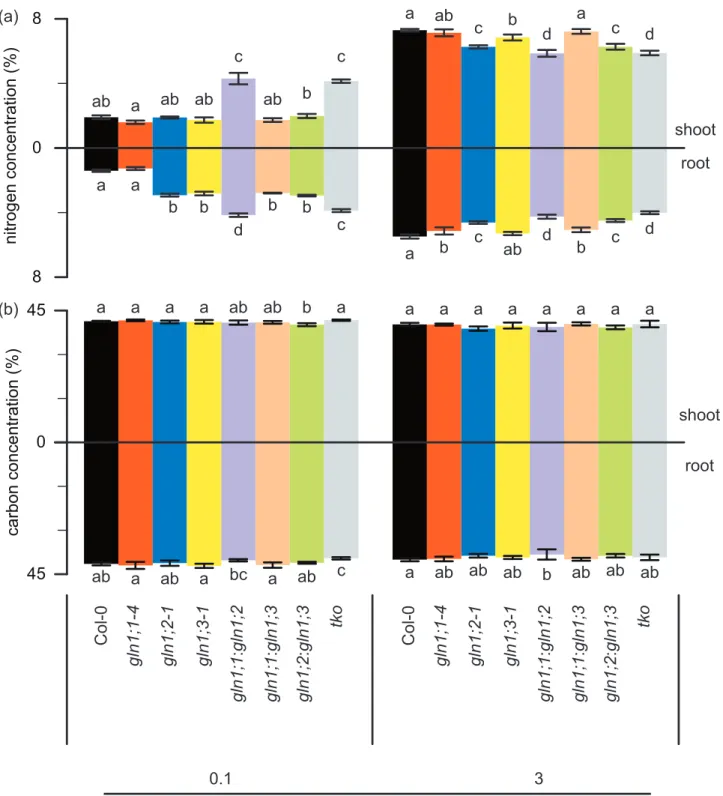
Figure 4. Ammonium-dependent nitrogen and carbon concentrations in roots and shoots of wild type and gln1 mutants
Nitrogen (a) and carbon (b) concentrations in shoots and roots of the wild type (Col-0), GLN1 single mutants (gln1;1, gln1;2, and gln1;3), double mutants (gln1;1:gln1;2, gln1;1:gln1;3, and gln1;2:gln1;3), and triple mutant (gln1;1:gln1;2:gln1;3). Plants were grown in hydroponic culture with 0.1 or 3 mM ammonium and 10 µM nitrate for 6 weeks. Data are presented as mean ± SD (n = 6). One-way ANO-VA, followed by Bonferroni test, was performed, and significant differences at p< 0.05 within each group are indicated by different letters.
0 8 8 nitrogen concentration (% ) 0 45 45 carbon concentration (% ) ab a ab ab c ab c b a ab c b d a c d a a b b d b c b a b c ab d b d c root shoot a a a a ab ab b a a a a a a a a a ab a ab a bc a ab c a ab ab ab b ab ab ab root shoot (a) (b) ammonium concentration (mM) 3 0.1 Col-0 gln1;1-4 gln1;2-1 gln1;3-1 tk o gln1; 1: gln1; 2 gln1; 1: gln1;3 gln1; 2: gln1;3 Col-0 gln1;1-4 gln1;2-1 gln1;3-1 tk o gln1; 1: gln1; 2 gln1; 1: gln1;3 gln1; 2: gln1;3
70 70
0
total amino acid (µmo
l • gF W -1) 40 0 glutamine (µmo l • gF W -1) 40 30 0 ammonium (µmo l • gF W -1) 30 a a a a b a a c a ab b b c b c b a a a ab b ab b a a b a bc a c b root shoot ab a ab a b ab ab c a ab bc b cd b d c a a a a b b ab c b a d c de c e d root shoot a a a b a a a a a a a a a a a b a a b a c a d bc a a ab a c ab c b root shoot (a) (b) (c) ab ammonium concentration (mM) 3 0.1 Col-0 gln1;1-4 gln1;2-1 gln1;3-1 tk o gln1; 1: gln1; 2 gln1; 1: gln1;3 gln1; 2: gln1;3 Col-0 gln1;1-4 gln1;2-1 gln1;3-1 tk o gln1; 1: gln1; 2 gln1; 1: gln1;3 gln1; 2: gln1;3 0 1 1 ammonium (µmo l • gF W -1) root shoot 0 4 2 glutamine (µmo l • gF W -1) root shoot
GLN1;2, or GLN1;3 was detected in the roots under both ammonium conditions (Fig. S3). Knockout of GLN1;2 led to a decrease of GLN1;1, GLN1;4, and GLN2 (Fig. S3) un-der a low ammonium supply, suggesting the dependence of these GLN genes on GLN1;2. Interest-ingly, the GLN1;4 transcript level was highest in the tko (Fig. S3) at higher ammonium supply, suggest-ing the possible compensatory upregulation of GLN1;4 in the absence of other GLN1 genes.
Soluble proteins from roots of hydroponically grown Arabidopsis were subjected to a protein gel blot analysis using an antibody raised against rice GS1 (Ishiyama et al.
2004b) to evaluate the amount of GLN1 protein. A specific band at 40 kDa (GS1) was detected (Fig. S4); however, GS2 (44 kDa) was hardly detectable in roots. Since antibody staining showed the changes in the level of GLN1 pro-tein in knockout mutants, the band intensity was quantified using the image processing program, ImageJ. While only gln1;1:gln1;2 and tko showed significant decreases in GLN1 protein at 0.1 mM ammo-nium, in all mutants with the gln1;2 genetic background, there were always significant decreases in GLN1 protein at 3 mM ammonium, in-dicating that GLN1;2 was the major form of GLN1 protein under the higher-ammonium condition.
Nitrogen and carbon concentra-tions were determined in the single and multiple mutants (Fig. 4) under conditions with the supply of 0.1 and 3 mM ammonium to evaluate the effect of the knockout of GLN1 genes. Under the condi-tion with 0.1 mM ammonium, the nitrogen concentration in roots of mutants, except gln1;1, was higher than that of the wild type. In par-ticular, the nitrogen concentrations of gln1;1:gln1;2 and tko were not only higher in roots but also in shoots (Fig. 4a).
The nitrogen might be concen-trated in mutants, since their biomass was reduced. Under the condition with 3 mM ammonium, the nitro-gen concentration was markedly diminished in the mutants with
knockout of GLN1;2. Specifically, in the single mutant gln1;2, the double mutants gln1;1:gln1;2 and gln1;2:gln1;3, and the triple mutant tko, there were significant decreas-es in nitrogen concentration in all cases (Fig. 4a). The nitrogen con-centration in those mutants was approximately 15%–25% less than that of the wild type. Moreover, the single mutant gln1;1 and the dou-ble mutant gln1;1:gln1;3 showed significant reductions in nitrogen concentration in the roots (Fig. 4a). In contrast to the findings for the nitrogen concentration, there were few significant differences in the carbon concentration between the wild type and gln1 mutants under both low- and high-ammonium conditions (Fig. 4b).
To investigate the contribution of individual GLN1s to ammonium assimilation, the total amino acid, glutamine, and ammonium con-centrations were determined in plants (Fig. 5). Amino acid com-position is summarized in Figure S5, which depicts the impact of GLN1 on amino acid metabolism. Furthermore, to estimate the ca-pacity for ammonium assimilation in the roots, the concentrations of ammonium and glutamine were determined in xylem sap (Fig. S6). In the low-ammonium condition, total amino acid and glutamine levels of tko were significantly higher than those of the wild type (Fig. 5a and 5b). Double mutants, gln1;1:gln1;2 and gln1;1:gln1;3,
Figure 5. Triple knockout in GLN1 led to a marked accumulation of ammoni-um
The concentrations of total ami-no acids (a), glutamine (b), and ammonium (c) were measured in shoots and roots of the wild type (Col-0), GLN1 single mu-tants (gln1;1, gln1;2, and gln1;3), double mutants (gln1;1:gln1;2,
gln1;1:gln1;3, and gln1;2:gln1;3),
and triple mutant
(gln1;1:gl-n1;2:gln1;3). Plants were grown
in hydroponic culture with 0.1 or 3 mM ammonium and 10 µM nitrate for 6 weeks. Data are presented as mean ± SD (n = 3). One-way ANOVA, followed by Bonferroni test, was performed, and significant differences at p < 0.05 within each group are in-dicated by different letters.
also accumulated glutamine (Fig. 5a and 5b).
This accumulation of glutamine in tko might reflect its ammonium accumulation. Indeed, the ammo-nium concentration of tko was considerably increased, whereas gln1 single and double mutants did not show any differences from the wild type (Fig. 5c). The ammonium concentration of tko was 60 times higher in roots and 13 times
high-er in shoots than that of the wild type (Fig. 5c). Among the single mutants, gln1;2 showed marked decreases in total amino acids and glutamine (Fig. 5a and 5b). There was also a significant difference in the amino acid composition between low (Fig. S5a and S5b) and high ammonium supply (Fig. S5c and S5d). Wild type plants had a high ratio of alanine to total amino acids under the condition with 0.1 mM
ammonium. The share of alanine reached 48.3% in root and 44.5% in shoot. Aspartic acid (4.8% in root and 8.9% in shoot) and glu-tamic acid (13.8% and 20.8%) were also highly accumulated, and lysine (2.1% and 1.7%), valine (2.7% and 1.7%), and threonine (4.1% and 2.4%) levels were relatively high. Under the condition with 3 mM ammonium, glutamine was the most abundant amino acid. The
Figure 6. Localization of GLN1;1 and GLN1;4 promoter activities in roots
Transgenic plants expressing either the GLN1;1 promoter:GFP (a, c, e, h, j, and l) or the GLN1:4 pro-moter:GFP (b, d, f, g, i, k, and m) fusion gene constructs were grown for 6 weeks in hydroponic nu-trient solutions containing either 0.1 mM (a, b, e, f, g, j, and k) or 3 mM ammonium (c, d, h, i, l, and m) and 10 µM nitrate as the nitrogen sources. Whole-mount images from root tips (j–m), root hair zones (e–i), and mature parts (a–d) were taken by confocal laser scanning microscopy. Boxed areas in (f) are magnified four times in (g). ep, epidermis; co, cortex; en, endodermis, pe, pericycle. Scale bars represent 50 µm.
share of glutamine reached 61.9% in root and 41.4% in shoot. Aspar-agine (6.0% and 12.6%) and serine (6.3% and 10.5%) were also accu-mulated. Notably, arginine was highly accumulated in shoot: it rose by 11.8% in shoot under the con-dition with 3 mM ammonium. Finally, ammonium supply did not change either proline or glycine accumulation.
The amino acid composition in tko showed a great difference. With the lower supply of ammonium, its level of glutamic acid dropped from 13.8% to 5.4% in root and 20.8% to 10.2% in shoot; moreover, as-partic acid dropped from 4.8% to 3.9% in root and 8.9% to 6.5% in shoot in tko. The proportions of lysine, valine, and threonine were all decreased in tko. Conversely, the proportions of serine and glu-tamine were increased. Serine in-creased from 4.7% to 7.4% in root
GLN1;4 +/ + +/ - -/-GLN1;2 -/- +/-+/+ 0 0 0 5 41 3 78 0 4 total 182 plants GLN1;2 GLN1;3 GLN1;4 GLN1;1 UBQ2 wild-type line 98’ GLN1;4 +/+ +/- -/-GLN1;2 -/- +/-+/+ 0 0 0 7 73 3 99 1 0 total 183 plants (a) (b) (c) Supplemental Figure S1. Segregation of T-DNA in-sertion in GLN1;2 and
GLN1;4
The segregation of T-DNA in-sertion in the F2 generation of the line obtained from crossing between gln1;2 and gln1;4 (a). RT-PCR analysis (b) and prog-eny test (c) of the self-propagation of line 98’. Genotypes of GLN1;2 and GLN1;4 were confirmed by PCR analysis with gene-specific primers. The symbol “+” indicates no T-DNA insertion, while “–” indicates T-DNA insertion in either GLN1;2 or GLN1;4.
Col-0 gln1; 1 gln1; 2 gln1;1:gln1; 2 Col-0 gln1; 2 gln1; 3 gln1;2:gln1;3 gln1; 1 gln1;1:gln1;2 gln1;1:gln1;3 tko 0.1 3 100 80 60 40 20 0 20 40 60 80 100 Col-0 gln1; 1 gln1; 3 gln1;1:gln1; 3 gln1; 2 gln1;1:gln1; 2 gln1;2:gln1; 3 tk o FW ratio (% ) 80 60 40 20 0 20 40 60 80 100 100 80 60 40 20 0 20 40 60 80 100 100 80 60 40 20 0 20 40 60 80 100 100 80 60 40 20 0 20 40 60 80 100 100 80 60 40 20 0 20 40 60 80 100 Col-0 gln1; 1 gln1; 3 gln1;1:gln1; 3 gln1; 2 gln1;1:gln1; 2 gln1;2:gln1; 3 tk o gln1; 1 gln1;1:gln1;2 gln1;1:gln1;3 tko gln1; 3 gln1;1:gln1; 3 gln1;2:gln1; 3 tk o gln1; 3 gln1;1:gln1; 3 gln1;2:gln1; 3 tk o Col-0 gln1; 1 gln1; 2 gln1;1:gln1; 2 Col-0 gln1; 2 gln1; 3 gln1;2:gln1;3 shoot root FW ratio (% ) shoot root FW ratio (% ) shoot root FW ratio (% ) shoo t root FW ratio (% ) shoot root FW ratio (% ) shoot root s s s s s s a a s s e e s s/a e s/e nd s s s s s/a a a ammonium (mM) 0.1 3 ammonium (mM) (a) (b) (c) (d) (e) (f)
and 7.7% to 23.8% in shoot, while glutamine increased from 6.5% to 11.5% in root and 4.0% to 17.4% in shoot in tko. Under the high-er-ammonium condition, the proportions of glutamine and as-paragine in tko were lower than those of the wild type. Glutamine decreased from 61.9% to 14.1% in root and 41.4% to 15.4% in shoot, while asparagine dropped from 6.0% to 3.4% in root and 12.6% to 4.4% in shoot in tko. Conversely, the proportion of ala-nine in tko was higher than that in the wild type. The proportion of arginine in shoot was also lower in tko.
Xylem sap analysis suggested that GLN1;1 and GLN1;2 contribute to the ability of roots to perform ammonium assimilation (Fig. S6) because the ammonium
concen-tration of xylem sap was increased in gln1;1:gln1;2 and tko. The con-centrations of ammonium in gl-n1;1:gln1;2 and tko were signifi-cantly higher than those of the wild type under all ammonium concen-tration conditions tested. Converse-ly, the concentration of total amino acid, especially glutamine, was decreased in gln1;2, gln1;1:gln1;2, and tko (Fig. S6b and S6c).
The promoter activities of GLN1;1 were localized in surface cell layers, and GLN1;4 was strongly expressed in the pericycle of basal parts of lateral roots
Figure 6 illustrates the localization of GLN1;1 and GN1;4 promoter activities under low- and high-am-monium conditions. The promot-er activities of GLN1;1 wpromot-ere local-ized in the epidermis, cortex, and root tip under low ammonium concentrations (Fig. 6a, e, and j). The GLN1;1 promoter-dependent GFP signal was also observed in the endodermis in the mature regions of the root (Fig. 6a). With increas-ing ammonium concentration, GLN1;1-dependent signals disap-peared from the endodermis of mature regions and the cortex of elongating regions (Fig. 6c and 6h). Under low-ammonium conditions, GLN1;4 promoter activities were localized in the pericycle of basal regions of lateral roots (Fig. 6b) and were also observed in the pericycle
of elongating regions (Fig. 6f and 6g). GLN1;4-dependent GFP sig-nal was not detected at the root tip (Fig. 6k and 6 m). These GLN1;4 promoter activities disappeared under the high ammonium supply (Fig. 6d and 6i).
Discussion
Glutamine synthetase genes are part of a multi-gene family in the genome of most plant species. Their products, GLN1 and GLN2, are categorized by their subcellular localization (Thomsen et al. 2014). Analysis of plant genome sequenc-es has revealed five GLN1 homologs in Arabidopsis, three in rice, five in maize, seven in wheat, and 16 in Brassica napus (Orsel et al. 2014). Substantial research in recent years has focused on the job-sharing of GLN1 genes to understand the links between nitrogen-related nutrition and plant growth. We describe here a reverse-genetic approach and promoter analysis in roots to iden-tify the organization and contribu-tion of GLN1 isozymes to ammo-nium assimilation in Arabidopsis roots.
Among the six GLN genes in Arabidopsis, GLN1;1, GLN1;2, GLN1;3, and GLN1;4 were highly expressed in roots (Ishiyama et al. 2004b). Nitrogen deficiency led to the upregulation of GLN1;1, GLN1;3, and GLN1;4 in roots (Konishi et al. 2017, Figure S3). A previous biochemical study indi-cated that recombinant proteins of
Supplemental Figure S2. Comparison of biomass in knockout lines for GLN1
The biomass data shown in Fig. 3 were arranged to interpret the synergistic interaction in double mutants. Plants were grown in a hydroponic culture with 0.1 or 3 mM ammonium and 10 µM nitrate for 6 weeks. The level of biomass relative to that in the wild type is shown. Com-parison of single mutants and double mutants (a, c, and e), and comparison of double mutants and triple mutant (b, d, and f). The double mutant phenotype can be considered as additive (a), epistatic (e), or synergistic (s).
0 4 nd nd nd nd nd nd nd nd ab ab b a a a a a relative expression 0 a a b a a b ab b ab ab ab a a b ab c relative expression 0 1 nd nd nd nd nd nd nd nd nd nd nd nd nd nd nd nd relative expression 0 0.1 ab ab b c a c ab c a ab ab ab ab ab ab b relative expression ammonium concentration (mM) 3 0.1 0 0.5 relative expression a ab b nd a a a a nd nd nd nd nd nd nd ab 0 1
relative expression (GLN1;1 / UBQ2
) a nd b a ab nd nd nd a nd a a nd nd a nd 2.5 Col-0 gln1;1-4 gln1;2-1 gln1;3-1 tk o gln1; 1: gln1; 2 gln1; 1: gln1;3 gln1; 2: gln1;3 (GLN1;2 / UBQ2 ) (GLN1;3 / UBQ2 ) (GLN1;4 / UBQ2 ) (GLN1;5 / UBQ2 ) (GLN2 / UBQ2 ) Col-0 gln1;1-4 gln1;2-1 gln1;3-1 tk o gln1; 1: gln1; 2 gln1; 1: gln1;3 gln1; 2: gln1;3
both GLN1;1 and GLN1;4 had high-affinity to ammonium (Ishi-yama et al. 2004b), suggesting a contribution of these two GLN1 isozymes to efficient ammonium assimilation in roots under nitro-gen-limited conditions. However, neither single mutants for GLN1;1 and GLN1;4 nor the double mutant for these two GLN1 isozymes showed a reduction in biomass under ammonium-limited conditions (Fig. 1), suggesting that the GLN1 genes have redundant functions in ammonium assimilation in roots. Indeed, none of the gln1 single mutants (gln1;1, gln1:2, gln1;3, and gln1;4) showed notable phenotyp-ic changes under low ammonium
concentrations (Figs. 3, S3, 4, and 6). These results indicate that, in a single mutant of GLN1, compen-sation by other GLN1 isozymes could occur; thus, low concentrations of ammonium are probably assim-ilated by the redundant functions of GLN1 isozymes in Arabidopsis roots. It was surprising that the high-affinity GLN1;1 could be compensated for by the low-affin-ity GLN1;2 and GLN1;3. The concentration of free ammonium in roots may account for this com-pensation. The ammonium con-centration of all knockout lines ranged from 0.5 to 1 mM, except that of tko (Fig. 5c). Previous work suggested that the affinity constants (Km) of GLN1;2 and GLN1;3 for ammonium are 2.5 and 1.2 mM, respectively (Ishiyama et al. 2004b), suggesting a possible contribution of these two GLN1 isozymes to the ammonium assimilation in the lower-ammonium condition pre-sented in this study. A hydroponic culture solution containing ammo-nium at a concentration below 0.1 mM might reduce the effects of GLN1;2 and GLN1;3 to reveal those of GLN1;1 and GLN1;4. However, it would not be possible to conduct such a culture because 1) plants would suffer from severe nitrogen starvation and 2) the ni-trogen starvation would trigger the degradation of nitrogen compounds to maintain the ammonium con-centration (Bittsanszky et al. 2015). In both of these cases, it is likely
that the functions of GLN1;1 and GLN1;4 would not be revealed. Therefore, the generation of mul-tiple mutants is a powerful tool to investigate the function of specific GLN1 enzymes.
Amino acid analysis indicated that a loss of function in GLN1 led to an imbalance of amino acid composition. The wild type accu-mulated Ala under the condition with 0.1 mM ammonium (Fig. S5). Pyruvate is one of the sources for Ala and Val synthesis (Hirai et al. 2004), and it is also one of the sources for the TCA cycle. Ammo-nium assimilation depends on 2-oxoglutarate, one of the compo-nents of the TCA cycle. The increase of Ala under the condition with low ammonium might have reflect-ed the lower demand for pyruvate from the TCA cycle. Similar to Ala, Val was accumulated under the condition with 0.1 mM ammoni-um. Moreover, the wild type accu-mulated Gln, Asn, Ser, and Arg (Fig. S5) in 3 mM ammonium. These changes in amino acid levels were similar to those described in a previous work (Lemaire et al. 2008). Another study reported that a higher ammonium supply increas-es Gln (Konishi et al. 2014 and Kojima et al. 2014). Under high-ni-trogen conditions, the increase of asparagine follows the increase of glutamine (Lea et al. 2007). The arginine molecule contains four nitrogen atoms and acts as a nitro-gen reservoir (Lemaire 2008).
Supplemental Figure S3. Ammonium-dependent
GLN1 gene expression in
roots of the triple mutant (tko)
GLN1;1, GLN1;2, GLN1;3, GLN1;4, GLN1;5, and GLN2
mRNA abundance in roots of the wild type or mutants was quantified by qPCR. Plants were grown in hydroponic culture solution containing either 0.1 or 3 mM ammonium as the major nitrogen source for 6 weeks.
UBQ2 was used to standardize
the signal intensity. Data are presented as mean ± SD (n = 3–4).
One-way ANOVA, followed by Bonferroni test, was used, and significant differences at p < 0.05 within each group are indicated by different letters. nd indicates not detectable.
Triple mutations in GLN1 led to decreases of Glu, Asp, Lys, Val, and Thr (Fig. S5) at 0.1 mM ammoni-um. Nitrogen starvation was also reported to increase the levels of
these amino acids (Krapp et al. 2011). Therefore, it can be assumed that a decrease of Gln synthesis in the triple mutant triggers severe nitrogen starvation. Interestingly,
the triple mutant accumulated Gln at 0.1 mM ammonium. The lack of Gln synthesis probably inhibits the other amino acids, including Glu, since the synthesis of other
GS1
100 200 0 100 200relative signal intensit
y ab abc abc a bc abc abc c a a a a b b b b ammonium concentration (mM) 3 0.1 Col-0 gln1;1-4 gln1;2-1 gln1;3-1 tk o gln1; 1: gln1; 2 gln1; 1: gln1; 3 gln1; 2: gln1; 3 Col-0 gln1;1-4 gln1;2-1 gln1;3-1 tk o gln1; 1: gln1; 2 gln1; 1: gln1; 3 gln1; 2: gln1; 3
MemCode
stain
Supplemental Figure S4. The accumulation of GLN1 protein in roots of the triple mutant (tko)
The accumulation of GS1 protein in roots was determined using protein gel blot analysis. The protein concentrations were determined by the Bradford assay (Bradford 1976). Equal amounts of protein (4 µg) were separated by SDS-PAGE and blotted onto the membrane. Antibodies raised against recom-binant rice GS1 were used for staining. The membrane was stained with MemCodeTM Reversible Protein Stain as a loading control. The analysis was repeated three times. The signal intensities were quantified using the software Image J (Abramoff et al. 2004). The signal intensities were standardized by that of the wild type.
One-way ANOVA, followed by Bonferroni test, was used, and significant differences at p < 0.05 with-in each group are with-indicated by different letters. nd with-indicates not detectable.
amino acids is dependent on the GS/GOGAT cycle. Because of the inhibition of ammonium assimila-tion in tko, plants might suffer from ammonium toxicity upon a low ammonium supply. Indeed, tko accumulated much more ammo-nium than the wild type (Fig. 5).
At higher ammonium, the concen-trations of Gln and Asn in the triple mutant were lower than those in the wild type. This again indicates that Asn synthesis requires Gln in plants (Ohashi et al. 2015).
Under the higher ammonium condition, the expression of GLN1;1,
GLN1;3, and GLN1;4 was decreased, while that of GLN1;2 was increased. Previous articles described the es-sential role of GLN1;2 at an am-monium supply above a concen-tration of 1 mM (Lothier et al. 2011, Guan et al. 2016, Konishi et al. 2017). Our previous work
0 70 0 70 0 70 0 70
Amino acid (as % of total)
Amino acid (as % of total)
Amino acid (as % of total)
Amino acid (as % of total)
Asn Ser Gln Arg Gly Asp Glu Thr Ala Pro Lys Val others
0.1 mM ammonium; root 0.1 mM ammonium; shoot 3 mM ammonium; root 3 mM ammonium; shoot * * * * * * * * * * * * * * * * * * * * * * * * * * * * * * * * * * * **** * ** * * * * * * * * * * * * * * * * * * * * * * * * * * * * * * * * ** * * ** * * ** * * * * * * * * * * * * * * * * * * * * * ** * * * * ** * * * * * * * * * * * * * * * * * * * * ** * * Col-0 gln1;1-4 gln1;2-1 gln1;3-1 tko gln1;1:gln1;2 gln1;1:gln1;3 gln1;2:gln1;3 (a) (b) (c) (d)
Supplemental Figure S5. Amino acid composition in shoots and roots of knockout lines for GLN1 under low- and high-ammonium conditions
The concentrations of amino acids were measured in shoots (b and d) and roots (a and c) of wild type (Col-0), GLN1 single mutants (gln1;1, gln1;2, and gln1;3), double mutants (gln1;1:gln1;2, gln1;1:gln1;3, and gln1;2:gln1;3), and the triple mutant (gln1;1:gln1;2:gln1;3). Plants were grown in a hydroponic culture with 0.1 (a and b) or 3 mM ammonium (c and d) and 10 µM nitrate for 6 weeks. Data are pre-sented as mean ± SD (n = 3). One-way ANOVA, followed by Bonferroni test, was performed, and signif-icant differences at p < 0.05 within each group are indicated by different letters.
9 0 ammonium (mM) 9 0 glutamine (mM) 10 0
total amino acid (mM)
ammonium concentration (mM) 3 0.1 1 a a a c a ab b c a a b c a a a b b a c d a b c d a a a b b a c d a b c d b c d a d d ab d e Col-0 gln1;1-4 gln1;2-1 gln1; tko 1: gln1;2 (a) (b) (c) Col-0 gln1;1-4 gln1;2-1 gln1; tko 1: gln1;2 Col-0 gln1;1-4 gln1;2-1 gln1; tko 1: gln1;2
Supplemental Figure S6. Amino acid and ammonium concentrations in xylem sap harvested from knockout lines for GLN1
The concentrations of ammonium (a), glutamine (b), and total amino acids (c) were measured in xylem sap of wild type (Col-0), GLN1 single mutants (gln1;1 and gln1;2), double mutants (gln1;1:gln1;2), and triple mutant (gln1;1:gln1;2:gln1;3, tko). Plants were grown for 42 days in a nutrient solution containing 2 mM ammonium nitrate and transferred to a nutrient solution without nitrogen. After 3 days, the plants were again transferred to a nutrient solution containing 0.1, 1, or 3 mM ammonium and 10 µM nitrate. After 24 h, plants were excised, and xylem sap was collected. Bars indicate mean ± standard deviation (SD) (n = 4). One-way analysis of variance (ANOVA), followed by Bonferroni test, was used, and significant differences at p < 0.05 within each group are indicated by different letters.
also showed the contribution of GLN1;2 upon a higher ammonium supply in hydroponic culture
(Kon-ishi et al. 2017). The addition of nitrate to the hydroponic nutrient solution could alleviate the
toxici-ty of ammonium at a higher con-centration (Fig. S6). The knockout in GLN1;2 led to a decrease in biomass, while neither gln1;1 nor gln1;3 showed a difference (Fig. 3). However, gln1;1:gln1;2 showed considerable decreases in biomass (Fig. 3), nitrogen concentration (Fig. 4), and glutamine (Fig. 5), which were lower than those in gln1;2. These phenotypes found in this study were consistent with those observed in previous work (Guan et al. 2016). For example, Guan et al. (2016) reported that GLN1;1 supports GLN1;2 for overcoming the toxic effects of excessive levels (20 mM) of ammonium in Arabi-dopsis shoot. The double mutant gln1;1:gln1;3 showed significant decreases in fresh weight (Fig. 3) and also in glutamine concentration (Fig. 5). These results indicate that GLN1;2 can compensate for the single mutant in either GLN1;1 or GLN1;3, but not for their double mutant, suggesting that the con-tributions of GLN1;1 and GLN1;3 to ammonium detoxification in Arabidopsis roots are not negligible, although GLN1;2 shows the larg-est contribution.
The contributions of GLN1;1, GLN1;2, and GLN1;3 to biomass as determined in single mutants were not the same as those deter-mined in the comparison between single mutants and double mutants or those determined in the com-parison between double mutants and the triple mutant (tko; Fig. S2).
Supplemental Figure S7. A small amount of nitrate alleviated the ammonium toxicity in hydroponic culture
Wild type plants were grown in a hydroponic solution containing various concentrations of ammonium (0.1, 0.3, 1, 3, and 5 mM) with or without 10 µM nitrate for 6 weeks. Fresh weights without (orange-red column) and with nitrate (blue column). Bars indicate mean ± SD (n = 3–6). Significant differences between with nitrate condition and without nitrate condition, identified by Student’s t-test, are marked with asterisks: *p < 0.05 and ***p < 0.005; n.s. indicates not significant.
The contribution of GLN1;1 and GLN1;2 in single mutants amount-ed to 0%–20% of that of the wild type, but this increased to 40%–60% in the double mutant under low-er-ammonium conditions. In the knockout lines with an insertion in GLN1;3, the contributions of GLN1;1 and GLN1;2 amounted to 10%–35% of that of gln1;3, which increased to 65%–80% in the tko, suggesting the synergistic interactions of GLN1;1 and GLN1;2. Double mutation in GLN1;1 and GLN1;2 increased the nitrogen concentration upon a low ammo-nium supply, in both gln1;1:gln1;2 and tko (Fig. 4). This might be partially explained by the decrease of biomass or the potential upreg-ulation of ammonium uptake in both mutants. Recently, it was suggested that there is a link between the response of GLN1;2 and am-monium uptake capacity (Yasuda et al. in press). Interestingly, not only GLN1;1–GLN1;2 but also GLN1;2–GLN1;3 and GLN1;1– GLN1;3 showed synergistic inter-actions under low-ammonium conditions, suggesting the func-tional redundancy of these GLN1 isozymes in roots upon a low sup-ply of ammonium. Since there was no obvious upregulation of mRNA levels in the knockout lines (Fig. S3), the compensation of GLN1 at the transcriptional level could be ruled out to explain the growth of single mutants. Thus, post-transla-tional regulation might be
respon-sible for their synergistic effect. GLN1;1, GLN1;2, and GLN1;3 have been shown to interact with each other to form homo- and heterodecamers (Dragicevic et al. 2014). Furthermore, GLN1 proteins have been found to be regulated by post-translational modifications (Li et al. 2006). Thus, future work should focus on the post-transla-tional regulation of GLN1 proteins to understand the mechanism behind the synergistic interactions of GLN1. Promoter analysis indicated that GLN1;2, with support from GLN1;1, is responsible for assimilating am-monium within the outer cell layers of the root (Fig. 6, Konishi et al. 2017). This overlapping ex-pression of GLN1;1 and GLN1;2 suggests that root surface cell layers are crucial sites for ammonium assimilation. Arabidopsis root ex-presses ammonium transporter to transport ammonium from the environment into root cells (Yuan et al. 2007).
AMT1 isozymes, AMT1;1, AMT1;2, AMT1;3, and AMT1;5, contribute to 95% of the ammo-nium acquisition under nitrogen-de-ficient conditions at the surface cell layers in the roots (Yuan et al. 2007). The localization of AMT1 was re-ported to overlap well with that of GLN1;1 and GLN1;2 (Yuan et al. 2007), suggesting that GLN1;1 and GLN1;2 could assimilate am-monium after uptake through AMT1s in the root surface cell layers.
Promoter analysis also indicated that GLN1;3 and GLN1;4 could assimilate the ammonium concen-trated in the pericycle (Fig. 6, Konishi et al. 2017). The ammo-nium accumulation in tko was higher than that in gln1;1:gln1;2 (Fig. 5c), which allows estimation of the function of GLN1;3. Previ-ously, we showed that GLN1;3 contributes to growth and glutamine loading to xylem sap under low-am-monium conditions (Konishi et al. 2017). Consistently, this work shows the higher ammonium accumulation in tko than in gln1;1:gln1;2, sug-gesting the contribution of GLN1;3 to ammonium assimilation around the pericycle. Neither single nor double mutants of GLN1;4 showed notable differences in growth (Figs. 1 and 2); however, several lines of evidence indicated the physiologi-cal function of GLN1;4: 1) tko was not lethal but could grow and achieve 25% of the fresh weight of the wild type (Fig. 3); 2) the ex-pression of GLN1;4 was increased in roots of tko (Fig. 5); and 3) GLN1;4 promoter activity was found in the pericycle in low-am-monium conditions (Fig. 6). These results demonstrate the potential contribution of GLN1;4 and GLN2 to ammonium assimilation around the pericycle under nitrogen-defi-cient conditions.
Interestingly, neither gln1;2:gln1;4 nor gln1;1:gln1;3:gln1;4 was isolat-ed (Fig. S1). Although the germi-nation of the selfed progeny of
gln1:2 (+/-):gln1;4 (+/-) and line 98’ was not influenced, the segre-gation ratio did not follow Mendel’s law of inheritance in both lines. The P values of the chi-square tests
were 3.19 × 10−42 and 7.66 × 10−107,
respectively (Fig. S1). These results indicate the potential contribution of GLN1;4 in the reproductive stage. In future, it will be necessary to investigate the detailed functions of GLN1;4 for the productivity of Arabidopsis.
Methods
Isolation of knockout lines for GLN1;1 and GLN1;4
The Arabidopsis thaliana accession line Columbia (Col-0) was used as the wild type. The following knock-out lines in the Col-0 genetic background were also used: gln1;1-4 (AT5G37600; GABI_265C09), gln1;4-1 (AT5G16570; SALK_042546), gln1;4-2 (SALK_007138), gln1;2-1, and gln1;3-1 (Konishi et al. 2017). Knockout lines for GLN1;1 and GLN1;4 were obtained from the Arabidopsis Biological Resource Center, self-fertilized, and selected for T-DNA homozygous plants. The T-DNA insertions were deter-mined by genomic PCR using primers for gln1;1-4, GLN1;1 cDNA F2 (5’ - CAT CAA CCT TAA CCT CTC AGA CT - 3’), GLN1;1 cDNA R2 (5’ – TCT GCA ATC ATG GAA GTG ACA AT - 3’), and GABI T-DNA LB o8409 (5’ – ATA TTG ACC ATC ATA CTC ATT GC - 3’); for gln1;4-1, gln1;4 042546 F2 (5’
– GGT TTC GTA TAG AGC ATA AAG G - 3’), gln1;4 042546 R3 (5’ – TTT GAT CGC TGG GAG AAG TT - 3’), and T-DNA LB-01 (Kon-ishi et al. 2017); and for gln1;4-2, gln1;4 genome 117504 F (5’ – GGA GTT GGA GCA GAC AAA GC - 3’), gln1;4 genome 117504 R (5’ – AAG CTG GCC TAC GAT CTT CA - 3’), and T-DNA LB-01.
Isolation of multiple-knock-out lines for GLN1 genes
gln1;1-4 and gln1;2-1 or gln1;3-1 and glngln1;3-1;4-gln1;3-1 were crossed, and double mutants (gln1;1:gln1;2 and gln1;3:gln1;4) were isolated. More-over, gln1;1:gln1;2 and gln1;3:gln1;4 were crossed, and the double- (gl-n1;1:gln1;3) and triple-knockout lines (gln1;1:gln1;2:gln1;3) and line 98’ [gln1;1:GLN1;2 (+/-):gl-n1;3:GLN1;4 (+/-)] were isolated. T-DNA insertion types were deter-mined by genomic PCR by using primers for gln1;1-4 (as aforemen-tioned), gln1;2-1; gs1;2-1 -2 mutant genome F (5’ – GGT TGG TGG TTC TGG TAT GGA CAT GAG – 3’), gs1;2-1 mutant genome R (5’ – ACT TCA GCA ATA ACA TCA GGG TTA GCA – 3’), T-DNA LB-01, gln1;3-1; gln1;3-1 mutant genome F3 (5’ – CGC CGG TAT TGG TAT TTC TG – 3’), gln1;3-1 mutant genome R3 (5’ – CAG CTG AAG CTT CCC TAT CG – 3’), T-DNA LB-01, and gln1;4-1 (as aforemen-tioned). Multiple-knockout lines were selected from self-fertilized F2 generation plants. The isolation of
gln1;2:gln1;3 was as described previously (Konishi et al., 2017).
gln1;2-1 and gln1;4-1 were crossed, self-fertilized, and the T-DNA in-sertion types were determined by genomic PCR. The T-DNA inser-tion types were determined by genomic PCR in the F2 plants of line 98’. Plants were grown on agar plates containing half-strength Murashige and Skoog medium (Murashige and Skoog, 1962) for 3 to 4 weeks. Genomic DNA was prepared from leaf samples. Hydroponic culture
Hydroponic culture and plant harvesting were performed in ac-cordance with the method of Konishi et al. (2017). Plants were grown in nutrient solution with
0.1 or 3 mM NH4Cl and 10 µM
KNO3 for 6 weeks. Plants (34 plants
per line, 8 genotypes) were precul-tured in a plastic container filled with 8 L of nutrient solution. Plants were transferred to a black acrylic resin plate from the preculture containers at 25 days after sowing. Plants were grown in a climate chamber under the following en-vironmental conditions (Biotron LPH-350S; Nippon Medical and Chemical Instruments Co., Ltd., Tokyo, Japan): 10 h/14 h light/ dark, 22 °C, 60% humidity, and
160 µmol m−2 s−1 light intensity.
The size of the tanks after the pre-culture was 0.8 L, and six to eight plants were transferred from the preculture. The composition of the
nutrient solution was described by Loqué et al. (2006) with modifica-tions; it was buffered with 5 mM 2-(N-morpholino)ethanesulfonic acid (MES) adjusted to a pH of 5.8
with KOH, and 2 mM NH4NO3
was removed to be replaced with
10 µM KNO3 and various
concen-trations of NH4Cl. We added a
small amount of nitrate to alleviate the detrimental effects of pure ammonium nutrition.
Quantitative real-time (q) PCR analysis and reverse transcription (RT)-PCR anal-ysis
RNA extraction, reverse transcrip-tion, qPCR, and RT-PCR analysis were performed in accordance with the work of Konishi et al. (2017). Plants were grown hydroponically in nutrient solution with 0.1 or 3
mM NH4Cl and 10 µM KNO3 for
6 weeks.
Gene-specific primers for GLN1;2, GLN1;3, GLN1;4, GLN2, and ubiquitin2 (UBQ2; AT2G36170) were prepared following the meth-od of Konishi et al. (2017). For RT-PCR, GLN1;2-specific primers were Gln1;2RF (5’ – TGT TAA CCT TGA CAT CTC AGA CAA CAG T – 3’, Ishiyama et al. 2004b) and NK124 (5’ – CGG ATC ATC CTT TCA AGG GTT CCA GAG GAG – 3’, Konishi et al. 2017).
The GLN1;1-specific primer pair was gln11-4_qRTPCR_F3 (5’ – AAA CAA CAT TCT TGT CAT GTG C – 3’) and gln11-4_qRTPCR_R3 (5’
– GCA GGC CTT GTA GTG AGA ATC AAC AAC – 3’).
For RT-PCR, the GLN1;1-spe-cific primer pair was GLN1;1 cDNA F2 (5’ – CAT CAA CCT TAA CCT CTC AGA CT – 3’) and GLN1;1 cDNA R2 (5’ – TCT GCA ATC ATG GAA GTG ACA AT – 3’). For GLN1;4, the specific primer pair was GS1;4F (5’ – ATG TCT TCA CTT GCA GAT TTA ATC A – 3’) and GS1;4R (5’ – TCA TGG TTT CCA AAG GAT TGT GGA T – 3’). GLN1;2-, GLN1;3-, GLN2-, and UBQ2-specific primers were prepared following the method of Konishi et al. (2017).
Serial fivefold dilution of cDNAs was used to calculate the standard curve and measure the amplification efficiency for each target and refer-ence gene with LightCycler® 480 Software version 1.2.
Western blotting
Frozen whole-root samples were homogenized in four volumes of GS extraction buffer (Ishiyama et al. 2004b and Saito et al. 2017) using a mortar and pestle. The homogenates were centrifuged at 20,000 × g for 30 min at 4 °C. Soluble protein content was deter-mined by the Bradford method (Bradford, 1976). Soluble proteins were separated by SDS-PAGE in a 12.5% (w/v) polyacrylamide gel and transferred to a polyvinylidene difluoride membrane (Bio-Rad, Hercules) by electroblotting. West-ern blot analysis was carried out
against 4 µg of total soluble protein extracted from the root. The mem-brane was incubated with anti-GS1 polyclonal antibody (Ishiyama et al. 2004b) and ECL Rabbit IgG (HRP-linked whole Ab from don-key; GE Healthcare Life Sciences, Marlborough). The ECL prime western blotting detection system (GE Healthcare Life Sciences, Marlborough) was used for detec-tion. Signals were captured by an Image Quant 400 (GE Healthcare Life Sciences, Marlborough). The membrane was stained with Mem-CodeTM (Thermo Scientific) Reversible Protein Stain as a load-ing control. Signal intensities were quantified with ImageJ (Abramoff et al. 2004).
Nitrogen and carbon content Plants were grown hydroponical-ly in a nutrient solution with 0.1
or 3 mM NH4Cl and 10 µM KNO3
for 6 weeks. Shoot or root samples were air-dried at 80 °C for 4–7 days and weighed with an electronic balance (XS Analytical Balances; Mettler-Toledo International Inc., Columbus). Dried samples were powdered with a Tissue Lyser II (Qiagen, K.K., Tokyo, Japan). Approximately 1-mg aliquots were weighed with an ultra-microbalance (UMX2; Mettler Toledo Interna-tional Inc., Tokyo, Japan) and wrapped in tin foil. The determi-nation of total carbon and nitrogen contents was performed, as described previously (Konishi et al. 2017).
Measurement of free amino acids and ammonium
Plants were grown hydroponical-ly in a nutrient solution with 0.1
or 3 mM NH4Cl and 10 µM KNO3
for 6 weeks. Free amino acids and ammonium were extracted from frozen shoot or root samples. The methods of extraction, purification, derivatization, and measurement were followed as described previ-ously (Konishi et al. 2017). Cellular localization of GLN1;1 and GLN1;4 promoter activ-ities
The GLN1;1 promoter-GFP lines and GLN1;4 promoter-GFP lines originated from our previous study (Ishiyama et al. 2004b). Plants were grown in a hydroponic culture containing 0.1 or 3 mM ammoni-um and 10 µM nitrate as nitrogen sources for 6 weeks. Laser scanning confocal microscopy was performed with a Nikon C1si system. Details are as described previously (Konishi et al. 2017).
Xylem sap collection
Plants were grown hydroponical-ly in nutrient solutions for 42 days (Loqué et al. 2006) and transferred to hydroponic solutions containing 0.1 or 3 mM ammonium and 10 µM nitrate as nitrogen sources. The hypocotyls were excised with a razor (Feather Safety Razor Co., Ltd., Osaka, Japan) at 3 days after
transfer. Bleeding sap was then collected in a mounted silicon tube (internal diameter 1 or 1.5 mm; Asone Corporation, Osaka, Japan) for 20–30 min. Xylem collection started at 3 h after the light period. Xylem sap was stored at −80 °C. The concentrations of amino acids and ammonium were determined by UPLC (Nihon Waters K.K., Tokyo, Japan).
Statistics
All data sets were analyzed using Microsoft Excel add-in software (Social Survey Research Information Co., Ltd., Tokyo, Japan).
Funding:
JSPS KAKENHI Grant Numbers 21688006 and 26450073 to SK supported this work.
The present study was supported by a Grant-in-Aid of Tohoku Uni-versity’s Division for Interdisciplin-ary Advanced Research and Edu-cation.
Disclosures
Conflicts of interest: No conflicts of interest are declared.
Acknowledgments
We are grateful to Mrs. Ikumi Sakurada-Enomoto for technical assistance and to Dr. Hiroyuki Ishida for help with the microsco-py.
References
Abramoff, M.D., Magalhaes, P.J. and Ram, S.J. (2004) Image processing with ImageJ. Biophot. Inter. 11(7): 36-42.
Andrews, M., Raven, J.A. and Lea, P.J. (2013) Do plants need nitrate? The mechanisms by which nitro-gen form affects plants. Ann. Appl. Biol. 163: 174-199. Bittsanszky, A., Pilinszky, K.,
Gyu-lai, G. and Komives, T. (2015) Overcoming ammonium toxici-ty. Plant Sci. 231: 184-190. Bradford, M.M. (1976) Rapid and
sensitive method for quantitation of microgram quantities of protein utilizing principle of protein-dye binding. Anal. Biochem. 72: 248-254.
Britto, D.T. and Kronzucker, H.J.
(2002) NH4+ toxicity in higher
plants: a critical review. J. Plant Physiol. 159: 567-584.
Chardon, F., Noël, V. and Mas-claux-Daubresse, C. (2012) Ex-ploring NUE in crops and in Arabidopsis ideotypes to improve yield and seed quality. J. Exp. Bot. 63: 3401-3412.
dos Santos, I.L., de Oliveira, A.D., de Figueiredo, C.C., Malaquias, J.V., dos Santos, J.D.G., Ferreira,
emissions from long-term agro-ecosystems: Interactive effects of rainfall seasonality and crop ro-tation in the Brazilian Cerrado. Agr. Ecosyst. Environ. 233: 111-120.
Dragicevic, M., Todorovic, S., Bogdanovic, M., Filipovic, B., Music, D. and Simonovic, A. (2014) Knockout mutants as a tool to identify the subunit com-position of Arabidopsis glutamine synthetase isoforms. Plant Physi-ol. Biochem. 79: 1-9.
Goodall, A.J., Kumar, P. and Tobin, A.K. (2013) Identification and expression analyses of cytosolic glutamine synthetase genes in barley (Hordeum vulgare L.). Plant Cell Physiol. 54: 492-505. Guan, M., Møller, I.S. and
Schjør-ring, J.K. (2015) Two cytosolic glutamine synthetase isoforms play specific roles for seed germi-nation and seed yield structure in Arabidopsis. J. Exp. Bot. 66: 203-212.
Guan, M., de Bang, T.C., Pedersen, C. and Schjørring, J.K. (2016) Cytosolic glutamine synthetase Gln1;2 is the main isozyme con-tributing to GS1 activity in Arabidopsis shoots and can be up-regulated to relieve ammoni-um toxicity. Plant Physiol. 171: 1921-1933.
Guan, M. and Schjørring, J.K. (2016) Peering into the separate roles of root and shoot cytosolic glutamine synthetase 1;2 by use of grafting experiments in Arabi-dopsis. Plant Signal. Behav. 11. Hachiya, T., Watanabe, C.K.,
Fu-jimoto, M., Ishikawa, T., Taka-hara, K., Kawai-Yamada, M., et al. (2012) Nitrate addition alle-viates ammonium toxicity with-out lessening ammonium accu-mulation, organic acid depletion and inorganic cation depletion in Arabidopsis thaliana shoots. Plant Cell Physiol. 53: 577-591. Hirai, M.Y., Yano, M., Goodenowe,
D.B., Kanaya, S., Kimura, T., Awazuhara, M., et al. (2004) Integration of transcriptomics and metabolomics for under-standing of global responses to nutritional stresses in Arabidopsis thaliana. Proc. Natl. Acad. Sci. U S A 101: 10205-10210. Ishiyama, K., Inoue, E., Tabuchi,
M., Yamaya, T. and Takahashi, H. (2004a) Biochemical back-ground and compartmentalized functions of cytosolic glutamine synthetase for active ammonium assimilation in rice roots. Plant Cell Physiol. 45: 1640-1647. Ishiyama, K., Inoue, E.,
Wata-nabe-Takahashi, A., Obara, M., Yamaya, T. and Takahashi, H. (2004b) Kinetic properties and
ammonium-dependent regulation of cytosolic isoenzymes of gluta-mine synthetase in Arabidopsis. J. Biol. Chem. 279: 16598-16605. Kiyomiya, S., Nakanishi, H., Uchi-da, H., Tsuji, A., Nishiyama, S., Futatsubashi, M., et al. (2001)
Real time visualization of 13
N-trans-location in rice under different environmental conditions using positron emitting tracer imaging system. Plant Physiol. 125: 1743-1753.
Kojima, S., Konishi, N., Beier, M.P., Ishiyama, K., Maru, I., Hayaka-wa, T., et al. (2014) NADH-de-pendent glutamate synthase participated in ammonium as-similation in Arabidopsis root. Plant Signal. Behav. 9: e29402. Konishi, N., Ishiyama, K.,
Mat-suoka, K., Maru, I., Hayakawa, T., Yamaya, T., et al. (2014) NADH-dependent glutamate synthase plays a crucial role in assimilating ammonium in the Arabidopsis root. Physiol. Plant. 152: 138-151.
Konishi, N., Ishiyama, K., Beier, M.P., Inoue, E., Kanno, K., Ya-maya, T., et al. (2017) Contribu-tion of two glutamine synthetase isozymes to ammonium assimi-lation in Arabidopsis roots. J. Exp. Bot. 68: 613-625.
M., Mercey-Boutet, S., Yu, A., Castaings, L., et al. (2011) Ara-bidopsis roots and shoots show distinct temporal adaptation patterns toward nitrogen starva-tion. Plant Physiol. 157: 1255-1282.
Lea, P.J. and Azevedo, R.A. (2007) Nitrogen use efficiency. 2. Amino acid metabolism. Ann. Appl. Biol. 151: 269-275.
Lemaitre, T., Gaufichon, L., Bou-tet-Mercey, S., Christ, A. and Masclaux-Daubresse, C. (2008) Enzymatic and metabolic diag-nostic of nitrogen deficiency in Arabidopsis thaliana Wassileskija accession. Plant Cell Physiol. 49: 1056-1065.
Li, B.H., Li, G.J., Kronzucker, H.J., Baluska, F. and Shi, W.M. (2014) Ammonium stress in Arabidopsis: signaling, genetic loci, and phys-iological targets. Trends Plant Sci. 19: 107-114.
Li, R.J., Hua, W. and Lu, Y.T. (2006) Arabidopsis cytosolic glutamine synthetase AtGLN1;1 is a potential substrate of AtCRK3 involved in leaf senescence. Bio-chem. Biophy. Res. Co. 342: 119-126.
Loqué, D., Yuan, L., Kojima, S., Gojon, A., Wirth, J., Gazzarrini, S., et al. (2006) Additive contri-bution of AMT1;1 and AMT1;3
to high-affinity ammonium uptake across the plasma membrane of nitrogen-deficient Arabidopsis roots. Plant J. 48: 522-534. Lothier, J., Gaufichon, L.,
Sorma-ni, R., Lemaître, T., Azzopardi, M., Morin, H., et al. (2011) The cytosolic glutamine synthetase GLN1;2 plays a role in the con-trol of plant growth and ammo-nium homeostasis in Arabidopsis rosettes when nitrate supply is not limiting. J. Exp. Bot. 62: 1375-1390.
Martins, M.R., Jantalia, C.P., Po-lidoro, J.C., Batista, J.N., Alves, B.J.R., Boddey, R.M., et al. (2015) Nitrous oxide and ammonia emissions from N fertilization of maize crop under no-till in a Cerrado soil. Soil Till. Res. 151: 75-81.
Murashige, T. and Skoog, F. (1962) A revised medium for rapid growth and bio assays with tobacco tissue cultures. Physiol. Plantarum 15: 473-497.
Ohashi, M., Ishiyama, K., Kojima, S., Konishi, N., Nakano, K., Kanno, K., et al. (2015) Aspar-agine synthetase1, but not aspar-agine synthetase2, is responsible for the biosynthesis of asparagine following the supply of ammo-nium to rice roots. Plant Cell Physiol. 56: 769-778.
Orsel, M., Moison, M., Clouet, V., Thomas, J., Leprince, F., Canoy, A.S., et al. (2014) Sixteen cyto-solic glutamine synthetase genes identified in the Brassica napus L. genome are differentially reg-ulated depending on nitrogen regimes and leaf senescence. J. Exp. Bot. 65: 3927-3947. Riley, W.J., Ortiz-Monasterio, I.
and Matson, P.A. (2001) Nitrogen leaching and soil nitrate, nitrite, and ammonium levels under ir-rigated wheat in Northern Mex-ico. Nutr. Cycl. Agroecosys 61: 223-236.
Sakakibara, H., Shimizu, H., Hase, T., Yamazaki, Y., Takao, T., Shi-monishi, Y., et al. (1996) Molec-ular identification and character-ization of cytosolic isoforms of glutamine synthetase in maize roots. J. Biol. Chem. 271: 29561-29568.
Saito, M., Konishi, N., Kanno, K., Yamaya, T. and Kojima, S. (2017) Transcriptional repressor IAA17 is involved in nitrogen use by modulating cytosolic glutamine synthetase GLN1;2 in Arabidop-sis roots. Soil Sci. Plant Nutr. 63(2): 163-170.
Tabuchi, M., Abiko, T. and Yama-ya, T. (2007) Assimilation of ammonium ions and reutilization of nitrogen in rice (Oryza sativa L.). J. Exp. Bot. 58: 2319-2327.
Thomsen, H.C., Eriksson, D., Moller, I.S. and Schjørring, J.K. (2014) Cytosolic glutamine syn-thetase: a target for improvement of crop nitrogen use efficiency? Trends Plant Sci. 19: 656-663. Tobin, A.K. and Yamaya, T. (2001)
Cellular compartmentation of ammonium assimilation in rice and barley. J. Exp. Bot. 52: 591-604.
von Wirén, N., Gazzarrini, S., Gojon, A. and Frommer, W.B. (2000) The molecular physiology of ammonium uptake and retriev-al. Curr. Opin. Plant Biol. 3: 254-261.
Yamaya, T. and Kusano, M. (2014) Evidence supporting distinct functions of three cytosolic glu-tamine synthetases and two NADH-glutamate synthases in rice. J. Exp. Bot. 65: 5519-5525. Yasuda, T., Konishi, N. and Kojima,
S. (2017) Ammonium uptake capacity and response of cytoso-lic glutamine synthetase 1;2 to ammonium supply are key factors for the adaptation of ammonium nutrition in Arabidopsis thaliana. Soil Sci. Plant Nutr., in press. Yuan, L., Loque, D., Kojima, S.,
Rauch, S., Ishiyama, K., Inoue, E., et al. (2007) The organization of high-affinity ammonium uptake
in Arabidopsis roots depends on the spatial arrangement and bio-chemical properties of AMT1-type transporters. Plant Cell 19: 2636-2652.